
七年级英语 MODULE 11-外研版 (ppt)
grandson
Modu11
• 6 Look and match. Look at the pictures. Write the corret words beside each picture .
donkey
village
old man
road
market
pears
old woman
Step Two • Listen and say . (Listen to the tape)
1 What are they doing? 2 What is the donkey carrying?
1 They are travelling from their village to the town.
•Show Time
M :Hey old man! You have a donkey .Why don’t you ride on the donkey ? It’s silly not to ride on the donkey,isn’t it? G: Yes,that man is right.The donkey is strong. It’s silly not to ride on the donkey.You ride on the donkey and I’ll walk. B:All right,grandpa. W:Hey,you ! Why are you riding on the donkey ? You should let your grandfather ride on the donkey.He’s not as strong as you .Let him ride on the donkey and you walk. B:Yes,she’s right .I’m young and grandpa is old,I’ll let him ride the donkey.
11 Tick the correct picture.
• Which picture shows what is happening after the old man and the boy meet the old woman ?
• A[
]
B[
]
C[
]
•Retell the story.
Step 3 9 Read and answer. (T or F)
(1)
(2)
1 The old man, the boy and the donkey are walking from the town to the village. F
2 The old man is carrying two bags of pears. F 3 The old man is going to sell the bags of fruit at the market. T 4 The first person they meet is a man. T 5 The man tells them that they should ride on the donkey. T 6 The old man tells his grandson to ride on the donkey. T
The Right Way To Ride A Donkey
Part One
•Step1 Preparation
• Look and sห้องสมุดไป่ตู้y .
a donkey
a village
an old man
a road
the market
two heavy bags of pears
an old woman
• 3 Does the boy think the old woman is right? Yes,he does. • ___________________ • 4 What does the boy do ? He gets off the donkey and his • _________________________ grandfather climbs onto the donkey ___________________________
grandson
• Read the words. • Donkey village • Road market
old man
• Pears old woman grandson
•7 Thinking and answer.
1 Where is the old man going? He is going to the town(market). 2 Who is the old man ? He is the boy’s grandfather. 3 Whose donkey is it? It’s the old man’s. 4 Whose pears are those? They are the old man’s. 5 Whose grandson is shown in the picture? The old man’s.
• Who is riding on the donkey? • Who is walking ?
Step4 10 Read and write. 1 Who does the old man meet next ? an old woman He meets________________. 2 What does the woman tell the boy ? She tells him let his grandfather to______________________ ride on the donkey ___________________.
2 The donkey is carrying two heavy bags of pears.
• Who do they meet first? • Who is riding on the donkey? • Who is walking ?
• 1 They meet a man. • 2 The boy is riding on the donkey. • 3 The old man is walking .
合集下载
外研版七年级下册英语Module 11 Unit 1 They touch noses! (3)

4. Theyusually__k_is_s____ ( 亲 吻 )whentheymeetothersforthefirsttime.
5. Thereisalwaysabig____sm__i_le_ ( 微 笑 )onmyteacher’sface.
二、根据汉语意思完成句子, 并背记英语句子 6. 毛利人见面时碰鼻子。
OurEnglishteacheris_______________withayoung
man.
19. 请把那些红苹果放在一起。 Please______p_u_ttheredapples________. together
20. 他们见面时经常点头。 Theyoften_____n_o_d_t_h_e_i_r_h_e_a_dws hentheymeet.
ouch
6【点拨】 kiss意思为“亲吻”。这里指
妈妈吻了吻婴儿的脸。注意用过去式。
8. Theywenttothetheatertyesotegredtahye.r
9. Hetoldusthegoodnewswithas. mile 10. Theoldfriendshwhentheymet.
ugged
IntheUSsomepeosphlae_k_e_h_a_n_d_s_________, andsomekissoerahcuhgo_t_h_e_r_________.
9. 在印度, 人们把手放在一起并点头。
InIndia,
people___p_u_t___theirhands__________a nd_t_o_g_et_h_e_r_nthoedirheads.
A. because
B. before
C. until
外研版七年级下册英语Module 11 习题课件 Unit 3 Language in use

B. having C. tohave
D. had
5. Becauseoftheheavyrain, theplanedidn'tarrive_____. C
A. attimes
B.
intime
C. ontime
【点拨】D.考so查me短tim语e辨析。attimes意为“有时”;intime 意为“及时”;ontime意为“准时”;sometime意为 “一段时间”。分析句意可知飞机未能按时到达,用 ontime。
【t点os拨top】ca由rso句rb中ust的eosianrteh可est知ree是t,现he在rai进se行shi时sh,and故. tell加-ing。 Allof________27(they) areusingsignlanguage. wants
【点拨】theanswerto…th意em为“……的答案”。
D. difference
3. ____C____sleeptoolate. It'sbadforyourhealth. A. Can't
B. Notto C. Don't
D. Doesn't
4. It'safinedaytoday. Howabout_______B_apicnic? A. have
一、单项选择
1. ______whenyoucrosstheroad. B
A. Tocare
B. Becareful
C. Tobecareful
D.
Becare
2. TomandTimaretwins, buttheylook_______A_. A. different
B. same C. like
D. had
5. Becauseoftheheavyrain, theplanedidn'tarrive_____. C
A. attimes
B.
intime
C. ontime
【点拨】D.考so查me短tim语e辨析。attimes意为“有时”;intime 意为“及时”;ontime意为“准时”;sometime意为 “一段时间”。分析句意可知飞机未能按时到达,用 ontime。
【t点os拨top】ca由rso句rb中ust的eosianrteh可est知ree是t,现he在rai进se行shi时sh,and故. tell加-ing。 Allof________27(they) areusingsignlanguage. wants
【点拨】theanswerto…th意em为“……的答案”。
D. difference
3. ____C____sleeptoolate. It'sbadforyourhealth. A. Can't
B. Notto C. Don't
D. Doesn't
4. It'safinedaytoday. Howabout_______B_apicnic? A. have
一、单项选择
1. ______whenyoucrosstheroad. B
A. Tocare
B. Becareful
C. Tobecareful
D.
Becare
2. TomandTimaretwins, buttheylook_______A_. A. different
B. same C. like
外研英语七年级下册Module11Unit 1(共30张PPT) (1)
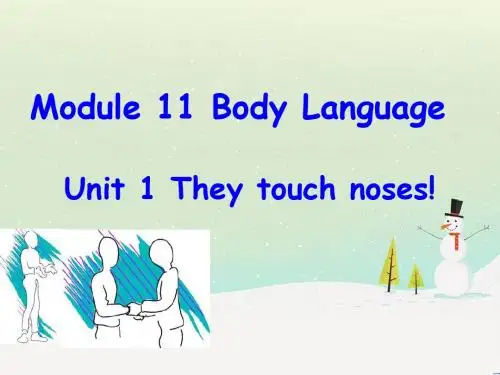
Listen Carefully
Can you find out the correct countries?
1. People in __________ usually kiss three times, left, right, left.
2. People in __________ often shake hands, smile and nod heads. 3. People in __________ often kiss and hug. 4. People in __________ put hands together and nod their heads. 5. Maori people in __________ often touch noses.
When you meet_________, please _______________.
In Nepal (尼泊尔), they kiss each other’s feet at important festivals.
In China, nodding heads means “yes”. In India, nodding heads means “no”.
Listen Carefully
Can you find out the correct countries?
1. People in ___R_u_ss_i_a___ usually kiss three times, left, right, left.
2. People in ___C_h_in_a____ often shake hands, smile and nod heads. 3. People in ___t_he__U_S___ often kiss and hug. 4. People in ___I_n_d_ia____ put hands together and nod their heads. 5. Maori people in _N_e_w__Z_e_a_la_n_d often touch noses.
外研版七年级英语下 Module_11__Body_language_Unit_2__Here_are_some_ways_to_welcome_them_hhh.
shake hands and smile when they meet. They usually __________
Where are they from?
Maybe
They are from America. They are American. How do they greet? They usually _______________ shake _________ kiss _______________________ hands, when they meet. or hug each other
In Greece, it’s not at all polite! In fact, it’s very rude.
wave to say goodbye be careful in fact
挥手告别 小心 事实上
语法讲解----祈使句
But be careful!
1.—Don’t be late again, Mike? —_______________. A. No, I don’t C. Sorry, I won’t B. Don’t worry D. I don’t know
Maybe
Where are they from? They are from New Zealand. They are Maori. How do they greet?
They touch noses.
You know, when we meet others, we often use our body to greet each other. Now, let learn about our body.
head
ear
外研版英语七年级下册Module11Unit2Here+are+some+ways+to
语言点精析
要点1:(P68)You can stand close to people in the Middle East but don't stand too close to North Americans!
在中东,你可以站得离人们近些,但是不要站得离北美人 太近!
【重点探究1】 close作副词,意为“接近地”,常用短语:close to意为 “离……近”。
( T )5.In Greece, it isn't polite to wave to say goodbye.
二、请认真阅读教材P68课文内容,把下面的短文补充完 整
Here are some 1.___w_a_y_s__ to welcome new foreign students.In 2.___B_r_i_ta_i_n___,people don't like to touch others, but in South America, they like to 3.___h_o_l_d__ your arm so you can't 4.__m__o_v_e__ away.Remember to 5.___g_iv_e___ someone from North America lots of 6.___p_e_r_s_o_n_a_l__ space.In some countries, it isn't 7.___p_o_li_t_e___ to look at people when you talk.And it isn't polite to 8.___w_a_v_e__ to say goodbye in Greece.In 9.___f_a_c_t __,it's quite 10.__r_u_d_e___.
外研版七年级英语下册Module 11 Unit 1-崔玉萍

/a1_61_020090922/000407.htm
2 1
Free talk
Choose a picture and ask and answer, using the following patterns:
Guessing
Bridge:If there is no bridge, trains can’t go across the river. 桥梁 Foreign: from another country外国的 铁路 Railroad: the road that trains can run on it 英雄 Hero: a person who is very brave 民族的 National: of a nation
Speaking
Ask and answer questions about your national hero:
• • • • Who is/was he/she? When was he/she born? What is/was his/her job? Why is he/she famous today?
Reading:
• Read the dialogue and answer the following questions: • What did Zhan Tianyou do? • When did Zhan Tianyou die? • Where did the railroad start? • What did the Chinese do when he died? • Where did it finish? • Why didn’t the government want foreign engineers? • When did Zhan Tianyou work on it?
2 1
Free talk
Choose a picture and ask and answer, using the following patterns:
Guessing
Bridge:If there is no bridge, trains can’t go across the river. 桥梁 Foreign: from another country外国的 铁路 Railroad: the road that trains can run on it 英雄 Hero: a person who is very brave 民族的 National: of a nation
Speaking
Ask and answer questions about your national hero:
• • • • Who is/was he/she? When was he/she born? What is/was his/her job? Why is he/she famous today?
Reading:
• Read the dialogue and answer the following questions: • What did Zhan Tianyou do? • When did Zhan Tianyou die? • Where did the railroad start? • What did the Chinese do when he died? • Where did it finish? • Why didn’t the government want foreign engineers? • When did Zhan Tianyou work on it?
七年级英语下册Module11BodylanguageUnit1Theytouchnoses同步课件外研版
Ⅰ.从方框中选词填空,有的需要变换形式,每词限用一次
bow,shake,together,Russian,smile
1.He usually
to others because he is Japanese.
2.She
the juice before she drank it.
3.He met ten
3. (2017安徽芜湖二十九中期中)Our teacher says that many
(visit)
will come to our school next day.
4.She wanted to try Japanese food and
(India)food.
5.—What did they do?
例 根据汉语意思完成句子。每空一词
他向我微笑,并和我握手。
He smiled at me and
me.
解析 本题考查shake hands with sb.的固定搭配。
答案 shook hands with
知识点二 nod的用法 nod作动词,意为“点(头)”,可以作及物动词,也可以作不及物动
词。例如: He nodded when I asked if he understood. 当我问他是否懂了的时候,他点了点头。 She nodded her head when she passed me in the street. 她在街上与我擦肩而过时向我点了点头。 拓展 nod one's head 点头 注意 nod的过去式和过去分词是nodded,要双写结尾的d。有的动词的 过去式和过去分词要双写结尾的辅音字母,如stopped,dropped等。
Ⅱ.单项选择
外研版英语七年级下册Module11Unit1Theytouchnoses课件
当会见来访者的时候,我们中国人经常握手微笑,有时候 我们点头。
【重点探究1】 shake hands作动词短语,意为“握手”,shake hands with sb.意为“与某人握手”。 Do you shake hands with your friends when you meet them? 你和朋友见面时会握手吗?
在美国,有些人握手,有些人亲吻或彼此拥抱。 【重点探究1】 each other 构 成 固 定 短 语 , 意 为 “ 互 相 ” , 相 当 于 one another。
【重点探究2】 each指两个或两个以上的人或事物中的“每个”。each作 形容词时修饰单数名词;作代词时,单独使用,充当主语时谓 语动词使用单数形式。each of...作主语时,谓语动词使用单数 或复数形式均可。放在复数名词和代词后作同位语时,谓语动 词使用复数形式。 He gave a book to each of his parents.他给他父母各送了一本 书。 He gave each boy an apple.他给每个男孩一个苹果。
动词(v.):
1.bow / ________ / 鞠躬;弯腰
2.________ /ʃeɪk/ 摇晃
C.quickly D.correctly
3.nod / ________ / 点(头) ): ________ /'brɪtɪʃ/ 英国的;
shake hands作动词短语,意为“握手”,shake hands with sb.
代词(pron.): each / ________ / 各个;每个
副词(adv.): ________ /tə'geðə/ 一起;共同
兼类词: 1.kiss / ________ / v.&n.吻;亲吻 2. ________ /smaɪl/ v.&n.微笑
【重点探究1】 shake hands作动词短语,意为“握手”,shake hands with sb.意为“与某人握手”。 Do you shake hands with your friends when you meet them? 你和朋友见面时会握手吗?
在美国,有些人握手,有些人亲吻或彼此拥抱。 【重点探究1】 each other 构 成 固 定 短 语 , 意 为 “ 互 相 ” , 相 当 于 one another。
【重点探究2】 each指两个或两个以上的人或事物中的“每个”。each作 形容词时修饰单数名词;作代词时,单独使用,充当主语时谓 语动词使用单数形式。each of...作主语时,谓语动词使用单数 或复数形式均可。放在复数名词和代词后作同位语时,谓语动 词使用复数形式。 He gave a book to each of his parents.他给他父母各送了一本 书。 He gave each boy an apple.他给每个男孩一个苹果。
动词(v.):
1.bow / ________ / 鞠躬;弯腰
2.________ /ʃeɪk/ 摇晃
C.quickly D.correctly
3.nod / ________ / 点(头) ): ________ /'brɪtɪʃ/ 英国的;
shake hands作动词短语,意为“握手”,shake hands with sb.
代词(pron.): each / ________ / 各个;每个
副词(adv.): ________ /tə'geðə/ 一起;共同
兼类词: 1.kiss / ________ / v.&n.吻;亲吻 2. ________ /smaɪl/ v.&n.微笑
外研英语七年级下册Module 11Unit3(共28张PPT)
1. It’s important to be careful. Be careful.
2. It’s important to clean and tidy the lab. Clean and tidy the lab.
3. You cannot touch anything if the teacher doesn’t ask you to. Don’t touch anything if the teacher doesn’t ask you to.
2) Does body language mean the same thing in different countries? No, it doesn’t.
3) How do the Russians say hello to each other when they meet? They usually kiss three times.
用于表达叮嘱、希望、命令、请求、劝 告、警告、禁止等的句子叫做祈使句。 Come to my office,please!(请求) Be careful! (叮嘱)
Don't be late again. (劝告/警告) Don't smoke. (禁止)
归纳总结:
1. 祈使句一般没有主语,说话的对象是第二人 称“你”或“你们”,所以也可以理解为省略了主 语you。 2. 以动词原形开头,无时态和数的变化。 3. 祈使句的否定形式是在动词原形前加don't。 4. 在表达请求时,可以加上please; 表达比较强 烈的语气时,可以用感叹号。
an old man in Japan?
A. The old man. B. The young man.
七年级英语上册(外研版2024)新教材解读ppt课件
ideas、reflection。重点学习的内容在中间的三个板块, 出现过的语言知识,以帮助同学们有效地实现从
starting out在于激活,reflection在于回顾反思。板块 小学到初中英语学习的过渡,另外还包括10个学
与板块之间构成一个学习“大循环”,即从activate激 习模块(Module)和两个复习模块(Revision
Topic Self-introduction New school life
Hobbies Family Festival Animals Plants
Weather Dates Sports
单元 Starter Module 1
新旧教材单元语法对比
旧教材 语法
单元
26个字母的读音;问候语
Starter
新教材单元结构说明
外研版初中英语教材分为三 个年级,每年级均分为上、 下两册,按新课标要求,体 现三级内容。整套教材内容 具备体系性、延伸性、接续 性。本套教材各册由 6 个学 习单元及附录组成,各册具 体结构如图所示。
新教材单元结构说明
外研版初中英语教材共包含 36 个学习单元,每个单元由五个板块构 成,分别为:背景激活(Starting out)、主题理解(Understandingideas)、思 维拓展(Developing ideas)、主题实践(Presentingideas)、自我评价 (Reflection)学习单元覆盖了新课标三级对主题、语篇、语言知识、文化 知识、语言技能和学习策略所要求的所有课程内容。同时,单元内的学 习过程分为“理解一发展一实践”三个环节,各环节及其子环节之间密 切关联、相互衔接,共同构成学生课程学习的完整学习链和发展进程。 学习单元具体结构如下图所示。
starting out在于激活,reflection在于回顾反思。板块 小学到初中英语学习的过渡,另外还包括10个学
与板块之间构成一个学习“大循环”,即从activate激 习模块(Module)和两个复习模块(Revision
Topic Self-introduction New school life
Hobbies Family Festival Animals Plants
Weather Dates Sports
单元 Starter Module 1
新旧教材单元语法对比
旧教材 语法
单元
26个字母的读音;问候语
Starter
新教材单元结构说明
外研版初中英语教材分为三 个年级,每年级均分为上、 下两册,按新课标要求,体 现三级内容。整套教材内容 具备体系性、延伸性、接续 性。本套教材各册由 6 个学 习单元及附录组成,各册具 体结构如图所示。
新教材单元结构说明
外研版初中英语教材共包含 36 个学习单元,每个单元由五个板块构 成,分别为:背景激活(Starting out)、主题理解(Understandingideas)、思 维拓展(Developing ideas)、主题实践(Presentingideas)、自我评价 (Reflection)学习单元覆盖了新课标三级对主题、语篇、语言知识、文化 知识、语言技能和学习策略所要求的所有课程内容。同时,单元内的学 习过程分为“理解一发展一实践”三个环节,各环节及其子环节之间密 切关联、相互衔接,共同构成学生课程学习的完整学习链和发展进程。 学习单元具体结构如下图所示。