
小学英语外研版(三起)三年级下册m9u1 (2)
Yes , I have.
Yes , I have.
Have you got a sweater? Have you got a sweater? No , I haven’t. No , I haven’t.
Listen and match.
• • • • • Lingling Daming Amy Sam Tom dress and coat sweater animals book sport book T-shirt
Have you got …? Yes , I have.
Have you got …?
Yes , I ve. Have you got a T-shirt?
Have you got a T-shirt?
Yes , I have.
Yes , I have.
Have you got …?
Have you got …?
coat
sweater
T-shirt
Have you got…?
Yes, I have. No, I haven’t.
I’ve got a dress, dress, dress, dress; I’ve got a coat, coat, coat, coat; I’ve got a sweater, sweater, sweater, sweater; I’ve got a T-shirt, T-shirt, T-shirt, T-shirt.
小学英语外研版(三起)三年级下册
Module 9 Unit 1
I’ve got a new book.
Where, where, where’s the cat?
On, on, on the line.
Under, under, under the chair. In, in, in the bag. On, on, on the bed.
I’ve got a pen.
I’ve got …
I’ve got a book. 我拥有一本书。 It’s about animals.它是关于动物的。
I’ve got another book. 我拥有另一本 书。 It’s about sport.它是关于运动的。
dress
I’ve got …
M9U1 I've got a new book(课件)-三年级英语下学期同步精品课堂(外研版三起)
Vocabulary
/bed/(名词)床
【复数】beds 【短 语】go to bed 去睡觉 【例 句】The dog is under the bed. 那只狗在床底下。
Vocabulary
/laɪn/(名词)线,绳,金属丝
【短 语】on the line 在绳子上 【例 句】Look! My cap is on the line.
Vocabulary
/spɔːt/(名词)运动
【例句】 My favourite sports swimming.我最喜欢的运动是游泳。 【短语】 sports meeting 运动会 【派生词】 sportsman(名词)运动员 【注意】 sport作为体育运动的总称时,是不可数名词,没有复数形式 。
2. 我有一本新书。它是关于动物的。 _______ a _______ . It’s_______ . 3. 大明,你也有本好书吗?是的。看,它是关于运动的。 ——_______ you_______ ,_______ ? —— _______ ,I _______ , _______ .
4. 埃米,你有一本新书吗?不,我没有。我有一条新连衣裙和一件新外套。 —— __________ you__________ __________ ?
约有30个学生。
(2)表示“将要,将近”。I'm about ready.我快准备好了。
(3)表示“到处,各处”。The children are running about.孩子们到处乱跑。
Grammar
② 作介词
about 的用法:
(1)表示“在……到处;在……各处”。
He walks about the town.他在城镇到处走。
外研版三起三年级英语下册Module 9 Unit 1 I’ve got a new book课件
It’s a nice book.
Have you got a new book, Amy?
Have you got a new sweater, Sam?
No, I haven’t. I’ve got a new dress and a new coat.
Yes, I have.
No, I haven’t. I’ve got a blue T-shirt.
Have you got a new sweater, Sam?
No, I haven’t. I’ve got a new dress
and a new coat.
Yes, I have.
No, I haven’t. I’ve got a blue T-shirt.
Tom, have you got a new sweater too?
Ha ha...
I’ve got a new _b_o_o_k_. It’s about _a_n_im__a_ls_. I’ve got a new _b_o_o_k_ about _s_p_o_rt_.
I’ve got a new _d_r_e_s_s_ and a new _c_o_a_t_. I’ve got a new _s_w_e_a_t_e_r.
Who are they? What are they talking about?
What is Lingling’s new book about?
I’ve got a new book. It’s about
animals.
关于
动物
It’s about _a_n_i_m_a_l_s_.
What is Daming’s new book about?
外研版(三起)英语三年级下册M9-10
Step2: New concepts.
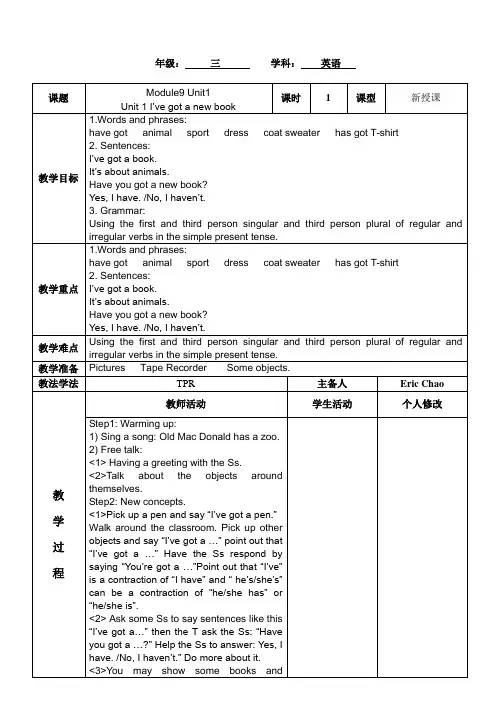
<1>Pick up a pen and say “I’ve got a pen.”
Walk around the classroom. Pick up other objects and say “I’ve got a …” point out that “I’ve got a …” Have the Ss respond by saying “You’re got a …”Point out that “I’ve” is a contraction of “I have” and “ he’s/she’s” can be a contraction of “he/she has” or “he/she is”.
c. Now have the class say the chant and do the actions.
<6>. Do AB Activity 1.
Listen to the tape and circle the correct pictures then ask some Ss to say about the pictures.
Pictures TapeRecorder
教法学法
TPR
主备人
Eric Chao
教
学
过
程
教师活动
学生活动
个人修改
一、Warming up: 1. Greeting:
T: Hello, boys and girls. Let us recite the seasons. Ok?
外研版三年级下册英语Module 9课件
Homework
1. 熟记本节课所学的单词、短语和句型,必 须会听、说、读、写。 2. 将Listen, point and find “I’ve got…” 朗 读流利。
第二课时
热身
I have got a sweater.
单项选择。
( A ) 1. I _______ a new book.
A. have got
B. has got
( C ) 2. — Have you got a new pen?
— __________.
A. Yes, I hasYes, I have.
( B ) 3. — ______ you got a ruler? — No, I haven’t.
I’ve got a new desk.
— Have you got a new book too, Daming? 大明,你也有一本新书吗?
— Yes, I have. 是的,我有。
询问对方是否有某物的句型: — Have you got+ 某物? — Yes, I have.(肯定回答)/
( D ) 4.
A. The dress is on the line. B. I have got a book about sport. C. I have got a book about animals
D. The bag is under the desk.
小小翻译家。
sweater__毛__线_衫__ dress___连_衣__裙___ animal___动_物_____
It’s a nice book.
三年级下册英语教案-Module 9第三课时Unit 2 1~3 外研版(三起)
三年级下册英语教案-Module 9第三课时Unit 2 1~3 外研版(三起)教学目标1.知识目标:本课时让学生掌握以下内容:熟练掌握单词:find, socks, shoes, trampoline,掌握日常交际用语:Where are my socks/shoes? They’re under/on/in/behind/near the trampoline. 知道使用方位介词描述物品的位置,如On the floor, under the bed2.能力目标:让学生通过本课时的学习,培养其语言表达能力和听说能力,提高学生的英语交流能力。
3.情感目标:通过本次课程,让学生体验到英语学习的乐趣,培养学生学习英语的兴趣,增强爱好英语的意识。
教学重难点1.重点:掌握日常交际用语Where are my socks/shoes? They’reunder/on/in/behind/near the trampoline.2.难点:理解并正确使用方位介词描述物品的位置。
教学准备教学PPT、录音设备、绘本《The Birthday Surprise》、物品模型(包括trampoline、socks、shoes等)教学过程活动设计1.Warm-up:通过对比和发现图片中的不同之处来复习单词find和具体名称。
2.Review:请一名学生上来表演之前所学的过言表演技巧。
3.Presentation:呈现物品模型并复习方位词汇,使学生能够理解物品的位置和方位关系。
4.Practice:分组比赛,说出自己的鞋子和袜子在物品模型的哪个位置。
5.Production:在自我表述中使用方位词汇,如on the floor,under the bed等。
6.Summary:总结本节课所学单词和句型。
7.Homework:记录并说出自己房间中的物品在哪里。
具体步骤1.Warm-up通过一组包含两张图片的对比,引导学生回忆单词 find 的含义,并巩固学过单词具体名称。
外研版(三起)三年级英语下册精品教学课件 Module 9 Unit 1
Module 9教学设计Unit1 I’ve got a new book教学目标:1、听、说、认、读本课的重点单词和词组:have got, has got, dress, coat, sweater, sport, T-shirt。
2、学会运用句型:“I’ve got…”“Have you got…?”“He\She has got…”3、能够在实际生活中运用句型:Have you got a new book?Yes, I have. / No, I haven’t.来谈论自己和他人拥有的物品。
教学重点:1、听、说、认、读本课的重点单词和词组:have got, has got, dress, coat, sweater, sport, T-shirt。
2、掌握“I’ve got…”的读音和用法。
教学难点:用have got( has got——第三人称单数)“Have you got a book?”这类语句询问某人是否拥有某物。
并能用Yes, I have. No, I haven’t.回答。
教学准备:多媒体、单词卡、图片教学过程:Step 1: Warm up老师热情地和学生打招呼问好。
Step 2: Presentation1、老师拿起一本英语书说:“I’ve got a book.”然后在教室里走动,拿起其他物品说:“I have got a...”让学生转述:“You’ve got a...”。
老师告诉学生“I’ve”是“I have”的缩写形式,然后老师问学生:“Have you got a...?”帮助学生回答:“Yes, I have./No, I haven’t.”2、老师出示几本精美的图书,向学生介绍。
例如:老师指着一本科普书说:“It’s about science.”指着一本关于体育运动的书说:“It’s about sports.”请学生在小组内向小组成员介绍自己的书。
外研版(新标准一起)小学英语三年级下册M9教学设计
《英语》(新标准)(小学一起)三年级下册M9教学设计the time.3. Give Ss some picturesand sentences. Then askSs to work in groups.3 Do a group work.4. Sum up通过展示教师的相册,引起学生的学习欲望,为下面相册的制作做好准备。
帮助学生进行小组活动完成相册,培养学生的小组合作能力,并且学以致用,利用本节课所学知识。
引导学生总结所学,不仅仅局限于单词句型,让学生学会总结知识点。
ClassroomAssessment家庭作业:Make your poster with your parents.Then put them together to make your class album.(与父母做自己的海报,汇总为班级相册。
)第二课时教学设计教材分析Amy到Lingling家做客,看到Lingling家墙上挂的一张黑白照片,于是就问Lingling照片上的人是谁。
Lingling告诉Amy,照片上是自己的爷爷奶奶,他们那时很年轻,Lingling又给Amy看爷爷奶奶现在的照片,他们已经老了。
Amy又问旁边照片上的小女孩是谁,Lingling告诉Amy那是自己两岁的照片,那时她留着短发,而现在已经是长发了。
Amy认为那时Lingling很可爱,而Lingling回忆说自己那时也很淘气。
在小学阶段的英语学习中第一次引入了过去时,主要是was和were的运用。
涉及的词汇有:were, young, beautiful, was, also, then ,who,was\wasn’t\were\were n’t.Step4 Consolidation and summary.(12 minutes)1. Show Lingling’sfamily holiday, andhelp Ss to tick.2. Give Ss somepictures andsentences. Then askSs to work in groups.3. Write.Read the passage andtick.Do a group work to talkabout their holiday byusing the patterns.In the holidays…...was......wasn’t......were......weren’t...Try to write the letterabout your family to yourfriend.Sum up通过一篇小的阅读材料,再次感受描述家人过去状态的句型结构,为下面的简单协作打基础。
外研版小学英语(新标准三起)三年级下册M9课件设计
Let’s learn.
line
Let’s learn.
I have got a new pen.
Let’s learn.
It’s about animals.
Let’s learn.
It’s about sport.
Let’s learn.
dress
Let’s learn.
coat
Let’s learn.
bus
Let’s listen and answer.
(1) — Has Amy got a bike? — Yes, she has.
(2) — Has Sam got a bike? — No, he hasn’t.
Let’s listen and answer.
(1) How does Mr Smart go to work? He has got a car. He goes to work by car.
Let’s learn.
T-shirt
Let’s learn. (1) — Have you got a new book, Daming?
— Yes, I have.
(2) — Have you got a new book, Amy?
— No, I haven’t.
Let’s do role-play.
Let’s look Has your dad got a bike?
Yes, he has.
《英语》(新标准)(小学三起) 三年级下册
Module 9 Unit 1 I’ve got a new book.
Let’s listen and answer.
(1) What is Daming’s present? (2) Where is it?
三年级-外研版(三起点)-英语-下册-[教学设计]-Module-9-Unit-2-(1)
Module 9Unit 2 Has Amy got a bike?一、教学目标1. 知识目标:(1) 能够听懂、会说并认读:by car, by bus, by bike, walk to school等短语。
(2) 能够听懂、会说并使用句型Has he/she/ …got a …? Yes, he/she has. / No, he/she hasn’t.和He/She/ … goes to school/work by …(3) 认读并正确书写字母Uu, Vv, Ww。
2. 能力目标:能用所学语句谈论出行的交通方式。
3. 情感目标:通过谈论交通工具及交通方式,培养学生对英语的兴趣。
二、教学重点能够听懂、会说并使用句型Has he/she/ … got a …? Yes, he/she has. / No, he/she hasn’t.和He/She/ … goes to school/work by …三、教学难点主语为第三人称单数时谓语动词的变化。
四、教学准备多媒体课件。
五、教学过程Step I Warm-upListen and sing.播放动画歌谣:How do you go to school?【设计意图】歌曲导入学习话题,活跃了课堂气氛,激发了学生的学习兴趣。
Step II Presentation and practice1. Let’s learn.(1) 呈现图片,教师询问学生:“How do you go to school?”学生根据图片变化说出不同的交通方式,在语境中呈现并学习短语:by bike, by bus, by car, walk to school。
(2) 呈现自行车图片,教师询问学生:“Have you got a bike?”学生回答:“Yes,I have./No, I haven’t.”教师询问学生:“Has your father got a bike?”引导学生回答:“Yes, he has./No, he hasn’t.”【设计意图】创设情景,在语境中呈现并学习生词和短语。
外研版(三起)-英语-三年级下册--Module 9 Unit 2 Has Amy got a bike-教案
Unit 2:Has Amy got a bike?(第二单元:埃米有一辆自行车吗?)(教材53~55页)1 .Listen and chant,听一听.然后唱儿歌(教材第53页)课文英汉互译He has got a bike 他有一辆自行车。
It's a nice bike. 它是一辆漂亮的自行车。
She's got a kite. 她有一个风筝。
It's a nice kite. 它是一个漂亮的风筝。
朗读参考He's got a bike.It's a nice bike.She's got a kite.It's a nice kite.新词速记Has got /haez g t/拥有例句:Sam has got a red sweater.萨姆有一件红色的毛线衫。
He has got a little dog.他有一只小狗。
否定形式:hasn't got没有My sister_________ got a new dress.A. hasB. haveC. isGive him an inch and he'II take an ell.重难点精析has got的用法He has got a bike.他有一辆自行车。
点拨当主语是第三人称单数时,我们用has got表示“有”。
例如:She has got a new dress.她有一件新连衣裙。
在has后面加上not,句子就变成了否定句。
例如:She hasn't got a new book.她没有一本新书。
将has提到句首,句子就变为一般疑问句,肯定回答是“Yes,主语+has.”,否定回答是“No,主语+hasn't.”。
例如:-Has she got a new pencil?她有一支新铅笔吗?-Yes,she has.是的,她有。
/No,she hasn't.不,她没有。