
外研版七年级上册module 6 unit 1 Does it eat meat
Unit 1 Does it eat meat?d from Wenzhou Zhongtong International School
Let’s check
tiger lion panda monkey
Animals
bear
'ra: f/ /dʒɪ gi ra ffe
zebra
/'e lɪ f ənt / e le ph ant
tall The giraffe is_____.
The … is... strong c ute .
f unny d _ng_r_ _s a e ou
Pair work
eats
A. meat A. meat B. plants
E. other animals
B. plants
The elephant
The panda
B. plants C. bamboo D. leaves The lion eats……
Read the text with the tape(跟录音齐读课文) Read the text in three(组内三人分角色朗读)
Animals are our friends. Let's love and protect(保护)them.
Level A:
1.模音activity 3. 2.用“Does it come from/eat…?”编对话谈论动物(至 少5句)。
Level B(选做)
预习第二单元并网上搜索和归纳动物来自哪些大洲,
leaves
a leaf
Pair work
A: Does the …eat…? B: Yes, it does. / No, it doesn’t. It eats …
Let’s listen
Listening 1: tick(√) the animals you hear.勾出 你听到的动物
The lion The giraffe The tiger The bear The zebra
以及它们的生活习性。
D: Does it eat…? …eat...? B: Yes, it does./No, it doesn’t. E: …? …
Tips:可猜动 物的颜色,及 其它特点
F:…? I think it’s the… ...: I think it’s the… B: Yes, you’re right. /Sorry, it is the….
The elephant
The panda
Tips (听力策略):听前可根据题干预测动物吃什么。
Listening 2: finish the table B. plants A. meat C. bamboo D. leaves E. other animals
The animal The lion The bear
Summary
Animals: bear, zebra, giraffe, elephant, panda, tiger, lion, monkey… How to guess animals? “Does it come from…?” “Does it eat…?” 它来自中国吗? 是的。 does come Does _____from ____it China? Yes, it_____. 它吃竹子吗?不,它不吃。 eat doesn’t Does _____it _____ bamboo? No, it _______.
Name: Huahua
Come From:
Eat :
Does _____it come from…? Yes it does. , No, it doesn’t.
Come From:
The monkey comes from China . This monkey comes from America . / 'd ɪ f r ə n t/ country Monkeys come from _________ diffe rent countries .
Guessing game:猜测某一组员最喜爱的动物 (5人猜,1人答) (其它组猜, 1人答)
A: What’s your favourite animal? What…? B: Guess. C: Does it come from…? Guess B: Yes, it does./No, it does n’t. …come from…?
Does it eat …?
Yes, it does.
Eat:
No, it doesn’t. TheThe zoo I has like many eating animals, fruit, monkey eats plants,such as the___and___.
grass
bamboo
plants
A:What’s your favourite animal?
B:My favourite animal is the… A: Why? B:Because it is…, and you? A:My favourite animal is the… Because it is… cute tall big strong funny dangerous …
外研版初一英语七年级上册Module6 Unit1 Does it eat meat公开课课件
Home: Africa, Asia, America Food: meat, leaves, fruit and eggs
Read the passage and find these sentences. 1.The elephant lives in Africa and in Asia. 2. It eats plants, leaves, bamboo and a little fruit. 3. The panda eats about 30 kilos of bamboo a day, as well as plants and leaves. 4. The tiger likes water and is good at swimming.
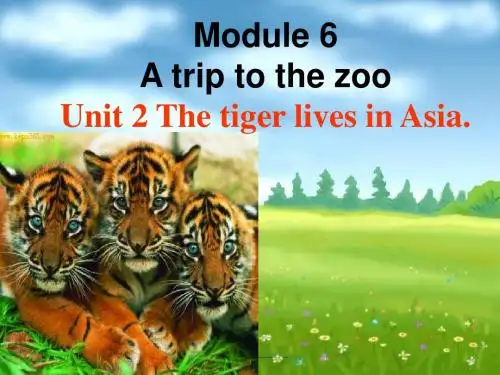
Module 6 A trip to the zoo Unit 2 The tiger lives in Asia.
:
Language goals 1. To learn some key words and useful expressions Key vocabulary Asia, Africa, Europe, a little, only, kilo, as well as, alone, all over the world, large, be good at, strong, catch, even Key structures The tiger lives in Asia. There are about 200 kinds of monkeys. 2. Ability goal To know about some animals living in different places and write a short passage about your favourite animal. 3. Attitude goal Animals are our friends, we should love them.
七年级英语上册 Module 6 A trip to the zoo Unit 1 Does it eat meat教案 (新版)外研版

Book1 Module 6 A trip to the zoo一、教学内容:Unit 1 Does it eat meat?二、课型:Listening and speaking三、教学目标:语言目标(1)To help students master the words ,如: elephant, giraffe, kangaroo, lion, monkey,pan da, polar bear,, tiger, wolf, zebra, bamboo,there, such as, leaf-leaves, dangerous.(2)To help students master the sentences如:①Does it eat meat?Yes, it does.No, it doesn’t.能力目标(1) To understand and get more detailedinformation about animals fromlistening and reading.(2) To ask and answer questions about the habitat and the food of differentanimals.(3) To talk about their favourite animal.情感目标Students can love and protect animals from learning 。
四、教学重难点:重点:(1)重点句型:一般现在时(主语第三人称单数)的一般疑问句以及肯定和否定形式。
(2)重点话题:Talk about one’s favourite animal.难点:(1)掌握一般现在时(主语第三人称单数)的一般疑问句以及肯定和否定形式。
(2) 能用恰当地道的英语问答有关动物的问题以及介绍自己的最喜爱的动物。
五、教学准备:本次课堂为听说课,主要采用互动式教学法,创设真实语境,通过个人呈现,同伴互动,小组活动等师生、生生的交流,充分体现了学生在学习过程中的主体地位,教师只是课堂的引导者,组织者和合作者,让学生在使用中学会英语,综合培养学生的英语语言运用能力。
新外研版初中英语七年级上册Module 6 Unit 1 Does it eat meat?优质课公开课教案
Module 6 Unit 1 Does it eat meat?ⅠTeaching modelListening and speakingⅡTeaching methodInteractive approachⅢTeaching aims1. To find specific information in the listening.2. To recognize the third person singular endings –s.3. To ask and answer questions about animals.4. To enable students to talk about animals.ⅣTeaching ObjectivesKey vocabulary: bear, elephant, giraffe, lion, monkey, panda, tiger, zebra, zoo, guide, animal, such, as, come, different, country, other, dangerous, ugh,also, plant, look, tall, leaf (pl. leaves), sure, bamboo, cute, shall,them, which, over, funny, callKey structures:1.— That’s a giraffe. — Yes, and there are some giraffes2.—Do lions eat meat? —Yes, they do.3.—Does it eat meat? —No, it doesn’t. It eats plants.4.—Do pandas eat plants and leaves? —Sure. They love bamboo.5. Shall we go and…?6. That’s very funny.ⅤTeaching aidsTape recorder , OHP , video , a clockⅥTeaching StepsStep 1 Warming-up1. Lead inT: Hello, boys and girls!Ss: Hello, Mr. Zhang.T: Today, we are going to learn Module 6 A trip to the zoo. Have you been to the zoo?Ss: Yes.T: Do you know Beijing zoo?S1: Yes, I went there last year. I saw many animals…S2:…T: OK. Today I’ll take you to visit Beijing zoo. Are you happy?Ss: Yes.T: Please look at the screen and get to know some information about Beijing Zoo. Ss: …(Look at the screen and try to know some information about it.)2. Show some pictures to ask and answer: What can you see?3. Call back the answer from the whole class and check the answer.Step 2 Practice1. Show some pictures of the animals.2. Introduce the new words.3. Look at the pictures. Ask and answer: What can you see?4. Call back the answers from the whole class and check the answer .5. Read the words.Step 3 Work in pairs1. Listen and check ( √) the words in Activity 1 you hear.2. Now work in pairs and say what you can see.—That’s a giraffe.—Yes, and there are some giraffesStep 4 Listen and read.1. Ask the students to read the conversation silently.2. Play the recording and ask the students to listen and read the conversation.3. Read the conversation.4. Act it out.5. Ask the students to complete the table in Activity 3.6. Call back the answer from the whole class and check the answer.Keys: 1. meat, other animals 2. meat, plants 3. plants 4. bambooStep 5 Underline the correct words.1. Ask the students to read through the passage.2. Underline the correct words.3. Call back the answer from the whole class and check the answer.Keys: 1. many 2. countries 3. such 4. dangerous 5. plants 6. different 7. tall 8. plants 9. bamboo 10. panda’sStep 6 Listen and repeat.1. Play the recording once without stopping.2. Play the recording again and stop at the end of each line. Ask the whole class to repeat.3. Play the recording again and stop at the end of each line. Ask individual students to repeat.4. Ask the students to practice the sounds in pairs.Step 7 Listen and choose / s/ or / z /1. Play the recording once without stopping.2. Play the recording again and stop at the end of each line. Ask the whole class to repeat.3. Play the recording again and stop at the end of each line. Ask individual students to repeat.4. Ask the students to practice the sounds in pairs.Step 8 Work in pairs .Talk about your lessons .1. Go through the language in the substitution table with the class.2. Pair them to ask and answer.A: What’s your favourite animal? Does it eat plants?B: Yes, it does.A: Does it come from China?B: Yes, it does.A: Is it the panda?3. Circulate and monitor their production.Step 9 Do exercises:A.首字母填空:1. Beijing Zoo has many kinds of a______.2. The lions are d__________ because they eat meat.3. Pandas are black and white and eat b__________.4. The b_______ eat meat and plants.5. An e__________ is tall and eats plants.Answers:1. animals2.dangerous3.bamboo4.bears5. elephantB.翻译下列句子:1.这些动物来自不同的国家。
外研版英语七年级上册 Module 6 A trip to the zoo Unit 1 Does it eat meat?同步训练 含答案

Module 6 A trip to the zoo Unit 1 Does it eat meat?一、根据汉语提示写单词1. The matches ______ (结束) at half past nine.2. We _____ (不) live in New York.3. Sam likes _____ (做) housework.4. The lesson _______ (开始) at nine.5. On Saturday we watch TV _____ (或者)play games.6. After having two lessons, we have a ______ (休息).7. We have meat and rice _______ (和)vegetables.8. We have lunch in the ________ _______ (餐厅) at half past twelve.9. Do you have _________ (晚餐) at half past six in the evening?二、用所给的单词的适当形式填空1. She ____ (go) to bed at nine o’clock.2. You ________ (not go) home.3. She _______ (watch) TV in the evening.4. He gets up and ___ (have) breakfast.5. _______ (lesson) start at half past one in the afternoon.6. We do our __________ (homework) in the evening.三、句型转换1. I play basketball with my friends. (否定句)I _________ _________ basketball with my friends.2. They have two classes in the afternoon. (一般疑问句) ________ they _________ two classes in the afternoon? _________, they __________. (否定回答)3. He does his homework after breakfast. (否定句)He _______ _____ his homework after breakfast.4. We have lunch at school. (就划线部分提问)_______ _______ you have lunch at school?5. Lessons finish at 3:30. (就划线部分提问)_______ _______ lessons finish?四、翻译下列句子:1. 我们11:00上美术课。
七年级英语上册Module6Unit1Doesiteatmeat说课稿(新版)外研版

七年级英语上册 Module 6 Unit 1 Does it eat meat说课稿(新版)外研版一. 教材分析《七年级英语上册 Module 6 Unit 1 Does it eat meat》是人教版初中英语教材七年级上册的一个单元,本单元主要围绕动物展开,让学生学会询问动物的习性,如:吃肉、吃植物等。
通过本单元的学习,学生能够掌握一般现在时态的疑问句和回答,以及一些关于动物的词汇和短语。
二. 学情分析七年级的学生已经初步掌握了英语学习的基本语法和词汇,但是对于一般现在时态的疑问句和回答还比较陌生。
此外,学生的阅读和写作能力还有待提高,需要通过大量的练习来加强。
在教学过程中,教师需要关注学生的学习兴趣,激发他们的学习积极性,帮助他们建立自信心。
三. 说教学目标1.知识目标:学生能够掌握一般现在时态的疑问句和回答,学会询问和描述动物的习性。
2.能力目标:学生能够用英语进行简单的对话,提高他们的口语表达能力。
3.情感目标:学生能够培养对动物的热爱和保护意识,增强他们的环保意识。
四. 说教学重难点1.重点:学生能够掌握一般现在时态的疑问句和回答,学会询问和描述动物的习性。
2.难点:学生能够用英语进行简单的对话,特别是运用一般现在时态进行问答。
五. 说教学方法与手段1.教学方法:采用任务型教学法,让学生在完成任务的过程中学习英语,提高他们的实践能力。
2.教学手段:利用多媒体课件、图片、卡片等教学辅助工具,激发学生的学习兴趣,帮助他们更好地理解和记忆。
六. 说教学过程1.引入:教师通过展示一些动物的图片,引导学生谈论他们喜欢的动物,激发他们的学习兴趣。
2.新课呈现:教师通过课件展示本节课的主要内容,让学生初步了解一般现在时态的疑问句和回答,以及关于动物的词汇和短语。
3.实践环节:教师学生进行小组活动,让他们用英语询问和描述动物的习性,练习一般现在时态的问答。
4.巩固环节:教师通过游戏、练习等方式,让学生进一步巩固本节课所学内容。
外研版七年级英语上册module6unit1 Does it eat meat 课件 (共9页)

Unit 1 Does it eat meat?
学习目标
1.学习有关动物名称的单词. 2.一般现在时的第三人称单数做主 语的疑问句及其回答. 3.能用所学知识谈论自己喜欢的动 物。
核对导学案 Page25
一.词组检测
1. different countries 2. over there 3. be (come) from 4.all kinds of 5.welcome to 6.look at 7 black and white 8 for example/such as 二.首字母填空 1. zoo 2. leaves 3.world 4.Pandas 5.trip 6.Lions 三. 词形转换 1.zoos 2.monkeys 3.wolves 4.visitor 5.there 6.Australian n
1熊 2 大象 3 长颈鹿 4 狮子 5 猴子 6 熊猫 7 老虎
bear elephant giraffe lion monkey panda tiger
8 斑马
9 动物园 10 导游
zebra
zoo guide
பைடு நூலகம்
11 动物
12 这样的 如此的 13 像…一样
animal
such as
14 比如
15 来自
Summary
(总结评价)
1. 回扣学习目标。 2. 小组及个人本堂课的表现总结。
1.复习巩固所学的单词和词组。
2.预习Module 6 Unit 2.
一.完成单词 1.bamboo 2.elephant 3 .every 4. Monkeys 5. desert 二.单选 1.A 2.A 3.B 4.B 5.C 6.A 7.C 8.A 三.所给词填空 1.thousand 2.visit 3.giraffes 4.doesn’t eat 5.to play 6.lives 7.Does eat 8.gets 四. 句型转换 1.do best 2. comes from 3.Does eat 4.No doesn’t 五.能力提升CAFBE
外研版七年级英语上册 Module 6 Unit 1 Does it eat meat教案 精品
Book1 Module 6 A trip to the zoo 工欲善其事,必先利其器。
《论语·卫灵公》翰皓学校陈阵语一、教学内容:Unit 1 Does it eat meat?二、课型:Listening and speaking三、教学目标:语言目标(1)To help students master the words ,如: elephant, giraffe, kangaroo,lion, monkey, pan da, polar bear,, tiger, wolf, zebra, bamboo,there, such as, leaf-leaves, dangerous.(2)To help students master the sentences如:①Does it eat meat?Yes, it does.No, it doesn’t.能力目标(1) To understand and get more detailedinformation about animals fromlistening and reading.(2) To ask and answer questions about the habitat and the food ofdifferent animals.(3) To talk about their favourite animal.情感目标Students can love and protect animals from learning 。
四、教学重难点:重点:(1)重点句型:一般现在时(主语第三人称单数)的一般疑问句以及肯定和否定形式。
(2)重点话题:Talk about one’s favourite animal.难点:(1)掌握一般现在时(主语第三人称单数)的一般疑问句以及肯定和否定形式。
(2) 能用恰当地道的英语问答有关动物的问题以及介绍自己的最喜爱的动物。
2020版七年级初一英语外研版全套课件Module6Unit 1 Does it eat meat
3. Shall we go and see them? 我们去看看它们好吗? ◆Shall I / we do sth. ? 意为“我/我们做某事好吗?”,表示征 求对方意见或提建议。如: (3)—__S_h_a_l_l_w_e__g_o____________ to play basketball? 我们去打篮球好吗? —OK,let’s go. 好的,咱们走。
Module 6 A trip to the zoo
Unit 1 Does it eat meat?
目录导航
01 课 前 预 习 02 课 堂 导 学 03 课 文 理 解 04 巩 固 提 升
课前预习 一、必背单词 (请在课文中找出下列单词)
名词
1. 熊___b_e_a_r_______
2. 大象__e_l_ep__h_a_n_t____
助词 ……好吗?要不要……?___s_h_a_ll_______
代词 1. 他们;它们;她们______th__em_____ 2. 哪一个___w__h_ic_h______
介词 1. 像……一样__a_s__________ 2. 在……上方__o_v_e_r________
二、常用短语(请在课文中画出下列短语)
动词
1. 来__k__
3. 把……叫作;称呼……为___c_a_l_l _______
副词 1. 也;而且____s_u_c_h______ 2. 当然;的确_____d_if_f_erent 3. 在哪里;往哪里____o_t_h_e_r_____
【学以致用】 (1)Where does she __co_m__e__fr_o_m___? 她来自哪里? (2)I __c_o_m_e__fr_o_m________ Beijing,China. =I ____a_m__f_ro_m__________ Beijing,China. 我来自中国北京。
外研版七年级英语上册教案Module 6 Unit 1 Does it eat meat
第一课时Unite1 Does it eat meat?环节1 新课导入T: Hello, boys and girls!Ss: Hello, Mr. Zhang.T: Today, we are going to learn Module 6 A trip to the zoo. Have you been to the zoo?Ss: Yes.T: Do you know Beijing zoo?S1: Yes, I went there last year. I saw many animals…S2:…T: OK. Today I’ll take you to visit Beijing zoo. Are you happy?Ss: Yes.T: Please look at the screen and get to know some information about Beijing Zoo.Ss: …(Look at the screen and try to know some information about it.)设计意图:以图片的形式进行直观教学,能很快导入课文,抓住学生的好奇心,吸引学生的学习兴趣。
环节2 学习1-81.教师给出一副图的某一部分,让学生猜出是什么动物,以此引入动物名词。
2.听活动2的录音,让学生勾出所听到的活动1中的单词。
3.听活动3的录音,完成表格。
4.核对答案。
再听一遍录音,让学生勾出文中重要的词汇和句子。
教师对文中的难句和知识点进行讲解。
5.让学生完成活动4 的任务。
教师核对答案。
6.听活动5和活动6的录音,让学生跟读,并完成相应任务。
7.让学生结对根据活动3短文中对动物的描述进行提问和回答。
8.让学生结对编写关于动物的对话,并抽取2-3组学生当堂进行表演。
9.学以致用。
根据首字母提示写出单词(1)Beijing Zoo has many kinds of a______.(2)The lions are d__________ because they eat meat.(3)Pandas are black and white and eat b__________.(4)The b_______ eat meat and plants.(5)An e__________ is tall and eats plants.Answers:(1)animals (2)dangerous (3)bamboo (4)bears (5)elephant设计意图:引导学生运用结对练习法进行初步的语言实践,鼓励学生大胆开口,培养学生运用目标语言进行交际的能力。
Module 6 Unit 1 Does it eat meat 教学设计-外研版七年级英语上册
七年级英语上册Module 6 Unit 1 Does it eat meat?P1 同学们,大家好。
很高兴可以和同学们一起学习,今天我将和同学们一起学习七年级上册Module 6 Unit 1 的内容。
P2 (Step 1: Analysis of the material)首先来看看本节课我们将学习什么内容。
P3本节课的主要内容为动物园解说员与托尼和玲玲之间的对话。
通过孩子们和导游之间的问答为同学们介绍了几种动物的习性。
通过本课的学习,同学们能听懂介绍动物的对话,并能在听力中找出细节信息。
能够提问并且回答关于不同种类动物的生活习性和食物。
P4 同学们,今天我们将开始一次愉快的动物园之旅。
我们将来到北京动物园。
(点击)P5北京动物园是中国开放最早、珍禽异兽种类最多的动物园。
我们从教材中了解到如下信息;它建于1906年,位于北京西直门外,占地面积约九十公顷,饲养展览动物四百五十余种,海洋鱼类及海洋生物五百余种,每年接待中外游客六百多万人次。
在开始动物园之旅前,我会用英文描述几个动物,请仔细听,看看同学们能否用英语快速说出他们的英文名字。
P6 Let’s guess the names of the animals. Now, begin.P7. Let’s guess the first one. Now listen to my description.They are black and white.They live in China.They eat bamboo.Do you know what they are?(点击)Yes, they are the lovely pandas.P8 The second one.They are very tall.They are brown and white.They eat leaves(树叶).They have long necks.(点击)They are giraffes. They are different from other animals.P9 The third one. Let’s see what they are.They are cute and funny.They come from many different countries.They like eating bananas.That’s easy. (点击)They are monkeys. They are almost everywhere in the world.P10 Let’s look at the next one.It is a big animal.It has a long nose and two long teeth.What’s this animal?Do you know? (点击)Yes, it is an elephant.P11 Let’s guess this animal.It is a black and white animal.It doesn’t eat bamboo.It is like a horse.(点击)Yes, it is a zebra. It is difficult for us to find two zebras exactly the same.P12 Let’s guess the last one.It eats other animals.It is dangerous.It is brown.It lives in the grassland(草原).It is the king of the grassland.It’s a little difficult. So I will give you more information. Some students may think it is a tiger, but it lives in the grassland. Can you get the answer now? (点击)It is a lion. It is a dangerous animal, because it eats other animals.同学们,你们非常棒,大家可以通过老师给出的关于动物的描述信息,猜出动物的名称,并可以用英语准确表达。