
故宫 英文ppt
故宫的英文介绍ppt课件

魏益虎
精选
1
The Purple Forbidden City is the largest and most well reserved imperial residence in China today. It was built begin in 1406 and it took 14 years to built it. The first ruler who actually lived here was Ming Emperor Zhudi. North to south is 961 meters, and 753 meters from east to west. And the area of about 725,000 square meters.And the Forbidden City was recognized as a world cultural legacy. Beijing Forbidden City is also the head 精选of the world's top five palace.2
The Hall of Supreme Harmony
(太和殿)
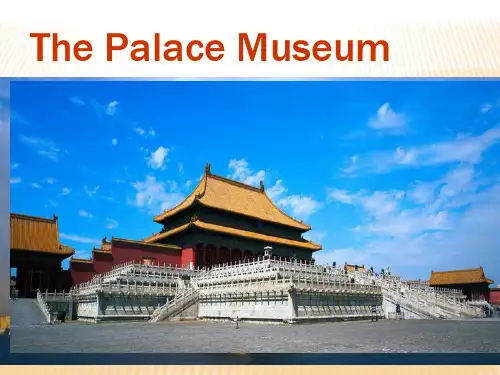
This is the most grandiose one.And this temple area is the largest one of various in Forbidden City. This temple is the place where the emperor held a major ceremony.
This was a place where the annual New Year's Eve emperors entertained the other kings. At the same time, the final imperial examination was held here.
高三英语一轮复习:故宫(the Forbidden City)介绍课件
Introduction to the Forbidden City
Introduction to the Forbidden City
The Forbidden City was the palatial heart of China. It is an imperial palace complex of the Ming and Qing dynasties (1368– 1912) in Beijing, China.
谪仙当日事狂游,槌碎黄鹤夸风流。有无较版则且置,格高兴逸吞山邱。
故宫登楼名偶似,远眺欲见蓬瀛洲。陡思我祖开创艰,守成予责增惕愁。
The architecture
Wooden Structures without Nails
The Forbidden City is the largest and most complete complex of ancient wooden structures in the world.
During the Ming and Qing dynasties, yellow was a
symbol of supreme power and only used by the
imperial family. If you climb up to the top of "Scenery
Hill" in Jingshan Park and overlook the Forbidden
Forbidden City carpenters used interlocking mortise and tenon joints to build its great palace buildings "harmoniously", without nails. Nails were considered violent andee an expanse of yellow glazed tile
故宫博物馆英文介绍PPT课件
began in 1406. It took 14years to build the Forbidden City. The first ruler who actually
lived here was Ming Emperor Zhudi. For five
centuries thereafter, it continued to be the
residence of23 successive emperors until
1911 when Qing Emperor Puyi was forced to
abdicate the throne(退位).
6
7
Color’s symbol
The red and yellow used
on the palace walls and
roofs are also symbolic.
Red represents
happiness, good fortune
and wealth. Yellow is the
9
Whole scene
10
The ensemble (整体布局)
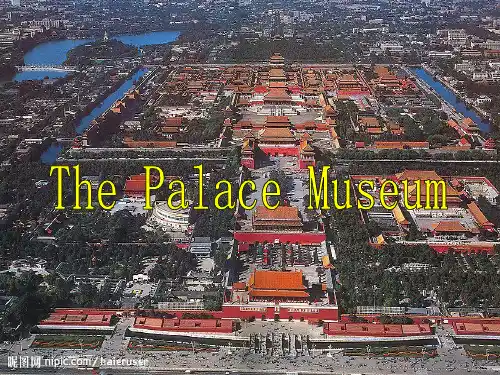
Traditionally, the Forbidden City is divided into two parts. The Outer Court and Inner Court.
The Inner Court includes the northern sections, and was the residence of the Emperor and his family, and was used for day-to-day affairs of state.
故宫英文介绍ppt

故宫英文介绍pptThe Forbidden City, also known as the Palace Museum, is a UNESCO World Heritage site located in the heart of Beijing, China. It was the imperial palace of the Ming and Qing dynasties for over 500 years, serving as the political and ceremonial center of Chinese government. The Forbidden City is a symbol of China's rich cultural heritage and a testament to the country's imperial past.Constructed in the early 15th century, the Forbidden City covers an area of 180 acres and consists of over 980 buildings with approximately 9,000 rooms. The complex is surrounded by a 26-foot high wall and a moat, creating a sense of grandeur and isolation from the outside world. The architecture of the Forbidden City is a blend oftraditional Chinese design principles with unique imperial elements, such as yellow roof tiles and intricate carvings.The Forbidden City is divided into two main sections: the Outer Court and the Inner Court. The Outer Court wasused for ceremonial and administrative purposes, while the Inner Court was the private residence of the emperor andhis family. Each section contains numerous halls, pavilions, courtyards, and gardens, showcasing the grandeur and opulence of the imperial lifestyle.Visitors to the Forbidden City can explore the various halls and courtyards, each with its own uniquearchitectural style and historical significance. Highlights include the Hall of Supreme Harmony, the Hall of Central Harmony, and the Hall of Preserving Harmony, which wereused for important state ceremonies and events. TheImperial Garden, located at the rear of the complex, offers a peaceful retreat from the bustling city streets.In addition to its architectural and historical significance, the Forbidden City houses a vast collectionof cultural artifacts and treasures, including paintings, ceramics, calligraphy, and imperial robes. The Palace Museum has over 1.8 million pieces in its collection, with only a fraction on display at any given time. Theseartifacts provide insight into the artistic, cultural, andpolitical achievements of the imperial dynasties that once ruled China.Overall, the Forbidden City is a must-visit destination for anyone interested in Chinese history, culture, and architecture. It stands as a testament to the country's imperial past and serves as a reminder of China's rich cultural heritage. With its stunning architecture, expansive grounds, and impressive collection of artifacts, the Forbidden City continues to captivate visitors from around the world and remains a symbol of China's enduring legacy.。
英语演讲—故宫的介绍【优质PPT】
The Hall of Supreme Harmony (太和殿)
This is the most grandiose one.And this temple area is the largest one of various in Forbidden City. This temple is the place where the emperor held a major ceremony.
The Purple Forbidden City is the largest and most well reserved imperial residence in China today. It was built begin in 1406 and it took 14 years to built it. The first ruler who actually lived here was Ming Emperor Zhudi. North to south is 961 meters, and 753 meters from east to west. And the area of about 725,000 square meters.And the Forbidden City was recognቤተ መጻሕፍቲ ባይዱzed as a world cultural legacy. Beijing Forbidden City is also the head of the world's top five palace.
The Gate of Devine Might(神武门)
The Meridian Gate(午门)
Want to know more ?
Have a visit
故宫博物馆英文介绍PPT课件
Here, purple is associated with auspicious developments. The word jin (forbidden) is selfexplanatory as the imperial palace was heavily guarded and off-explanatory as the imperial palace was heavily guarded and off-limits to ordinary people.
color of the earth on the
Loess Plateau, the
original home of the
Chinese people. Yellow
became an imperial color
during the Tang dynasty,
8
Shape
The Forbidden City is rectangular in shape. It is 960 meters long from north to south and 750 meters wide from east west. It has 9900 rooms under a total roof area 150000 square meters. A 52-meter-wide-moat encircles a 9.9 –meter- high wall which encloses the complex.
The Outer Court was where the emperor exercised his supreme power over the nation.
11