
人教版四年级下册英语第二单元说课稿
Unit 2 What Time Is It?
Unit 2 What Time Is It?说课稿一
小学英语课堂教学形式伴随着各种教学理念的深入人心,已进行了多轮的改革,有效英语教学被越来越多的人所认可并践行着。
在教学PEP4 Unit2 What time is it?这一课时,努力琢磨每一个教学环节,力
求达到单词、句型、语篇的和谐统一,力求使学生在细腻无痕的过程中进行英语的有效学习。
从以下几个方面来简单地说说我的课:
一、说教学内容
本课的教学主要是6个词组和1个句型,并结合四年级学生英语学习的特点,在原有教材的基础上融入了Let’s go to the _________.句型的简单教学,也是教材重组的一个课型。
词组:music class, P.E.class, English class, breakfast, lunch, dinner.句型:What time is it?并作出相应的回答:It’s ____ o’clock. It’s time for _________.
二、对教学内容及学生的分析
对于时间的表达方式,教材在编排上还是第一次面向全体学生,
所以这个学习内容对学生来说有一定的新鲜感。
而从难易程度上来讲,本课的教学设计基本上符合四年级学生英语学习的特点,大部分学生是能接受的。
本课在设计时将时间与事件及地点相结合,呈现给了学生一个个短小的事件体系。
将简单的时间表达进行了深入的挖掘,让学生在本课学习上不感到单调。
同时,也给予了不同的学生不同的学习起点,并提出了不同的要求。
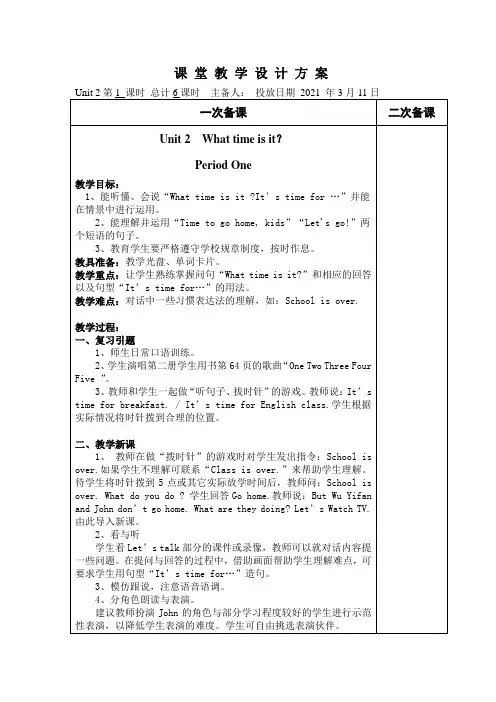
三、教学目标:。
人教版四年级英语下册第二单元教案
四、布置作业
1、熟读并背诵所学内容。
2、设计学习时间表并用英语描述。
五、板书设计
Feed-back:
课堂教学设计方案
Unit 2第6课时总计6课时主备人:投放日期2021年3月11日
一次备课
二次备课
Unit 2 Whattimeisit?
Periodsix
教学目标:
四、布置作业
1、熟读并背诵第17页的Let’s talk。
五、板书设计
Feed-back:
课堂教学设计方案
Unit 2第5课时总计6课时主备人:投放日期2021年3月11日
一次备课
二次备课
Unit 2 Whattimeisit?
PeriodFive
教学目标:
1、能够听、说、认读本课时的四个动词词组。
1、听Let’s talk 部分的录音,读给同伴、朋友或家长听。
四、布置作业
1、听Let’s talk部分的录音,读给同伴、朋友或家长听。
2、四人小组一起动手做一个英语课程表并用所学语言进行表述。
五、板书设计
Feed-back:
课堂教学设计方案
Unit 2第2课时总计6课时主备人:投放日期2021年3月11日
2、能够理解并在情景中正确使用句型:It’s time to …
教具准备:教学光盘、单词卡片。
教学重点:听、说、认读本课时的四个动词词组。
教学难点:在情景中正确使用句型:It’s time to …
教学过程:
一、复习引题
1、数学游戏:教师给学生出一些数学算式,可以是加减混合运算,也可是连加连减,学生算出来后用手指头表示答案。
pep小学英语四年级下册第二单元说课稿

Good afternoon,everyone! It 's my great pleasure
to be here and share my lesson with you.
The content of my lesson is PEP Primary English Book4 Unit2 “ What time is it ” First, let metalk about my teaching material. Part I Teaching material analysis . This lesson is the second part of unit2 “ Let ' s talk ” .In the first part,the Ss have learned the sentence “ What time is it It 's nine o ' clock. It 's time for English class. ” So the Ss have mastered how to express the time ,like:It ' s 6: 's 8:35. In this lesson,we will continue to learn how to express the time ,and the Ss are able to express “ It ' s time to do something ” .Therefore ,on study the teaching material ,I put forward the teaching objectives . 1. knowledge objective: 2. a)The Ss can hear, read, and use the main
sentence:It ' s ,,, o'' s time to,,,.It ' s time for,,,. b)The Ss can understand and read the conversation of the lesson. 3. objective: 4. The Ss can not only inquiring “ What time is it ”, but also can use the sentence patterns to describe the daily life of themselves. 5. objective: 6. By completing this lesson,to enhance the Ss ' sense of cherishing time and to help them form a habit of living a regular help the Ss build confidence in learning English. 7. Next,the key points of this lesson: 8. Study and use the sentence patterns to describe the daily life. 9. Difficult points: 10. Recognizing the difference of “ It 's time to,,, ”and“ It 's time for,,, ”.Besides,the Ss can
新人教版PEP版英语四年级下册Unit2整单元优质课公开课教案
新人教版PEP版英语四年级下册Unit2整单元优质课公开课教案第二单元教学计划一、单元教学内容分析1、单元教学内容:本单元重点自学时间的抒发以及叙述相同时间展开的日常活动。
主要句型就是:whattimeisit?it's...it'stimefor..../it'stimeto...a、b部分的let'stalk扩散了这几个代莱句型,应当做为本单元的教学难点;学生们日常生活丰富多采,同时也就是很有规律的。
建议教师在教授崭新科学知识时紧密结合学生的生活实际,鼓励他们用英文定义自己的日常活动。
2、单元教学重点:能够询问时间并做出正确的回答,如:whattimeisit?it'snineo'clock.能够结合学过的语言描述自己的日常活动,如:it'stimeforenglishclass.it'stimetogotoschool.3、单元教学难点:字母组合ur在单词中的发音。
二、单元教学目标:认读partaandpartb中的单词;实际情景中灵活运用let’stalk 中的重要句型。
三、单元教学准备:1、教师准备工作教学过程中所须要的图片、声音、课件,以及本单元的单词卡。
2、准备工作一些教师的照片或图片。
3、教师准备工作录音机及录音带。
四、单元教学措施:1、在教学过程中,对于学习困难的学生,可通过请学生复述老师的话或是复述同学的回答,让学生对老师和同学的发言引起注意,让学生意识到要仔细听别人的说话。
12、对于学习还不错,但是不愿或害怕发言的学生,课堂中教师主动请他们表达其意见,培养他们良好的学习英语的习惯。
3、充分运用英语名、英文歌、儿歌、绕口令、顺口溜、谜语等,给与小学生语言病毒感染的机会。
还可以积极开展各种活动,引导学生交际。
第一课时教学目标:1、能听懂、会说“whattimeisit?it’stimefor…”并能在情景中进行运用。
Unit_2_My_favorite_season第一课时说课稿

Unit 2 My favoutite season说课稿(Part A Let’s learn)柳树镇中心校:胡洁一、说教材1、教材分析:“My favourite season”是人教版小学英语第六册第二单元的核心话题,这个话题是小学英语日常交际的重要组成部分。
本课时是本单元的第一课时,属于词汇新授课,在四年级下册第四单元已学过有关天气的内容的基础上进一步加深学生对季节和天气的了解,所以在这个课时里我们将进一步学习关于天气的提问句型:What's the weather like in···?及其回答,还有对所喜欢的季节及原因进行问答:What's your favourite season?在单词方面主要学习season fall winter spring summer与季节有关的单词。
2、教学内容:根据新课程标准的要求和指导,我确定了以下内容:单词:season 、summer 、winter 、fall 、spring 句型:What’s your favourite season ? What’s the weather like in ···?二、说教学目标:1、能力目标:能够就所喜欢的季节及原因进行回答:What's your favourite season?和能够就天气情况进行问答如:“What'sthe weather like in ···?2、知识目标:能听、说、读写四会单词season、fall、 summer、spring、winter.句型What's your favourite ···?3、素质目标:能形成正确的语音面貌,能正确地运用句型进行交际。
三、说教学重难点:1、掌握本节课四会单词:season、spring、summer、fall、winter2、正确书写单词和灵活运用句型“What's your favourite season?”和“What'sthe weather like in···?”进行问答。
小学四年级英语第二单元B课说课稿
这篇关于⼩学四年级英语第⼆单元B课说课稿,是特地为⼤家整理的,希望对⼤家有所帮助!Background of English teaching in primary school: It is not a long history that English is as a subject in primary school in our country and the main instructional aims of teaching English in primary school is to cultivate pupils' basic abilities of their listening and speaking and their good sense of the English language. Our boys and girls are exposed to English for the first time, so it is very important to develop their keen interest in English. I. Contents: Today I'm going to talk about Part B of Unit 2, PEP Primary English, Book 3. This lesson includes two parts: Let's talk and let's practice. In section 1, it mainly deals with the dialogue about “What's in the schoolbag?” and the answers. And in section 2, it provides a real situation for the Ss to prastise the pattern: How many n.(pl.) do you have? And the answer: I have 23 n.(pl.) II. Teaching aims 1. Aims on the knowledge (1) To enable the Ss to understand and speak: “My schoolbag is heavy. What's in it? Thank you sooooooo much.” Make sure that Ss can use these sentences in real situations. (2) To help Ss to finish the survey. (3) Let Ss finish the assessment of “Let's check” in this unit. 2. Aims on the abilities (1) To develop Ss' abilities of listening and speaking. (2) To train the Ss' ability of working in groups. (3) To foster Ss' abilities of communication and their innovation. 3. Aims on the emotion (1) To foster Ss' consciousness of good co-operation and proper competition. (2) To lead Ss to show their loveliness to the poor. III. Key-points of this lesson (1) To help Ss ask and answer the question: What's in it? (2) To enable Ss to study in groups and co-operate skillfully. (3) To develop Ss' interest in English. IV. Difficult points (1) To help the Ss ask and answer the question “What's in it?” and make sure they can use the plural nouns correctly. (2) To finish the survey by themselves. V. Teaching methods As we all know: the main instructional aims of learning English in primary school is to cultivate pupils' basic abilities of listening and speaking and their good sense of the English language. So in this lesson I'll mainly use “Task-based” teaching method. That is to say, I will let the Ss learn in real situations, finish a task by making a survey to help the Ss to get a better understanding of the key structure of the dialogue. I will arrange four kinds of activities: singing, guessing game, finishing a survey and having a competition. And in this lesson a recorder, CAI, school things and a printed form will be needed. Students should prepare some school things. VI. Teaching procedures and purposes of my designing. I'll finish this lesson in five steps. Step 1. Warm-up and preview 1. Free talk between T and Ss about things in the classroom.2. Sing the song together: Books and pencils. 3. Do some TPR, for example: Show me your English book. Show me your crayon. 4. Review the numbers by asking: “How many crayons do you have?” Purpose: It is important to form a better English learning surrounding for the Ss by singing and doing some total physical response and at the same time it provides situations to review learned knowledge for the next step. Step 2. Presentation Now I'll mainly talk about this step. 1. Present the pattern: “My schoolbag is heavy.” “What's in it?.” (1) Show a bag and say: “Look! I have a bag.” Carry it and say: “Oh, it is heavy. My schoolbag is heavy.” Help the Ss understand the meaning with the help of my body language. Then lead the Ss to read the sentence. Make sure they can say it correctly. (2) T: My schoolbag is heavy. Open the bag and say: “What's in it? What's in my schoolbag?” Take out a Chinese book. Then do the action again. Let the Ss read the sentence. 2. Play a guessing game. Divide the whole class into four groups to have a competition. Let them guess: What's in the bag? How many? Purpose: To present the key structures one by one is much easier for the Ss to learn and grasp the meanings. Proper competition can arouse the Ss' interest in English learning. 3. With the help of the CAI to present the dialogue. Set a situation to help Ss understand: Two Ss are coming. One girl is carrying a heavy bag on her back. They are talking. Girl: My schoolbag is heavy. Boy: What's in it? Girl: 20 story-books, 32 pencil, 9 rulers, 12 crayons and 30 picture-books. Etc. Boy: What will you do? Girl: They are for the poor. Boy: Great! I'll bring some school things too. The boy comes back home and puts a lot of things into the bag. Then he goes to school again and gives them to a teacher. While he is taking them out, he is counting the numbers of all things. The teacher says: Thank you soooooooo much. 4. Mention that we should take care of the poor. 5. Play the cassette. Let the Ss listen and imitate the dialogue. Pay attention to their pronunciation and intonation. Purpose: CAI can provide a real situation for the Ss to understand the dialogue and the relationships between people better. Tell the Ss we should show our loveliness to the Ss. Step 3. Practice Divide Ss into groups of six children. Each one would finish the printed form by asking and answering: How many storybooks do you have? Find out which group finishes faster. things name story bookspicture-books sharp eners crayons pencils erasers pencil-cases rulers Chen Jie Purpose: Task-based teaching method is used here to develop Ss' ability of communication and also their ability of co-operation will be well trained. Step 4. Assessment Help Ss finish “Let's check” of this unit and workbook. Purpose: To check the knowledge Ss have learned in this period. Step 5. Add-activity 1. Let Ss tell each other how many school things they have after class. Tell their parents how many school things they have at home.。
四年级下册英语第二单元教案

学生能够掌握本单元的词汇和句型,并运用所学知识进行简单的英语交流。 学生能够理解并运用本单元的重点语法知识,提高英语语言表达能力。 学生能够通过完成本单元的听力、阅读和写作练习,提高英语听、说、读、写四项技能。 学生能够通过参与课堂活动和小组讨论,提高英语交际能力和合作学习能力。
培养学生学习英 语的兴趣和积极 性
导入新课:通过提问、游戏等方式引导学生进入新课题 新课讲解:讲解新知识,注重与旧知识的联系和运用 课堂互动:组织小组讨论、角色扮演等活动,提高学生的参与度 巩固练习:布置相关练习,帮助学生巩固所学知识
词汇练习:通过词汇填空、匹配和翻译等方式,帮助学生巩固所学词汇。 语法练习:设计语法选择题、改错题和翻译题等,加深学生对语法的理解和运用。 阅读练习:选取与课文相关的阅读材料,提高学生的阅读能力和阅读速度。 写作练习:让学生根据所学知识,进行简单的英语写作练习,提高其写作能力。
添加标题
学会运用所学词汇描述季节和天气,如“I like spring because it is warm and sunny.”。
添加标题
通过词汇的学习,培养学生的语言感知和表达 能力,为以后的英语学习打下基础。
掌握一般现在时的基本用法
了解动词第三人称单数的变化 规则
学习疑问句和否定句的构成和 用法
掌握常用的日常交际用语
课文主题:介绍家庭成员
教学目标:掌握家庭成员的英 文表达方式
重点词汇:爸爸、妈妈、哥哥、 姐姐等家庭成员的英文单词
难点解析:如何正确使用英文 表达家庭成员的关系
练习题目的类型和难度
练习题目的解题思路和技巧
练习题目的答案解析和反馈
练习题目的教学目的和作用
单击此处添加标题
定义:通过创设真实、生动、具体的语言环境,激发学生学习兴趣,提高语 言应用能力。
小学四年级英语第二单元说课稿
小学四年级英语第二单元说课稿本文从网络收集而来,上传到平台为了帮到更多的人,如果您需要使用本文档,请点击下载按钮下载本文档(有偿下载),另外祝您生活愉快,工作顺利,万事如意!中国()为您整理了:四年级英语第二单元说课稿欢迎大家阅读愉快!四年级英语第二单元说课稿BackgroundofEnglishteachinginprimaryschool:ItisnotalonghistorythatEnglishisasasubjectinprimaryscho olinourcountryandthemaininstructionalaimsofteachingEn glishinprimaryschoolistocultivatepupils’basicabilitieso,so itisveryimportanttodeveloptheirkeeninterestinEnglish.:TodayI’mgoingtotalkaboutPartBofUnit2,PEPPrimaryEng lish,:Let’stalkandlet’,itmainlydealswiththedialogueabout“what’sintheschoolbag?”,itprovidesarealsituationfortheSst oprastisethepattern:?Andtheanswer:Ihave23n.:“‘sinit?Thankyousooooooomuch.”“Let’scheck”inth isunit.’’’abilitiesofcommunicationandtheirinnovation.’TohelpSsaskandanswertheque stion:what’sinit?ToenableSstostudyingroupsandco-operateskillfully.TodevelopSs’interestinEnglish.TohelptheSsaskandanswerthequestion“what’sinit?”andm akesuretheycanusethepluralnounscorrectly.Tofinishthesurveybythemselves.Asweallknow:themaininstructionalaimsoflearningEnglish inprimaryschoolistocultivatepupils’basicabili’llmainlyuse “Task-based”,IwilllettheSslearninrealsituations,finishatas kbymakingasurveytoh:singing,guessinggame,,cAI, I’llfinishthislessoninfivesteps.:Booksandpencils.,forexample::“Howmanycrayonsdoyouhave?”Purpose:ItisimportanttoformabetterEnglishlearningsurrou ndingfortheSsbysinginganddoingsometotalphysicalresponseandatthesa metimeitprovidessituationstoreviewlearnedknowledgeforthenext step.NowI’llmain lytalkaboutthisstep.:“myschoolbagisheavy.”“what’sinit?.”Showabagandsay:“Look!Ihaveabag.”carryitandsay:“oh,”HelpT:myschoolbagisheavy.openthebagandsay:“what’sinit?what’sinmyschoolbag?”Letthemguess:what’sinthebag?Howmany?Purpose:Topresentthekeystructuresonebyoneismucheasie rfortheSstolearn’interestinEnglishlearning.:Girl:myschoolbagisheavy.Boy:what’sinit?Girl:20story-books,32pencil,9rulers,Boy:whatwillyoudo?Girl:Theyareforthepoor.Boy:Great!I’llbringsom eschoolthingstoo.,heiscounting:Thankyousoooooooomuch.pronunciationandintonation.Purpose:cAIcanprovidearealsituationfortheSstounderstan dthedialogueourlovelinesstotheSs.:Howmanystorybooksdoyouhave?Findoutwhichgrou pfinishesfaster.thingsnamestorybookspicture-bookssharpenerscrayonspencilseraserspencil-casesrulerschenjiePurpose:Task-basedteachingmethodisusedheretodevelop Ss’abilityofcommunicationandalsotheirabilityofco-operationwillbew elltrained.HelpSsfinish“Let’scheck”ofthisunitandworkbook.Purpose:TochecktheknowledgeSshavelearnedinthisperiod .parentshowmanyschoolthingstheyhaveathome.相关信息:小学四年级英语上册Lesson31说课稿小学四年级英语pep4Unit3说课稿本文从网络收集而来,上传到平台为了帮到更多的人,如果您需要使用本文档,请点击下载按钮下载本文档(有偿下载),另外祝您生活愉快,工作顺利,万事如意!。
pep小学英语四年级下册第二单元说课稿
Good afternoon,everyone!It’s my great pleasure to be here and share my lesson with you.The content of my lesson is PEP Primary English Book4 Unit2“What time is it”First, let me talk about my teaching material.Part I Teaching material analysis.This lesson is the second part of unit2“Let’s talk”.In the first part,the Ss have learned the sentence“What time is it It’s nine o’clock. It’s time for English class.”So the Ss have mastered how to express the time ,like:It’s 6:’s 8:35. In this lesson,we will continue to learn how to express the time ,and the Ss are able to express“It’s time to do something”.Therefore ,on study the teaching material ,I put forward the teaching objectives .1.knowledge objective:2.a)The Ss can hear, read, and use the mainsentence:It’s ,,, o’’s time to,,,.It’s time for,,,.b)The Ss can understand and read the conversation of the lesson.3. objective:4.The Ss can not only inquiring “What time is it”, but also can use the sentence patterns to describe the daily life of themselves.5. objective:6.By completing this lesson,to enhance the Ss’sense of cherishing time and to help them form a habit of living a regular help the Ss build confidence in learning English.7.Next,the key points of this lesson:8. Study and use the sentence patterns to describe the daily life.9.Difficult points:10. Recognizing the difference of“It’s time to,,,”and“It’s time for,,,”.Besides,the Ss can understand the“oops”means a surprising ’d like to use11.a chant to help them recognise the two sentence patterns.12.methods. I’ll talk about my teaching methods and learning strategies below.13.Part 2 Teaching Methods:14.In this lesson,I adopt the five-step Teaching Method and Task-based Language method offer the Ss an opportunity to complete the tasks in real life,the Ss can learn by doing ,learning by using.15.Part 3 Studying Methods:16.17.Let Ss study in a relaxed atmosphere. Ss understand the new knowledge in certain degree through the process of hearing, saying, observing, thinking etc. And make preparation for completing the new study task.Part4 Teaching AidsAs for teaching aids ,I will useblackboard ,type,record .Besides,I will also use power- point documents and multimedia , it can promote the Ss’ enthusiasm and creativity in learning English.Part 5 Teaching Procedure:Step1,Warming upa)Greeting:Good afternoon,everyone!Do you know what time is itIt’s 15:55,It’s time for English class. There will be a greeting between the teacher and the Ss,the greeting is related with the it can easily lead the Ss into the class.b)Sing a song: What time is itSo as to the psychological characteristics of children,singing a song can make Ss feel pleased and satisfied, and can lead the Ss into a English studying atmosphere.Step 2 Revisiona)use“TPR”,first,the teacher and the Ss reading the phrases while doing gestures ,then do the games “You do I guess”,one S perform,the other Ss guess what is it These activities aims to help the Ss review the phrase they have learned.b)With the help of ppt ,let the Ss practice“What time is itIt’s,,,.”,When the Ss are familiar to express the time ,the teacher ask the Ss“Are youready”leading:I’m ready!Step3 Presentationa)The teacher draw a clock at six o’clock in the blackboard ,and leading today’s topic“Mike’sdaily life”.Then the teacher use the muti media to play two interesting dialogues to explain“oops”.b)Listen carefully and reading the test aftertype ,after that each two Ss do role playing.Step4 practicea)The teacher give the Ss a chant like part A Let’s do,to help them remember the expression of “It’s time to,,,and It’s time to,,,.It can also practice their listening skills and arise their interesting.Time for ,jump and for Chinese,read and to getup ,eat some to go to school,meet my friends.b)pair workTwo Ss express the same meaning in different ways to practice the two pattern sentences .Forexample ,A:It’s time for lunch .B:It’s time to go to the canteen.Step 5 consolidationLet the Ss according to the same time speaking different activities that they can do.It’s 7:’s time to go to ,s time to have breakfast.Step6 sump upIt’s timefor+breakfast/lunch/dinner/P,E/English class...It’s time to+go to school/get up(V phrases)Step7 homework1.Modeled on the picture in the book,describe your work and rest time to your friends.2.Make a report of cherishing time.3.Part6 Blackboard design4.The left is...the middle is...the right is...5.Above is the lecture notes of my lesson. Thank you!。
人教版四年级英语下册第2单元教案
1、Let’s play:操练句型“What time is it ?It’s„”
做本单元A Let’s talk部分的作业本上的配套练习。
四、布置作业
听Let’s talk部分的录源自,读给同伴、朋友或家长听。四人小组一起动手做一个英语课程表并用所学语言进行表述。
六、小结反思
板书设计:
Feed-back:
教学过程:
复习引题
教师播放第一单元Story time 的录音或者请一组学生表演Story time中的故事。 教师在听录音或学生表演之后想学生提问:Where is Zoom ?学生回答:He is in the canteen .教师又问:Why ? 学生答:He is hungry .教师再问: Why in he hungry ?What time is it ? 引导学生答出:It’s time for lunch .接下来,教师可鼓励学生说出哪些东西可以告诉我们时间,如: the sun , the moon , the tree .等等,学生如果不能用英文说,也可用中文说。
2、Review:A、B两部分的词语及对话。
二、教学新课
1、让学生练习运用What time is it? It's...练习说句子。
2、在学生能说的基础上在让学生书写这样的句子。 三、巩固练习
读一读并排序。
听录音并排序。
3、看一看并连线。
4、唱Let’s sing 的歌曲。
5、听录音看动画理解Story time 的内容。
3、能够听懂指示语,并按要求做出相应的动作。
教具准备:
与教材内容相关的课件、声音、图片等媒体素材。 2、教师准备一个教具钟。
教学重点:
英语人教版四年级下册unit 2what time is it
四年级下册unit 2what time is it ?说课表说教材 亲爱的各位领导,各位老师: 大家好!非常高兴今天能站在这里跟大家一起谈论课标。今天我说的内容是PEP小学英语四年级下册unit 2 what time is it ?下面我将从课标和教材两方面进行阐述。
首先说课标 课标要求四年级结束时,应达到一级目标要求,以及目标的重点是以培养学生的兴趣为主,使学生形成初步的综合语言运用能力。根据总体目标对语言技能、语言知识、情感态度、学习策略和文化意识等方面的要求,我认为四年级学生应具备以下能力:
1、听的方面:引导学生能够抓住关键信息做相应的动作,变成做事情。 2、说的方面:能够做简单的角色表演,见到图片或实物,能说出简单的单词或句子。 3、读的方面:能够在图片的帮助下读懂简单的对话或小故事。 4、写的方面:要求学生能够描红仿写单词或简单的句子,书写工整漂亮 。 每一节课教学中,我不仅注重学生的语言知识和语言技能的培养,也渗透中西方文化差异,更重注学生的学习策略的培养,同时也关注学生的情感态度。 以上是我对本阶段课标的理解。 接下来说教材:
1、说教材地位与作用 我选择的内容是第二单元unit 2 what time is it ?这个话题是小学英语日常交际的重要组成部分,在整个小学英语知识体系中是不可或缺的。主要学习通过询问时间和谈论某一时间做某事来进一步学习动词短语,名词还有数次的运用。它不仅贴近学生的实际生活,而且实用、有趣,容易让学生接受并掌握。
2、对教材的理解分析 本课的教学内容是Let’s talk的对话。这是一节对话课,对话部分是单元的核心内容,旨在把每单元的核心句型和词汇融入一个有一定意义的对话语篇中,让学生整体体验词汇和句型的语用情境,并作为文本范例,帮助学生巩固记忆并形成语言运用能力。 本课的let’s talk板块后面辅以了let’s play 的形式进行巩固练习。学生在前面课时学过句型What time is it? It’s nine o’clock. It’s time for English class. 他们已经掌握了整点和几点几分的表达方法,比较使用 It’s time for…和It’s time to…. 。我相信通过这一节课的学习,有助于学生巩固和丰富表达时间的方式,并学会如何表达“到时间做某事”。 3、根据教材的特点和学生情况,在结合对课标的理解,在本课时的教学中,我将重点关注三大目标: 1) 知识目标:要求学生能听说读写get up, go to school., go home, go to bed四个动词词组;能认读、区分并灵活运用It’s time to…. 和 It’s time for….两个句型。 2)能力目标:要求学生看懂时间;能流利地问答非整点时间;能用It’s time to….来描述自己一天的活动。 3)情感目标:主要是帮助学生树立学好英语的信心。增加学生参与意识,引导学生积极与他人合作。共同完成学习任务并在成功中体会学习中的乐趣。加强学生珍惜时间的意识,帮助学生养成良好的作息习惯。 4、教学重点和难点 It’s time to„和It’s time for„的用法。