
人教版新目标七年级英语上册Unit-6 Do you like bananas-SectionA-1a-1c-教案-学案
Unit 6 Do you like bananas?(Section A 1a-1c)Teaching aims:1. Learn new words of fruits and vegetables.2. Be able to talk about likes and dislikes.3. Understand the difference between countable nouns and uncountable nouns.4. To improve Sts’ communicating skills and enable them to keep their health.Teaching key and difficult points:1. Learn new words , read and write them.2. Be able to talk about likes and dislikes.Teaching aids:pictures, food, a box, tape recorderTeaching steps:Step 1. Warm-up(1)Daily greeting to the students(2)a student to make a speechStep 2. Leading-inTake out an orange, and ask questions : What’s this in English? What color is it? How to spell it?Step 3. Presentation –New words(1)Show pictures and learn the words: apple, pear, banana, strawberry, bread, hamburger, milk, ice-cream, salad.(2)Classify the words into fruit, vegetable or food.(3)Guessing Game: Put one object into a box, let the Sts guess what it is.(4)Summarize: Countable nouns and Uncountable nouns, Singular and Plural nounsStep 4. Work on 1a.Match the words with the things in the picture, and then check the answers .Step 5. Presentation –New Sentence1. I like …….2. Do you like ……? Yes , I do. / No, I don't .Step 6. Pairwork . / Work on 1c.Get the Sts to ask and answer in pairs, using the sentences: A: Do you like…?B: Yes, I do./ No, I don’t. Also fill in the chart in Guiding Case and give a report.Step 7. Work on 1b.Listen and number the conversations. Check the answers.Step 8. Let’s ChantApples, apples, I like apples.Bananas, bananas, I don’t like bananas.Do you like salad? Do you like salad?Yes, I do. Yes, I do.No, I don’t. Yes, I do.Step 9. HomeworkBlackboard design:Unit 6 Do you like bananas?New Words: apple, pear, banana, strawberry, bread, hamburger ……New Sentences: Do you like……?Yes , I do. / No ,I don’t.Unit6 Do you like bananas?(SectionA 1a—1c)学习目标:1、掌握新单词和短语:apple, banana, pear, strawberry, tomato, hamburger, salad, milk, bread, ice-cream, food, fruit, vegetable2、掌握重要句式:-- Do you like bananas?-- Yes,I do./No, I don’t.I like pears. I don’t like apples.学习重点:学习区分可数名词和不可数名词,并掌握可数名词单数变复数的规律。
学习难点:运用“Do you like……?”询问他人对某种食物的爱恶。
『相关链接』The Peasant's Lot (Tang Dynasty ·Li Shen )悯农(唐·李绅)Hoeing the grass under the noonday sun, His sweat drips on the ground beneath.Who knows that on the dining plate, Every single grain means hardship.锄禾日当午,汗滴禾下土。
谁知盘中餐,粒粒皆辛苦。
Thinking: What can we learn from the poetry?思考:通过欣赏这首诗,我们有什么启发?『课前尝试』课前完成1、预习P.31单词2、完成预习题:在图片下面的横线上写出对应的单词例:orange______ ______ ______ ______ ____________ ______ ______ ______ ______☆推荐一个串记口诀:美味食物摆上桌,眼花缭乱非常多。
果蔬搭配有营养,一看我就Like。
草莓strawberry,沙拉原是salad;French fries是薯条,全部吃完打饱嗝。
冰湛淋ice- cream ,坏了肠胃了不得。
Pear梨,orange橙,香蕉就是banana;broccoli花椰菜,tomato西红柿,汉堡包就是hamburger。
『小组练习』1、完成下列表格Countable nouns (可数名词)Uncountable nouns (不可数名词)2、根据以下例子,小组合作总结可数名词单数变复数的规则(1)例:apple →apple s orange →orange s banana →banana s △一般情况_________________________________(2)例:strawberry →stawberr ies family →famil ies△以辅音字母加y结尾的词______________________(3)例:class →class es box →box es watch →watch esdish →dish es△以s,x,sh,ch结尾的词__________________________(4)tomato →tomato es potato →potato es photo →photo s△以o结尾的词,有生命的___________,无生命的_______________☆复数名词中的-s或-es的发音:字母s在清辅音/p/,/k/等后面发清辅音/s/,如books. 字母s在浊辅音/l/, /n/, /g/ 等后面发浊辅音/z/ ,如apples,bags.在某些单词中,如,cats,birds等中,字母t和s一起发/ts/,字母d和s一起发/dz/。
以s, ss, x , ch等结尾的名词在后面加-es构成复数,-es读作/iz/。
例如:classes ,boxes. 3、调查学习小组内每个成员对以下食物的好恶,练习“Do you like ……”句型,完成下表,并作一个报告(Report)。
foodName(√×)例:√×√√××rt:Mynameis_______.I like _______, but I don’t like _______._______ likes _______, but he/she doesn’t like _______._______ likes _______ and _______, but he/she doesn’t like _______.『复习巩固』Let’s chant! 让我们一起吟唱!Apples, apples, I like apples.Bananas, bananas, I don’t like bananas.Do you like salad? Do you like salad?Yes, I do. Yes, I do.No, I don’t. Yes, I do.『知识拓展』1. English proverbs 英语谚语An apple a day, keeps doctors away. 每天一苹果,医生远离我。
One should eat to live, not live to eat. 一只烂,烂一筐,一个坏朋友可以影响一群好人。
A black plum is as sweet as a white, 乌梅白梅一样甘甜.管它黑猫白猫, 抓到耗子便是好猫。
2. names of food 食物的名字porridge 稀饭rice 米饭steamed bread 馒头noodles 面条bread 面包dumplings 饺子wonton 馄饨soup 汤fish 鱼meat 肉sausage 香肠fried chicken 炸鸡chips 薯条pie 馅饼『课后检测』一.选择题:()1.Do you like____?A. bananaB. bananasC. the bananas()2.My cousin ___ oranges.A. likeB. likesC. to like()3.____your mother like tomatoes?A. DoesB. DoC. Is( )4.She ____like ice cream.A. doesn’tB. don’tC. isn’t( )5.Do they like______?A. saladB. a saladC. salads二、写出下列单词的复数形式.hamburger__________ dictionary__________ tomato_________ photo_________ strawberry__________ banana__________三、按要求改写下列句子,每空一词1. I like this banana. (改为复数)____like_____ _____.2.My sisters like salad.(该为否定句)My sisters_____ _____salad.3. They like hamburgers.(改为一般疑问句)____they _____ hamburgers?4.Liza likes ice-cream.(改为一般疑问句,并作答)____Liza like ice-cream?Yes ,____ ____.『自我评价』你这堂课的表现如何?给自己个评价吧!(A B C)(√)。
人教版新目标七年级上Unit 6Unit 6 Do you like bananas Lesson

Unit 6 Do you like bananas?Fourth Period (Section B, 2a –3b)Teaching aims and language points:1. Learn these words and be able to say, read and write them: ● star, well, habit, healthy, really, question, want, be, fat2. Be able to talk about and writ e about one’s eating habits by using : ● What do you like for breakfast?● Do you like hamburgers for dinner? ● They’re not healthy. ● I don’t want to be fat. ● Cindy likes healthy food.3. Be able to understand difficult sentences like: ● Which food do you think is healthy?● David asks the volleyball star, Cindy Smith, about her eating habits.Teaching steps:1.Warm-up and revision (课堂热身和复习) (1)Daily greeting to the students (日常问候) (2)Revision (复习): Check the homework.Ask some of the Ss to read out their sentences. Get thecarefully and correct any mistakes. (3) Competition.Show the Ss a chart about what Boband Gina like and don breakfast and lunch.they act out their conversations. 2. Presentation (呈现新知识)Do you think hamburgers are healthy? Do you think milk is healthy? Do you think chicken is healthy? Do you think salad is healthy? (2) Work on Section B, 2a.check Yes, Maybe or No in the chart. 3. Reading (阅读3b )(1) Read the magazine article quickly and answer the questions: Does Cindy eat healthy food?Does she have good eating habits?Ask the questions first. Then, see if the students understand the questions. Next, get the Ss to read the article quickly to find out the answers. Finally, check the answers.(2) Read the magazine article again and circle the food words. (3) Put the food words into the chart below.(4) Read the article aloud. 4. Writing (写作)Ss work on 2c. They write five sentences according to the chart above. 5. Study the key words and difficult sentences in this part of the book. 6. Work on 3a in pairs. 7. Homework (家庭作业)Work on 3b. Ask the Ss to write about what they and their partners like and don ’t likefor breakfast, lunch and dinner according to their survey.4. 学生通过反复阅读,完成圈词、填表,基本可以掌握全文的大意。
新目标英语七年级上Unit_6_Do_you_like_bananas

Unit 6 Do you like bananas?Section A( 1a-1c)Changjiang siyuan experimental school—by Luo ManxiaTeaching aims :1. The names of the food and fruits.(bananas, oranges, pears, strawberries, milk, bread, ice-cream, tomatoes, salad.)2. Talk about likes and dislikes.-Do you like…?-Yes, I do. /No, I don’t.Language points and difficulties:1.Yes/No questions and short answers. Do you like …? Yes, I do./ No, I don’t.2. Words:tomatoes, hamburgers, pears, oranges, ice-cream, salad, bananas, strawberries, milk, breadTeaching procedures:Step 1. Warming-up and revision(1) Introduction.(2)Revision:What are these? They’re…Step 2. Presentation.1.Learn the new words.Show a picture of oranges and say:What are these?(They are oranges. I like oranges.Show a picture of bananas and ask:What are these?(They arebananas.) Making a horrible face and say:I don’t like bananas. Show the pictures of the new words. Teach the new words of the food and fruits one by one. Then read them together after the teacher.2.Play a game.(piercing eyes火眼金睛)3. Match the words.Let them read and match. After it, they can finish Section A 1a. 4. Listening1b. Listen and number the conversations.Step 3 Consolidation1. Guessing gamea. Guess what the tea cher’s favorite food is. The teacher say:I like …Let students guess by using:Do you like …? Then the teacher answer:Yes, I do. / No , I don’t. Do the same game with students.b. 1c.Ask the students to talk about their likes and dislikes in talking pairs. Then ask some pairs to share their conversations2.Exercises:a. Translate and write them down.(翻译句子)(1).- 你喜欢沙拉吗?- 我不喜欢。
Unit6Doyoulikebanans单元语法知识和重要句子人教版英语七年级上册
人教版英语七年级上册正式单元第六单元Unit 6 Do you like bananas?语法知识及重点句子复习资料Unit 6 Do you like bananas?1、关于like的用法。
(1)、like sth.喜欢…;后面的名词如果是可数名词,要用复数。
例如:I like apples , what about you? 我喜欢苹果,你呢?(2)、like to do sth.\ like doing sth. 喜欢做某事。
例如:I like going there by bus.我喜欢乘坐公共汽车去那儿。
2、关于可数名词和不可数名词。
(1)、可数名词:有单复数之分。
这类名词单数变为复数的方法:一般情况,在该名词后面加上s,例如:apple—apples ; banana—bananas ; pear—pears;以s , sh , ch , x结尾的名词,在后面加es,例如:bus—buses ; watch—watches ; box—boxes;以o结尾的名词,一般有生命的词,一般加es,无生命的词,一般在末尾加s。
例如:photo—photos ; zoo—zoos ; radio—radios ; tomato—tomatoes ; potato—potatoes ; hero —heroes;以辅音字母加y结尾的名词,变y为i,再加es。
例如:party—parties ; dictionary—dictionaries ; strawberry—strawberries。
特殊的需要记忆的名词单复数:man—men woman—women child—children sheep—sheep deer—deer注意:有些名词,既可以做可数名词,也可以做不可数名词。
例如:salad, ice cream, food, fruit , chicken , fish等等。
3、关于good与wellgood好的、令人满意的,形容词,修饰名词。
最新人教新目标版七年级英语上册 Unit 6 Do you like bananas?Section A教案2 (新版)
Unit 6 Do you like bananas?话题热身:引导学生思考日常吃的蔬菜和水果。
教学活动设计意图:引出本单元话题,为学习本单元目标语做好准备。
教学步骤教师行为学生行为Step 1利用动画资源,启发学生尽量说出食物的单词,并鼓励学生积极举手抢答。
Ask students to watchthe fla sh and say whatthey can see. Look and say.根据教师展示的动画尽量说出自己知道的英语单词。
Step 2展示更多的图片,比较直观地展示更多的词汇,让学生对与单元话题相关的新词汇有更多的了解,激发他们的学习欲望和兴趣。
Show more pictures ofvegetables and fruitthat students may notknow. See more pictures of vegetables and fruit. 看图片,了解更多的词汇。
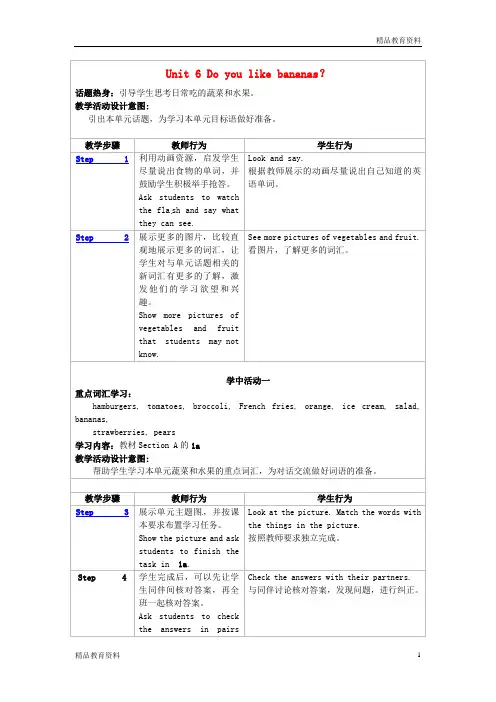
学中活动一重点词汇学习:hamburgers, tomatoes, broccoli, French fries, orange, ice cream, salad, bananas,strawberries, pears学习内容:教材Section A的1a教学活动设计意图:帮助学生学习本单元蔬菜和水果的重点词汇,为对话交流做好词语的准备。
教学步骤教师行为学生行为Step 3展示单元主题图,并按课本要求布置学习任务。
Show the picture and askstudents to finish thetask in 1a. Look at the picture. Match the words with the things in the picture.按照教师要求独立完成。
Step 4学生完成后,可以先让学生同伴间核对答案,再全班一起核对答案。
Ask students to checkthe answers in pairs Check the answers with their partners. 与同伴讨论核对答案,发现问题,进行纠正。
人教新目标七年级上 Unit 6 Do you like bananasSection A
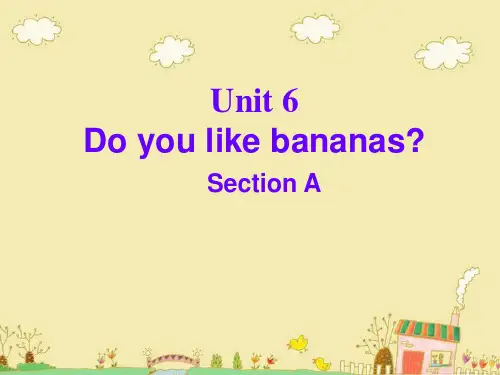
2
A: Do you like salad? B: No, I don’t.
1
A: Do you like bananas? B: Yes, I do.
3
A: Do you like oranges? B: Yes, I do.
Read the conversations together
Pair-work
A: Do you like _h_a_m__b_u_r_g_e_r_s_? B: Yes, I do. I like hamburgers. a hamburger /’hæ mbɜ:gə(r)/ /No, I don’t.
I don’t like hamburgers.
hamburgers /’hæmbɜ:gə(r)z/
uncountable nouns
milk
tea
meat
water
bread
rice
3.Pairwork: Review the words and fill in the chart.
countable noun
(可数名词)
hamburger,tomato, orange,banana,
strawberry,pear
salad 不可数名词没有复数形式
A: Do you like s_a_l_a_d_? B: Yes, I do. I like salad.
/ No, I don’t. I don’t like salad.
ice-cream
[ais’kri:m]
ice-cream
不可数名词没有复数形式
A:Do you like _ic_e_-_c_r_e_a_m_? B:Yes,I do.I like ice-cream.
人教版新目标版七年级英语上册-Unit-6-Do-you-like-bananas-教案
Period 1 (Section A: 1a-2c.)
Teaching class: Junior1, Class 11
Teacher: Peng Qingyun
教材分析:本单元的中心话题是Food,主要语言功能项目是Talk about likes and dislikes,语法结构为Present tense tolike,Yes / No questions and short answers, Affirmative and negative statements。本单元Section A所呈现的是与谈论喜好与厌恶相关的基本语言知识及其初步运用。这部分内容从呈现食物词汇开始,通过视、听等方式输入信息,并引出本单元主要句型:Do you like…?及其回答Yes, Ido / No, I don’t.
②— Does she\he like …? — Yes, she/he does.\No, she/he doesn’t.
③— I like …\I don’t like …
④— He\She likes …\He\She doesn’tlike …
Difficult points
To enable students to express like and dislike and use the new words correctly.
教学目标:
1 Knowledge Objects:
1、掌握关于食物的词汇。2、熟练运用所学功能项目谈论喜好和厌恶。
3、能准确地用英语描述一日三餐的食谱。
2 Ability Objects开展多种任务型的听说活动,获得理解、识别和处理与谈论喜好、厌恶相关的信息。
最新人教新目标版中学七年级英语上册 Unit 6 Do you like bananas(第1课时)教案 (新版)
Unit 6 Do you like bananas教学目标:知识目标:1)Words and phrases:banana, hamburger, tomato, ice-cream,salad, strawberry, pear, bread, birthday2)New patterns: Do you like salad? /Does he like pears?Countable nouns and Uncountable nouns能力目标:通过学习问句及回答,提高学生听说读写的能力。
情感目标:通过练习对话,在小组合作中,培养学生团结协作精神。
Step 1. Greeting Warming-up1.Follow the tape, read the new words together2. Let someone read.Step 2. Revision.Show a picture of an orange, then ask some questions..Do you like oranges?Step 3. Presentation.利用实物和幻灯片图片呈现本课的主要词汇,学习新单词。
Like this:实物呈现a banana:T-- What is this in English ?Ss--- It’s a banana.以同一方法学习单词hamburger, tomato, ice-cream,salad, strawberry, pear, bread,Step 5 Gessing game 猜猜这些物品所在的位置. T--: Where is the...?让学生回答。
(利用学过的句型练习运用这些单词,让学生在不知不觉中达到熟识程度,加强记忆。
)Step 6.Playing games.(设置比赛活动,激发学生的兴趣。
)Step 7. 再次呈现生词图片,进一步巩固新单词Step 8. Look at the words in 1a and match the wor ds with the things in the picture.Keys: 1. d 2. i 3. f 4. h 5. b6. g7.c8. j9. e 10. aStep 9. Listening practice.1b,2a and 2bPlay the recording. The first time, students only listen. The second time, students circle the words they hear.Check their answers.1b: 213 2a: hamburgers, tomatoes, ice-cream,2b: 1. hamburgers 2. tomatoes, tomatoes 3. ice-cream, ice-creamStep 10. Practice the conversations. 2c1. Read the conversations in 1c.(Ask students to repeat.)2.引导学生展开Pairwork活动,完成lc部分口语交际的教学任务,学会运用助动词Do you like...? Yes, I do./ No, I don’t.进行问答. 让每个学生都参与到这个活动来,人人都有表现的机会。
人教版七年级上册英语Unit6Doyoulikebananas
人教版七年级上册英语Unit6 Do you like bananas一. 教材分析人教版七年级上册英语Unit6 Do you like bananas主要讲述了关于喜好和食物的话题。
本节课的主要内容是让学生能够用英语询问和描述他们对不同食物的喜好。
教材通过简单的对话和词汇,帮助学生掌握基本的交际用语,并能够运用这些句子进行日常交流。
此外,本单元还引入了一般现在时态的用法,让学生能够用英语描述他们的日常喜好和习惯。
二. 学情分析在进入七年级上册时,学生们已经掌握了基本的英语语法和词汇知识,具备一定的听、说、读、写的能力。
然而,对于一般现在时态的用法和复杂的句子结构,他们可能还较为陌生。
因此,在教学过程中,需要注重引导学生理解和运用一般现在时态,并通过大量的练习和实际操作,让他们能够熟练运用该时态进行描述和交流。
三. 说教学目标1.知识目标:学生能够掌握一般现在时态的用法,并能够用英语询问和描述他们对不同食物的喜好。
2.能力目标:学生能够听懂、说出一般现在时态的句子,并能够运用该时态进行日常交流。
3.情感目标:通过小组合作和互动交流,学生能够增强自信心,提高团队合作意识。
四. 说教学重难点1.教学重点:一般现在时态的用法和食物词汇的掌握。
2.教学难点:一般现在时态的运用和食物词汇的灵活运用。
五. 说教学方法与手段1.教学方法:采用任务型教学法,通过小组合作、互动交流和实际操作,引导学生主动参与学习过程。
2.教学手段:利用多媒体教学资源,如图片、音频和视频,增加学生的学习兴趣和参与度。
六. 说教学过程1.导入:通过展示一些常见食物图片,引导学生谈论他们对食物的喜好。
2.新课呈现:引入一般现在时态的概念,并通过示例句子让学生理解一般现在时态的用法。
3.对话练习:让学生听录音或观看视频,模仿对话中的句子,并进行角色扮演。
4.小组活动:学生分组进行讨论,用英语询问和描述他们对食物的喜好。
5.巩固练习:通过完成练习题和互动游戏,让学生进一步巩固一般现在时态的用法。
人教版七年级英语(上册)Unit 6 Do you like bananas(五)教案
John’s eating habits
For breakfast For lunch For dinner
John’s eating habits
For breakfast eggs and some fruits For lunch For dinner
Jack’s eating habits
Q1: What food does Jack eat every day? Jack eats lots of healthy food every day.
Q2: What unhealthy food should John stop eating?
Q2: What unhealthy food should John stop eating?
Jack and Bill are my good friends. We eat different food every day.
I like lots of food. For breakfast, I eat eggs and some fruits. I like oranges and bananas. For lunch, I have hamburgers and some salad. For dinner, I have chicken and some vegetables. I like carrots and tomatoes.
Bill’s eating habits
For breakfast nothing For lunch hamburgers For dinner French fries
John compares (比较) his friends’ eating habits.
人教版新目标七年级上Unit 6Unit 6 Do you like bananas Lesson
Unit 6 Do you like bananas?Second Period (Section A, 2d –3c)Teaching aims and language points:1. Learn these words and be able to say, read and write them:● birthday, dinner, week, think about, food, sure, how about, burger, right, then, rice, so 2. Be able to talk about what to eat for a meal by using:● John ’s birthday dinner is next week. ● Let’s talk about the food. ● How/What about …? ● You’re right.3. Consolidate the pronunciation and spelling of key vocabulary.4. Be able to understand the main differences between countable and uncountable nouns.Teaching steps:1. Warm-up and revision (课堂热身和复习) (1)Daily greeting to the students (日常问候) (2)Revision (复习):Look at the pictures, and say and spell the words. Teach three new words: burger, milk, food. (3)Work on 3b.First, Ss read and number the conversation. Next, Ss discuss what the word “so ” means in the conversation. Finally, Ss make up their own conversations in pairs.2. Work on 2d(1) Ss read the conversations by themselves and circle the food in it. (2) Ss role-play the conversation in groups of three. (3) Answer some questions about the conversation. (4) Read the conversation again. Try to understand the conversation better and pay attention to some key sentences. 3. Study the grammar (学习语法)(1) Ss complete the exercise in 3a by themselves. (2) Ss work in groups to check their answers. (3) Get the Ss to discuss two questions.(4) Read Grammar Focus and answer the questions. 4. Chant (吟诵)Join us, join us. Let’s have a party. Do you like salad? Yes, I do.2. 通过自己阅读,分角色阅读对话,使学生理解对话的发生的情景和句意。