
2020年普通高等学校招生全国统一考试全国卷Ⅲ英语高考试题(含答案)
绝密★启用前2020年普通高等学校招生全国统一考试(全国卷III)英语注意事项:1. 答卷前,考生务必将自己的姓名、准考证号填写在答题卡和试卷指定位置上。
2. 回答选择题时,选出每小题答案后,用铅笔把答题卡上对应题目的答案标号涂黑。
如需改动,用橡皮擦干净后,再选涂其他答案标号。
回答非选择题时,将答案写在答题卡上,写在本试卷上无效。
3. 考试结束后,将本试卷和答题卡一并交回。
第一部分听力(共两节,满分30分)做题时,先将答案标在试卷上。
录音内容结束后,你将有两分钟的时间将试卷上的答案转涂到答题卡上。
第一节(共5小题;每小题1.5分,满分7.5分)听下面5段对话。
每段对话后有一个小题,从题中所给的A、B、C三个选项中选出最佳选项。
听完每段对话后,你都有10秒钟的时间来回答有关小题和阅读下一小题。
每段对话仅读一遍。
例:How much is the shirt?A. £19.15.B. £9.18.C. £9.15.答案是C。
1. Where does the conversation probably take place?A. In a supermarket.B. In the post office.C. In the street.2. What did Carl do?A. He designed a medal.B. He fixed a TV set.C. He took a test.3. What does the man do?A. He’s a tailor.B. He’s a waiter.C. He’s a shop assistant.4. When will the flight arrive?A. At 18:20.B. At 18:35.C. At 18:50.5. How can the man improve his article?A. By deleting unnecessary words.B. By adding a couple of points.C. By correcting grammar mistakes.第二节(共15小题;每小题1.5分,满分22.5分)听下面5段对话或独白。
每段对话或独白后有几个小题,从题中所给的A、B、C三个选项中选出最佳选项。
听每段对话或独白前,你将有时间阅读各个小题,每小题5秒钟;听完后,各小题将给出5秒钟的作答时间。
每段对话或独白读两遍。
听第6段材料,回答第6、7题。
6. What does Bill often do on Friday night?A. Visit his parents.B. Go to the movies.C. Walk along Broadway.7. Who watches musical plays most often?A. Bill.B. Aarah.C. Bill’s parents.听第7段材料,回答第8至10题。
8. Why does David want to speak to Mike?A. T o invite him to a party.B. To discuss a schedule.C. T o call off a meeting.9. What do we know about the speakers?A. They are colleagues.B. They are close friends.C. They’ve never met before.听第8段材料,回答第10至12题。
10. What kind of camera does the man want?A. A TV camera.B. A video camera.C. A movie camera.11. Which function is the man most interested in?A. Underwater filming.B. A large memory.C. Auto-focus.12. How much would the man pay for the second camera?A. 950 euros.B. 650 euros.C. 470 euros.听第9段材料,回答第13至16题。
13. Who is Clifford?A. A little girl.B. The man’s pet.C. A fictional character.14. Who suggested that Norman paint for children’s books?B. Elizabeth.C. A publisher.15. What is Norman’s story based on?A. A book.B. A painting.C. A young woman.16. What is it that shocked Norman?A. His unexpected success.B. His efforts made in vain.C. His editor’s disagreement.听第10段材料,回答第17至20题。
17. Who would like to make small talk according to the speaker?A. Relatives.B. Strangers.C. Visitors.18. Why do people have small talk?A. T o express opinions.B. To avoid arguments.C. T o show friendliness.19. Which of the following is a frequent topic in small talk?A. Politics.C. Salaries.20. What does the speaker recommend at the end of his lecture?A. Asking open-ended questions.B. Feeling free to change topics.C. Making small talk interesting.第二部分阅读理解(共两节,满分40分)第一节(共15小题;每小题2分,满分30分)阅读下列短文,从每题所给的A、B、C和D四个选项中,选出最佳选项。
AJourney Back in Time with ScholarsClassical Provence(13days)Journey through the beautiful countryside of Provence,France,with Prof. Ori Z. Soltes. We will visit some of the best-preserved Roman monuments in the world. Our tour also includes a chance to walk in the footsteps of Van Gogh and Gauguin. Fields of flowers, tile-roofed(瓦屋顶)villages and tasty meals enrich this wonderful experience.Southern Spain(15days)Spain has lovely white towns and the scent(芳香)of oranges,but it is also a treasury of ancient remains including the cities left by the Greeks,Romans and Arabs. As we travel south from Madrid with Prof. Ronald Messier to historic Toledo,Roman Merida and into Andalucia, we explore historical monuments and architecture.China’s Sacred Landscapes(21days)Discover the China of“past ages,its walled cities,temples and mountain scenery with Prof. Robert Thorp. Highlights(精彩之处)include China’s most sacred peaks at Mount Tai and Hangzbou’s rolling hills,waterways and peaceful temples. We will wander in traditional small towns and end our tour with an exceptional museum in Shanghai.Tunisia(17days)Join Prof. Pedar Foss on our in-depth Tunisian tour. Tour highlights include the Roman city of Dougga,the underground Numidian capital at Bulla Regia, Roman Sbeitla and the remote areas around T ataouine and Matmata,uique for underground cities. Our journey takes us to picturesque Berber villages and lovely beaches.21. What can visitors see in both Classical Provence and Southern Spain?A. Historical monuments.B. Fields of flowers.C. Van Gogh’s paintings.D. Greek buildings.22. Which country is Prof. Thorp most knowledgeable about?A. France.B. Spain.C. China.D. Tunisia.23. Which of the following highlight the Tunisian tour?A. White towns.B. Underground cities.C. Tile-roofed villages.D. Rolling hills.BWhen "Rise of the Planet of the Apes" was first shown to the public last month, a group of excited animal activists gathered on Hollywood Boulevard. But they weren’t there to throw red paint on fur-coat-wearing film stars. Instead, one activist, dressed in a full-body monkey suit, had arrived with a sign praising the filmmakers: "Thanks for not using real apes (猿)!"The creative team behind "Apes" used motion-capture (动作捕捉) technology to createdigitalized animals, spending tens of millions of dollars on technology that I records an actor’s performance and later processes it with computer graphics to create a final image (图像). In this case, one of a realistic-looking ape.Yet "Apes" is more exception than the rule. In fact, Hollywood has been hot on live animals lately. One nonprofit organization, which monitors the treatment or animals in filmed entertainment, is keeping tabs on more than 2,000 productions this year. Already, a number of films, including "Water for Elephants," "The Hangover Part Ⅱ" and "Zookeeper," have drawn the anger of activists who say the creatures acting in them haven’t been treated properly.In some cases, it’s not so much the treatment of the animals on set in the studio that has activists worried; it’s the off-set training and living conditions that are raising concerns. And there are questions about the films made outside the States, which sometimes are not monitored as closely as productions filmed in the Sates.24. Why did the animal activists gather on Hollywood Boulevard?A. T o see famous film stars.B. To oppose wearing fur coats.C. T o raise money for animal protection.D. T o express thanks to some filmmakers.25. What does paragraph 2 mainly talk about?A. The cost of making "Apes."B. The creation of digitalized apes.C. The publicity about “Apes."D. The performance of real apes.26. What does the underlined phrase "keeping tabs on" in paragraph 3 probably mean?A. Listing completely.B. Directing professionally.C. Promoting successfully.D. Watching carefully.27. What can we infer from the last paragraph about animal actors?A. They may be badly treated.B. They should take further training.C. They could be traded illegallyD. They would lose popularity.CWith the young unable to afford to leave home and the old at risk of isolation(孤独), more families are choosing to live together.The doorway to peace and quiet, for Nick Bright at least, leads straight to his mother-in-law, she lives on the ground floor, while he lives upstairs with his wife and their two daughters.Four years ago they all moved into a three-storey Victorian house in Bristol —one of a growing number of multigenerational families in the UK living together under the same roof. They share a front door and a washing machine, but Rita Whitehead has her own kitchen, bathroom, bedroom and living room on the ground floor.“We floated the idea to my mum of sharing at a house,”says Kathryn Whitehead. Rita cuts in: “We spoke more with Nick because I think it’s a big thing for Nick to live with his mother-in-law.”And what does Nick think? “From my standpoint, it all seems to work very well. Would I recommend it? Yes, I think I would.”It’s hard to tell exactly how many people agree with him, but research indicates that the numbers have been rising for some time. Official reports suggest that the number of households with three generations living together had risen from 325,000 in 2002 to 419,000 in 2013.Other varieties of multigenerational family are more common. Some people live with their elderly parents; many more adult children are returning to the family home, if they ever left. It is said that about 20% of 25-34-year-olds live with their parents, compared with 16% in 1991.The total number of all multigenerational households in Britain is thought to be about 1.8 million.Stories like that are more common in parts of the world where multigenerational living is more firmly rooted. In India, particularly outside cities, young women are expected to move in with their husband’s family when they get married.28. Who mainly uses the ground floor in the Victorian house in Bristol?A. Nick.B. Rita.C. KathrynD. The daughters.29. What is Nick’s attitude towards sharing the house with his mother-in -law?A. Positive.B. Carefree.C. Tolerant.D. Unwilling.30. What is the author’s statement about multigenerational family based on?A. Family traditions.B. Financial reports.C. Published statistics.D. Public opinions.31. What is the text mainly about?A. Lifestyles in different countries.B. Conflicts between generations.C. A housing problem in Britain.D. A rising trend of living in the UK.DWe are the products of evolution, and not just evolution that occurred billions of years ago. As scientists look deeper into our genes (基因), they are finding examples of human evolution in just the past few thousand years. People in Ethiopian highlands have adapted to living at high altitudes. Cattle -raising people in East Africa and northern Europe have gained a mutation (突变) that helps them digest milk as adults.On Thursday in an article published in Cell, a team of researchers reported a new kind of adaptation - not to air or to food, but to the ocean. A group of sea-dwelling people in Southeast Asia have evolved into better divers. The Bajau, as these people are known, number in the hundreds of thousands in Indonesia, Malaysia and the Philippines. They have traditionally lived on houseboats; in recent times, they've also built houses on stilts (支柱) in coastal waters. “They are simply a stranger to the land," said Redney C. Jubilado, a University of Hawaii researcher who studies the Bajau.Dr. Jubilado first met the Bajau while growing up on Samal Island in the Philippines. They made a living as divers, spearfishing or harvesting shellfish. "We were so amazed that they could stay underwater much longer than us local islanders," Dr. Jubilado said. “I could see them actually walking under the sea."In201, Melissa Ilardo, then a graduate student in genetics at the University of Copenhagen, heard about the Bajau. She wondered if centuries of diving could have led to the evolution of physical characteristics that made the task easier for them. “it seemed like the perfect chance for natural selection to act on a population," said Dr. Ilardo. She also said there were likely a number of other genes that help the Bajau dive.32. What does the author want to tell us by the examples in paragraph 1?A. Environmental adaptation of cattle raisers.B. New knowledge of humanevolution.C. Recent findings of human origin.D. Significance of food selection.33. Where do the Bajau build their houses?A. In valleys.B. Near rivers.C. On the beach.D. Off the coast.34. Why was the young Jubilado astonished at the Bajau?A. They could walk on stilts all day.B. They had a superb way of fishing.C. They could stay long underwater.D. They lived on both land and water.35. What can be a suitable title for the text?A. Bodies Remodeled for a Life at SeaB. Highlanders' Survival SkillsC. Basic Methods of Genetic ResearchD. The World's Best Divers第二节(共5小题;每小题2分,满分10分)根据短文内容,从短文后的选项中选出能填入空白处的最佳选项。
2020年高考英语试卷听力+原文+答案(新课标Ⅱ、Ⅲ)

2020年普通高等学校招生全国统一考试(全国卷II、Ⅲ)英语注意事项:1.答卷前,考生务必将自己的姓名、准考证号填写在答题卡和试卷指定位置上。
2.回答选择题时,选出每小题答案后,用铅笔把答题卡上对应题目的答案标号涂黑。
如需改动,用橡皮擦干净后,再选涂其他答案标号。
回答非选择题时,将答案写在答题卡上,写在本试卷上无效。
3.考试结束后,将本试卷和答题卡一并交回。
第一部分听力(共两节,满分30分)做题时,先将答案标在试卷上。
录音内容结束后,你将有两分钟的时间将试卷上的答案转涂到答题卡上。
第一节(共5小题;每小题1.5分,满分7.5分)听下面5段对话。
每段对话后有一个小题,从题中所给的A、B、C三个选项中选出最佳选项。
听完每段对话后,你都有10秒钟的时间来回答有关小题和阅读下一小题。
每段对话仅读一遍。
例:How much is the shirt?A. £19.15.B. £9.18.C. £9.15.答案是C。
1.Where does the conversation probably take place?A. In a supermarket.B. In the post office.C. In the street.2.What did Carl do?A. He designed a medal.B. He fixed a TV set.C. He took a test.3.What does the man do?A He’s a tailor. B. He’s a waiter. C. He’s a shop assistant.4.When will the flight arrive?A. At 18:20.B. At 18:35.C. At 18:50.5.How can the man improve his article?A. By deleting unnecessary words.B. By adding a couple of points.C. By correcting grammar mistakes.第二节(共15小题;每小题1.5分,满分22.5分)听下面5段对话或独白。
2020年高考英语全国Ⅲ卷试题及答案

2020年高考英语全国Ⅲ卷试题及答案导读:我根据大家的需要整理了一份关于《2020年高考英语全国Ⅲ卷试题及答案》的内容,具体内容:随着今年高考结束,2020高考真题试题和答案也陆续出来,下面我为大家带来,供大家参考阅读。
2020年高考英语全国Ⅲ卷试题第一部分阅读理解(共两节,满分40分)第一节(共15小题;每小题2分...随着今年高考结束,2020高考真题试题和答案也陆续出来,下面我为大家带来,供大家参考阅读。
2020年高考英语全国Ⅲ卷试题第一部分阅读理解(共两节,满分40分)第一节(共15小题;每小题2分,满分30分)阅读下列短文,从每题所给的四个选项(A、B、C和D)中,选出最佳选项,并在答题卡该项涂黑。
AMusicOpera at Music Hall: 1243 Elm Street. The season runs June through August, with additional performances in March and September. The Opera honors Enjoy the Arts membership discounts. Phone: 241-2742. . Chamber Orchestra: The Orchestra plays at Memorial Hall at 1406 Elm Street, which offers several concerts from March through June. Call 723-1182 for more information. http: //.Symphony Orchestra: At Music Hall and Riverbend. For ticket sales, call 381-3300. Regular season runs September through May at Music Hall in summer at Riverbend. .College Conservatory of Music (CCM): Performances are on the main campus(校园) of the university, usually at Patricia Cobbett Theater. CCM organizes a variety of events, including performances by the well-known LaSalle Quartet, CCMs Philharmonic Orchestra, and various groups of musicians presenting Baroque through modern music. Students with I.D. cards can attend the events for free. A free schedule of events for each term is available by calling the box office at 556-4183. .Riverbend Music Theater: 6295 Kellogg Ave. Large outdoor theater with the closest seats under cover (price difference).Big name shows all summer long! . .1. Which number should you call if you want to see an opera?A. 241-2742.B. 723-1182.C. 381-3300.D. 232-6220.2. When can you go to a concert by Chamber Orchestra?A. February.B. May.C. August.D. November.3.Where can students go for free performances with their I.D. cards?A. Music Hall.B. Memorial Hall.C. Patricia Cobbett Theater.D. Riverbend Music Theater.4. How is Riverbend Music Theater different from the other places?A. It has seats in the open air.B. It gives shows all year round.C. It offers membership discounts.D. It presents famous musical works.BOn one of her trips to New York several years ago, Eudora Welty decided to take a couple of New York friends out to dinner. They settled in at a comfortable East Side cafe and within minutes, another customer was approaching their table."Hey, arent you from Mississippi?" the elegant, white-haired writer remembered being asked by the stranger. "Im from Mississippi too."Without a second thought, the woman joined the Welty party. When her dinner partner showed up, she also pulled up a chair."They began telling me all the news of Mississippi," Welty said. "I didnt know what my New York friends were thinking."Taxis on a rainy New York night are rarer than sunshine. By the time the group got up to leave, it was pouring outside. Weltys new friends immediately sent a waiter to find a cab. Heading back downtown toward her hotel, her big-city friends were amazed at theturn of events that had changed their Big Apple dinner into a Mississippi."My friends said: Now we believe your stories," Welty added. "And I said: Now you know. These are the people that make me write them." Sitting on a sofa in her room, Welty, a slim figure in a simple gray dress, looked pleased with this explanation."I dont make them up," she said of the characters in her fiction these last 50 or so years. "I dont have to."Beauticians, bartenders, piano players and people with purple hats, Weltys people come from afternoons spent visiting with old friends, from walks through the streets of her native Jackson, Miss., from conversations overheard on a bus. It annoys Welty that, at 78, her left ear has now given out. Sometimes, sitting on a bus or a train, she hears only a fragment(片段) of a particularly interesting story.5. What happened when Welty was with her friends at the cafe?A. Two strangers joined her.B. Her childhood friends came in.C. A heavy rain ruined the dinner.D. Some people held a party there.6. The underlined word "them" in Paragraph 6 refers to Weltys .A. readersB. partiesC. friendsD. stories7. What can we learn about the characters in Weltys fiction?A. They live in big cities.B. They are mostly women.C. They come from real life.D. They are pleasure seekers.CIf you are a fruit grower—or would like to become one—take advantage of Apple Day to see whats around. Its called Apple Day but in practice its more like Apple Month. The day itself is on October 21, but since it has caught on, events now spread out over most of October around Britain.Visiting an apple event is a good chance to see, and often taste, a wide variety of apples. To people who are used to the limited choice of apples such as Golden Delicious and Royal Gala in supermarkets, it can be quite an eye opener to see the range of classical apples still in existence, such as Decio which was grown by the Romans. Although it doesnt taste of anything special, its still worth a try, as is the knobbly(多疙瘩的) Cats Head which is more of a curiosity than anything else.There are also varieties developed to suit specific local conditions. One of the very best varieties for eating quality is Orleans Reinette, but youll need a warm, sheltered place withperfect soil to grow it, so its a pipe dream for most apple lovers who fall for it.At the events, you can meet expert growers and discuss which ones will best suit your conditions, and because these are family affairs, children are well catered for with apple-themed fun and games.Apple Days are being held at all sorts of places with an interest in fruit, including stately gardens and commercial orchards(果园).If you want to have a real orchard experience, try visiting the National Fruit Collection at Brogdale, near Faversham in Kent.8.What can people do at the apple events?A. Attend experts lectures.B. Visit fruit-loving families.C. Plant fruit trees in an orchard.D. Taste many kinds of apples.9.What can we learn about Decio?A. It is a new variety.B. It has a strange look.C. It is rarely seen now.D. It has a special taste.10. What does the underlined phrase "a pipe dream" in Paragraph 3mean?A. A practical idea.B. A vain hope.C.A brilliant plan.D. A selfish desire.11.What is the authors purpose in writing the text?A. To show how to grow apples.B .To introduce an apple festival.C. To help people select apples.D. To promote apple research.DBad news sells. If it bleeds, it leads. No news is good news, and good news is no news. Those are the classic rules for the evening broadcasts and the morning papers. But now that information is being spread and monitored(监控) in different ways, researchers are discovering new rules. By tracking peoples e-mails and online posts, scientists have found that good news can spread faster and farther than disasters and sob stories."The if it bleeds rule works for mass media," says Jonah Berger, a scholar at the University of Pennsylvania. "They want your eyeballs and dont care how youre feeling. But when you share a story with your friends, you care a lot more how they react. You dont want them to think of you as a Debbie Downer."Researchers analyzing word-of-mouth communication—e-mails, Web posts and reviews, face-to-face conversations—found that it tended to be more positive than negative(消极的), but that didnt necessarily mean people preferred positive news. Was positive news shared more often simply because people experienced more good things than bad things? To test for that possibility, Dr. Berger looked at how people spread a particular set of news stories: thousandsof articles on The New York Times website. He and a Penn colleague analyzed the "most e-mailed" list for six months. One of his first findings was that articles in the science section were much more likely to make the list than non-science articles. He found that science amazed Times readers and made them want to share this positive feeling with others.Readers also tended to share articles that were exciting or funny, or that inspired negative feelings like anger or anxiety, but not articles that left them merely sad. They needed to be aroused(激发) one way or the other, and they preferred good news to bad. The more positive an article, the more likely it was to be shared, as Dr. Berger explains in his new book, "Contagious: Why Things Catch On."12 .What do the classic rules mentioned in the text apply to?A. News reports.B. Research papers.C .Private e-mails. D. Daily conversations.13. What can we infer about people like Debbie Downer?A. Theyre socially inactive.B. Theyre good at telling stories.C. Theyre inconsiderate of others.D. Theyre careful with their words.14.Which tended to be the most e-mailed according to Dr. Bergersresearch?A . Sports new. B. Science articles.C. Personal accounts.D. Financial reviews.15 .What can be a suitable title for the text?A. Sad Stories Travel Far and WideB .Online News Attracts More PeopleC. Reading Habits Change with the TimesD. Good News Beats Bad on Social Networks第二节 (共5小题;每小题2分,满分10分)根据短文内容,从短文后的选项中选出能填入空白处的最佳选项。
2020年全国卷Ⅲ英语高考试题(含答案)

绝密★启用前2020年普通高等学校招生全国统一考试(全国卷III)英语注意事项:1. 答卷前,考生务必将自己的姓名、准考证号填写在答题卡和试卷指定位置上。
2. 回答选择题时,选出每小题答案后,用铅笔把答题卡上对应题目的答案标号涂黑。
如需改动,用橡皮擦干净后,再选涂其他答案标号。
回答非选择题时,将答案写在答题卡上,写在本试卷上无效。
3. 考试结束后,将本试卷和答题卡一并交回。
第一部分听力(共两节,满分30分)做题时,先将答案标在试卷上。
录音内容结束后,你将有两分钟的时间将试卷上的答案转涂到答题卡上。
第一节(共5小题;每小题1.5分,满分7.5分)听下面5段对话。
每段对话后有一个小题,从题中所给的A、B、C三个选项中选出最佳选项。
听完每段对话后,你都有10秒钟的时间来回答有关小题和阅读下一小题。
每段对话仅读一遍。
例:How much is the shirt?A. £19.15.B. £9.18.C. £9.15.答案是C。
1. Where does the conversation probably take place?A. In a supermarket.B. In the post office.C. In the street.2. What did Carl do?A. He designed a medal.B. He fixed a TV set.C. He took a test.3. What does the man do?A. He’s a tailor.B. He’s a waiter.C. He’s a shop assistant.4. When will the flight arrive?A. At 18:20.B. At 18:35.C. At 18:50.5. How can the man improve his article?A. By deleting unnecessary words.B. By adding a couple of points.C. By correcting grammar mistakes.第二节(共15小题;每小题1.5分,满分22.5分)听下面5段对话或独白。
2020年全国卷Ⅲ英语高考试题及答案(word版)

绝密★启用前2020年普通高等学校招生全国统一考试(全国卷III)英语(全国卷Ⅲ适用地区:云南、广西、贵州、四川、西藏等地区)注意事项:1. 答卷前,考生务必将自己的姓名、准考证号填写在答题卡和试卷指定位置上。
2. 回答选择题时,选出每小题答案后,用铅笔把答题卡上对应题目的答案标号涂黑。
如需改动,用橡皮擦干净后,再选涂其他答案标号。
回答非选择题时,将答案写在答题卡上,写在本试卷上无效。
3. 考试结束后,将本试卷和答题卡一并交回。
第一部分听力(共两节,满分30分)做题时,先将答案标在试卷上。
录音内容结束后,你将有两分钟的时间将试卷上的答案转涂到答题卡上。
第一节(共5小题;每小题1.5分,满分7.5分)听下面5段对话。
每段对话后有一个小题,从题中所给的A、B、C三个选项中选出最佳选项。
听完每段对话后,你都有10秒钟的时间来回答有关小题和阅读下一小题。
每段对话仅读一遍。
例:How much is the shirt?A. £19.15.B. £9.18.C. £9.15.答案是C。
1. Where does the conversation probably take place?A. In a supermarket.B. In the post office.C. In the street.2. What did Carl do?A. He designed a medal.B. He fixed a TV set.C. He took a test.3. What does the man do?A. He’s a tailor.B. He’s a waiter.C. He’s a shop assistant.4. When will the flight arrive?A. At 18:20.B. At 18:35.C. At 18:50.5. How can the man improve his article?A. By deleting unnecessary words.B. By adding a couple of points.C. By correcting grammar mistakes.第二节(共15小题;每小题1.5分,满分22.5分)听下面5段对话或独白。
2020年高考英语全国Ⅲ卷(解析版)
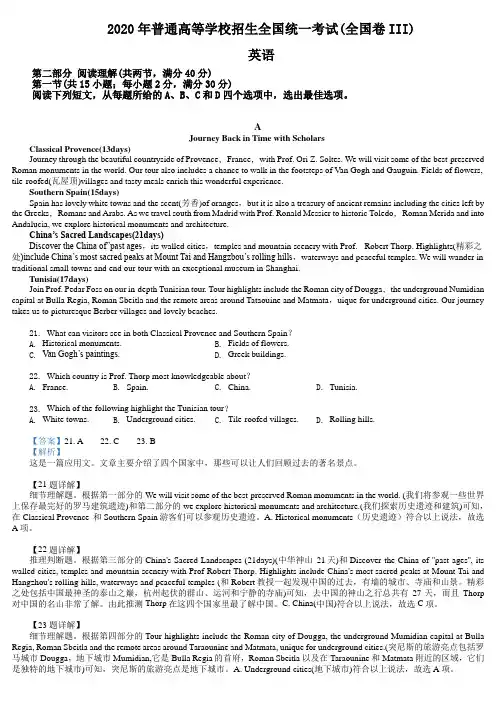
A.Historical monuments.B.Fields of flowers.
C.Van Gogh’s paintings.D.Greek buildings.
【23题详解】
细节理解题。根据第四部分的Tour highlights include the Roman city of Dougga, the underground Mumidian capital at Bulla Regia, Roman Sbeitla and the remote areas around Taraounine and Matmata, unique for underground cities.(突尼斯的旅游亮点包括罗马城市Dougga,地下城市Mumidian,它是Bulla Regia的首府,Roman Sbeitla以及在Taraounine和Matmata附近的区域,它们是独特的地下城市)可知,突尼斯的旅游亮点是地下城市。A. Underground cities(地下城市)符合以上说法,故选A项。
【22题详解】
推理判断题。根据第三部分的China's Sacred Landscapes (21days)(中华神山21天)和Discover the China of ''past ages'', its walled cities, temples and mountain scenery with Prof Robert Thorp. Highlights include China's most sacred peaks at Mount Tai and Hangzhou's rolling hills, waterways and peaceful temples (和Robert教授一起发现中国的过去,有墙的城市、寺庙和山景。精彩之处包括中国最神圣的泰山之巅,杭州起伏的群山、运河和宁静的寺庙)可知,去中国的神山之行总共有27天,而且Thorp对中国的名山非常了解。由此推测Thorp在这四个国家里最了解中国。C. China(中国)符合以上说法,故选C项。
2020年普通高等学校招生全国统一考试(英语全国卷III)(word附答案)

绝密★启用前2020年普通高等学校招生全国统一考试(全国卷III)英语注意事项:1. 答卷前,考生务必将自己的姓名、准考证号填写在答题卡和试卷指定位置上。
2. 回答选择题时,选出每小题答案后,用铅笔把答题卡上对应题目的答案标号涂黑。
如需改动,用橡皮擦干净后,再选涂其他答案标号。
回答非选择题时,将答案写在答题卡上,写在本试卷上无效。
3. 考试结束后,将本试卷和答题卡一并交回。
第一部分听力(共两节,满分30分)做题时,先将答案标在试卷上。
录音内容结束后,你将有两分钟的时间将试卷上的答案转涂到答题卡上。
第一节(共5小题;每小题1.5分,满分7.5分)听下面5段对话。
每段对话后有一个小题,从题中所给的A、B、C三个选项中选出最佳选项。
听完每段对话后,你都有10秒钟的时间来回答有关小题和阅读下一小题。
每段对话仅读一遍。
例:How much is the shirt?A. £19.15.B. £9.18.C. £9.15.答案是C。
1. Where does the conversation probably take place?A. In a supermarket.B. In the post office.C. In the street.2. What did Carl do?A. He designed a medal.B. He fixed a TV set.C. He took a test.3. What does the man do?A. He’s a tailor.B. He’s a waiter.C. He’s a shop assistant.4. When will the flight arrive?A. At 18:20.B. At 18:35.C. At 18:50.5. How can the man improve his article?A. By deleting unnecessary words.B. By adding a couple of points.C. By correcting grammar mistakes.第二节(共15小题;每小题1.5分,满分22.5分)听下面5段对话或独白。
2020年统一考试(全国卷III)高考英语试题及答案
2020年普通高等学校招生全国统一考试(全国卷III)英语第一部分听力(共两节,满分30分)做题时,先将答案标在试卷上。
录音内容结束后,你将有两分钟的时间将试卷上的答案转涂到答题卡上。
第一节(共5小题;每小题1.5分,满分7.5分)听下面5段对话。
每段对话后有一个小题,从题中所给的A、B、C三个选项中选出最佳选项。
听完每段对话后,你都有10秒钟的时间来回答有关小题和阅读下一小题。
每段对话仅读一遍。
例:How much is the shirt?A. £19.15.B. £9.18.C. £9.15.答案是C。
1. Where does the conversation probably take place?A. In a supermarket.B. In the post office.C. In the street.2. What did Carl do?A. He designed a medal.B. He fixed a TV set.C. He took a test.3. What does the man do?A. He’s a tailor.B. He’s a waiter.C. He’s a shop assistant.4. When will the flight arrive?A. At 18:20.B. At 18:35.C. At 18:50.5. How can the man improve his article?A. By deleting unnecessary words.B. By adding a couple of points.C. By correcting grammar mistakes.第二节(共15小题;每小题1.5分,满分22.5分)听下面5段对话或独白。
每段对话或独白后有几个小题,从题中所给的A、B、C三个选项中选出最佳选项。
2020年高考全国卷Ⅲ英语(含答案)
2020年高考全国卷Ⅲ英语(含答案)-CAL-FENGHAI-(2020YEAR-YICAI)_JINGBIAN绝密★启用前2020年普通高等学校招生全国统一考试(全国卷III)英语注意事项:1. 答卷前,考生务必将自己的姓名、准考证号填写在答题卡和试卷指定位置上。
2. 回答选择题时,选出每小题答案后,用铅笔把答题卡上对应题目的答案标号涂黑。
如需改动,用橡皮擦干净后,再选涂其他答案标号。
回答非选择题时,将答案写在答题卡上,写在本试卷上无效。
3. 考试结束后,将本试卷和答题卡一并交回。
第一部分听力(共两节,满分30分)做题时,先将答案标在试卷上。
录音内容结束后,你将有两分钟的时间将试卷上的答案转涂到答题卡上。
第一节(共5小题;每小题1.5分,满分7.5分)听下面5段对话。
每段对话后有一个小题,从题中所给的A、B、C三个选项中选出最佳选项。
听完每段对话后,你都有10秒钟的时间来回答有关小题和阅读下一小题。
每段对话仅读一遍。
例:How much is the shirtA. £19.15.B. £9.18.C. £9.15.答案是C。
1. Where does the conversation probably take place?A. In a supermarket.B. In the post office.C. In the street.2. What did Carl do?A. He designed a medal.B. He fixed a TV set.C. He took a test.3. What does the man do?A. He’s a tailor.B. He’s a waiter.C. He’s ashop assistant.4. When will the flight arrive?A. At 18:20.B. At 18:35.C. At18:50.5. How can the man improve his article?A. By deleting unnecessary words.B. By adding a couple of points.C. By correcting grammar mistakes.第二节(共15小题;每小题1.5分,满分22.5分)听下面5段对话或独白。
2020年高考英语 全国卷 Ⅲ
绝密★启用前已校对好2020年普通高等学校招生全国统一考试全国卷Ⅲ英语注意事项:1. 答卷前,考生务必将自己的姓名、准考证号填写在答题卡上。
2.回答选择题时,选出每小题答案后,用铅笔把答题卡上对应题目的答案标号涂黑。
如需改动,用橡皮擦干净后,再选涂其他答案标号。
回答非选择题时,将答案写在答题卡上,写在本试卷上无效。
3.考试结束后,将本试卷和答题卡一并交回。
第一部分听力(共两节,满分30分)做题时,先将答案标在试卷上。
录音内容结束后,你将有两分钟的时间将试卷上的答案转涂到答题卡上。
第一节(共5小题:每小题1.5分,满分7.5分)听下面5段对话。
每段对话后有一个小题,从题中所给的A、B、c三个选项中选出最佳选项,并标在试卷的相应位置。
听完每段对话后,你都有10 秒钟的时间来回答有关小题和阅读下一小题。
每段对话仅读一遍。
例: How much is the shirt?A. £19.15.B. £9.18.C. £9.15.答案是C.1. Where does the conversation probably take place?A. In a supermarket.B. In the post office.C. In the street.2. What did Carl do?A. He designed a medal.B. He fixed a TV set.C. He took a test.3. What does the man do?A. He's a tailor.B. He's a waiter.C. He's a shop assistant.4. When will the flight arrive?A. At 18:20.B. At 18:35.C. At 18:50.5. How can the man improve his article?A. By deleting unnecessary words.B. By adding a couple of points.C. By correcting grammar mistakes.第二节(共15小题:每小题1.5分,满分22.5分)听下面5段对话或独白。
2020年普通高等学校招生全国统一考试英语试题(上海卷,含答案)(3)
绝密★启用前2020年普通高等学校招生全国统一考试英语试题(上海卷,含答案)考生注意:1.考试时间120分钟, 试卷满分150分。
2.本考试设试卷和答题纸两部分。
试卷分为第I卷(第1-12页)和第II卷(第13页),全卷共13页。
所有答题必须涂(选择题)或写(非选择题)在答题纸上,做在试卷上一律不得分。
答题前,务必在答题纸上填写准考证号和姓名,并将核对后的条形码贴在指定位置上,在答题纸反而清楚地填写姓名。
第I卷(共103分)I. Listening ComprehensionSection ADirections: In Section A, you will hear ten short conversations between two speakers. At the end of each conversation, a question will be asked about what was said. The conversations and the questions will be spoken only once. After you hear a conversation and the question about it, read the four possible answers on your paper, and decide which one is the best answer to the question you have heard.1. A. It is satisfactory. B. It is luxurious.C. It is old-fashioned.D. It is disappointing.2. A. On August 5th. B. On August 6th. C. On August 7th. D. On August 8th.3. A. A waiter. B. A butcher. C. A porter. D. A farmer.4. A. In a theatre. B. In a library. C. In a booking office. D. In a furniture store.5. A. She expected to a better show. B. She could hardly find her seat.C. She wasn’t interested in the show.D. She didn’t get a favourable seat.6. A. The woman often eats out for breakfast. B. The cafeteria serves good breakfast.C. The woman doesn’t have breakfast.D. The cafeteria doesn’t serve breakfast.7. A. Selling cucumbers. B. Planting vegetables. C. Cooking a meal. D. Picking tomatoes.8. A. The man should work hard. B. The man should turn down the job offer.C. The man may have another chance.D. The man can apply for the job again.9. A. It is a hot and smoggy day. B. There is a traffic jam on King Street.C. A vehicle is polluting the air.D. The man is reading a report online.10. A. Its ending is not good enough. B. Its special effects are not satisfying.C. It deserves an award.D. It is good except for the scary part. Section BDirections: In Section B, you will hear two short passages, and you will be asked three questions on each of the passages. The passages will be read twice, but the questions will be spoken only once. When you hear a question, read the four possible answers on your paper and decide which one would be the best answer to the question you have heard.Questions 11 through 13 are based on the following passage.11. A. $1. B. $2 C. $3 D. $ 52.12. A. Pay the bills first.B. Spend 2% of the salary on living expenses.C. Deposit $1000 every month.D. Put part of the money in a savings account.13. A. Methods of saving money.B. Saving money for family emergencies.C. The importance of saving money.D. Secrets of spending money wisely.Questions 14 through 16 are based on the following passage.14. A. Free education.B. A sum of money.C. Donations from a local newspaper.D. Gifts from many people.15. A. Let students in before school.B. Offer ice cream and coffee.C. Introduce a bank into the campus.D. Reduce the traffic jams around.16. A. It lacks positive news.B. It should grow into a big city.C. It is a place worth living in.D. It remains peaceful and quiet.Section CDirections: In section C, you will hear two longer conversations. The conversations will be read twice. After you hear each conversation, you are required to fill in the numbered blanks with the information you have heard. Write your answers on your answer sheet.Blanks 17 through 20 are based on the following conversation.Complete the form. Write ONE WORD for each answer.Class Diary (June 13-19)Blank 21 through 24 are based on the following conversation.Complete the form. Write NO MORE THAN THREE WORDS for each answer.II. Grammar and VocabularySection ADirections: After reading the passages below, fill in the blanks to make the passages coherent and grammatically correct. For the blanks with a given word, fill in each blank with the proper form. of the given word; for the otherblanks, use one word that best fits each blank.(A)Bags of LoveLast year, I was assigned to work at an office near my mother’s house, so I stayed with her for a month. During that time, I helped out with the housework and contributed to the groceries.After less than a week, I started noticing that the groceries were running out pretty quickly —we were always suddenly out of something.(25)_______(wonder) how my mum could consume them so quickly, I began observing her daily routine for two weeks. To my surprise, I found that she would pack a paper bag full of canned goods and head out every morning at about nine. Eventually, I decided to follow her and (26)_______ happened truly amazed me. She was taking the food to the refugee camp, in (27)______ she distributed it to children.I asked around and found out that my mum was very well known in the area. The kids were very friendly with her and even looked up to her as if she were their own mother. Then it hit me —shy would she mot want to tell me about what she (28)_____(do)? Was she worried about how I would react or that I would stop (29)_____(buy) the groceries if I found out?When she got home, I told her about my discovery. (30)_____ she could react,I gave her a big hug and told her she didn’t need to keep it a secret(31)______ me. She told me that some of the children lived with an older lady in a shelter while others slept on the streets. For years, my mum has been helping out by giving them whatever food she could spare. I was so impressed by (32)_____ selfless she was.(B)Stress: Good or Bad?Stress used to be an almost unknown word, but now that we are used to talking about it, I have found that people are beginning to get stressed about being stressed.In recent years, stress(33)______(regard) as a cause of a whole range of medical problems, from high blood pressure to mental illness. But like so many other things, it is only too much stress(34)______ does you harm. It is time you considered that if there were no stress in your life, you would achieve a little. If you are stuck at home with no stress, then your level of performance will be low. Up to a certain point, the more stress you are under, the (35)_____(good) your performance will be. Beyond a certain point, though , further stress will only lead to exhaustion, illness and finally a breakdown. You can tell when you are over the top and on the downward slope, by asking yourself (36)_______ number of questions. Do you, for instance, feel that too much is being expected of (37)______, and yet find it impossible to say no? Do you find yourself getting impatient of (38) _____(annoy) with people over unimportant things?... If the answer to all those questions is yes, you had better(39)______(control ) your stress, as you probably are under more stress than is good for you.To some extent you can control the amount of stress in your life. Doctors have worked out a chart showing how much stress is involved in various events. Getting married is 50, pregnancy 40, moving house 20, Christmas 12,etc. If the total stress in your life is over 150, you are twice as likely (40)_______ (get )ill.Section BDirections: Complete the following passage by using the words in the box. Each word can only be used once. Note that there is one word more than you need.Golden Rules of Good DesignWhat makes good design? Over the years, designers and artists have been trying to 41 the essentials of good design. They have found that some sayings can help people understand the ideas of good design. There are four as follows.Less is more. This saying is associated with the German-born architect Mies van der Rohe. In his Modernist view, beauty lies in simplicity and elegance, and the aim of the designer is to create solutions to problems through the most efficient means. Design should avoid unnecessary 42 More is not a bore. The American-born architect Robert Venturi concluded thatif simplicity is done badly, the result is 43 design. Post-Modernist designers began to 44 with decoration and color again. Product design was heavily influenced by this view and can be seen in kitchen 45 such as ovens and kettles.Fitness for purpose. Successful product design takes into consideration a product’s function, purpose, shape, form, color, and so on. The most important result for the user is that the product does what is 46 . For example, think of a(n) 47 desk lamp. It needs to be constructed from materials that will stand the heat of the lamp and regular adjustments by the user. It also needs to be stable. Most importantly, it needs to 48 light where it is needed.From follows emotion. This phrase is associated with the German designer Hartmut Esslinger. He believes design must take into 49 the sensoryside of our nature—sight, smell, touch and taste. These are as important as rational(理性的). When choosing everyday products such as toothpaste, we appreciate a cool-looking device that allows us to easily 50 the toothpaste onto our brush.III. Reading ComprehensionSection ADirections: For each blank in the following passage there are four words or phrases marked A, B, C and D. Fill in each blank with the word or phrase that best fits the context.In the 1960s, Douglas McGregor, one of the key thinkers in the art of management, developed the mow famous Theory X and Theory Y. Theory X is the idea that people instinctively 51 work and will do anything to avoid it. Theory Y is the view that everyone has the potential to find satisfaction in work.In any case, despite so much evidence to the 52 , many managers still agree to Theory X. They believe, 53 , that their employees need constant supervision if they are to work effectively, or that decisions must be imposed from 54 without consultation. This, of course, makes for authoritarian (专制的) managers.Different cultures have different ways of 55 people. Unlike authoritarian management, some cultures, particularly in Asia, are well known for the consultative nature of decision-making—all members of the department or work group are asked to 56 to this process. This is management by the collective opinion. Many western companies have tried to imitate such Asian ways of doing things, which are based on general 57 . Some experts say that women will become more effective managers than men because they have the power to reach common goals in a way that traditional 58 managerscannot.A recent trend has been to encourage employees to use their own initiative, to make decisions on their own without 59 managers first. This empowerment (授权) has been part of the trend towards downsizing: 60 the number of management layers in companies. After de-layering in this way, a company may be 61 with just a top level of senior managers, front-line managers and employees with direct contact with the public. Empowerment takes the idea of delegation (委托) much further than has 62 been the case. Empowerment and delegation mean new forms of management control to 63 that the overall business plan is being followed, and that operations become more profitable under the new organization, rather than less.Another trend is off-site or 64 management, where teams of people linked by e-mail and the Internet work on projects from their own houses. Project managers evaluate the 65of the team members in terms of what they produce for projects, rather than the amount of time they spend on them.51. A. desire B. seek C. lose D.dislike52. A. contrary B. expectation C. degree D. extreme53. A. vice versa B. for example C. however D. otherwise54. A. outside B. inside C. below D. above55. A. replacing B. assessing C. managing D. encouraging56. A. refer B. contribute C. object D. apply57. A. agreement B. practice C. election D. impression58. A. bossy B. experienced C. western D. male59. A. asking B. training C. warning D. firing60. A. doubling B. maintaining C. reducing D. estimating61. A. honoured B. left C. crowded D. compared62. A. economically B. traditionally C. inadequately D. occasionally63. A. deny B. admit C. assume D. ensure64. A. virtual B. ineffective C. day-to-day D. on-the-scene65. A. opinion B. risk C. performance D. attractivenessSection BDirection:Read the following three passages. Each passage is followed by several questions or unfinished sattments. For each of them there are four choices markedA, B, C and D. Choose the one that fits best according to the information given in the passage you have just read.(A)One early morning, I went into the living room to find my mother reading a thick book called Best Loved Poems to Read Again and Again. My interest was aroused only by the fact that the word “Poems” appeared in big, hot pink letters.“Is it good?” I asked her.“Yeah,” she answered. “There’s one I really like and you’ll like it, too.” I leaned forward.“‘Patty Poem,’” she read the title. Who is Patty? I wondered. The poem began:She never puts her toys away,Just leaves them scattered①where they lay,…①散乱的The poem was just three short sections. The final one came quickly:When she grows and gathers poise②, ②稳重I’ll miss her harum-scarum③ noise, ③莽撞的And look in vain④ for scattered toys. ④徒劳地And I’ll be sad.A terrible sorrow washed over me. Whoever Patty was, she was a mean girl. Then, the shock.“It’s you, honey,” My mother said sadly.To my mother, the poem revealed a parent’s affection when her child grows up and leaves. To me, the “she”in the poem was horror. It was my mama who would be sad. It was so terrible I burst out crying.“What’s wrong?” my mother asked.“Oh Mama,” I cried. “I don’t want to grow up ever!”She smiled. “Honey, it’s okay. You’re not growing up anytime soon. And when you do, I’ll still love you, okay?”“Okay,”I was still weeping. My panic has gone. But I could not help thinking about that silly poem. After what seemed like a safe amount of time, I read the poem again and was confused. It all fit so well together, like a puzzle. The language was simple, so simple I could plainly understand its meaning, yet it was still beautiful. I was now fascinated by the idea of poetry, wordsthat had the power to make or break a person’s world.I have since fallen in love with other poems, but “Patty Poem” remains my poem. After all, “Patty Poem” gave me my love for poetry not because it was the poem that lifted my spirits, but because it was the one that hurt me the most.66. Why was the writer attracted by the book Best Loved Poems to Read Again and Again?A. It was a thick enough book.B. Something on its cover caught her eye.C. Her mother was reading it with interest.D. It has a meaningful title.67. After her mother read the poem to her, the writer felt ______ at first.A. sadB. excitedC. horrifiedD. confused68. The writer’s mother liked to read “Patty Poem”probably because______.A. it reflected her own childhoodB. it was written in simple languageC. it was composed by a famous poetD. it gave her a hint of what would happen69. It can be concluded from the passage that“Patty Poem”leads the writer to _______.A. discover the power of poetryB. recognize her love for puzzlesC. find her eagerness to grow upD. experience great homesickness(B)Is there link between humans and climate change or not? This question was first studied in the early 1900s. Since then, many scientists have thoughtthat our actions do make a difference. In 1997, the Kyoto Protocol explained our role in the Earth’s ch anging atmosphere and set international limits for gas emissions(排放) from 2020 to 2020. Some countries have decided to continue these reductions until 2020. More recently, the Paris Agreement, stuck by nearly 200 countries, also aims to limit global warming. But just now how much warmer it will get depends on how deeply countries cut carbon emissions.3.5℃This is how much temperatures would rise by 2100 even ifnations live up to the initial Paris promises to reduce carbonemissions; this rise could still put coastal cities underwater and drive over half of all species to extinction.2℃To meet this minimum goal, the Agreement requires countriesto tighten emissions targets every five years. Even thisincrease could sink some islands, worse drought(干旱) anddrive a decline of up to a third in the number of species.1.5℃This is the most ambitious goal for temperature rise set bythe Paris Agreement, after a push by low-lying island nationslike Kiribati, which say limiting temperature rise to 1.5℃could save them from sinking.0.8℃This is how much temperatures have risen since the industrial age began, putting us 40% of the way to the 2℃ point.0℃The baseline here is average global temperature before the start of the industrial age.70. It can be concluded from paragraph 1 that _______.A. the problem of global warming will have been quite solved by 2020B. gas emissions have been effectively reduced in developed countriesC. the Paris Agreements is more influential than the Kyoto ProtocolD. humans have made continuous efforts to slow down global warming71. If nations could only keep the initial promises of the Paris Agreement, what would happen by the year 2100?A. The human population would increase by one third.B. Little over 50% of all species would still exist.C. Nations would not need to tighten their emissions targets.D. The Agreement’s minimum goal would not be reached.72. If those island nations not far above sea level are to survive, the maximum temperature rise, since the start of the industrial age, should be_______.A. 0.8℃B. 1.5℃C. 2℃D. 3.5℃(C)Enough “meaningless drivel”. That’s the message from a group of members of the UK government who have been examining how social media firms like LinkedIn gather and use social media data.The House of Commons Science and Technology Committee’s report, released last week, has blamed firms for making people sign up to long incomprehensible legal contracts and calls for an international standard or kitemark (认证标记) to identify sites that have clear terms and conditions.“The term and conditions statement that we all carelessly agree to is meaningless drivel to anyone,” says Andrew Miller, the chair of the committee. Instead, he says, firms should provide a plain-English version of their terms. The simplified version would be checked by a third party and awarded a kitemark if it is an accurate reflection of the original.It is not yet clear who would administer the scheme, but the UK government is looking at introducing it on a voluntary basis. “we need to think through how we m ake that work in practice,” says Miller.Would we pay any more attention to a kitemark? “I think if you went and did the survey, people would like to think they would,” says Nigel Shadbolt at the University of Southampton, UK, who studies open data. “We do know people worry a lot about the inappropriate use of their information.” But what would happen in practice is another matter, he says.Other organisations such as banks ask customers to sign long contracts they may not read or understand, but Miller believes social media requires special attention because it is so new. “We still don’t know how significant the long-term impact is going to be of unwise things that kids put on social media that come back and bite them in 20 years’ time,” he says.Shadbolt, who gave evidence to the committee, says the probl em is that we don’t know how companies will use our data be cause their business models and uses of data are still evolvin g. Large collections of personal information have become valuabl e only recently, he says.The shock and anger when a social media firm does something with data that people don’t expect, even if users have apparently permission, show that the current situation isn’t working. If properly administered, a kitemark on terms and conditions could help people know what exactly they are signing up to. Although they would still have to actually read them.73. What does the phrase “ meaningless drivel” in paragraphs 1 and 3 refer to?A. Legal contracts that social media firms make people sign up to.B. Warnings from the UK government against unsafe websites.C. Guidelines on how to use social media websites properly.D. Insignificant data collected by social media firms.74. It can be inferred from the passage that Nigel Shadbolt doubts whether _______.A. social media firms would conduct a survey on the kitemark schemeB. people would pay as much attention to a kitemark as they thinkC. a kitemark scheme would be workable on a nationwide scaleD. the kitemark would help companies develop their business models75. Andrew Miller thinks social media needs more attention than banks mainly because _______.A. their users consist largely of kids under 20 years oldB. the language in their contracts is usually harder to understandC. the information they collected could become more valuable in futureD. it remains unknown how users’ data will be taken advantage of76. The writer advises users of social media to _______.A. think carefully before posting anything onto such websitesB. read the terms and conditions even if there is a kitemarkC. take no further action if they can find a kitemarkD. avoid providing too much personal information77. Which of the following is the best title of the passage?A. Say no to social media?B. New security rules in operation?C. Accept without reading?D. Administration matters!Section CDirections: Read the passage carefully. Then answer the questions or complete the statements in the fewest possible words.Walking will be banned on escalators as part of a trail designed ti reduce congestion(拥堵) at some of the country’s busiest stations.In the first move of its kind, all travelers will be forced to stand on both sides of escalators on the London Underground as part of a plan to increase capacity(容量) at the height of the rush hour.A xix-month trial will be introduced at Holborn station from mid-April, eliminating the rule of standing on the right and walking on the left. The move, imitating a similar structure in Far eastern cities such as Hong Kong, is designed to increase the number of people using long escalators at the busiest times . it could be expanded across the Tube network in coming years. According to London Underground, only 40 percent of travelers walk the full length of long escalators, leaving the majority at the bottom as they waitto get on to the “standing “side.A three-week trial at Holborn last year found that the number of people using escalators at any time of could be raised by almost a third. Peter McNaught, operations director at London Underground, said: “It may not seem right that you can go quicker by standing still, but our experiments at Holborn have proved that it can be true. This new six-month trial will help us find out if we can influence customers to stand on both sides in the long term.”Holborn has one of the longest sets of escalators on the Underground network at 23.4 high. Tube bosses claim that capacity was limited because so few people wanted to walk up—meaning only one side was used at all times. Research has shown that it is more effective use of escalators over 18.5 to ban walking.The previous trial found that escalators at the station normally carried 2,500 people between 8:30am and 9:30am on a typical day, rising to 3,250 during the researching period.In the new trial, which will be launched from April 18, one of three “up”escalators will be standing only, with a second banning walking at peak times.A third will remain a mix of walking and standing.(Note: Answering the questions the questions or complete the statements in NO MORE THAN TEN WORDS.)78. What is the existing problem with standing on the right and walking on the left?79. What did last year’s three-week trial at Holborn station prove?80.The research suggests that walking should be forbidden on escalators that are at least _________ in height.81. In the new trail, in addition to one escalator banning walking in rush hours, the other “up” escalators will be used for_________________.第II卷(共47分)I.TranslationDirections: Translate the following sentences into English, using the words given in the brackets.1.我真希望自己的文章有朝一日能见报。