
九年级英语上册知识点归纳Unit 4(仁爱版英语)
九年级英语上册知识点归纳Unit 4(仁爱版英语)九年级英语上册知识点归纳Unit4轮流(做某事)11ndubt无疑地12asellas除……的之外,也13frinstane/exaple例如14rn做……(方面)的工作1dependn/upn依靠,依赖16turnn打开17turnff关掉18turnup开大19turndn关小20lin用鼠标点击21lfrardtdingsth期待做某事二、重点句型:1Nbigplansarebeingadetsendupresatellitesandevenbuil daspaestatin现在中国正在计划发射更多的卫星,甚至建造一个空间站。
句子“arebeingade”是现在进行时的被动语态,结构“bebeing+过去分词”。
主动句中的宾补如果是不带t的不定式时,变成被动句后,成为主补的不定式必须带t,常见跟不带t的复合宾语的动词有see、feel、hear、ae 等。
2I’vedbhatangLieidid我被杨利伟所做的事感动了。
hatangLieidid是介词b的宾语从句,意为“杨利伟所做的事”bevedb为……而感动如:Thestudentsarevedbtheldan’sstr同学们为那位老人的故事而感动。
3Generallspeaing,eareingdhealthn一般来说,我们现在的健康状况良好。
generallspeaing“一般来说、大体上、大概”ingd/badhealth处于好(不好)的身体状况。
如:Hehasald,heisalasinbadhealth他感冒了,他的身体状况总是不好。
4euldn’thelplingattheearthagainandagain 我们忍不住再三地看着地球。
an’t/uldn’thelpdingsth忍不住做某事,不能停止做某事。
如:Ian’thelpring我忍不住哭了。
againandagain一再,屡次,如:Theteaherhastldhiagainandagain老师已屡次和他讲过了。
IasabletfallasleepassnasIgtintthesleepingbagetturns thavearest一进入睡袋我就睡着了。
我们轮流休息。
taeturnst轮流(做某事)。
TheBrnstaeturnstlafterthebab 布朗一家轮流照看这个婴儿。
6Ithasprvedthathinahasadegreatprgressindevelpingits spaeindustr这证明了中国航天业的发展已取得了巨大的进步。
Ithasprvedthat…这证明了……7Thereisndubtthatputersareidelusedbrersinbusinessan dtehnlg毫无疑问,电脑被商业,科技工作者广泛地应用Thereisndubtthat…译为“毫无疑问”如:Thereisndubtthateshuldprtettheenvirnent毫无疑问我们应该保护环境。
8putershaveadetherldsaller,liea “village”电脑使得世界变小了,就像一个“村庄”。
ae+宾语+形容词“使……怎样”如:e’lltrurbesttaeuruntrreandrebeautiful我们将尽全力使我产的国家越来越美丽三、日常交际用语:ngratulatins!ThansfrurintrdutinPleasedteetu=NieteetuIt’sanhnrtintervieunhatduthinfShenZhuVI?=hatareurthugh tsabutShenZhuVI?四、重点语法:宾语补足语:宾语补足语用来补充说明宾语,与宾语一起构成复合宾语。
可作宾语补足语的有名词、形容词、副词、介词和动词不定式等。
(一)、名词、形容词、副词、介词短语作宾语补足语。
如:1eallhii (名词)我们叫他吉姆。
2eusteepurshlleaneverda(形容词)我们必须每天保持校园清洁。
3allhiin,please(副词)请叫他进来。
4Leaveitnthedes(介词短语)把它留在桌上。
(二)、动词不定式作宾语补足语可分为三种情况:1跟带t 的不定式作宾语补足语。
常见的这类动词有:as,tell,get,teah,ant,invite,lie,all,ish,enurage等。
如:Tellanetsingusasng叫简给我们唱支歌。
2跟不带t的不定式作宾语补足语。
常见的这类动词有“一感(feel)、二听(listent,hear),三让(ae,let,have),四看(lat,see,ath,ntie)如:Let’shavearest让我们休息一会儿。
但这种结构变成被动语态时,t必须加上。
如:Heasseentleavetherithabinhishand有人见他手拿着一本书离开这个房间。
3跟带t或不带t的动词不定式作宾语补足语。
这类动词只有help。
如:anuhelpeashlthes?你能帮我洗衣服吗?(三)、分词作宾语补足语可分为两种情况。
1现在分词作宾语补足语,经常表示正在发生的动作。
可跟这类补足语的动词有:see,ath,hear等。
如:Ihearsebdsinginginthenextr我听见有人在隔壁唱歌。
2过去介词作宾语补足语,经常表示被动。
如:uneedthaveurhairut你需要理发了。
Tpi2一、重点词汇:1beusedfr+ving被用做……2etrue实现3It’ssaidthat据说4during/inne’slife某人一生bennas以……(身份)而著名6n/safrertain确切知道/肯定地说7allthetie一直、总是8nlnger=nt…anlnger不再9aslngas只要10asfaras 就……,尽……11aeagreatntributin对…作出巨大贡献12therestfthetie在其余地时间里13atantie在任何时候二、重点句型:1BeauseI’ntalledtplaputergaes因为我不可以玩电脑游戏。
all“允许、准许”的意思。
常用于以下几种形式:all+n/prep如:ean’tallsuhathing我们不容许这种事情发生。
allsbtdsth允许某人做某事如:Shealledetgfishing她允许我去钓鱼。
all+dingsth允许做某事如:edn’tallsinginthereading-r我们不允许在阅览室吸烟。
bealledtdsth如:被允许做某事Thestudentsarealledtplagaesntheplagrundaftershl放学后学生们被准许在操场上做游戏。
2HdusathisinEnglish?这用英语怎么说?其意思与hat’sthisinEnglish相同。
3It’sadefrd它用木材做的。
beadein在……地方制造,后接表示地点的名词。
beadef用……制造的,表示原材料未经化学变化,仍可看得出原材料。
beadefr用……制造的,表示原材料经过化学变化,已看不出其原样。
beadeb由(被)……(人)制作,后接表示人的名词或代词。
beadeint(某物)被制成……beadeupf由……组成如:TheTVsetisadeinapan 这台电视机是日本生产的。
Thesehusesareadefstnes这些房子是由石头建造的。
Paperisadefrd纸是木头造的。
asthisaeadeburther?这蛋糕是你妈妈做的吗?etalanbeadeintallindsfthings金属可以制成各种各样的物品。
Theedialteaisadeupftendtrs这支医疗队由10位大夫组成。
4It’susedfrhelpingustiprveurEnglish它用来帮助我们提高英语水平。
beusedfr+vingbeusedtd(被)用来做……强调用途或作用beusedas(被)作为……而用,强调被当作工具或手段来用。
beusedb被……使用,b后跟人/物,强调使用者。
如:Pensareusedfrriting钢笔被用来写字。
disusedtaepaper木材被用来造纸。
Englishisusedasafreignlanguageinhina英语在中国被当作外语使用。
RerdersareftenusedbEnglishteahers英语老师经常使用录音机。
Peplearesurprisedattherapiddevelpentfrbts人们为机器人的飞速发展感到惊讶。
句子中besurprisedat…是一个系表结构,表示“对……感到惊讶”。
而besurprisedb…是一个被动语态形式,表示“被……所惊讶”。
如:Iasurprisedatu我对你的举动感到诧异。
Theanagerassurprisedbhathesantheputer那位经理被眼前出现在电脑屏幕上的东西所惊讶。
6Theillnlngeranttbeurservants,buturasters它们将不再愿意做我们的人,而要做我们的主人。
nlnger(通常在动词前),nt…anlnger;nt…anre(用于非正式文体中)都可表示“(过去曾……)现在不再……”如:ShenlngerliveshereShedesn’tlivehereanlnger她不在这儿住了。
(过去她曾住这儿)7Thisethdredellatnightaslngastheeatherasgdandthesta rsuldbeseen在夜间只要天气晴朗,能看见星星,这种方法就能很好地发挥作用。
rell有效aslngas只要三、日常交际用语:hat’sitadeffr?hen/hereasitade?Itasinventedin1879hatillu rfuturebelie?Ihpeurdreailletrue四、重点语法:1、一般过去时的被动语态谓语部分的基本形式是be的过去式as/ere+及物动词的过去分词。
如:henasitade?它是什么时候制造的?Itasadein1980它是1980年制造的。
henasthedigitalaerainvented?数码像机是什么时候发明的?Itasinventedin197它是197年发明的。
2、时间前所用介词的速记歌年月周前要用in,日子前面却不行。
遇到几号要用n,上午下午又是in。
要说某日上下午,用n换in才能行。
午夜黄昏须用at,黎明用它也不错。
at也用在时分前,说“差”可要用上t。
说“过”只可使用past,多说多练牢牢记,莫让岁月成蹉跎。
(完整版)仁爱英语九年级上册知识点归纳
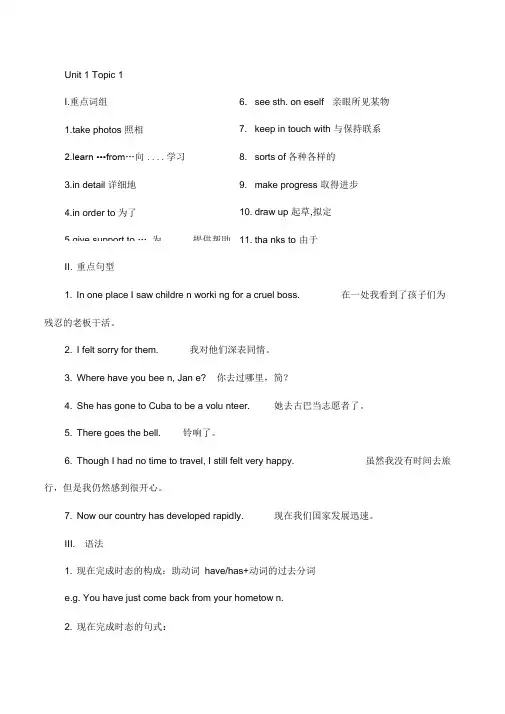
Unit 1 Topic 1 6. see sth. on eself 亲眼所见某物 7. keep in touch with 与 保持联系 8. sorts of 各种各样的 9. make progress 取得进步 10. draw up 起草,拟定11. tha nks to 由于 II. 重点句型1. In one place I saw childre n worki ng for a cruel boss. 在一处我看到了孩子们为残忍的老板干活。
2. I felt sorry for them.我对他们深表同情。
3. Where have you bee n, Jan e? 你去过哪里,简?4. She has gone to Cuba to be a volu nteer. 她去古巴当志愿者了。
5. There goes the bell.铃响了。
6. Though I had no time to travel, I still felt very happy. 虽然我没有时间去旅行,但是我仍然感到很开心。
7. Now our country has developed rapidly. 现在我们国家发展迅速。
III. 语法1. 现在完成时态的构成:助动词 have/has+动词的过去分词 e.g. You have just come back from your hometow n.2. 现在完成时态的句式:I.重点词组 1.take photos 照相2.learn •••from …向 .... 学习3.in detail 详细地4.in order to 为了5.give support to … 为 ...... 提供帮助e.g. (1) I have been to Mount Huang with my parents.(2) I haven ' t seen him for a long time.⑶ Where have you bee n?(4) ------- Have you ever cleaned a room? ------------ Y es, I have. / No, I haven ' t. 3. have/ has bee n 与 have/has gone 的区另 Shave/has bee n to sp. 表示曾经至U 过某地 have/has gone to sp. 表示已经去了某地e.g. (1) I have bee n to Mount Hua ng with my pare nts. (2) She has gone to CubaII. 重点句型1. Have you fou nd him yet? 你已经找到他了吗?2. ---- 1 really hate to go shopp in g.我的确讨厌购物。
九年级英语上册unit知识点仁爱版
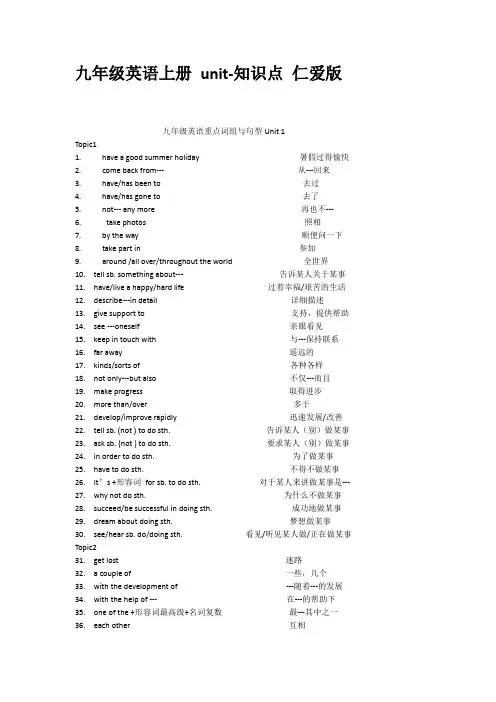
九年级英语上册unit-知识点仁爱版九年级英语重点词组与句型Unit 1Topic11. have a good summer holiday 暑假过得愉快2. come back from--- 从---回来3. have/has been to 去过4. have/has gone to 去了5. not--- any more 再也不---6. take photos 照相7. by the way 顺便问一下8. take part in 参加9. around /all over/throughout the world 全世界10. tell sb. something about--- 告诉某人关于某事11. have/live a happy/hard life 过着幸福/艰苦的生活12. describe---in detail 详细描述13. give support to 支持,提供帮助14. see ---oneself 亲眼看见15. keep in touch with 与---保持联系16. far away 遥远的17. kinds/sorts of 各种各样18. not only---but also 不仅---而且19. make progress 取得进步20. more than/over 多于21. develop/improve rapidly 迅速发展/改善22. tell sb. (not ) to do sth. 告诉某人(别)做某事23. ask sb. (not ) to do sth. 要求某人(别)做某事24. in order to do sth. 为了做某事25. have to do sth. 不得不做某事26. It’s +形容词for sb. to do sth. 对于某人来讲做某事是---27. why not do sth. 为什么不做某事28. succeed/be successful in doing sth. 成功地做某事29. dream about doing sth. 梦想做某事30. see/hear sb. do/doing sth. 看见/听见某人做/正在做某事Topic231. get lost 迷路32. a couple of 一些,几个33. with the development of ---随着---的发展34. with the help of --- 在---的帮助下35. one of the +形容词最高级+名词复数最---其中之一36. each other 互相37. call /ring sb.up 给某人打电话38. at least 至少39. sth. happen to sb. 某人发生某事40. What happened to sb.某人发生某事?41. take place 发生42. because of 因为,由于43. be strict with sb./in sth. 对某人/某事严格要求44. carry out 执行45. thousands/millions/hundreds of 成千上万/无数的/成百上千46. two thousand/million/hundred 两千/百万/百(具体数字后面不加s)47. half of--- 一半---48. two thirds 三分之二49. be short of 短缺50. so far 到目前为止51. be known/famous for 因为---而闻名52. be known/famous as 作为---而闻名53. thanks to 幸亏54. have a long way to go 有很长的路要走55. a town called --- 一个叫做---的镇56. fewer than/less than 少于57. place of interest 名胜古迹58. be interested in 对---感兴趣59. such as 例如60. look/smell/sound/feel/taste +形容词看/闻/听/摸/尝起来61. such a/an+形容词+sb./sth .如此---的人/物62. take sb. to sp 带某人去某地.63. keep up with 赶上64. What a/an + 形容词+sth./ How +形容词感叹句65. have a population of--- 有---人口66. What’s the population of---? ---有多少人口?67. want to do sth. 想要做某事68. hate to do sth 讨厌做某事.69. take measures to do sth. 采取措施做某事70. have(no) chance/time to do sth. 有机会/时间做某事71. used to do sth. 过去常常做某事72. be used to do sth. 被用来做某事73. be/get used to doing sth. 习惯做某事74. work well in doing sth. 在---方面起到显著作用75. have fun doing sth. 做某事很愉快Topic376. with the money 用这些钱77. so that 为了,以便于78. so---that--- 如此---以致于79. in fact/as a matter of fact 事实上80. come for a visit 来参观81. in need 在困难时82. decide on sth. 决定某事83. provide sth. for sb./provide sb. with sth. 为某人提供某物84. feel good about --- 对---有信心85. lend sth. to sb/lend sb. sth. 把某物借给某人86. borrow sth. from sb. 向某人借某物87. at the same time 同时88. talk on the phone 在电话中交谈89. take drugs 吸毒90. pay for 付款91. buy sth. for sb. 给某人买某物92. at home and abroad 在国内外93. send sb. to sp. 送某人去某地94. send for sb. 派人去请某人95. aim to do sth. 目的是做某事96. decide (not)to do sth. 决定(不)做某事97. finish doing 结束做某事98. How do you like---/What do you think of---? 你觉得---怎么样?99. sb.spend st.in doing sth=It takes sb.st. to do sth. 某人花费---时间做某事100. sb.spend some money on sth.=sb.pay some money for sth. 某人花费---钱买某物101. so/neither+be/助动词/情态动词+主语表示后者情况与前者一样/ 102. so +主语+/be/助动词/情态动词表示的确如此九年级英语重点词组与句型Unit 2Topic 11. smell/sound/feel/taste/look +形容词闻/听/感觉/尝/看起来……2.There be sb doing sth 有某人正在做某事3. do(great) harm to…对……有害=be harmful to/be bad for4. What/How about(doing) sth./Let’s do sth./Shall we do sth.?/Why not do sth./Why don’t you do sth. 提供建议5. pour…into…把……倒入……6. see/hear sb. doing/do sth. 看/听见某人正在/在做某事7. do sth useful to do sth=take measures to do sth. 采取措施做某事8. How long have you been like this?你像这样有多久了?(回答用since 或for 短语)9.make sb do sth 使某人做某事10.make noise 制造噪音11.what’s more 而且12.be in a good/bad mood 心情好/坏13.stand sth/doing 忍受某事/做某事14.manage to do sth 努力做某事15.write to sb 给某人写信16.had better do sth 最好做某事had better not do sth最好不要做某事17.not all 不是所有not every 不是每一个18.quite a few 相当多19. no better than 与……一样差,不比……好20. cause sb to do sth 导致某人做某事21. try to do sth. 努力做某事22. all sorts/kinds of 各种各样23. not only……but also 不仅……而且……24. as well 也(置于句末)25. in many ways 在许多方面;以许多方式26. It is reported/said that+从句据报道/据说Topic 227. as a result 因此28. leave sth. sp. 把某物遗忘在某地29. leave sth here and there 乱扔……30. walk on 踩踏31. care for 关心,照顾= take care of/ look after32. do everything sb can to do sth 尽某人最大努力做某事=try/do one's best to do sth33. even worse 更糟糕的是34. none of 代词(宾格)/名词没有……35. in the beginning 一开始36. better and better 越来越好37. day by day 一天天38. be in danger 处于危险中39. be in danger of 面临……的危险40. come to realize 逐渐意识到41. just now 现在,刚才(与一般过去时连用)42. stop/keep/prevent…from doing sth 防止……做某事43. need to do sth 需要做某事44. wash/blow away 冲走/吹走45.in public 在公共场合46. come into being 形成47. turn off/on/up/down 关掉/打开/调高/调低(声音)48. deal with=do with 处理解决49. take away 带走50. blow strongly 风刮得厉害51. walk down the street 在街上走52. change into 把……转换成58. protect the environment 保护环境64.remember/forget (not) to do sth. 记得/忘记(不)做某事65.be bad/good for 对……有害/有益67. refer to 提到/涉及68. have difficulty/trouble/problems doing sth. 有困难做某事69. take up 占据Topic 370. pick sth up 捡起某物71. How often 多久一次72.work for 为……工作73.be used for doing 某物被用于做某事74.take a shower 淋浴75. use sth to do sth用某物做某事76.It’s a pity that+从句很遗憾……77.encourage sb to do sth 鼓励某人做某事78.It’s kind of sb to do sth 某人做某事好79. be supposed to do sth 应该做某事80. I’d love to. 我乐意81. ought to do 应该做某事否定ought not to do( oughtn’t to do)82. instead of doing 而不是做某事83. on time 准时84. in time 及时85. There will be sth to do 有某事要去做86. make sure to do sth 确定做某事87. push…forward/ down 向前/下推……88. pull…up 向上拉……九年级英语上册unit3-4知识点仁爱版Unit 3 Topic 1贴在墙上stick sth on the wall 来看一看come and have a look为……做准备be ready for sth 准备做某事be ready to do sth迫不及待做某事can’t wait to do sth=can’t help doing sth.有机会做某事have a chance to do sth 练习做某事practice doing sth能够做某事be able to do sth 从现在起,开始from now on设法做某事try one’s best to do sth 对…满意be pleased with…be satisfied with和…相似be similar to 与…..一样be the same as 出差on business把…翻译成translate…into 整理包pack one’s bag进行(一次)长谈have a long conversation, have long conversations向…求助ask …for help 总的来说,通常in general =usually (毫不)费力做某事have (no) trouble/ difficulties (in)doing sth 偶尔once in a while作为母语as mother tongue /first language 第二语言second language外语foreign language 官方语言the official language把。
Unit4+Topic2+SectionA-Secti课件2022-2023学年仁爱版九年级英语上册

on soft screens.Schoolbags and pens _a_re__u_se_d____(use) at schools
now. But, computers _w_il_l _be__u_s_ed_(use) by teachers and students
in the future. Many spaceships _w_il_l _b_e_s_e_n_t _(send) into space. Some scientists believe that aliens _w_i_ll_b_e_f_o_un_d_(find) in outer
注意:be able to与can不能重叠使用。
1b. Listen to 1a,then answer the following questions.
1. When will the movie be shown? It will be shown tonight.
2. What’s the movie about? It is about life in space.
Unit 4 Amazing Science Topic 2 I’m excited about the things that
will be discovered in the future.
Section A
Many spaceships are sent into space by China.
2. I really admire them. admire v. 钦佩,羡慕,赞赏 admire sb. for sth. 钦佩/羡慕/赞赏 某人……
e.g. I admire you for your honesty.
仁爱版英语九年级上册:Unit 4 Topic 1. When was it invented 教
教学目标
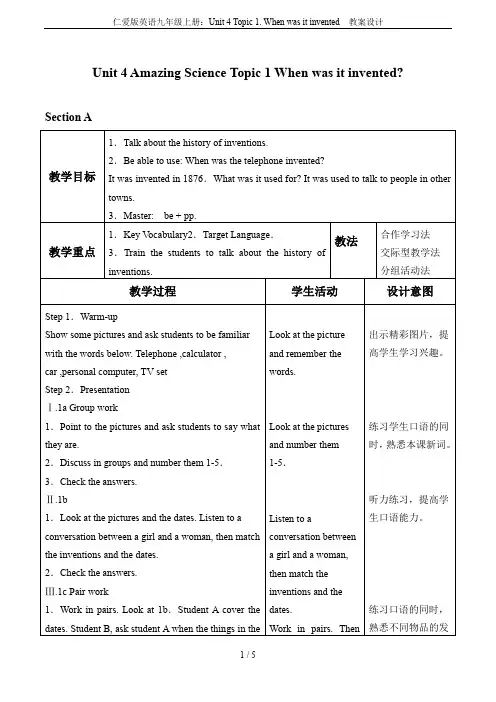
What are they used for? When was it invented? Who was it invented by?
教学重难点
1.Talk about the helpful inventions and
annoying inventions.
2.Guide the students to
2.Tellthe group what you choose and why, use these sentences.
I think the most helpful invention is…
I’d like to have a… because I could…
It’s used for…
I also want a… because it…
出示精彩图片,提高学生学习兴趣。
练习学生口语的同时,熟悉本课新词。
听力练习,提高学生口语能力。
练习口语的同时,熟悉不同物品的发明年代。
完成不同的听力任务,提高学生的口语能力,进一步理解不同物品的历史。
运用本课学习的句子创作对话,提高学生口语交际能力。
作业布置
Homework;1.Copy grammar twice.
discuss their opinions on the inventions.
教法
合作学习法
交际型教学法
分组活动法
教学过程
学生活动
设计意图
Step 1 Revision
Wat Showsome pictures about inventions such as computer, telephone, car, TV, calculator… Ask the students to practice speaking.
仁爱英语九年级上册各单元知识点归纳汇总

Unit 1 Topic 1 重点词组I. 照相1.take photos …向……学习from…2.learn 详细地3.in detail 为了4.in order to 为……提供帮助…5.give support to 亲眼所见某物 6.see sth. oneself 与……保持联系7.keep in touch with 各种各样的8.sorts of 取得进步9.make progress 拟定,起草10.draw up 由于11.thanks to 重点句型II. 在一处我看到了孩子们为1. In one place I saw children working for a cruel boss. 残忍的老板干活。
我对他们深表同情。
2. I felt sorry for them. ? 你去过哪里,简3. Where have you been, Jane? 她去古巴当志愿者了。
4. She has gone to Cuba to be a volunteer. 铃响了。
5. There goes the bell. 虽然我没有时间去旅6. Though I had no time to travel, I still felt very happy. 行,但是我仍然感到很开心。
现在我们国家发展迅速。
7. Now our country has developed rapidly. 语法III. 动词的过去分词have/has+现在完成时态的构成:助动词1. e.g. You have just come back from your hometown. :现在完成时态的句式2. e.g. (1) I have been to Mount Huang with my parents. t seen him for a long time. ’(2) I haven (3) Where have you been?——Have you ever cleaned a room? ——(4) t. ’Yes, I have. / No, I haven 的区别have/has gone 与3. have/ has been 表示已经去了某地 have/has goneto sp.表示曾经到过某地——have/has been to sp. 1e.g. (1) I have been to Mount Huang with my parents. (2) She has gone to Cuba to be a volunteer. Unit 1 Topic 2 重点词组I. 迷路1. get lost 彼此2. each other 至少3.at least 发生4take place 因为5because of 对某人严格要求6.be strict with sb. 实行7.carry out 缺乏8.be shortof 采取措施做某事9.take measures to do sth. …10.be known a s 作为……而著名…在……方面起作用11.work well in doing 一些12.a coupleof 跟上,赶上13keep up with 重点句型II. ? 你已经找到他了吗1. Have you found him yet? 我也如此。
仁爱版英语九年级上册Unit2-Unit4知识点归纳

仁爱版英语九年级上册Unit2-Unit4知识点归纳U2 Topic 2I. 重点词组1. as a result 结果2. here and there 到处3. in the beginning 一开始4. in danger 处于危险中5. cut down 砍倒6. change sth. into sth. 把……变成……7. prevent from 防止8. greenhouse effect 温室效应9. refer to 提到10.deal with 处理11.take up 占据12.cut off 中断II. 重点句型1. As we know, none of us likes pollution. 众所周知,没有人喜欢污染。
none与no one 的区别:a)none “全无”,既可指人也可指物,后常跟of 的短语; 作主语时,谓语动词既可用单数也可用复数;no one只指人,后不能跟of 的短语; 作主语时,谓语动词只用作单数。
如:He has read none of these books.(指物)这些书他一本都没看过。
None of my friends like/ likes drawing.(指人)我的朋友们没有一个喜欢画画。
No one is here.没有一个在这儿。
b)none回答how many/ much的问题;no one回答who的问题。
如:A: How many students come to school by taxi? B: None.有多少的学生搭出租车来上学?没有人。
A: How much water is there in the bottle? B: None.瓶子里有多少水?一点儿也没有。
A: Who is in the room? B: No one.谁在房中?没有人。
2、Trees can also stop the wind blowing the earth away.树木也能防风固土。
仁爱版英语九年级上册Unit 4 Topic 1. 《When was it invented》教学
仁爱版英语九年级上册Unit 4 Topic 1. 《When was it invented》教学设计一. 教材分析《仁爱版英语九年级上册Unit 4 Topic 1. 》是一篇介绍发明物及其发明时间的文章。
文章通过讲述各种发明的起源和发展,引导学生了解科技对人类生活的影响,并激发他们对科学和技术的兴趣。
本节课的主要内容是让学生掌握一般过去时的被动语态,并能够运用所学知识进行对话。
二. 学情分析九年级的学生已经具备了一定的英语基础,能够听懂并运用一般现在时和一般过去时的陈述句和疑问句。
但是,对于一般过去时的被动语态,学生可能还比较陌生,需要通过实例和练习进行巩固。
此外,学生可能对于一些科技发明的发展历程不太了解,需要在课堂上进行补充和拓展。
三. 教学目标1.知识目标:学生能够掌握一般过去时的被动语态,并能够运用所学知识进行对话。
2.能力目标:学生能够听懂、说出一般过去时的被动语态句子,并能够运用该语法知识描述发明物的发展历程。
3.情感目标:学生能够了解科技对人类生活的影响,激发他们对科学和技术的兴趣。
四. 教学重难点1.重点:学生能够掌握一般过去时的被动语态。
2.难点:学生能够运用一般过去时的被动语态进行对话。
五. 教学方法采用任务型教学法,通过情景设定、小组讨论、游戏活动等方法,激发学生的学习兴趣,培养学生的合作精神和语言运用能力。
六. 教学准备1.教师准备:准备好相关的科技发明资料,制作PPT。
2.学生准备:学生提前预习课文,了解文章内容。
七. 教学过程1.导入(5分钟)教师通过提问方式引导学生回顾一般过去时的疑问句和陈述句,为新课的学习做好铺垫。
2.呈现(10分钟)教师通过PPT展示各种科技发明,引导学生用一般过去时进行描述。
然后,教师呈现课文内容,让学生听录音并跟读。
3.操练(10分钟)教师设计一些情境,让学生运用一般过去时的被动语态进行对话。
例如,教师可以设定一个情境,让学生扮演记者采访科学家,询问某种发明的发明时间和发明过程。
Unit 4 Topic 3-Section C课文讲解-仁爱版英语九年级上册
With the help of computers, doctors can find diseases easily and solve other problems.
译文:在电脑的帮助下,医生能够轻而易举地发现疾病并解决其他问题。
with the help of… 在……帮助下 e.g. With the help of my classmates, my spoken English got
除了最后一个问题没答外,其余问题他都答了。
except后接名词、代词、动名词和动词原形,这时except=but; 但except后跟副词、介词短语时,不能用but代替。 e.g. The window is never open except in summer.
这扇窗户从来不开,除夏季外。 He did nothing except/ but clean the house. 他只是打扫了房子。
instead of 代替
The whole world is connected. The Internet is making the world smaller, like a village. 译文:整个世界都联系在一起。网络让地球变得更小,像个村子一样。
connect v. 连接
connection n. 关系,联系
except 除……之外(不再有) e.g. We all passed the exam except Tom.
我们都通过了考试,汤姆除外。(整体中……汤姆一人不及格) except前几乎总有all、any、every、no及其复合词等词。 e.g. He answered all the questions except the last one.
仁爱英语九年级上册语法精讲
1.现在完成时的用法:表示过去某一时间发生的动作或存在的状态,对现在仍有影响。
e.g. I have just posted the letter. 我刚把信邮寄了。
She has lost her watch. 她弄丢了手表。
2.现在完成时可以和不明确指出时间的状语连用,如already, yet,just,before, ever, lately, once等。
e.g. Have you heard from your friend lately?你最近收到你朋友的来信了吗?3.现在完成时也可以和包括现在在内的时间状语连用。
如this week, thismorning, today, thisyear等。
e.g. They have moved three times this year. 今年他们已经搬了三次家。
4.现在完成时不能和明确表示过去时间的状语连用。
如yesterday, last week, in 1999, two days ago,just now, when I came in等。
Unit 1-topic3现在完成时(Ⅲ)1.现在完成时表示从过去某一时刻延续到现在的动作或状态,常与for,since引导的状语连用。
for+一段时间,since+过去时间点或从句(从句的谓语动词用过去式)。
e.g. I have lived here for twenty years.我住在这里已有20年了。
We have built many factories since 1985.自1985年以来,我们建了许多工厂。
He has always helped me with my English since he came here.自从他到这里以后,他总是帮助我学习英语。
2.有的动词所表示的动作不是瞬间就可以完成的,要持续一段时间,这样的动词叫延续性动词。
不能延续下去的动词,叫非延续性动词或瞬间动词。
Unit 4 Topic 1-Section C课文讲解-仁爱版英语九年级上册
An invention may be a new product or a new way of doing things. Inventions come about in many ways. Most of the time, inventions happen because someone works to solve a problem. Sometimes inventions are the result of accidents.
An invention may be a new product or a new way of doing things. Inventions come about in many ways. Most of the time, inventions happen because someone works to solve a problem. Sometimes inventions are the result of accidents.
Q:What is an invention? An invention may be a new product or a new way of doing things.
invention n.发明,创造 invent v. 发明,创造 inventor n. 发明者,发明家 e.g. Tomas Edison was a great American inventor.
一般过去时中的被动语态:was/were + done
e.g. 1.这些窗户是昨天被Jack打破的。 The windows were broken (break) by Jack yesterday. 2.上周被偷了多少钱? How much money was stolen (steal) last week?