
2016年12月大学英语六级考试真题(3套)
!"!"#$##!$!%#&!#!
!"#$!#!"#$%&’()*+,!-"%&’(!!!!)’*(*+,!!!!-".*+/(01"2*’03(*4+1!!"#$%&’()#$"*"+)#,)--".,/012&3+$,’$".#&$,)’%"#$,’’)*"3&34,3$&"356"+#,’’)*’%"+-/&37-+/,$%,&2("#$)37,"8&34,3$&"3)3/2,)’+#,’$"9,$):,3$",37"+#);,&34,3$&"356"+)#,#,<+&#,/$".#&$,)$-,)’$=>1."#/’9+$3"2"#,$%)3?11."#/’5
%&’("!!5*1(0+*+,!64.7’080+1*4+!!!-".*+/(01"903(*4+:2*’03(*4+1!@3$%&’’,7$&"3"*"+.&--%,)#$."-"3;7"34,#’)$&"3’5A$$%,,3/"8,)7%7"34,#’)$&"3"*"+.&--%,)#8"+#<+,’$&"3’5B"$%$%,7"34,#’)$&"3)3/$%,<+,’$&"3’.&--9,’(":,3"3-*"37,5A8$,#*"+%,)#)<+,’$&"3"*"+2+’$7%""’,$%,9,’$)3’.,#8#"2$%,8"+#7%"&7,’2)#:,/A#"B#"C#)3/D#5E%,32)#:$%,7"##,’("3/&3;-,$$,#"3!"#$%&’(%%)*.&$%)’&3;-,-&3,$%#"+;%$%,7,3$#,5
;/01(*4+1#(4<&’0=&10>4+(8034+?0’1&(*4+@4/8&?0A/1(80&’>B#%&#’(()*+,(-.)+/*0((1+.-,,*23+()+4/,-563-27303*87(+01746+%9#’(,(:/*+,(1+*8.70(,-563-27303*87(+01746+-4.+-.3+;,3*<+,%
=#’(3*4>,(1+,0*+40+-503*87(+01746+(-+0-4-8*074/.-3*0?*,,:+,%@#’(5-0:,+,-4(1++55-)(,0-:4()*+,07487>+(-/+73A*(163-273A7)8*46%!%&#’(A*33(7>+73-46(*8+2+5-)+70-4,+4,:,*,)+701+/-4*(,*8.70(%9#’(A-:3/2+8-)+0-,(3?(-/+73A*(1*(,0-4,+B:+40+,(174(-7<-*/*(%
=#’(*,(1+8-,(.)+,,*46*,,:+0-45)-4(*467330-:4()*+,%@#’(*,2-:4/(-07:,++4/3+,,/*,.:(+,78-4647(*-4,%C%&#D1+()74,*(*-4(-3-AE07)2-4+4+)6?,?,(+8,%!!=#D1+,*64*46-5763-27376)++8+4(%9#D1+0--.+)7(*-478-46A-)3/87F-).-A+),%@#D1+)7*,*46-5.+-.3+;,7A7)+4+,,%G%&#=7))?-:(8-)+)+,+7)01-4*(%=#H374A+33*47/<740+%9#=:(/-A4+4+)6?0-4,:8.(*-4%@#&/-.(4+A(+014-3-6?%
;/01(*4+1C(4D&’0=&10>4+(8034+?0’1&(*4+@4/8&?0A/1(80&’>BI%&#J1+43:0>.37?,7)-3+%=#J1+(1+).)70(*0+87>+,.+)5+0(%9#J17(/+(+)8*4+,,:00+,,%@#K-A*8.-)(74(47(:)73(73+4(*,%$%&#’(>4-0>,7(?-:)/--)-43?-40+*47A1*3+%=#’(0-8+,47(:)733?-:(-5-4+;,,+35E0-45*/+40+%
9#’(*,,-8+(1*46(17(4--4+074.-,,*23?0)+7(+%@#’(8+74,2+*466--/7(,+*L*46-..-)(:4*(*+,%M%&#N:0>)7)+3?0-4()*2:(+,(-7.+),-4;,,:00+,,%9#O4+8:,(17<+47(:)73(73+4((-2+,:00+,,5:3%=#O4+,1-:3/73A7?,2+)+7/?(-,+*L+-..-)(:4*(*+,%@#H)70(*0+*,+,,+4(*73(-2+0-8*466--/7(,-8+(1*46%
P%&#H:((*46(*8+74/+55-)(*4(-5:4(1*46,*,.)-5*(723+%9#H+-.3+A1-3-<+A17((1+?/-07)+3*((3+72-:(8-4+?%=#9+*46.7,,*-47(+72-:(A-)>07487>+-4+A+73(1?%@#H+-.3+*44++/-58-4+?A-)>17)/7:(-87(*0733?%!"!"#$##!$!%#&
!!
903(*4+E2*’03(*4+1!@3$%&’’,7$&"3"*"+.&--%,)#$."()’’);,’5A$$%,,3/"8,)7%()’’);,"*"+.&--%,)#$%#,,"#8"+#<+,’$&"3’5B"$%$%,()’’);,)3/$%,<+,’$&"3’.&--9,’(":,3"3-*"37,5A8$,#*"+%,)#)<+,’$&"3"*"+2+’$7%""’,$%,9,’$)3’.,#8#"2$%,8"+#7%"&7,’2)#:,/A#"B#"C#)3/D#5E%,32)#:$%,7"##,’("3/&3;-,$$,#"3!"#$%&’(%%)*.&$%)’&3;-,-&3,$%#"+;%$%,7,3$#,5
;/01(*4+1F(4#!&’0=&10>4+(807&11&,0@4/8&?0A/1(80&’>BQ%&#D1+,(:8.-576*74(()++%=#D1+.+7>-578-:4(7*4%9#&1:6+.*+0+-5)-0>%@#&(73301*84+?%#"%&#K:87470(*<*(?%=#=1+8*073.)-0+,,+,%9#J*4/74/A7(+)%@#R*)+74/5:)?%##%&#’(*,71*,(-)*0738-4:8+4(%=#’(*,’4/*74,;,70)+/.370+5-)A-),1*.%9#’(A7,2:*3(*4740*+4((*8+,%@#’(A7,0)+7(+/2?,:.+)47(:)73.-A+),%#!% ?,1+3(+)*46(1+8*4707<+%=#9?3*5(*46(1+8A+3372-<+(1+6)-:4/%9#9?>*33*46(1+7((70>*462+7),%@#9?(7>*46(1+8(-(1+(-.-578-:4(7*4%;/01(*4+1#-(4#C&’0=&10>4+(807&11&,0@4/8&?0A/1(80&’>B#C%&#D1+?A*332:?,-8+(1*465)-8(1+0-4<+4*+40+,(-)+,%9#D1+?A*33(7>+7/<74(76+-5(1+(*8+(-)+,(7A1*3+%=#D1+?A*3317<+(1+*)<+1*03+,A7,1+/-),+)<*0+/%@#D1+?A*33.*0>:.,-8+,-:<+4*),-)6*5(*(+8,%#G%&#D1+?0742)*46-43?(+8.-)7)?.3+7,:)+,%=#D1+?,1-:3/2+/-4+7A7?A*(173(-6+(1+)%9#D1+?7)+8+74(5-)(1++S()+8+3?A+73(1?%@#D1+?87?+<+4(:733?/)*<+-4+(-274>):.(0?%#I%&#&6--/A7?(-,-0*73*L+*,(-17<+/7*3?3:401A*(1-4+;,0-33+76:+,%9#T+(*)+8+4(,7<*46,,1-:3/0-8+5*),(*4-4+;,578*3?2:/6+(*46%=#&<707(*-4A*332+755-)/723+*5-4+,7<+,!"/-337),7A++>%@#U8733/7*3?,7<*46,07487>+72*6/*55+)+40+*4-4+;,3*5+%
903(*4+62*’03(*4+1!@3$%&’’,7$&"3"*"+.&--%,)#$%#,,#,7"#/&3;’"8-,7$+#,’"#$)-:’8"--".,/9*$%#,,"#8"+#
<+,’$&"3’5E%,#,7"#/&3;’.&--9,(-)*,/"3-*"37,5A8$,#*"+%,)#)<+,’$&"3"*"+2+’$7%""’,$%,9,’$)3’.,#8#"2$%,8"+#7%"&7,’2)#:,/A#"B#"C#)3/D#5E%,32)#:$%,7"##,’("3/&3;-,$$,#"3!"#$%&’(%%)*.&$%)’&3;-,-&3,$%#"+;%$%,7,3$#,5
;/01(*4+1#$(4#D&’0=&10>4+(80’034’>*+,@4/8&?0A/1(80&’>B#$%&#D1+?,1-:3/2+/-4+7A7?A*(1%=#D1+?+4)*01-:)+S.+)*+40+%9#D1+?7)+4+0+,,7)?*4-:)3*<+,%@#D1+?7)+17)85:3(-1+73(1%#M%&#D1+?5++3,()+,,+/-:(+<+4A*(1-:(74?01733+46+,*43*5+%9#D1+?5++3(---<+)A1+38+/(-/+73A*(13*5+;,.)-23+8,%=#D1+?7)+74S*-:,(-5)++(1+8,+3<+,5)-83*5+;,()-:23+,%@#D1+?7)++S17:,(+/+<+4A*(1-:(/-*4674?1+7%#P%&#D1+?+S.74/-:)8*4/%=#D1+?47))-A-:)5-0:,%9#D1+?.)-3-46-:)3*<+,%@#D1+?3+,,+4-:)2:)/+4,%;/01(*4+1#F(4!!&’0=&10>4+(80’034’>*+,@4/8&?0A/1(80&’>B#Q%&#’(*,4-(+7,*3?2)+7>723+%=#’()+.)+,+4(,(1+37(+,(,(?3+%9#’(078+5)-87C@.)*4(+)%@#’(A7,87/+2?757,1*-4/+,*64+)%!"%&#J1+4,1+17/F:,(6)7/:7(+/5)-81+)0-33+6+%9#J1+4,1+7((+4/+/70-45+)+40+*4V+AW-)>%=#J1+4,1+A7,,(:/?*467(757,1*-4/+,*64,01--3%@#J1+4,1+7((+4/+/757,1*-4,1-A4*4+8-4(1,76-%
【英语真题】2021年12月大学英语六级考试真题(第三套)
2021年12月大学英语六级考试真题(第三 套)Part I Writing(30minutes)(请于正式开考后半小时内完成该部分,之后将进行听力考试)Directions:For this part,you are allowed30minutes to write an essay based on the short passage given below.In your essay,you are to comment on the phenomenon described in the passage and suggest measures to address the issue.You should write at least150words but no more than200words.Young people spend a lot of time on the internet.However,they are sometimes unable to recognize false information on the internet,judge the reliability of online information sources,or tell real news stories from fake ones.Part II Listening Comprehension(30minutes)(略)Part III Reading Comprehension(40minutes) Section A(略)Section BDirections:In this section,you are going to read a passage with ten statements attached to it.Each statement contains information given in one of the paragraphs. Identify the paragraph from which the information is derived.You may choose a paragraph more than once.Each paragraph is marked with a letter.Answer the questions by marking the corresponding letter on Answer Sheet2.Do music lessons really make children smarter?[A]A recent analysis found that most research mischaracterizes the relationship between music and skills enhancement.[B]In2004,a paper appeared in the journal Psychological Science,titled“Music Lessons Enhance IQ.”The author;composer and psychologist Glenn Schellenberg had conducted an experiment with144children randomly assigned to four groups: one learned the keyboard for a year,one took singing lessons,one joined an acting class,and a control group had no extracurricular training.The IQ of the children in the two musical groups rose by an average of seven points in the course of a year; those in the other.two groups gained an average of4.3points.[C]Schellenberg had1ong been skeptical of the science supporting claims hat music education enhances children’s abstract reasoning,math,or language sills.If children who play the piano are smarter,he says,it doesn’t necessarily mean they are smarter because they play the piano.It could be that the youngsters who play the piano alsodoes not prove causation.[D]The2004paper was specifically designed to address those concerns.And as a passionate musician,Schellenberg was delighted when he turned up credible evidence that music has transfer effects on general intelligence.But nearly a decade later,in 2013,the Education Endowment Foundation funded a bigger study with more than 900students.That study failed to confirm Schellenberg’s findings,producing no evidence that music lessons improved math and literacy skills.[E]Schellenberg took that news in stride while continuing to cast a skeptical eye on the research in his field,Recently,he decided to formally investigate just how often his fellow researchers in psychology and neuroscience make what he believes are erroneous—or at least premature—causal connections between music and intelligence. His results,published in May,suggest hat many of his peers do just that.[F]For his recent study,Schellenberg asked two research assistants to look for correlational studies on the effects of music education.They found a total of114 papers published since2000.To assess whether the authors claimed any causation, researchers then looked for telltale verbs in each paper’s title and abstract,verbs like “enhance”,“promote”,“facilitate”,and“strengthen”.The papers were categorized as neuroscience if the study employed a brain imaging method like magnetic resonance, or if the study appeared in a journal that had“brain”,“neuroscience”,or a related term in its title.Otherwise the papers were categorized as psychology.Schellenberg didn’t tell his assistants what exactly he was trying to prove.[G]After computing their assessments,Schellenberg concluded that the majority of the articles erroneously claimed that music training had a causal effect.The overselling,he also found,was more prevalent among neuroscience studies,three quarters of which mischaracterized a mere association between music training and skills enhancement as a cause-and-effect relationship.This may come as a surprise to some.Psychologists have been battling charges that they don’t do“real”science for some time—in large part because many findings from classic experiments have proved unreproducible.Neuroscientists,on the other hand,armed with brain scans and EEGs(脑电图),have not been subject to the same degree of critique.[H]To argue for a cause-and-effect relationship,scientists must attempt to explain why and how a connection could occur.When it comes to transfer effects of music, scientists frequently point to brain plasticity—the fact that the brain changes according to how we use it.When a child learns to play the violin,for example, several studies have shown that the brain region responsible for the fine motor skills of the left hand’s fingers is likely to grow.And many experiments have shown that musical training improves certain hearing capabilities,like filtering voices from background noise or distinguishing the difference between the consonants(辅音)‘b’and‘g’.[I]But Schellenberg remains highly critical of how the concept of plasticity has been applied in his field.“Plasticity has become an industry of its own,”he wrote in his May paper.Practice does change the brain,he allows,but what is questionable is the assertion that these changes affect other brain regions,such as those responsible forspatial reasoning or math problems.[J]Neuropsychologist Lutz Jäncke agrees.“Most of these studies don’t allow for causal inferences,”he said.For over two decades,Jäncke has researched the effects of music lessons,and like Schellenberg,he believes that the only way to truly understand their effects is to run longitudinal studies.In such studies,researchers would need to follow groups of children with and without music lessons over a long period of time—even if the assignments are not completely random.Then they could compare outcomes for each group.[K]Some researchers are staring to do just that.The neuroscientist Peter Schneider from Heidelberg University in Germany,for example,has been following a group of children for ten years now.Some of them were handed musical instruments and given lessons through a school-based program in the Ruhr region of Germany called Jedem Kind ein Instrument,or“an instrument for every child,”which was carried out with government funding.Among these children,Schneider has found that those who were enthusiastic about music and who practiced voluntarily showed improvements in hearing ability,as well as in more general competencies,such as the ability to concentrate.[L]To establish whether effects such as improved concentration are caused by music participation itself,and not by investing time in an extracurricular activity of any kind, Assal Habibi,a psychology professor at the s University of Southern California,is conducing a five-year longitudinal study with children from low-income communities in Los Angeles.The youngsters fall into three groups:those who take after school music,those who do after-school sports,and those with no structured after-school program at all.After two years,Habibi and her colleagues reported seeing structural changes in the brains of the musically trained children,both locally and in the pathways connecting different parts of the brain.[M]That may seem compelling,but Habibi’s children were not selected randomly.Did the children who were drawn to music perhaps have something in them from the start that made them different but eluded the brain scanners?“As somebody who started taking piano lessons at the age of five and got up every morning at seven to practice, that experience changed me and made me part of who I am today,”Schellenberg said.“The question is whether those kinds of experiences do so systematically across individuals and create exactly the same changes.And I think that is that huge leap of faith.”[N]Did he have a hidden talent that others didn’t have?Or more endurance than his peers?Music researchers tend,like Schellenberg,to be musicians themselves,and as he noted in his recent paper,“the idea of positive cognitive and neural side effects from music training(and other pleasurable activities)is inherently appealing.”He also admits that if he had children of his own,he would encourage them to take music lessons and go to university.“I would think that it makes them better people,more critical,just wiser in general,”he said.[O]But those convictions should be checked at the entrance to the lab,he added. Otherwise,the work becomes religion or faith.“You have to let go of your faith if you want to be a scientist.”neuroscientists wrongly believe in the causal relationship between music and IQ. 37.The belief in the positive effects of music training appeals to many researchers who are musicians themselves.38.Glenn Schellenberg was doubtful about the claim that music education helps enhance children’s intelligence.39.Glenn Schellenberg came to the conclusion that most of the papers assessed made the wrong claim regarding music’s effect on intelligence.40.You must abandon your unverified beliefs before you become a scientist.41.Lots of experiments have demonstrated that people with music training can better differentiate certain sounds.42.Glenn Schellenberg’s findings at the beginning of this century were not supported by a larger study carried out some ten years later.43.One researcher shares Glenn Schellenberg’s view that it is necessary to conduct long-term developmental studies to understand the effects of music training.44.Glenn Schellenberg’s research assistants had no idea what he was trying to prove in his new study.45.Glenn Schellenberg admits that practice can change certain areas of the brain but doubts that the change can affect other areas.Section CDirections:There are2passages in this section.Each passage is followed by some questions or unfinished statements.For each of them there are four choices marked A),B),C)and D).You should decide on the best choice and mark the corresponding letter on Answer Sheet2with a single line through the centre. Passage OneQuestions46to50are based on the following passage.The trend toward rationality and enlightenment was endangered long before the advent of the World Wide Web.As Neil Postman noted in his1985book Amusing Ourselves to Death,the rise of television introduced not just a new medium hut a new discourse:a gradual shift from a typographic(印刷的)culture to a photographic one, which in turn meant a shift from rationality to emotions,exposition to entertainment. In an image-centered and pleasure-driven world,Postman noted,there is no place for rational thinking,because you simply cannot think with images.It is text that enables us to“uncover lies,confusions and overgeneralizations,and to detect abuses of logic and common sense.It also means to weigh ideas,to compare and contrast assertions, to connect one generalization to another.”The dominance of television was not confined to our living rooms.It overturned all of those habits of mind,fundamentally changing our experience of the world, affecting the constructively and tactfully,exactly how their inflated sense ofdeservingness is somewhat distorted.They’d then go further to explain the specific, and objective,criteria the employee must meet to receive their desired rewards.This shift away from unrealistic expectations is successful because entitled employees feel more confident that ethical leaders will deliver on their promises.This occurs because they’re perceived to be fair and trustworthy.The researchers,however,exercise caution by warning no one single response in the perfect remedy.But there’s no denying ethical leadership is at least a critical step in the right direction.51.What does a recent study find about a growing number of workers?A)They attempt to make more contributions.B)They feel they deserve mote than they get.C)They attach importance to job satisfaction.D)They try to diminish workplace dysfunction.52.Why don’t some employees work hard according to many scholars?A)They lack a strong sense of self-worth.B)They were spoiled when growing up.C)They have received unfair treatment.D)They are overindulged by their boss.53.What is a manager supposed to do to enable workers to do a better job?A)Be aware of their emotions.B)Give them timely promotions.C)Keep a record of their performance.D)Seek ways to sustain their motivation.54.What do the research findings reveal about ethical leaders?A)They are held accountable by their employees.B)They are always transparent in their likes and dislikes.C)They convey their requirements in a straightforward way.D)They make it a point to be on good term with their employees.55.What kind of leaders are viewed as ethical by entitled employees?A)Those who can be counted on to fulfill commitments.B)Those who can do things beyond normal expectations.C)Those who exercise caution in making major decisions.D)Those who know how to satisfy their employees’needs.49.What does the passage say about the World Wide Web?A)It was developed primarily for universities worldwide.B)It was created to connect people in different countries.C)It was viewed as a means to quest for knowledge.D)It was designed as a discussion forum for university students.50.What do we learn about users of social media?A)They are bent on looking for an alternative space for escape.B)They are constantly seeking approval from their audience.C)They are forever engaged in hunting for new information.D)They are unable to focus their attention on tasks for long.Passage TwoQuestions51to55are based on the following passage.According to a recent study,a small but growing proportion of the workforce is affected to some degree by a sense of entitlement.Work is less about what they can contribute but more about what they can take.It can lead to workplace dysfunction and diminish their own job satisfaction.I’m not referring to employees who are legitimately dissatisfied with their employment conditions due to,say,being denied fair pay or flexible work practices.I’m talking about those who consistently believe they deserve special treatment and generous rewards.It’s an expectation that exists irrespective of their abilities or levels of performance.As a result of that discrepancy between the privileges they feel they’re owed and their inflated sense of self-worth,they don’t work as hard for their employer.They prefer instead to slack off.It’s a tendency which many scholars believe begins in childhood due to parents who overindulge their kids.This thereby leads them to expect the same kind of spoilt treatment throughout their adult lives.And yet despite how these employees feel,it’s obviously important for their manager to nonetheless find out how to keep them motivated.And,by virtue of that heightened motivation,to perform well.The research team from several American universities surveyed more than240 individuals.They sampled managers as well as team members.Employee entitlement was measured by statements such as“I honestly feel I’m just more deserving than others”.The respondents had to rate the extent of their agreement.Employee engagement,meanwhile,was assessed with statements like“I really throw myself into my work.”The findings revealed ethical leadership is precisely what alleviates the negative effects of employee entitlement.That’s because rather than indulging employees or neglecting them,ethical leaders communicate very direct and clear expectations.They also hold employees accountable for their behaviors and are genuinely committed to doing the right thing.Additionally,these leaders are consistent in their standards.They’re also less likely to deviate in how they treat employees.This means,when confronted by an entitled team member,an ethical leader is significantly disinclined to accommodate their demands.He or she will instead point out,conduct of politics,religion,business,and culture.It reduced many aspects of modern life to entertainment,sensationalism,and commerce.“Americans don’t talk to each other,we entertain each other,”Postman wrote.“They don’t exchange ideas, they exchange images.They do not argue with propositions,they argue with good looks,celebrities and commercials.”At first,the web seemed to push against this rend.When it emerged towards theend of the1980s as a purely text-based,it was seen as a tool to pursue knowledge,not pleasure.Reason and thought were most valued in this garden—all derived from the project of the Enlightenment.Universities around the world were among the first to connect to this new medium,which hosted discussion groups,informative personal or group blogs,electronic magazines,and academic mailing lists and forums.It was an intellectual project,not about commerce or control,created in a scientific research center in Switzerland.And for more than a decade,the web created an alternative space that threatened television’s grip on society.Social networks,though,have since colonized the web for television’s values. From Facebook to Instagram,the medium refocuses our attention on videos and images,rewarding emotional appeals—‘like’buttons—over rational ones.Instead of a quest for knowledge,it engages us in an endless zest(热情)for instant approval from an audience,for which we are constantly but unconsciously performing.(It’s telling that,while Google began life as a PhD thesis,Facebook started as a tool to judge classmates’appearances.)It reduces our curiosity by showing us exactly what we already want and think,based on our profiles and preferences.The Enlightenment’s motto(座右铭)of‘Dare to know’has become‘Dare not to care to know’.46.What did Neil Postman say about the rise of television?A)It initiated a change from dominance of reason to supremacy of pleasure.B)It brought about a gradual shift from cinema going1o home entertainment.C)It started a revolution in photographic technology.D)It marked a new age in the entertainment industry.47.According to the passage,what is the advantage of text reading?A)It gives one aces to huge amounts of information.B)It allows more information to be processed quickly.C)It is capable of enriching one’s life.D)It is conducive to critical thinking.48.How has television impacted Americans?A)It has given them a lot more to argue about.B)It has brought celebrities closer to their lives.C)It has made them care more about what they say.D)It has rendered their interactions more superficial.PartⅣTranslation(30minutes)Directions:For this part,you are allowed30minutes to translate a passage from Chinese into English.You should write your answer on Answer Sheet2.延安位于陕西省北部,地处黄河中游,是中国革命的圣地。
2020年12月英语六级真题(共三套)
2020年12月大学英语六级考试真题(第1套)Part I Writing (30 minutes) Directions:For this part you are allowed 30 minutes to write an essay on why students should be encouraged to develop the ability to meet challenges. You should write at least 150 wordsbut no more than 200 words._____________________________________________________________________________________ _____________________________________________________________________________________ _____________________________________________________________________________________ _____________________________________________________________________________________ _____________________________________________________________________________________ Part II Listening Comprehension (30 minutes) Section ADirections:In this section, you will hear two long conversations. At the end of each conversation, you will hear four questions. Both the conversation and the questions will be spoken only once.After you hear a question, you must choose the best answer from the four choices marked A),B), C), and D). Then mark the corresponding letter on Answer Sheet 1 with a single linethrough the centre.Questions 1 to 4 are based on the conversation you have just heard.1. A. She has not received any letter from the man.B. Her claim has been completely disregarded.C. She has failed to reach the manager again.D. Her house has not been repaired in time.2. A. Their caravan was washed away by the flood.B. The ground floor of their cottage was flooded.C. Their entire house was destroyed by the flood.D. The roof of their cottage collapsed in the flood.3. A. The woman’s failure to pay her house insurance in time.B. The woma n’s inaccurate description of the whole incident.C. The woman’s ignorance of the insurance company’s policy.D. The woman’s misreading of the insurance company’s letter.4. A. Revise the terms and conditions of the contract.B. Consult her lawyer about the insurance policy.C. Talk to the manager of Safe House Insurance.D. File a lawsuit against the insurance company.Questions 5 to 8 are based on the conversations you have just heard.5. A. They are both worried about the negative impact of technology.B. They differ greatly in their knowledge of modern technology.C. They disagree about the future of AI technology.D. They work in different fields of AI technology.6. A. Stimulating and motivating.B. Simply writing AI software.C. More demanding and requiring special training.D. Less time-consuming and focusing on creation.7. A. Old people would be taken care of solely by unfeeling robots.B. Humans would be tired of communicating with one another.C. Digital life could replace human civilization.D. There could be jobs nobody wants to do.8. A. It will be smarter than human beings.B. Chips will be inserted in human brains.C. It will take away humans’ jobs altogether.D. Life will become like a science fiction film.Section BDirections: In this section, you will hear two passages. At the end of each passage, you will hear three or four questions. Both the passage and the questions will be spoken only once. After you hear aquestion, you must choose the best answer from the four choices marked A), B), C) and D).Then mark the corresponding letter on Answer Sheet 1 with a single line through the center. Questions 9 to 11 are based on the passage you have just heard.9. A. Try to earn as much money as possible.B. Invest shrewdly in lucrative businesses.C. Save one-fifth of their net monthly income.D. Restrain themselves from high-risk investments.10. A. Cut 20% of their daily spending. B. Ask a close friend for advice.C. Try to stick to their initial plan.D. Start by doing something small.11. A. A proper mindset. B. An ambitious plan.C. An optimistic attitude.D. A keen interest.Questions 12 to 15 are based on the passage you have just heard.12. A. She found her outfit inappropriate. B. She was uninterested in advertising.C. She often checked herself in a mirror.D. She was unhappy with fashion trends.13. A. To save the expenses on clothing.B. To keep up with the current trends.C. To meet the expectations of fashion-conscious clients.D. To save the trouble of choosing a unique outfit every day.14. A. It boosts one’s confidence when looking for employment.B. It matters a lot in jobs involving interaction with others.C. It helps people succeed in whatever they are doing.D. It enhances people’s ability to work independently.15. A. Design their own uniform to appear unique.B. Fight the ever-changing trends in fashion.C. Do whatever is possible to look smart.D. Wear classic pieces to impress their clients.Section CDirections: In this section, you will hear three recordings of lectures or talks followed by three or fourquestions. The recordings will be played only once. After you hear a question, you mustchoose the best answer from the four choices marked A), B), C) and D). Then mark thecorresponding letter on Answer Sheet 1 with a single line through the centre.Questions 16 to 18 are based on the recording you have just heard.16. A. Their failure to accumulate wealth. B. Their obsession with consumption.C. The deterioration of the environment.D. The ever-increasing costs of housing.17. A. Things that we cherish most. B. Things that boost efficiency.C. Things that cost less money.D. Things that are rare to find.18. A. They are mostly durable. B. They are easily disposable.C. They serve multiple purposes.D. They benefit the environment.Questions 19 to 21 are based on the recording you have just heard.19. A. All respondents were afraid of making a high expense claim.B. A number of respondents gave an average answer of 400 miles.C. Most of the respondents got compensated for driving 384 miles.D. Over 10% of the respondents lied about the distance they drove.20. A. They endeavored to actually be honest.B. They wanted to protect their reputation.C. They cared about othe r people’s claims.D. They responded to colleagues’ suspicion.21. A. They seem positive. B. They are illustrative.C. They seem intuitive.D. They are conclusive.Questions 22 to 25 are based on the recording you have just heard.22. A. Older people’s aversion to new music.B. Older people’s changing musical tastes.C. Insights into the features of good music.D. Deterioration in the quality of new music.23. A. They seldom listen to songs released in their teens.B. They can make subtle distinctions about music.C. They find all music sounds the same.D. They no longer listen to new music.24. A. The more you experience something, the better you’ll appreciate it.B. The more you experience something, the longer you’ll remember it.C. The more you are exposed to something, the deeper you’ll understand it.D. The more you are exposed to something, the more familiar it’ll be to you.25. A. Teenagers are much more sensitive. B. Teenagers are much more sentimental.C. Teenagers’ memories are more lasting.D. Teenagers’ emotions are more intense.Part III Reading Comprehension (40 minutes) Section ADirections:In this section, there is a passage with ten blanks. You are required to select one word for each blank from a list of choices given in a word bank following the passage. Read thepassage through carefully before making your choices. Each choice in the bank is identifiedby a letter. Please mark the corresponding letter for each item on Answer Sheet 2 with asingle line through the centre. You may not use any of the words in the bank more than once.The idea of taxing things that are bad for society has a powerful allure. It offers the possibility of a double benefit—26 harmful activities, while also providing the government with revenue.Take sin taxes. Taxes on alcohol make it more expensive to get drunk, which reduces excessive drinking and 27 driving. At the same time, they provide state and local governments with billions of dollars of revenue. Tobacco taxes, which generate more than twice as much, have proven 28 in the decline of smoking, which has saved millions of lives.Taxes can also be an important tool for environmental protection, and many economists say taxing carbon would be the best way to reduce greenhouse gas emissions. Economic theory says that unlike income or sales taxes, carbon taxes can actually increase economic efficiency; because companies that 29 carbon dioxide into the sky don’t pay the costs of the climate change they cause, carbon taxes would restore the proper 30 to the market.In reality, carbon taxes alone won’t be enough to halt global warming, but they would be a useful part of any climate plan. What’s more, the revenue from this tax, which would31 be hundreds of billions of dollars per year, could be handed out to citizens as a 32 or used to fund green infrastructure projects.Similarly, a wealth tax has been put forward as a way to reduce inequality while raising revenue. The revenue from this tax, which some experts 33 will be over $4 trillion per decade, would be designated for housing, child care, health care and other government benefits. If you believe, as many do, that wealth inequality is 34 bad, then these taxes improve society while also 35 government coffers (金库).Section BDirections:In this section, you are going to read a passage with ten statements attached to it. Each statement contains information given in one of the paragraphs. Identify the paragraph fromwhich the information is derived. You may choose a paragraph more than once. Eachparagraph is marked with a letter. Answer the question by marking the corresponding letteron Answer Sheet 2.The Challenges for Artificial Intelligence in AgricultureA) A group of corn farmers stands huddled around an agronomist (农学家) and his computer on the sideof an irrigation machine in central South Africa. The agronomist has just flown over the field with a hybrid unmanned aerial vehicle (UA V) that takes off and lands using propellers yet maintains distance and speed for scanning vast hectares of land through the use of its fixed wings.B) The UA V is fitted with a four spectral band precision sensor that conducts onboard processingimmediately after the flight, allowing farmers and field staff to address, almost immediately, any cropabnormalities that the sensor may have recorded, making the data collection truly real-time.C) In this instance, the farmers and agronomist are looking to specialized software to give them anaccurate plant population count. It’s been 10 days since the corn emerged and the farmer wants to determine if there are any parts of the field that require replanting due to a lack of emergence or wind damage, which can be severe in the early stages of the summer rainy season.D) At this growth stage of the plant’s development, the farmer has another 10 days to conduct anyreplanting before the majority of his fertilizer and chemical applications need to occur. Once these have been applied, it becomes economically unviable to take corrective action, making any further collected data historical and useful only to inform future practices for the season to come.E) The software completes its processing in under 15 minutes producing a plant population count map.It’s difficult to grasp just how impressive this is, without understanding that just over a year ago it would have taken three to five days to process the exact same data set, illustrating the advancements that have been achieved in precision agriculture and remote sensing in recent years. With the software having been developed in the United States on the same variety of crops in seemingly similar conditions, the agronomist feels confident that the software will produce a near accurate result.F) As the map appears on the screen, the agronomist’s face begins to drop. Having walked through theplanted rows before the flight to gain a physical understanding of the situation on the ground, he knows the instant he sees the data on his screen that the plant count is not correct, and so do the farmers, even with their limited understanding of how to read remote sensing maps.G) Hypothetically, it is possible for machines to learn to solve any problem on earth relating to thephysical interaction of all things within a defined or contained environment by using artificial intelligence and machine learning.H) Remote sensors enable algorithms (算法) to interpret a field’s environment as statistical data that canbe understood and useful to farmers for decision-making. Algorithms process the data, adapting and learning based on the data received. The more inputs and statistical information collected, the better the algorithm will be at predicting a range of outcomes. And the aim is that farmers can use t his artificial intelligence to achieve their goal of a better harvest through making better decisions in the field.I) In 2011, IBM, through its R&D Headquarters in Haifa, Israel, launched an agriculturalcloud-computing project. The project, in collaboration with a number of specialized IT and agricultural partners, had one goal in mind—to take a variety of academic and physical data sources from an agricultural environment and turn these into automatic predictive solutions for farmers that would assist them in making real-time decisions in the field.J) Interviews with some of the IBM project team members at the time revealed that the team believed it was entirely possible to “algorithm” agriculture, meaning that algorithms could solve any problem in the world. Earlier that year, IBM’s cognitive learning system, Watson, competed in the game Jeopardy against former winners Brad Rutter and Ken Jennings with astonishing results. Several years later, Watson went on to produce ground-breaking achievements in the field of medicine.K) So why did the project have such success in medicine but not agriculture? Because it is one of the most difficult fields to contain for the purpose of statistical quantification. Even within a single field, conditions are always changing from one section to the next. There’s unpredictable weather, changes in soil quality, and the ever-present possibility that pests and diseases may pay a visit. Growers may feel their prospects are good for an upcoming harvest, but until that day arrives, the outcome willalways be uncertain.L) By comparison, our bodies are a contained environment. Agriculture takes place in nature, among ecosystems of interacting organisms and activity, and crop production takes place within that ecosystem environment. But these ecosystems are not contained. They are subject to climatic occurrences such as weather systems, which impact upon hemispheres as a whole, and from continent to continent. Therefore, understanding how to manage an agricultural environment means taking literally many hundreds if not thousands of factors into account.M) What may occur with the same seed and fertilizer program in the United States’ Midwest region is almost certainly unrelated to what may occur with the same seed and fertilizer program in Australia or South Africa. A few factors that could impact on variation would typically include the measurement of rain per unit of a crop planted, soil type, patterns of soil degradation,daylight hours, temperature and so forth.N) So the problem with deploying machine learning and artificial intelligence in agriculture is not that scientists lack the capacity to develop programs and protocols to begin to address the biggest of growers’ concerns; the problem is that in most cases, no two envir onments will be exactly alike, which makes the testing, validation and successful rollout of such technologies much more laborious than in most other industries.O) Practically, to say that AI and Machine Learning can be developed to solve all problems related to our physical environment is to basically say that we have a complete understanding of all aspects of the interaction of physical or material activity on the planet. After all, it is only through our understanding of ‘the nature of things’ that pro tocols and processes are designed for the rational capabilities of cognitive systems to take place. And, although AI and Machine Learning are teaching us many things about how to understand our environment, we are still far from being able to predict critical outcomes in fields like agriculture purely through the cognitive ability of machines.P) Backed by the venture capital community, which is now investing billions of dollars in the sector, most agricultural technology startups today are pushed to complete development as quickly as possible and then encouraged to flood the market as quickly as possible with their products.Q) This usually results in a failure of a product, which leads to skepticism from the market and delivers a blow to the integrity of Machine Learning technology. In most cases, the problem is not that the technology does not work, the problem is that industry has not taken the time to respect that agriculture is one of the most uncontained environments to manage. For technology to truly make an impact on agriculture, more effort, skills, and funding is needed to test these technologies in farmers’ fields.R) There is huge potential for artificial intelligence and machine learning to revolutionize agriculture by integrating these technologies into critical markets on a global scale. Only then can it make a difference to the grower, where it really counts.36. Farmers will not profit from replanting once they have applied most of the fertilizer and otherchemicals to their fields.37. Agriculture differs from the medical science of the human body in that its environment is not acontained one.38. The agronomist is sure that he will obtain a near accurate count of plant population with his software.39. The application of artificial intelligence to agriculture is much more challenging than to most otherindustries.40. Even the farmers know the data provided by the UA V is not correct.41. The pressure for quick results leads to product failure, which, in turn, arouses doubts about theapplicability of AI technology to agriculture.42. Remote sensors are aimed to help farmers improve decision-making to increase yields.43. The farmer expects the software to tell him whether he will have to replant any parts of his farmfields.44. Agriculture proves very difficult to quantify because of the constantly changing conditions involved.45. The same seed and fertilizer program may yield completely different outcomes in different places. Section CDirections:There are 2 passages in this section. Each passage is followed by some questions or unfinished statements. For each of them there are four choices marked A), B), C) and D). Youshould decide on the best choice and mark the corresponding letter on Answer Sheet 2 with asingle line through the centre.Passage OneQuestions 46 to 50 are based on the following passage.What is the place of art in a culture of inattention? Recent visitors to the Louvre report that tourists can now spend only a minute in front of the Mona Lisa before being asked to move on. Much of that time, for some of them, is spent taking photographs not even of the painting but of themselves with the painting in the background.One view is that we have democratised tourism and gallery-going so much that we have made it effectively impossible to appreciate what we’ve travelled to see. In this oversubscribed society, experience becomes a commodity like any other. There are queues to climb Mt. Jolmo Lungma as well as to see famous paintings. Leisure, thus conceived, is hard labour, and returning to work becomes a well-earned break from the ordeal.What gets lost in this industrialised haste is the quality of looking. Consider an extreme example, the late philosopher Richard Wollheim. When he visited the Louvre he could spend as much as four hours sitting before a painting. The first hour, he claimed, was necessary for misperceptions to be eliminated. It was only then that the picture would begin to disclose itself. This seems unthinkable today, but it is still possible to organise. Even in the busiest museums there are many rooms and many pictures worth hours of contemplation which the crowds largely ignore. Sometimes the largest crowds are partly the products of bad management; the Mona Lisa is such a hurried experience today partly because the museum is being reorganised. The Uffizi in Florence, another site of cultural pilgrimage, has cut its entry queues down to seven minutes by clever management. And there are some forms of art, those designed to be spectacles as well as objects of contemplation, which can work perfectly well in the face of huge crowds.Olafur Eliasson’s current Tate Modern show, for instance, might seem nothing more than an entertainment, overrun as it is with kids romping (喧闹地玩耍) in fog rooms and spray mist installations. But it’s more than that: where Eliasson is at his most entertaining, he is at his most serious too, and his disorienting installations bring home the reality of the destructive effects we are having on the planet—not least what we are doing to the glaciers of Eliasson’s beloved Iceland.Marcel Proust, another lover of the Louvre, wrote: “It is only through art that we can escape from ourselves and know how another person sees the universe, whose landscapes would otherwise have remained as unknown as any on the moon.”If any art remains worth seeing, it must lead us to such escapes. But a minute in front of a painting in a hurried crowd won’t do that.46. What does the scene at the Louvre demonstrate according to the author?A. The enormous appeal of a great piece of artistic work to tourists.B. The near impossibility of appreciating art in an age of mass tourism.C. The ever-growing commercial value of long-cherished artistic works.D. The real difficulty in getting a glimpse at a masterpiece amid a crowd.47. Why did the late philosopher Richard Wollheim spend four hours before a picture?A. It takes time to appreciate a piece of art fully.B. It is quite common to misinterpret artistic works.C. The longer people contemplate a picture, the more likely they will enjoy it.D. The more time one spends before a painting, the more valuable one finds it.48. What does the case of the Uffizi in Florence show?A. Art works in museums should be better taken care of.B. Sites of cultural pilgrimage are always flooded with visitors.C. Good management is key to handling large crowds of visitors.D. Large crowds of visitors cause management problems for museums.49. What do we learn from Olafur Eliasson’s current Tate Modern show?A. Children learn to appreciate art works most effectively while they are playing.B. It is possible to combine entertainment with appreciation of serious art.C. Art works about the environment appeal most to young children.D. Some forms of art can accommodate huge crowds of visitors.50. What can art do according to Marcel Proust?A. Enable us to live a much fuller life.B. Allow us to escape the harsh reality.C. Help us to see the world from a different perspective.D. Urge us to explore the unknown domain of the universe.Passage TwoQuestions 51 to 55 are based on the following passage.Every five years, the government tries to tell Americans what to put in their bellies. Eat more vegetables. Dial back the fats. It’s all based on the best available science for leading a healthy life. But the best available science also has a lot to say about what those food choices do to the environment, and some researchers are annoyed that new dietary recommendations of the USDA (United States Department of Agriculture. released yesterday seem to utterly ignore that fact.Broadly, the 2016-2020 dietary recommendations aim for balance: More vegetables, leaner meats and far less sugar.But Americans consume more calories per capita than almost any other country in the world. So the things Americans eat have a huge impact on climate change. Soil tilling releases carbon dioxide, and delivery vehicles emit exhaust. The government’s dietary guidelines could have done a lot to lower that climate cost. Not just because of their position of authority: The guidelines drive billions of dollars of food production through federal programs like school lunches and nutrition assistance for the needy.On its own, plant and animal agriculture contributes 9 percent of all the country’s greenhouse gas emissions. That’s not counting the fuel burned in transportation, processing, refrigera tion, and other waypoints between farm and belly. Red meats are among the biggest and most notorious emitters, but trucking a salad from California to Minnesota in January also carries a significant burden. And greenhouse gas emissions aren’t the whole sto ry. Food production is the largest user of fresh water, largestcontributor to the loss of biodiversity, and a major contributor to using up natural resources.All of these points and more showed up in the Dietary Guidelines Advisory Committee’s scientific report, released last February. Miriam Nelson chaired the subcommittee in charge of sustainability for the report, and is disappointed that eating less meat and buying local food aren’t in the final product. “Especially if you consider that eating less meat, especially red and processed, has health benefits,” she says.So what happened? The official response is that sustainabili ty falls too far outside the guidelines’ official scope, which is to provide “nutritional and dietary information.Possibly the agencies in charge of drafting the decisions are too close to the industries they are supposed to regulate. On one hand, the USDA is compiling dietary advice. On the other, their clients are US agriculture companies.The line about keeping the guidelines’ scope to nutrition and diet doesn’t ring quite right with researchers. David Wallinga, for example, says, “In previous guidelines, they’ve always been concerned with things like food security—which is presumably the mission of the USDA. Y ou absolutely need to be worried about climate impacts and future sustainability if you want secure food in the future.”51. Why are some researchers irritated at the USDA’s 2016-2020 Dietary Guidelines?A. It ignores the harmful effect of red meat and processed food on health.B. Too much emphasis is given to eating less meat and buying local food.C. The dietary recommendations are not based on medical science.D. It takes no notice of the potential impact on the environment.52. Why does the author say the USDA could have contributed a lot to lowering the climate cost throughits dietary guidelines?A. It has the capacity and the financial resources to do so.B. Its researchers have already submitted relevant proposals.C. Its agencies in charge of drafting the guidelines have the expertise.D. It can raise students’ environmental awareness through its programs.53. What do we learn from the Dietary Guidelines Advisory Committee’s scientific report?A. Food is easily contaminated from farm to belly.B. Greenhouse effect is an issue still under debate.C. Modern agriculture has increased food diversity.D. Farming consumes most of our natural resources.54. What may account for the neglect of sustainability in the USDA’s Dietary Guidelines according to theauthor?A. Its exclusive concern with Americans’ food safety.B. Its sole responsibility for providing dietary advice.C. Its close ties with the agriculture companies.D. Its alleged failure to regulate the industries.55. What should the USDA do to achieve food security according to David Wallinga?A. Give top priority to things like nutrition and food security.B. Endeavor to ensure the sustainable development of agriculture.C. Fulfill its mission by closely cooperating with the industries.D. Study the long-term impact of climate change on food production,Part IV Translation (30 minutes)。
2016 年 6 月英语六级真题及答案(三套全)
2016 年6 月英语六级真题及答案(三套全)2016 年年6 月大学英语六级真题试卷一Part I Writing (30 minutes)Directions: For this part, you are allowed 30 minutes to write an essay commenting on AlbertEinstein’s remark “I have no special talents, but I am only passionately curious.” You can giveone example or two to illustrate your point of view. You should write at least 150 words but no morethan 200 words.Part II Listening Comprehension (30 minutes)Section ADirections: In this section, you will hear 8 short conversations and 2 long conversations. At the endof each conversation, one or more questions will be asked about what was said. Both theconversation and the questions will be spoken only once. After each question there will be a pause.During the pause, you must read the four choices marked A), B), C) and D), and decide which is thebest answer. Then mark the corresponding letter on Answer Sheet 1 with a single line through thecentre.1. A) The woman seldom speaks highly of herself.B) The man is unhappy with the woman's remark.C) The man behaved as if he were a thorough fool.D) The woman thinks she is cleverer than the man.2. A) Three crew members were involved in the incident.B) None of the hijacker carried any deadly weapons.C) The plane had been scheduled to fly to Japan.D) None of the passengers was injured or killed.2016 年6 月英语六级真题及答案(三套全)第- 2 -页,共一百〇五页共3. A) At a checkout counter.B) At a commercial bank.C) At a travel agency.D) At a hotel front desk.4. A) The restaurant was not up to the speakers’ expe ctations.B) The restaurant places many ads in popular magazines.C) The critic thought highly of the Chinese restaurant.D) Chinatown has got the best restaurants in the city.5. A) Prof. Laurence has stopped conducting seminars.B) Prof. Laurence is going into an active retirement.C) The professor's graduate seminar is well received.D) The professor will lead a quiet life after retirement.6. A) Finding a replacement for Leon.B) Assigning Leon to a new position.C) Arranging for Rodney's visit tomorrow.D) Finding a solution to Rodney's problem.7. A) Helen has been looking forward to the exhibition.B) The photography exhibition will close tomorrow.C) Helen asked the man to book a ticket for her.D) Photography is one of Helen's many hobbies.8. A) The speakers share the same opinion.B) Steve knows how to motivate employees.C) The woman is out of touch with the real world.D) The man has a better understanding of Steve.2016 年6 月英语六级真题及答案(三套全)第- 3 -页,共一百〇五页共Questions 9 to 11 are based on the conversation you have just heard.9. A) It is well paid.B) It is demanding.C) It is stimulating.D) It is fairly secure.10. A) A lighter workload.B) Free accommodation.C) Moving expenses.D) A quick promotion.11. A) He has to sign a long-term contract.B) He has trouble adapting to the local weather.C) He has to spend a lot more traveling back and forth.D) He has difficulty communicating with local people.Questions 12 to 15 are based on the conversation you have just heard.12. A) The woman sympathizes with a man.B) The man is in the process of job hunting.C) The man is going to attend a job interview.D) The woman will help the man make a choice.13. A) To see if he can get loan from the woman's bank.B) To see if he can find a job in the woman's company.C) To inquire about the current financial market situation.D) To inquire about the interest rates at the woman's bank.14. A) Long-term investment.2016 年6 月英语六级真题及答案(三套全)第- 4 -页,共一百〇五页共B) Any high-interest deposit.C) A three-month deposit.D) And high-yield investment.15. A) She treated him to a meal.B) She raised interest rates for him.C) She offered him dining coupons.D) She gave him loans at low rates.Section BDirections: In this section, you will hear 3 short passages. At the end of each passage, you willhear some questions. Both the passage and the questions will be spoken only once. After you hear aquestion, you must choose the best answer from the four choices marked A),B),C)and D). Thenmark the corresponding letter on Answer Sheet 1with a single line through the centre.注意:此部分试题请在答题卡1 上作答。
大学英语四六级考试-16年12月四级真题(第二套)
2016年12月英语四级真题(卷二)Part I Writing(30 minutes)Directions: For this part, you are allowed 30 minutes to write an essay. Suppose you have two options upon graduation: one is to work in a state-owned business and the other in a joint venture. You are to make a choice between the two. Write an essay to explain the reasons for your choice. You should write at least 120 words but no more than 180words.Part ⅡListening Comprehension(25 minutes )Section ADirections: In this section, you will hear three news reports. At the end of each news report, you will hear two or three questions. Both the news report and the questions will be spoken only once. After you hear a question, you must choose the best answer from the four choices marked A, B, C and D .Then mark the corresponding letter on Answer Sheet I with a single line through the centre.Questions 1 and 2 are based on the news report you have just heard.1.A. To satisfy the curiosity of tourists. B.To replace two old stone bridges.C.To enable tourists to visit Goat Island.D.To improve utility services in the state.2.A. Countless tree limbs. B.A few skeletons.C.Lots of wrecked boats and ships.lions of coins on the bottom.Questions 3 and 4 are based on the news report you have just heard.3.A. It suspended diplomatic relations with Libya.B.It urged tourists to leave Tunisia immediately.C.It shut down two border crossings with Libya.D.It launched a fierce attack against Islamic State.4.A. Advise Tunisian civilians on how to take safety precautions.B.Track down the organization responsible for the terrorist attack.C.Train qualified security personnel for the Tunisian government.D.Devise a monitoring system on the Tunisian border with Libya.Questions 5 to 7 are based on the news report you have just heard.5.A. An environment-friendly battery. B.An energy-saving mobile phone.C.A plant-powered mobile phone charger.D.A device to help plants absorb sunlight.6.A. While sitting in their school's courtyard. B.While playing games on their phones.C.While solving a mathematical problem.D.While doing a chemical experiment.7.A. It increases the applications of mobile phones.B.It speeds up the process of photosynthesis.C.It improves the reception of mobile phones.D.It collects the energy released by plants.Section BDirections: In this section, you will hear two long conversations. At the end of each conversation, you will hear four questions. Both the conversation and the questions will be spoken only once. After you hear a question, you must choose the best answer from the four choices marked A, B, C and D. Then mark the corresponding letter on Answer Sheet 1with a single line through the centre.Questions 8 to 11 are based on the conversation you have just heard.8. A. He visited the workshops in the Grimsby plant.B. He called the woman and left her a message.C. He used stand-ins as replacements on all lines.D. He asked a technician to fix the broken production line.9. A. It is the most modern production line. B. It assembles super-intelligent robots.C. It has stopped working completely.D. It is going to be upgraded soon.10. A. To seek her permission. B. To place an order for robots.C. To request her to return at once.D. To ask for Tom's phone number.11. A. She is on duty. B. She is having her day off.C. She is on sick leave.D. She is abroad on business.Questions 12 to 15 are based on the conversation you have just heard.12. A. He saved a baby boy's life. B. He wanted to be a superhero.C. He prevented a train crash.D. He was a witness to an accident.13. A. He has a 9-month-old boy. B. He is currently unemployed.C. He enjoys the interview.D. He commutes by subway.14. A. A rock on the tracks. B. A misplaced pushchair.C. A strong wind.D. A speeding car.15. A. She stood motionless in shock. B. She cried bitterly.C. She called the police at once.D. She shouted for help.Section CDirections: In this section, you will hear three passages. At the end of each passage, you will hear three or four questions. Both the passage and the questions will be spoken only once. After you hear a question, you must choose the best answer from the four choices marked A, B, C and D. Then mark the corresponding letter on Answer Sheet I with a single line through the centre.Questions 16 to 18 are based on the passage you have just heard.16. A. She inherited her family ice-cream business in Billings.B. She loved the ice-cream business more than teaching primary school.C. She started an ice-cream business to finance her daughter's education.D. She wanted to have an ice-cream truck when she was a little girl.17. A. To preserve a tradition. B. To amuse her daughter.C. To help local education.D. To make some extra money.18. A. To raise money for business expansion. B. To make her truck attractive to children.C. To allow poor kids to have ice-cream too.D. To teach kids the value of mutual support. Questions 19 to 21 are based on the passage you have just heard.19. A. The reasons for imposing taxes. B. The various services money can buy.C. The various burdens on ordinary citizens.D. The function of money in the modem world.20. A. Educating and training citizens. B. Improving public transportation.C. Protecting people's life and property.D. Building hospitals and public libraries.21. A. By asking for donations. B. By selling public lands.C. By selling government bonds.D. By exploiting natural resources.Questions 22 to 25 are based on the passage you have just heard.22. A. It is located at the center of the European continent.B. It relies on tourism as its chief source of revenues.C. It contains less than a square mile of land.D. It is surrounded by France on three sides.23. A. Its beauty is frequently mentioned in American media.B. Its ruler Prince Rainier married an American actress.C. It is where many American movies are shot.D. It is a favorite place Americans like to visit.24. A. Tobacco. B. Potatoes.C. Machinery.D. Clothing.25. A. European history. B. European geography.C. Small countries in Europe.D. Tourist attractions in Europe.Part Ⅲ Reading Comprehension(40 minutes)Section ADirections: In this section, there is a passage with ten blanks. You are required to select one word for each blank from a list of choices given in a word bank following the passage. Read the passage through carefully before making your choices. Each choice in the bank is identified by a letter. Please mark the corresponding letter for each item on Answer Sheet 2 with a single line through the centre. You may not use any of the words in the bank more than once.Questions 26 to 35 are based on the following passage.The ocean is heating up. That's the conclusion of a new study that finds that Earth's oceans now 26 heat at twice the rate they did 18 years ago. Around half of ocean heat intake since 1865 has taken place since 1997, researchers report online in Nature Climate Change.Warming waters are known to 27 to coral bleaching (珊瑚白化) and they take up more space than cooler waters, raising sea 28 While the top of the ocean is well studied, its depths are more difficult to 29 The researchers gathered 150 years of ocean temperature data in order to get abetter 30 of heat absorption from surface to seabed. They gathered together temperature readings collected by everything from a 19th century 31 of British naval ships to modem automated ocean probes. The extensive data sources, 32 with computer simulations ( 计算机模拟), created a timeline of ocean temperature changes, including cooling from volcanic outbreaks and warming from fossil fuel 33About 35 percent of the heat taken in by the oceans during the industrial era now resides at a 34 of more than 700 meters, the researchers found. They say they're 35 whether the deep-sea warming canceled out warming at the sea's surface.A. absorbB. CombinedC. ContributeD. depthE. emissionsF. excursionG. explore H. floor I. heights J. indifferent K. levels L. mixed M. pictureN. unsure O. voyageSection BDirections: In this section, you are going to read a passage with ten statements attached to it. Each statement contains information given in one of the paragraphs. Identify the paragraph from which the information is derived. You may choose a paragraph more than once. Each paragraph is marked with a letter. Answer the questions by marking the corresponding letter on Answer Sheet 2.The Secret to Raising Smart KidsA) I first began to investigate the basis of human motivation--and how people persevere after setbacks--as a psychology graduate student at Yale University in the 1960s. Animal experiments by psychologists at the University of Pennsylvania had shown that after repeated failures, most animals conclude that a situation is hopeless and beyond their control. After such an experience an animal often remains passive even when it can effect change--a state they called learned helplessness.B) People can learn to be helpless, too. Why do some students give up when they encounter difficulty, whereas others who are no more skilled continue to strive and learn? One answer, I soon discovered, lay in people's beliefs about why they had failed.C) In particular, attributing poor performance to a lack of ability depresses motivation more than does the belief that lack of effort is to blame. When I told a group of school children who displayed helpless behavior that a lack of effort led to their mistakes in math, they learned to keep trying when the problems got tough. Another group of helpless children who were simply rewarded for their success on easier problems did not improve their ability to solve hard math problems. These experiments indicated that a focus on effort can help resolve helplessness and generate success.D) Later, I developed a broader theory of what separates the two general classes of learners—helpless versus mastery-oriented. I realized these different types of students not only explain their failures differently, but they also hold different "theories" of intelligence. The helpless ones believe intelligence is a fixed characteristic: you have only a certain amount, and that's that. I call this a "fixed mind-set (思维模式). " Mistakes crack their self-confidence because they attribute errors to a lack of ability, which they feel powerless to change. They avoid challenges because challenges make mistakes more likely. The mastery-oriented children, on the other hand, think intelligence is not fixed and can be developed through education and hard work. Such children believe challenges are energizing rather than intimidating (令人生畏); they offer opportunities to learn. Students with such a growth mind-set were destined (注定) for greater academic success and were quite likely to outperform their counterparts.E) We validated these expectations in a study in which two other psychologists and I monitored373students for two years during the transition to junior high school, when the work gets more difficult and the grading more strict, to determine how their mind-sets might affect their math grades. At the beginning of seventh grade, we assessed the students' mind-sets by asking them to agree or disagree with statements such as "Your intelligence is something very basic about you that you can't really change. " We then assessed their beliefs about other aspects of learning and looked to see what happened to their grades.F) As predicted, the students with a growth mind-set felt that learning was a more important goal than getting good grades. In addition, they held hard work in high regard. They understood that even geniuses have to work hard. Confronted by a setback such as a disappointing test grade, students with a growth mind-set said they would study harder or try a different strategy. The students who held a fixed mind-set, however, were concerned about looking smart with less regard for learning. They had negative views of effort, believing that having to work hard was a sign of low ability. They thought that a person with talent or intelligence did not need to work hard to do well. Attributing a bad grade to their own lack of ability, those with a fixed mind-set said that they would study less in the future, try never to take that subject again and consider cheating on future tests.G) Such different outlooks had a dramatic impact on performance. At the start of junior high, the math achievement test scores of the students with a growth mind-set were comparable to those of students who displayed a fixed mind-set. But as the work became more difficult, the students with a growth mind-set showed greater persistence. As a result, their math grades overtook those of the other students by the end of the first semester--and the gap between the two groups continued to widen during the two years we followed them.H) A fixed mind-set can also hinder communication and progress in the workplace and discourage or ignore constructive criticism and advice. Research shows that managers who have a fixed mind-set are less likely to seek or welcome feedback from their employees than are managers with a growth mind-set.I) How do we transmit a growth mind-set to our children? One way is by telling stories about achievements that result from hard work. For instance, talking about mathematical geniuses who were more or less born that way puts students in a fixed mind-set, but descriptions of great mathematicians who fell in love with math and developed amazing skills produce a growth mind-set.J) In addition, parents and teachers can help children by providing explicit instruction regarding the mind as a learning machine. I designed an eight-session workshop for 91 students whose math grades were declining in their first year of junior high. Forty-eight of the students received instruction in study skills only, whereas the others attended a combination of study skills sessions and classes in which they learned about the growth mind-set and how to apply it to schoolwork. In the growth mind-set classes, students read and discussed an article entitled "You Can Grow Your Brain. " They were taught that the brain is like a muscle that gets stronger with use and that learning prompts the brain to grow new connections. From such instruction, many students began to see themselves as agents of their own brain development. Despite being unaware that there were two types of instruction, teachers reported significant motivational changes in 27% of the children in the growth mind-set workshop as compared with only 9% of students in the control group.K) Research is converging (汇聚) on the conclusion that great accomplishment and even genius is typically the result of years of passion and dedication and not something that flows naturally from a gift.36. The author's experiment shows that students with a fixed mind-set believe having to work hard is an indication of low ability.37. Focusing on effort is effective in helping children overcome frustration and achieve success.38. We can cultivate a growth mind-set in children by telling success stories that emphasize hard work and love of learning.39. Students' belief about the cause of their failure explains their attitude toward setbacks.40. In the author's experiment, students with a growth mind-set showed greater perseverance in solving difficult math problems.41. The author conducted an experiment to find out about the influence of students' mind-sets on math learning.42. After failing again and again, most animals give up hope.43. Informing students about the brain as a learning machine is a good strategy to enhance their motivation for learning.44. People with a fixed mind-set believe that one's intelligence is unchangeable.45. In the workplace, feedback may not be so welcome to managers with a fixed mind-set.Section CDirections: There are 2 passages in this section. Each passage is followed by some questions or unfinished statements. For each of them there are four choices marked A., B., C. And D . You should decide on the best choice and mark the corresponding letter on Answer Sheet 2 with a single line through the centre.Passage OneQuestions 46 to 50 are based on the following passage."Sugar, alcohol and tobacco," economist Adam Smith once wrote," are commodities which are nowhere necessaries of life, which have become objects of almost universal consumption, and which are, therefore, extremely popular subjects of taxation. "Two and a haft centuries on, most countries impose some sort of tax on alcohol and tobacco. With surging obesity levels putting increasing strain on public health systems, governments around the world have begun to toy with the idea of taxing sugar as well.Whether such taxes work is a matter of debate. A preliminary review of Mexico's taxation found a fall in purchases of taxed drinks as well as a rise in sales of untaxed and healthier drinks. By contrast, a Danish tax on foods high in fats was abandoned a year after its introduction, amid claims that consumers were avoiding it by crossing the border to Germany to satisfy their desire for cheaper, fattier fare.The food industry has, in general, been firmly opposed to such direct government action. Nonetheless, the renewed focus on waistlines means that industry groups are under pressure to demonstrate their products are healthy as well as tasty.Over the past three decades, the industry has made some efforts to improve the quality of its offerings. For example, some drink manufacturers have cut the amount of sugar in their beverages.Many of the reductions over the past 30 years have been achieved either by reducing the amount of sugar, salt or fat in a product, or by finding an alternative ingredient. More recently, however, some companies have been investing money in a more ambitious undertaking: learning how to adjust the fundamental make-up of the food they sell. For example, having salt on the outside, but none on the inside, reduces the salt content without changing the taste.While reformulating recipes ( 配方) is one way to improve public health, it should be part of a multi-sided approach. The key is to remember that there is not just one solution. To deal with obesity, mixture of approaches--including reformulation, taxation and adjusting portion sizes--will be needed. There is no silver bullet.46. What did Adam Smith say about sugar, alcohol and .tobacco?A. They were profitable to manufacture.B. They were in ever-increasing demand.C. They were subject to taxation almost everywhere.D. They were no longer considered necessities of life.47. Why have many countries started to consider taxing sugar?A. They are under growing pressure to balance their national budgets.B. They find it ever harder to cope with sugar-induced health problems.C. The practice of taxing alcohol and tobacco has proved both popular and profitable.D. The sugar industry is overtaking alcohol and tobacco business in generating profits.48. What do we learn about Danish taxation on fat-rich foods?A. It did not work out as well as was expected.B. It gave rise to a lot of problems on the border.C. It could not succeed without German cooperation.D. It met with firm opposition from the food industry.49. What is the more recent effort by food companies to make foods and drinks both healthy and tasty?A. Replacing sugar or salt with alternative ingredients.B. Setting a limit on the amount of sugar or salt in their products.C. Investing in research to find ways to adapt to consumers' needs.D. Adjusting the physical composition of their products.50. What does the author mean by saying, at the end of the passage, "There is no silver bullet" ( Line 4, Para.7)?A. There is no single easy quick solution to the problem.B. There is no hope of success without public cooperation.C. There is no hurry in finding ways to solve the obesity problem.D. There is no effective way to reduce people's sugar consumption.Passage TwoQuestions 51 to 55 are based on the following passage.You may have heard some of the fashion industry horror stories: models eating tissues or cotton balls to hold off hunger, and models collapsing from hunger-induced heart attacks just seconds after they step off the runway.Excessively skinny models have been a point of controversy for decades, and two researchers say a model's body mass should be a workplace health and safety issue. In an editorial released Monday in the American Journal of Public Health, Katherine Record and Bryn Austin made their case for government regulation of the fashion industry.The average international runway model has a body mass index (BMI) under 16--low enough to indicate starvation by the World Health Organization's standard. And Record and Austin are worried not just about the models themselves, but about the vast number of girls and women their images influence."Especially girls and teens," says Record. "Seventy percent of girls aged 10 to 18 report that they define perfect body image based on what they see in magazines. " That's especially worrying, she says, given that anorexia (厌食症) results in more deaths than does any other mental illness, according to the National Institute of Mental Health.It's commonly known that certain diseases are linked with occupations like lung disease in coalminers. Professional fashion models are particularly vulnerable to eating disorders resulting from occupational demands to maintain extreme thinness.Record's suggestion is to prohibit agents from hiring models with a BMI below 18.In April, France passed a law setting lower limits for a model's weight. Agents and fashion houses who hire models with a BMI under 18 could pay $ 82,000 in fines and spend up to 6 months in jail. Regulating the fashion industry in the United States won't be easy, Record says. But with the new rules in France, U.S. support could make a difference. "A designer can't survive without participating in Paris Fashion Week", she says, adding," Our argument is that the same would be true of New York Fashion Week. "51. What do Record and Austin say about fashion models' body mass?A. It has caused needless controversy.B. It is but a matter of personal taste.C. It is the focus of the modeling business.D. It affects models' health and safety.52. What are Record and Austin advocating in the Monday editorial?A. A change in the public's view of female beauty.B. Government legislation about models' weight.C. Elimination of forced weight loss by models.D. Prohibition of models eating non-food stuff.53. Why are Record and Austin especially worried about the low body mass index of models?A. It contributes to many mental illnesses.B. It defines the future of the fashion industry.C. It has great influence on numerous girls and women.D. It keeps many otherwise qualified women off the runway.54. What do we learn about France's fashion industry?A. It has difficulty hiring models.B. It has now a new law to follow.C. It allows girls under 18 on the runway.D. It has overtaken that of the United States.55. What does Record expect of New York Fashion Week?A. It will create a completely new set of rules.B. It will do better than Paris Fashion Week.C. It will differ from Paris Fashion Week.D. It will have models with a higher BMI.Part ⅣTranslation( 30 minutes )Directions: For this part, you are allowed 30 minutes to translate a passage from Chinese into English. You should write your answer on Answer Sheet 2.随着中国的改革开放,如今很多年轻人都喜欢举行西式婚礼。
2016年12月六级真题第2套
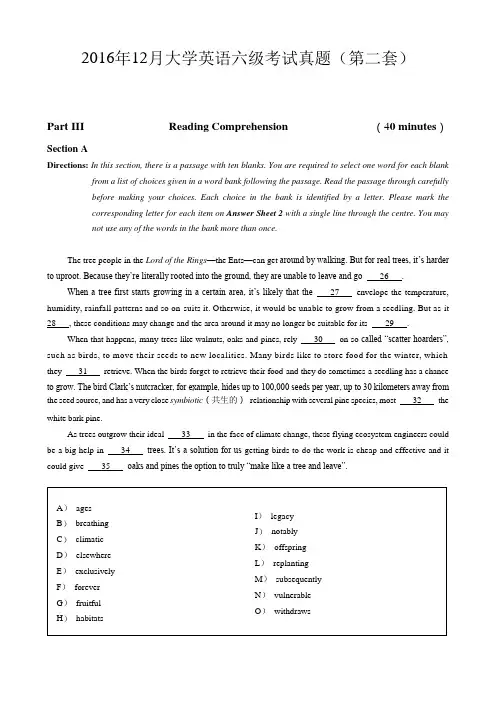
2016年12月大学英语六级考试真题(第二套)Part III Reading Comprehension (40 minutes)Section ADirections: In this section, there is a passage with ten blanks. You are required to select one word for each blank from a list of choices given in a word bank following the passage. Read the passage through carefullybefore making your choices. Each choice in the bank is identified by a letter. Please mark thecorresponding letter for each item on Answer Sheet 2 with a single line through the centre. You maynot use any of the words in the bank more than once.The tree people in the Lord of the Rings—the Ents—can get around by walking. But for real trees, it’s harder to uproot. Because they’re literally rooted into the ground, they are unable to leave and go 26 .When a tree first starts growing in a certain area, it’s likely that the 27 envelope-the temperature, humidity, rainfall patterns and so on-suits it. Otherwise, it would be unable to grow from a seedling. But as it 28 , these conditions may change and the area around it may no longer be suitable for its 29 .When that happens, many trees like walnuts, oaks and pines, rely 30 on so-called “scatter hoarders”, such as birds, to move their seeds to new localities. Many birds like to store food for the winter, which they 31 retrieve. When the birds forget to retrieve their food-and they do sometimes-a seedling has a chance to grow. The bird Clark’s nutcracker, for example, hides up to 100,000 seeds per year, up to 30 kilometers away from the seed source, and has a very close symbiotic(共生的)relationship with several pine species, most 32 the white bark pine.As trees outgrow their ideal 33 in the face of climate change, these flying ecosystem engineers could be a big help in 34 trees. It’s a solution for us-getting birds to do the work is cheap and effective-and it could give 35 oaks and pines the option to truly “make like a tree and leave”.Section BDirections: In this section, you are going to read a passage with ten statements attached to it. Each statement contains information given in one of the paragraphs. Identify the paragraph from which theinformation is derived. You may choose a paragraph more than once. Each paragraph is marked witha letter. Answer the questions by marking the corresponding letter on Answer Sheet 2.The American Workplace Is Broken. Here’s How We Can Start Fixing It.[A]Americans are working longer and harder hours than ever before. 83% of workers say they’re stressed about their jobs, nearly 50% say work-related stress is interfering with their sleep, and 60% use their smartphones to check in with work outside of normal working hours. No wonder only 13% of employees worldwide feel engaged in their occupation.[B]Glimmers(少许)of hope, however, are beginning to emerge in this bruising environment: Americans are becoming aware of the toll their jobs take on them, and employers are exploring ways to alleviate the harmful effects of stress and overwork. Yet much more work remains to be done. To call stress an epidemic isn’t exaggeration. The 83% of American employees who are stressed about their jobs-up from 73% just a year before-say that poor compensation and an unreasonable workload are their number-one sources of stress. And if you suspected that the workplace had gotten more stressful than it was just a few decades ago, you’re right. Stress levels increased 18% for women and 24% for men from 1983 to 2009. Stress is also starting e arlier in life, with some data suggesting that today’s teens are even more stressed than adults.[C]Stress is taking a significant toll on our health, and the collective public health cost may be enormous. Occupational stress increases the risk of heart attack and diabetes, accelerates the aging process, decreases longevity, and contributes to depression and anxiety, among numerous other negative health outcomes. Overall, stress-related health problems account for up to 90% of hospital visits, many of the m preventable. Your job is “literally killing you”, as The Washington Post put it. It’s also hurting our relationships. Working parents say they feel stressed, tired, rushed and short on quality time with their children, friends and partners.[D]Seven in 10 workers say they struggle to maintain work-life balance. As technology(and with it, work emails)seeps(渗入)into every aspect of our lives, work-life balance has become an almost meaningless term. Add a rapidly changing economy and an uncertain future to this 24/7 connectivity, and you’ve got a recipe for overwork, according to Phyllis Moen. “There’s rising work demand coupled with the insecurity of mergers, takeovers, downsizing and other factors,” Moen said. “Part of the work-life issue has to talk about uncertainty about the future.”[E] These factors have converged to create an increasingly impossible situation with many employees overworking to the point of burnout. It’s not only unsustainable for workers, but also for the companies that employ them. Science has shown a clear correlation between high stress levels in workers and absenteeism(旷工), reduced productivity, disengagement and high turnover. Too many workplace policies effectively prohibit employees from developing ahealthy work-life balance by barring them from taking time off, even when they need it most.[F]The U.S. trails far behind every wealthy nation and many developing ones that have family-friendly work policies including paid parental leave, paid sick days and breast-feeding support. According to a 2007 study, the U.S. is also the only advanced economy that does not guarantee workers paid vacation time, and it’s one of only two countries in the world that does not offer guaranteed paid maternity leave. But even when employees are given paid time off, workplace norms and expectations that pressure them to overwork often prevent them from taking it. Fulltime employees who do have paid vacation days only use half of them on average.[G]Our modern workplaces also operate based on outdated time constraints. The practice of clocking in for an eight-hour workday is a leftover from the days of the Industrial Revolution, as reflected in the then-popular saying, “Eight hours labor, eight hours recreation, eight hours rest”.[H] We’ve held on t o this workday structure—but thanks to our digital devices, many employees never really clock out. Today, the average American spends 8.8 hours at work daily, and the majority of working professionals spend additional hours checking in with work during eve nings, weekends and even vacations. The problem isn’t the technology itself, but that the technology is being used to create more flexibility for the employer rather than the employee. In a competitive work environment, employers are able to use technology to demand more from their employees rather than motivating workers with flexibility that benefits them.[I]In a study published last year, psychologists coined the term “workplace telepressure” to describe an employee’s urge to immediately respond to em ails and engage in obsessive thoughts about returning an email to one’s boss, colleagues or clients. The researchers found that telepressure is a major cause of stress at work, which over time contributes to physical and mental burnout. Of the 300 employees participating in the study, those who experienced high levels of telepressure were more likely to agree with statements assessing burnout, like “I’ve no energy for going to work in the morning”, and to report feeling fatigued and unfocused. Telepressure was also correlated with sleeping poorly and missing work.[J]Harvard Business School professor Leslie Perlow explains that when people feel the pressure to be always “on”, they find ways to accommodate that pressure, including altering their schedules, work habits and interactions with family and friends. Perlow calls this vicious cycle the “cycle of responsiveness”: Once bosses and colleagues experience an employee’s increased responsiveness, they increase their demands on the employee’s time. And becau se a failure to accept these increased demands indicates a lack of commitment to one’s work, the employee complies.[K] To address skyrocketing employee stress levels, many companies have implemented workplace wellness programs, partnering with health care providers that have created programs to promote employee health and well-being. Some research does suggest that these programs hold promise. A study of employees at health insuranceprovider Aetna revealed that roughly one quarter of those taking in-office yoga and mindfulness classes reported a 28% reduction in their stress levels and a 20% improvement in sleep quality. These less-stressed workers gained an average of 62 minutes per week of productivity. While yoga and meditation(静思)are scientifically proven to reduce stress levels, these programs do little to target the root causes of burnout and disengagement. The conditions creating the stress are long hours, unrealistic demands and deadlines, and work-life conflict.[L]Moen and her colleagues may have found the solution. In a 2011 study, she investigated the effects of implementing a Results Only Work Environment(ROWE)on the productivity and well-being of employees atBest Buy’s corporate headquarters.[M]For the study, 325 employees spent six months taking part in ROWE, while a control group of 334 employees continued with their normal workflow. The ROWE participants were allowed to freely determine when, where and how they worked—the only thing that mattered was that they got the job done. The results were striking. After six months, the employees who participated in ROWE reported reduced work-family conflict and a better sense of control of their time, and they were getting a full hour of extra sleep each night. The employees were less likely to leave their jobs, resulting in reduced turnover. It’s important to note that the increased flexibility didn’t encourage them to work around the clock. “They didn’t work anywhere and all the time—they were better able to manage their work,” Moen said. “Flexibility and control is key,” she continued.36. Workplace norms pressure employees to overwork, deterring them from taking paid time off.37. The overwhelming majority of employees attribute their stress mainly to low pay and an excessive workload.38. According to Moen, flexibility gives employees better control over their work and time.39. Flexibility resulting from the use of digital devices benefits employers instead of employees.40. Research finds that if employees suffer from high stress, they will be less motivated, less productive and morelikely to quit.41. In-office wellness programs may help reduce stress levels, but they are hardly an ultimate solution to the problem.42. Health problems caused by stress in the workplace result in huge public health expenses.43. If employees respond quickly to their job assignments, the employer is likely to demand more from them.44. With technology everywhere in our life, it has become virtually impossible for most workers to keep a balancebetween work and life.45. In America today, even teenagers suffer from stress, and their problem is even more serious than grown-ups’.Section CDirections: There are 2 passages in this section. Each passage is followed by some questions or unfinished statements. For each of them there are four choices marked A), B), C) and D). You should decide onthe best choice and mark the corresponding letter on Answer Sheet 2 with a single line through thecentre.Passage OneQuestions 46 to 50 are based on the following passage.Dr. Donald Sadoway at MIT started his own battery company with the hope of changing the world’s energy future. It’s a dramatic endorsement for a technology most people think about only when their smartphone goes dark. But Sadoway isn’t alone in trumpeting energy storage as a missing link to a cleaner, more efficient, and more equitable energy future.Scientists and engineers have long believed in the promise of batteries to change the world. Advanced batteries are moving out of specialized markets and creeping into the mainstream, signaling a tipping point for forward-looking technologies such as electric cars and rooftop solar panels.The ubiquitous(无所不在的)battery has already come a long way, of course. For better or worse, batteries make possible our mobile-first lifestyles, our screen culture, our increasingly globalized world. Still, as impressive as all this is, it may be trivial compared with what comes next. Having already enabled a communications revolution, the battery is now poised to transform just about everything else.The wireless age is expanding to include not just our phones, tablets, and laptops, but also our cars, homes, and even whole communities. In emerging economies, rural communities are bypassing the wires and wooden poles that spread power. Instead, some in Africa and Asia are seeing their first light bulbs illuminated by the power of sunlight stored in batteries.Today, energy storage is a $33 billion global industry that generates nearly 100 gigawatt-hours of electricity per year. By the end of the decade, it’s expected to be worth over $50 billion and generate 160 gigawatt-hours, enough to attract the attention of major companies that might not otherwise be interested in a decidedly pedestrian technology. Even utility companies, which have long viewed batteries and alternative forms of energy as a threat, are learning to embrace the technologies as enabling rather than disrupting.Today’s battery breakthroughs come as the world looks to expand modern energy access to the billion or so people without it, while also cutting back on fuels that warm the planet. Those simultaneous challenges appear less overwhelming with increasingly better answers to a centuries-old question: how to make power portable.To be sure, the battery still has a long way to go before the nightly recharge completely replaces the weekly trip to the gas station. A battery-powered world comes with its own risks, too. What happens to the centralized electric grid, which took decades and billions of do llars to build, as more and more people become “prosumers”, who produce and consume their own energy onsite?No one knows which—if any—battery technology will ultimately dominate, but one thing remains clear. The future of energy is in how we store it.46. What does Dr. Sadoway think of energy storage?A)It involves the application of sophisticated technology.B)It is the direction energy development should follow.C)It will prove to be a profitable business.D)It is a technology benefiting everyone.47. What is most likely to happen when advanced batteries become widely used?A)Mobile-first lifestyles will become popular.B)The globalization process will be accelerated.C)Communications will take more diverse forms.D)The world will undergo revolutionary changes.48. In some rural communities of emerging economies, people have begun to __________.A)find digital devices simply indispensableB)communicate primarily by mobile phoneC)light their homes with stored solar energyD)distribute power with wires and wooden poles49. Utility companies have begun to realize that battery technologies __________.A)benefit their businessB)transmit power fasterC)promote innovationD)encourage competition50. What does the author imply about the centralized electric grid?A)It might become a thing of the past.B)It might turn out to be a “prosumer”.C)It will be easier to operate and maintain.D)It will have to be completely transformed.Passage TwoQuestions 51 to 55 are based on the following passage.More than 100 years ago, American sociologist W. E. B. Du Bois was concerned that race was being used as a biological explanation for what he understood to be social and cultural differences between different populations of people. He spoke out against the idea of “white” and “black” as distinct groups, claiming that these distinctions ignored the scope of human diversity.Science would favor Du Bois. Today, the mainstream belief among scientists is that race is a social construct without biological meaning. In an article published in the journal Science, four scholars say racial categories need to be phased out.“Essentially, I could not agree more with the authors,” said Svante Pääbo, a biologist and director of the Max Planck Institute for Evolutionary Anthropology in Germany. In one example that demonstrated genetic differences were not fixed along racial lines, the full genomes(基因组)of James Watson and Craig Venter, two famous American scientists of European ancestry, were compared to that of a Korean scientist, Seong-Jin Kim. It turned out that Watson and Venter shared fewer variations in their genetic sequences than they each shared with Kim.Michael Yudell, a professor of public health at Drexel University in Philadelphia, said that modern genetics research is operating in a paradox: on the one hand, race is understood to be a useful tool to illuminate human genetic diversity, but on the other hand, race is also understood to be a poorly defined marker of that diversity.Assumptions about genetic differences between people of different races could be particularly dangerous in a medical setting. “If you make clinical predictions based on somebody’s race, you’re going to be wrong a good chunk of the time,” Yudell told Live Science. In the paper, he and his colleagues used the example of cystic fibrosis, which is underdiagnosed in people of African ancestry because it is thought of as a “white” disease.So what other variables could be used if the racial concept is thrown out? Yudell said scientists need to get more spec ific with their language, perhaps using terms like “ancestry” or “population” that might more precisely reflect the relationship between humans and their genes, on both the individual and population level. The researchers also acknowledged that there are a few areas where race as a construct might still be useful in scientific research: as a political and social, but not biological, variable.“While we argue phasing out racial terminology(术语)in the biological sciences, we also acknowledge thatusing race as a political or social category to study racism, although filled with lots of challenges, remains necessary given our need to understand how structural inequities and discrimination produce health disparities(差异)between groups.” Yudell said.51. Du Bois was opposed to the use of race as ________.A)a basis for explaining human genetic diversityB)an aid to understanding different populationsC)an explanation for social and cultural differencesD)a term to describe individual human characteristics52. The study by Svante Pääbo served as an example to show ________.A)modern genetics research is likely to fuel racial conflictsB)race is a poorly defined marker of human genetic diversityC)race as a biological term can explain human genetic diversityD)genetics research should consider social and cultural variables53. The example of the disease cystic fibrosis underdiagnosed in people of African ancestry demonstrates that _____.A)it is absolutely necessary to put race aside in making diagnosisB)it is important to include social variables in genetics researchC)racial categories for genetic diversity could lead to wrong clinical predictionsD)discrimination against black people may cause negligence in clinical treatment54. What is Yudell’s sugges tion to scientists?A)They be more precise with the language they use.B)They refrain from using politically sensitive terms.C)They throw out irrelevant concepts in their research.D)They examine all possible variables in their research.55. What c an be inferred from Yudell’s remark in the last paragraph?A)Clinging to racism prolongs inequity and discrimination.B)Physiological disparities are quite striking among races.C)Doing away with racial discrimination is challenging.D)Racial terms are still useful in certain fields of study.Part VI Translation (30 minutes)Directions: For this part, you are allowed 30 minutes to translate a passage from Chinese into English. You should write your answer on Answer Sheet 2.随着中国经济的蓬勃发展,学汉语的人数迅速增加,使汉语成了世界上人们最爱学的语言之一。
2016年12月大学英语六级考试答案与解析(第2套)

2016年12月大学英语六级考试答案与解析(第2套)Part I Writing【范文】Throughout the ages, we have concluded a number of factors that contribute to success, among which is creation. Just as the saying goes, ^There is no doubt that creation is the most important human res ou rc e of all.”Not only is creation the force driving economy and society to advance, but it is also essential to the development of individuals. Those who often come up with new i d e as often turn out to be easy to achieve success while a man who always sticks to h a b i t and e x p erie n c e can hardly c r e at e new t h in g s.In t er ms of g ivin g m e a s u r es to en c ou ra ge c reatio n, I w ill lis t t he f ollo w in g on e s. O n t he one hand, the public are expected to realize the significance of creation, so the social media should play its d ue role in ad v o catin g the value of innovation and encouraging the public to c ultivat e awareness of creation. On the other hand, those who are equipped with creative thinking d eserv e some kind of praise, both materially and s p irit u ally.Creation has been a hot word for a long ti me and we cannot emphasize the importance of creation too much. Therefore, we should spare no effort to learn knowledge as much as possible to prepare ourselves to be creative people.Pari II L iste n in g Comprehension1 〜5 : CCABC 6〜10 : ADACD 11 〜15 : BBDAB16〜20:DP)CBD 21〜25:CAADDSection AConversation OneM: Guess what? The worst food Ive ever had was in France.W: Really? That’s odd. (1) I thought the French were all good cooks.M: Yes. That’s right. I suppose it’s really like anywh ere else,though You know, some places are good. Some bad.Put it’s r e ally all our own fault.W: What d o you mean?M: Well it was the first time Id been to France. This was years ago when I was at school. (2)I went there with my parents5friends, from my f ather’s school. They’d hired a coach to take them toSw itzerla nd.W: A school trip?M: Right. Most of them had never been abroad before. We?d crossed the English Channel at night, and we set off through France, and breakfast time arrived, and the coach driver had arranged for us to stop at this litt l e cafe. There we all were tir ed and hungry, and then we made the great discovery.W: Wh a t was t h at?女士认为法国人怎么样? A) 他们为他们的菜肴而自豪。
2016年6月全国大学英语六级考试真题答案(共三套)
2016年6月全国大学英语六级考试真题答案(共三套)2016年6月全国大学英语六级考试真题答案(共三套)听力注:听力部分共有2套。
第一套Section A1. D) Market research consultant。
2. A) Quantitative advertising research。
3. D)They study trends or customer satisfaction over a long period.4. B) Checking charts and tables.5。
A) His view on Canadian universities。
6. B) It is rather inflexible.7. C)Everyone should be given equal access to higher education。
8. C)It is hard to say which is better, a public university or a private one。
Section B9。
B) The worsening real wage situation around the world。
10. A)They will feel less pressure to raise employees’wages.11. C) Employees work shorter hours to avoid layoffs.12。
A) Whether memory supplements work。
13。
D) They are not based on real science。
14. D) They are prescribed by trained practitioners.15. B) Taking them with other medications might entail unnecessary risks.Section C16。
2021年12月大学英语六级考试真题(第3套)
大学英语六级考试2021年12月真题(第三套)Part I Writing(30 minutes) Directions:For this part, you are allowed 30 minutes to write an essay related to the short passage given below. In your essay, you are to comment on the phenomenon described in the passage and suggest measures to address the issue. You should write at least 150 words but no more than 200 words.Some parents in China are overprotective of their children. They plan everything for their children, make all the decisions for them, and do not allow them to explore on their own in case they make mistakes or get hurt. Part II Listening Comprehension(30 minutes)特别说明:由于多题多卷,官方第三套真题的听力试题与第二套真题的一致,只是选项顺序不同,因此,本套试卷不再提供听力部分。
Part III Reading Comprehension(40 minutes) Section A特别说明:由于多题多卷,此次官方第三套真题的阅读Section A与第二套真题的一致,因此,本套试卷不再提供阅读Section A。
Section BDirections: In this section, you are going to read a passage with ten statements attached to it. Each statement contains information given in one of the paragraphs. Identify the paragraph from which the information is derived. You may choose a paragraph more than once. Each paragraph is marked with a letter. Answer the questions by marking the corresponding letter on Answer Sheet 2.Why facts don’t change our mindsA)The economist J. K. Galbraith once wrote, “Faced with a choice between changing one’s mind and provingthere is no need to do so, almost everyone gets busy with the proof.”B)Leo Tolstoy was even bolder: “The most diffi cult subjects can be explained to the most slow-witted man if hehas not formed any idea of them already; but the simplest thing cannot be made clear to the most intelligent man if he is fi rmly persuaded that he knows already, without a shadow of doubt, what is laid before him.”C)What’s going on here? Why don’t facts change our minds? And why would someone continue to believe afalse or inaccurate idea anyway? How do such behaviors serve us? Humans need a reasonably accurate view of the world in order to survive. If your model of reality is wildly diff erent from the actual world, then you struggle to take eff ective actions each day. However, truth and accuracy are not the only things that matter to the human mind. Humans also seem to have a deep desire to belong.D) In Atomic Habits, I wrote, “Humans are herd animals. We want to fi t in, to bond with others, and to earn therespect and approval of our peers. Such inclinations are essential to our survival. For most of our evolutionaryhistory, our ancestors lived in tribes. Becoming separated from the tribe—or worse, being cast out—was a death sentence.”E)Understanding the truth of a situation is important, but so is remaining part of a tribe. While these two desiresoften work well together, they occasionally come into confl ict. In many circumstances, social connection is actually more helpful to your daily life than understanding the truth of a particular fact or idea. The Harvard psychologist Steven Pinker put it this way, “People are embraced or condemned according to their beliefs, so one function of the mind may be to hold beliefs that bring the belief-holder the greatest number of allies, protectors, or disciples (信徒), rather than beliefs that are most likely to be true.”F)We don’t always believe things because they are correct. Sometimes we believe things because they makeus look good to the people we care about. I thought Kevin Simler put it well when he wrote, “If a brain anticipates that it will be rewarded for adopting a particular belief, it’s perfectly happy to do so, and doesn’t much care where the reward comes from—whether it’s pragmatic (实用主义的) (better outcomes resulting from better decisions), social (better treatment from one’s peers), or some mix of the two.”G)False beliefs can be useful in a social sense even if they are not useful in a factual sense. For lack of a betterphrase, we might call this approach “factually false, but socially accurate.” When we have to choose between the two, people often select friends and family over facts. This insight not only explains why we might hold our tongue at a dinner party or look the other way when our parents say something off ensive, but also revealsa better way to change the minds of others.H)Convincing someone to change their mind is really the process of convincing them to change their tribe. Ifthey abandon their beliefs, they run the risk of losing social ties. You can’t expect someone to change their mind if you take away their community too.You have to give them somewhere to go. Nobody wants their worldview torn apart if loneliness is the outcome.I)The way to change people’s minds is to become friends with them, to integrate them into your tribe, to bringthem into your circle. Now, they can change their beliefs without the risk of being abandoned socially.J)Perhaps it is not diff erence, but distance, that breeds tribalism and hostility. As proximity increases, so does understanding. I am reminded of Abraham Lincoln’s quote, “I don’t like that man. I must get to know him better.”K)Facts don’t change our minds. Friendship does. Years ago, Ben Casnocha mentioned an idea to me that I haven’t been able to shake: The people who are most likely to change our minds are the ones we agree with on 98 percent of topics. If someone you know, like, and trust believes a radical idea, you are more likely to give it merit, weight, or consideration. You already agree with them in most areas of life. Maybe you should change your mind on this one too. But if someone wildly diff erent than you proposes the same radical idea, well, it’s easy to dismiss them as nuts.L)One way to visualize this distinction is by mapping beliefs on a spectrum. If you divide this spectrum into 10 units and you fi nd yourself at Position 7, then there is little sense in trying to convince someone at Position 1.The gap is too wide. When you’re at Position 7, your time is better spent connecting with people who are at Positions 6 and 8, gradually pulling them in your direction.M) The most heated arguments often occur between people on opposite ends of the spectrum, but the most frequent learning occurs from people who are nearby. The closer you are to someone, the more likely it becomes that the one or two beliefs you don’t share will bleed over into your own mind and shape your thinking. The further away an idea is from your current position, the more likely you are to reject it outright.When it comes to changing people’s minds, it is very diffi cult to jump from one side to another. You can’t jump down the spectrum. You have to slide down it.N)Any idea that is suffi ciently diff erent from your current worldview will feel threatening. And the best place to ponder a threatening idea is in a non-threatening environment. As a result, books are often a better vehicle for transforming beliefs than conversations or debates. In conversation, people have to carefully consider their status and appearance. They want to save face and avoid looking stupid. When confronted with an uncomfortable set of facts, the tendency is often to double down on their current position rather than publicly admit to being wrong. Books resolve this tension. With a book, the conversation takes place inside someone’s head and without the risk of being judged by others. It’s easier to be open-minded when you aren’t feeling defensive.O)There is another reason bad ideas continue to live on, which is that people continue to talk about them.Silence is death for any idea. An idea that is never spoken or written down dies with the person who conceived it. Ideas can only be remembered when they are repeated. They can only be believed when they are repeated. I have already pointed out that people repeat ideas to signal they are part of the same social group. But here’s a crucial point most people miss: People also repeat bad ideas when they complain about them. Before you can criticize an idea, you have to reference that idea. You end up repeating the ideas you’re hoping people will forget—but, of course, people can’t forget them because you keep talking about them. The more you repeat a bad idea, the more likely people are to believe it.P)Let’s call this phenomenon Clear’s Law of Recurrence: The number of people who believe an idea is directly proportional to the number of times it has been repeated during the last year—even if the idea is false.36.According to the author, humans can hardly survive if separated from their community.37. People often accept false beliefs because they prioritize social bonds rather than facts.38.Most often people learn from those close to them.39. Sometimes people adopt certain beliefs in order to leave a favorable impression on those dear to them.40. Compared with face-to-face communication, books often provide a better medium for changing people’sbeliefs.41. On many occasions in daily life, people benefi t more from their social bonds than from knowing the truth.42. If you want to change somebody’s beliefs, you should fi rst establish social connection with them.43. Humans cannot survive without a fair knowledge of the actual world.44. Repetition of bad ideas increases their chances of being accepted.45. Nobody is willing to give up their beliefs at the risk of getting isolated.Section CDirections:There are 2 passages in this section. Each passage is followed by some questions or unfinished statements. For each of them there are four choices marked A), B), C) and D). You should decide on the best choice and mark the corresponding letter on Answer Sheet 2 with a single line through the centre.Passage OneQuestions 46 to 50 are based on the following passage.The subject of automation and its role in our economy has taken hold in American public discourse. Technology broadly and automation specifi cally are dramatically reshaping the way we work. And we need to have a plan for what’s still to come.We don’t have to look further than our own communities to see the devastating impact of automation. From automated warehouses to cashierless grocery stores to neighborhood libraries that offer self-checkout lanes instead of employing real people—automation is increasingly replacing jobs and leaving too few good new jobs behind.The statistics in manufacturing are staggering. Despite the widespread fears about trade, a recent report showed that just 13 percent of jobs lost in manufacturing are due to trade—the rest of the losses have been due to advances in technology.That is why more people are criticizing the ever-increasing role of technology in our economy. Our country is manufacturing more than ever before, but we are doing it with fewer workers. However, it’s not just factories that are seeing losses—software and information technology are also having a dramatic impact on jobs most people think are secure from the forces of a rapidly-changing economy. Something transformative is happening in America that is having an adverse eff ect on American families. Whether policymakers and politicians admit it or not, workers have made clear their feelings about their economic insecurity and desire to keep good jobs in America.So why are people so insistent on ignoring the perils of automation? They are failing to look ahead at a time when planning for the future is more important than ever. Resisting automation is futile: it is as inevitable as industrialization was before it. I sincerely hope that those who assert that automation will make us more effective and pave the way for new occupations are right, but the reality of automation’s detrimental effects on workers makes me skeptical. No one can currently say where the new jobs are coming from or when, and any sensible company or country should prepare for all alternatives.I’m not overstating the danger: look at what’s happened to the labor force. According to economic research, one in six working-age men, 25-54, doesn’t have a job. Fifty years ago, nearly 100 percent of men that age were working. Women’s labor force participation, meanwhile, has slipped back to the level it was at in the late 1980s.American families and prominent business leaders are aware that there’s a big problem with automation. The value of a college degree is diminishing, and our upward mobility is declining. If we want an economy that allows everyone to be economically secure, we need to start thinking about how we can rightfully address automation.46. What can we observe from the author’s description of our communities?A)The growing passion for automation.C)Their changing views on employment.B)The shift from manual jobs to IT ones.D)Their fading employment opportunities.47. What do we learn from a recent report?A)The manufacturing sector is declining at a fast rate.B)The concerns about the eff ect of trade are exaggerated.C)The fears about trade have been spreading far and wide.D)The impact of trade on employment has been staggering.48. What does the passage tell us about American workers in an era of transformation?A)They feel ignored by politicians.C)They keep adapting to the changes.B)They feel increasingly vulnerable.D)They keep complaining but to no avail.49. What does the author think of automation?A)It will have the same impact as industrialization.C)Its alleged positive eff ects are doubtful.B)It provides sensible companies with alternatives.D)Its detrimental eff ects are unavoidable.50. What should we attach importance to when dealing with automation?A)College graduates’ job prospects.C)People’s economic security.B)Women’s access to employment.D)People’s social mobility.Passage TwoQuestions 51 to 55 are based on the following passage.Look at the people around you. Some are passive, others more aggressive. Some work best alone, others crave companionship. We easily recognize that there is great variation among the individuals who live near us. Yet, when we speak of people from elsewhere, we seem to inevitably characterize them based on their country of origin.Statistics specialists, when they speak of national averages, often make the same mistake.Newly published research shows how erroneous such overviews are. Three researchers analyzed decades of values-based surveys and found that only between 16% and 21% of the variation in cultural values could be explained by diff erences between countries. In other words, the vast majority of what makes us culturally distinct from one another has nothing to do with our homeland.To determine what factors really are associated with culture, the authors combined data from 558 prior surveys that each measured one or more of Hofstede’s cultural dimensions. These are traits, such as individualism and masculinity, that describe work-related cultural values. (They are not a measure of visible cultural traits, such as food or dress.) Though the validity of Hofstede’s dimensions has been questioned, they have the singular benefi t of having been in use for decades, which allows for historical and international comparisons.The researchers found that both demographic factors, such as age, and environmental factors, such as long-term unemployment rates, were more correlated with cultural values than nationality. Occupation and social economic status were the most strongly correlated, suggesting that our values are more economically driven than we usually give them credit for.The evidence implies that people with similar jobs and incomes are more culturally alike, regardless of where they live. Vas Taras, the lead author of the study, puts it this way: “Tell me how much you make and I will make a pretty accurate prediction about your cultural values. Tell me what your nationality is and I probably will make a wrong prediction.”Taras says our erroneous belief that countries are cultures has caused businesses to teach their employees useless or even harmful ways of interacting with their international peers. Chinese and American lawyers might be trained to interact based on the assumption that the Chinese person is less individualistic, even though their similar social economic situations make it probable they are actually quite alike in that regard.The country, as the unit of authority, is often a convenient way of generalizing about a population. However, our focus on countries can mask broad variations within them. In the majority of cases we would be better offidentifying people by the factors that constrain their lives, like income, rather than by the lines surrounding them on a map.51. What error do experts often make when describing people from other places?A)They tend to overly rely on nationality.C)They often misunderstand their cultures.B)They often exaggerate their diff erences.D)They tend to dwell on national averages.52. What do we learn about Hofstede’s cultural dimensions?A)They are useful in comparing cultural values across time and space.B)They have brought unusual benefi ts to people of diff erent cultures.C)They are widely used to identify people’s individual traits.D)They provide valuable questions for researchers to study.53. What did researchers fi nd about previous studies on factors determining people’s values?A)Environmental factors were prioritized over other factors.B) An individual’s fi nancial status was often underestimated.C)Too much emphasis had been placed on one’s occupation.D)The impact of social progress on one’s values was ignored.54. What is the impact on employees when cultures are identifi ed with countries?A)They may fail to see the cultural biases of their business partners.B)They may fail to attach suffi cient importance to cultural diversity.C)They may not be taught how to properly interact with overseas partners.D)They may not be able to learn the legal procedures for business transactions.55. What does the author suggest at the end of the passage?A)There is sufficient reason to generalize about a country’s population.B)The majority of people are still constrained by their national identity.C)It is arguable that the country should be regarded as the unit of authority.D) Nationality is less useful than socio-economic status as an indicator of one’s values.Part IV Translation (30 minutes) Directions:For this part, you are allowed 30 minutes to translate a passage from Chinese into English. You should write your answer on Answer Sheet 2.井冈山地处湖南江西两省交界处,因其辉煌的革命历史被誉为“中国革命红色摇篮”。
2016年12月六级真题(第二套)
2016年12月大学英语六级考试(第2套)Part ⅠWriting (30 minutes)Directions: For this part, you are allowed 30 minutes to write a short essay on creation. Your essay should include the importance of creation and measures to be taken to encourage creation. You are required to write at least 150 words but no more than 200 words.Part II Listening Comprehension (30 minutes)Section ADirections: In this section, you will hear three news reports. At the end of each news report, you will hear two or three questions. Both the news report and the questions will be spoken only once. After you hear a question, you must choose the best answer from the four choices marked A), B), C) and D). Then mark the corresponding letter on Answer Sheet 1 with a single line through the centre.Questions 1 to 4 are based on the conversation you have just heard.1. A. They were proud of their cuisine.B. They were particular about food.C. They were all good at cooking.D. They were fond of bacon and eggs.2. A. His parents.B. His friends.C. His parents' friends.D. His schoolmates.3. A. No one of the group ate it.B. It was a little overcooked.C. No tea was served with the meal.D. It was the real English breakfast.4. A. It was full of excitement.B. It was rather disappointing.C. It was a risky experience.D. It was really extraordinary.Questions 5 to 8 are based on the conversation you have just heard.5. A. The woman's earnings over the years.B. The key to running a shop at a low cost.C. The business success of the woman's shop.D. The woman's relationship with other shops.6. A. Keep down its expenses.B. Expand its business scale.C. Improve its customer service.D. Upgrade the goods it sells.7. A. They are in great demand.B. They are delivered free of charge.C. They are very-popular with the local residents.D. They are sold at lower prices than in other shops.8. A. To maintain friendly relationships with other shops.B. To avoid being put out of business in competition.C. To attract more customers in the neighborhood.D. To follow the custom of the local shopkeepers.Section BDirections: In this section, you will hear two passages. At the end of each passage, you will hear three or four questions. Both the passage and the questions will be spoken only once.After you hear a question, you must choose the best answer from the four choices marked A, B, C and D. Then mark the corresponding letter on Answer Sheet 1 with a single line through the centre.Questions 9 to 12 are based on the passage you have just heard.9. A. They are on the verge of extinction because of pollution.B. They carry plant seeds and spread them to faraway places.C. They deliver pollutants from the ocean to their nesting sites.D. They can be used to deliver messages in times of emergency.10. A. They originate from Devon Island in the Arctic area.B. They migrate to the Arctic Circle during the summer.C. They have the ability to survive in extreme weathers.D. They travel as far as 400 kilometers in search of food.11. A. They had become more poisonous.B. They were carried by the wind.C. They poisoned some of the fulmars.D. They were less than on the continent.12. A. The effects of the changing climate on Arctic seabirds.B. The harm Arctic seabirds may cause to humans.C. The diminishing colonies for Arctic seabirds.D. The threats humans pose to Arctic seabirds.Questions 13 to 15 are based on the passage you have just heard.13. A. It has remained basically the same.B. It has become better understood.C. It has been exaggerated.D. It has decreased.14. A. It is now the second leading cause of death for centenarians.B. It develops more easily in centenarians not actively engaged.C. It calls for more intensive research.D. It has had no effective cure so far.15. A. They cherish their life more than ever.B. Their minds fall before their bodies do.C. Their quality of life deteriorates rapidly.D. They care more about their physical health.Section CDirections: In this section, you will hear three recordings of lectures or talks followed by three or four questions. The recordings will be played only once. After you hear a question, you must choose the best answer from the four choices marked A, B, C and D Then mark the corresponding letter on Answer Sheet 1 with a single line through the centre.Questions 16 to 18 are based on the recording you have just heard.16. A. They form the basis on which he builds his theory of love.B. They were carried out over a period of some thirty years.C. They were done by his former colleague at Yale.D. They are focused more on attraction than love.17. A. The relationship cannot last long if no passion is involved.B. It is not love if you don't wish to maintain the relationship.C. Romance is just impossible without mutual understanding.D. Intimacy is essential but not absolutely indispensable to love.18. A. Whether it is true love without commitment.B. Which of them is considered most important.C. How the relationship is to be defined if any one is missing.D. When the absence of any one doesn't affect the relationship.Questions 19 to 22 are based on the recording you have just heard.19. A. The history of social work.B. Social work as a profession.C. Academic degrees required of social work applicants.D. The aim of the National Association of Social Workers.20. A. They try to change people's social behavior.B. They raise people's awareness of the environment.C. They create a lot of opportunities for the unemployed.D. They help enhance the well-being of the underprivileged.21. A. They have all made a difference through their work.B. They are all members of the National Association.C. They all have an academic degree in social work.D. They have all received strict clinical training.22. A. Social workers' job options and responsibilities.B. Ways for social workers to meet people's needs.C. The importance of training for social workers.D. The promotion of social workers' social status.Questions 23 to 25 are based on the recording you have just heard.23. A. To fight childhood obesity.B. To help disadvantaged kids.C. To urge kids to follow their role models.D. To encourage kids to play more sports.24. A. They are most effective when appearing on TV.B. They best boost product sales when put online.C. They are becoming more and more prevalent.D. They impress kids more than they do adults.25. A. Do what they advocate in public.B. Always place kids' interest first.C. Pay attention to their image before children.D. Message positive behaviors at all times.Part III Reading Comprehension (40 minutes)Section ADirections: In this section, there is a passage with ten blanks. You are required to select out one word for each blank from a lot of choices given in a word bank following the passage. Read the passage through carefully before making your choices. Each choice in the bank is identified by a letter. Please mark the corresponding letter for each itemon Answer Sheet 2 with a single line through the centre. You may not use any of the words in the bank more than once.Small communities, with their distinctive character—where life is stable and intensely human—are disappearing. Some have __26____ from the face of the earth, others are dying slowly, but all have ___27___ changes as they have come into contact with an ___28___ machine civilization. The merging of diverse peoples into a common mass has produced tension among members of the minorities and the majority alike.The Old Order Amish, who arrived on American shores in colonial times, have ___29___ in the modern world in distinctive, small communities. They have resisted the homogenization ___30___ more successfully than others. In planting and harvest times one can see their bearded men working the fields with horses and their women hanging out the laundry in neat rows to dry. Many American people have seen Amish families with the men wearing broad-brimmed black hats and the women in long dresses. In railway or bus ___31___.Although the Amish have lived with ___32___ America for over two and a half centuries. They have moderated its influence on their personal lives, their families, communities, and their values.The Amish are often ___33___ by other Americans to be relics of the past who live a simple, inflexible life dedicated to inconvenient out-dated customs. They are seen as abandoning both modem ___34___ and the American dream of success and progress, But most people have no quarrel with the Amish for doing things the old-fashioned way. Their conscientious objection was tolerated in wartime. For after all. They are good farmers who ___35___ the virtues of work and thrift.A)accessing I)progressB)conveniences J)respectiveC)destined K)survivedD)expanding L)terminalsE)industrialized M)undergoneF)perceived N)universalG)practice O)vanishedH)processSection BDirections: In this section, you are going to read a passage with ten statements attached to it. Each statement contains information given in one of the paragraphs. Identify the paragraph from which the information is derived. You may choose a paragraph more than once. Each paragraph is marked with a letter. Answer the questions by marking the corresponding letter on Answer Sheet 2.Countries Rush for Upper Hand in AntarcticaA) On a glacier-filled island with fjords(峡湾)and elephant seals, Russia has built Antarctica’s first Orthodox church on a bill overlooking its research base. Less than an hour away by snowmobile. Chinese laborers have updated the Great Wall Station, a vital part of China’s plan to operate five basses on Antarctica, complete with an indoor badminton court and sleeping quarters for 150 peop le. Not to be outdone, India’s futuristic new Bharathi base, built on stills(桩子)using 134 interlocking shipping containers, resembles a spaceship. Turkey and Iran have announced plans to build bases, too.B) More than a century has passed since explorers raced to plant their flags at the bottom of the world, and for decades to come this continent is supposed to be protected as a scientific preserve, shielded from intrusions like military activities and mining . But an array of countries are rushing to assert greater influence here, with an eye not just towards the day those protective treaties expire, but also for the strategic and commercial that already exist.C) The newer players are stepping into what they view as a treasure house of resources. Some of the ventures focus on the Antarctic resources that are already up for grabs, like abundant sea life. South Korea, which operates state-of–the-art bases here, is increasing its fishing of krill(磷虾),found in abundance in the Southern Ocean, while Russia recen tly frustrated efforts to create one of the world’s largest ocean sanctuaries here.D) Some scientists are examining the potential for harvesting icebergs form Antarctica, which is estimated to have the biggest reserves of fresh water on the planet. Nations are also pressing ahead with space research and satellite projects to expand their global navigation abilities.E) Building on a Soviet-era foothold, Russia is expanding its monitoring stations for Glonass, its version of the Global Positioning System(GPS). At least three Russian stations are already operating in Antarctica, part of its effort to challenge the dominance of the American GPS, and new stations are planned for sites like the Russian base, in the shadow of the Orthodox Church of the Holy Trinity.F) Elsewhere in Antarctica, Russian researchers boast of their recent discovery of a freshwater reserve the size of Lake Ontario after drilling through miles of solid ice. “You can see that we’re here to stay,” said Vladimir Cheberdak, 57, chief of the Bellingshausen Station, as he sipped tea under a portrait of Fabian Gottlieb von Bellingshausen, a high-ranking officer in the Imperial Russian Navy who explored the Antarctic coast in 1820.G) Antarctica’s mineral, oil and gas wealth are a longer-term prize. The treaty banning mining here, shielding coveted(令人垂诞的)reserves of iron ore, coal and chromium, comes up for review in 2048. Researchers recently found kimberlite(金伯利岩) deposits hinting at the existence of diamonds. And while assessments vary widely, geologists estimate that Antarctica holds at least 36 billion barrels of oil and natural gas.H) Beyond the Antarctic treaties, huge obstacles persist to tapping these resources, like drifting icebergs that could jeopardize offshore platforms. Then there is Antarctic’s remoteness, with some mineral deposits found in windswept locations on a continent that is larger the Europe and where winter temperatures hover around minus 55 degrees Celsius.I) But advances in technology might make Antarctica a lot more accessible three decades from now. And even before then, scholars warn, the demand for resources in an energy-hungry world could raise pressure to renegotiate Antarctica’s treaties, possibly allowing more commercial endeavours here well before the prohibit ions against them expire. The research stations on King George lsland offer a glimpse into the long game on this ice-blanketed continent as nations assert themselves, eroding the sway long held by countries like the United States, Britain. Australia and New Zealand.J) Being stationed in Antarctica involves adapting to life on the planet’s driest, windiest and coldest continent, yet each nation manages to make itself at home. Bearded Russian priests offer regular services at the Orthodox church for the 16 or so Russian speakers who spend the winter at the base, largely polar scientists in fields like glaciology and meteorology. Their number climbs to about 40 in the warmer summer months. China has arguably the fastest growing operations in Antarctica. It opened its fourth station last year and is pressing ahead with plans to build a fifth. It is building its second ice-breaking ship and setting up research drilling operations on an ice dome 13,422 feet above sea level that is one the planet’s coldest places. Chinese officials say the expansion in Antarctica prioritises scientific research. But they also acknowledge that concerns about “resource security” influence their moves.K) China’s newly renovated Great Wall Station on King George lsland makes the Russia n and Chilean bases here seem outdated. ”We do weather monitoring here and other research.” Ning Xu, 53, the chief of the Chinese base, said over tea during a fierce blizzard(暴风雪) in late November. The large base he leads resembles a snowed-in college campus on holiday break, with the capacity to sleep more than 10 times the 13 people who were staying on through the Antarctic winter. Yong Yu, a Chinese microbiologist, showed off the spacious building, with empty desks under an illustrated timeline detailing the rapid growth of China’s Antarctic operations since the 1980s “We now feel equipped to grow,” he said.L) As some countries expand operations in Antarctica, the United States maintains three year-round stations on the continent with more than 1,000 peo ple during the southern hemisphere’s summer, including those at the Amundsen Scott station, built in 1956 at an elevation of 9,301 feet on a plateau at the South Pole. But US researchers quietly complain about budget restraints and having far fewer icebreakers the Russia, limiting the reach of the United States in Antarctica.M) Scholars warn that Antarctica’s political drift could blur the distinction between military and civilian activities long before the continent’s treaties come up for renegotiation, e specially in parts of Antarctica that are ideal for intercepting(拦截) signals from satellites or retasking satellite systems, potentially enhancing global electronic intelligence operations.N) Some countries have had a hard time here, Brazil opened a research station in 1984, but it was largely destroyed by a fire that killed two members of the navy in 2012, the same year that a diesel-laden Brazilian barge sank near the base. As if that were not enough. a Brazilian C-130 Hercules military transport plane has remained stranded near the runway of Chile’s air base here since it crash-landed in 2014.O) However, Brazil’s stretch of misfortune has created opportunities for China, with a Chinese company winning the $100 million contract in 2015 to rebuild the Brazilian station.P) Amid all the changes, Antarctica maintains its allure. South Korea opened its second Antarctic research base in 2014, describing it as a way to test robots developed by Korean researchers for use in extreme conditions. With Russia’s help, Belarus is preparing to build this first Antarctic base. Colombia said this year that it planned to join other South American nations with bases in Antarctica.Q) “The old days of the Antarctic being dominated by the interests and wishes of white men fro m European. Australasian and North American states are over.” Said Klaus Dodds, a politics scholar at the University of London who specialises in Antarctica. “The reality is that Antarctica is geopolitically contested.”36. According to Chinese officials, their activities in Antarctica lay greater emphasis on scientific research.37. Efforts to create one of the world’s largest ocean sanctuaries failed because of Russia’s obstruction.38. With several monitoring stations operating in Antarctica, Russia is t rying hard to counter America’s dominance in the field of worldwide navigational facilities.39. According to geologists’ estimates. Antarctica has enormous reserves of oil and natural gas.40. It is estimated that Antarctica boasts of the richest reserves of fresh water on earth.41. The demand for energy resources may compel renegotiation of Antarctica’s treaties before their expiration.42. Many countries are racing against each other to increase their business and strategic influence on Antarctica.43. Antarctica’s harsh natural conditions constitute huge obstacles to the exploitation of its resources.44. With competition from many countries, Antarctica is no longer dominated by the traditional white nations.45. American scientists complain about lack of sufficient money and equipment for their expansion in Antarctica. Passage oneQuestions 46 to 50 are based on the following passage.Any veteran nicotine addict will testify that fancy packaging plays no role in the decision to keep smoking. So, it is argued, stripping cartons of their branding will trigger no mass movement to quit.But that isn’t why the government—under pressure from cancer charities, health workers and the Labour party—has agreed to legislate for standardized packaging. The theory is that smoking should be stripped of any appeal to discourage new generations from starting in the first place. Plain packaging would be another step in the reclassification of cigarettes from inviting consumer products to narcotics(麻醉剂).Naturally, the tobacco industry is violently opposed. No business likes to admit that it sells addictive poison as a lifestyle choice. That is why government has historically intervened, banning advertising, imposing health warnings and punitive(惩罚性的) duties. This approach has led over time to a fall in smoking with numbers having roughly halved since the 1970s. Evidence from Australia suggests plain packaging pushes society further along that road. Since tobacco as one of the biggest causes of premature death in the UK, a measure that tames the habit even by a fraction is worth trying.So why has it taken so long? The Department of Health declared its intention to consider the move in November 2010 and consulted through 2012. But the plan was suspended in July 2013. It did not escape notice that a lobbying firm set up by Lynton Crosby, David Cameron’s election campaign director, had previously acted for Philip Morris International. (The prime minister denied there was a connection between his news adviser’s outside interests and the change in legislative programme.) In November 2013, after an unnecessary round of additional consultation, health minister Jane Ellison said the government was minded to proceed after all. Now we are told Members of Parliament (MPs) will have a free voice before parliament is dissolved in March.Parliament has in fact already authorised the government to tame the tobacco trade. MPs voted overwhelmingly in favour of Labour amendments to the children and families bill last February that included the power to regulate for plain packaging. With sufficient will in Downing Street this would have been done already. But strength of will is the missing ingredient where Mr. Cameron and public health are concerned. His attitude to state intervention has looked confused ever since his bizarre 2006lament(叹息) that chocolate oranges placed seductively at supermarket check-outs fueled obesity.The government has moved reluctantly into a sensible public health policy, but with such obvious over-cautiousness that any political credit due belongs to the opposition. Without sustained external pressure it seems certain Mr. Cameron would still be hooked on the interests of big tobacco companies.46. What do chain smokers think of cigarette packaging?A) Fancy packaging can help to engage new smokers.B) It has little to do with the quality or taste of cigarettes.C) Plain packaging discourages non-smokers from taking up smoking.D) It has little impact on their decision whether or not to quit smoking.47. What has the UK government agreed to do concerning tobacco packaging?A) Pass a law to standardise cigarette packaging.B) Rid cigarette cartons of all advertisements.C) Subsidise companies to adopt plain packaging.D) Reclassify cigarettes according to packaging.48. What has happened in Australia where plain packaging is implemented?A) Premature death rates resulting from smoking have declined.B) The number of smokers has dropped more sharply than in the UK.C) The sales of tobacco substitutes have increased considerably.D) Cigarette sales have been falling far more quickly than in the UK.49. Why it taken so long for the UK government to consider plain packaging?A) Prime Minister Cameron has been reluctant to take action.B) There is strong opposition from veteran nicotine addicts.C) Many Members of Parliament are addicted to smoking.D) Pressure from tobacco manufacturers remains strong.50. What did Cameron say about chocolate oranges at supermarket checkouts?A) They fueled a lot of controversy.B) They made more British people obese.C) They attracted a lot of smokers.D) They had certain ingredients missing.Passage TwoQuestions 51 to 55 are based on the following passage.What a waste of money!In return for an averageof£44,000 of debt,students get an average of only 14 hours of lecture and tutorial time a week in Britain. Annual fees have risen from£1,000 to $9,000 in the last decade. But contact time at university has barely risen at all. And graduating doesn’t even provide any guarantee of a decent job:sixin ten graduates today are in non-graduate jobs.No wonder it has become fashionable to denounce many universities as little more that elaborate com-tricks(骗术). There’s a lotfor students to complain about the repayment threshold for paying back loans will be frozen for five years, meaning that lower-paid graduals have to start repaying their loans, and maintenance grants have been replaced by loans meaning that students from poorer backgrounds face higher debt than those with wealthier parents.Yet it still pa ys to go to university. If going to university doesn’t work out, students pay very little—if any—of their tuition fees back, you only start repaying when you are earning £21, 000 a year. Almost half of graduates—thosewho go on to earn less—will have a por tion of their debt written off. It’s not just the lectures and tutorials that are important. Education is the sum of what students teach each other in between lectures and seminars. Students do not merely benefit while at university, studies show they go on to be healthier and happier than non-graduates, and also far more likely to vote.Whatever your talents, it is extraordinarily difficult to get a leading job in most fields without having been to university. Recruiters circle elite universities like vulturous(兀鹰). Many top firms will not even look at applications from those who lack a 2.1, i.e., an upper-second class degree, from an elite university. Students at university also meet those likely to be in leading jobs in the future, forming contacts for life. This might not be right, but school-leavers who fail to acknowledge as much risk making the wrong decision about going to university.Perhaps the reason why so many universities offer their students so little is they know studying at a top university remains a brilliant investment even if you don’t learn anything.Studying at university will only become less attractive if employers shift their focus away from where someone went to university—and there is no sign of that happening anytime soon. School-leavers may moan, but they have little choice but to embrace university and the student debt that comes with it.51. What is the author’s opinion of going to university?A) It is worthwhile after all.B) It is simply a waste of time.C) It is hard to say whether it is good or bad.D) It is too expensive for most young people.52. What does the author say about the employment situation of British university graduates?A) Few of them are satisfied with the jobs they are offered.B) It usually takes a long time for them to find a decent job.C) Graduates from elite universities usually can get decent jobs.D) Most of them take jobs which don’t require a college degree.53. What does the author say is important for university students besides classroom instruction?A) Making sure to obtain an upper-second class degree.B) Practical skills they will need in their future careers.C) Interactions among themselves outside the classroom.D) Developing independent and creative thinking abilities.54. What is said to be an advantage of going to university?A) Learning how to take risks in an ever-changing world.B) Meeting people who will be helpful to you in the future.C) Having opportunities of playing a leading role in society.D) Gaining up-to-date knowledge in science and technology.55. What can we infer from the last paragraph?A) It is natural for students to make complaints about university education.B) Few students are willing to bear the burden of debt incurred at university.C) University education is becoming attractive to students who can afford it.D) The prestige of the university influences employers’ recruitment decisions.Part IV Translation (30minutes)Directions: For this part, you are allowed 30 minutes to translate a passage from Chinese into English. You should write your answer on Answer Sheet 2.随着中国经济的蓬勃发展,学汉语的人数迅速增加,使汉语成了世界上人们最爱学的语言之一。
2016年6月英语六级真题和详细答案(第三套)
2016年6月大学英语六级真题第三套月大学英语六级真题第三套Direc ons: For this part, you are allowed 30 minutes to write a short essay on e-learning. Try to imagine what will happen when more and more study online instead of a ending school. You are required to write at least 150 words but no more than 200 words.上作答。
注意:此部分试题请在答题卡1上作答。
Section ADirections: In this section, you will hear two long conversations. At the end of each conversation, you will hear four questions. Both the conversation and the questions will be spoken only once. After you hear a question, you must choose the best answer. from the four choices marked A), B),C) and D). Then mark the corresponding letter on Answer Sheet 1 with a single line through the centre.注意:此部分试题请在答题卡1上作答。
Questions 1 to 4 are based on the conversation you have just heard.1. A) It is advertising electronic products.B) It is planning to tour East Asia.C) It is sponsoring a TV programme.D) It is giving performances in town.2. A) 20,000 pounds.B) 12,000 pounds.C) Less than 20,000 pounds.D) Less than 12,000 pounds.3. A) A lot of good publicity.B) T alented artists to work for it.C) Long-term investments.D) A decrease in production costs.4. A) Promise long-term cooperation with the Company.B) Explain frankly their own current financial situation.C) Pay for the printing of the performance programme.D) Bear the cost of publicising the Company's performance.Questions 5 to 8 are based on the conversation you have just heard.5. A) He has been seeing doctors and counsellors.B) He has found a new way to train his voice.C) He was caught abusing drugs.D) He might give up concert tours.6. A) Singers may become addicted to it.B) It helps singers warm themselves up.C) Singers use it to stay away from colds.D) It can do harm to singers' vocal chords.7. A) They are eager to become famous.B) Many lack professional training.C) Few will become successful.D) They live a glamorous life.8. A) Harm to singers done by smoky atmospheres.B) Side effects of some common drugs.C) Voice problems among pop singers.D) Hardships experienced by many young singers.Section BDirections:聽In this section, you will hear two passages. At the end of each passage, you will hear three or four questions. Both the passage and the questions will be spoken only once. After you hear a question, you must choose the best answer from the four choices marked A), B), C) and D). Then mark the corresponding letter on Answer Sheet 1 with a single line through the centre.Passage OneQuestions 9 to 12 are based on the passage you have just heard.9. A) It has not been very successful.B) It has long become a new trend.C) It has met with strong resistance.D) It has attracted a lot of users.10. A) It saves time.B) It increases parking capacity.C) It ensures drivers' safety.D) It reduces car damage.11. A) Collect money and help new users.B) Maintain the automated system.C) Stay alert to any emergency.D) Walk around and guard against car theft.12. A) They will vary with the size of vehicles.B) They will be discountable to regular customers.C) They will be lower than conventional parking.D) They will be reduced if paid in cash.Passage TwoQuestions 13 to 15 are based on the passage you have just heard.13. A) They do not know any solution.B) They do not give up drunk driving.C) They do not behave in public places.D) They do not admit being alcohol addicts.14. A) To stop them from fighting back.B) To thank them for their hospitality.C) To teach them the European lifestyle.D) To relieve their pains and sufferings.15. A) Without intervention they will be a headache to the nation.B) With support they can be brought back to a normal life.C) They readily respond to medical treatment.D) They pose a serious threat to social stability.Section CDirections:聽In this section, you will hear three recordings of lectures or talks followed by three or four questions. The recordings will be played only once. After you hear a question, you must choose the best answer from the four choices marked A),B),C) and D). Then mark the corresponding letter on Answer Sheet 1 with a single line through the centre.Recording OneQuestions 16 to 19 are based on the recording you have just heard.16. A) To award them for their hard work.B) To build common views.C) To bring in business projects.D) To vote for action.17. A) Recovering from the Great Recession.B) Creating jobs and boosting the economy.C) Rewarding innovative businesses.D) Launching economic campaigns.18. A) T alking over paying off deficit.B) Increasing the number of middle class.C) Controlling the impact on education.D) Planning to reduce energy consumption.19. A) Shorten America's way to prosperity.B) Be cautious about reducing the deficit.C) Increase deficit to cover the revenue.D) Require the richest to pay more taxes.Recording TwoQuestions 20 to 22 are based on the recording you have just heard.20. A) They can be redeemed for cash.B) They can be used to reduce meal costs.C) They can be used as membership certificate.D) They can be used to make reservations.21. A) It is free for us to download the app.B) It helps you to be a professional cook.C) It provides advice about making recipes.D) It only rates recipes by popularity.22. A) By showing the weight of 200 kinds of food.B) By providing the price of 200 calories of food.C) By picturing the food of 200 calories with weights.D) By telling people 200 kinds of healthy food.Recording ThreeQuestions 23 to 25 are based on the recording you have just heard.23. A) About 43 percent of American adults.B) About 18 percent of the whole population.C) About 40 million American adults.D) About a half million people in America.24. A) To set a series of bans on public smoking.B) To set the price of cigarettes properly.C) To package the cigarettes with tips of warning.D) To reduce the production and supply of cigarettes.25. A) The office of the Surgeon General.B) The Food and Drug Administration.C) The Center for Tobacco Products.D) The Center for Disease Control and Prevention.Section ADirections: In this section, there is a passage with ten blanks. You are required to select one word for each blank from a list of choices given in a word bankfollowing the passage. Read the passage through carefully before making your choices. Each choice in the bank is identified by a letter. Please mark the corresponding letter for each item on ,Answer Street 2 with a single line through the centre. You may not use any of the words in the bank more than once. Questions 26 to 35 are based on the following passage.Pursuing a career is an essential part of adolescent development. "The adolescent becomes an adult when he26__________ a real job." To cognitive researchers like Piaget, adulthood meant the beginning of an27__________ . Piaget argued that once adolescents enter the world of work, their newly acquired ability to form hypotheses allows them to create representations that are too ideal. The28__________ of such ideals, without the tempering of the reality of a job or profession, rapidly leads adolescents to become29__________ of the non-idealistic world and to press for reform in a characteristically adolescent way. Piaget said: "T rue adaptation to society comes30__________ when the adolescent reformer attempts to put his ideas to work."Of course, youthful idealism is often courageous, and no one likes to give up dreams. Perhaps, taken31__________ out of context, Piaget's statement seems harsh. What he was32__________ , however, is the way reality can modify idealistic views. Some people refer to such modification as maturity. Piaget argued that attaining and accepting a vocation is one of the best ways to modify idealized views and to mature.As careers and vocations become less available during times of33__________ , adolescents may be especially hard hit. Such difficult economic times may leave many adolescents34__________ about their roles in society. For this reason, community interventions and government job programs that offer summer and vacation work are not only economically __35__ but also help to stimulate the adolescent's sense of worth.A. automaticallyB. beneficialC. capturingD. confusedE. emphasizingF. entranceG. excitedH. existenceI. incidentallyJ. intolerantK. occupationL. promisesM. recessionN. slightlyO. undertakesSection BDirections: In this section, you are going to read a passage with ten statements attached to it. Each statement contains information given in one of the paragraphs. Identify the paragraph from which the information is derived. You may choose a paragraph more than once. Each paragraph is marked with a letter. Answer the questions by marking the corresponding letter on Answer Sheet 2.Can societies be rich and green?[A] our economies are to flourish, if global poverty is to be eliminated and if the well-being of the world's people enhanced—not just in this generation but in succeeding generations—we must make sure we take care of the natural environment and resources on which our economic activity depends." That statement comes not, as you might imagine, from a stereotypical tree-hugging, save-the-world greenie (环保主义者), but from Gordon Brown, a politician with a reputation for rigour, thoroughness and above all, caution.[B] A surprising thing for the man who runs one of the world's most powerful economies to say? Perhaps; though in the run-up to the five-year review of the Millennium (千年的)Goals, he is far from alone. The roots of his speech, given in March at the roundtable meeting of environment and energy ministers from the G20 group of nations, stretch back to 1972, and the United Nations Conference on the Human Environment in Stockholm.[C] "The protection and improvement of the human environment is a major issue which affects the well-being of peoples and economic development throughout the world," read the final declaration from this gathering, the first of a sequence which would lead to the Rio de Janeiro Earth Summit in 1992 and the World Development Summit in Johannesburg three years ago.[D] Hunt through the reports prepared by UN agencies and development groups—many for conferences such as this year's Millennium Goals review—and you will find that the linkage between environmental protection and economic progress is a common thread.[E] Managing ecosystems sustainably is more profitable than exploiting them, according to the Millennium Ecosystem Assessment. But finding hard evidence to support the thesis is not so easy. Thoughts turn first to some sort of global statistic, some indicator which would rate the wealth of nations in both economic and environmental terms and show a relationship between the two.[F] If such an indicator exists, it is well hidden. And on reflection, this is not surprising; the single word "environment" has so many dimensions, and there are so many other factors affecting wealth—such as the oil deposits—that teasing out a simple economy-environment relationship would be almost impossible.[G] The Millennium Ecosystem Assessment, a vast four-year global study whichreported its initial conclusions earlier this year, found reasons to believe that managing ecosystems sustainably— working with nature rather than against it—might be less profitable in the short term, but certainly brings long-term rewards.[H] And the World Resources Institute (WRI) in its World Resources 2005 report, issued at the end of August, produced several such examples from Africa and Asia; it also demonstrated that environmental degradation affects the poor more than the rich, as poorer people derive a much higher proportion of their income directly from the natural resources around them.[I] But there are also many examples of growing wealth by trashing the environment, in rich and poor parts of the world alike, whether through unregulated mineral extraction, drastic water use for agriculture, slash-and-burn farming, or fossil-fuel-guzzling (大量消耗) transport. Of course, such growth may not persist in the long term—which is what Mr. Brown and the Stockholm declaration were both attempting to point out. Perhaps the best example of boom growth and bust decline is the Grand Banks fishery. For almost five centuries a very large supply of cod (鳕鱼) provided abundant raw material for an industry which at its peak employed about 40,000 people, sustaining entire communities in Newfoundland. Then, abruptly, the cod population collapsed. There were no longer enough fish in the sea for the stock to maintain itself, let alone an industry. More than a decade later, there was no sign of the ecosystem re-building itself. It had, apparently, been fished out of existence; and the once mighty Newfoundland fleet now gropes about frantically for crab on the sea floor.[J] There is a view that modem humans are inevitably sowing the seeds of a global Grand Banks-style disaster. The idea is that we are taking more out of what you might call the planet's environmental bank balance than it can sustain; we are living beyond our ecological means. One recent study attempted to calculate the extent of this "ecological overshoot of the human economy", and found that we are using 1.2 Earth's-worth of environmental goods and services—the implication being that at some point the debt will be called in, and all those services—the things which the planet does for us for free-will grind to a halt.[K] Whether this is right, and if so where and when the ecological axe will fall, is hard to determine with any precision—which is why governments and financial institutions are only beginning to bring such risks into their economic calculations. It is also the reason why development agencies are notunited in their view of environmental issues; while some, like the WRI, maintain that environmental progress needs to go hand-in-hand with economic development, others argue that the priority is to build a thriving economy, and then use the wealth created to tackle environmental degradation.[L] This view assumes that rich societies will invest in environmental care. But is this right? Do things get better or worse as we get richer? Here the Stockholm declaration is ambiguous. "In the developing countries," it says, "most of theenvironmental problems are caused by under-development." So it is saying that economic development should make for a cleaner world? Not necessarily; "In the industrialized countries, environmental problems are generally related to industrialisation and technological development," it continues. In other words, poor and rich both over-exploit the natural world, but for different reasons. It's simply not true that economic growth will surely make our world cleaner. [M] Clearly, richer societies are able to provide environmental improvements which lie well beyond the reach of poorer communities. Citizens of wealthy nations demand national parks, clean rivers, clean air and poison-free food They also, however, use far more natural resources—fuel, water (all those baths and golf courses) and building materials.[N] A case can be made that rich nations export environmental problems, the most graphic example being climate change. As a country's wealth grows, so do its greenhouse gas emissions. The figures available will not be completely accurate. Measuring emissions is not a precise science, particularly when it comes to issues surrounding land use; not all nations have released up-to-date data, and in any case, emissions from some sectors such as aviation are not included in national statistics. But the data is exact enough for a clear trend to be easily discernible. As countries become richer, they produce more greenhouse gases; and the impact of those gases will fall primarily in poor parts of the world.[O] Wealth is not, of course, the only factor involved. The average Norwegian is better off than the average US citizen, but contributes about half as much to climate change. But could Norway keep its standard of living and yet cut its emissions to Moroccan or even Ethiopian levels? That question, repeated across a dozen environmental issues and across our diverse planet, is what will ultimately determine whether the human race is living beyond its ecological means as it pursues economic revival.注意:此部分试题请在答题卡2上作答。