
上海音乐厅中英文简介Final
关于上海音乐厅
上海音乐厅是上海第一座由中国建筑设计师设计建造的西方古典风格建筑, 也是全国第一座专业音乐厅,落成于1930年3月。
1991年被列为近代优秀建筑文物保护单位。
2003年7月8日,音乐厅整体平移到位,从原址向东南方向平移66.46米,整个建筑抬高了3.38米。
2004年10月1日上海音乐厅重新开放。
上海音乐厅作为上海地标性的音乐演出场馆,每年都有超过200多场的高品质音乐会在此上演,接待观众逾20万人次。
美国费城交响乐团、英国皇家爱乐乐团、慕尼黑爱乐乐团、利物浦皇家爱乐乐团、斯图加特广播交响乐团、朱丽亚弦乐四重奏组、小提琴家斯特恩、阿卡多、钢琴大师安德拉斯·席夫、波利尼、拉萝查、傅聪以及国内著名的交响乐团和音乐家都曾在此演出。
Shanghai Concert Hall
Listed as China's Heritage Architecture Building and Cultural Relic Protected Unit in 1991, Shanghai Concert Hall is the first western classical architecture designed by a Chinese architect and designer. It is also the first professional concert hall in China. The hall was relocated on July 8th, 2003, southeastward for 66.46 meters and uplifted 3.38 meters from former address. It reopened on October 1st, 2004.
As a landmark of music performance hall in Shanghai, Shanghai Concert Hall organizes over 200 high quality concerts and brings in an estimated 200,000 visitors every year. The Philadelphia Chamber Orchestra, The Royall Philharmonic Orchestra, The Munich Philharmonic, The Royal Liverpool Philharmonic Orchestra, The Stuttgart Radio Symphony Orchestra, Juilliard Quartet, violinist Isaac Stern and Accardo, pianist Andras Schiff, Maurizio Pollini and Alicia de Larrocha, as well as many famous Chinese symphony orchestras and musicians have performed here.。
上海音乐厅:欣赏音乐艺术的圣殿
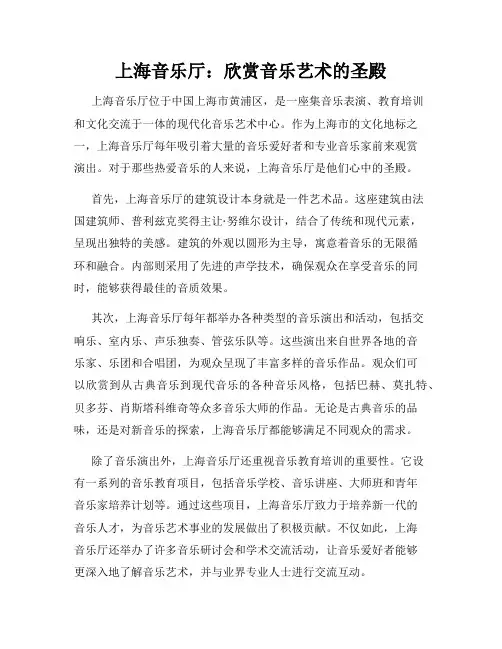
上海音乐厅:欣赏音乐艺术的圣殿上海音乐厅位于中国上海市黄浦区,是一座集音乐表演、教育培训和文化交流于一体的现代化音乐艺术中心。
作为上海市的文化地标之一,上海音乐厅每年吸引着大量的音乐爱好者和专业音乐家前来观赏演出。
对于那些热爱音乐的人来说,上海音乐厅是他们心中的圣殿。
首先,上海音乐厅的建筑设计本身就是一件艺术品。
这座建筑由法国建筑师、普利兹克奖得主让·努维尔设计,结合了传统和现代元素,呈现出独特的美感。
建筑的外观以圆形为主导,寓意着音乐的无限循环和融合。
内部则采用了先进的声学技术,确保观众在享受音乐的同时,能够获得最佳的音质效果。
其次,上海音乐厅每年都举办各种类型的音乐演出和活动,包括交响乐、室内乐、声乐独奏、管弦乐队等。
这些演出来自世界各地的音乐家、乐团和合唱团,为观众呈现了丰富多样的音乐作品。
观众们可以欣赏到从古典音乐到现代音乐的各种音乐风格,包括巴赫、莫扎特、贝多芬、肖斯塔科维奇等众多音乐大师的作品。
无论是古典音乐的品味,还是对新音乐的探索,上海音乐厅都能够满足不同观众的需求。
除了音乐演出外,上海音乐厅还重视音乐教育培训的重要性。
它设有一系列的音乐教育项目,包括音乐学校、音乐讲座、大师班和青年音乐家培养计划等。
通过这些项目,上海音乐厅致力于培养新一代的音乐人才,为音乐艺术事业的发展做出了积极贡献。
不仅如此,上海音乐厅还举办了许多音乐研讨会和学术交流活动,让音乐爱好者能够更深入地了解音乐艺术,并与业界专业人士进行交流互动。
此外,上海音乐厅还与世界各地的音乐厅和乐团进行了广泛的文化交流合作。
它定期邀请来自不同国家和地区的音乐家来上海进行演出和交流,推动了中外音乐文化的对话和融合。
同时,上海音乐厅也积极参与国际音乐节和音乐比赛,为上海市争得了宝贵的国际影响力。
最后,作为上海市的文化名片,上海音乐厅为城市的文化旅游产业发展做出了突出贡献。
每年,成千上万的观众慕名而来,为上海带来了巨大的经济效益。
音乐剧中的名词解释英文

音乐剧中的名词解释英文音乐剧(Musical)是一种结合了音乐、歌唱、对白和舞蹈的戏剧形式。
它是一门综合性艺术形式,通过演员演唱歌曲和表演剧情,向观众展示故事情节、传达情感和思想。
音乐剧源于19世纪末的欧美,如今已成为世界各地受欢迎的演艺形式之一。
音乐剧中有很多专有名词,这些名词常常是英文单词或短语,掌握它们对于理解和欣赏音乐剧至关重要。
在这篇文章中,我将解释一些音乐剧中常见的英文名词,帮助读者更好地了解这一艺术形式。
1. Overture(序曲)音乐剧通常以一段叫做Overture的音乐作为开场。
Overture是一首表达整个音乐剧主题的乐曲,由管弦乐队演奏。
它能在剧情开场前为观众创造一种期待感,并帮助观众进入剧情的氛围。
2. Prologue(前奏)Prologue是音乐剧开场的一段表演,通常用来引出剧情的背景和主要人物。
它可以是一个完整的场景或者是短暂的片段,通过音乐和表演向观众交代剧情的背景和故事的起点。
3. Act(幕)音乐剧通常分为两个或者更多个Act,每个Act之间通过幕布、舞台设置或者人物的出入进行转场。
每个Act都能带给观众新的情节发展和乐曲表演,使得整个音乐剧变得更加精彩有趣。
4. Ballad(抒情歌)Ballad是音乐剧中常见的一种歌曲形式,它通常用来表达角色的情感、内心独白或个人经历。
Ballad的歌词抒情,旋律通常悠扬柔美,带给观众一种深情的感受。
5. Ensemble(合唱)Ensemble是指一群演员同时演唱的歌曲,通过合唱可以展现出多个角色的情绪、互动和关系。
Ensemble常常在重要的情节发展、戏剧高潮或者大合唱的时候使用,给观众带来视听上的震撼。
6. Finale(结尾曲)Finale是音乐剧的结束部分,通常是一首大合唱或者全剧的总结曲目。
Finale能够汇集全剧的主题、情节和角色,带给观众一种强烈的感觉,同时也给予剧情一个圆满的收尾。
7. Choreographer(编舞者)Choreographer是音乐剧中负责设计和指导舞蹈的人员。
上音歌剧院历史保护建筑介绍

上音歌剧院历史保护建筑介绍在上音歌剧院的历史长河中,不仅有丰富的演出活动,还留存了许多具有历史价值和文化意义的建筑。
这些建筑见证了我国音乐事业的发展,也承载了无数音乐爱好者的梦想。
接下来,让我们继续深入了解上音歌剧院的历史保护建筑,感受它们的独特魅力。
一、建筑风格与特点上音歌剧院的历史保护建筑分为两部分,一部分是具有欧洲古典建筑风格的歌剧厅,另一部分是富有中国传统建筑特色的中式园林。
这两部分相互映衬,体现了中西文化的交融与碰撞。
1.歌剧厅:歌剧厅采用欧洲古典建筑风格,内部装饰华丽,观众席分为上下两层。
上层为包厢,下层为大厅。
包厢设计独特,使观众能够近距离欣赏表演。
大厅则宽敞明亮,营造出舒适的观演氛围。
2. 中式园林:中式园林部分以山水景观为主题,巧妙地融入了亭台楼阁、小桥流水等元素。
园林内绿树成荫,花草丛生,为观众提供了一个宁静的休憩场所。
在园林中漫步,仿佛能让人忘却城市的喧嚣,沉浸于优美的音乐之中。
二、保护建筑的意义上音歌剧院的保护建筑不仅具有美学价值,还具有很高的历史价值和社会价值。
它们是音乐文化的载体,见证了我国音乐事业的辉煌历程。
同时,这些建筑也是教育、演出、交流的重要场所,为培养音乐人才和推广音乐文化发挥了重要作用。
三、传承与创新在保护历史建筑的同时,上音歌剧院还致力于传承和创新音乐文化。
剧院通过举办各类音乐会、大师课、音乐讲座等活动,为观众提供丰富的音乐体验。
此外,剧院还积极培养年轻音乐家,为他们提供展示才华的舞台。
在传承经典的同时,鼓励创新,使音乐文化不断焕发生机。
四、未来发展面对未来,上音歌剧院将继续深化保护历史建筑的工作,让更多人了解和欣赏这些珍贵的文化遗产。
同时,剧院还将拓宽演出领域,引进更多优秀的国内外演出团队,提升音乐品质,为广大观众带来更高水平的音乐盛宴。
结语上音歌剧院的历史保护建筑是音乐文化的瑰宝,它们见证了我国音乐事业的繁荣与发展。
让我们共同努力,传承和发扬这些宝贵的历史遗产,为音乐事业的未来添砖加瓦。
音乐馆的简介英文作文
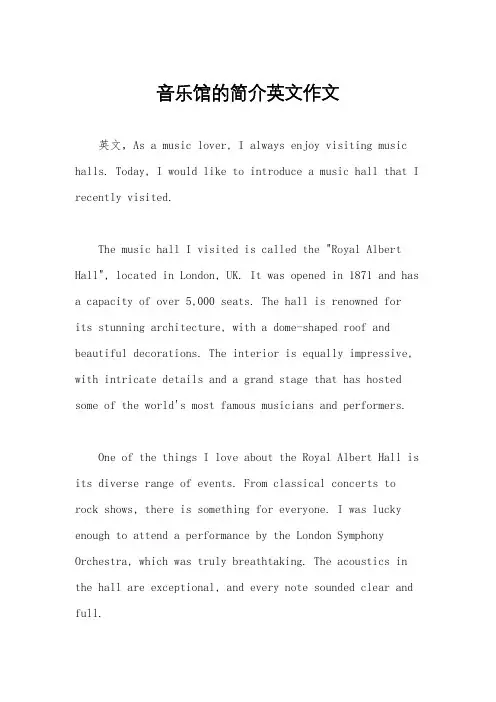
音乐馆的简介英文作文英文,As a music lover, I always enjoy visiting music halls. Today, I would like to introduce a music hall that I recently visited.The music hall I visited is called the "Royal Albert Hall", located in London, UK. It was opened in 1871 and has a capacity of over 5,000 seats. The hall is renowned forits stunning architecture, with a dome-shaped roof and beautiful decorations. The interior is equally impressive, with intricate details and a grand stage that has hosted some of the world's most famous musicians and performers.One of the things I love about the Royal Albert Hall is its diverse range of events. From classical concerts to rock shows, there is something for everyone. I was lucky enough to attend a performance by the London Symphony Orchestra, which was truly breathtaking. The acoustics in the hall are exceptional, and every note sounded clear and full.Another thing that sets the Royal Albert Hall apart is its history. Over the years, it has hosted some of the most iconic events in music history, including the first ever performance of "The Proms" in 1895. The hall has also been used for a variety of other events, from political ralliesto boxing matches.Overall, I would highly recommend visiting the Royal Albert Hall if you are ever in London. It is a must-see for any music lover, and the experience is truly unforgettable.中文,作为一个音乐爱好者,我总是喜欢去音乐馆参观。
国内音乐厅简介
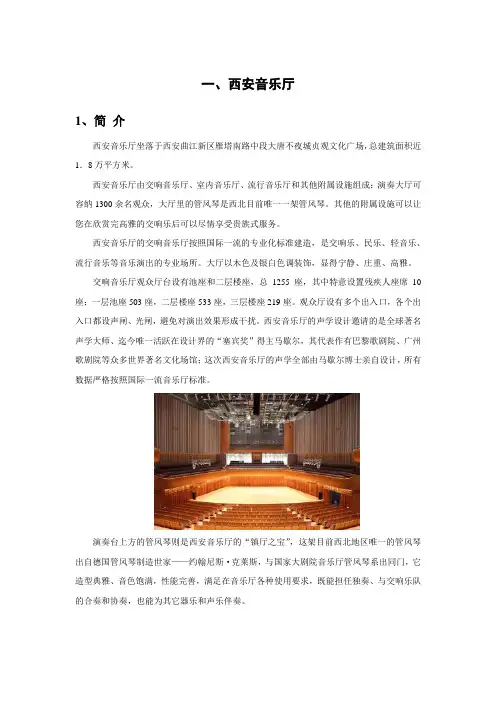
一、西安音乐厅1、简介西安音乐厅坐落于西安曲江新区雁塔南路中段大唐不夜城贞观文化广场,总建筑面积近1.8万平方米。
西安音乐厅由交响音乐厅、室内音乐厅、流行音乐厅和其他附属设施组成:演奏大厅可容纳1300余名观众,大厅里的管风琴是西北目前唯一一架管风琴。
其他的附属设施可以让您在欣赏完高雅的交响乐后可以尽情享受贵族式服务。
西安音乐厅的交响音乐厅按照国际一流的专业化标准建造,是交响乐、民乐、轻音乐、流行音乐等音乐演出的专业场所。
大厅以木色及银白色调装饰,显得宁静、庄重、高雅。
交响音乐厅观众厅台设有池座和二层楼座,总1255座,其中特意设置残疾人座席10座;一层池座503座,二层楼座533座,三层楼座219座。
观众厅设有多个出入口,各个出入口都设声闸、光闸,避免对演出效果形成干扰。
西安音乐厅的声学设计邀请的是全球著名声学大师、迄今唯一活跃在设计界的“塞宾奖”得主马歇尔,其代表作有巴黎歌剧院、广州歌剧院等众多世界著名文化场馆;这次西安音乐厅的声学全部由马歇尔博士亲自设计,所有数据严格按照国际一流音乐厅标准。
演奏台上方的管风琴则是西安音乐厅的“镇厅之宝”,这架目前西北地区唯一的管风琴出自德国管风琴制造世家——约翰尼斯·克莱斯,与国家大剧院音乐厅管风琴系出同门,它造型典雅、音色饱满,性能完善,满足在音乐厅各种使用要求,既能担任独奏、与交响乐队的合奏和协奏,也能为其它器乐和声乐伴奏。
流行乐厅整体装饰采用黑色金属网材质,呈现倒扇形的平面形状,保证最优秀的视线和声场分布。
观众座席分池座和楼座两层,共计138座。
流行音乐厅还专门配备有专业的灯光、音像设备,主要用于电声乐队表演、流行乐队演出,原创音乐会,音乐沙龙等活动。
室内音乐厅以银白色调装饰,宁静、清新。
观众厅呈现倒扇形的平面形状,观众座席分池座和楼座两层,共计138座。
主要用于室内乐演出、个人器乐独奏、艺术家大师课等。
附属设施包括有:商务洽谈和会员接待的商务中心、可供60人录音的大录音室和三个小录音室组成的数字录音棚、咖啡厅、红酒吧、贵宾厅、存放了供艺术家使用的德国原厂施坦威和意大利法西奥利三脚钢琴及数十架世界名琴、乐器琴房和分别供指挥、首席、独奏家、独唱家、演奏员及合唱团员休息、练琴、练声的化妆间。
音乐厅用英语怎么说

音乐厅用英语怎么说音乐厅,顾名思义就是音乐的厅堂,是举行音乐会及音乐相关活动的场所,是人们感受音乐魅力的地方。
那么你知道音乐厅用英语怎么说吗?下面和店铺一起来学习一下音乐厅的英语说法吧。
音乐厅的英语说法1:odeum音乐厅的英语说法2:Concert Hall音乐厅的英语说法3:music hall音乐厅相关英语表达:迪士尼音乐厅 Disney Concert Hall王家音乐厅乐团 Royal Concertgebouw Orchestra国家音乐厅 National Concert Hall音乐厅的英语例句:1. Big concert halls do not faze Melanie.巨大的音乐厅不会让梅拉妮发慌。
2. The Albert Hall is a huge auditorium.艾伯特音乐厅是一个大型音乐厅。
3. This piece really belongs in the concert hall.这曲子很适合在音乐厅演奏。
4. The acoustics of the new concert hall are excellent.新音乐厅的传声效果极佳。
5. The Queen attended a gala concert at the Royal Festival Hall.女王出席了在皇家音乐厅举行的音乐盛会.6. The acoustics of the new concert hall are excellent.这座新音乐厅的音响效果极好.7. To christen the new hall, a number of great orchestras havebeen invited to play.几个著名交响乐团受邀演出,以庆祝新音乐厅的启用。
8. Mr Ashkenazy has informed us that he will be unable to honour his contract with Symphony Hall to perform the piano recital.阿什克纳齐先生已通知我们,他将无法履行和交响音乐厅签订的钢琴独奏演出合同。
unit1 more reading-The concert hall which moved
1.Lift
v.
a.举起 抬起 使升起 I can’t lift this bag, it’s too heavy. He was too weak even to lift his hand. The good news lifted his spirits.
Lift n.
a.
电梯 He took the lift to the 14th floor. b. 搭便车 give sb a lift Can I give you a lift home? thumb a lift to s.p. c.情绪更振奋 Passing the exam gave me a real lift.
在59台千斤顶的作用下 以每分钟2毫米的速度向上 抬升 ,抬升后的音乐厅与 地面已出现空隙,一块10 厘米左右高的混凝土垫块 充填了空隙。以后千斤顶 每顶高10厘米,施工人员 就要往音乐厅底下放垫块, 在垫块的基础上再向上顶。
顶升只是上海音乐厅平移 工程的第一步。音乐厅将 在原地抬升1.70米,预计 10天左右抬升到位,抬升 到位后,再用20天左右时 间进行音乐厅下部的滑道 安装,安装完毕后将正式 进行平移顶推,10天后 “搬迁”到宁海路、龙门 路口。平移到位后音乐厅 将再次顶升1.68米,下面 浇铸新的地基与原有结构 对接
上海音乐厅赭红色的外 墙已被二十多根粗大 的钢衍架“五花大 绑”,内部1000多平 方米的大厅布满了用 于固定的钢架,穹顶、 旋梯等关键部位还得 到了“特别照顾”
音乐厅的基座已被转移到一个新建的1800吨钢筋 混凝土托盘之上,而这个可以移动的托盘正是使 重达5650吨的上海音乐厅“能上能走”的关键。
3.Be used for …被用来
The knife was only used for cutting fruit.
音乐馆的简介英文作文
音乐馆的简介英文作文英文回答:The Concert Hall is a world-renowned venue that has hosted some of the most celebrated musicians and orchestras in history. Inaugurated in 1900, the Concert Hall is a magnificent example of Beaux-Arts architecture, with its grand facade, ornate interior, and exceptional acoustics.The Concert Hall has a long and storied history. It was originally built as the home of the Boston Symphony Orchestra (BSO), and it has been the orchestra's primary performance space ever since. Over the years, the Concert Hall has also hosted countless other musical events, including recitals, chamber music concerts, and opera performances.The Concert Hall is known for its exceptional acoustics. The hall's design was carefully planned to create a warmand reverberant sound that is perfect for classical music.The hall's acoustics have been praised by musicians and audiences alike, and it is considered one of the best concert halls in the world.In addition to its musical offerings, the Concert Hall also offers a variety of educational programs and community outreach initiatives. The hall's Education Departmentoffers a wide range of programs for students of all ages, from school tours to master classes with BSO musicians. The Concert Hall also partners with local organizations to provide free or discounted tickets to underserved communities.The Concert Hall is a vital part of the Boston arts scene. It is a place where people can come to experience the joy of live music, learn about music history, and connect with the community. The Concert Hall is a treasure that has enriched the lives of generations of Bostonians.中文回答:音乐馆是世界著名的场馆,这里曾举办过有史以来一些最著名的音乐家和管弦乐队的演出。
上海著名景点英文介绍(附图)
※ShanghaiOriental Pearl Tower之迟辟智美创作The Oriental Pearl Tower is a TV tower in Shanghai, China. The Oriental Pearl Tower is located at the tip of Lujiazui in the Pudong district, by the side of Huangpu River, opposite of The Bund.It was designed by the Shanghai Modern Architectural Design Co. Ltd. Principal designers are Jiang Huan Chen, Lin Benlin and Zhang Xiulin. Construction began in 1990 and the tower was completed in 1994. At 468 m (1,535 feet) high, it was the tallest structure in China (excluding Taiwan; see Taipei 101) from 1994–2007, when it was surpassed by the Shanghai World Financial Center.The spheres in the towerThe tower features 11 spheres, big and small. The two largest spheres, along the length of the tower, have diameters of 50 m (164 ft) for the lower and 45 m (148 ft) for the upper. They are linked by three columns, each 9 m (30 ft) in diameter. The highest sphere is 14 m (46 ft) in diameter.The entire building is supported by three enormous columns that start underground.Observation levelsThe tower has fifteen observatory levels. The highest (known as the Space Module) is at 350 m (1148 ft). The lower levels are at 263 m (863 ft) (Sightseeing Floor) and at 90 m (295 ft) (Space City). There is a revolving restaurant at the 267 m (876 ft) level. The project also contains exhibition facilities, restaurants and a shopping mall. There is also a 20-room hotel called the Space Hotel between the two large spheres.Antenna spireAn antenna, broadcasting TV and radio programs, extends the construction by another 118 m (387 ft) to a total height of 468 m (1,535 ft).Chinese symbolism in the designThe design of the building is said to be based on a verse of the Tang Dynasty poem Pipa Song by Bai Juyi about the wonderful sprinkling sound of a pipa instrument, like pearls, big and small falling on a jade plate. However, the designer Jiang Huancheng says that he did not have the poem in mind when designing the tower. It was the chief of the jury board who said it reminded him of that poem.※Shanghai World Financial CenterThe Shanghai World Financial Center is a supertallskyscraper located in the Pudong district of Shanghai, China. It was designed by Kohn Pedersen Fox and developed by Mori Building. It is a mixed-use skyscraper, consisting of offices, hotels, conference rooms, observation decks, and ground-floor shopping malls. Park Hyatt Shanghai is the hotel component, containing 174 rooms and suites. Occupying the 79th to the 93rd floors, it is the second-highest hotel in the world, surpassing the Grand Hyatt Shanghai on the 53rd to 87th floors of the neighboring Jin Mao Tower.On 14 September 2007, the skyscraper was topped out, at 492.0 meters (1,614.2 ft) making it the second-tallest building in the world at the time, and the tallest structure in the People's Republic of China prior to the construction of the nearby Shanghai Tower. It also had the highest occupied floor and the highest height to roof, two categories used to determine the title of "The World’s Tallest Building".On 28 August 2008, the SWFC officially opened for business. Two days later, the world's tallest observation deck opened, offering views from 474 m (1,555 ft) above ground level. TheSWFC continues to have the tallest observation deck in the world.The SWFC has been lauded for its design, and in 2008 it was named by architects as the year's best completed skyscraper. HistoryDesigned by Kohn Pedersen Fox, the 101-story tower was originally planned for construction in 1997, but work was temporarily interrupted by the Asian Financial Crisis in the late 1990s and later to accommodate design changes by Mori Building Co. The building of the tower is financed by several multinational firms, including Chinese, Japanese, and Hong Kong banks, as well as by the Japanese developer and as-yet unnamed American and European investors. American investment bank Morgan Stanley is coordinating the financing for Mori Building.ConstructionThe foundation stone was laid on 27 August 1997. In the late 1990s the Pierre de Smet Building Corporation had a fund shortage caused by the Asian financial crisis in 1997 to 1998, which halted the project after the foundations were completed.On 13 February 2003, the Mori Group increased the building's height to 492 m and 101 stories from the initial plans for a 460 m (1,509 ft), 94-story building. The new building would use the foundation of the original design. The building construction resumed on 16 November 2003.The building reached its total height of 492 m on 14 September 2007 after installation of the final steel girder. The final cladding panels were installed in mid June 2008, and elevator installation was finished in mid July 2008. On 17 July 2008 The Shanghai World Financial Center was completed and on 28 August 2008, the SWFC officially opened for business. On 30 August 2008, the observation floors were opened to the public.ArchitectureThe most distinctive feature in the design of the building is an aperture at the peak. The original design specified a circular aperture, 46 m (151 ft) in diameter, to reduce the stresses of wind pressure, as well as serve as a subtext for the design, since "Chinese mythology represents the earth with a square and the sky with a circle".It also resembled a Chinese moon gate due to its circular form in Chinese architecture. However, this initial design began facing protests from some Chinese, including themayor of Shanghai, who considered it too similar to the rising sun design of the Japanese flag. Pedersen then suggested that a bridge be placed at the bottom of the aperture to make it less circular. On 18 October 2005, KPF submitted an alternative design to Mori Building and a trapezoidal hole WordStrd the circle at the top of the tower, which in addition to changing the controversial design, would also be cheaper and easier to implement according to the architects. In the eyes of some, the building resembles a giant bottle opener. In fact, metal replicas of the building that function as actual bottle openers are sold in the observation deck gift shop.There are 3 observation decks in Shanghai World Financial Center. The height of its lowest observation deck (观光年夜厅) is 423 m (1,388 ft), on the 94th floor, the second is 439 m (1,440 ft) high, on the 97th floor, named "Observatory Bridge" (观光天桥), and the highest (观光天阁) is 474 m (1,555 ft) high, on the 100th floor. Admission ranges from 100 RMB (15.4 USD) for the 94th floor only to 150 RMB (about 23.1 USD) for all three observation decks.The skyscraper's roof height is set at 492 m, and has temporarily claimed the highest roof in the world. Before construction resumed on the roof, tower height was scheduled to be 509.2 m(1,671 ft) so the building would hold the title of the world's tallest building (structural top) over the Taipei 101, but a height limit was imposed, allowing the roof to reach a maximum height of 492 m. Architect William Pedersen and developer Minoru Mori have resisted suggestions to add a spire that would surpass that of Taipei 101 and perhaps One World Trade Center, calling the Shanghai WFC a "broad-shouldered building". The SWFC boastsa gross floor area of more than 377,300 m2 (4,061,200 sq ft) and31 elevators and 33 escalators.AwardsShanghai World Financial Center was named by architects as the best skyscraper completed in 2008 receiving both the Best Tall Building Overall and Asia & Australasia awards from the Council on Tall Buildings and Urban Habitat (CTBUH). CTBUH's Carol Willis, head of New York's Skyscraper Museum, states: "The simplicity of its form as well as its size dramatizes the idea of the skyscraper." Architect Tim Johnson noted its innovative structural design: "Steel trusses gird against the forces of wind and earthquake and made the building lighter, made it use less steel, and contributed to its sustainability." Johnson described the SWFC's structure as "nothing short of genius."※Huangpu River cruiseIf you cruise by the river you will see hundreds of cargo and passenger ships. You don't remain indifferent to beauty of four Shanghai bridges: Xupu, Lupu, Nanpu and Yangpu. The splendid array of structures resembles misty ice palaces in a riot of colors-golden yellow, pure white and aquamarine blue. Constantly changing colors mesmerize.It is also a major water source for Shanghai. Huangpu Rver, known as the mother river of Shanghai, which rises in the Tai Lake, Jiangsu Province, flows through the urban area of the city and empties into the mouth of the Yangtze River, with a total length of 112 kilometers. First of all the river is thruway for Shanghai.History and CultureHuangpu River, 97 km long, rising in the lake district of Shanghai Municipality, East China, and flowing northeast past Shanghai into the Chang estuary at Wusong. The Huangpu River can also be called either the Chun Shen River or the Huang Xie River.It is also a major water source for Shanghai, and as the city has grown it has suffered from water shortages and polluted drinking water; in 1996 a project to divert water from the Chang River (Yangtze) to the Huangpu was completed. The cruise boatmeanders eastward along the golden waterway to the intriguing "three-layer waters" at the Wusong Mouth, confluence of the three and half hours over a distance of 60 kilometers, with beautiful view emerging one after another.Its famous riverside avenue, with its park-like green areas and tall buildings, is Shanghai's landmark. Here, the visitor stands in front of magnificent buildings in the art nouveau style that once housed the clubs, banks, companies and hotels of the foreign rulers.※Madame Tussauds Gallery in ShanghaiThe second Asian outlet is located in the Chinese city of Shanghai. Attracted by Shanghai's growing reputation and tourism volume in East Asia, the Tussauds Group approached Shanghai authorities to discuss the possibility of opening its second Asian location in early 2004. The Shanghai authorities agreed with the proposal and Madame Tussauds Shanghai was opened on 1 May 2006 on the 10th floor of the New World Department Store at West Nanjing Road.The Shanghai outlet houses nearly 75 wax figures of local and internationally-known celebrities to date, and will add more in its second and third phases. The museum opens all year round from 10 am to 10 pm daily and it is divided up into seven themed sections: Glamour, Behind the Scenes, History and Heroes,Music, Film, Speed and Sport. Admission fee is RMB 135 (US$20) for adults and RMB 100 for students. Madame Tussauds Shanghai is the Tussauds Group's sixth waxwork museum after London, Amsterdam, Las Vegas, New York City and Hong Kong※City God Temple of ShanghaiThe City God Temple or Chenghuang Miaois a temple located in Shanghai, China, within the old walled city. Today the "City God Temple" not only refers to the large temple complex, but also the traditional district of commerce in the city, surrounding the temple. There are over a hundred stores and shops in this area, and most of these store buildings are nearly a century old. The temple connects to the Yuyuan Garden, another landmark of the old city.The temple's surrounding area and vicinity is a large commercial district that hosts an array of shops, restaurants, teahouses, as well as annual temple fair events.A paifang adjacent to the temple One of the altars of the templePavilions and teahouses in the ChenghuangThe streets of Chenghuang MiaoMiao areaRegardless of size, many walled cities in ancient China contained a temple dedicated to one or more immortal or god as the spirit(s) or protector(s) of the city.The City God Temple in Shanghai originated as the Jinshan God Temple, dedicated to the spirit of Jinshan, or "Gold Mountain", an island off the coast of Shanghai. It was converted into a City God Temple in 1403, during the Yongle era of the Ming dynasty. During the Qing Dynasty, the temple grew popular. Residents of the old city as well as nearby areas visited the temple to pray for good fortune and peace. The temple reached its largest extent in the Daoguang era. The popularity of the temple also led to many businesses being set up in the area, turning the surrounding streets into a busy marketplace.In 1951, the Board of Trustees of the City God Temple was dissolved, and the temple was handed over to the Shanghai Taoist Association and made into a Taoist center. The institution made changes to the temple, removing statues representing folk Underworld personalities such as Yama, the judge of the dead, and placing an emphasis on Taoist spirituality instead.During the Cultural Revolution, the temple was closed down and used for other purposes. For many years, the main hall was used as a jewellery shop. In 1994, the temple was restored to its former use as a temple, with resident Taoist priests. The Temple, together with nearby Yuyuan Garden and the surrounding streets, are now part of a large pedestrian zone dedicated to restaurants and retail.A complete restoration of the City God Temple took place between 2005 and 2006. In October 2006 the place of worship was reopened and reconstructed by Taoist clergymen.※Yu Yuan GardenYu Yuan GardenYu Yuan Garden located in the center of the Old City next to the Chenghuangmiao area in Shanghai, China, is considered one of the most lavish and finest Chinese gardens in the region. The garden is accessible from the nearby Yuyuan Garden Station on the Shanghai Metro line 10.HistoryThe garden was first established in 1559 as a private garden created by Pan Yunduan, who spent almost 20 years building agarden to please his father Pan En, a high-ranking official in the Ming Dynasty, during his father's old age. Over the years, the gardens fell into disrepair until about 1760 when bought by merchants, before suffering extensive damage in the 19th century. In 1842, during the Opium Wars, the British army occupied the Town God Temple for five days. During the Taiping Rebellion the gardens were occupied by imperial troops, and damaged again by the Japanese in 1942. They were repaired by the Shanghai government from 1956–1961, opened to the public in 1961, and declared a national monument in 1982.DesignYu Yuan GardenToday, Yuyuan Garden occupies an area of 2 hectares (5 acres), and is divided into six general areas laid out in the Suzhou style:Grand Rockery - rockery made of huangshi stone (12 m high), featuring peaks, cliffs, winding caves and gorges. This scenery was possibly created by Zhang Nanyang in the Ming Dynasty. This area also contains the Sansui (Three Corn Ears) Hall.Heralding Spring Hall (Dianchun) - built in 1820, the first year of the Emperor Daoguang's reign. From September 1853 to February 1855, it served as the base of the Small Swords Society.Inner Garden - rockeries, ponds, pavilions, and towers, first laid out in 1709 and more recently recreated in 1956 by combining its east and west gardens.Jade Magnificence Hall (Yuhua) - furnished with rosewood pieces from the Ming Dynasty.Lotus Pool - with a zigzag bridge and mid-lake pavilion.Ten Thousand-Flower Tower (Wanhua)Garden areas are separated by "dragon walls" with undulating gray tiled ridges, each terminating in a dragon's head.Features•Sansui Hall •YangshanHall•HugeRockery •Cuixui Hall •RelaxationStone Boat •Yule Pavilion •Double Lane Corridor •Wanhua •Nine LionStudy•Ancient WellPavilion•Relic Hall•Dianchun Hall•Acting andSinging Stage•KualiouPavilion•Hexu Hall•Huijing Tower•Yuhua Hall•Deyue Chamber•Jade Water Corridor•Depository of Booksand Paintings•Exquisite Jade Rock•Huanlong Bridge•Inner Garden•Jingguan Tower•Guantao Tower•Dress Circle•Keyl Hall•Stone Boat•Big Stage•Mid-LakePavilion•Nine ZigzagBridge•Master LaoHalChamber •Gingko Tree •Toasting Pavilion※TianZiFangHave you ever been to shanghai? If you are going to travel to shanghai, you must have a walk at TianZiFang, which locates at Kangtai Street in shanghai.Comparing with the brand new modern buildings, you can find the special architecture of old shanghai city. Peoples, who lived in shanghai in their life, still live here. It’s such a peaceful and quiet place to live.On the other hand, it’s also a good shopping area. There are a lot of beautiful, special and unique goods. The stores are little, but very characteristic with full of art beauty. The whole shopping area is not so large, but you will enjoy walking here and find out a lot of fun. When you’re tired, you can go to one of the little cafe or bar to have a drink or cake. What a beautiful day!(End)。
中国上海国际艺术节节目介绍中英文时地
第十四届中国上海国际艺术节参演节目单(9月12日艺术节新闻发布会版本)1.上海大剧院和奥地利萨尔茨堡艺术节联合制作歌剧《波西米亚人》时间:10月18-20日地点:上海大剧院OperaLa Bohemiaby Shanghai Grand Theater and Austria Salzburg Art Festival Dates: Oct.18-20 Venue: Shanghai Grand Theatre2.俄罗斯著名小提琴家瓦汀•列宾音乐会时间:10月19日地点:上海音乐厅Violin Recitalby Vadim Repin, Russia violinistDate: Oct.19 Venue: Shanghai Concert Hall3.音乐剧金曲盛典《极致百老汇》2012升级版时间:10月19日-28日地点:文化广场Songs from Musical ClassicsUltimate BroadwayDates: Oct.19-28 Venue: Culture Square4.国家京剧院京剧《韩玉娘》时间:10月19日地点:逸夫舞台Beijing OperaHan Yuniangby China National Beijing Opera CompanyDates: Oct.19 Venue: Yifu Stage5.太原舞蹈团舞剧《千手观音》时间:10月19日-21日地点:城市剧院Dance DramaOne-Thousand-Hand Avalokitesvaraby Taiyuan Dance CompanyDates: Oct.19-21 Venue: City Theater6.澳大利亚悉尼交响乐团音乐会(阿什肯纳齐指挥,王健独奏)时间:10月24日地点:东艺音乐厅Concert by the Sydney Symphony(Conductor: Vladimir Ashkenazy, Soloist: Wang Jian) Dates: Oct.24 Venue: Oriental Art Center Concert Hall7.中德青少年合作现代舞《火鸟》时间:10月24日地点:上海大剧院Modern DanceFirebirdCooperated by Chinese and German TeenagersDates: Oct.24 Venue: Shanghai Grand Theater8.成都军区战旗文工团大型原创民族舞剧《英雄格萨尔》时间:10月24日、25日地点:东艺歌剧厅Dance DramaKing Gesarby the Zhanqi Art Ensemble of the Chengdu Military Region Dates: Oct.24-25 Venue: Oriental Art Center Opera Hall9.上海昆剧团新编历史剧《景阳钟变》时间:10月26日地点:逸夫舞台New Edition of Historical PlayThe Final Days of Chongzhen Emperorby Shanghai Kun TheatreDate: Oct.26 Venue: Yifu Stage10.谷村新司上海演唱会时间:10月26日地点:上海大剧院Solo Recital by Shinji TanimuraDate: Oct.26 Venue: Shanghai Grand Theatre11.英国动感多媒体舞蹈团《水形百态》时间:10月27日、28日地点:东艺歌剧厅Scatteredby Motionhouse, BritainDates: Oct.27-28 Venue: Oriental Art Center Opera Hall12.2012中国京剧名家名剧系列演出《京剧流派演唱会》时间:10月27日地点:逸夫舞台Concert for China Beijing Opera Masters, Classics and SchoolsDate: Oct.27 Venue: Yifu Stage13.日本动漫音乐上海超级盛典时间:10月27日地点:奔驰文化中心Japan’s Super Animation Music ConcertAnisama in ShanghaiDate: Oct.27 Venue: Mercedes-Benz Arena14. 上海交响乐团与石勒苏益格-荷尔斯泰因节日合唱团音乐会时间:10月27日地点:东艺音乐厅Concertby the Choir Academy of the Schleswig-Holstein Music Festival, Germany Date: Oct.27 Venue: Oriental Art Center Concert Hall15.艾纽纳——爱尔兰国家合唱团《王者之声》音乐会时间:10月28日地点:上海音乐厅Concertby Anuna, Ireland’s National ChoirDate: Oct.28 Venue: Shanghai Concert Hall16.无锡市演艺集团歌舞剧院原创舞剧《绣娘》时间:10月29日地点:上海大剧院Date: Oct.29Dance Drama Xiu Niang by Wuxi Musical Drama TheatreVenue: Shanghai Grand Theater17.德国德累斯顿国家管弦乐团交响音乐会(蒂勒曼指挥)时间:10月30日、31日地点:上海大剧院Concertby Sächsische Staatskapelle Dresden (Con ductor: Thielemann)Dates: Oct.30-31 Venue: Shanghai Grand Theater18.中央民族乐团音乐会《江山如此多娇》时间:10月30日地点:文化广场ConcertThe Land So Rich in Beautyby China Central National OrchestraDate: Oct.30 Venue: Culture Square19.英国盲顶剧团新木偶剧《桌子》时间:10月30日、31日地点:1933老场坊空中剧院New Puppet ShowThe Tableby Blind Summit,BritainDates: Oct.30-31 Venue: Theater of 1933 Old Millfun20.杨丽萍——舞剧《孔雀》时间:10月31日-11月2日地点:东艺歌剧厅Ethnic Dance DramaPeacockby Yang LipingDates: Oct.31-Nov.2 Venue: Oriental Art Center Opera Hall21.意大利著名青年歌唱家音乐会时间:10月31日东艺音乐厅Concertby Famous Young Singers from ItalyDate: Oct.31 Venue: Oriental Art Center Concert Hall22.湖北省京剧院京剧《建安轶事》时间:11月2日地点:逸夫舞台Beijing OperaJian’an Anecdotesby Hubei Beijing Opera TheatreDate: Nov.2 Venue: Yifu Stage23.台湾爱乐乐团音乐会(吕绍嘉指挥,林以信独奏)时间:11月2日地点:东艺音乐厅Concertby Taiwan Philharmonic Orchestra (Conductor: Shao-Chia Lü, Dual Violin Recital: Lin Yixin)Date: Nov.2 Venue: Oriental Art Center Concert Hall24.中国国家话剧院话剧《理查三世》时间:11月2日-4日地点:艺海剧院Shakespeare’s DramaRichard IIIby China National TheatreDates: Nov.2-4 Venue: Shanghai Arts Theatre25.上海幽篁古韵古琴艺术团中国古琴群英音乐会时间:11月3日地点:上海音乐厅Chinese Guqin Concertby Shanghai Youhuang Guyun Guqin Art TroupeDate: Nov.3 Venue: Shanghai Concert Hall26.德国斯图加特芭蕾舞团芭蕾舞剧《茶花女》时间:11月3日、4日地点:上海大剧院BalletLa Traviataby the Stuttgart Ballet, GermanyDates: Nov.3-4 Venue: Shanghai Grand Theater27.忆莲•佩姬上海演唱会时间:11月3日、4日地点:文化广场Vocal Recitalby Elaine PaigeDates: Nov.3-4 Venue: Culture Square28.廖昌永和他的朋友们音乐会时间:11月4日地点:东艺音乐厅Recitalby Liao ChangyongDate: Nov.4 Venue: Oriental Art Center Concert Hall29.河南省豫剧二团豫剧《清风亭上》时间:11月5日地点:东艺歌剧厅Yu OperaAt the Qing Feng Pavilionby the Second Yu Opera Troupe of Henan ProvinceDate: Nov.5 Venue: Oriental Art Center Opera Hall台湾豫剧团新编豫剧《花嫁巫娘》时间:11月3日地点:上戏剧院New Version Yu Opera The Sorceress Bride By Taiwan Yu Opera Troupe Date:Nov.3 Venue:STA Theater30.河南省话剧院话剧《红旗渠》时间:11月6日、7日地点:上海大剧院DramaRed Flag Canalby Henan TheatreDates: Nov.6-7 Venue: Shanghai Grand Theater31.上海话剧艺术中心原创话剧《钢的琴》时间:11月6日、7日地点:艺海剧院DramaThe Piano in a Factoryby Shanghai Dramatic Arts CenterDates: Nov.6-7 Venue: Shanghai Arts Theater32.英国韦恩·麦克格雷戈尔兰登舞蹈团现代舞《本质》时间:11月9日、10日地点:东艺歌剧厅Modern Dance SpecialEntityby Wayne McGregor / Random Dance Company of BritainDates: Nov.9-10 Venue: Oriental Art Center Opera Hall33.上海歌剧院原创舞剧《周璇》时间:11月10日地点:上海大剧院Original Dance Drama Zhou Xuan by Shanghai Opera HouseDates: Nov. 10Venue: Shanghai Grand Theater34.刘谦世界魔术巡回之旅2012上海站公演时间:11月10日、11日地点:长宁体操中心Magic Showby Liu QianDates: Nov.10-11 Venue: Changning Gymnastics Center35.2012日本时尚音乐组合“钻石犬神”——炫舞演唱会时间:11月10日、11日地点:文化广场Concertby Japanese Fashion Music Unit Diamond InugamiDates: Nov.10-11 Venue: Culture Square36.万山红上海演唱会时间:11月11日地点:上海大剧院Recital by Wan ShanhongDate: Nov. 11Venue: Shanghai Grand Theater37.无锡锡剧院锡剧《二泉映月·随心曲》时间:11月13日、14日地点:东艺歌剧厅Xi OperaThe Moon Reflected in the Second Spring - Heart Songsby the Xi Opera Company of WuxiDates: Nov.13-14 Venue: Oriental Art Center Opera Hall38.美国旧金山交响乐团音乐会(蒂尔森指挥,王羽佳独奏)时间:11月14日、15日地点:东艺音乐厅Concertby the San Francisco Symphony(Conductor: Steve , Soloist: Yujia Wang)Dates: Nov.14-15 Venue: Oriental Art Center Concert Hall39.中国国家芭蕾舞团芭蕾舞剧《牡丹亭》时间:11月14日地点:文化广场BalletPeony Pavilionby China National Ballet CompanyDate: Nov.14 Venue: Culture Square中国国家芭蕾舞团芭蕾舞剧《红色娘子军》时间:11月16日、17日文化广场BalletRed Detachment of Womenby China National Ballet CompanyDates: Nov.16-17 Venue: Culture Square40.国家大剧院大型京剧《赤壁》时间:11月14日、15日地点:上海大剧院Beijing OperaRed Cliffby National Center for the Performing ArtsDates: Nov.14-15 Venue: Shanghai Grand Theater41.上海音乐学院意大利经典——帕格尼尼国际小提琴比赛金奖获得者黄滨、宁峰音乐会时间:11月16日地点:东艺音乐厅Concertby Shanghai Conservatory Symphony Orchestra and the First Price winners in Paganini International Violin Competition Huang Bing and Ning Feng Date: Nov.16 Venue: Oriental Art Center Concert Hall42.以色列伊什剧院肢体喜剧《奥德修斯》时间:11月16日-18日地点:话剧艺术中心Physical Comedy "Odysseus" by Ish Theater, IsraelDates: Nov. 16-18Venue: Dramatic Arts Center43.维也纳音乐平台室内乐团音乐会时间:11月17日地点:东艺音乐厅Concert by Chamber Orchestra of Vienna Music PlatformDate: Nov.17 Venue: Oriental Art Center Concert Hall44.上海爱乐乐团陈其刚作品音乐会(汤沐海指挥)时间:11月18日地点:上海音乐厅Concert for Chen Qigang’s MusicBy Shanghai Philharmonic Orchestra with Tang Muhai as Conductor Date: Nov.18 Venue: Shanghai Concert Hall45.上海芭蕾舞团原创芭蕾舞剧《简•爱》时间:11月18日、19日地点:上海大剧院Original BalletJane Eyreby Shanghai BalletDates: Nov.18-19 Venue: Shanghai Grand Theater46.俄罗斯马林斯基剧院交响乐团交响音乐会(捷杰耶夫指挥,郎朗独奏)时间:11月20日地点:东方艺术中心Concertby Mariinsky Theatre Orchestra (Conductor: Valery Gergiev, Solo: Lang Lang)Date: Nov.20 Venue: Oriental Art Center Concert Hall中国上海国际艺术节“扶持青年艺术家计划”委约作品首演《上海·梦》Shanghai ·Dream Premiere of 2012 R.A.W! Commissioned WorksChina Shanghai International Arts Festival Young Talents Program。