
英美概况美国部分整理
America➢The Founding of Colonies殖民地的建立First Inhabitants:American IndiansDiscovery of the New World:1492 Christopher Columbus →the discoverer of America(Italian)Spanish Queen’ s support1501-2 Amerigo Vespucci →the new land was name after him as America.reached the mouth of Amazon RiverAmerica—the New WorldEurope—the Old World13 colonies:New England Colonies: Mid Atlantic Colonies: Southern Colonies:Massachusetts →(2nd colony,1620)New York MarylandNew Hampshire Pennsylvania Virginia →(1st colony,1607)Rhode Island Delaware North CarolinaConnecticut South CarolinaGeorgia →(the last colony,1733)New England Region(6个): Massachusetts, Rhode Island, Connecticut, New Hampshire, Maine and Vermont建立原因:Virginia, 1607Virginia CompanyFor foreign expansion as a way of easing religious dispute and economic distress in England105 men (no women)Jamestown in honor of the kingMassachusetts In 1620102 Puritans (“Pilgrim Fathers”), in Mayflower, from Plymouth in England to America First in Plymouth (today’s Massachusetts); and then BostonSeek religious freedomMayflower Compact <五月花号公约>:self-governmentHardships when arrivedthe help of the IndiansThanksgiving Day to thank the Indians and the God for protectionThe next three coloniesRhode Island, Connecticut, New HampshireReasons:1. religious disputes and struggles in Massachusetts intensified2. more immigrantsMaine and VermontReason: Proximity (邻近)Non-English ColoniesNew York, New Jersey were first colonized by the Dutch.Delaware was founded by the Swedish.Pennsylvania: Quakers /the Society of Friends (another group of English Protestant) William Penn, the founderGranted coloniesMaryland granted by Charles I to his friend Lord Baltimore as a refuge for English Catholics. South Carolina and North Carolina given by Charles II to his eight close supporters.The last colony GeorgiaA haven (港口,避难所) for English prisoners of debt who could not discharge their debts.➢The Early Immigrants最初的殖民与殖民生活White Anglo-Saxon Protestants (WASPs)Reasons to immigrate:1. religious disputes (persecute Catholics and Protestants)2. to become rich in the New World (Protestant work ethic)3. poor men as indentured servants(契约劳工)4. convictsAmerican culture:A blending of European cultures, but not a mere transplantation.New values:1. new ideas and reforms2. adaptations: less formal and more practical; less conservative and more outspoken3. industrious4. elasticity (弹性,灵活性),tolerance, compromise5. religion as a private affair6. liberty and democracy➢Boston Tea Party 波士顿倾茶事件Relation between England and ColoniesEconomic: supply England with raw materials while importing goods manufactured in England. England ←Rival; seven years war (1756-1763) →FranceProtection Make use of Indians to attack each other↓English colonies in America ←attack →Indians波士顿倾茶事件Cause: England allow the East India Company to undersell tea without paying import tax in the colonies.Place&Time:December 16, 1773, Boston harbor英国惩罚措施Intolerable Acts:ask to pay tea loss;to deprive self-ruleResult: This policy aroused the colonial opposition and they declared“no taxation without representation”. ➢Two Continental Congresses 两次大陆会议1st Continental CongressSept. 5, 1774 in PhiladelphiaDelegates from 12 colonies except GeorgiaDocument: Declaration of Rights and Grievances 《权利和不满宣言》Rejected by the British ParliamentColonial militiamen were organized.The first armed clash (莱克星顿的枪声——导火索)April 19, 1775; Gunshots at the village Lexington, near Boston2nd Continental CongressMay 10, 1775 in Philadelphia, Independence HallOrganize and equip an American armyAppointing George Washington as commander-in-chiefAsk for help from other countries, esp. FrancePublic support: 1776, Thomas Paine published Common Sense and The American Crisis➢Declaration of Independence独立宣言During the 2nd Continental Congress——A committee,(composed of Thomas Jefferson,Benjamin Franklin,John Adam and other members)To draw up the Declaration of Independence.It was drafted by Thomas Jefferson on July 4th, 1776(Independence Day / the National Day of the US)was a milestone in American history.It is remarkable in that it approaches the problem of American independence from the angle of human rights.“We hold these truths to be self-evident, that all men are created equal, that they are endowed by their Creator with certain unalienable Rights, that among these are Life, Liberty and the pursuit of Happiness; that to secure these rights, governments are instituted among men, deriving their just powers from the consent the governed; that whenever any form of government becomes destructive of these ends, it is the right of the people to alter or to abolish it, and to institute a new government...”--- Declaration of Independence, drafted by Thomas Jefferson, Benjamin Franklin, John Adams, etc..来源和评价:A masterpiece of western philosophy; mainly comes from the British philosopher John Lockeequality and freedomuniversal; beyond American boundaries➢Military Struggle and the Final Victory 战争经过和最后胜利England VS America 战前实力对比England Americapopulation: 10 m. 3 millionmost advanced not developedstrongest navy noneHigh morale-- Americans: high morale but repeated setbacksDifficulties:1. not every colonist support the revolution: loyalists such as big merchants and bankers2. the Continental Congress cannot pass laws and it did not have an executive branch to carry out the decisions3. lack money4. each colony is more concerned about defending itself than gaining independence as a whole5. lack the strength to fight against the British army.Turning point and the victories1.Surprise attacks游击战2.Franklin’ s diplomatic activities to obtain foreign aids, such as aids from France, Spain and Holland.3.French volunteers: e.g. LafayetteLast victory: Decisive battle at Yorktown led by WashingtonOn Oct. 19, 1781, British general Cornwallis (康沃利斯) surrendered.The final peace treaty The Treaty of Paris in 1783 acknowledged the American Independence.(The final peace treaty was signed in 1782 and went in effect in 1783)➢Constitutional Convention 制宪会议America Following Independencenew problems1) how to make use of the new territory--allow the founding of new states [equality and democracy]2) not very closely united--13 separate states rather than a united country3) economic difficulties-- trade problem with Britain--debts because of the Independance War-- increasing tax and Shays’Rebellion in MassachusettsThe need for a new Government was felt——May 25,1787,55 delegates from all states except Rhode Island attended the Constitutional Convention in Philadelphia. No easy work:the North vs the Souththe upper class vs lower classstate government vs central governmentThe draft of Constitution--completed on September 17, 1787--Constitutional Day of the USThe Father of the Constitution: James MadisonBill of Rights(1789): 10 amendments to the Constitutionfreedom of religion,freedom of speech and the press,the right of peaceful assembly and petition,the right to keep and bear arms,the right against unreasonable searches and seizures,the right against self-incrimination(自证其罪)---the right for everyone to refuse to give witness against himself in any criminal case.---a defense line against violations of human rights政治体制见另一张➢Territorial Expansion 领土扩张Washington as the First President 华盛顿执政期间April 6, 1789, Washington was elected as the First President by a unanimous vote in New York (provisional capital)1) success in transforming the states into a union2) Economy witnessed development"the first man in war, the first man in peace”Ways to Expand 四种领土扩张方式Purchase: Louisiana Purchase, Gadsden Purchase, Alaska Purchase, etcWar: Mexican War, Independence War, Spanish Cessions, etc.Annexation: Mexican Annexation, Hawaii Annexation, etc.Westward MovementJefferson and the Purchase of Louisiana 杰斐逊执政期间---third US President in 1801---emphasized development of agriculture and commerce---favored the westward expansionLouisiana Purchase, 1803其意义:1.doubled the territory of US and make possible further expansion2.put the Mississippi River system under the complete control of the US1) stimulate the agricultural and industrial development of the Midwest2)appearance of large cities as Chicago and Kansas CitiesThe Mexican War (1846-1848 ) 过程-- America claimed Texas, used to be part of the great Spanish Colony, was included in the purchase of Louisiana. -- In 1836, self-declaration of independence of Texas with many American Settlers from Mexico-- 1846, The Mexican War broke but finally an unequal treaty was forced on Mexico.➢Westward Movement 西进运动Expansion to the west (end of 18th- first half of 19th century)reason to move:1.small for increased population2.not satisfied with the present life3.American frontiersmen 拓荒者The most outstanding of all the westward migration took place after the war of 1812,there were many contributing factors:--the war 1812 drove the native Indians--the Federal government built roads and canals-- The Mississippi River opened and steam boat was invented in 1807.-- government policy: land for sale--the Homestead Act 宅地法(1862 President Lincoln)Cities:San Francisco,Portland,DenverThe significance and importance西进运动的重要性和影响-- Frontiersmen's InfluencePositive:on Politics:---Frontiersmen as presidents; Jackson, Lincoln and GrantExpanded territory and increased population laid the foundation for a global power.On Economicsfast development of agriculturefood surplus for tradecontribution to industrializationOn transportation and urbanizationOn American character and value---dash and daring, ready to run risks and aggressive---learn many skills and self-reliance, self-discipline---farmers and hunters , poor lower class; so not pay attention to social background---hard work: "work freaks", and "work addicts"---rough , pragmatic and less refined , honestNegative: Trail of Tears of Indians➢The beginning of Slavery in America 美国奴隶制起源Reason: labor shortage in the coloniesTime: first in 1619 to plant tobaccoMethod: the triangular trade :carried out by the slave traders mainly from the New England by capturing Negros in west Africadevelopment and change:-- declined after Independence War-- revived when the American Industrial Revolution began in late 18th century.-- By 1860, 3 million Negro slaves; 1/3 of the Southern population➢American Civil War 南北战争/美国内战Conflicts arising from SlaveryReasons:-- Economically,north demanded the Congress to pass the protective tariff law--Politically,westward expansion: new land as free states or slave-holding states?--Religious and moral reason:slavery as inhuman and brutalDevelopment of the conflict1) abolitionists: to end slavery---secret organization to help slaves escape---mobilize public support2)the publication of Uncle Tom's Cabin (1852 Mrs. Stowe)(led to the outbreak of the American civil war一个小妇人的一部小书引起了一场战争)总结:Civil War爆发的原因:1.Political balance between the North and the South was broken2.Slavery inhibited the development of capitalism3.Some Christians opposed slavery for religious and moral reasons.Abraham Lincolna Republican; anti -slaveryOn March 4, 1861 President LincolnFirm in preserving the UnionMilitary Contest in the Civil War2 sides : the Confederate States of America (Confederacy) led by Davis and the Union led by Abraham Lincoln Attack On April 12, 1861 led by Fort Sumter, South CarolinaLincoln's goal: to defend the Union and defeat separatism分离论North Southadvantages: advantages:---larger population ---strong military tradition---loyal Navy ---experienced military officers---factories for munition production ---high morale---enough food supplydisadvantages: disadvantages:---poorly prepared ---smaller population---inexperienced soldiers ---not enough food supplyThe year 1863 was a turning point when the blockade stopped all foreign trade of the South.In July 1863, a great victory of the North in Gettysburg, Pennsylvania.Emancipation Proclamation, effective on Jan. 1, 1863Lincoln's Gettysburg Address: government of the people, by the people, for the people. 民有,民治,民享The Suffering of the South:men were killed, cities leveled to the ground, crops destroyedThe Union win the Final VictoryApril 2, 1865, Appomattox; Ulysses Grant (Union)vs. Robert Lee (Confederate)Effect of the Civil WarFinally put an end to slaverybut not really carried outKu Klux Klan (3K党):secret organization to threaten the black people.Economic development:Henry Ford in 1908Wright Brothers in 1903Telephone by Bill in 1876The lamp and motion picture by Thomas EdisonMonopolies 垄断公司The Standard Oil Company ,founded by John D. Rockefeller in 1870The United States Steel Corporation by Andrew CarnegieThe Bell telephone system➢America in and after WWI一战中和一战后的美国America before WWI (1914-1918)in the West: Latin America and the Caribbean were the backyard of it.In the East, the US advocated the Open Door Policy to guarantee its trade access.Military Blocs:Triple Alliance / Central Powers:Allied Entente:Germany BritainAustria-Hungary FranceItaly(后加入Allied Entente)RussiaAmerica (1917) On April 6,1917,the United States declared war on Germany Reasons of America to Join WarGerman submarines sank American shipsfear of Americans interests(huge loans made to Britain)Germany induced Mexico to war against AmericaAfter WWIPeace Conference in Paris in 1919the US president, Woodrow Wilson, put forward the Fourteen Points Plan, hoping to establish a new world order based on American values and ideals.Fourteen Points Plan unaccepted.The Americans shifted to isolationism.The Treaty of Versailles (American opposed to)The Roaring 20s("the jazz age")Peaceful and prosperous"the jazz age"material consumptionspiritual frustrationIndustrial BoomBased on science and technologyMass production by assembly lines(car,movie,radio,chemical industries)Social Life: Womanhood as an Examplefirst wave of Feminist Movement for political and economic rightswomen's vote right was granted with the 19th amendment to the Constitution in 1920New Woman Image: job, bobbed hair, short skirts, lavish cosmetics, smoking and beauty contestsAmerican Values Corrupted by MaterialismThe Prohibition Law in 1919Spiritual Frustration: the Lost Generationlost American writersdiscontent with the existing social reality, but they did not know what to do about it."eat, drink, and be happy for tomorrow we shall die"➢The Great Depression 经济大萧条Mark标志: New York stock market crash on October 24, 1929[The bear market; “the black Thursday”]Results:BankruptcyShortage of money/ povertySharply reduced industrial productionStricken agricultureUnemploymentHomelessness: Many people had to live in dug-outs or tin-can shacks which were nicknamed Hoovervilles, a word derived from the name of President Hoover.Franklin Roosevelt: a light in the darkness 罗斯福介绍Roosevelt selected as president in 1932.Family background: rich familyEducation background: Harvard Uni.Health: polio at 40; can't walk normallyPresident Roosevelt's “New Deal”罗斯福新政---presented to Congress more than 70 bills for approval, known as “New Deal”[新政]---1st: to pass the Emergency Banking Act---to enlarge employment and increase consumption---public projects: infrastructure---to raise the price of farm productsetc.Roosevelt's "Fireside Chat" 炉边谈话first "chat" on the radio to ask for confidence in the government and to return gold and money so as to reopen them.30 chats during the depression and the coming WWII.warmed, cheered, united people at that timeSignificance of New Deal 新政的重要性/影响---Roosevelt achieved some success in revitalizing American economy.---His New Deal strengthened the government regulation of economic activities and initiated the social welfare system in the United States.➢America in and after WWⅡ二战背景Background:The spread of Great Depression: Germany was the worst hit; led to Hitler’s fascist expansion. Time:Sept. 1939Mark: Germany’s invasion of Poland各国不同立场:---Russia-German nonaggression pact signed in Moscow in 1939---England and France: first, appeasement and nonintervention policy [by Munich Agreement], by selling other lands forpeace [e.g. Sudetenland in Czech]; later, declared war on Germany when German army drove into France.Changes of US Stance:--- Neutrality from 1935-1937: 3 neutrality acts--- Pro-Ally policy from 1939: sell arms and munitions to belligerents on a “cash-and-carry”basis.--- Getting prepared for war from 1940 due to the deteriorated situation: the Roman-Berlin Axis [fascist military bloc]--- Contribution to the war from 1941: Lend-Lease Bill [clever invention of Roosevelt]: any qualified countries could borrow or rent American weapons ---America is“the great arsenal of democracy”--- Entry into the war on Dec. 8, 1941: Japan’s air raid on Pearl HarborAmerica in the War:War-time economyConcentrated on the battlefields in EuropeSeveral million American soldiers诺曼底登陆(D-Day):June 6, 1944, known as D-day, the first contingents of American and British invasion army landed on the beaches of Normandy, opening the long-delayed western front to attack the Germans.Surrender of Japan 日本投降On August 6 and 9, 1945, American aircraft dropped two atom bombs on Hiroshima and Nagasaki in Japan, killing nearly 200,000 people. On August 14, Japan surrendered unconditionally and the WWII ended.America after the War-- Became a creditor nation-- Unemployment disappeared-- Dominant industrial production in the world and robust GDP-- Export monopoly in the world market-- Personal wealth accumulation and growing domestic marketA rising superpower and world leader➢Cold War and America in the 21st CenturyCold War (1945-1989)Cold war: the international tension, conflicts and containment without bloody hot war between Soviet Union and the U.S.Duration: end of WWII to the collapse of Berlin Wall in 1989Hot-spots热点地带:---Southern and Western Europe and Truman Doctrine, Marshall Plan;---Berlin Wall---Korean War---Vietnam War---Cuban Missile CrisisThe Truman Doctrine and the Marshall Plan 杜鲁门主义和马歇尔计划Stage 1:In Feb. 1947, Britain would end the economical support of Greece and Turkey, which would fall into the hands of the Soviet Union. America decided to help the two countries.Stage 2:The Truman Doctrine: President Truman’s speech to the Congress in Feb. 1949: the U.S. government would support any country which said it was fighting against Socialism.[real purpose]Stage 3:The worsening economic situation in Western Europe, coupled with a severe cold and snowstorm: might turn CommunistStage 4:The Marshall Plan (1947-1952): offer economic aid to Western economy; announced by Secretary of State (美国国务卿) George Marshall on June 5, 1947; $ 13 billionBerlin WallSoviet Union: block the West Berlin in June, 1948The U.S. : Airlift for food suppliesSoviet Union: Lifted the blockade in May, 1949.The foundation of NATO laterVietnam War (1955-1975)After 1970sIn 1980s, Reagan Revolution; Economic policy to counter against the inflation in 1970s:George Bush: Gulf War海湾战争Bill Clinton: Whitewater affair; Lewinsky ScandalAmerica in the 21st Century: terrorism and anti-terrorismGeorge W. Bush: Sept. 11th, Afghanistan War; Iraqi WarBarack Obama: new terrorismAmerican Political System美国政治体制:(Overview)The American Constitution---significancefounded federalism and introduced checks and balances(三权分立)into government for the first time in history—Based on division of power↓1.The First division of power-- federal governmentproblems of general concern coin money, regulate commerce, raise an army and declare war, to make peace and treaties, levy taxes (征税)-- state governmentAll the powers not listed in the Constitution to pass state laws2.The Second division of power: check and balance system---three separate yet interdependent branches:The Executive (administration): presidentThe Legislative : the CongressThe Judicial: the Supreme Court, 11 courts of appeals and 91 district courts1)The Legislative : the Congress(535人)---the House of Representatives(435人,任期两年): in proportion to population---the Senate(100人,任期六年,三分之一的参议院席位每两年选举一次):2 Senators of each statethe Congress : make laws, levy taxes and money to cover government expenditure2)The Executive: Administration Headed by President总统任期四年,可连任一届the power of the President:to execute the law passed by theCongressto sign the act passed by Congress into lawto veto the bill passed by the Congressto appoint Federal Judges and Federal officials with the approval of the Senatein charge of the foreign policyCannot dissolve Congress while Congress cannot remove the President from office so long as he behaves well.总统选举——选举人团制度“胜者全得”制度(the winner-take-all System),即把本州的选举人票全部给予在该州获得相对多数普选票的总统候选人。
英美概况美国部分初稿
《英美概况》讲稿——美国部分美国部分.........................................................第一章美国地理位置Geography................第二章美国人口种族Population,Race and Ethnic groups................第三章美国历史(一)American History(I)................第四章美国历史(二)American History(II)................第五章美国历史(三)American History(III)................第六章美国经济The Economy................第七章政治制度Political institution................第八章美国教育Education................第九章文化建筑和音乐Literature, Architecture and Music................第十章节日和假期Holidays and Festivals美国部分.........................................................第十三章美国地理位置Geography................第十四章美国人口种族Population,Race and Ethnic groups................第十五章美国历史(一)American History(I)................第十六章美国历史(二)American History(II)................第十七章美国历史(三)American History(III)................第十八章美国经济The Economy................第十九章政治制度Political institution................第二十章美国教育Education................第二十一章文化建筑和音乐Literature, Architecture and Music ................第二十二章节日和假期Holidays and Festivals英美概况精讲——美国部分Chapter 1 geography 地理位置1.Alaska and Hawaii are the two newest states in American. Alaska northwestern Canada,and Hawaii lies in the central Pacific.阿拉斯加和夏威夷是最近加入美国的两个新州。
英美概况美国部分
Lecture one: Geography and PeopleLocation :Situated in the central part of North America with Canada on the north ,Mexico and the Gulf of Mexico on the south ,the United States is on the east coast of Pacific and west coast of Atlantic.Territorial area:9.5million square kilometers50states and seat of government is Washington D.CLargest state---AlaskaLargest on the continent---TexasSmallest-----Rhode Island(罗德岛州)Newest---HawaiiThree geographical divisions(三大地形区):Western ,central and eastern part .Land forms and region:Eastern part:Highlands formed by Appalachian rangeWestern part:High plateaus and mountains(Rockies are called as the back bone of the continent). Great central plain:A large plain between the eastern Appalachian and western RockiesMain geographical regions:New England(6,northeast, longest history featured with mountains ,valleys and rivers ,and cities and towns with historic sites ,top-ranking universities )The Mid-Atlantic StatesThe West (11,a wealth of forests and stream notable cities, high-tech industry predominant agricultural yielding,14% of GDP )The Mid-WestThe South(13,plenty of rainfall and mild climate are favorable for agriculture, fast growing industry and population recent years, great size with few large citiesThe SouthwestHawaii:Tourism is the largest source of incomeTropical climateRivers and Lakes:Mississippi River---largess and most important river in the system of GulfKnown as the river to American Indians.Hudson River:Flow through New York.The Great Lakes:Lake Superior, Lake Michigan, Lake Ontario, Lake Huron and Lake Erie.The most important system of inland waterways in the world.Lake Michigan is wholly within the United StatesPart of the boundary runs through these lakesNiagara Fall is located on the U.S-Canada border between Lake Erie and Lake Ontario. Climate:Mainly temperate and some mild subtropical areas with only southern Florida and Hawaii being tropical.Natural resources:Abounds in mineral resourcesPopulation:The third most populous country in the worldUneven distribution :most densely populatedNation of Immigrants :White Anglo-Saxon protestantThe Black :The Civil Rights Movements:The Civil Rights Movements began when the black people spontaneously oppose the Segregation Law and establish organizations to make the protest successful.Martin Luther King:The political and religious leaders of non-violent civil rights movementNobel peace prize.Hispanics:Spanish-speaking AmericansMexican-Americans, Puerto Ricans, Cuban-Americans(best economic achievements )MiamiAsian Immigrants :The Chinese were the first Asians to come to the U.S, ”model minority”.Racial Assimilation:America is a nation of many ethnic groups, making it a ”Melting Pot”and a Multi-Cultural SocietySpeak the same languageHave the same habits and manner.Lecture2:government and political systemAmerican constitution :Set down the basic framework of American government.Basic concept :Separation of power ,check and balances.Functions :Founding the American rule of law.Creating the federal system with a supreme national government.Having great flexibilityBuilding up the Republican form of government(共和制政体).Defining and limiting the power of the national government.Defining the relationship between national government and individual(个别)state governments.Guaranteeing the rights of the citizens of America.Supreme law, authority derived from people.Significance :Taking precedence over (为…开创先例)all state constitutions and law.First of its kind in the world, it has inspired dozens of other countries to seek for political reform.Federal system and government:The definition of Federalism(联邦制):The states are united into a federation.Federal government has the delegated power(委托权).Both federal government and state government are Supreme power in their spheres of authority.Significance of federalism :Unify the states in their pursuit of common goals without completely deprive them of their independence.Federal government:Established by a federalism, there is a federal republic of 50 U.S states, District ofColombia and many other insular(岛屿的) areas.Branches of the government :Legislative ,executive and judicial branch.Separate but equally important ,checked and balanced by each other.The legislative branch :Congress :Briefing :Conference venue(会议场所):The capitol(国会大厦)with Senate in the north wing and the house of representatives in the south wing.Law making and supreme legislative body.Monitor /supervise and influence aspects of the executive branch(congress’s responsibility :ensure ,comply with the law)Two chambers ----Senate(参议院)and the House of representatives(众议院). Senate:Two members from each state as required by the Constitution with current membership 100.More important, consent to president’s proposal.The house of representatives:Each congressional district elect a representative.Each state is represented on the basis of population.More partisan that the Senate.The function:Pass the laws for the Union.The revenue bills must be originated in the house of representatives.The executive branch: comprises 14 branches and other independent agencies.Cabinet :formed by department’s heads ----secretaries.President:the chief of executive branch of the federal government. state and commander-in-chief of the military.Presidential residence: White House ,presidential term :Serve one or two successive terms.Responsibility: taking care of the laws be faithfully executed.Executive Departments :Functions:The day-to-day enforcement and administration of federal laws.Head of the departments are chosen by president and approved by the Senate .Cabinet :A part of the executive branches of the U.S government and consists of the heads of the executive departments.Secretary of the state:Head of the Department of State, foreign affairs.Judicial branch:Definition:consist of a series of courts:supreme court (highest),court of appeal and district court.What it applies to ?In most criminal cases and some civil cases.Function:Finders of factDecide on whether the defendant committed the crime.Unanimous decision.Political partiesDemocratic party and Republican partyDonkey and ElephantThe Democratic Party(donkey):Liberal.Anti –federalists southwest cotton plantation ownersEmphasizing the governmental interference in economy.The Republican Party(GOP, elephant):Conservative (more assertive in international affairs)Difference and similarity:With regard to economy, the Democrats favor the governmental intervention while the Republicans stress the role of the market.On social issues, the Democrats support a strong social security system while the Republican oppose a large social security programs.Presidential election:Only the candidates nominated by the two Parties have the chance to win a Presidential election.Presidential election has 4 stages:The first stage: choosing the candidatesThe second stage: the campaigning stageThe third stage: votingThe forth stage: meeting the states capitalsLecture3:EconomyThe U.S economy is the current economic, industrial and technological giant.The largest developed country and the only superpower in the worldMixed economy:Emphasizing the private ownership(私有制).Federal government will regulate businesses.Private business produce the most goods and services.Economy system :free enterprise system.Type of business: Proprietorship(独资), cooperation and partnerships.History of American economy:The colonial period:Colonies are settled to escape religious persecutions and business ventures.After the settlement of the new England in1620,The English investors turn over colonial charter to the settlersSubsequently, the settlers established secondary industries formed a clear regional patterns of development.Since the America gained its independence:(词汇自己衔接)The constitution establish the nation as a unified market.Alexander Hamilton’s economic development strategyThe Industrial Revolution :the boom of the cotton cloth production and textile industry(棉布生产和纺织业的繁荣)During that period of time, the south were dependant on the north for capital and manufactured goods.The Second Industrial Revolution gave birth to an explosion of new discoveries and inventions.In the 20 century :The U.S experienced a period of prosperity in the early of 20 century.Underwent Great Depression in the 1930s.President Roosevelt’s New Deal (massive intervention of the government )saved itseconomy.略看:历届总统经济政策:Regan administration---new monetarist policiesGeorge Bush H.W----slow recession.Clinton----RecoveryAppearance of the new tycoonCurrent American economy:Agriculture:favorable natural condition.Successful agriculture mode (investment, labor method)and modern technology of farming .Remain to be the foundation of the economyManufacturing industry : America formed an industrial system with large productivity(northeastern is the lead region)Service industry:Financial services :banking, real estates and law servicesPublic welfare services:sheltering and retail servicesTop high-tech industryAdvanced space technology, information technology and computing.Lecture 4: Thirteen Colonies and the Independence War Pilgrim fathers:Columbus discovered the new world in1492.The discovery of new world epoch-making: people come to realise the world is round.Pilgrim Father(English separatists and other colonists) landed on north America on Dec 21th,1620 to escape religious persecutions. Forefather’s day Dec 21th(Mayflower).Thanksgiving day:For celebrating their first harvest of the forefathers.Fourth Thursday of November.Thirteen colonies:Those colonies were separately charted and governed by the Great Britain and finally became independent by signing the Declaration of Independence, which led the American Revolutionary War and the establishment of the U.SThe first colony was Virginia.The independence war:A series of armed conflict between the Great Britain and its 13 colonist for the colonists trying to gain their Independence and the uncontrollable contradictions. The shot of Lexington marked the beginning of the American Revolutionary WarThe Second Continental Congress:Held in Philadelphia ,May 10th , 1775Assume the functions of a national governmentFounding continental Army and NavyAppointed George Washington as the commander-in-chief of America forces. Printing paper money and open diplomatic relations.On fourth of the January,1776 approved the Declaration of IndependentThe Declaration :Consisting two parts:1.Justifing the rights for people to rebel against a government that denied theirnatural rights2.Indicting the King George for his cruel tyranny.Significance :Upholding the principle of equality and freedom of all manThe principle that people have the right to revolt.Independent DayJuly 4thThe course of the independence war:It dragged on for seven yearsThe victory of Saratoga became the turning point of the war.With the Assistance of French, Spain and Holland the war quickly ended.The Treaty of Paris put an end to the war and bring about the Independence of the 13states.Lecture 5:The American Constitution and Civil War.The American Constitution:The Constitutional Convention(制宪会议)Washington(elected as chairman), James Madison and other predominant figures discussed issues on federalism James Madison became “the father of the constitution”.Content :Representation : equal number of Senators, representatives based on population Structure of the government:a strong central government divided into 3 branches. Establishing federalism. (constitution day Sep17,1787)Causing disagreement between the federalist and the anti-federalist.Ten amendments were add to the constitution, known as “The Bill of Rights”.First general election: First President Washington.Significance of the US Constitution:Designed to unite all the people and prevent abuse of power by government officials Dividing the federal government into 3 separate but interdependent part: legislature, judiciary and executive.Becoming the first written constitution in modern sense upholding the principle that government should serve the people.Guaranteeing the unalienable human rights with the adoption of the Bill of Rights ,people’s supremacyupholding equality and political liberalism .The Era of Expansion:Louisiana Purchase became the first major event in American expansion.The Monroe doctrine: show “America for Americans “in foreign policy.Initiating Mexican American War annexed the entire southeast and CaliforniaThe civil war :The American civil war was fought in the united states between the Union and the Confederate States of the America from 1861 until 1865.The only war fight on America soil by Americans.Causes:Economic reason: contradictions between the two different existing economic systemsPolitical reason: the independence of the states.Immediate cause :The dispute over Negro slavery finally led to the session of the southern sates Abraham Lincoln:On Feb 4,1861,Abraham Lincoln took the office and insisted that slavery was evil and should be ultimately abolished.1862,he announced the Emancipation Proclamation, providing all slaves in the rebellion states freedom and setting the stage for the ultimate abolition to slavery. Gettysburg---turning point of the war.Lincoln deliver the famous Gettysburg Address, proposing the 3 principles of an ideal: government of the people, by the people and for the people.Assassinate , Lincoln memorialAftermath(result) :Victorious Union government sought to end the slavery and guarantee a permanently unbreakable union.The Confederate surrendered, the U.S stayed as a whole countrySlavery was totally abolished through the 13 and 14 amendment to the constitution, which swept the obstacles to the development of the U.S capital production.。
英美概况之美国Unit1
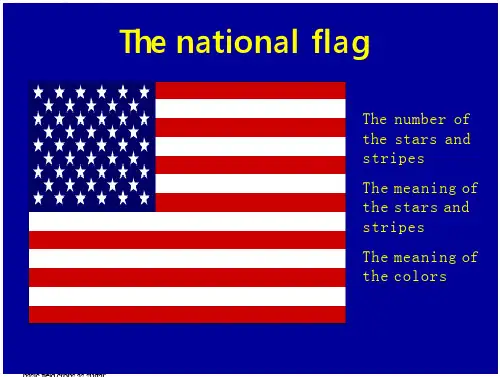
The national flag
50 stars: 50 states 13 stripes: the f i r s t 13 states that used to be
colonies red: valor and hardiness white: innocence and purity blue: vigilance, perseverance and justice
The Central valley of Californ highly productive area basic field crops as sugar beets, beans, rice and cotton
Climate
The United States is mainly situated i the northern temperate zone.
Administrative States
· 50 states The largest in area: Alaska The second: Texas The youngest: Alaska and Hawaii
· Afederal district The District of Columbia Capital City: Washington
Yellowstone National Park
It covers an area of about 9000 sq.km.There are about 3,000 geysers and hot springs in the park.There are also other natural wonders.
Deep South
South Carolina Georgia Texas Alabama Mississippi Louisiana
英美概况美国部分复习.docx

Melting Pot: Immigrants from different regions and cultures came to live in the United States, their old ways of life melt away and they became part of the American culture・WASPs: WASPS are the mainstream Americans, referring to the white Anglo-Saxon ProtestantsThe Hispanics: The Hispanics are Spanish-speaking people from Latin America, which was once dominated by the Spanish Empire・American Indians: The Indian peoples are known as the first Americans. When Columbus landed in the New World in 1492, he thought he had reached India and called the natives Indians・Separation of powers: Under the federalist system, the federal and the state governments have separate and distinct powers laid down in the Constitutio n.^Winner-take-air5principle: The party that wins most votes (simple majority) in a state wins all the electoral votes for the state and the defeated party gets none・Federalism: Federalism in the United States is the evolving relationship between U.S. state governments and the federal government of the United States・ Since the founding of the country, and particularly with the end of the American Civil War, power shifted away from the states and towards the national government.Thanksgiving Day: It's on the fourth Thursday of Novembe匚It is a typicalAmerican holiday that originated in the colonial time・ It is an annual day for people to thank God for the blessing they have enjoyed during the yea 匚The theme of thanksgiving has always been peace and plenty, health and happiness・Independence Day: It9s on July 4. It is American^ most important patriotic holiday and the birthday of the nation.Easter Sunday: It's on the first Sunday after the full moon that occurs on or after March 21, and it is for celebrating the rising of Jesus Christ from his tomb three days after his death・Halloween: In the US, Halloween falls on Oct 31. It's a nighttime children's day and a time for frightening costumes, masks, parties, games and tricks― all for fun..Mayflower Compact: It was signed by all adult male passengers on the ship. They agreed to stick together, to abide by majority role, to have a right to choose their own leader. It was the beginning of the US democracy.1The Sugar Act: In 1764, the English Parliament passed the Sugar Act, which imposed import duties on non-English cloth, indigo, coffee, wine, sugar, and molasses.2The Stamp Act: In 1765, the Stamp Act was carried by the English Parliament. The act, aimed to collect more taxes, provided that stamp paper must be used for all legal documents, pamphlets, newspapers, college diplomas, bonds, contracts, bills of sales, license, leases and many otherarticles.3Boston Massacre: In March 1770, several boys threw snowballs at the English soldiers guarding the office building for collecting import duties in Boston. As more people gathered and pushed forward, the jumpy soldiers fired into the crowd, killing five protesters・4The Boston Tea Party: On the night of December 16, 1773, a band of 50 men disguised as Indians and led by Samuel Adams, boarded three British tea-bearing ships lying at anchor in Boston Harbor and dumped their 340 chests of tea cargo into the sea・5The Second Continental Congress: While the alarms of Lexington were still resounding, the Second Continental Congress met in Philadelphia on May 10, 1775, in Independence Hall. The Second Continental Congress agreed to take steps to organize and equip an American army and appointed George Washington commander in chief of the American forces. Congress also provided for asking help from other countries, especially France which was a rival of Britain. All these steps were aimed at preparing for armed struggles to protect their liberties.6The Declaration of Independence: The Declaration of Independence was mainly drafted by Thomas Jefferson and was adopted by the Congress on July 4,1776, when the people of 13 English colonies in North America were fighting for their freedom and independence from the British colonial rule・The document declared that all men were equal and that they were entitledto have some unalienable rights such as life, liberty and the pursuit of happiness. It also explained the philosophy of governments: the powers of governments came from the consent of the governed and the purpose of governments was to secure the rights mentioned above. The theory of politics and the guiding principles of the American Revolution mainly came from John Locke・7 Significance of Independence War: The American War of Independence was an event of great historic importance・By smashing the fetters of British rule, it gave the colonies their right to national independence and assured U.S. capitalism of a free development. It was the first large-scale revolutionary movement of a colonial people against national oppression一for political and economic emancipation. The revolution shook the foundation of feudalism all over Europe. It directly led to the French Revolution in 1789 and some fifty years later, to the revolutions in the Spanish colonies in America・The Constitutional Convention: In 1787, a conference was held in Philadelphia to consider what should be done to make the Articles of Confederation adequate・ All the delegates agreed to revise the Articles of Confederation and draw up a new plan of government. After struggle, the Constitution was ratified at last. This con fere nee is called the Constitutional Convention.The Bill of Rights: In 1789, James Madison introduced in the House ofRepresentatives a series of amendments which later were drafted into twelve proposed amendments and sent to the states for ratification. Ten of them were ratified in 1791 and the first ten amendments to the constitution were called the Bills of Rights because they were to insure individual liberties.The Great Depression: It took place from 1929 to 1933. In 1929, there swept a "Great crash^^・ The New York Stock Market failed money banks closed down, many shops shut down too. In 1933, 13 million people best their job. Agriculture got worse for the products found no market. Plenty of “extra" goods and products were destroyed.The “New Deal”:When Franklin • D • Roosevelt was elected American President in 1932, American was in the Great Depression. In order to save the situation, he made a program to deal with the economic emergency. This program is known as the "New Deal”. According to the "New Deal", Roosevelt took efforts to consolid the old marker at abroad and also to conquer new ones・ At home, many public projects, were launched to create employment through a huge increase in government responsibility. Crops were destroyed and agriculture production was cut down to stabilize the falling farm prices. The big industries were compelled to make reforms Roosevelt also took some measures of “social security" playi ng pension to the old unemployed and the injured. The "New Deal" relaxed the economic crisis made some concessions to the working people・ The more importantthing is that the Roosevelt Government carried out a progressive foreign policy against fascist aggression and wars.The civil War:It was during 1861 to 1865.The cause: The issue of slavery became the focus in American politics, economics and cultural life. The important point is the contradiction between the two different economic forms. The direct reason is Abraham Lincoln selected the president, the southern states almost immediately began to secede from the Federal Union, and 11 southern states proclaimed themselves an independent nation.The beginning: In 1861, the South opened the 行Te.The process of the Civil War:The first stage (186862 summer): Failure after failure came to the North. The second stage: (1862, 9一1865, 4) In 1862, the Homestead Act was passed・ Lincoln announced the famous Emancipation Proclamation. It provided that all the slaves in the rebel states be freed on January 1, 1863 and they were welcome to join the Union troops・ In July 1863, the turning point of the war came at Gettysburg, the Union army defeated the Confederate army led by General Lee.The third stage: the victory. In 1865, the north defeated the south, and Richmond was abandoned.Influence of the war: Realize the unification of the American nation. Endthe slavery system. Sweep away the last obstacle to the development of U.S. capitalism.。
英美概况知识点总结归纳
英美概况知识点总结归纳英美概况是指英国和美国的文化、历史、政治、经济、教育等各方面的概况。
这两个国家在世界上具有重要的地位,对世界文化和政治产生了深远的影响。
下面将对英美概况的各个方面进行总结归纳。
一、文化概况1. 英国文化英国是一个拥有悠久历史的国家,其文化底蕴深厚。
英国文学自古至今在世界范围内具有重要地位,莎士比亚、狄更斯、奥斯丁等众多文学家的作品至今仍然备受人们喜爱。
英国音乐、戏剧、电影等领域也有着丰富的传统。
2. 美国文化美国是一个移民国家,因此其文化融合了来自世界各地的元素,呈现出多元化和包容性。
美国文学、音乐、电影等在世界上具有很大影响力,如杰克·伦敦、海明威、福克纳等作家的作品、爵士乐、摇滚乐、好莱坞电影等都深受人们喜爱。
3. 英美文化交流英美两国之间的文化交流十分频繁,互相影响。
英国音乐、戏剧、文学等在美国具有很大影响力,而美国的流行音乐、电影、文化现象也在英国广受欢迎。
二、历史概况1. 英国历史英国历史可以追溯到古代,罗马、盎格鲁-撒克逊、诺曼底人等不同民族和文化在英国留下了深远的影响。
英国从16世纪开始成为世界上的帝国大国,殖民了大量领土。
20世纪初,英国逐渐衰落,但仍然在政治、文化方面占有重要地位。
2. 美国历史美国历史相对年轻,但是却是一个充满传奇色彩的国家。
美国独立战争后成为独立国家,并在19世纪成为世界上最强大的国家之一。
20世纪,美国在两次世界大战后成为世界超级大国,对世界政治、经济产生了深远影响。
3. 英美历史关系英国曾是美国的殖民地,双方有着深厚的历史渊源。
美国革命后,两国保持了密切的关系,经济、文化、政治等方面有着广泛的交流合作。
三、政治概况1. 英国政治英国是一个君主立宪制国家,国家元首是君主,首相是政府首脑。
英国的政治体系成熟稳定,经过数百年的发展,形成了一套完善的议会制度和法律体系。
2. 美国政治美国是一个总统制国家,总统是国家元首和政府首脑。
英美概况知识点总结 美国
英美概况知识点总结美国美国概况知识点总结1. 地理位置:美国位于北美洲的中央,与加拿大和墨西哥接壤,东临大西洋,西临太平洋。
2. 面积:美国是世界上第四大的国家,总面积约为9.83万平方公里。
3. 人口:美国是世界上第三大的人口国家,人口约为3.27亿。
4. 政治体制:美国是一个联邦制共和国,政治体制为总统制,国家元首为总统。
5. 首都:美国的首都是华盛顿哥伦比亚特区。
6. 经济实力:美国是世界上最大的经济体,国内生产总值(GDP)居世界首位。
7. 联邦制度:美国是一个由50个州组成的联邦制国家,每个州都享有一定的自治权利。
8. 文化多样性:美国是一个移民国家,拥有来自世界各地的不同种族和文化,因此其文化也非常多样化。
9. 科技实力:美国在航空航天、信息技术、医药和生物技术等领域处于世界领先地位。
10. 社会体系:美国拥有完善的社会保障体系和医疗保健制度,以及广泛的教育资源。
英国概况知识点总结1. 地理位置:英国位于欧洲大陆西北部,横跨大不列颠岛和爱尔兰岛东北部。
2. 面积:英国总面积约为24.12万平方公里。
3. 人口:英国是世界上人口密度最高的国家之一,人口约为6600万。
4. 政治体制:英国是一个君主立宪制国家,国家元首为君主,国家首相为政府首脑。
5. 首都:英国的首都是伦敦,也是英国最大的城市和金融中心。
6. 经济实力:英国是世界上经济实力较强的国家之一,拥有发达的金融、服务和制造业。
7. 文化传统:英国有着悠久的文化传统,包括文学、音乐、戏剧和艺术等领域。
8. 政治影响:英国是联合国安全理事会常任理事国之一,对国际事务有重要影响。
9. 教育体系:英国拥有世界一流的教育资源和大学,吸引了大量国际学生前来留学。
10. 社会福利:英国的社会福利制度完善,提供医疗保障、养老金和失业救济等项目。
美国和英国在政治、经济和文化等方面都有着自己独特的特点,对于全球事务具有重要的影响力。
这些国家的概况知识点总结可以帮助我们更好地了解它们的国情和影响力。
英美概况重点美国篇第5章
英美概况重点美国篇第5章英美概况重点ppt25.Judicial BranchThe judicial branch is headed by the Supreme Court, which is the only court specifically created by the Constitution. In addition, the Congress has established 11 federal courts of appeal(联邦上诉法院) and, below them, 91 federal district courts. Federal judges are appointed for life or voluntary retirement, and can only be removed from office through the process of impeachment(弹劾) and trial in the Congress.英美概况重点ppt司法部门是由最高法院,这是唯一的法院专门设立的宪法.此外,美国国会已经设立了11个联邦上诉法院(联邦上诉法院) , 并低于它们, 91联邦地区法院.联邦法官终身任职或自愿退休,并且只能被免职的过程弹劾(弹劾)和审判大会.英美概况重点ppt26.Federal courts have jurisdiction over cases arising out of the Constitution; laws and treaties of the United States; maritime cases; issues involving foreign citizens or governments; and cases in which the federal government itself is a party. Ordinarily,federal courts do not hear cases arising out of the laws of individual states. The Supreme Court today consists of a chief justice(首席大法官)and eight associate justices (大法官).英美概况重点ppt联邦法院具有管辖权的情况下所产生的宪法法律和条约的美国;海事案件;问题涉及外国公民或政府首脑以及在何种情况下,联邦政府本身就是一个党.通常情况下,联邦法院不审理案件所产生的法律的个别国家. 最高法院今天由一名首席法官(首席大法官)和8名助理法官(大法官) .英美概况重点ppt27.Political PartiesToday, the United States has two major political parties: 1)The Democratic Party /symbol: donkey(驴); 2) The Republican Party/symbol: elephant(象). It is quite unusual that a party member does not have a membership(党籍) and he is not required to pay party dues. On voter registration, one only needs to declare and register to become a member of either party.英美概况重点ppt今天,美国有两个主要政党: 1 )民主党/象征物:驴(驴) ; 2 )共和党/象征物:大象(象) . 这是相当不寻常,一个党员没有一个会员国(党籍) ,他是不是需要缴纳党费.关于选民登记, 一个只需要申报和登记成为会员之一英美概况重点ppt27.Steps for Presidential Election1) The party calls a national convention to elect a presidential candidate(the one who gets more than half of the votes wins the normination提名); 2) The presidential candidate chooses his/her running mate(竞选伙伴), the candidate for the vice presidency;英美概况重点ppt党的要求的国家公约,选出的总统候选人(一个谁得到超过半数的选票,赢得提名) ; 总统候选人选择他/她的竞选搭档(竞选伙伴)的候选人,副总统;英美概况重点ppt28.3)The presidential candidates form a campaign team to raise compaign funds, plan general election tactics and prepare campaign details; 4) The campaign starts。
英美概况考试重点整理 美国史
Unit 1 The United States of America1. The United States is bordered on the north by Canada, on the south by Mexico and the Gulf of Mexico, on the east by the Atlantic Ocean, and on the west by the Pacific Ocean.2. According to the text, the large territory of the continental US is divided into three basic areas:A. The Atlantic Seacoast west to the Appalachians;B. The Mississippi River Basin;C. The Rockies west to the Pacific;Unit 2 American population3. The first blacks arrived in Jamestown in 1619 as indentured servants, but soon after 1619 they were brought to colonies as slaves. The blacks were formally freed in 1863, but continued to suffer the institutionalized segregation for about a century. Today many blacks still live in the south, some have entered the middle class, but one-third of all black families still live below the poverty line.Chapter 5 The Confederation and the Constitution 1.Under the Articles of Confederation the national government consisted of only a legislature; it had no separate executive and judicial divisions. The state government was left the exclusive powers to regulate commerce and to tax their citizens.2. The Antifederalists opposed the constitution and prefermd a more decentralized federal system of government.3. George Washington was elected unanimously as the first US President in 1788. The first Vice-President was John Adams, the first Secretary of Treasury was Alexander Hamilton and the first Secretary of State was Thomas Jefferson.4. The most glorious achievement of Jefferson as President was the Louisiana Purchase which was about 828000 square miles. This Purchase doubled the area of the then United States.5. The War of 1812 is also called the Second War of Independence. This war lasted three years and ended in another American victory. An important result of the war was the strengthening of national unity and patriotism. And it was after this war that the US was able to make the change of a semi-colonial economy into a really independent national economy.名词解释Confederation(邦联):A confederation is a government in which the constituent governments , called states in the US, create a central government by constitutional compact but do not give it power to regulate the conduct of individuals.问答1. What powers do the national government and the individual states have under the Articles of confederation?the national government: conduct war & foreign affairs; make commercial treaties;negotiate with Indians; coin money & issue bills of creditthe individual states: deal with foreign countries; engage in war; issue money & bills of credit; collect taxesChapter6 American Expansion and the Civil War1.The essence of Monroe Doctrine was which later became the __cornerstone __of the US policy.2.Oregon territory was settled between Britain and the United States in_1846__.Its boundary on the north was fixed at the _forty--ninth_parallel of north latitude.3.Under Missouri Compromise,Missouri was admitted as a _slave_state,but the balance of political power maintained by admission of _Maine_as a_free_state.In addition,slavery was to be prohibited in the rest of Louisiana Territory north of the line_36°30’_ parallel.4.In 1862,the federal government took two revolutionary measures:(1)Homestead Act and(2)Emancipation Proclamation.5.In July 1863 came the turning point of of the war at Gettysburg.Here the Confederate army under the general Robert E.Lee was defeated.The battlefield was made a national cemetery,where Lincoln gave his famous speech,the Gettysburg Address on November 19,1863.6.In 1865,the Thirteenth Amendment to the US Constitution was adopted,which abolished slavery throughout the United States.问答1.What was the Monroe Doctrine?The Monroe Doctrine written by James Monroe, declared in December of 1823, was a superlative U.S. foreign policy statement. It was precipitated by various independence movements in South America and the U.S. government's desire to discourage European nations from colonizing the Americas, and a growing American nationalism.The Monroe Doctrine stated that European nations should not intervene in countries to the south of the U.S. Finally, it promised to stay out of foreign affairs.U.S. will not interfere with European affairs in Europe.The essence of the Doctrine is“America for Americans”.Whic h later became a cornerstone of the US foreign policy.As the New World developed in the years ahead this doctrine became more meaningful and was strengthened by a border interpretation to meet the needs of an energetic and ambitious United States.名词解释1.Gettysburg AddressThe Gettysburg Address is a speech delivered by U.S. President Abraham Lincoln during the American Civil War on November 19, 1863 after the northern victory at Gettysburg.It is regarded as one of the most significant expressions of American democracy. In just over two minutes, Lincoln reiterated the principles of human equality espoused by the Declaration of Independence and proclaimed the Civil War as a struggle for the preservation of the Union sundered by the secession crisis,with "a new birth of freedom,"that would bring true equality[5] to all of its citizens.Lincoln also redefined the Civil War as a struggle not just for the Union, but also for theprinciple of human equality.Chapter 7 Reconstruction and the Birth of Us Imperialism1、The Reconstruction Acts divided all the former confederate states, exceptTennessee, into five military districts and each was put under the control of a Northern army officer. The officer had the power to keep order and to enforce martial law if necessary.2、During the Reconstruction the Southern whites who supported the radicalreconstruction and joined the Republican Party were called scalawags. They were considered as traitors by the Southern Democrats.3、The KKK, founded in Tennessee in 1866, was a secret society for resortingwhite supremacy and driving blacks out of politics.名词解释Open Door PolicyIn Sino-American relations, Theodore Roosevelt pushed the so- called “Open Door Policy” which demanded that all the imperialist powers should enjoy equal chance in China as freely as othe r aggressors.Chapter 8 world war I and the depression1、The First World War was waged between two groups of imperialist powers: the Allies and the Central European Power.2、The direct cause that made the US declare war on Germany in 1917 was the Germany’s unlimited submarine campaign.3、The major triumph for Wilson at the Paris Peace Conference was the formation of the League of Nations.4、The United States didn’t join the League of Nations because the US Senate refused to approve the Treaty of Versailles.5、The Great Depression started with the sudden collapse of the Stock Market in New York in October, 1929. This economic distress extended to Europe, Asia, Africa, Australia and South America.名词解释:Roaring Twenties: The ten years between 1919 and 1929, usually called the “Roaring Twenties” or the “Jazz Age”, were a time of carefree prosperity, isolation from the world’s problems, bewildering social change and a feverish pursuit of pleasure.问答题:1、Why did the US join the First World War so late?First, the United States was lack of military preparedness when the war began.Another factor for the US to join the war was the American financial and industrial commitment to the Allied cause,F inally the factor that pushed the US into the war was Germany’s submarine campaign against merchant ships.2、What were the major contents and basic ideas of the New Deal? How do you comment on the New Deal?The aims of the New Deal were to raise commodity prices by limiting production,devaluing the dollar, maintaining high tariffs on foreign goods, and to carry through a modest inflation by providing money at low rates of interest to farmers and to industry.For farmers, the Agricultural Adjustment Act was passed in 1933, which enabled the government, among other things, to pay grants to induce them to reduce the amount of products, which included such commodities as cotton, wheat, corn, pigs, rice, tobacco, milk, sugar and others.In industry Roosevelt, by the National Recovery Act of 1933, was given power to control working conditions, and to fix minimum wages.Chapter 9 American During and After World II1.The cash-and-carry policy allowed US citizens to_sell___ certain nonprohibitedgoods to belligerent nations as long as those goods were not transported on _American_ ships.2.Stars Wars program was proposed by President _Reagan_in __1983__. Theprogram seeks to construct a defensive “shield”against incoming _missiles_.The shield would be made of _laser__ and electronic _devices _that would destroy such missiles launched to attack _ the US__名词解释1.The Cold WarDuring the time 1945-1991, because disagreed about the configuration of the post-war world, especially about that of Europe, there was a continuing state of political and military tension between the powers of the Western world, led by the U.S., and the communist world, led by the USSR. The Cold War was ended with the dissolution of the USSR in 1991.2.The Truman Doctrinea policy by Truman on Mar. 12, 1947 stating that the U.S. would support Greece and Turkey with economic and military aid ($400m) to prevent their falling into the Soviet sphere. It was the start of the Cold War and the start of the containment policy to stop Soviet expansion. . It became the basis of U.S. Cold War policy throughout Europe and around the world.3.Marshall PlanThe economic equivalent of the containment policy was presented by secretary of state George Marshall, called Marshall plan. It was in operation for four years beginning in April 1948. the purpose of the plan was to modernize European industrial and business practices using high-efficiency American models, reduce artificial trade barriers, and instill a sense of hope and self-reliance. (The U.S. gave monetary support to help rebuild European economies to combat the spread of communism.) the plan had two major aims:(1)to keep communists out of political power in Europe. (2)to stabilize the international economic order in a way favorableto capitalism. It was one of the first elements of European integration问答1.What are the major forms of American Civil Rights Movement from 1955 to 1968?Can you give one specific examples?Boycotts; Sit-ins;Montgomery Bus Boycott (1955-1956)●On Dec. 1, 1955, Rosa Parks refused to give up her seat on a public bus tomake room for a white passenger, and then Parks was arrested, tried, and convicted for disorderly conduct and violating a local ordinance.After word of this incident reached the black community, 50 African-American leaders gathered and organized the Montgomery Bus Boycott to demand a more humane bus transportation system.90% of African Americans in Montgomery partook in the boycotts, which reduced bus revenue by 80% until a federal court ordered Montgomery's buses desegregated in Nov. 1956, and the boycott ended.●Chapter 10 The Federal System and Congress1.Federalism means the division of powers by a constitution between the centralgovernment and state government. It operates only on two levels, the national and the state . Units of government within a state enjoy no independent existence. 2.Separation of powers in the United States means not only allocating legislativepower to Congress, executive power to President and judicia l power to the Supreme Court, but also giving each branch constitutional and political independence and checks and balances that ensure each of the three branchesa sufficient role in the actions of the others.3.According to the Constitution, members of the House of Representatives must be25 years old and must have been citizens for 7 years. Senators must be at least 30and must have been citizens for 9 years.4.The Vice President is officially the presiding officer and is called the presidentof the Senate. In fact he seldom appears in the Senate chamber in this role unless it appears that there might be tie vote in the Senate. In such instances, he casts the tiebreaking vote. To deal with day-to-day business, the Senate chooses the president pro tempore.名词解释1 federalism: This division of powers by a constitution between the national government and state government.2 separation of powers: It means constitutional division of powers between the legislative, executive, and judicial branches回答问题What are the three basic principles of U.S political system?The US political system was established on the basis of the three main principles-----federalism, separation of powers, and supremacy of the constitution. Federalism is the division of powers by a constitution between the national government and state government. It should be observed that federalism operates only on two levels, the national and the state .Separation of powers means constitutional division of powers between the legislative, executive, and judicial branches. It meansmore than allocating legislative power to the Supreme Court. It also means giving each branch constitutional and political independence and checks and balances that ensure each of the three branches a sufficient role in the actions of the others so that no one branch may dominate the others. Supremacy of the constitution means that every American citizen is required to respect the Constitution and to obey the laws of the United StatesChapter 11The President and the Judiciary1 By law any natural-born American citizen of and over 35 years of age and ofbeing a resident within the United States for 14 years can run for thepresident .The duly elected and duly qualified president-elect takes office on the 20th of January following his election.2 The Supreme Court has the power to examine the bills passed by Congress andpolicies made by President, and declare them unconstitutional and thus abolish them. John Marshall, the most famous chief justice (1801-1835) in Americahistory, called this power of interpretation judicial review.3 There are three federal court levels: 1) the district courts, 2) the courts ofappeal, 3) the Supreme Cour t. All the judges of federal courts appointed byPresident with the consent of the Senate. The state court system also has ahierarchy of three levels: 1) superior cour ts, 2) appellate courts 3)a statesupreme court. The state court judges are usually elected. The term of the county court judges is usually four years. And the judges in higher state courts usually serve eight or twelve years for one term.问答How is the president’s power limitedThe president has no power to declare war on other countries. He can call Congress into special session and can adjourn Congress, but he cannot dismiss Congress. He cannot pardon the person who is impeached. All appropriations of the government are legislated by Congress. The Supreme Court has the power to declare the pr esident’s policy, even if it has already been approved by Congress, unconstitutional and thus abolished it. If the president abuses his power or commits crimes, he will be impeached by Congress.Chapter 12 Political Parties and ElectionThe candidate with the most votes in a state wins all of that state’s electoral votes. This is known as the “winter-take-all” principle. The candidate who wins the majority of the 538 Electoral College votes will be the US President in the next four years.名词解释Election Day: the day set by law for the general elections of public officials. It occurs on the Tuesday after the first Monday in November. (The earliest possible date is November 2 and the latest possible date is November 8.)Winner-take-al l:The candidate with the most votes in a state wins all of that state’selectoral votes.问答题How is the U.S. president elected?First stage: the major parties hold conventions to choose candidates for President and Vice President and to determine the parties’ platforms.Second stage: the campaigning stage. From early fall of the election year to Election Day, candidates travel across the country and deliver countless speeches, campaigning for support.Third stage: voters to choose a slate of president electors in their state who make up the Electoral College. The candidate with the most votes will be the President in the next four years.Fourth stage: when the new Congress assembled on Jan. 6, the electoral votes are formally counted in a joint session of the two houses and the President of the Senate announces the “state of the vote”. If there’s no electoral college winner, the house of representatives choose the president.。
英美概况美国部分第二章
the Great Plain
1) a comparatively small population; 2) the Northern part is empty and
featherless, North and South Dakotas, Nebraska and Kansas have 4,390,763 people.
Cuba
"other Spanish“ origin
California, Texas living place other parts of the
nation as well
in the barriors of New York, Chicago and other northern cities
low increase in population.
·New York City---the largest one with more than 18 million people; ·Chicago--- the third largest one with 8 million people.
Asians and Pacific Islanders----7,273,662 people in 1990 represented 2.9% of the whole.
张奎武《英美概况》笔记及习题 美国(美国经济的发展)【圣才出品】
第4章美国经济的发展4.1 复习笔记I. General introductionII. Involvement of American GovernmentIII. American Agriculture and IndustryIV. Recent DevelopmentI. General introduction (简要介绍)1. From 1890 until now, the United States has been the biggest industrial country in the world.2. The U.S.A. got a great amount of benefits from the two world wars and then became the most powerful nation in the world.3. The America ranks first in so many fields such as computers, electronics, space and nuclear technology.4. The fast economic growth contributes many factors, which mainly include geographic, historic and governmental ones.1. 从1890年到现在,美国一直是世界上最大的工业国家。
2. 美国从两次世界大战中得到了很多好处,成为了世界上最强大的国家。
3. 美国的电脑,电子,宇航和核技术等很多领域的成就都位于世界第一。
4. 美国经济的快速发展得益于很多因素,包括地理因素,历史因素和政府因素。
II. Involvement of American Government (美国政府的干预)1. The government has always been playing an import role in the development of American economy.2. Before 1900, the government only involves itself in transportation. With the development of industrialization, the federal became more and more involved in regulating economy.3. The Great Depression helped increase the government interference.4. Now the American economy is characterized by monopoly with high degree. Thus, the federal government has to continue to regulate in America’s economic development.1. 在美国经济的发展历程中,政府起了很大的作用。