
2014年山东卷高考西班牙语真题(含答案) (4)
济南外国语学校2013-2014学年高一上学期期末考试西班牙语试题
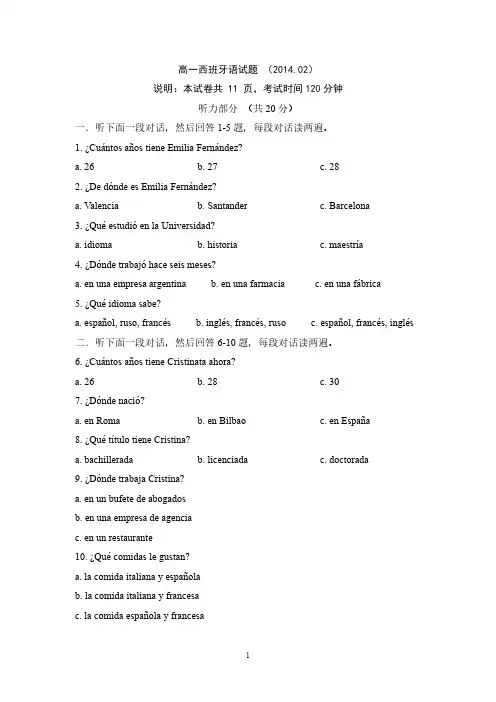
高一西班牙语试题 (2014.02)说明:本试卷共 11 页,考试时间120分钟听力部分(共20分)一.听下面一段对话,然后回答1-5题,每段对话读两遍。
1. ¿Cuántos años tiene Emilia Fernández?a. 26b. 27c. 282. ¿De dónde es Emilia Fernández?a. Valenciab. Santanderc. Barcelona3. ¿Qué estudió en la Universidad?a. idiomab. historiac. maestría4. ¿Dónde trabajó hace seis meses?a. en una empresa argentinab. en una farmaciac. en una fábrica5. ¿Qué idioma sabe?a. español, ruso, francésb. inglés, francés, rusoc. español, francés, inglés 二.听下面一段对话,然后回答6-10题,每段对话读两遍。
6. ¿Cuántos años tiene Cristinata ahora?a. 26b. 28c. 307. ¿Dónde nació?a. en Romab. en Bilbaoc. en España8. ¿Qué título tiene Cristina?a. bachilleradab. licenciadac. doctorada9. ¿Dónde trabaja Cristina?a. en un bufete de abogadosb. en una empresa de agenciac. en un restaurante10. ¿Qué comidas le gustan?a. la comida italiana y españolab. la comida italiana y francesac. la comida española y francesa三.听下面一段对话,然后回答11-15题,每段对话读两遍。
2014年西班牙语专四真题

I. Prueba del uso de los artículos y combinación de artículo y preposición. Entre las opciones dadas para rellenar los espacios en blanco señala la acertada. (6 puntos, 0.4x15)i) A __1__ día siguiente continuamos nuestro viaje a la Playa del Carmen donde nosalojamos en __2__ hotel pequeño, pero muy bonito. La Playa del Carmen es __3__ punto de __4__ encuentro de muchos turistas, ya que desde allí se puedeii) Con __6__ fin de mejorar el tráfico de la ciudad de Buenos Aires, Mauricio Macri, jefe de gobierno de esta ciudad, anuncia medidas destinadas a corregir los problemas de __7__ tráfico que sufre __8__ ciudad porteña. Señala que estas reformas fomentarán __9__ transporte público y están destinadas a disminuiriii) Los humanos representamos una mínima parte de __11__ especies, ya que, según algunos cálculos, pueden existir entre tres y cien millones de ellas, de las cuales __12__ gran cantidad ni tan siquiera ha sido descubierta por nosotros todavía. Sin embargo, con más de seis mil millones de __13__ individuos abusando constantemente de los recursos de la Tierra, los seres humanos no paramos de conquistar terreno y de destruir hábitats (生存环境) de __14__ restoII. Prueba del uso de las preposiciones. Entre las opciones dadas para rellenar los espacios en blanco señala la acertada. (6 puntos, 0.4x15)i) Es tarde __16__ llamar a Manolo Muñoz, aunque, a veces, se acuesta pasadas lasdoce.16. A. por B. de C. a D. paraii) Aseguraron que, __17__ corto plazo, nos darían una respuesta definitiva.17. A. a B. hasta C. en D. desdeiii) Siento decirte que no basta __18__ tus buenos propósitos. Debes cumplir lo que prometes.18. A. a B. para C. con D. siniv) Como la maleta pesaba mucho, la tuvieron que subir __19__ todos.19. A. en B. por C. sobre D. entrev) Los Vázquez se gastan la mitad del sueldo __20__ pagar los colegios de los niños.20. A. a B. en C. con D. devi) ¡Dejadme en paz! No estoy __21__ bromas.21. A. con B. para C. en D. porvii) __22__ una encuesta (调查) realizada por teléfono, las dos terceras partes de los entrevistados salen de viaje turístico una vez al año.22. A. Desde B. En C. Según D. Paraviii) __23__ mi punto de vista, es un monasterio románico digno __24__ ser__25__ __26__a __27__ aceptar la oferta de su editor, pero no se atrevió __28__–No, ¿qué?–¡Que __29__ más de veinte años __30__ casados Mari Paz y Javier se hanIII. Prueba de las formas verbales. Entre las opciones dadas para rellenar los espacios en blanco señala la acertada. (20 puntos, 0.5×40)i) Al final no fuimos a Mallorca. Nos __31__ pero no pudimos ir, porque Javier__32__ enfermo.31 A. había gustado B. gustó C. gustaría D. habría gustado32 A. se puso B. se pondría C. se ponía D. se poneii) En este restaurante __33__ muy bien, pero, desde que __34__ de cocinero, ya no se come tan bien.33 A. se come B. se comía C. se comió D. se ha comido34 A. cambian B. ha cambiado C. se había cambiado D. han cambiado iii) Si vosotros __35__ hacerlo, __36__, pero conmigo no __37__. Bastantes problemas tengo yo ahora como para hacer tonterías.35 A. queréis B. quisierais C. queríais D. queráis36 A. lo hacéis B. lo hagáis C. hacedlo D. haciéndolo37 A. contáis B. contéis C. contad D. contaréisiv) Ante el comportamiento excesivamente familiar del invitado, la señora de la casa, __38__ que el invitado __39__ al servicio, le comenta al marido:–¡Qué educación! Parece como si __40__ en su casa.38 A. aprovechada B. aprovechando C. está aprovechando D. ha aprovechado39 A. iba B. vaya C. yendo D. ha ido40 A. está B. esté C. estaría D. estuvierav) Las botas nuevas no me __41__ nada. La próxima vez que __42__ algo de mi interés en una tienda de esa marca, me lo __43__ dos veces antes de entrar.41 A. duran B. duraban C. han durado D. durarían42 A. veo B. vea C. se ve D. veré43 A. pienso B. piensa C. pensaré D. pensaríavi) Clemente Yerovi __44__ presidente de Ecuador en 1966. Era un hombre cordial, inteligente y culto. __45__ mucho de economía, no es que __46__ a la universidad, sino porque desde joven __47__ en tareas de comercio, agricultura e industria.44 A. era B. fue C. ha sido D. había sido45 A. Sabía B. Supo C. Sabría D. Había sabido46 A. fue B. había ido C. fuera D. hubiera ido47 A. practicó B. practicara C. había practicado D. hubiera practicado vii) –Oye, ¿tú sabes si a Maribel le pasa algo? ¡Está rarísima! Le he preguntado si __48__ a desayunar con nosotros y me ha contestado de forma fatal.–Sí, la verdad es que desde __49__ unos días estámuy rara. Pero mira, no le vamos a decir nada, que __50__. Ya se le pasará.48 A. vendría B. ha venido C. haya venido D. viniera49 A. hacen B. hace C. hacían D. hacía50 A. se fastidia B. se fastidie C. se fastidiará D. se ha fastidiado viii) Había oído mencionar su nombre, pero la primera vez que la __51__ __52__ un rato antes de subir al barco. Mi familia había venido a despedirme y yo __53__ emocionado, no porque __54__ a Buenos Aires a pasar una semana con mis primos, sino porque nunca __55__ sin compañía al extranjero.51 A. vi B. veía C. vio D. vieron52 A. fuera B. fue C. era D. había sido53 A. estaba B. estuve C. estaría D. estuviera54 A. viajé B. viajaba C. viajaría D. viajara55 A. iba B. había ido C. iría D. fueraix) Cierta noche de invierno __56__ a su puerta, y el tendero vio a un chico descalzo y muy sucio, que lo __57__ muy fijo con sus brillantes ojos negros.– ¿__58__ indicarme quién es el tendero Ezequiel? –dijo–. Vengo de muy lejos, para traerle una carta importante.–Yo soy Ezequiel –contestó el tendero–. Pero no __59__ engañarme, porque no tengo amigos ni parientes, y nadie me __60__ a un muchacho como tú para traerme ninguna carta.__61__ a cerrarle la puerta en las narices; pero el muchacho, que era escurridizo (滑溜的) como un pez, __62__ por la rendija (缝隙) empujándole y riéndose.56 A. llamó B. llamaban C. llamaron D. se llamaban57 A. habría mirado B. miraba C. mirase D. había mirado58 A. Pudiera B. Podrá C. Podría D. Pueda59 A. intentes B. intenta C. intentarías D. intentará60 A. envía B. enviaba C. envíe D. enviaría61 A. Fue B. Iba C. Iría D. Estaba yendo62 A. hubiese penetrado B. penetraba C. ha penetrado D. había penetrado x) Una cosa incomprensible de la informática es que le __63__ a uno a escribir mal.Todo junto, sin acentos, sin mayúsculas, sin eñes. Los habitantes del correo electrónico y de Internet en general __64__ afásicos (患失语症的), como si les __65__ un golpe en la cabeza. Al principio uno se rebela, pero __66__ un momento en que si __67__ en utilizar las mayúsculas, los acentos, las eñes, incluso la sintaxis, en el espacio cibernético, te __68__ por un psicópata (神经病).No sabe uno cómo explicar que __69__ mal es imposible pensar bien. Pero quizálo que __70__ tras las disposiciones de todo junto, sin acentos, sin mayúsculas, sin eñes, sin sintaxis, se resume en esta otra: sin pensamiento, por favor.63 A. obliga B. obligue C. obligan D. obliguen64 A. se parecen B. se parecerán C. parecen D. parecerán65 A. diera B. dieran C. hubieran dado D. hubiera dado66 A. llega B. llegan C. ha llegado D. han llegado67 A. persistas B. persistes C. persistirás D. persistieras68 A. tomarás B. vas a tomar C. toman D. es tomado69 A. se escribe B. escribe C. escribir D. escribiendo70 A. esconde B. ha escondido C. se esconde D. se ha escondido IV. Prueba del léxico. Entre las opciones dadas para rellenar los espacios en blanco señala la acertada. (10 puntos, 0.5×20)i) La conquista de Granada a los árabes fue difícil y __71__ prácticamente diez años.El interés de los Reyes Católicos por conquistarla __72__ principalmente al carácter simbólico que tenía la ocupación árabe. Así__73__ a casi ochocientos años de la España musulmana.71 A. tardó B. siguió C. permaneció D. duró72 A. debió B. se debió C. se atribuyó D. contribuyó73 A. comenzó B. se definió C. se puso fin D. se prolongóii) La familia actual se ha reducido, el número de hijos cada vez es __74__, y es fácil __75__ que cuando mis hijos se casen y tengan hijos, mis nietos no __76__ con tantos primos para jugar como tuvimos la mayoría de nosotros.74 A. menor B. menos C. mayor D. más75 A. pensar B. imaginar C. reflexionar D. considerar76 A. dispondrán B. tendrán C. contarán D. encontrarán iii) Yo escondía los libros __77__ mi colchón y esperaba a que mi padre hubiera salido o estuviese dormido para poder leer. En una ocasión me __78__ leyendo de noche y, furioso, él me __79__ el libro de las manos y lo __80__ por la ventana.77 A. abajo B. debajo de C. debajo D. de abajo78 A. miró B. asombró C. chocó D. sorprendió79 A. extrajo B. llevó C. arrancó D. separó80 A. tiró B. metió C. impulsó D. atravesóiv) El pueblo gitano __81__ su historia de forma oral. Esta historia está __82__ de injusticias, misterios y miedo. Los gitanos han sufrido durante siglos el trato brutal de los __83__ y la marginación de la sociedad. Por estas razones, los gitanos son muy cautelosos, e __84__ desconfían del poder. Para los gitanos, la familia es muy importante. Además, tienen una fuerte __85__ de que todos son de un mismo pueblo.81 A. ha trasladado B. ha transportado C. ha transmitido D. ha publicado82 A. cubierta B. sobra C. harta D. llena83 A. gobernantes B. gobernadores C. dirigentes D. directores84 A. incluido B. incluso C. inclusivo D. incluyendo85 A. conciencia B. mente C. confianza D. cuentav) Mario era un muchacho de altos ideales. Leía mucho y todo lo analizaba para __86__ sus propias conclusiones. A pesar del mundo burgués en que __87__ se decidióa __88__ otro camino. Cuando aprobóel último examen, andaba procurándose un empleo para ganarse la vida por su propia cuenta. __89__ a ser un buen ingeniero. Todo eso le __90__ mucho respeto entre sus amigos.86 A. llegar B. hallar C. sacar D. conducir87 A. desarrollaba B. habitaba C. se metía D. se movía88 A. elegir B. seleccionar C. optar D. hacer89 A. Intentaba B. Ambicionaba C. Aspiraba D. Suspiraba90 A. merecía B. ofrecía C. brindaba D. prestabaV. Hay un error en alguna de las partes subrayadas de las oraciones, señálalo. (10 puntos, 1×10)91. Era la hora del almuerzo pero nadie comía (A). Salvos (B) los niños, quemasticaban el pan con (C) chorizo. Todos guardaban silencio y asomaban la cabeza hacia (D) un mismo punto.92. Más de (A) 2.000 millones personas (B) del mundo viven en la era digital.Pueden acceder a un vasto universo de información, comunicarse a (C) escaso o ningún costo con familiares y amigos, así como conectarse con otros con los (D) que pueden cooperar de nuevas maneras.93. La relación entre (A) la medicina y la meteorología es muy antigua; yaHipócrates estaba seguro de (B) que existiera (C) una relación muy estrecha; a (D) la misma conclusión habían llegado los maestros de la tradición china.94. Es verdad que muchos niños ahora dominen (A) el uso de un iPad mucho antesde que tengan (B) la edad necesaria para ir a la escuela. Aun (C) así, una muy buena parte de la información que recibimos por Internet, correo electrónico y mensajes de texto está (D) basada en el lenguaje.95. Los países en desarrollo siguen pidiendo (A) compensaciones por lacontaminación ambiental de las potencias y éstas no quieren comprometerse nada(B). La Tierra padece (C) desastres naturales cada vez más intensos (D) ante lapasividad de todos.96. También se observó que en los últimos ocho años la cantidad de menores de (A)25 años que fuman (B) se redujo 5% (C). Pero, en contraposición, el consumoaumentó (D) en la población de 45 a 65 años.97. Cuando estamos alegres nos conectamos (A) más fácilmente con sentimientospositivos como la (B) solidaridad y cooperación, los (C) problemas nos parecen más pequeños, vemos el lado bueno de las cosas, y sentimos (D) poderosos.98. Las dificultades de aprendizaje en el niño implican sufrimiento y afectan a (A)su calidad de vida asícomo también lo (B) de sus padres. De allí(C) la importancia de tener en cuenta los aspectos emocionales del niño cuando se presenta (D) con estas dificultades.99. Lo normal (A) es que un gato adulto pese entre 3 y 5 kilos, aunque las razasgrandes pueden llegar a (B) superar al (C) 6 kilos. Las hembras suelen pesar menos que los (D) machos.100. El estudio es vivido como una obligación moral de los jóvenes hacia los padres, sin embargo, (A) hacia la sociedad. El estudio se relaciona con poder (B) cumplir aspiraciones (C) incumplidas de los propios (D) padres.VI. Lee el siguiente texto y pon en la hoja de respuesta las soluciones de los ejercicios que se dan. (34 puntos)Pequeños inventos, grandes cambiosLa historia de la humanidad está llena de pequeños inventos que han cambiado la vida de muchas personas. Muchas veces se trata de inventos muy sencillos y es difícil imaginar cómo era la vida antes de que existieran(101), ya que han llegado a ser absolutamente imprescindibles. Curiosamente, muchos de esos inventos son españoles. (párrafo 1)¿Qué tienen en común una fregona (拖把) y una jeringuilla (注射器) desechable? Muy sencillo: su (102) inventor. Manuel Jalón Corominas es el inventor de la fregona que miles de personas utilizan cada día en el mundo, asícomo de las agujas hipodérmicas (入皮的) o jeringuillas que se utilizan en millones de hospitales cada día. (párrafo2)Todo comenzóen 1956 en un bar. Manuel Jalón era un joven ingeniero aeronáutico (航空的) que acababa de volver de un viaje a Estados Unidos. En su cabeza traía cientos de ideas para mejorar el sistema de vuelo de los aviones. Pero en una charla informal, un amigo le (103) sugirióque pensara también en cosas para mejorar la vida cotidiana de las personas, por ejemplo, de las mujeres (que entonces eran quienes realizaban las tareas domésticas) que sufrían problemas de espalda por tener que limpiar(104) los suelos de rodillas. Manuel se lo(105) tomóen serio e inventó la fregona, compuesta por un mocho (拖布) que se moja para limpiar el suelo, y un palo largo para no tener que agacharse. La (106) creó a partir de un sistema de limpieza que se utilizaba en los hangares (飞机库) estadounidenses. La fregona significóuna mejora para la salud –ya no había que agacharse(107) ni entrar en contacto con el agua sucia –y también de las condiciones de trabajo en general. (párrafo 3)Con el tiempo, Corominas fue introduciendo mejoras en su (108) invento, hasta que en 1964 aparecióla fregona tal como la conocemos hoy: ligera, sencilla y de plástico. Según cuentan algunos, a los turistas que visitaban España en aquella época les sorprendía este invento, pero volvían (109) a casa con una fregona en la maleta. Desde entonces, su uso se ha extendido por todo el mundo. Un dato curioso es que, alprincipio, a muchas señoras de la limpieza no les gustó (110) porque pensaban que iban a perder su trabajo. (párrafo 4)Seguramente un palo pequeño dio más alegrías a su inventor, además de hacerlo rico. Si bien el palo de la fregona de Manuel Jalón mejoróla vida de muchas personas, el palo de Enric Bernat cambióla vida de muchos niños. (párrafo 5)En los años cincuenta, Enric Bernat fundó una empresa de caramelos. Por aquella época los caramelos eran de colores llamativos. Los niños se los metían en la boca y muchas veces los sacaban para verlos de nuevo, para hablar con sus compañeros, para esconderlos de sus padres o, incluso, para guardarlos en los bolsillos de los pantalones.(párrafo 6)Al observar(111) las costumbres de los niños, a quienes conocía bien, Bernat tuvo la idea de crear el chupa-chups, un nuevo caramelo, pero con palo. Por primera vez, los niños podían sacarse el caramelo de la boca sin tener que tocar lo con las manos (a menudo sucias de jugar en la arena). Fue una idea sencilla, pero cambió(112) la forma de comer caramelos en España y en el mundo. (párrafo 7) Los primeros chupa-chups eran de siete sabores y cada uno costaba(113) una peseta. Si bien esto equivale a menos de un céntimo de euro, el precio ya era muy elevado para la época: España no era aún una economía desarrollada y la dictadura la (114) mantenía aislada del exterior. Este precio era parte de la estrategia escogida por la compañía, que quería vender su caramelo como un producto de calidad. (párrafo 8)En un primer momento, la empresa pensó llamar lo(115) “gol”, por el parecido del caramelo con un balón de fútbol, pero no estaba convencida de que ese (116) fuera el nombre comercial adecuado, así pidióasesoramiento a una agencia de publicidad. Al final se decidieron por “chups”. Sin embargo, el nombre se convirtió en “chupa-chups” por la canción que acompañaba al anuncio televisivo, cuya (117) letradecía: “Obtén algo dulce para chupar, chupar, chupar como un chups. Es redondo y dura mucho. Chu pa, chupa, chupa un chups.” La gente empezó por eso a llamar lo (118) “chupa-chups”, y es el nombre que tiene hasta hoy. (párrafo 9) Como dato curioso, hay que decir que su (119) éxito no solo ha traspasado las fronteras del país, sino de la Tierra: los astronautas de la estación espacial MIR pidieron caramelos Chupa Chups. Otro dato curioso es que el logotipo (图标) de la marca lo (120) diseñó el pintor catalán Salvador Dalí, en solo una hora. Por último, cada día se fabrican cerca de 12 millones de chupa-chups, lo que significa nada menos que unas 17.000 toneladas al año. (párrafo 10) (774 palabras)(Adaptación de Colección Marca España por José Ángel Gonzalo García de León)Ejercicios:i) ¿A qué se refieren o modifican las palabras subrayadas? Tratándose de verbo,¿cuál es el sujeto? Entre las opciones dadas en cada caso señala la acertada.(10 puntos, 0.5×20)101. Muchas veces se trata de inventos muy sencillos y es difícil imaginar cómo era la vida antes de que existieran...El sujeto de existieran esA. desconocido / impersonalB. inventosC. muchas vecesD. personas102. ¿Quétienen en común una fregona y una jeringuilla desechable? Muy sencillo: su inventor.El posesivo su quiere decirA. de una fregona y una jeringuilla desechableB. de una fregonaC. de una jeringuilla desechableD. de Qué103. Pero en una charla informal, un amigo le sugirió que pensara también en cosas para mejorar la vida cotidiana de las personas...El pronombre le se refiere aA. Manuel JalónB. un amigoC. su cabezaD. el sistema de vuelo104. ...que sufrían problemas de espalda por tener que limpiar los suelos de rodillas.El sujeto de tener que limpiar esA. las personasB. las tareas domésticasC. problemas de espaldaD. las mujeres105. Manuel se lo tomó en serio e inventó la fregona...El pronombre lo se refiere aA. un amigoB. realizaban tareas domésticasC. sufrían problemas de espaldaD. lo que le sugirió el amigo106. La creó a partir de un sistema de limpieza que se utilizaba en los hangares (飞机库) estadounidenses.El pronombre la representa aA. compuestaB. sistema de limpiezaC. la fregonaD. una mejora107. La fregona significó una mejora para la salud –ya no había que agacharse ni entrar en contacto con el agua sucia–...El sujeto de agacharse esA. la fregonaB. desconocido / impersonalC. la saludD. el palo108. ...Corominas fue introduciendo mejoras en su invento...El posesivo su quiere decirA. del tiempoB. de la fregonaC. de mejorasD. de Corominas109. ...pero volvían a casa con una fregona en la maleta.El sujeto de volvían esA. algunosB. los turistasC. los españolesD. desconocido / impersonal110. ...a muchas señoras de la limpieza no les gustó porque pensaban que iban a perder su trabajo.El sujeto de gustó esA. la fregonaB. un dato curiosoC. la limpiezaD. su trabajo111. Al observar las costumbres de los niños, a quienes conocía bien, Bernat tuvo la idea de crear el chupa-chups...El sujeto de observar esA. BernatB. padresC. empresaD. desconocido / impersonal112. ...pero que cambió la forma de comer caramelos en España y en el mundo. El sujeto de cambió esA. empresaB. BernatC. ideaD. la forma113. Los primeros chupa-chups eran de siete sabores y cada uno costaba una peseta.El sujeto de costaba esA. cada chupa-chupsB. cada saborC. una pesetaD. cada niño114. España no era aún una economía desarrollada y la dictadura la mantenía aislada del exterior.El pronombre la representa aA. la épocaB. EspañaC. economíaD. dictadura115. En un primer momento, la empresa pensó llamar lo“gol”...El pronombre lo se refiere aA. precioB. carameloC. momentoD. balón116. ...pero no estaba convencida de que ese fuera el nombre comercial adecuado...El pronombre ese se refiere aA. “gol”B. parecidoC. el carameloD. balón117. ...el nombre se convirtió en “chupa-chups” por la canción que acompañaba al anuncio televisivo, cuya letra decía...El antecedente (先行词) del relativo (关系词) cuya esA. “chupa-chups”B. canciónC. anuncio televisivoD. letra118. La gente empezó por eso a llamar lo“chupa-chups”...El pronombre lo se refiere aA. anuncio televisivoB. “chupa-chups”C. chupsD. nombre119. Como dato curioso, hay que decir que su éxito no solo ha traspasado las fronteras del país...El posesivo su quiere decirA. de Enric BernatB. del anuncio televisivoC. del dato curiosoD. del caramelo chupa-chups120. Otro dato curioso es que el logotipo de la marca lo diseñó el pintor catalán Salvador Dalí...El pronombre lo representa aA. anuncio televisivoB. otro dato curiosoC. logotipoD. Salvador Dalíii) Entre las posibles interpretaciones de las siguientes palabras señala la acertada según el contexto. (6 puntos, 0.5 × 12)121. imprescindibles (palabra extraída del párrafo 1)A. insensiblesB. necesariosC. imprecisosD. imaginables122. desechable (palabra extraída del párrafo 2)A. aprovechableB. aceptableC. multifuncionalD. destinado a ser usado solo una vez123. agacharse (palabra extraída del párrafo 3)A. rendirseB. mancharseC. inclinarseD. acostarse124. introduciendo (palabra extraída del párrafo 4)A. presentandoB. entrandoC. añadiendoD. metiendo125. se ha extendido (palabra extraída del párrafo 4)A. se ha difundidoB. se ha extinguidoC. se ha prolongadoD. se ha aumentado126. tocar (palabra extraída del párrafo 7)A. cogerB. acercarC. chocarD. acariciar127. dictadura (palabra extraída del párrafo 8)A. posiciónB. distanciaC. control militarD. autoridad absoluta128. aislada (palabra extraída del párrafo 8)A. protegidaB. separadaC. rodeadaD. libre129. estrategia (palabra extraída del párrafo 8)A. decisiónB. arteC. consideraciónD. prudencia130. parecido (palabra extraída del párrafo 9)A.semejanzaB. aparienciaC. relaciónD. identidad131. asesoramiento(palabra extraída del párrafo 9)A. permisoB. consejoC. propagandaD. orden132. ha traspasado (palabra extraída del párrafo 10)A. ha transmitidoB. ha trasladadoC. ha superadoD. ha atravesadoiii) Entre las opciones dadas señala la más adecuada a cada caso según el contenido del texto. (puntos, 1×10)133. “Muchas veces se trata de inventos muy sencillos” (párrafo 1), quiere decir que esos inventos ______A. tienen poco valor.B. son insignificantes.C. no son complicados ni difíciles.D. no ostentan adornos ni artificio.134. Manuel Jalón inventó la fregona porque ______A. era ingeniero y aprendió mucho en EE UU.B. tomó la sugerencia de su amigo.C. su mujer sufría problemas de espalda.D. quería librar a su mujer de los quehaceres cotidianos.135. El mayor beneficiario por la invención de la fregona es ______A. el ama de casa.B. el mismo inventor.C. el amigo del inventor.D. el suelo del hangar.136. Los turistas que visitaban España en aquella época se sorprendían de la fregona inventada en este país porque ______A. era ligera, sencilla y de plástico.B. era cosa tan exótica.C. les gustó mucho.D. era lo más específico de España.137. Muchas mujeres de la limpieza no estaban contentas con la fregona recién inventada ya que ______A. era muy costosa.B. era muy pesada.C. les suponía más tarea de limpieza.D. reduciría demanda de mano de obra.138. “El palo de Enric Bernat cambió la vida de muchos niños”, porque ______A. los niños ya pudieron sacarse el caramelo de la boca sin tocarlo.B. los caramelos con palo tenían más sabores y costaban menos que otros.C. se dieron a los niños más posibilidades de elección.D. los caramelos con palo les servían también como juguete.139. La particularidad del caramelo creado por Enric Bernat principalmente consiste en ______A. los colores llamativos.B. el palo que lleva.C. su denominación interesante.D. la posibilidad de sacarlo de la boca.140. Al principio chupa-chups se vendía a una peseta, menos de un céntimo del euro actual, en aquella época era ______A. caro.B. barato.C. barato, si se compraban los siete sabores a la vez.D. caro, si se compraba cada vez uno.141. Los primeros chupa-chups se vendían a precio de una peseta, porque la compañía quería ______A. que todos los niños pudieran adquirirlo.B. indicar la excelente calidad de su producto.C. manifestar lo sencillo de su producto.D. ocupar más mercado.142. El nombre “chupa-chups” se dio al caramelo de Enric Bernat por ______A. una agencia de publicidad.B. los astronautas de la estación espacial MIR.C. Salvador Dalí.D. el público.iv) Traduce en chino las partes de letras en negrilla del texto (los párrafos 5 y 6).(8 puntos)。
2014年高考真题——英语(山东卷)解析版

2014年普通高等学校招生全国统一考试(山东卷)英语第一部分英语知识运用(共两节,满分55分)第一节单项选择(共10小题;每小题1.5分,满分15分)1. Writing out all the invitations by hand was more time-consuming than we______.A. will expectB. are expectingC. expectD. had expected【考点】考察时态【答案】D【解析】本题考察的时态。
句义:手工写下所有的邀请函要比我们预料的花去更多的时间。
根据句义可知我们预料是在实际上写之前发生的,而本句中实际写花去的时间使用了过去时was,所以expect使用过去完成时。
故D正确。
【试题延伸】时态题的考察要特别注意动词发生的先后顺序,尤其是现在完成时或者过去完成时,这一点特别明显。
【举一反三】-----We didn’t find Smith attending the lecture.------No one __________ him about __________ a lecture the following day.A. told; there to beB. had told; there to beC. told; there wasD. had told; there being【答案】D【解析】考查时态和非谓语。
根据前面一句可知told动作发生在didn’t find之前,故用过去完成时;而about 是个介词,故后面应用there being .2. I don’t really lik e the author,_______ I have to admit his books are very exciting.A. althoughB. unlessC. untilD. once【考点】考察状语从句连词辨析【答案】A【解析】本题考察的是状语从句的连词表示。
2014年高考真题——语文(山东卷)Word版含答案)供参习
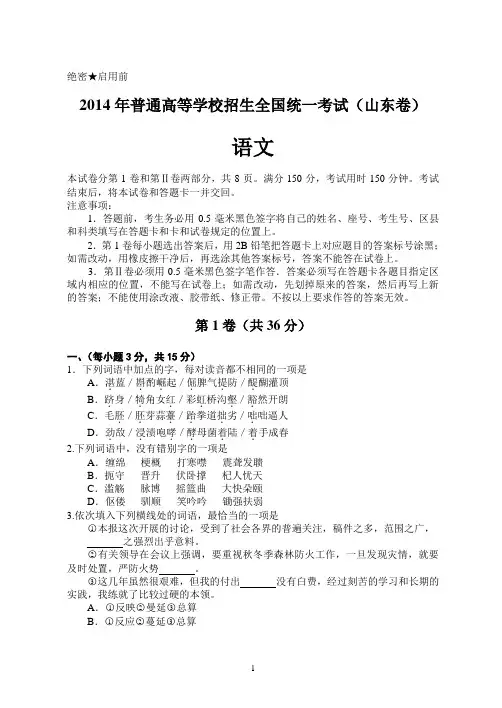
绝密★启用前2014年普通高等学校招生全国统一考试(山东卷)语文本试卷分第1卷和第Ⅱ卷两部分,共8页。
满分150分,考试用时150分钟。
考试结束后,将本试卷和答题卡一并交回。
注意事项:1.答题前,考生务必用0.5毫米黑色签字将自己的姓名、座号、考生号、区县和科类填写在答题卡和卡和试卷规定的位置上。
2.第1卷每小题选出答案后,用2B铅笔把答题卡上对应题目的答案标号涂黑;如需改动,用橡皮擦干净后,再选涂其他答案标号,答案不能答在试卷上。
3.第Ⅱ卷必须用0.5毫米黑色签字笔作答.答案必须写在答题卡各题目指定区域内相应的位置,不能写在试卷上;如需改动,先划掉原来的答案,然后再写上新的答案;不能使用涂改液、胶带纸、修正带。
不按以上要求作答的答案无效。
第1卷(共36分)一、(每小题3分,共15分)1.下列词语中加点的字,每对读音都不相同的一项是A.湛.蓝/斟.酌崛.起/倔.脾气提.防/醍.醐灌顶B.跻.身/犄.角女红./彩虹.桥沟壑./豁.然开朗C.毛胚./胚.芽蒜薹./跆.拳道拙.劣/咄.咄逼人D.劲.敌/浸.渍咆哮./酵.母菌着.陆/着.手成春2.下列词语中,没有错别字的一项是A.缠绵梗概打寒噤震聋发聩B.扼守晋升伏卧撑杞人忧天C.滥觞脉博摇篮曲大快朵颐D.伛偻驯顺笑吟吟锄强扶弱3.依次填入下列横线处的词语,最恰当的一项是○1本报这次开展的讨论,受到了社会各界的普遍关注,稿件之多,范围之广,之强烈出乎意料。
○2有关领导在会议上强调,要重视秋冬季森林防火工作,一旦发现灾情,就要及时处置,严防火势。
○3这几年虽然很艰难,但我的付出没有白费,经过刻苦的学习和长期的实践,我练就了比较过硬的本领。
A.○1反映○2曼延○3总算B.○1反应○2蔓延○3总算C.○1反映○2蔓延○3终于D.○1反应○2曼延○3终于4.下列各句中,加点的成语使用正确的一句是A.严冬的夜晚,凛冽的北风从后窗缝里灌进来,常常把人们从睡梦中冻醒,让人不寒而栗....。
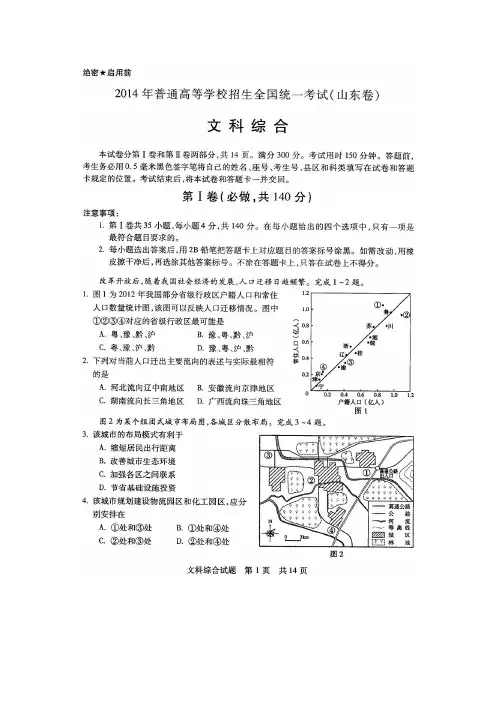
2014年普通高等学校招生全国统一考试文科综合及答案(高清扫描)
2014年普通高等学校招生全国统一考试(山东卷)文科综合试题参考答案第II卷36.(1)年降水量多(3分);西非众多河流的发源地(地势高)(3分)。
(2)原因:河流带来丰富的泥沙(3分);洋流由北向南流动(3分)。
不利影响:形成障碍(淤塞航道),不利于通航(3分)。
(3)加强国际合作,合理分配用水(3分);修建水利设施(若答出具体的水利工程措施也可得分)(3分);合理选择农业生产类型(若答出具体的农业结构调整措施也可得分)(3分);采取节水灌溉措施(若答出具体的农业节水灌溉措施也可得分)(3分)。
37.(1)市场需求量大(市场潜力大)(3分);生产成本低(劳动力成本低;土地成本低)(3分)。
(2)有利于企业实现专业化生产(分工合作,调整产业结构,提高工业化水平(3分);当地企业规模扩大、数量增多,促进了当地的经济发展(扩大了当地经济规模)(3分);增加了就业机会(推动了城市化进程)(3分)。
38.(1)材料甲反映出历代统治者特别是明清统治者都重视对节烈女的宣传褒扬,从一个层面反映了古代中国妇女受礼教压迫的状况;研究材料甲能够了解古代妇女的社会地位及其成因,为探讨20世纪初中国妇女地位的变化提供比较研究的视角。
(2)考生作答时应结合具体事实进行概括归纳,准确说明事实与结论①的关系。
举一例说明即可。
如:觉慧反对鸣凤叫自己少爷,希望娶凤鸣为妻等,反映出当时出现了自由平等的新思想,是社会进步的表现;李欣淑的父母包办其婚姻等,说明当时封建礼教根深蒂固,反映出人们的守旧和社会的保守。
(3)材料丙。
材料丙是当时的新闻报道,相对较为真实,史料价值高;材料乙是文学作品,在一定的程度上反映了社会现实,但有艺术加工成分,使用时应与其他史料印证。
(4)李欣淑接受新式教育、反对包办婚姻及与封建家庭的斗争等行为时20世纪中国女性解放的缩影。
20世纪初的中国社会正发生着深刻变化。
经济上,中国民族资本主义经济发展,为反封建斗争和社会进步奠定了物质基础,让更多妇女可以走出家庭并实现经济独立。
2014年西班牙语专四真题(带答案)
2014年西班牙语专四真题(带答案)El día de los Reyes Magos es muy importante para los niños españoles。
ya que ellos son los que traen los regalos de Navidad。
Según la leyenda católica。
los ___。
En la víspera de la fiesta。
los niños dejan sus zapatos en un lugar visible para ___。
Por lamañana。
los niños se despiertan nados al encontrar que los Reyes___.___。
especialmente para los niños。
A diferencia de otrospaíses。
donde Papá Noel es el que trae los regalos de Navidad。
___ la tradición católica。
los ___。
En la víspera de la fiesta。
losniños dejan sus zapatos en un lugar visible para ___。
Por lamañana。
los niños se despiertan nados al encontrar que los Reyes___.El día de los Reyes Magos es una de las fiestas más importantes en España。
2014年山东卷高考真题英语试卷-学生用卷
2014年山东卷高考真题英语试卷-学生用卷一、单项选择1、【来源】 2014年高考真题山东卷第1题2014年高考真题山东卷Writing out all the invitations by hand was more time-consuming than we______.A. will expectB. are expectingC. expectD. had expected2、【来源】 2014年高考真题山东卷第2题2014年高考真题山东卷2014年高考真题I don't really like the author, I have to admit his books are very exciting.A. althoughB. unlessC. untilD. once3、【来源】 2014年高考真题山东卷第3题2014年高考真题山东卷—This apple pie is too sweet, don't you think so?—. I think it's just right, actually.A. Not reallyB. I hope soC. Sounds goodD. No wonder4、【来源】 2014年高考真题山东卷2014年高考真题山东卷第4题2019~2020学年9月广东深圳福田区深圳市高级中学高中部高一上学期周测第43题1分2019~2020学年2月江苏苏州吴江区盛泽中学高一下学期周测D卷文科第15题1分Susan made clear to me that she wished to make a new life for herself.A. thatB. thisC. itD. her5、【来源】 2014年高考真题山东卷2014年高考真题山东卷第5题They made up their mind that they a new house once Larry changed jobs.A. boughtB. would buyC. have boughtD. had bought6、【来源】 2014年高考真题山东卷2014年高考真题山东卷第6题2019~2020学年广东深圳南山区深圳市南山区华侨城中学高二下学期期中第4题1分2017~2018学年11月广东深圳南山区深圳市南山外国语学校高三上学期月考第29题1分2018~2019学年10月黑龙江哈尔滨香坊区哈尔滨市第六中学高二上学期月考第76题0.5分There is a note pinned to the door when the shop will open again.A. sayingB. saysC. saidD. having said7、【来源】 2014年高考真题山东卷第7题2014年高考真题山东卷2016~2017学年陕西西安长安区西安市长安区第一中学高一下学期期中实验班第17题1分It is difficult for us to imagine life was like for slaves in the ancient world.A. whereB. whatC. whichD. why8、【来源】 2014年高考真题山东卷2014年高考真题山东卷第8题—Is Anne coming tomorrow?—. If she were to come, she would have called me.A. Go aheadB. CertainlyC. That’s rightD. I don’t think so9、【来源】 2014年高考真题山东卷2014年高考真题山东卷第9题It's standard practice for a company like this one a security officer.A. employedB. being employedC. to employD. employs10、【来源】 2014年高考真题山东卷2014年高考真题山东卷第10题2018~2019学年10月黑龙江哈尔滨香坊区哈尔滨市第六中学高二上学期月考第77题0.5分2018~2019学年广东深圳南山区深圳大学附属中学高二下学期期中第8题1分2018~2019学年广东深圳南山区深圳大学师范学院附属中学高二下学期期中第8题1分A company profits from home markets are declining may seek opportunities abroad.A. whichB. whoseC. whoD. why二、完形填空11、【来源】 2014年高考真题山东卷第11题AThere was a pet store and the owner had a parrot. One day a1walked in and the parrot said to the man ,“Hey you!” The man said, “What!?” The parrot said,“Your 2is really ugly.” The man gotvery3and went to the store owner and said, “Your birdjust4my wife. It said she was ugly.”The owner stormed over,5the bird, took it into the “blackroom,”shook it a bit, 6out a few feathers, and said,“Don’t ever, ever say anything to7my customers again. You got that”With that8he took the bird and put it back into its cage. The old bird shook out its9and relaxed in its cage. A couple ofweeks10and in walked this guy and his wife again. The parrot said, “Hey you!” The guy said, “What!?” The parrot answered, “You know that.”A. groupB. teamC. coupleD. crowdA. wifeB. sisterC. motherD. daughterA. curiousB. nervousC. guiltyD. angryA. greetedB. puzzledC. offendedD. scaredA. huggedB. seizedC. trainedD. rescuedA. sentB. handedC. pulledD. dugA. touchB. amuseC. cheatD. embarrassA. warningB. commentC. suggestionD. requestA. eyesB. feathersC. furD. skinA. lastedB. arrivedC. appearedD. passed12、【来源】 2014年高考真题山东卷(B篇)第12题Charlotte Whitehead was born in England in 1843, and moved to Montreal, Canada at the age five with her family. While1her ill elder sister throughout the years, Charlotte discovered she had a(an)2in medicine. At 18 she marriedand3 a family. Several years later, Charlotte said she wanted to bea4.Her husband supported her decision.5, Canadian medical schools didnot6women students at the time. Therefore, Charlotte went to the United States to study7at the Women's Medical College in Philadelphia. It took her five years to8her medical degree.Upon graduation, Charlotte9to Montreal and set up aprivate10.Three years later, she moved to Winnipeg, Manitoba, and there she was once again a11doctor. Many of her patients were from the nearby timber and railway camps. Charlotte12herself operating on damaged limbs and setting13bones, in addition to delivering all the babies in the area.But Charlotte had been practicing without a license. She had14 a doctor's license in both Montreal and Winnipeg, but was15.The Manitoba College of Physicians and Surgeons, an all-male board, wanted her to16her studies at a Canadian medical college!Charlotte refused to17her patients to spend time studying what she already knew. So in 1887, she appealed to the Manitoba Legislatureto18 a license to her but they, too, refused.Charlotte19to practice without a license until 1912. She died four years later at the age of 73.In 1993, 77 years after her20, a medical license was issued to Charlotte. This decision was made by the Manitoba Legislature to honor "this courageous and pioneering woman." A. raisingB. teachingC. nursingD. missingA. habitB. interestC. opinionD. voiceA. inventedB. selectedC. offeredD. startedA. doctorB. musicianC. lawyerD. physicistA. BesidesB. UnfortunatelyC. OtherwiseD. EventuallyA. hireB. entertainC. trustD. acceptA. historyB. physicsC. medicineD. lawA. improveB. saveC. designD. earnA. returnedB. escapedC. spreadD. wanderedA. schoolB. museumC. clinicD. labA. busyB. wealthyC. greedyD. luckyA. helpedB. foundC. troubledD. imaginedA. harmfulB. tiredC. brokenD. weakA. put awayB. taken overC. turned inD. applied forA. punishedB. refusedC. blamedD. firedA. displayB. changeC. previewD. completeA. leaveB. chargeC. testD. cureA. sellB. donateC. issueD. showA. continuedB. promisedC. pretendedD. dreamedA. birthB. deathC. weddingD. graduation三、阅读理解13、【来源】 2014年高考真题山东卷第13题AOne morning, Ann’s neighbor Tracy found a lost dog wandering around the local elementary school.She asked Ann if she could keep an eye on the dog. Ann said that she could watch it only for the day.Tracy took photos of the dog and printed off 400 FOUND fliers(传单),and put them in mailboxes. Meanwhile, Ann went to the dollar store and bought some pet supplies, warning her two sons not to fall in love with the dog. At the time, Ann’s son Thomas was 10 years old, and Jack, who was recovering from a heart operation, was 21 years old.Four days later Ann was still looking after the dog, whom they had started to call Riley. When she arrived home from work, the dog threw itself against the screen door and barked madly at her. As soon as she opened the door, Riley dashed into the boys’ room where Ann found Jack suffering from a heart attack. Riley ran over to Jack, but as soon as Ann bent over to help him the dog went silent.“If it hadn’t come to get me, the doctor said Jack would have died,” Ann reported to a local newspaper. At this point, no one had called to claim the dog, so Ann decided to keep it.The next morning Tracy got a call. A man named Peter recognized his lost dog and called the number on the flier. Tracy started crying, and told him, “That dog saved my friend’s son.”Peter drove to Ann’shouse to pick up his dog, and saw Thomas and Jack crying in the window. After a few moments Peter said, “Maybe Odie was supposed to find you, maybe you should keep it."(6) What did Tracy do after finding the dog?A. She looked for its owner.B. She gave it to Ann as a gift.C. She sold it to the dollar store.D. She bought some food for it.(7) How did the dog help save Jack?A. By breaking the door for Ann.B. By leading Ann to Jack’s room.C. By dragging Jack out of the room.D. By attending Jack when Ann was out.(8) What was Ann’s attitude to the dog according to Paragraph 4?A. Sympathetic.B. Doubtful.C. Tolerant.D. Grateful.(9) For what purpose did Peter call Tracy?A. To help her friend’s son.B. To interview Tracy.C. To take back his dog.D. To return the flier to her.(10) What can we infer about the dog from the last paragraph?A. It would be given to Odie.B. It would be kept by Ann'family.C. It would be returned to Peter.D. It would be taken away by Tracy.14、【来源】 2014年高考真题山东卷第14~18题It was one of those terribly hot days in Baltimore. Needless to say, it was too hot to do anything outside. But it was also scorching in our apartment. This was 1962, and I would not live in a place with an air conditioner for another ten years. So my brother and I decided to leave the apartment to find some place indoors. He suggested we could see a movie. It was a brilliant plan.Movie theaters were one of the few places you could sit all day and—most important—sit in air conditioning. In those days, you could buy one ticket and sit through two movies. Then, the theater would show the same two movies again. If you wanted to, you could sit through them twice. Most people did not do that, but the manager at our theater. Mr. Bellow did not mind if you did.That particular day, my brother and I sat through both movies twice, trying to escape the heat. We bought three bags of popcorn and three sod as each. Then, we sat and watched The Music Man followed by The Man Who Shot Liberty Valance. We'd already seen the second movie once before.Ithad been at the theater since January, because Mr. Bellow loved anything with John Wayne in it.We left the theater around 8, just before the evening shows began. But we returned the next day and saw the same two movies again, twice more. And we did it the next day too. Finally, on the fourth day, the heat wave broke.Still, to this day I can sing half the songs in The Music Man and recite half of John Wayne and Jimmy Stewart's dialogue from The Man Who Shot Liberty Valance! Those memories are some of the few I have of the heat wave of 1962. They're really memories of the screen, not memories of my life.(1) In which year did the author first live in a place with an air conditioner?A. 1952.B. 1962.C. 1972.D. 1982.(2) What does the underlined word "It"in Paragraph 3 refer to?A. The heat.B. The theater.C. The Music Man.D. The Man Who Shot Liberty Valance.(3) What do we know about Mr. Bellow?A. He loved children very much.B. He was a fan of John Wayne.C. He sold air conditioners.D. He was a movie star.(4) hy did the author and his/her brother see the same movies several times?A. The two movies were really wonderful.B. They wanted to avoid the heat outside.C. The manager of the theater was friendly.D. They liked the popcorn and the soda at the theater.(5) What can we learn from the last paragraph?A. The author turned out to be a great singer.B. The author enjoyed the heat wave of 1962.C. The author's life has been changed by the two movies.D. The author considers the experience at the theater unforgettable.15、【来源】 2014年高考真题山东卷第15题CElizabeth Freeman was born about 1742 to African American parents who were slaves. At the age of six months she was acquired, along with her sister, by John Ashley, a wealthy Massachusetts slaveholders. She became known as “Mumbet” or “Mum Bett.”For nearly 30 years Mumbet served the Ashley family. One day,Ashley’s wife tried to strike Mumbet’s sister with a spade. Mumbet protected her sister and took the blow instead. Furious, she left the house and refused to come back. When the Ashleys tried to make her return, Mumbet consulted a lawyer, Theodore Sedgewick. With his help, Mumbet sued(起诉) for her freedom.While serving the Ashleys, Mumbet had listened to many discussions of the new Massachusetts constitution. If the constitution said that all people were free and equal, then she thought it should apply to her. Eventually, Mumbet wonher freedom---- the first slave in Massachusetts to do so under the new constitution.Strangely enough,after the trial, the Ashleys asked Mumbet to come back and work for them as a paid employee. She declined and instead went to work for Segdewick. Mumbet died in 1829, but her legacy lived on in her many descendants(后裔). One of her great-grand children was W.E.B.Du Bois, one of the founder of the NAACP, and an important writer and spokes person for African American civil rights.Mumbet’s tombstone still stands in the Massachusetts cemetery where she was buried. It reads, in part: “She was born a slave and remained a slave and remained a slave for nearly thirty years. She could neither read nor write, yet in her own sphere she had no superior or equal.”(6) What do we know about Mumbet according to Paragraph 1?A. She was born a slaveB. She was a slave holderC. She had a famous sisterD. She was born into a rich family(7) Why did Mumbet run away from the Ashleys?A. She found an employerB. She wanted to be a lawyerC. She was hit and got angryD. She had to take care of her sister(8) What did Mumbet learn from discussions about the new constitution?A. She should always obey her owners’ ordersB. She should be as free and equal as whitesC. How to be a good servantD. How to apply for a job(9) What did Mumbet do after the trial?A. She chose to work for a lawyerB. She found the NAACPC. She continued to serve the AshleysD. She went to live with her grandchildren(10) What is the test mainly about?A. A story of a famous writer and spokes personB. The friendship between a lawyer and a slaveC. The life of a brave African American womanD. A trial that shocked the whole world16、【来源】 2014年高考真题山东卷(D篇)第16题How fit are your teeth? Are you lazy about brushing them? Never fear: An inventor is on the case. An electric toothbrush senses how long and how well you brush, and it lets you track your performance on your phone.The Kolibree toothbrush was exhibited at the International Consumer Electronics Showin Las Vegas this week. It senses how it is moved and can send the information to an Android phone or iPhone via a Bluetooth wireless connection.The toothbrush will be able to teach you to brush right (don't forget the insides of the teeth!) and make sure you're brushing long enough. "It's kind of like having a dentist actually watch your brushing on a day-to-day basis, " saysThomas Serval, the French inventor.The toothbrush will also be able to talk to other applications on your phone, so developers could, for instance, create a game controlled by your toothbrush. You could score points for beating monsters among your teeth. "We try to make it smart but also fun, " Several says.Serval says he was inspired by his experience as a father. He would come home from work and ask his kids if they had brushed their teeth. They said "yes, " but Serval would find their toothbrush heads dry. He decided he needed a brush that really told him how well his children brushed.The company says the Kolibree will go on sale this summer, for $99 to $199, developing on features. The U.S. is the first target market.Serval says that one day, it'll be possible to replace the brush on the handle with a brushing unit that also has a camera. The camera can even examine holes in your teeth while you brush.(1) Which is one of the feature of the Kolibree toothbrush?A. It can sense how users brush their teeth.B. It can track users' school performance.C. It can detect users' fear of seeing a dentist.D. It can help users find their phones.(2) What can we learn from Serval's words in Paragraph 3?A. You will find it enjoyable to see a dentist.B. You should see your dentist on a day-to–day basis.C. You can brush with the Kolibree as if guided by a dentist.D. You’d like a dentist to watchyou brush your teeth every day.(3) What is Paragraph 5 mainly about?A. How Serval found out his kids lied to him.B. Why Serval thought brushing teeth was necessary.C. How Serval taught his kids to brush their teeth.D. What inspired Serval to invent the toothbrush(4) Which of the following might make the Kolibree tooth brush fun?A. It can be used to update mobile phones.B. It can be used to play mobile phone games.C. It can send messages to other users.D. It can talk to its developers.(5) What can we infer about Serval's children?A. They were unwilling to brush their teeth.B. They often failed to clean their toothbrushes.C. They preferred to use a toothbrush with a dry head.D. They liked brushing their teeth after Serval came home.(6) What can we learn about the future development of the Kolibree?A. The brush handle will be removed.B. A mobile phone will be built into it.C. It will be used to fill holes in teeth.D. It will beable to check users' teeth.17、【来源】 2014年高考真题山东卷(E篇)第17题The kids in this village wear dirty, ragged clothes. They sleep beside cows and sheep in huts made of sticks and mud. They have no school. Yet they all can chant the English alphabet, and some can make words.The key to their success: 20 tablet computers(平板电脑)dropped off in their Ethiopian village in February by a U.S. group called One Laptop Per Child.The goal is to find out whether kids using today's new technology can teach themselves to read in places where no schools or teachers exist. The Massachusetts Institute of Technology researchers analyzing the project data say they're already amazed. "What I think has already happened is that the kids have already learned more than they would have in one year of kindergarten, " said Matt Keller, who runs the Ethiopia program.The fastest learner—and the first to turn on one of the tablets—is 8-year-old Kelbesa Negusse. The device's camera was disabled to save memory, yet withinweeks Kelbesa had figured out its workings and made the camera work. He calledhimself a lion, a marker of accomplishment in Ethiopia.With his tablet, Kelbasa rearranged the letters HSROE into one of the many English animal names he knows. Then he spelled words on his own. "Seven months ago he didn't know any English. That's unbelievable, " saidKeller.The project aims to get kids to a stage called "deep reading, " where they can read to learn. It won't be in Amharic, Ethiopia's first language, but in English, which is widely seen as the ticket to higher paying jobs.(1) How does the Ethiopia program benefit the kids in the village?A. It trains teachers for them.B. It contributes to their self-study.C. It helps raise their living standards.D. It provides funds for building schools.(2) What can we infer from Keller's words in Paragraph 3?A. They need more time to analyze data.B. More children are needed for the research.C. He is confident about the future of the project.D. The research should be carried out in kindergartens.(3) It amazed Keller that with the tablet Kelbesa could _______.A. learn English words quickly.B. draw pictures of animals.C. write letters to researchers.D. make phone calls to his friends.(4) What is the aim of the project?A. To offer Ethiopians higher paying jobs.B. To make Amharic widely used in the world.C. To help Ethiopian kids read to learn in English.D. To assist Ethiopians in learning their first language.四、阅读表达18、【来源】 2014年高考真题山东卷第18题阅读下面的短文并用英语回答问题,然后将答案写到答题卡相应的位置上(请注意问题后的字数要求)。
2014年西班牙语专四真题(带答案)
第一部分:听写(Dictado, 10 puntos)考生将听写一篇120字左右的文章。
首先,我们以正常语速朗读一遍。
之后,断句朗读两遍,同时考生开始听写。
最后,我们再以正常语速通篇朗读一遍,请考生核对。
全部朗读结束后,考生有一分钟检查时间。
现在开始。
请注意:录音中已经将听写时间留出,监考人员无需干预。
TextoEl día de los Reyes Magos es el día de mayor felicidad para los niños españoles, porque en España no es Papá Noel el que trae los regalos de Navidad, sino los Tres Reyes Magos.Según la leyenda católica, los Reyes Magos son los tres visitantes que, tras el nacimiento de Jesús, acudieron desde países extranjeros para rendirle homenaje y entregarle regalos de gran riqueza simbólica.En la víspera de la fiesta, antes de acostarse, los niños dejan sus zapatos en un lugar donde los Reyes los vean con total seguridad. Como dicen que a estos les encantan los dulces, los niños normalmente dejan unos caramelos para atraer a los Reyes. Por la mañana, descubren emocionados que ellos se han comido los dulces y junto a sus zapatos han dejado los regalos.(第一遍结束后,录音中有指示:“开始听写”)现在考生有一分钟时间用于检查。
2014年普通高等学校招生全国统一考试山东卷
2014年普通高等学校招生全国统一考试(山东卷)英语本试卷分第Ⅰ卷和第Ⅱ卷两部分。
满分150分,考试用时120分钟。
第Ⅰ卷(共105分)第一部分英语知识运用(共两节,满分55分)第一节单项填空(共10小题;每小题1.5分,满分15分)从A、B、C、D四个选项中,选出可以填入空白处的最佳选项,并在答题卡上将该项涂黑。
1.Writing out all the invitations by hand was more time-consuming than we ______.A.will expect B.are expectingC.expect D.had expected答案:D 考查动词时态。
句意:手写出所有的这些请帖比我们原先预料的更费时。
根据前面的was可以看出,此处表示过去的动作,且expect发生在“过去的过去”,故用过去完成时。
2.I don't really like the author,______ I have to admit his books are very exciting.A.although B.unlessC.until D.once答案:A 考查状语从句。
句意:我实在不喜欢这位作者,尽管我不得不承认他写的书很激动人心。
根据句意可知,此处表示让步关系,故用although。
3.—This apple pie is too sweet,don't you think so?—______.I think it's just right,actually.A.Not really B.I hope soC.Sounds good D.No wonder答案:A 考查交际用语。
句意:——这个苹果派太甜了,你不觉得吗?——那倒不是。
实际上我觉得正合适。
Not really “事实并非如此”;I hope so “我希望如此”;Sounds good “听起来不错”;No wonder “难怪”。
2014年山东卷英语详细解析word版
10. 2014年普通高等学校招生全国统一考试英语(山东卷)【名师简评】2014年是山东英语高考的一个转折点,其中变化最大的是其题型的变化。
首先取消了听力,减少了5道单选题,增加了一篇设10空的完形填空,同时还增加了一篇阅读。
尽管有这些变化,但是其难易度与去年相似,比前年难些。
其命题原则,命题思路及命韪的特点基本与上一年保持一致,即侧重基础,注重语境,突出语篇,强调检测考生语言运用的能力,既有利于高校的选拔,也有利于中学英语教学进一步推进素质教育。
从试题内容方面看,所选材料贴近生活,具有时代感,知识覆盖面广,生活气息浓郁,集基础性、交际性、文化性和能力性于一体,不但强调语言基础知识的运用,在每一种题型均设置了若干个有一定难度的试题,在语言、词汇、选材、内涵、思想等方面有了更多的突破;充分体现r试卷应有的选拔功能,对中学英语教学的改革和已经开始的中学英语新课程标准的实施起到了很好的衔接作用。
本卷容易失分之处为第四篇阅读,为说明文,文章篇幅长,设题多,内容抽象,今后学习时,要重视对阅读能力的培养,多做题,多思考。
第一部分英语知识运用第一节单项填空1.【考点】本题考查时态。
【答案】D【解析】根据主句中的关键词语was可知“耗费时间”这一动作已经发生,而“预想时间”应该是发生在“耗费时间”之前,即expect的时态为过去的过去(过去完成时),故选D项。
句意:手写出所有的邀请函比我们预想的更耗时。
2.【考点】本题考查状语从句。
【答案】A【解析】句意:尽管我不得不承认他的书很令人心动,但我真得不喜欢这位作家。
分析题意可知前后两句并没有时间关系或条件关系,因此可排除until(直到……)、unless(除非)、once(一旦)。
关键词don’t really like(并不真喜欢)与very exciting(激动人心的)构成前后逻辑语义上的强烈对比,故用让步状语从句的引导词although符合题意。
【方法技巧】解答此题的关键是准确理解前后语境,考生会误认为是考查not…until…结构而错选until。