
牛津译林版八年级英语上册Unit6 Welcome to the unit教案
3.Ask the students ‘Which is your favorite bird? Why?
Practice Part B on Page69inpairs
Step4Production
Make up new conversations using Part B as a model and act them out.
2. Play a game : reading and guessing (guess what bird it is.)
e.g. I live in wetland. I am very tall. I have long beak, long
neck and long legs. I haveblack and white feathers. Who am I?
Difficult points:
Totalk about birds on two aspects: characteristics and appearance.
教学流程设计
Step1 warming-up
Talking about birds
Show the pictures of different kinds of birds and talk about them focusing on what’s special about the birds.
2.)Does he really love birds?
3.)What kind of birds does he like best?
2.Practice reading in pairs and try to act it out
Step6Production
Choose a kind of birds and describe its appearance using thenew words.
Step5Presentation
1.Say: We love birds. Eddie loves birds, too. Listen to the tape and find the answers to the following questions.
1.)What is Eddie going to do?
2.To talk about birds on two aspects: characteristics and appearance.
3.To arouse the students’interest in birds in the wild.
重点难点
Key points:
To learn the common names of birds
Step2Presentation
Learn the new words(Revise some old words at the same time)Do Part A on Page69
Step3Practice
1.Show the pictures together and then get the students to give their names. Make sure all the students can read the names correctly.
Talk about birds freely
Showpictures about different birds
Learn new words
Show and practice
Play a game
Listen to tape and answer the questions
Practice in pairs
牛津译林版八年级英语chingWelcome to the unit教案
年级:八年级学科:英语主备人:
教学内容
8AUnit6 Birdwatching Welcome to the unit
二次备课
教学目标
1.To learn the common names of birds
Homework:
1.Look for more information about birds.
2.Write a short article about your favorite bird (characteristics and appearance)
3.Preview the new words inReading(reading and reciting)
Do exercises
牛津英语7A Unit6 welcome to the unit课件ppt
New words
11. 12. 13. 14. 15. 16. 17. 18. 19. 20. 年轻的 羊毛 皮 丝绸 风格 时髦的 软底运动鞋 舒适的 现代的 一条裤子 young wool leather silk style smart trainer comfortable modern a pair of trousers
C. An interview
Kitty: Congratulations, Sandy. The show is
great. I really like your red boots. Sandy: Thank you. I think they match my (1) __________ blouse. red silk
Simon wears the clothes from the _____. 1980s His trousers are ______.His tie is _____ white red and _______. yellow His shirt is _______. purple
colourful . He looks _________
shirt tie suit
trousers
shoes
jumper
handbag
skirt
boots
Clothes and materials It’s made of--cotton silk wool leather
In different times(时代,时期),people wear different clothes in different styles(风格,式样).
B. Read and tick √ √ √ √ √ √ √
最新牛津译林版八年级英语上册Unit6 welcome课件
a
b
c
d
A: What do …… look like? The sparrows are very small. They They…… have brown and greyB:feathers.
birds
Appearance
small, brown and grey feathers long thin neck, white feathers
tall
long thin neck
long legs
crห้องสมุดไป่ตู้ne
swans
long thin necks
white feathers
sparrow
small
brown and grey feathers
brown feathers
broad wings
[brɔ:d] [wɪŋz]
eagle
1. Crane b tall long legs long thin neck a 2. Sparrow small brown and grey feathers d 3. Swan long thin neck white feathers c 4. Eagle broad wings brown feathers
Enjoy some pictures
[ˈspærəʊ]
an eagle
[ˈi:ɡl]
Parrot
Let’s read the new words
crane sparrow swan eagle
parrot
parrot 1. A _______ can repeat our words. 2. The ______ can both fly in the sky and swans swim in the lake. cranes 3. Chinese people like________, because they stand for “having a long life”. sparrows 4. The _______ are small in size. They can’t fly high and you can see them everywhere. eagle 5. An _______ is very brave and it is good at catching small animals
牛津译林版-英语-八上-6单元strip Welcome to the unit

Langue points:
was sleeping------过去进行时
(表示过去某个时间正在发生的事情)
结构: was/were (not) + doing
Practice: Make some sentences
The boy was walking home when the typhoon came.
The girl was doing homework in her bedroom when the thunder and lightning came.
A man and a woman were walking in the water
People were having dinner at home when the the snowstorm came.
rain
a rainstorm
What’s the weather like? It’s rainy.
What is it? typhoon
• What’s the weather like?
It’s windy.
What is it? thunder and lightning
• What’s the weather like?
typhoon
Thunder and lightning
rainstorm
snowstorm
What’s the weather like? What happened to Hobo?
What’s the weather like?
What happened to Hobo? What was Hobo doing when it started to rain? When did Hobo hear the rain? What happened to Hobo’s house? Why doesn’t he want to go home alone?
牛津译林版9A Unit6 TV programmes welcome to the unit课件(共13张PPT)

comedy
game show
cartoon
documentary
chat show
drama series
1. What type of TV programmes does Millie like? 2. Why does Millie like watching documentaries?
Which type of TV programmes do you like best?
cartoons
drama
film
sports
MV
(music video)
documentary
/ɒ /
A. Sandy is doing a quiz. Help her match the scenes below with the types of TV programmes. Write the correct name p79A under each picture. cartoon documentary chat show drama series comedy game show
Listen and answer:
She likes watching documentaries.
Because she can learn a lot about nature, history and real-life events from them.
3. What does Amy think of chat shows?
What type of TV programmes do you like?
1. 工作快做完了。 The job’s nearly done. 2. 那种事只发生在电影里,而不是现实生活中。 That kind of thing only happens in films, not in real life. 3. 这部电影真乏味,满是差劲的对白! It is a boring movie full of bad dialogue. 4. 我认为访谈节目和游戏节目一样精彩。 I think chat shows are as wonderful as game shows. 5. 你喜欢哪种电视节目?
牛津译林版7A Unit6 Food and lifestyle Welcome to the unit课件(共20张PPT)
Put the food into the correct groups. Vegetables: potatoes, tomatoes, carrots…
Fruits: lemons, watermelons
meat:
chicken, beef, pork……
drinks: milk, juice……
What food does Millie and Daniel like/dislike?
Millie likes bananas _______, carrots ________ fish and _______. eggs She dislikes ______. Daniel likes hamburgers ________. eggs He likes _________. carrots He dislikes _________.
snacks: chocolate, sweets ……
Work in pairs, using love, like and dislike :
• • • • • I like… What food do you like? Do you like…? I like … I don’t like… What about you? ……
Hamburgers and meat.
never
eats carrots
never
eats hamburgers
Is he a healthy pet?
Why or Why not?
It’s noon, Hobo.Let’s have a hamburger.
And hamburgers are not good for us. Let’s eat apples.
牛津译林版英语八上Unit 6《Birdwatchers》(welcome)教学设计

牛津译林版英语八上Unit 6《Birdwatchers》(welcome)教学设计一. 教材分析牛津译林版英语八上Unit 6《Birdwatchers》主要介绍了关于观鸟的知识。
通过本单元的学习,学生将掌握观鸟的基本技巧、鸟类的主要特征以及如何保护鸟类等知识。
本单元包括两个部分:welcome部分和mn task部分。
welcome部分主要通过一幅漫画引出本课的主题,让学生对观鸟产生兴趣。
mn task部分则是一个关于鸟类观察的实践活动,学生需要运用所学知识完成任务。
二. 学情分析八年级的学生已经具备了一定的英语基础,对于动物类话题也相对熟悉。
然而,他们在阅读长篇文章时可能会遇到一些困难,特别是对于一些专业术语的理解。
因此,在教学过程中,需要帮助学生克服这些困难,提高他们的阅读理解能力。
此外,学生对于观察和实践活动比较感兴趣,可以充分利用这一点激发他们的学习兴趣。
三. 教学目标1.知识目标:学生能够掌握与观鸟相关的词汇和表达方式,如birdwatcher、habitat、protect等;了解鸟类的主要特征,如羽毛、翅膀、喙等;理解观鸟的基本技巧,如观察、记录、保护等。
2.能力目标:学生能够运用所学知识进行简单的阅读理解和口语表达,如描述鸟类特征、表达观鸟经历等。
3.情感目标:培养学生对大自然的热爱,提高他们的环保意识。
四. 教学重难点1.重点:观鸟相关的词汇和表达方式,鸟类的主要特征,观鸟的基本技巧。
2.难点:对于一些专业术语的理解,如habitat、protect等;如何运用所学知识进行实际操作。
五. 教学方法1.任务型教学法:通过设定各种任务,让学生在实际操作中运用所学知识,提高他们的实践能力。
2.情境教学法:创设各种真实的语境,帮助学生更好地理解和学习观鸟的相关知识。
3.合作学习法:鼓励学生分组讨论和合作完成任务,提高他们的团队协作能力。
六. 教学准备1.准备相关图片、视频等教学资源,以便在课堂上进行展示和讲解。
Unit6wele课件牛津译林版八年级英语上册
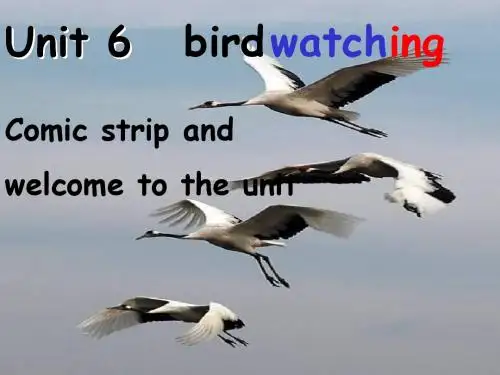
Comic strip &Welcome to the unit
The studWenhtsata’rsetwheatscohninggatbhoeubtirds.
They arTehbisirdswonagtchiseras(b观o鸟ut者a). story between They likaesgibrilrdawndatcahiktniygnp(d观e 鸟o)f. birds.
Discussion
(讨论)
What actions can we take to protect birds
1. Don’t catch or kill them. 2. Don’t eat their meat! 3. Don’t buy anything made of feathers 4. Plant more trees and forests 5. Stop hunters from hunting them 6. Make laws to protect them. 7. Build more nature reserves.
an eagle n.鹰 iː
brown feathers
broad wings 宽大的翅膀 ɔː i
Match the birds with the descriptions
a
1 Crane
b
tall, long legs
long thin neck
2 Sparrow
a
b
c
small
brown and grey feathers
TALK
We’ve talked about many different kinds of birds. Annie and Simon are talking about birds too.
江苏新教材牛津英语Unit6 Birdwatching Welcome to the unit
Listen to the comic strip and answer the following questions.
1. What is Eddie going to do? He is going birdwatching.
2. Where is Eddie going to watch birds? At the market.
a long thin neck, 15 types of cranes, rare birds.
学习句子: I often go to the market to watch the birds . What does Simon’s favourite bird? What do cranes look like? How many types of cranes are there in the world? There are only 15 types of cranes. They 2. 技能目标: 1) Introduce birdwatching in English. 2) Talk about birds.
Hobo: The market?
Eddie: Yes. I like the birds at the market.
Hens and ducks… Yummy.
当堂反馈
Homework
What’s your favorite bird? Can you
tell us? Please write a letter to your best friend what your favorite bird is and describe it carefully.
Cranes are tall. They have long legs and a long thin neck.
牛津译林版八年级英语上册Unit6 Welcome课件
Feathers white
Neck long, thin
Eagle ['iːgl]
It has ___b_r_o_w_n__ feathers and two __b_r_oa_d__ wings.
[brɔːd]
Describe the bird !
Name eagle
Wings broad
Feathers brown
2.What should a real birdwatcher do?
He should watch, learn, help and protect birds. 3.Why birds like cranes are rare birds?
Because people like Eddie like eating them/kill them for meat...
Hens and ducks.
Read and answer
Does he really like watching the birds?
No, he doesn’t.He likes eating them.
Further thinking
1.Is Eddie a real birdwatcher? Why? No, because he doesn’t go out to watch birds.
because he does not really like birds . He really
likes__e_a_ti_n_g__delicious hens and ducks. After Hobo knows it ,he is very s__u_rp_r_is_e_d__.
Let’s enjoy the birds
牛津译林版八年级英语上册Unit6单元教案教学设计
三、教学重难点和教学设想
(一)教学重难点
1.重点:本单元的重点在于让学生掌握一般过去时态的用法,熟练运用动词的过去式,并能够用英语描述过去的假期经历。
难点:对于一般过去时态的深入理解和正确运用,尤其是在口语交流中的自然转换和表达。
2.教学目的:通过这个环节,让学生在轻松愉快的氛围中回顾和运用过去时态,为新课的学习做好铺垫。
(二)讲授新知
1.教学内容:本节课主要学习一般过去时,包括动词过去式的变化规则、一般过去时的用法以及相关词汇。
2.教学过程:
-教师通过图片和实例,引导学生观察并总结动词过去式的变化规律。
-教师讲解一般过去时的用法,结合课文中的句子进行示范,让学生理解并模仿。
2.重点:提高学生的阅读理解能力,特别是对文章细节和主旨大意的把握。
难点:引导学生运用阅读策略,如预测、扫描、精读等,提高阅读效率和理解深度。
3.重点:通过听力练习,增强学生的听力技巧,特别是在理解日常对话中的关键信息。
难点:帮助学生克服在听力过程中遇到的生词和复杂句子结构造成的障碍。
4.重点:培养学生的口语表达和书面表达能力,特别是在叙述过去事件时的语言组织。
-录制一段2-3分钟的口语视频,讲述一个有趣的假期故事,注意语法的正确性和表达的流畅性。
3.阅读作业:
-阅读课本中与本单元相关的阅读材料,总结文章大意,并回答课后问题。
-选择一篇关于假期的英文文章进行阅读,尝试运用课堂上学到的阅读策略,如预测、扫描和精读。
4.研究性作业:
- �搜索并了解一个自己感兴趣的地方或活动,用英语整理出相关信息,包括过去时的描述。