
七年级下Unit 10 I'd like some noodles教案
Unit 10 I'd like some noodles. 第一课时 Section A (1a-1c)
1.重点单词:noodle, mutton, beef, cabbage, potato, special, would, yet 2.重点短语:would like 3.重点句式:—What would you like? —I'd like the beef noodles. I'm not sure yet.
1.日常生活中有关食物的名称 2.区分可数名词与不可数名词 3.掌握“would like”的用法
1.区分可数名词与不可数名词
一、预习课本P55新单词并识记, 完成下面的汉译英。 1.面条__________ 2.羊肉__________ 3.牛肉__________ 4.洋白菜__________ 5.土豆__________ 6.特色菜__________ 7.愿意__________ 8.还,仍然__________ 二、认真预习1a,1b,1c,找出下列短语和句型。 1.牛肉面__________ 2.想要 __________ 3.你想要什么?________________________________________________________________________ 4. 我想要这些牛肉面。________________________________________________________________________ 5. 我还不知道。________________________________________________________________________
Step 1 情景导入 Teacher:As we all know, we can't live without food. We have to eat something to keep us strong and healthy. Everyone has his own taste. So what kind of food do you like?What's your favorite food? Do you like noodles? What kind of noodles do you like? Today we'll talk about the kinds of noodles. 环节说明:就学生感兴趣的身边的话题导入新课,简洁明了,引人入胜。 Step 2 完成教材1a-1c的任务 1.学生认真观察1a图片中的食物,然后将词语与图片搭配,集体核对答案。(2分钟) 2.老师领读单词,并纠正发音。(2分钟) 3.大声朗读图片中的小对话,认真听录音,标出顾客所点的面条,集体核对答案,完成课本上1b的听力任务。(3分钟) 4.两人一组练习1a中的对话,然后利用1a中的信息仿照1a中的对话编新对话进行练习,并请一些学生表演出他们的对话。(5分钟) 参考案例 A: What would you like? B: I'm not sure yet. Are there any vegetables in the mutton noodles? A: Yes, there are some cabbages. B: OK, I'd like the mutton noodles. 5.小结训练。(3分钟) (C)1.—Would you like some milk? —________. A.Yes, I would B.No, I wouldn't C.Yes, please D.Thanks 2.She'd like a story book. (改为一般疑问句) Would she like a story book? 3.Kate would like something to eat. (改为同义句) Kate wants something to eat. 环节说明:听说结合,第一时间向学生传达语言目标,通过结对对话练习和小结训练,使语言目标得以强化。 Step 3 问题探究 1.some, any的用法 1)牛肉面里有一些西红柿。There_are_some_tomatoes_in_the_beef_noodles. 2)羊肉面里没有一些洋白菜。There_aren't_any_cabbages_in_the_mutton_noodles. 3)我能问你一些问题吗?Can_I_ask_you_some_questions? some 意为“一些”用在肯定句中,any 用在否定句或一般疑问句中。some 也可以用到委婉的一般疑问句中,表示希望得到对方的肯定答复。 2.would like 用法 1)他想吃些面条。He_would_like_some_noodles. 2)你想和我打篮球吗?Would_you_like_to_play_basketball_with_me? 3)他想让我帮他学英语。He_would_like_me_to_help_him(to)_learn_English. would like意为:想要=want。would是情态动词,无人称和数的变化。变否定句在would后面加not;变一般疑问句把 would提前。 would like可构成以下词组:想要某物would_like_sth.,想要做某事would_like_to_do_sth.,想要某人做某事would_like_sb._to_do_sth.。Would you like…? 表示委婉地征求对方的意见或劝诱,意为“你想要/愿意……吗?”多用于口语中,其肯定回答为Yes,please.否定回答为No,thanks. Would you like…?引导的疑问句中,用_some,不用any。Would you like to do…? 其肯定回答是Yes,I'd_love/like_to. 3.—What's her name? —Sorry, ________. A.I know B.I am know C.I'm not sure. 答案选C。I'm not sure=I don't know 意为“我不知道”。
请同学们做前面课时训练部分。 第二课时 Section A (2a-2d)
1.重点单词:order, bowl, size, tofu, large 2.重点句式: —What kind of noodles would you like? —I'd like beef noodles. —What size would you like? —Large. May I take your order?
1.日常生活中有关食物的名称 2.区分可数名词与不可数名词 3.熟练掌握如何订购食物
熟练掌握如何订购食物 一、预习课本P56新单词并识记, 完成下面的汉译英。 1.点菜__________ 2. 碗__________ 3.大小,尺码__________ 4. 豆腐__________ 5.大的__________ 二、认真预习2a,2b,2c和2d,找出下列句型。 1.你想要什么种类的面条?我想要牛肉面。 ________________________________________________________________________ 2.你想要多大碗的?大碗的。 ________________________________________________________________________ 3.你们现在可以点菜了吗? ________________________________________________________________________
Step 1 情景导入 Teacher:Do you like noodles? What kind of noodles do you like? Student 1:I like noodles very much. And I like beef noodles, and there are some vegetables in the noodles. Teacher: What about you? Student 2:I don't like noodles with meat in them. I like tomato noodles. …… 环节说明:通过师生互动复习上节课的内容,并且为新课的学习打下了基础。 Step 2 完成教材2a-2c的任务 1.学生先观察图片,再和相对应图片匹配,最后完成la的听力任务。(5分钟) 2.听录音,完成2b填空,核对答案后大声朗读句子。(3分钟) 3.听第三遍录音,跟读并从整体上感知对话内容。(2分钟) 4.两人一组,根据2b中的信息来练习对话,并邀请几组表演。(3分钟) 参考案例 A: What kind of noodles would you like? B: I'd like beef noodles. 5.小结训练。(2分钟) (C)1.—Would you like some onions? —________. A.Yes, I would B.No, I wouldn't C.No, thanks D.Yes, you would (B)2.I'd like some ________ and ________. A.mutton,vegetable B.beef,tomatoes C.potatos,bananas D.French fries,orange (C)3.The girl likes drinking water, she drinks________ every day. A.two bowls of waters B.two bowl of water C.two bowls of water D.two bowl of waters 环节说明:通过听、说学习训练让学生掌握了解了要掌握的语言目标,学生的口语表达能力在这一环节得到提升。 Step 3 完成教材2d的任务 1.学生自读对话,根据对话内容完成下列句子。(5分钟) 1)Sally would like some vegetables in the beef soup. 2)Sally wants one large bowl of beef soup. 3)Sally would like one_large_bowl_of_beef_soup,one_Gongbao_chicken,_one_mapo_tofu_with_rice_in all. 2.大声朗读2d 对话,读熟后与同伴结对练习,分角色表演对话。(3分钟) 3.创设情景:假设部分同学是服务员,另一部分是顾客,来练习对话。(5分钟) 4.小结训练。(3分钟) A:Can I help you? B:OK, I'd __1__ some soup, please. A:What __2__ of soup would you like? B:I'd like egg and tomato soup. A:Well, what __3__ bowl of soup would you like? B:What sizes do you have? A:We have __4__, medium and small bowls. B:Oh, a medium __5__, please. 1.like 2.kind 3.size 4.large 5.one 环节说明:将对话转化成填空题,这样能对所学的重要句型起到复习巩固的作用。 Step 4 问题探究 1.what size用法 你爸爸穿多大号的鞋?他穿8号的。 What_size_of_shoes_does_your_father_wear?Size_8. What size…? 句式是用来询问物体的尺寸和大小的常用句型。size是名词,意为“大小、尺寸”;即可表示物体的尺寸,又可表示服装、鞋帽等的型号 2. 1)一碗水 a_bowl_of_water 2)两碗面条 two_bowls_of_noodles
2019-2020年人教版英语七年级下册Unit 10 I’d like some noodles全
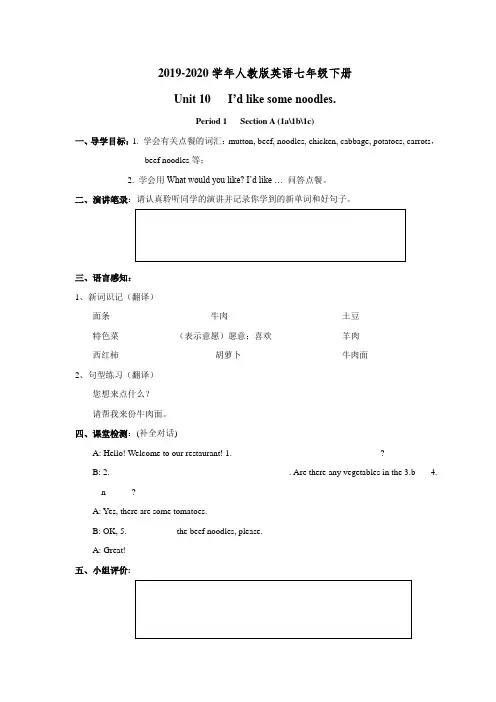
2019-2020学年人教版英语七年级下册Unit 10 I’d like some noodles.Period 1 Section A (1a\1b\1c)一、导学目标:1. 学会有关点餐的词汇:mutton, beef, noodles, chicken, cabbage, potatoes, carrots,beef noodles等;2. 学会用What would you like? I’d like … 问答点餐。
二、演讲笔录:请认真聆听同学的演讲并记录你学到的新单词和好句子。
三、语言感知:1、新词识记(翻译)面条_______ 牛肉_____________ 土豆___________特色菜_______ (表示意愿)愿意;喜欢_______ 羊肉____________西红柿__________ 胡萝卜___________ 牛肉面__________2、句型练习(翻译)您想来点什么?__________________________________________________请帮我来份牛肉面。
_________________________________________________四、课堂检测:(补全对话)A: Hello! Welcome to our restaurant! 1.__________________________________?B: 2._________________________________________. Are there any vegetables in the 3.b___ 4.n______?A: Yes, there are some tomatoes.B: OK, 5.___________ the beef noodles, please.A: Great!五、小组评价:Unit 10 I’d like some noodles.Period 2 Section A (2a\2b\2c\2d)一、导学目标:1. 学会词汇:a/one bowl of, take one’s order, size 等; 2. 能够听懂有关点餐的对话;3.能够和同伴谈论点餐的话题。
(人教版)七年级下册英语导学案:Unit 10 I’d like some noodles

Unit 10 I’d like some noodles.Period 1Section A(1a~2c)自主学习课前诊断温故知新两人一组回顾所学过的食品名称,并且分别归类。
Food: _______________________Drink: _______________________Countable noun: _______________________Uncountable noun: _______________________Countable and uncountable noun: _______________________二.设问导读Ⅰ. Pairwork.Talk about your needs in pairs:I’d like some…Ⅱ. Ask and answer.If you go to a noodle house, what will you say? For example:A: Hello, I’d like some noodles.B: What kind of noodles would you like?A: Beef and tomato noodles, please.B: What size bowl of noodles would you like?A: I’d like a small / medium / large bowl of noodles.三.自学检测Practice the dialogue and listen to 1b, 2a and 2b.互动学习问题解决special n. ______________special adj._________________1.___________________ is steak.星期四的特色菜是牛排。
2. We have some great__________today.今天我们有很好的特色菜。
七年级下册Unit10I'dlikesomenoodlesUnit10I写作课教案
Unit 10 I’d like some noodlesWriting (Section B 3a-3c)Date: . 2023Teacher: Tang WanjuType of lesson: writingⅠ.教材分析The analysis of the teaching materials3a的练习要求学生联系上下文,将零碎的句子形成一个完整的对话用方框中的单词填空,这要求学生能找到每个句中的关键词,再结合语境用正确的单词填空。
3b是让学生整理所学的食物名词及价格。
3c首先让学生进行对3a的句型总结,让学生了解句型结构,为之后的写作做好铺垫。
整个课程是通过过程性写作板块的训练,达到能够运用重点句型完成写作的任务。
Ⅱ.学情分析The analysis of the students学生学英语四个环节:听-说-读-写,写是最难的一个环节,四个环节环环相扣,只有做好了听,说,读的基础,才能进行写这一环节。
所以在写作前先做好词,句的练习,让学生在这个过程中有循可依,也做到了学以致用。
Ⅲ. 教学目标Teaching aims•语言目标Language goals掌握以下句型:--We have some ………--A medium bowl of …..is ….yuan/dollars.--T here are some… i n/at our restaurant.--Would you like sth./to do sth.•能力目标Ability goalsSs can use the key sentences to fill in the blanks.Ss can write an ad with the sentence structures .•情感目标Emotion and valuesⅣ. 教学重难点Teaching key and difficult point1.教学重点:1) 通过进行听、说的训练,来提高学生们综合运用所学知识的能力。
初中英语人教版七年级下册Unit10 I’d like some noodles.
设计主题Unit10I’d like some noodles.(第一课时)1.整体设计思路、指导依据说明一、整体设计思路:本节课设计思路是:以任务组织教学,在任务的履行过程中,以参与、体验、互动、交流与合作的学习方式,充分发挥学习者自身的认知能力,在完成任务的过程中能有所得。
知识:知识的呈现是按照词、句、文,即从易到难的顺序呈现的。
教材内容围绕食物展开,让学生学会表述喜欢的食物,并学会点餐。
任务:本节课任务设计以食物为主线,描述常见的食物,并学会用所学的知识做初步的点餐对话。
二、学习策略1、知识的呈现是按照词汇、句子、文章,即从易到难、由浅入深的顺序呈现的。
从教材内容围绕着点餐展开,让学生学会谈论食物的喜欢和如何点餐。
2、本节课任务设计以一家餐馆开始,以点餐为主线,上课以教师介绍自己的餐馆导入新任务。
介绍单词,呈现句型,以小组为单位共同参与完成对话和表演,并在说唱这一有趣而轻松的氛围中牢记本堂课的重点句型。
三、指导依据:(初中英语课程标准)初中英语课程标准的基本理念:注重素质教育,体现语言对学生发展的价值;面向全体学生,充分考虑学生学习语言的渐进性和持续性;强调学习的过程,重视语言的实践和应用。
初中英语课程标准的语言技能目标:1、熟悉与学生个人、家庭和学校生活密切相关的话题;2、能相互交流简单的个人信息;3、能表达简单的情感和感觉;4、能够根据表演猜测意思、说词语。
2.教学背景分析一、教学内容分析:(注:含本课时在本单元的教学定位分析)本单元的教学核心项目是“点餐”(Order food),谈论食物,以及如何点餐。
Section A从认识食物出发(Activity1a),逐步到听力练习中(Activity1b, 2a, 2b)呈现各种菜式,让学生让学生了解如何点餐。
从而引出本单元的语法项目would like及what 问句的用法,到句型操练(Activity1c,3,3b),语言目标层层递进,主要展示了重点句型:What would you like?I would like …What kind of noodles would you like ?I would like beef and tomato noodles, please.What size would you like?I would like a large/ medium / small bowl, please.二、学生情况分析:“点餐”与学生的实际生活密切相关,易于引发学生运用简单的英语进行交际和交流,所以在学习活动中,学生能根据已有的经历加上目标语言,进行交流。
七年级英语下册Unit10I'dlikesomenoodles第一课时SectionA(1a_1c)教案(新版)人教新目标版
Unit 10 I'd like some noodles.第一课时Section A(1a-1c)Target Navigation 【目标导航】Key words and phrases:noodle,mutton,beef,cabbage,potato,special,would,yet,would like Key sentences:(1)—What would you/she/he/they like?—I'd/She'd/He'd/They'd like some…/I'm not sure yet.(2)—What kind of noodles would you like?—I'd like beef noodles,please.Skills:掌握和熟练运用食物名称和学会如何预订食物。
Emotion:吃健康食物,停止浪费粮食!The guidance of learning methods 【学法指导】1.通过多媒体课件展示图片,创设情境,让学生对各种食物有感观的认识。
2.通过同伴之间编写、演练对话来操练句型和巩固新单词。
3.通过听听力并记录所听到的信息来巩固单词和句型。
4.通过设置“order food”这一活动,来运用本节课所学知识。
Learning important and difficult points【学习重难点】1.重要的食物名称和句型。
2.How to order food?(学会如何预订食物)。
3.学会如何表达自己的喜好。
Teaching Steps 【教学过程】Autonomous Learning Scheme 【自主学习方案】预习指导与检测(一)预习指导1.根据单元标题和图片等,预测新课内容。
2.根据音标拼读新单词并牢记。
3.勾画出重点和疑难点。
(二)预习检测Ⅰ.英汉互译。
1.想要,喜欢________ 2.牛肉面________3.卷心菜________ 4.鸡肉________5.羊肉________ 6.胡萝卜________7.土豆(复数)________8.西红柿(复数)________9.special________10.我还没想好。
人教版七年级英语下册课件单元话题写作 Unit 10 I’d like some noodles
Unit 10 I’d like some noodles.
为了宣传推广,一家名为“Happy Supermarket”(快乐超市) 的超市开展广告征文活动。请你根据下面提示,写一则广告。
内容包括: 1.超市食品(肉类、蔬菜和水果等); 2.营业时间。
Unit 10 I’d like some noodles.
Unit 10 I’d like some noodles.
1.第一步开头: 引入话题Welcome to …
2.第二步主体: 具体描述超市食品
There be …
We also have …
You can see …
You can use:help do the housework, clean the house,
Unit 10 I’d like some noodles.
One possible version: Happy Supermarket
Welcome to Happy Supermarket. The food in our supermarket is cheap. There is meat such as pork, beef, mutton, fish and chicken. All the meat is very fresh.
Unit 10 I’d like some noodles.
单元话题写作
Unit 10 I’d like some noodles.
Happy Time is a great restaurant in the southeast of the school. At Happy Time, you can have great food, drinks and desserts. Dumplings and noodles are our specials. You can also choose rice, hamburgers, pizza or bread here for your meal. Juice, tea and coffee are at very good prices. After meals, you can enjoy the desserts, such as ice cream and cakes. Welcome to Happy Time to have a great meal!
山东省青岛市平度市灰埠镇灰埠中学七年级英语下册 Unit 10 I’d like some noodles教案 (新版)人教新目标
Unit 10 I’d like some noodles一、 The analysis of the textbook.Different people have different tasts and habits of the food. Unit 8 focuses on the chinese food and it specialities. The main languge targets are “ What kind of noodles would you\he \she like ? I’d \ He’d\She’d like …… noodles. What size bowl of noodles would you \he \she like?” I’d\ He’d \She’d like a small\ medium\large bowl of noodles. It is an interesting topic related to the students’daily lives. So it is easy to arouse the interests of the students.二.The analysis of the students.The students show a lot enthusiams and passions to the lesson . Because the topic is useful and necessary in their daily lives. They show great curiosity and inquiry. Most names of the food are familiar to them. However some students are not familiar with some new words of the food such as beef, mutton, cabbage and so on. Besides the words of bowl , large, special are hard for them to pronouce. Some students have never seen or eaten the food in the lesson. So I will help them to overcome these obstacles. I will help them enjoy the fun of English .三.The analysis of the teaching methods.1. The students are always the masters of the class. The teachers are only the guides and organizers of the class activities. In English teaching, we should make the lessons close to their daily lives ,and complish the teaching goals in the activites. We should make the students master the ways to study in the activities. So the teachers and students can show their initiatives and creativities at their best.2. I adopt the task-based teaching method. I mix the main words and main language targets into the pratical act ivities. The students complish the goals through the experance of the class activities.3. Groupwork is the main teaching method in the English class. The te acher should give the students more freedom to show and express themselves. We should provide a stage for the students to mix the knowledge , exchange the information and share the resources .The teachers had better give them more praise and affirmation. So the relations between the teachers and students are natural and democratic. 四.The teaching goals.1.Knowlege object:words: would, I’d, noodle, beef, mutton, cabbage, potato, special, juice, drink, bowl, he’d, he would, sizelanguage goals:What kind of noodles would you\he \she like ? I’d \ He’d\She’d like ……noodles. What size bowl of noodles would you \he \she like?2. Ability object:The students are able to make the new conversations using the target languages. They foster the ability to speak ,listen, read, and study by themselves.3. Emotion object:Let the students enjoy the English and learn by using , learn by doing.4. learning strategy object:Self study and cooperation in groups.五.Teaching important and difficult points.Important points:1 The words of the food.2 The target language.Difficult points:Teach the students to put the knowledge into use.六.Teaching aids :The pictures of the food; a radio;a computer; a paper;七.Teaching procedure:Before ---task:( Let’s begin the lesson with the English song “ A mouse likes rice”)1 Warm up:Play a game using the target language “ Can you ? Yes, I can.\ No, I can’t.”T: My boys and girls, do you like games ? (The students may answer “Yes, I do”)T: Good ! now please take out a paper ( No matter how large the paper is . Any paper is ok!) and fold it like me ! First fold it into a square and cut the unnecessary part. If you can fold it easily , you can say loudly “Yes, I can”If you can’t go on to fold it , you can say loudly “ No, I can’t”T: Are you ready?S: Yes!T: Ok! Let’s go ! First fold it “ can you?”S: Y es, I can !T: Go on! “can you?”S: Yes, I can !T: Go on ! “ can you?”S: Yes, I can!T:Go on! “ can you?”S: Yes, I can!T: Go on! “can you?”S: Yes, I can !T: Go on ! “ can you?”S: Yes, I can!T:Go on! “ can you?”S: Yes, I can!T: Go on again! “ can you ?”S: No, I can’t!T: Go on again! “ can you ?”S: No, I can’t!T: Ok! Now unfold the paper and count how many times have you folded?S:Seven !T: Yes ! it is impossible for us to fold more than that, no matter how large the paper is! If you don’t believe it, you can try after class! Yeah! A very intersting game!(Until now the students are warm. They have prepared themselves for the coming lessons.)(3)…………..(4)(8)2. Check the prevision of the new words.The tea cher prepares the cards of the food ahead of time.The teacher presents the pictures to the students and the students say English together. The teacher shows the pictures twice. Then the teacher shows the pictures to the individual students and they are expected to say English according to the given pictures. If they can say them correctly, the teacher will send them the pictures! ( The students are eager to get them, they need the teacher’s encouragement, so they will an swer them actively!)3.Presentation.(1)Present the words of the food and the pictures of the food on the screen.( the student have been familiar with them)T: Do you know these food?S: Yes!T: Perfect! Now I will ask a girl and a boy to lead theother students to read them.Then I will present the names of the drinks in the sameway.Until now all of the new words of the food have been presented to the students.………….The teacher leads the students to read the target languages and makes the students to practice the conversations in pairs.The teacher asks several pairs to show them .Then the teacher presents the pictures of the meat like : beef, mutton, chicken, fish ……The teacher asks the students using the target languages “ What kind of meat would you like? I’d like …….”The teacher calls several students to answer and then let them practice in pairs. Later, the teacher names several pairs to show them.The teacher presents the pictures of the noodles.The teacher leads the students to express the kinds of noodles according to the pictures on the screen.Then the teacher asks the students to use the target languages “ What kind of noodles would you like? I’d like ……. noodles.”The teacher gives them minutes to practice and then asks them to present their conversations. Cheer for them at the duly time.3.While --- task.(1)T: Please turn to P47 and match the words with the pictures and let them checkwith their partners.Then the teacher presents the answers on the screen.(2) Let’s move on to activity 1b on Page47. The students will listen to theradio twice and then check the answers.(3) Present different sizes bowls of noodles. ( small, medium, large)T:Boys and girls, do you want to eat noodles?S: Yes!T: What size bowl of noodles would you like ?S: I’d like small\ medium\large bowl of noodles.Teacher asks the students to answer the questions and then let them practice inpairs. Three minutes later, the teacher asks the pairs to show their conversations.(4) Guessing game!The teacher shows the picture of a strong boy on the screen. Let the students guess what size bowl of noodles would he like? He’d like a ________ bowl of noodles.Then the teacher asks several pairs to present their guesses.Then the teacher shows the answer “ small”Let the students who guesses right put up their hands and cheer for them.(5) Let the students turn to p48 . Listen to the tape and do 2a .Then one student gives his answer and the teacher shows the right answers on the screen.Let us go on activity 2b . The students will listen to the tape twice and fill the blanks.Then the seated students check the answers with their partners and the teacher presents the correct answers on the screen.4. Post---task.(1) Role play.T: My boys and girls, do you want to have noodles?S: Yes!T: Good! Let us go to the noodle house to have noodles!One is a waiter, the other is a customer.Just act it out!Three minutes later, the teacher calls three pairs to act it!(2) Make a survey!Make a survey in the groups using the language goals :They may do it like this :A: Hello Peter! What kind of noodles would you like ?B: I’d like beef and cabbage noodles.A: What size bowl of noodles would you like?B: I’d like medium bowl of noodles.A: Hello Sally!............................. C:..................................name kind of noodles size bowl of noodlesPeter beef and cabbage medium.....................Then the teacher asks the students to report the survey like this :I’d like egg and tomato noodles. I’d like a small bowl of noodles. Peter would like beef and cabbage noodles. Peter would like a mediun bowl of noodles. AndSally......................................5 Check themselves!Do the exercise on the paper. The exercise includes two parts: check yourselves and challenge yourselves!6 Summary!The teacher asks a student to sum it up , then the teacher help him add7 Let us end the lesson with the english song “ A mouse likes rice”。
人教版七年级英语下册第十单元教案
UNIT 10 I’d like some noodles.Section A 第1课时(1a〜1c)自主学习方案1.自学生词,并记住拼读及拼写。
2.预习课本找出重点短语及句子。
(见学案自学导练内容)3.读记后完成自学导练内容。
课堂导学方案Step1 情景导入Everyone has his own taste. So what kind of food do you like?What’s your favorite food?Do you like noodles?What kind of noodles do you like?Today we'l talk about the kinds of noodles.环节说明:就学生感兴趣的身边的话题导入新课,简洁明了,引人入胜。
Step 2完成教材1a—1c的任务1.学生认真观察1a图片中的食物,然后将词语与图片搭配,集体核对答案。
(2分钟)2,老师领读单词,并纠正发音。
(2分钟)3.学生认真听录音,标出顾客所点的面条,集体核对答案,完成课本上1b的听力任务。
(3分钟)4.两人一组练习1a中的对话,然后编新对话进行练习,并请一些学生表演出他们的对话。
(5分钟)参考案例:A:What would you like?B: I,m not sure yet. Are there any vegetables in the mutton noodles?A: Yes,there are some cabbages.B: OK,I’d like the mutton noodles.5.小结训练。
(2分钟)(1)一Would you like some beef?— C .A. Yes,I wouldB. No,I wouldn’tC.Yes, pleaseD. Thanks(2)There are B hamburgers in our restrant. Would you like ?A.some;someB. some;anyC.any; anyD. any;some环节说明:听说结合,第一时间向学生传达语言目标,通过结对对话练习和小结训练,使语言目标得以强化。
新目标七年级下Unit 10 i'd like some noodles 导学案 (1)
【学习重点
难点】
重点:总结归纳Section A部分语法重点;
难点:将所学知识学以致用。
【学法指导】
预习自学导学解疑巩固
【教学过程】
【教学过程】
三、导入(启发探究3分钟)
1.根据Grammar Focus,归纳Section A部分语法重点;
2.自学课文,勾画出重点和疑惑。
Step3 Listening Listen and finish 1b. Check the answers.
Step4 Pair work Practice the conversations in1a.Then make your own conversations
四、总结(引深探究15分钟)
2.Check the answers and practice the conversation.
Step4 Group work
1.Write questions and answers using the words in brackets. Finish 3b.
2.Work in groups. Who would like the food in3c? Write their names on the cards above the food.
2.noodles, like, please, the, I’d , beef (.)______________________________________________________
3.sure, not, I yet, am (.)______________________________________________________
Unit 10 I’d like some noodles课文及语法重点
Unit 10 I’d like some noodles.(讲义)Part 1 Words and Expressionsnoodle /'nuːdl/ n. 面条mutton /'mʌtn/ n. 羊肉beef /biːf/ n. 牛肉cabbage /'kæbɪdʒ/ n. 卷心菜;洋白菜potato /pə'teɪtəʊ/ n. 土豆;马铃薯special /'speʃəl/ n. 特色菜;特价品adj. 特别的;特殊的would /wʊd/ modal v. (表示意愿)愿意would like (表示意愿)愿意;喜欢yet /jet/ adv.(常用于否定句或疑问句)还;仍然large /lɑː(r)dʒ/ adj. 大号的;大的order /'ɔː(r)də(r)/ n. & v. 点菜;命令take one’s order点菜size /saɪz/ n. 大小;尺码bowl /bəʊl/ n. 碗one (large) bowl of 一(大)碗……tofu /'təʊfuː/ n. 豆腐meat /miːt/ n. (可食用的)肉dumpling /'dʌmplɪŋ/n. 饺子porridge /'pɒrɪdʒ/ n. 粥;面糊onion /'ʌnjən/ n. 洋葱fish /fɪʃ/ n. 鱼;鱼肉pancake /'pænkeɪk/ n. 烙饼;薄饼world /wɜː(r)ld/ n. 世界around the world 世界各地answer /'ɑːnsə/ n. 答案v. 回答different/'dɪfərənt/ adj. 不同的cake /keɪk/ n. 蛋糕candle /'kændl/ n. 蜡烛age /eɪdʒ/ n. 年龄make a wish 许愿blow /bləʊ/ v. 吹blow out 吹灭if /ɪf/ conj. 如果will /wɪl/ v. 将要;会the UK /,ju: 'kei/(=the United Kingdom /ju'naɪtɪd 'kɪŋdəm/) n. 英国candy /'kændi/ n. 糖果lucky /'lʌki/ adj. 幸运的popular/'pɒpjʊlə/ adj. 受欢迎的;普遍的get popular 受欢迎;流行cut up 切碎idea /aɪ'dɪə/ n. 想法;主意bring good luck to…给……带来好运specialn. 特色菜;特价品We have some great specials today.adj. 特殊的;特别的The teacher always makes every child feel special.I would like you to try this kind of food. It is very special.Bob is a special friend of mine.would likeI want a large bowl of noodles.I would like a large bowl of noodles.I want to order a cup of coffee.I would like to order a cup of coffee.would like 意为“想要;愿意”,比want语气更委婉。