
2020外研版英语(新标准)八年级上册Module9PopulationUnit1教案
1 Module 9 Population 教案Unit 1 The population of China is about 1.37 million. 【教学目标】Knowledge objective 1.To understand the conversation in relation to population. 2.To get specific information from the listening material. 3.To talk about and understand numbers. Ability objective To make a short passage or a dialogue with the points in this unit Moral objective To get the student to know how to make a teamwork 【教学重点】New words and expressions To learn the grammar knowledge of big numbers 【教学难点】To grasp the phrases and important sentences 【教学方法】PWP method, task-based method and interactive approach 【教学手段】A tape recorder, multimedia and some pictures 【教学过程】Teaching Procedures:
2020-2021年最新2
Step 1 Lead-in Ss look at the pictures and fill in the blanks. Step 2 Consolidate new words Look and say. The teacher shows the pictures of new words and let the students say the new words as quickly as possible. Step 3 Look at the picture and talk about the picture Let Ss look at the picture and use the words in the box to talk in pairs. Step 4 Listening Listen to Activity 2 and choose the best answer. 1)What’s the population of Beijing?a) About 11 million c) About 20 million b) About 13 million 2) What’s the population of Chongqing?a) About 28 million c) About 36 million b) More than 33 million Step 5 Listen to the dialogue and answer the questions 1. What is Tony preparing for a report called “our growing population2. Where are they talking? Step 6 Listen to the dialogue and answer the questions Let Ss listen to the dialogue and answer the two questions. Then check in groups. Step 7 Read the dialogue and answer the questions
2020-2021年最新3
1. Is population increase a big problem in many countries? 2. How many babies are born every minute in the world? 3. Will China’s population grow fast? Why? Step 8 Now complete the notes Babies born in every minute (world): Babies born every year (world): Population of China: Population of the world: Step 9 Choose the correct answer Let Ss choose the correct answers and show in groups. 1) Birth happens at the start / at the end of life. 2) Huge means large / small. 3)An increase in population means more / fewer people. 4) Hang on a minute means waiting for a short time / a long time. 5) Making notes means writing a long passage / a few words. 6) A problem is something easy / difficult. 7) A report is a long piece of writing / a few words. 8) A billion is a hundred / a thousand million. Step 10 Everyday English I don’t believe!Hang on a minute! Great!
2020-2021年最新4
Step 11 Listen and repeat Listen and repeat the numbers. Get the students to learn how to read the numbers: thousand, billion, and million. Listen and repeat. 8,742 eight thousand, seven hundred and forty-two 2,463,128 two million, four hundred and sixty-three thousand, one hundred and twenty-eight 1,370,000,000 one billion, three hundred and seventy million 2,000,030,000 two billion and thirty thousand Step 12 Check the statements you agree with 1.To check the right statements according to your opinion. 2.Work in groups and discuss your answers. 1)There are too many people in the world. 2)The increasing population is the biggest problem in the world. 3)People should not have too many babies. 4)A city should not hold more than one million people. Step 13 Language points Let Ss master the main points of the passage.
2020-2021年最新5
1)I’m preparing some notes for a report called “Our growing populationprepare用作动词,意为“准备”,后面常跟名词、代词、不定式作宾语。prepare … for … 为……准备……e.g. He is preparing a dinner for his friends. 他正在为他的朋友准备晚饭。2) That causes a lot of problems, such as too much traffic and noise. too many 后面加可数名词,表示“太多的”。too much 后面加不可数名词,表示“太多的”。e.g. There are too many books in the bookshop. 书店有太多书。There is too much water on the ground. 地上有太多水。3) I can’t believe it!表示“简直难以置信”。表示一种惊讶。4) The population of China is about 1.37 billion. billion(十亿), million (百万), thousand (千)都是数字单位。前面有具体数字修饰时,用单数形式;billion还常用于固定结构billions of, 表示“数以十亿计的”。与此用法类似的词还有hundred, thousand, million等。e.g. The man is very rich. He has five billion. 那个男人非常富有。他拥有50亿。There are billions of books in the big library. 大图书馆有数以亿计的图书。5) That’s almost one fifth of the world’s population, ...
2020-2021年最新
外研版英语八年级上册:Module 9 Unit 1 教学课件
小数点读:point
1.37billion one point three seven billion 131.4billion one hundred and thirty-one
point four billion
not enough space
too many people
too much traffic
large population causes many problems
a huge city
1. What’s the population of Beijing? a) About 11 million c) About 20 million b) About 13 million
1.What is tony preparing for?
He is preparing for a report called "Our growing population".
2.翻译:That causes a lot of problems,such as too much traffic and noise. 3.填空:P_o_p_ul_a_ti_on __in_c_re_a_se_ is a big problem in many countries. 4 填空:The population of China is almost _o_n_e__ _f_if_th__ of the world's pop populaton of...? -The population of .. is... 2.That's almost one fifth of the world population.
Module9unit1教案外研版英语八年级上册

Objectives:1.To understand and discuss the population of China and itssignificance.2.To practice reading comprehension and vocabulary related topopulation.3.To develop speaking and writing skills through discussions andwritten tasks.Materials:1)Textbook: Foreign Language Teaching and Research Press, Grade 8,Semester 1, Module 9, Unit 1.2)Handouts with reading passages and comprehension questions.3)Whiteboard or blackboard, markers or chalk.Procedure:Warm-up1.Start the lesson by asking students what they know about thepopulation of China.2.Encourage students to share their knowledge or any interesting factsthey may have heard.Introduction to the topic:1)Write the sentence “The population of China is about 1.37 billion”on the board.2)Ask students to discuss the significance of China’s population and itsimpact on various aspects of the country.3)Guide the discussion by asking questions such as: How does thelarge population of China affect its economy, society, and environment?Reading comprehension :1.Provide students with a reading passage about the population ofChina and its growth.2.Ask students to read the passage individually and underline anyunfamiliar words or phrases.3.Discuss the passage as a class, addressing students’questions andclarifying the meanings of new vocabulary.4.Distribute comprehension questions related to the reading and askstudents to answer them individually or in pairs.5.Review the answers as a class and discuss any additional thoughts orinsights.Vocabulary expansion :◆Introduce new vocabulary related to population, such as “birth rate,”“death rate,”“migration,”“urbanization,”etc.◆Write the words on the board and discuss their meanings and usage.◆Provide examples and encourage students to use the new vocabularyin sentences.Group discussions :●Divide the class into small groups.●Assign each group a specific aspect of China’s population (e.g., agingpopulation, urbanization, population density, etc.).●Ask students to discuss the assigned topic, explore its impact onChina, and share their findings with the class.●Monitor the discussions and provide guidance as needed.Writing activity :1)Ask students to individually write a short paragraph summarizing themain points they have learned about China’s population.2)Encourage students to use the new vocabulary words and expresstheir thoughts clearly.3)Collect and review the written paragraphs for assessment. Assessment :➢Observe students’participation in group discussions and their ability to present information about the assigned topics.➢Review and assess the written paragraphs based on their comprehension, vocabulary usage, and clarity of expression. Closure:1.Recap the main points discussed in the lesson, emphasizing thesignificance and impact of China’s population.2.Encourage students to continue exploring and learning aboutpopulation-related topics in their daily lives.3.Summarize the importance of understanding population dynamicsfor a better understanding of global issues.Extension Activities (optional, depending on available time and resources):a. Research Project: Assign students a research project where they can explore the population trends and challenges in another country. They can present their findings in a PowerPoint presentation or a written report.b. Debate: Divide the class into two teams and organize a debate on a related topic, such as “Is overpopulation a global crisis?”or “Should governments implement population control measures?”Encouragestudents to research and prepare arguments for their respectivepositions.c. Guest Speaker: Invite a guest speaker, such as a demographer or asociologist, to talk to the students about population dynamics and its impact on society. Students can prepare questions in advance andengage in a Q&A session with the speaker.d. Creative Writing: Ask students to write a short story or create a comicstrip that highlights the consequences of population growth or offers innovative solutions to population-related challenges.Assessment and Evaluation:✧Assess students’understanding and participation throughout thelesson through observation, group discussions, and individual tasks.✧Review and provide feedback on students’written paragraphssummarizing the main points about China’s population.✧Use rubrics or a scoring guide to assess students’research projects,debates, or creative writing pieces, if applicable.Follow-up and Homework:❖Assign homework that reinforces the concepts learned in class, such as summarizing an article on population issues or discussing the topic with family members.❖Encourage students to continue exploring the topic on their own and bring in any relevant news articles or research findings to share in the next class.Conclusion:1)Recap the key points covered in the lesson and emphasize theimportance of understanding population dynamics in a global context.2)Encourage students to reflect on how population growth and relatedchallenges impact their own lives and communities.3)Thank students for their participation and encourage them tocontinue learning and staying informed about population-related issues.。
最新外研版八年级英语上Module 9 Population(unit 1-3)公开课优质教学课件
Presentation
Language points
2.分数的表达法
分子基数词 分母序数词 分子大于一 分母加S
1/2 2/5 3/10 1/100 2/100 one second two fifths three tenths one percent two percent
Presentation
There are about 7 billion people in the world.
Over 250 babies are born every minute in the world.
Lead in
Do you konw that?
The population of china is 1.37 billion.
Presentation
3
Everyday English
I can't believe it! Hang on a minute! Great!
Presentation
Language points
1.大数的表达法与读法
1 , 000 , 000 , 000
comma
billion million thousand
Consolidation
too much+ 不可数名词 too many+ 可数名词 much too+ 形容词/副词
太多的…... 太…...
too many They bought ________eggs yesterday. She spent ________money on clothes. too much You are walking ________ much too fast. Slow down.
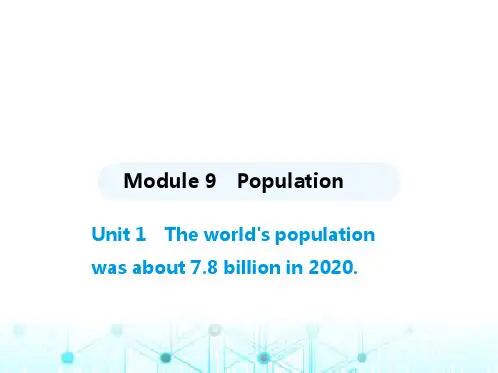
外研版八年级英语上册Module9 Unit1 课件
A: 30 B: Great! A.Well, I have no idea. B.Can you tell me something about it? C.Maybe India. I’m not sure. D.OK. Here we go. E.It was less than one billion. F.You’re welcome. 26. B 27. E 28. A 29. C 30. D
3.(跨学科·生物)(2023黑龙江龙东地区中考改编)The baby pandas often weigh about 0.1 to 0.2 kilos at birth (出 生). 4.(新素材·噪声污染) There are different kinds of pollution in our life. Noise (噪声) pollution is one of them. 5.The bad weather often causes (造成) problems for many farmers living there.
17.(2024内蒙古呼和浩特期末)Don’t make so much C .
My baby is sleeping.
A.voice
B.sound
C.noise
D.choice
解析 根据题干中的“我的婴儿正在睡觉”可知,不要制造 这么多“噪声”,noise符合题意。
18.(2023天ቤተ መጻሕፍቲ ባይዱ河北区期末)When the population increases too fast, it can D problems.
能力提升全练
Ⅵ.补全对话
(语言能力·理解能力)(2024广西防城港防城区期末, ★☆☆)
外研版八年级上册Module9Unit1上课教案
Step 8Language points
Let Ss master the main points of thedialogue.
教学过程方法
设计意图
Step 1 Revision and lead-in
Review the following numbers:2,12,22,220,222
Step 2Learn how to read large numbers.
Step 3Consolidate new words
The teacher shows the pictures of new words and let the students to saythe new words as quickly as possible.
语音
能够辨认并表述大数字。
语
言
技
能
目
标
听
能够听懂谈论人口的对话。
说
能够用数字讨论对话。
写
能够仿照范文,用数字讨论北京及中国的人口问题
学习策略
自学策略
能够利用语篇标题和图片来获取对话中的主要信息。
合作学习策略
能够通过自主、合作学习,充分地实践运用语言,激发创造性思维的发展。
课题
Module9Unit1The population ofChinais about 1.37 billion.
教材分析
本单元由对话自然地导入了数字的学习。同时,对话讨论了北京及中国的人口问题。
教学目标
外研版英语八年级上册 Module 9 Unit 1
Work in pairs. Look at the picture and talk about it. Use the words in the box to help you.
city shop noise people traffic
There are many people in the city. The city is very crowded. There is much noise. The traffic may be heavy.
Tony: Hang on a minute! I’ll make some notes! Lingling: When populations increase too fast, it can cause problems, such as too much traffic and noise. Tony: That’s true. How about countries with slow-growing populations? Lingling: Countries with low birth rates have problems too. There aren’t enough people to do all the jobs, or enough young people to look after the older ones. Tony: I see. Great, thanks for the information! Now I can write my report!
• 表示一个地区或一个国家有多少人口时,可用 the population of ... is ... 或 ... has a population of ...。
外研版八上英语Module 9 Population Unit 1
B
A. paying for B. preparing for C. caring for D. looking for
【解析】句意:——汤姆在干什么?——他正在大厅里准备英语演讲。pay for"为……付款";prepare for"为……做准备";care for"照料,照顾";look for"寻找"。由空后的"the English speech"可知,B项符合语境。
语境串记The steel production increased to 200 million tons. It meant that the production increased by about 25%.钢铁产量增加到了两亿吨。这意味着产量增加了约25%。
典例2 (南充中考)The number of Asian elephants in China has ___ from 170 in the 1970s to about 300 nowadays.
此处作及物动词 ,也可作不及物动词。其名词形式为preparation。常见用法:
prepare sth. 准备某物prepare to do sth. 准备做某事prepare...for... 为……准备……prepare for sth. 为某事/物做准备
They begin to prepare yangge even a month before the Chinese New Year. 他们甚至在新年前一个月就开始准备秧歌表演。(选自长沙中考)My mother prepared to make dumplings for dinner. 我母亲准备包晚饭要吃的饺子。
Module 9 Ppulation Unit 1 The population of China is about 1.37 billion.
5 Making notes means writing a long passage / a few words. 6 A problem is something easy / difficult. 7 A report is a long piece of writing / a few words. 8 A billion is a hundred / a thousand million.
众多问题,比如交通拥挤,噪音污染等。
一.population n. 人口
Language points
1) population 是一个集体名词,作主语时,若指一个
地区或国家的整体人口,谓语动词通常用单数;
The population of the city is about 20,000.
这个城市大约有两万人口。
Do you know how many people are there in the world now?
7 billion
One day, the world will be like this.
How about China?
It’s about 1.37 billion.
China's Population - Overview
b) About 33 million.
Everyday English
I can’t believe it! Hang on a minute! Great!
Listen and choose.
1. They are talking about . A. the population B. the pollution 2. They are preparing the notes for . A. a meeting B. a report
2020版八年级英语上册Module9PopulationUnit1ThepopulationofChinaisabout1.37billion课件1(最新版)外研
There are so many people on the Great Wall that you can’t take photos.
Use words in the box to describe the photo. noise people space traffic
Listen and answer.
What are they talking about? They are talking about the increasing population.
Read the conversation and complete the table.
People in the world
Listen and repeat the numbers.
8,742
eight thousand, seven hundred and forty-two
2,463,128
two million, four hundred and sixty-three thousand, one hundred and twenty-eight
Check the statements you agree with.
1. There are too many people in the world. 2. The increasing population is the biggest problem in the world. 3. People should not have too many babies. 4. A city should not hold more than one million people.
外研版英语八年级上册Module 9 Population Unit 1 课件
1,370,000,000 one billion, three hundred and seventy million
2,000,030,000 two billion and thirty thousand
The population in the world is growing faster and faster. And it brings a lot of problems.
billion people? India. 3. What will the growing population cause? It will cause a lot of problems, such as too much traffic and noise. 4. What will the slow-growing population cause?
The traffic is so heavy in modern cities. There is a lot of noise in the city, especially on the road. There are so many people in the shops.
P72 2
Listen and choose the correct answer. 1. What is the population of New York?
1. Birth happens at the start/ at the end of life.
2. Huge means large/ small.
3. An increase in population means more/ fewer
people.
4. Hang on a minute means waiting for a short