
高中英语北师大版版必修3教学案:Unit 9 Section 4 Word版含答案
过去分词作后置定语。
This is a traffic accidentcaused_by_drunken driving.
这是一个酒后驾车造成的交通事故。
1.(教材P38)sensitiveadj.敏感的,善解人意的
(1)be sensitive to对……敏感
7.checkin登记,报到
8.gothrough经历(困难、痛苦等)
1.be interested in ...对……感兴趣
2.at university上大学
3.take part in参加
4.how long多长时间
5.have a good impression of sth.对……有好的印象
6.ambassadorn.大使
7.sunlightn.阳光,日光
8.kindergartenn.幼儿园
Ⅱ.拓展词汇
1.fierceadj.凶狠的,凶恶的→fiercelyadv.猛烈地,厉害地
2.interpretern.译员,口译者→interpretv.翻译
3.foolishadj.愚蠢的→foolishlyadv.愚蠢地→fooln.傻瓜v.愚弄
对牛奶过敏的人越来越多了。
③I try to make senseofthe sentence.
我试着弄懂这个句子的意思。
2.(教材P38)likelyadj.可能的
(1)be likely to do sth.有可能做某事
It is likely that ...有可能……
(2)unlikelyadj.不大可能发生的
be doing...when ...意为“正在做某事这时……”。
I_was_watching_TV_whenthe phone rang.
我正在看电视,这时电话响了。
2.People have been worried about pollutioncausedby fuels like petrol and gas for a long time now.
Section_Ⅳ Lesson_2_&_Lesson_3_—_Language_Points
一、这样记单词
记得准·写得对
记得快·记得多
Ⅰ.基础词汇
1.greyadj.灰色的,灰白的
2.vocabularyn.词汇;词汇量
3.schedulen.时间表;进度表
4.platformn.站台,月台
5.baggagen.行李
⑤white白色的⑥red红色的
⑦orange橙色的⑧black黑色的
2.schedulen.时间表;进度表
[同义]timetable
[词块]①on schedule准时,按时间表
②ahead of schedule提前
③behind schedule晚点
3.impressionn.印象,感觉
[记法]im (=in)+press (压)→压在大脑里→使铭记→impress+
①Kelly's promotion means more money and moreresponsibility.
凯利的提升意味着钱多了,责任也更大了。
②It's my responsibilityto_take(take) good care of my parents and children.
be sensible of可以觉察出……
be sensible about对……在意
(2)make sense有意义,讲得通
make sense of弄懂……的意思
①She is alwayssensitiveand caring.
她总是善解人意,有爱心。
②Growing numbers of people are sensitivetocow's milk.
(1)a sense of responsibility责任感
take/have responsibility for ...对……负有责任
It's one's responsibility to do sth.
做某事是某人的责任
(2)responsibleadj.负责的
be responsible for对……负责
照顾好父母和孩子是我的责任。
③Who do you think should be responsibleforthe car accident?
6.all the time一直
7.above/below the average在平均水平以上/下
三、这样记句式
先背熟
再悟通
后仿用
1.Hewas goingthrough passport controlwhenhe realised he didn't have his passport.
他正在通过护照检查处,这时他意识到自己没带护照。
4.sensitiveadj.善解人意的;敏感的
[记法]sense(感觉)+
二、这样记短语
记牢固定短语
多积常用词块
1.relyon依赖,依靠
2.pullup(车辆)停止,停车
3.pullout(火车)驶离车站,出站
4.sofar迄今为止
5.takeplace举行;发生
6.complainabout抱怨
①She is the mostlikelygirl to win the prize.
她是最有希望得奖的女孩。
②She is likely to win the first prize.
=It_is_likely_thatshe wins the first prize.
她有可能获得一等奖。ቤተ መጻሕፍቲ ባይዱ
3.(教材P38)responsibilityn.负责,责任,职责
4.responsibilityn.负责,责任,职责→responsibleadj.负责任的,有责任的
5.gentleadj.和善的,温和的→gentlyadv.温柔地,温和地
6.reliableadj.可靠的→relyv.依赖,依靠
7.impressionn.印象,感觉→impressv.给……深刻的印象;使铭记
8.appreciatevt.欣赏;感谢→appreciationn.欣赏;感激
9.sensitiveadj.敏感的;善解人意的→sensen.意义;感官→sensibleadj.意识到的;明智的
1.greyadj.灰色的,灰白的
[联想]颜色大荟萃
①pale苍白的②green绿色的
③blue蓝色的④yellow黄色的
北师大版高中英语必修3 Unit 9《Wheels》(lesson 4 )word教案
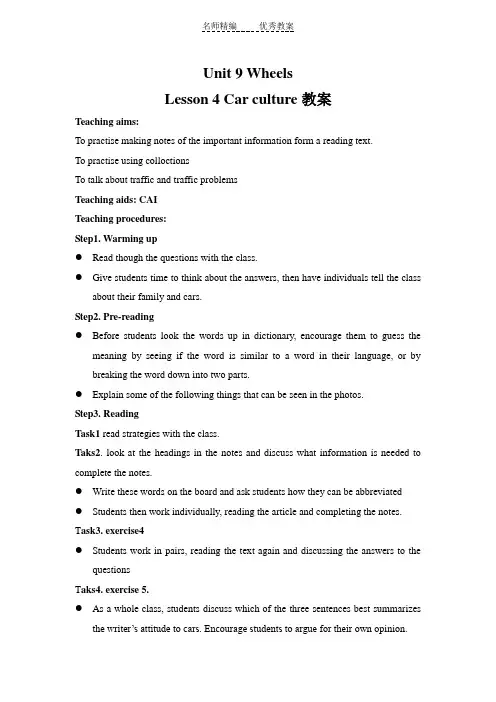
Unit 9 WheelsLesson 4 Car culture教案Teaching aims:To practise making notes of the important information form a reading text.To practise using colloctionsTo talk about traffic and traffic problemsTeaching aids: CAITeaching procedures:Step1. Warming up●Read though the questions with the class.●Give students time to think about the answers, then have individuals tell the classabout their family and cars.Step2. Pre-reading●Before students look the words up in dictionary, encourage them to guess themeaning by seeing if the word is similar to a word in their language, or by breaking the word down into two parts.●Explain some of the following things that can be seen in the photos.Step3. ReadingTask1 read strategies with the class.Taks2. look at the headings in the notes and discuss what information is needed to complete the notes.●Write these words on the board and ask students how they can be abbreviated●Students then work individually, reading the article and completing the notes.T ask3. exercise4●Students work in pairs, reading the text again and discussing the answers to thequestionsT aks4. exercise 5.●As a whole class, students discuss which of the three sentences best summarizesthe writer’s attitude to cars. Encourage students to argue for their own opinion.Step4. Speaking●In groups of four or five, students discuss the answers to the questions.●The group then report back to whole class and see how similar their answers are.。
北师大版高中英语必修3 Unit9 Lesson 4第1课时参考教案

WC3’
T talks about her personal experience related to traffic and discusses her feelings about traffic in Beijing. T encourages Ss to share their feelings.
Reading strategies:
1.predicting
2.skimming for the main idea
pleting notes
4.reading for inference
Teaching aids:
computer, blackboard, handouts
Homework:
Ss read for specific information and understand better all the problems caused by cards
Post-reading
7.
WC
5’
T erases gradually all the information from the table and Ss try to recall it.
IP&
time
Activity
Intentions
Warm-up
1.
WC2’
T elicits from the Ss words related to “road” by using pictures.
Familiarize Ss with the topic and introduce some related key words, such ashighway, pavement, crossroad, pedestrian overpass…
高中英语北师大版模块3【教学课件】Unit 9 Lesson 4

Unit 9 Lesson 4
Car Culture
北京师范大学出版社 |必修三
Teaching Objectives 1.To read the article and understand the main points 2.To compare and practice using the Present Perfect and Present Perfect Continuous tenses
about this?
北京师范大学出版社 |必修三
北京师范大学出版社 |必修三
1. What happened? Traffic accident. 2. What did it bring to us? It may cause death to us. And maybe we will get
北京师范大学出版社 |必修三
Homework
Write an article about the advantages and disadvantages of having a car according to the text.
Makes them angry and stressed.
3. Why do people make excuses?
Because they want to continue using their cars.
北京师范大学出版社 |必修三
4. What does Jenny Trowe think about car advertisements on TV? They present an untrue picture of driving and cars. 5. How does she think we should change our lifestyles? We should take action by writing to the papers, going to the town council, getting a protest group together.
高一英语北师大版必修三教学案:Unit 9 Section 4 含答案
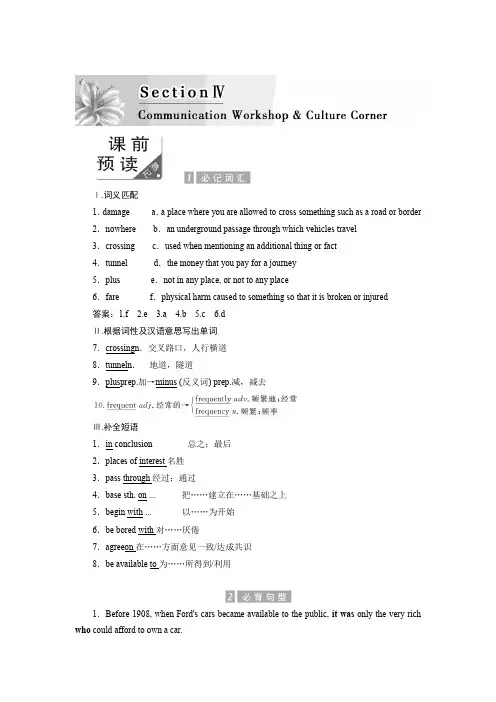
Ⅰ.词义匹配1.damage a.a place where you are allowed to cross something such as a road or border 2.nowhere b.an underground passage through which vehicles travel3.crossing c.used when mentioning an additional thing or fact4.tunnel d.the money that you pay for a journey5.plus e.not in any place, or not to any place6.fare f.physical harm caused to something so that it is broken or injured答案:1.f 2.e 3.a 4.b 5.c 6.dⅡ.根据词性及汉语意思写出单词7.crossing n.交叉路口,人行横道8.tunnel n.地道,隧道9.plus prep.加→minus (反义词) prep.减,减去Ⅲ.补全短语1.in conclusion总之;最后2.places of interest名胜3.pass through经过;通过4.base sth. on ... 把……建立在……基础之上5.begin with ... 以……为开始6.be bored with对……厌倦7.agreeon在……方面意见一致/达成共识8.be available to为……所得到/利用1.Before 1908, when Ford's cars became available to the public, it was only the very rich who could afford to own a car.1908年福特汽车问世之前,只有非常有钱的人才能买得起汽车。
新教材英语北师大版必修第三册学案unit9writingworkshopreadingclub
温馨提示:此套题为Word版,请按住Ctrl,滑动鼠标滚轴,调节合适的观看比例,答案解析附后。
关闭Word文档返回原板块。
Unit 9 LearningWriting Workshop & Reading Club读写结合.表达升级文体感知―Taskl…框架宏观建构.:…整体理解一Skim and reorder all the parts of the learning reflection.©Conclusion ©Beginning (3)Body答案:②③①1.Read the passage and fill in the blanks.Paragraph 1: Reflections on my past ©knowledge about memoryParagraph 2: ©Reflections on what I've learnt from the lessonParagraph 3: What I can do to ③improve my memory…Task?…文本微观剖析;―特色表达.1.Choose the best answer.(l)What can we infer from Paragraph 2?A.Not everyone has a photographic memory.B.Everyone should make the best of their memory.C.〃l"know a lot about memory by reading“The Secrets of Your Memory".D. 'T'think we remember the things that happened recently better than IV.摘录以上文章中的好词佳句,并补全汉语意思1.Getting to know the secrets of our memory means learning not only thefacts about it, but also the ways to improve it.了解我们记忆的秘密不仅意味着了解有关记忆的事实,还意味着了解改善记忆的方法。
北师大版高中英语必修3Unit9WheelsCommunicationWorkshopword教案
Unit 9 WheelsCommunication Workshop教案Objectives■To practise making notes of the important information from a reading text.■To practise using collocations.■To prepare for a speaking activity and to participate in discussion.■To discuss suggestions.■To write a report.■To use addition and contrast linking words.■To listen to and understand a song.Resources usedCassette, Writing Help 3.BackgroundJohn Denver (1943-1997) was a popular country and folk singer. He wrote and sang many worldwide hits (including Leaving on a Jet Plane) and his albums sold millions. He also did a lot of charity work for underprivileged children and campaigned for ecological causes. He died in a plane crash.Routes through the material. If you are short of time, set some of the written exercises for homework.. If you have time, do the Option Activity.. If you have two lessons for this unit, a suitable natural break is after the Speaking activity.Language Power: pages 86-87.Speaking: A DiscussionBefore you startExercise 1■ Advise students to read through the text quickly to get a general idea of the content before filling in as many gaps as they can.■Students compare their answers in pairs before listening to the cassette to check their answers.Answers1 main2 through3 accidents4 lorry5 pollution6 dirty7 damaged 8 traffic jam 9 park 10 shoppersTapescriptPresenter: And here is this week's County Report. At a council meeting yesterday, Ludford's traffic problems were discussed. The main problem is the A49 road, which goes right through the town.There have been several serious accidents recently―last week two children were killed by a lorry near the school. A report last year also showed that air pollution from traffic is increasing and the old buildings in the town are getting dirty and damaged. There is a terrible traffic jam every morning at Ludford Bridge and there’s nowhere to park in the centre. Because of the traffic, shoppers are going to other towns and localshops are closing down.Exercise 2■ Students work in pairs, studying the map and matching the words to the numbers on the map.Answersa) 3/4 b) 7/8 c) 5/6 d) 1/2Exercise 3■ Give students time to read through the expressions and the Function File and guess where the expressions fit into the sentences.■Students listen to the cassette and complete the Function File, checking their guesses.Answers1 should2 sure3 would4 Why don’t5 good idea6 how about7 don’t think8 What aboutTapescriptGirl: So, what do you think about all these new plans for the town? Personally, I think they should build the bypass. It would get the traffic out of the town.Boy: I’m not so sure. It would be very expensive and it would take a long time. It’s also not very ecolog ical. Think about the wildlife. Why don’t they improve the bus service? It’s not very good at the moment. More people would use the buses if they were cheap and came regularly, and there would be less traffic.Girl: That’s a good idea. The buses are terri ble at the moment. You have to wait ages. Boy: Mm, I know.Girl: And how about building a shopping centre? The nearest one’s miles away. Boy: I don’t think that’s a very good idea. What about the local shops? What would happen to them? And anyway I hate those big shopping centres …Stages 1-4■ Students follow the four stages to decide on the best plan for Ludford.■ In pairs, students read the Strategies.■Students then work in pairs listing the advantages and disadvantages of the four plans (a?Cd) in Exercise 2.■ The pairs then decide on their plan. Tell students that their plan can include their own ideas as well as the ones given in Exercise 2.■ In groups of four, the pairs tell each other about their plans and try to agree on a solution. Remind students to use the expressions from the Function File.Talkback■ The groups report back to the class. Encourage students to use the board to illustrate their plans for the town if they wish.■ The class then discusses which of the solutions are the most ecological.■ Ask students if they had any language difficulties when they were working out their solutions. Was there anything they wanted to say but didn’t know how to say? Writing: A ReportBefore you startExercise 1■ Ask students if they have seen or written any reports, . school reports, club/society reports, town council reports, government reports.■Elicit how reports are usually structured, . stating the topic of the report, giving positive points, giving negative points and offering advice, then concluding.■ Tell students they have to order the main sections (A-E), not the sub-sections within the main sections.■ Students work individually, reading the extracts and ordering them.■ They can compare their answers in pairs before checking answers in Writing Help 3.AnswersB D A E CLinkingExercise 2■ Students find the linking words in the report and then, working in pairs, write the words in two groups: 1 listing ideas, 2 contrasting ideas.AnswersListing ideas: and in addition plus also as well as tooContrasting ideas: but although however on the one hand on the other handStages 1-3■ Students follow the three stages to write a report for a school magazine.■ As a whole class, elicit ideas for the advantages and disadvantages of the present local transport system.■ Students then work in pairs, listing the advantages and disadvantages.■ Refer students to Writing Help 3 as they write their reports.■ Students refer to Writing Help 3 as they check their reports.■ If you wish, have students work in pairs, checking their reports and helping each other correct any mistakes.Listening: A Song■ Give students time to read through the questions before they listen to the song.■ Play the song twice for students to check their answers.Answers1 He’s standing outside her door.2 It’s early morning.3 He feels lonesome/lonely/sad.4 He doesn’t know when he’ll come back.5 He wants to marry her.TapescriptAll my bags are packed, I’m ready to go,I’m standing here outside your door,I hate to wake you up to say goodbye.But the dawn is breaking, it’s early morn,The taxi’s waiting, he’s blowing his horn,Already I’m so lonesome I could cry.So kiss me and smile for me, tell me that you’ll wait for me,Hold me like you’ll never let me go.I’m leaving on a jet plane, don’t know when I’ll be back again. Oh, babe, I hate to go.There’s so many times I’ve let you down,So many times, I’ve played around,I’ll tell you now they don’t mean a thing.Every place I go, I’ll think of you,Every song I sing, I’ll sing for you;When I come back, I’ll wear your wedding ring.So kiss me and smile for me, tell me that you’ll wait for me,Hold me like you’ll never let me go.I’m leaving on a jet plane, don’t know when I’ll be back again. Oh, babe, I hate to go.Now the time has come to leave you, one more time let me kiss you, Then close your eyes, I’ll be on my way.Dream about the days to come when I won’t have to leave alone, About the time I won’t have to say:Leaving on a jet plane, don’t know when I’ll be back again. Leaving on a jet plane, don’t know when I’ll be back again. OptionExtensionWrite this gapped text of the first part of the song on the board:All my (1) … are packed, I’m ready to (2) … ,I’m (3) … here outside your (4) … ,I (5) … to wake you up to say (6) … ,But the dawn is breaking, it’s (7) … morn,The (8) … waiting, he’s blowing his (9) … ,Already I’m so lonesome I could (10) … .Students work in pairs, filling in the gaps.Ch eck students’ answers by playing the song again.。
北师大版高中英语必修三Unit 9《Lesson 4 Car Culture》教案 1
Unit 9 WHEELSLesson 4 Car Culture教学设计Teaching Aims※Knowledge :(1)New Words and expressions: traffic jam, carbon monoxide, construction, addicted, on average, etc.(2)Grammar: The Present Perfect Tense※Ability :(1) Improve the students’ reading speed by skimming and scanning.(2) Improve the students’reading skill –making notes by short expressions to grasp the detailedinformation of the text.※Moral Lesson:.Raise awareness of environmental problems caused by cars.Key Points:1. New words and expressions.2. Grammar —the present perfect tense.Difficult Points:1. Grammar—the present perfect tense2. Using the new reading skill—making notes to grasp the detailed information of the text. Teaching Procedures:1.Pre-readingⅠ.Answer the questions about cars.1. Does your family have a car? (Yes, my family has a car.)2. How often do you travel in it? (Every day.)3. How do you use your car? (My father use it to go to work, my mother use it to go shopping, and I go toschool.)Conclusion: Indeed, with the improvement of living conditions, more and more people have their own cars. But have you ever thought what would happen on the roads if everybody travel in his own car? Maybe it isthe thing that everybody has never thought about.In fact, there are more cars are on roads, and more highways or express ways are built. Good or bad? Look at these pictures and then lead in the disadvantages by cars.Ⅱ.Words and expressions:1. Check the meaning of these traffic words.(Before class the students previewed the new words and expressions.)air pollution空气污染,carbon monoxide一氧化碳,crossroads十字路口(English to Chinese)人行道pavement, 交通堵塞traffic jam,速度限制speed limit(Chinese to English )2. Detailed study:(1).construction 建筑,建造construct (verb)reconstruct:Sichuan people is constructing their homes after the earthquake.(2). addicted对――上瘾,对――入迷He is addicted to drugs.他对毒品上瘾。
高一英语北师大版必修3教案:Unit9 Wheels4 含解析 精
示范教案Period 4Lesson 4Car CultureAnalysis of the teaching materialsThe fourth period of the unit,the reading lesson,is mainly about problems caused by cars and some advice on how to solve them.Its reading strategies focus on making notes,which can help students form a good habit of reading and concentrate on detailed information.Meanwhile,the content of the lesson is meaningful and educational for the youth,which is beneficial for them to form an eco-friendly lifestyle and a right attitude towards cars.Three-dimensional targetsKnowledge and skills1.To make the students grasp the new words and expressions concerning traffic and traffic problems.2.To have the ability to talk about traffic and traffic problems.3.To improve students' reading ability by scanning and skimming,especially a good command of making notes of the important information in reading.Process and methods1.Use the initial letters of the words concerning traffic to lead in the new text.2.During Pre-reading,some pictures are presented to the learners in order to elicit the topic.3.In While-reading,the reading strategies are fully applied to help students make notes correctly and information gap is also employed in the filling-in blanks.4.To further the comprehension of the text,pair work and group work are fully made use of in the filling-in blanks.5.In Post-reading,the teaching focus is mainly on the summary of the text.Emotion,attitude and value1.To develop students' eco-friendly awareness.2.To develop students' responsibility of protecting the environment.3.To encourage students to do all they could to create a clean and beautiful environment.Teaching & Learning methods1.The whole language approachInstruct students to begin with reading the title;then get the overall perception before the detailed understanding of the article,inspiring the students to participate in learning,discussion and cooperation.2.Task-based language teachingThe text deals with the theme of British traffic problems and the solutions.Pictures related to the theme will be presented by multimedia computers to arouse students' interest,which will help students understand the text and improve the teaching efficiency.A number of tasks are designed to ensure students the joy of success in reading the text.Teaching important and difficult points1.To improve students' reading ability and teach them to make notes effectively in reading.2.To help students get the main idea of the text and detailed information.Teaching proceduresStep 1Lead-inShow the initial letters of the words concerning traffic and let students guess what the words are.c(crossroad)p(pavement)h(highway)r(roundabout)O(One-way only)u(U-turn)f(freeway) z(zebra crossing)Step 2Pre-readingT:Just now we talked about some words concerning traffic and now let's look at the follwing pictures,which words will come into your mind?The teacher will elicit some more new words,such as construction work,road accidents,get stuck in traffic jams,feel stressed out.Step 3While-reading1.Get students to read the following questions and then make guesses about the traffic in the UK.①How many cars are there in Britain?A.25 million B.40 million②How much has the number of cars on the roads gone up by in Britain in the last ten years?A.10%B.30%③How many people die in road accidents in Britain every year?A.>3000B.>7000④How much of carbon monoxide is produced by cars in London?A.79%B.99%⑤How many deaths are caused by air pollution per year?A.10000B.25000Possible answers:ABABB2.Let students scan the first part of the passage (on page 42) to check whether their guesses are right or not.3.Ask students to make a list of the problems caused by cars in the UK.Problems caused by cars:☆traffic jams☆anger and stress☆too many deaths caused by road accidents☆too much carbon monoxide☆too many deaths caused by air pollution☆some types of cancer related to traffic pollution☆global warming and climate change4.The teacher will ask the following questions in order to make preparations for the reading material on page 43.a.What are the excuses that people make for using cars?b.What suggestions can you think of to reduce the use of cars?Then,ask students to skim the second part of the passage(on page 43)to underline excuses made by the British people for using cars and six ways of reducing the use of cars and reasons for advice.Excuses:Advice about how to give up cars:①Use your legs.②Use public_transport.③Think before you go.④Share cars.⑤Don't_believe advertisements!⑥Take_action somehow!a .He thinks they have more disadvantages than advantages.★b.He knows what he should do ,but often uses his car because it is convenient.c .He thinks it would be easy for us all to use our cars less.Step 4 Post-reading1.Fill in the blanks with the right form of the phrases in the box.There are more phrases thanpeople's life more convenient ,but they also ______(2) and bring serious air pollution to China.For example,14.4% of the vehicles are in Beijing and Shanghai.People in these cities often ______(3) the traffic jams on the way to work in the morning and feel ______(4) when they arrive at work.In 1995,the United Nations ranked three Chinese cities among the top ten most seriously polluted cities in the world and Beijing was one of them.Car pollution is one of the main reasons for this.Beijing government has ______(5) to solve this problem.It has put a lot of efforts in improving the public transport system.In 1996,the first special public transport lane was set up on Chang An Road.People who take public buses on that road find it much faster to travel by bus than by car.In addition ,building subways is considered as an effective and clean public transport system.Although people ______(6) cars now ,it is time for them to ______(7) cars and try to use their legs and public transport more.Answers :1.gone up by 2.cause traffic problems 3.get stuck in 4.stressed out 5.taken action 6.are addicted to 7.give up2.Finish Ex.6 on page 43.3.Sum up the structure of the reading passage. Problems ⎩⎪⎨⎪⎧Personal Get stuck in traffic jams ,arrive stressed out Social Too many cars ,too many deaths ,cancer ,air pollution , climate changeAdvice ReasonsUse your legs. Save money ,keep fitUse public transport. Save the number of cars ,relaxThink before you go. Go to nearby shopsShare cars. Cheaper and kinder...Don't believe advertisements! Not true ,be stuck in a traffic jamTake action somehow! Talk...,write...,go to...,ask for...Step 5 Homework1.Finish Ex.2,3 and 4 on page 84(Language Power)2.Find at least two pieces of information about cars and problems caused by cars in China from the following :—number of cars in China—number of deaths caused by road accidents in China—increase rate of cars in China per year—things the Chinese government is doing to reduce carbon monoxide in the atmosphere教学参考国外各大城市解决塞车之道纽约:到纽约曼哈顿上班的人,是从家里开车到市郊地铁站或火车站再换乘地铁或火车进入市区,在市内的活动靠公共汽车、地铁和出租汽车。
2021年高中英语北师大版版必修三教学案:Unit 9 Section 1 Word版
Nowadays more and more families own private cars. Private cars, as the product of modern civilization, have been playing a vital role in people's daily activities. First, private cars are a convenient means of transport. You can drive wherever you like. Second, there is no doubt that private cars will have a great impact on the economic growth . The rapid development of car industry will contribute much to keeping the country's economy growing at a higher rate in the near future.But every coin has two sides.The rapid development of private cars will bring about a series of problems. For example, the waste air given off by cars will do great harm to our health, too many private cars will lead to traffic jams and a great deal of energy will be wasted.So I think we should take advantage of private cars and make them serve us better. Meantime I hope that satisfactory solutions to these negative problems will be found soon.Section_ⅠWarm-up__&_Lesson_1_—_Pre-reading[原文呈现]Return of the white bikes!People have been enjoying①the benefits②of cycling in Amsterdam③for years. It is a good city for cycling because it is flat④and therefore⑤is convenient⑥for bikes. There are also plenty of places for bicycle parking⑦and most streets in the city centre have a bicycle path. Today some people call Amsterdam the “City of Bicycles〞because of the convenience⑧for bicycles there.In the 1960s, a group of cycling fans had an idea. They believed that it would be better for everybody if cars weren't allowed⑨in the city centre and only bicycles were.They were hopeful⑩that this would help to save energy, reduce pollution and provide⑪free public transport. The group painted⑫hundreds of⑬bicycles white and placed⑭them in lots of neighbourhoods⑮around Amsterdam for people to use. Anyone was allowed to take them and use them for short journeys. Wherever⑯someone finished a journey they would leave the bike there for someone else⑰to use. The problem was that it didn't work⑱—thieves⑲took all the bicycles within weeks![读文清障]①have been enjoying是现在完成进行时。
北师大版高中英语必修3 Unit9_Culture_Corner_名师教学设计
Unit9 Culture Corner 名师教学设计Unit 9 Wheels Culture Corner:America on the wheelClass model: readingAnalysis of the teaching material:This lesson is a reading passage. It is an ending part of this unit. By studying it, the students can improve their reading ability, learn more about the car culture and at the same time understand some difficult sentences to comprehend the passage better. Meanwhile, the students will do some listening and speaking, too. Of course, the students are expected to love English learning more, and form great interest in English culture learning.Analysis of the students:The students have ability to read articles by themselves, most of whom can understand the reading material for this class. They can follow and catch what the teacher says in simple English, meanwhile make response immediately. With the knowledge about cars they have learned in unit 9, the students have little trouble in understanding the development of motor cars. However,they are lack of vocabulary, so they are afraid of making mistakes. As a result, they don’t often use English to express themselves and communicate with others.Teaching aims:1. Knowledge aims:①Enable students to learn to use new words and phrases in the passage②Enable students to understand the main idea of the text③Enable students to write an article using the words learned2. Ability aim:Promote students’ reading, listening and speaki ng skills by reading strategies 3. Emotional aim:Form great interest in English culture learning.Teaching important point:1.Encourage students to practice reading skill—predicting.2.Enable students to guess some new words and expressions referring to the context.Teaching difficult point:Enable students to utilize the words, lexical chunks, expression related to the text Teaching methods:Task-based method, student-center method, multimedia assistance teaching, communicative method, group work, individual workTeaching Aids: computer Teaching procedures:Step Ⅰ GreetingGreet the students as usual(Purpose: draw their attention to the class)Step Ⅱ Warming up and leading-inShow a video on computer, and then get students to guess the main idea of the text.(Purpose: arouse students′ interest in this lesson)Step Ⅲ Before reading (words-learning practice)Ask students to do some practice to help them get familiar with some new words (Purpose: smooth away difficulties before reading)Step Ⅳ While reading1. Ask students to do a T or F exercise2. Ask students to read the passage gain and fill in the form3. Ask students to read the passage and answer 3 questions(Purpose: Enable students to get a general idea of the text)Step Ⅴ Further readingAsk students to find out the key sentence of each paragraph(Purpose: deepen students understanding of the text)Step Ⅵ ConsolidationGive the students 2questions for them to discuss1. Why did the American/Chinese public prefer European/foreign cars than American/Chinese-made ones?2. How to develop China car industry better and faster?(Purpose :cultivate students’ speaking skills and lead them to use the content learned in this lesson)Step Ⅶ SummarySummarize the important points learned in the text.Step Ⅷ Homework1. Ask students to read the text and try to memorize words and phrases we have learned2. Ask students to write a composition titled China on the wheel.ReflectionAfter the teaching, collect the feedback from the students, read just the teaching and improve the teaching in the future.。