
江苏省如东高级中学2019_2020学年高二英语上学期第一次月考试题
2019-2020年高二上学期第一次月考英语试题 含解析(II)
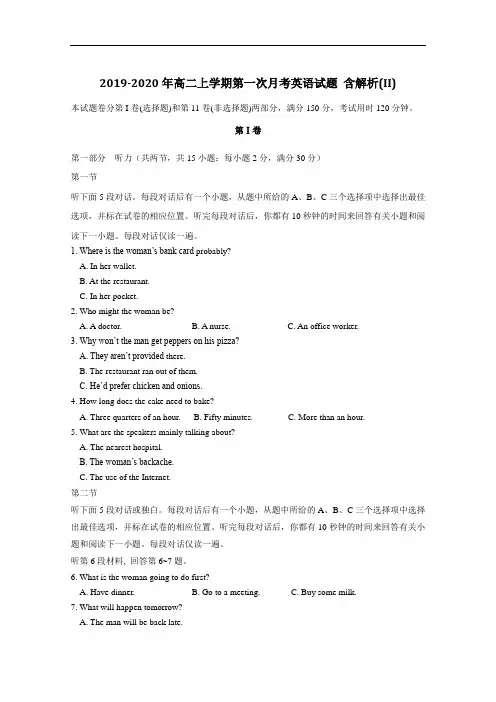
2019-2020年高二上学期第一次月考英语试题含解析(II)本试题卷分第I卷(选择题)和第11卷(非选择题)两部分,满分150分,考试用时120分钟。
第Ⅰ卷第一部分听力(共两节,共15小题;每小题2分,满分30分)第一节听下面5段对话。
每段对话后有一个小题,从题中所给的A、B、C三个选择项中选择出最佳选项,并标在试卷的相应位置。
听完每段对话后,你都有10秒钟的时间来回答有关小题和阅读下一小题。
每段对话仅读一遍。
1. Where is the woman’s bank card probably?A. In her wallet.B. At the restaurant.C. In her pocket.2. Who might the woman be?A. A doctor.B. A nurse.C. An office worker.3. Why won’t the man get peppers on his pizza?A. They aren’t provided there.B. The restaurant ran out of them.C. He’d prefer chicken and onions.4. How long does the cake need to bake?A. Three quarters of an hour.B. Fifty minutes.C. More than an hour.5. What are the speakers mainly talking about?A. The nearest hospital.B. The woman’s backache.C. The use of the Internet.第二节听下面5段对话或独白。
每段对话后有一个小题,从题中所给的A、B、C三个选择项中选择出最佳选项,并标在试卷的相应位置。
听完每段对话后,你都有10秒钟的时间来回答有关小题和阅读下一小题。
2019-2020学年高二英语上学期第一次月考试题(14).doc.doc
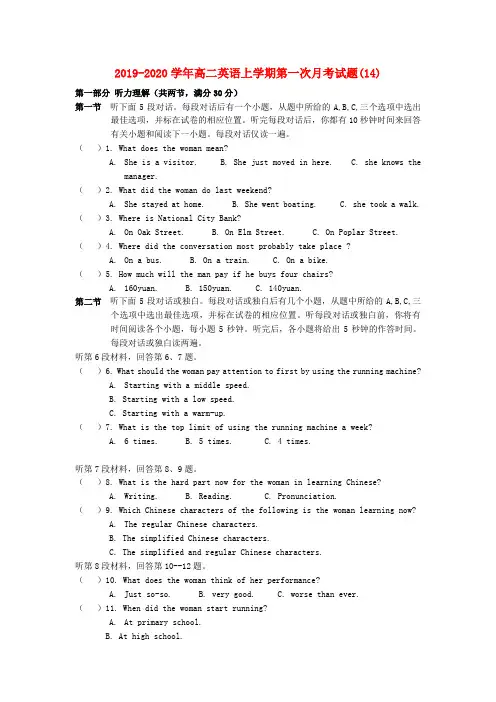
2019-2020学年高二英语上学期第一次月考试题(14)第一部分听力理解(共两节,满分30分)第一节听下面5段对话。
每段对话后有一个小题,从题中所给的A,B,C,三个选项中选出最佳选项,并标在试卷的相应位置。
听完每段对话后,你都有10秒钟时间来回答有关小题和阅读下一小题。
每段对话仅读一遍。
()1. What does the woman mean?A.She is a visitor.B. She just moved in here.C. she knows themanager.()2. What did the woman do last weekend?A.She stayed at home.B. She went boating.C. she took a walk.()3. Where is National City Bank?A.On Oak Street.B. On Elm Street.C. On Poplar Street.()4. Where did the conversation most probably take place ?A.On a bus.B. On a train.C. On a bike.()5. How much will the man pay if he buys four chairs?A.160yuan.B. 150yuan.C. 140yuan.第二节听下面5段对话或独白。
每段对话或独白后有几个小题,从题中所给的A,B,C,三个选项中选出最佳选项,并标在试卷的相应位置。
听每段对话或独白前,你将有时间阅读各个小题,每小题5秒钟。
听完后,各小题将给出5秒钟的作答时间。
每段对话或独白读两遍。
听第6段材料,回答第6、7题。
()6. What should the woman pay attention to first by using the running machine?A.Starting with a middle speed.B. Starting with a low speed.C. Starting with a warm-up.()7. What is the top limit of using the running machine a week?A. 6 times.B. 5 times.C. 4 times.听第7段材料,回答第8、9题。
2019-2020年高二上学期第一次月考英语试卷

2019-2020年高二上学期第一次月考英语试卷高二英语试卷第I卷(三部分115分)第一部分:听力(共两节,满分30分)第一节(共5小题;每小题1.5分,满分7.5分)听下面5段对话。
每段对话后有一个小题,从题中所给的A、B、C三个选项中选出最佳选项,并在答题卡上标出。
听完每段对话后,你都有10秒钟的时间来回答有关小题和阅读下一小题。
每段对话仅读一遍。
1. Why is the man late?A. His car was out of gas.B. He couldn't mend his car.C. He went back for clean clothes.2. How does the man probably go shopping?A. On foot.B. By car.C. By bike.3. What is the relationship between the man and the woman?A. Workmates.B. Brother and sister.C. Husband and wife.4. What are the two speakers going to do today?A. Go to a clothes show.B. Go to a book fair.C. Stay at home.5. What does the woman think of the advertisements on TV?A. They are too boring.B. They are good for eyes.C. They are a waste of time.第二节(共15小题;每小题1.5分,满分22.5分)听下面5段对话或独白。
每段对话或独白后有几个小题,从题中所给的A、B、C三个选项中选出最佳选项,并在答题卡的相应位置上标出。
听每段对话或独白前,你将有时间阅读各个小题,每小题5秒钟;听完后,各小题将给出5秒钟的作答时间。
2019—2020学年度上学期高二英语月考试卷(含答案)
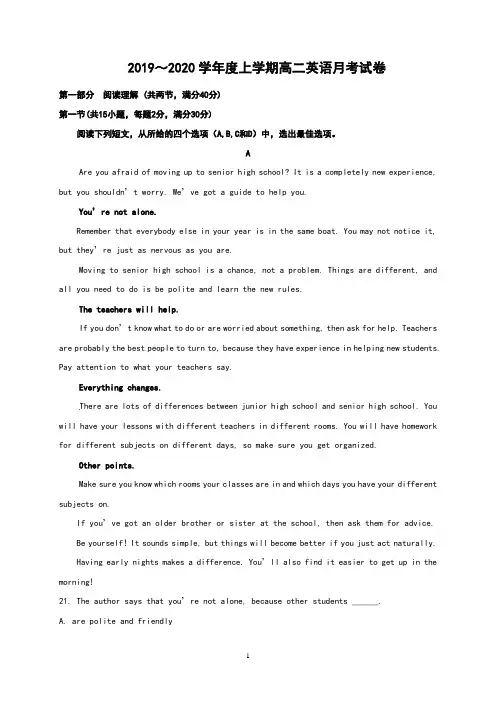
2019~2020学年度上学期高二英语月考试卷第一部分阅读理解 (共两节,满分40分)第一节(共15小题,每题2分,满分30分)阅读下列短文,从所给的四个选项(A,B,C和D)中,选出最佳选项。
AAre you afraid of moving up to senior high school? It is a completely new experience, but you shouldn’t worry. We’ve got a guide to help you.You’re not alone.Remember that everybody else in your year is in the same boat. You may not notice it, but they’re just as nervous as you are.Moving to senior high school is a chance, not a problem. Things are different, and all you need to do is be polite and learn the new rules.The teachers will help.If you don’t know what to do or are worried about something, then ask for help. Teachers are probably the best people to turn to, because they have experience in helping new students. Pay attention to what your teachers say.Everything changes.There are lots of differences between junior high school and senior high school. You will have your lessons with different teachers in different rooms. You will have homework for different subjects on different days, so make sure you get organized.Other points.Make sure you know which rooms your classes are in and which days you have your different subjects on.If you’ve got an older brother or sister at the school, then ask them for advice. Be yourself! It sounds simple, but things will become better if you just act naturally.Having early nights makes a difference. You’ll also find it easier to get up in the morning!21. The author says that you’re not alone, because other students ______.A. are polite and friendlyB. will help you if possibleC. feel the same as you doD. will learn the new rules with you22. What does the writer think of moving up to senior high school?A. It is a difficult problem.B. It’s a good chance.C. It sounds simple.D. It’s worrying.23. Which of the following does the writer suggest you do?A. Just act naturally.B. Don’t be shy.C. Change yourself.D. Pay attention to others.24. The main purpose of the passage is to ______.A. tell students about a new experienceB. help students that are going to senior high schoolC. tell students how to make full use of timeD. teach students how to organize themselvesBAccording to some researchers, you should not praise children for everything that they do. It does not help them build self-confidence(自信).Most parents and teachers agree that praise can help increase children’s self-confidence —the more, the better. However, according to some researchers, only proper praise is good for children. If adults praise everything children do, it makes children look for praise all the time, not trying to do their best. "Teachers should not say things like ‘good job’ or ‘nice work’ whenever a child does anything. They should encourage them to continue to improve," some researchers advise.Another idea is that children with high self-confidence are happier, and do better at school. About this, Marshall Duke, a researcher in children, says, "High self-confidence brought in by too much praise does not make children happier, get more, or become able to do more. Finding a child’s advantages and developing them can help build confidence more than too much praise can." Praise also loses its effect if it is given equally to all students."It’s important to tell children the truth about what they’ve done. Honest feedback(反馈) is far better than empty praise," Duke adds. "People have got into the habit of not telling children when they’re wrong. That makes it hard for them to deal with difficultie s when they grow up. That’s just how the world is."25. According to some researchers, if parents praise their children too much, their children will ______.A. always look for praiseB. increase self-confidenceC. become strongD. do better in their studies26. In order to help children build self-confidence, some researchers advise parents to ______.A. make them live more happilyB. let them do more difficult workC. help them do better in schoolD. encourage them to improve27. Which of the following is TRUE, according to the passage?A. Praise makes children become successful.B. Children don’t know what they’re really good at.C. The same praise for all children has no meaning.D. Duke thinks praise is more important than fin ding children’s strengths.28. The underlined word "it" in the third paragraph refers to _________.A. the effectB. the praiseC. the advantageD.the confidenceCHi! Have you ever suddenly felt that someone you knew was in trouble — and was he? Have you ever dreamed something that came true later? Maybe you have ESP(超感觉知觉).ESP stands for Extrasensory Perception. It may be called a sixth sense. It seems to let people know about events before they happen, or events that are happening some distance away.Here's an example. A woman was ironing clothes. Suddenly she screamed, "My father isdead! I saw him sitting in the chair!" Just then, a telegram came. The woman's father died of a heart attack. He died sitting in a chair.There are thousands of stories like this one on record. Scientists are studying them to find out what's behind these strange mental messages. Here's another example—one of hundreds of dreams that have come true.A man dreamed he was walking along a road when a horse and carriage came by. The driver said, "There's room for one more." The man felt the driver seemed dead, so he ran away. The next day, when the ma n was getting on a crowded bus, the bus driver said, "There's room for one more."Then the man saw that the driver's face was the same face he had seen in the dream. He wouldn't get on the bus. As the bus drove off, it crashed and burst into flames. Everyone was killed!Some people say stories like these are coincidences(巧合). Others, including some scientists, say that ESP is real. From studies of ESP, we may someday learn more about the human mind.29.According to the passage, the writer believes that the sixth sense is ________. A. in existence B. imaginative C. not real D. impossible30.ESP lets people know _________.A. about events before they happenB. about events after they happenC. about events that are happening some distance awayD. A and C31.By studying ESP, scientists may get to ________.A. learn how people tell liesB. know more about human dreamsC. know more about human mindD. learn how strange things happenDIt is interesting that the arrival of snow has the effect on people in different countries. For some countries it is an important happening to celebrate each year, while for others a disaster or even a wonder.But there are countries between these two kinds that normally expect snow some time over the winter months, but never receive snow regularly or in the same quantities every year. Britain is one of them, for which the arrival of snow quite simply creates problems. Within hours of the first snowfalls, however trains and buses have to stop in the middle of the way. Telephone calls become difficult and the post immediately takes more time than usual. And almost within hours there are also certain shortages — bread, vegetables and other things — not because all these things can no longer be produced or sent to shops, but mainly because people are frightened and go out and store up with food and so on —“just for fear that something bad should happen”.But why does snow have this effect? It is simply because there is not enough planning and preparation. We need money to buy equipment to deal with snow and ice. To keep the roads clear, for example, requires snow-ploughs(犁雪车) and machines to spread salt. The reason why a country like Britain does not buy snow-ploughs is that they are only used for a few days in any one year, and the money could be more useful in other things such as hospitals, education, helping the old and so on.32. According to the writer, Britain is a country .A. which has regular snowB. which is not well prepared for snowC. for which snow is a disasterD. for which snow is a wonder33. After a few hours’ snow there is often some shortage of food because .A. shops have closed downB. people buy as much as they canC. farmers cannot produce any moreD. people eat more vegetables in winter34. The first reason why the British do not buy snow-ploughs is that .A. spreading salt is good enoughB. old people need more moneyC. snow-ploughs are not used oftenD. the hospital is more important35.The underlined words “two kinds” mean the countries .A. which have snow either as yearly happening to celebrate or as rare weatherB. which either have heavy snow or light snowC. to which snow either causes problems or no problemsD. which either have snow-ploughs or no snow-ploughs第二节(共5小题,每小题2分,满分10分)根据短文内容,从短文后的选项中选出能填入空白处的最佳选项。
2019-2020学年高二英语上学期第一次月考试题(102).doc

2019-2020学年高二英语上学期第一次月考试题(102)说明:英语试卷共8页,满分150分。
考试时间150分钟。
注意事项:1.答题前,务必将自己的姓名、准考证号填写在答题卡规定的位置上。
2.答选择题时,必须使用2B铅笔将答题卡上对应题目的答案标号涂黑。
如需改动,用橡皮擦擦干净后,再选涂其它答案标号。
3.答非选择题时,必须使用0.5毫米黑色签字笔,将答案书写在答题卡规定的位置上。
4.所有题目必须在答题卡上作答,在试题卷上答题无效。
第一部分听力(共两节,满分30分)第一节(共5小题;每小题1.5分,满分7.5分)听下面5段对话,每段对话后有一个小题。
从题中所给的A、B、C三个选项中选出最佳选项,并标在试卷的相应位置。
听完每段对话后,你都有10秒钟的时间来回答有关小题和阅读下一小题。
每段对话仅读一遍。
例:How much is the shirt?A. £ 19. 15B. £ 9. 18C. £ 9. 15答案是 C.1.What does the man remember the most of his high school?A. Watching movies.B. Attending parties.C. Eating pizza.2.What’s the relationship between the speakers?A. Friends.B. Colleagues.C. Lovers.3.How many children does the woman have?A. 3.B. 4.C. 5.4.What is the woman advised to do?A. Buy some candles.B. Call the guest.C. Find the solution.5.What will Jack have?A. Cheese.B. Sandwich.C. Cake.第二节(共15小题;每小题1.5分,满分22.5分)听下面5段对话或独白。
2019-2020学年高二英语上学期第一次月考试题(I)(II).doc
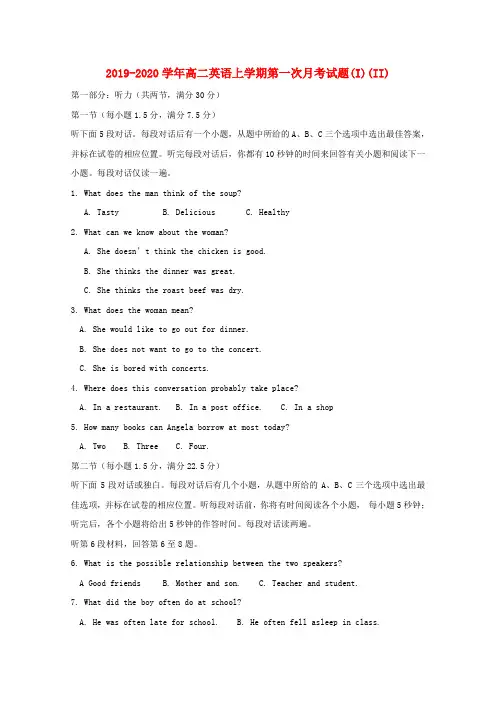
2019-2020学年高二英语上学期第一次月考试题(I)(II)第一部分:听力(共两节,满分30分)第一节(每小题1.5分,满分7.5分)听下面5段对话。
每段对话后有一个小题,从题中所给的A、B、C三个选项中选出最佳答案,并标在试卷的相应位置。
听完每段对话后,你都有10秒钟的时间来回答有关小题和阅读下一小题。
每段对话仅读一遍。
1. What does the man think of the soup?A. TastyB. DeliciousC. Healthy2. What can we know about the woman?A. She doesn’t think the chicken is good.B. She thinks the dinner was great.C. She thinks the roast beef was dry.3. What does the woman mean?A. She would like to go out for dinner.B. She does not want to go to the concert.C. She is bored with concerts.4. Where does this conversation probably take place?A. In a restaurant.B. In a post office.C. In a shop5. How many books can Angela borrow at most today?A. TwoB. ThreeC. Four.第二节(每小题1.5分,满分22.5分)听下面5段对话或独白。
每段对话后有几个小题,从题中所给的A、B、C三个选项中选出最佳选项,并标在试卷的相应位置。
听每段对话前,你将有时间阅读各个小题,每小题5秒钟;听完后,各个小题将给出5秒钟的作答时间。
2019-2020学年高二英语上学期第一次月考试题(45).doc
2019-2020学年高二英语上学期第一次月考试题(45)第一部分听力(共两节,满分30分)第一节(共5小题;每小题1.5分,满分7.5分)听下面5段对话。
每段对话后有一个小题,从题中所给的A.B、C三个选项中选出最佳选项并标在试卷的相应位置。
听完每段对话后,你都有10秒钟的时间来回答有关小题和阅读下一小题。
每段对话仅读一遍。
1.When does the woman’s train leave?A.At 10:00 tonight. B.At 5:10 tomorrow morning.C.At 10:00 tomorrow morning.2.What does the woman want to do?A.Go out of the room. B.Let the man in.C.Open the window.3.How long has the man been waiting for the woman?A.5 minutes. B.15 minutes. C.20 minutes.4.What may the speakers do this weekend?A.Watch a movie. B.Play table tennis. C.Climb a mountain. 5.How will the man probably go downtown?A.By bus. B.By taxi. C.By subway.第二节(共15小题;每小题1.5分,满分22.5分)听下面5段对话或独白。
每段对话或独白后有几个小题,从题中所给的A、B、C三个选项中选出最佳选项,并标在试卷的相应位置。
听每段对话或独白前,你将有时间阅读各个小题,每小题5秒钟;听完后,各小题将给出5秒钟的作答时间。
每段对话或独白读两遍。
听第6段材料,回答第6、7题。
6.What happened to the man’s bike?A.It was hit by a car. B.It was stolen yesterday afternoon.C.It was broken when he was riding it.7.What day is it today probably?A.Friday. B.Saturday. C.Sunday.听第7段材料,回答第8、9题。
2019-2020学年高二英语上学期第一次月考试题(10).doc
2019-2020学年高二英语上学期第一次月考试题(10)第一部分听力(共两节,满分30分)第一节(共5小题;每小题1.5分,满分7.5分)请听下面5段对话。
每段对话后有一个小题,从题中所给的A、B、C三个选择项中选择出最佳选项,并标在试卷的相应位置。
听完每段对话后,你都有10秒钟的时间来回答有关小题和阅读下一小题。
每段对话仅读一遍。
1. What will the man do?A. Go downstairs for a drink.B. Get something for the woman.C. Finish his homework.2. Who would the woman like to meet?A. A book seller.B. A writer.C. Her boss.3. What animal does the man want to see?A. Tigers.B. Pandas.C. Monkeys.4. What is the relationship between the speakers probably?A. Boss and secretary.B. Friends.C. Customer and waitress.5. When is the best time for the man to go to the show?A. Before 7:00.B. After 7:00.C. After 9:00.第二节(共15小题;每小题1.5分,满分22.5分)请听下面5段对话或独白。
每段对话或独白后有几个小题,从题中所给的A、B、C三个选项中选出最佳选项,并标在试卷的相应位置。
听每段对话或独白前,你将有时间阅读各个小题,每小题5秒钟;听完后,各小题将给出5秒钟的作答时间。
每段对话或独白读两遍。
听第6段材料,回答第6、7题。
6. What is true of the thief?A. He wore a beard.B. He was about 6 feet tall.C. He was very thin.7. Where will the woman go later?A. To the police station.B. Home.C. To the hospital.听第7段材料,回答第8、9题。