
七年级英语下册:Module 4 Life in the future导学案(外研版)
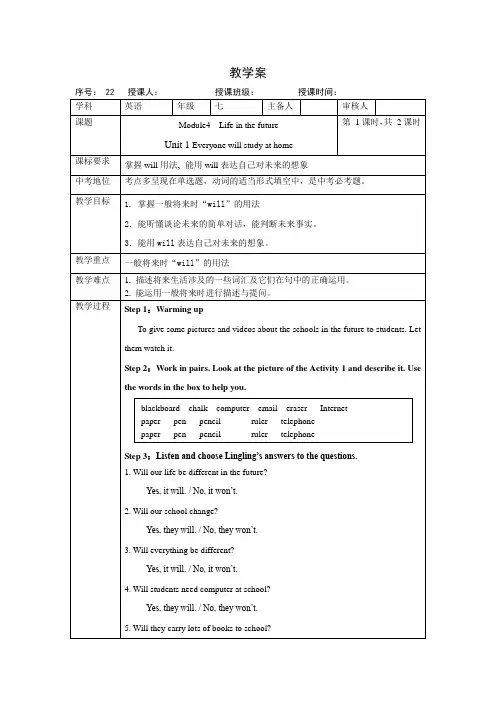
Module 4 Life in the future Unit 1 Everyone will study at home.教案 一、教学目标: 1.知识目标:通过学生自主学习,掌握本单元的词汇及短语。 2.能力目标:能够听懂谈论未来的简短对话,判断未来事实。能用will 表达自己对未来学校的想象。 3.情感目标:通过对未来学校的憧憬,培养乐观向上的精。 二、教学重、难点: 1.掌握“will +动词原形”的用法。 2.There be 句型的一般将来时态。 三、教具准备: 学案,录音机 四、教学方法:自主学习,小组合作 五、教学步骤: Step 1: Warming-up 1. Greeting each other. 2. Talk with the students. Where are you? What are you doing now? Ok. Today everyone studies at school. What will happen in the future? Perhaps everyone will study at home in the future. Step 2: Vocabulary. Check the preparation, and read them. Use the Picture in Activity 1. Ask: What can you see in it? Look around our classroom. What words can you use to describe our classroom? Work in groups, solve Activities 2 and 3.
Step 3: Listening 1. Daming and Betty are talking about schools in the future. Listen to the tape and finish Activity 4. Check the answers. Fill in the blank on your papers. Solve the questions that the students have. 2. Play the recording, students listen and repeat. Practise reading the dialogue in pairs. Ask some pairs to act out the dialogue. 3. Work in groups, answer the questions as quickly as you can. 4. Do you have any questions? Solve the questions. 5. Complete the sentences according to the dialogue. Step 4: Expansion According to the dialogue to describe what your school will be like in 10 years. Step 5: Test 1. Finish the exercises on the paper by yourselves. 2. Check in pairs. Step 6: Homework Finish off the exercises in your workbook. Preview next unit.
Unit 1 Everyone will study at home.学案 一. 学习目标: 1. 知识目标:通过自主探究,掌握本单元的词汇及短语。 2. 能力目标:能够听懂谈论未来的简短对话,判断未来事实。能用will 表达自己对未来学校的想象。 3. 情感目标:通过对未来学校的憧憬,培养乐观向上的精。 二. 学习重、难点: 1. 掌握“will +动词原形”的用法。 2. There be 句型的一般将来时态。 三. 预备知识:
翻译下列单词和短语: 1.生活------ 2.将来-------- 3.将要------ 4.计算器---------- 5.粉笔-------- 6.纸--------- 7.直尺------ 8.没有----------- 9.在将来------ 10.有线电视----------------- 11.移动电话------------ 12.没有人-------13.卫星电视---------------- 14.在家学习------------ 15.把……发送到-------------- 16.在黑板上写字-------------- 17.通过电子邮件发作业------------18.读书------------ 19.使用因特网------ 重点句型: 1. Everyone uses a pen. No one uses a calculator. 人人都用钢笔。没有人用计算器。 Everyone=everybody “每个人”、“人人”、“大家”,不指具体哪个人,后接单数动词。如需要物主代词,应用his 或their. No one“没有人”,后接单数动词。 In China, everyone_______(speak) Chinese. Today is Monday. Everyone ____(be) here. 2. Will there be schools in the future? 将来会有学校吗? 参阅 Language notes P138. There ____ (be) a big park over there. There _______ (be) an English party this weekend. There ________ (be) three new films in the cinema next month. 3. And will they send their homework to the teachers by email? 他们将通过电子邮件将作业发给老师吗? 参阅:Language notes P138. send sth. to sb.=send sb. sth. “把某物发送给某人”,“送给某人某物” Please ____ a card __ Grandpa. They want to travel __________. 他们想坐火车旅行。 语法:一般将来时态 1. 用法:表示未来的事实或对将来的预测等。 There will be a computer on every desk in the future. Students will use computers to learn.
2. 谓语构成:will +动词原形. Will 本身没有人称和数的变化。其否定句和疑问句的构成是怎样的?参阅:Guide to language use P146. 四. 学习过程: 1. 词汇学习,检查预备知识。 2. 小组合作完成Activity 1,2,3. 3. 完成Activity4 后,你能根据表格内容完成下列句子吗? Betty thinks _______________________________________. Daming thinks _____________________________________. 4. 小组合作探究问题 Activity6. 5. 根据对话内容,完成下列句子。 ① Betty thinks there _________schools in the future. ② Daming thinks everyone will study ________ and will use computers and the students will talk to their teachers ______________. ③ Betty thinks students will still study ___________. They will either read books or __________________.There will be _________ on each student’s desk. 五.巩固练习: (一).根据句意及首字母提示补全单词。 1. We are going to s____ our homework to our teachers by email in the future. 2. Daming is writing on the b_____ with chalk. 3. There is going to b______ a football match tomorrow afternoon. 4. The student will study at home on the I_______. 5. Mr. Li is t_____ to some parents in the classroom. (二).根据汉语完成句子。 1.吉姆明天要在电话中和他父亲谈话。 Jim will ____ ____ his father __ the phone tomorrow. 2.玲玲明年十四岁。 Lingling is _____ __ __ fourteen years old next year. 3.“明天上午你们要干什么?” “我们要去看音乐会。” “____ are you _____ __ __ tomorrow morning?”
七年级英语外研版下Module4Lifeinthefuture说课稿
3.角色扮演,模拟未来生活的场景,如太空旅行、智能家居等,让学生在角色扮演中运用所学知识。
4.个性化写作任务,让学生描述自己心目中的未来生活。
这些练习和活动旨在通过实际应用,让学生在实践中巩固和提升所学知识。
(四)总结反馈
在总结反馈阶段,以下方式将被采用以引导学生自我评价和提供有效反馈:
3.准备下节课的小组讨论内容,提前思考和准备关于未来生活的话题。
作业的目的是巩固课堂所学知识,提高学生的写作能力和思维能力,同时为下节课的讨论做好准备工作。
五、板书设计与教学反思
(一)板书设计
我的板书设计注重布局合理、内容清晰、风格简洁。板书的主要内容包括课题、学习目标、关键词汇、语法点、例句以及总结。布局上,将课题和学习目标写在黑板顶部,关键词汇和语法点列在中间,例句和总结位于底部。风格上,使用清晰的印刷体,保持字体大小一致,使用不同颜色标注重点内容。
5.给予学生正面的反馈和鼓励,建立他们的自信心,让他们相信自己能够掌握新的知识和技能。
三、教学方法与手段
(一)教学策略
本节课将采用以下主要教学方法:
1.任务型教学法:通过设定具体任务,让学生在实际的语言使用中学习,提高语言的实践性和实用性。
2.情境教学法:通过模拟真实的未来生活场景,让学生在情境中自然地学习和使用语言。
课后,我将通过学生的课堂表现、作业完成情况和问卷调查来评估教学效果。具体的反思和改进措施包括:根据学生的反馈调整教学方法和内容,对参与度不高的学生提供个性化辅导,对难点内容进行额外的解释和练习,以及持续更新教学资源,以增强教学的吸引力和有效性。
2.教学难点:
(1)一般将来时态的用法,以及情态动词表示推测的用法。
七年级英语外研版下Module4Lifeinthefuture优秀教学案例

1.布置相关的作业,如让学生写一篇关于未来生活的短文,或者设计一个关于未来生活的海报等,巩固所学知识。
2.强调作业的重要性,鼓励学生认真完成并提交作业,提醒学生在完成作业过程中注意思考和创造。
3.对作业进行评价和反馈,鼓励学生的努力和进步,并提出改进的建议。
五、案例亮点
1.未来主题的情景创设:通过展示未来的图片、视频等视觉资源,营造了一个充满想象力和创新氛围的学习环境,让学生在身临其境的情境中思考和探索未来的生活,激发了学生的好奇心和兴趣。
3.引导学生思考未来的生活与现实生活的差异,激发学生对未来生活的探索欲望。
(二)讲授新知
1.通过PPT或板书,系统介绍本节课的核心词汇和表达方式,如future, technology, robot, travel, house, job, education等。
2.结合教材内容,讲解一般将来时态的用法,如"There will be", "I think there will be", "In the future, people will"等。
2.通过问题引导学生主动探索和寻找答案,培养学生的批判性思维和问题解决能力。
3.鼓励学生提出自己的观点和疑问,激发学生的创新思维和独立思考能力。
(三)小组合作
1.设计各种小组活动,如小组讨论、小组项目研究等,让学生在合作中共同完成任务,培养学生的团队合作能力和沟通能力。
2.鼓励学生互相倾听和尊重对方的观点,培养学生的同理心和理解能力。
3.利用评价结果,对学生的学习进行反馈和指导,帮助学生提高学习效果和达到教学目标。
四、教学内容与过程
(一)导入新课
1.利用多媒体展示一些与未来相关的图片或视频,如未来城市、智能家居、自动驾驶汽车等,引发学生对未来的好奇心和兴趣。
七年级英语外研版下教学设计Module 4 Life in the future Unit 1 E
七年级教学设计Module 4 Life in the future Unit 1 Everyone will study at home.府城中学林声芳Ⅰ. Material analysis外研版7年级英语下册Module 4 Life in the future 本模块以学校为题材,要求学生想象未来学校的样子,通过对未来学校的描述,学习和掌握时态——一般将来时。
本模块的主要语法是一般将来时,教学重点是通过对未来学校的想象和描述,重点学习本模块中出现的重点词汇、短语、固定搭配和句型。
课前准备一些话题和资料,让学生在warming up时讨论。
围绕未来学校和未来生活这一话题展开听说读写的全面训练,使学生熟悉一般将来时并逐步开始这个时态。
Ⅱ.Teaching aims1. 语言知识目标:掌握下列单词: chalk, ruler, question, carry, life, level, change, everything, future, in the future, need, will, maybe, ask, by, able, be able to, more, not ...any more, free,2. 语言技能目标:1)能听懂谈论未来的简单对话,能判断未来事实。
2)能用will表达自己对未来的想象。
3. 情感目标:通过对未来美好的憧憬,培养积极乐观的精神。
Ⅲ. The key points and difficult points1. Key points:Words and phrases: chalk, ruler, question, carry, life, level, change, everything, future, in the future, need, will, maybe, ask, by, able, be able to, more,not ...any more, free.Sentences: Everyone will study at home.Computer won’t be able to do that.Grammar: Future tense2. Difficult points:能熟练地运用一般将来时及回答。
2019-2020年七年级英语下册 Module 4 Life in the future全模块教案 外研版
2019-2020年七年级英语下册 Module 4 Life in the future全模块教案外研版一、教学内容分析本模块以未来的教室及学习为切入点,谈论将来我们生活的各个方面,学生较为有兴趣,便于展开活动。
Unit1的主要内容是涉及一些有关于教室和科学方面的名词,一篇出现了将来时的听力、一段有关未来教室的对话以及相关的几个训练活动,在这个过程中学习和掌握一般将来时WILL+动词原形的陈述,一般疑问句及问答,及否定句。
二、学生情况分析本模块以学生心目中的未来教室为话题,这与学生的现实生活密切相关,他们有话可说,乐于参与课堂活动,而涉及的语法项目是一般将来时will 的陈述句,否定句,一般疑问句及回答,动词不用任何的变化,学生应该较为容易掌握。
三、教学目标1.能够正确理解有关未来学校的对话。
2.能够听懂有关未来生活的简单对话。
3.能够用一般疑问句正确问答有关将来的信息。
四、教学重点和难点1.词汇的正确运用。
2.一般将来时will 的陈述句,否定句,一般疑问句及回答五、教学策略任务型教学、自主学习、合作学习六、教学手段磁带,图片七、教学过程Step 1 . Everyday EnglishWhat day is it today?What do you do today?What are you going to do tomorrow?……Step2.Warm-upT: What will you do at this weekend?S: I will do my homework at this weekend..T: Will you play the piano this afternoon?S: Yes, I will /No, I will not.………Like this, ask the students to work in pairs to review the future tense.Step2. PresentationT: What will you do at this weekend?Help the students answer: I will play games at this weekend.(用be going to+do引出will+do,使同学们在很自然的复习语境中导入到新课)Ask the students to work in pairs to practice will+do.Step3.Vocabulary(1) Use the pictures to teach the new words :cable, , cell phone, , paper, ruler, satellite TV.(2)guessing games :What do you use to learn math and science ? calculatorWhat do I use to teach English? chalk(3)Let students repeat the words loudly.(创设情景教单词,使学生自然地掌握了单词的读音和用法。
最新外研版七年级英语下Module4 Life in the future教学设计
traffic jam
Step3:Read the passage of Activity 2 and match the pictures in Activity 1 with the paragraphs. Step4:Match the paragraphs with the headings. Step5:Check (√) the true sentences. Step6: Complete the passage of Activity 5 with the correct form of the words from the box. Step7:Match the words with their opposites. Use the passage in Activity 2 to help my students. Step8:Work in pairs. Talk about life in the future. Role play —I think everyone will have a small plane so travelling will talk about life in the be easy. future. —Yes, but I think there will be traffic jams in the air. Step9 : Make some sentences according to these sentences. Working hours will be short. People will have long holidays. Make Working hours will be short so people will have long some sentences. h olidays. 1. Everyone will have a plane so... ____________________________________ 2. The weather will get hot so... ___________________________________
2020-2021学年七年级英语外研版下册Module4Lifeinthefuture.教案
教学案教学案教学反思教学案教学反思教学案in the air. There will also be more space(空间)for all the cars in cities,and thestreets will have more space for people to walk. Three such cars can fit in the spacenow needed for one car of the usual size.The little cars of the future will cost much less money to own and to drive.These little cars can go only 65 kilometers an hour,so d riving will be safer,too. Thecars of the future will be fine for getting around city,but they will not be useful fora long trip. This kind of cars can save a lot of gasoline(汽油).They will go 450kilometers before needing to stop for more gasoline.If big cars are still used along with the small ones,two sets of roads will be needed in the future. Some roads will be needed for the big,fast cars and other roadswill be needed for the smaller, slower ones.1. There is much pollution in the air today because .A. people drive big carsB. people drive little carsC. people take a bus to workD. the usual size of cars today is too small2. There will be more space in the streets because .A. there will be fewer cars in the futureB. there will be fewer people in the streetsC. no people will drive carsD. future cars will be much smaller3. Can the little cars of the future save a lot of gasoline?A. Yes,they can.B. No,they don’t.C. No,they can’t.D. Yes,they are.4. Two sets of roads will be needed in the future because .A. there will be too many cars in the futureB. more and more people will live aroundC. big cars run faster and small cars run slowerD. it looks more be autiful to have two sets of roadsStep 4 Writing未来的一百年甚至一千年,我们的生活会变成什么样子呢?以“Life in thefuture”为题写一篇60词左右的短文。
Module+4+Unit3++课件+2023-2024学年外研版英语七年级下册
作业:
• 作业本:课本第106页bike至as well 5英1中 • 作文本:你的十年后 • E听说
3班小考提醒: 周五:默写M4单词:robot至as well
七下Module 4 Life in the future
Unit 3 Language in Use
In this class:
• Knowledge: Life in the future • Grammar: will/will not/ Will…do? • Writing: Your time travel
Traffic
The school in the future
ห้องสมุดไป่ตู้ working hours
In this class:
• Knowledge: Life in the future • Grammar: will/will not/ Will…do? • Writing: Your time travel
In this class:
• Knowledge: Life in the future • Grammar: will/will not/ Will…do? • Writing: Your time travel
Clothes
Schools
Jobs
Life
in the future
…
Weather
There will not be a computer on every desk in the future. = There won’t be a computer on every desk in the future. 未来每个桌子上都将没有一台电脑。
外研版《英语》七年级下册Module 4 Life in the future
4、通过对美好未来的憧憬,培养乐观向上的精神。
三、教材分析
教学内容:外研版《英语》七年级下册Module 4Life in the future
Unit1 Everyone will study at home.
2、练习说:
T: What’s this?
S: It’s acell phone..
(设计意图:激发学生的学习兴趣,培养学生的开口说英语能力。)
(二)Presentation:
1、接着上一活动,=Unit1%20Everyone%20will%20study%20at%20home&in=14941&cl=2&lm=-1&st=&pn=6&rn=1&di=75913351740&ln=1974&fr=&fm=&fmq=1330412637078_R&ic=&s=&se=&sme=0&tab=&width=&height=&face=&is=&istype=#pn6&-1
内容分析通过本课学习,能运用will描述自己对未来的设想。
学情分析:七年级的学生大部分学生会做一些简单的指令,能做简单的角色扮演,鼓励学生多说,应答他人的话语是本课重点要突破的地方。
教学重难点:1、本课时重点掌握单词、。
2、难点是will法:交流法,讲读法、观察法等。
/i?ct=5033=%B7%DB%B1%CA&in=23543&cl=2&lm=-1&st=&pn=8&rn=1&di=57042862365&ln=1998&fr=&fm=&fmq=1330411579734_R&ic=&s=&se=&sme=0&tab=&width=&height=&face=&is=&istype=#pn8&-1&di57042862365&objURLhttp%3A%2F
外研版英语七年级下册:Module 4 U
Module 4 Life in the futureUnit 1 Everyone will study at home教学设计一、教学内容分析“未来生活”是每个学生都很感兴趣的话题,本模块以未来的教室及学习为切入点,继而用托尼的画笔描绘出他心目中未来生活有关衣食住行等各方面的模样。
第一单元主要讨论未来学校,较为有趣,便于活动的开展。
在这个过程中学习和掌握一般将来时will+V.的表达方法。
二、教学目标1.教学目标(1)掌握词汇:chalk, ruler, carry, change, everything, future, inthe future, life。
(2)初识含有will的否定句子的结构和一般疑问句的句子结构及其答语。
2.教学重点:掌握一般将来时的用法,大致了解文段大意。
3.教学难点:用will表示一般将来时的句型结构。
三、教学流程Step I Warming up1.陈列学习目标。
(设计意图:让学生带着目标进行学习,提高学习效率)2.播放《哆啦A梦伴我通行》中关于未来世界的片段视频。
(设计意图引入本课话题,吸引学生兴趣。
)Step II Presentation1.新单词:领读、自读、提问。
(设计意图:学习新单词,为新课做准备。
)2.用上节课学过的be going to语法引入本课语法will表达一般将来时。
(设计意图:知识点由旧及新,知识点过度)3.讲解will的陈述句,否定句和疑问句,并给出例句,并做练习。
(设计意图:学习新语法)4.头脑风暴:“你能想出多少关于教室的单词?”(设计意图:头脑风暴,发散思维,回忆单词,为下一步描述教室做准备)5.找茬游戏:找出两间教室的不同点,并用There will be表达。
(设计意图:通过对比,学习并练习there be句型的一般将来时态)Step III Practice1.听力练习:完成书中第二题的听力练习。
2.观看动画:观看书中对话的动画,并回答问题“What are theytalking about?”(设计意图:动画吸引注意力,大致了解对话大意)3.补全对话:把书中的对话改编为补全对话,而需要填写的句子是之前讲解语法时的句子。
外研版七年级英语下册 Module 4课后练习(含答案)
Module4 Life in the future本单元提纲1. 主题功能:能够谈论未来的生活2. 重点单词:change, ask, traffic, cheap, heavy, hour 等。
3. 重点短语:in the future, not...any more, on the internet, come true, heavy rain 等。
4. 核心句型:Will school be different in the future?Everyone will study at home.等。
语法结构:will结构的一般将来时重难点精讲Will school be different in the future?将来学校会不一样吗?本句是一般将来时的一般疑问句,结构为“will+主语+动词原形+其它?”。
该句式的答语有两种形式:肯定回答Yes,主语+will否定回答No,主语+won’t一般将来时表示的是未来的事情或者是对将来的预测,will没有人称和数的变化。
如果表示将来不会,就要用will not或者缩写成won’t。
题一:翻译:那边将会有一个大型的公园。
将来每张桌子上都会有一台电脑。
我想人人都将用电脑学习。
他们将不用课本。
学校里会有电脑吗?In the future意为“将来,未来”。
in the future 意为“将来”in future 意为“今后,以后”,相当于from now onIn twenty years’ time, maybe there won’t be any schools.在20年后,也许将不会有任何学校。
in twenty years’ time意为“在20年后”,其中years’是名词所有格结构。
在一般将来时中,“in+时间段”表示“在一段时间之后”。
题二:翻译:谁知道将来会发生什么事情?今后多注意你的拼写。
(be careful with)五年后我将成为一名律师。