
新译林版4Bunit3教案
T: (Show a picture of Bobby on page15. ) Bobby gets up at six every day. Do you know when does Bobby have dinner every day?
Ss: At five/six…?
4.Ask and answer in pairs(同桌各自询问对方的timetable。并两人一组上台展示自己的完成情况:S1:When do you get up? S2: I get up at 6:30. )
二.Cartoon time
T: From your dialogue, we know you get up at six in the morning. And you go to school at seven thirty every day. I think you have good habits, right? And so is Bobby.
一. Fun time
1.Show a timetable and finish it.
T: Do you want to know something about my day? You can ask me like this:
Teach: When do you…?
Ss: When do you get up?
Well, boys and girls, let’s learn the story together.
3. Listen and repeat.
T:指导朗读。
Ss: Read together
4.Act in two.
Step3 Consolidation
T: It’s just a dream. It’s in the morning now, Bobby should get up. And a new day begins. Imagine: Bobby’s new day
Yesterday we learnt about Mike’s daily life. Now let’s look back again.
b. Find Mike’s activities
c. Answer the questions about Mike’s day.
Step 2 Presentation and practice
Make a story and act.
作业设计
1.Listen, read ,act and recite Cartoon time.
2.Make a new story and act.
板书
设计
Unit 3 My day
get up
…
go home
…ห้องสมุดไป่ตู้
watch TV
…
go to bed
in the morning
5.能够阅读并理解卡通部分的幽默,并能表演故事内容。
重点
1.掌握句型:When do you...? I usually ...at ...并能熟练运用本课所学的词汇和句型描述人物的日常活动。
2.阅读并理解卡通部分的幽默,并能表演故事内容。
难点
运用句型When do you...? I usually ...at ...描述人物的日常活动
2. T: Yes, he has dinner at six every day. Can he eat a cake for dinner? What happened?
Can Bobby eat the cake?
Yes, he can.
No, he can’t.
Let’s read the cartoon and choose the correct one.
教学准备
PPT,板书
教学过程设计
教学调整及过程解读
Step1 Greeting and warm up
T: Good morning, class.
Ss: Good morning.
1.Review the time:
Say the time quickly.
2.Review story time
a..(Show Mike.)
Ss: B.
T: Why? What can they see over there?
Ss: They see a big cake over there.
T: There’s a nice cake in the desert. But Bobby can not eat it. Because it’s a dream! Bobby is sleeping and he is very hungry. So he makes a dream.
T: I get up at six in the morning.
Ss ask ,T answers and draw the clocks.
2.T: Look ,this is my day.(Introduce the T’s day)
How about yours?
3.Ss draw and write.
课题
Unit 3 My day
Period 2
Fun time & Cartoon time
教
学
目
标
1.复习上节课所学的关于时间和日常活动的短语,能进一步熟练拼读。
2.复习上节课所学的句型,能进一步熟练运用。
3.能熟练运用本课所学的词汇和句型描述人物的日常活动。
4.学会统筹的安排时间,合理的安排自己的日程表,养成良好的生活和学习习惯。
When do you in the in the afternoon
in the evening
at night
I usually…at…
I…at…
课后
反思
云南省怒江傈僳族自治州某小学四年级英语下册Unit3Myday第4课时教案+说课稿新版牛津译林版
Unit 3 My daySound time, Checkout time & Ticking TimeTeaching contents 教学内容Sound time, Checkout time & Ticking TimeTeaching aims and learning objectives 教学目标1. 能听懂、会读、会拼写本单元单词和词组。
2. 能听懂、会说、会读、会运用本单元句型。
3. 能了解并会正确发出字母e和字母组合ee在单词中的读音[i:]。
4. 能正确、独立完成Checkout time并适当拓展。
5. 能客观评价自己的学习情况。
Focus of the lesson and predicted area of difficulty 教学重点和难点教学重点:1. 能听懂、会读、会拼写本单元单词和词组。
2. 能听懂、会说、会读、会运用本单元句型。
教学难点:能正确、独立完成Checkout time并适当拓展。
Teaching procedures 教学过程Step 1 Free talk & RevisionGreetingsT: Hello, boys and g irls. Welcome back to our English class. First, let’s look at today’s learning aims:(1) I can use “When” to ask about daily activities.我能用“When”提问并谈论日常活动。
(2) I know the sound of the letter “e” “ee”.我知道字母e,ee的发音。
(3) I can talk about my day.我能谈论自己一天的作息活动。
T: Are you ready for today’s lesson?S: Yes.T: Here we go!Asking time(你想了解Miss/Mr …吗?请试着用所给的提示词问些问题吧!看看谁的反应最快哦!) 【设计意图:通过师生交互问答,巩固本单元重点句型,同时营造宽松和谐的课堂气氛。
(集体备课教案)新译林 4B 新教材M3U1 Sounds(教案)
Module3 Things around usUnit 1 Sounds(Period 1)Language aims:Using the key words to in contexte.g. bell, televisionUsing adjectives to describe soundse.g . quiet, loudUsing yes/no questions to elicit a positive or negative response Are they playing basketball? Yes, they are.Ability aims:Students can use the key patterns to make a dialogue.Emotional aims:Know the natural sounds.Key and difficult points:Are -- (doing)..?.Materials:Student’s Book 4B( P32)Cassette 4Band cassette playerMultimedia: PPT板书:Is/are…. (doing)?Yes,…is./are./No,…isn’t/aren’t.noise noisywatch television /TV doorbell教学反思:Module3 Things around usUnit 1 Sounds(Period 2)Teaching aims :Language aims:Using adjectives to describe sounds.e.g. Your bell is too quiet!Identifying the pronunciation of ‘-are-’and‘-ear-’’-air’in words such as square, bear and haire.g. square, bear ,hairAbility aims:Students can read the rhyme correctly.Teaching aids:PPT, etc教学反思:Module3 Things around usUnit 1 Sounds(Period 3)Teaching aims :1. using adjectives to describe the soundse. g. It’s too loud.2. Using formulaic expressions to get attention,express warnings and give simple instructionse. g. Excuse me.Be careful.Be quiet.2. Using modelled sentences to todescribe things.e.g. The pond is quiet again.Main and difficult points:1. using adjectives to describe the sounds .3. Describing the sounds.Teaching aids: PPT etc板书设计 :Excuse me! I’m sorry.Be careful! wake /awakesleep /asleep教学反思:Module3 Things around usUnit 1 Sounds(Period 4)Language aims:Using adjectives to describe sounds.e.g . It’s quiet.Using the key words and sentences to talk and write about people’s activitiesEmotional aims:Know more the natural soundsKey and difficult points:_______ am/is/are ______(doing) in the ________.(place) Materials:Student’s Book 4B( P35)Cassette 4B and cassette playerMultimedia: PPT板书:by the pond have a bath /take a bath sing a song/sing an English songhave a nap a week laterhappy/unhappy教学反思:。
译林版四年级英语4Bunit3精品教案
4B Unit 3【教学三维目标】知识目标:1 知识目标:1.能听懂、会说、会读、会写句型和日常用语When do you …? I … at …2.能听懂、会说、会读、会写单词usually,go to school,in the morning,in the afternoon,go home,homework,watch TV,in the evening3.能听懂、会说、会读单词have lunch,play football,have dinner,go to bed,at night2 能力目标:会唱歌曲When do you get up?.学习字母e和字母组合ee在单词中的读音/i:/,能听懂、会说、发音准确。
3 情感目标:激发学习兴趣,培养良好的学习习惯。
【教学重点】1.在听说读练中,学会单词usually,go to school,in the morning,in the afternoon, have lunch,play football,have dinner,go to bed, go home2.在听说训练中,学会句型When do you …? I(usually) … at …3.通过听说训练,能正确听读、辨认字母e和字母组合ee在单词中的读音/i:/【教学难点】1.在听说训练中,学会句型When do you …? I(usually) … at …2.在听说读练中,学会有关日常活动的短语【课时分配】第一课时 Story time第二课时 Vocabulary & Fun time第三课时 Cartoon time & Rhyme time第四课时 Sound time, Checkout time, Ticking time & Happy Reading 第五课时 Practice & Revision【主备人】。
译林版高中英语选必四Unit3 Reading I 教案(雅礼版)

【设计意图:通过赏析黄炎培关于职业的名言,引导学生树立正确的职业观,尊重每一份职业,并认识到事业无贵贱,每一份对社会有益的职业都值得称赞。
】Step 3 Watching a videoT has students watch the video and fill in the blanks on page 29.T asks Ss the following questions:1) What is your understanding of the spirit of craftsmanship?2) Why do some people choose to be an art restorer? Do you want to become one of them?3) What do you expect from your future career?【设计意图:通过视频,帮助学生了解书画修复工作的特点,启发学生讨论“工匠精神”的内涵,并进一步探究人们的就业观,影响其选择某一份工作的多种原因。
】Step 4 Global readingRead the magazine article and complete the chart below with the main idea of each paragraph.【设计意图:通过速读,培养学生快速抓取文章大意的能力。
】Step 5 Detailed readingRead the magazine article again carefully and answer the following questions.1 According to the first paragraph, why do we have to work?2 What helped Yang Liwei become a pilot and later an astronaut?3 What should we do to adapt to a rapidly changing workplace?4 What can we take pride in according to the last paragraph?【设计意图:细读文章,提取相关细节信息,帮助学生更好地理解文章。
译林版4Bunit3myday教案
译林版4Bunit3myday教案4B unit 3 story time 张媛媛一、teaching aims1.能听说读词汇:(19页)2. 1.能正确熟练朗读课文3.能与同学讨论自己的一天二.Teaching importance and difficulty同上三. Teaching processStep 1 warm up1.课前歌曲《Good morning to you》引出greetingT: Good morning to you, boys and girls.T: Nice to see youT: I am your teacher today, and maybe you know nothing about me. Let’s introduce myself first. (PPT第三张,配图片或视频,本周末准备好)T: It’s my turn to know you. So when do you get up?(PPT出示句型第四张,提示学生回答),提问3、4人。
T: Here are several different time and pictures, please try to match them and make a sentence, of course you can discuss in group. (PPT第五张,找生回答)Step 2 presentation出示并点击Mike 的图片,超链接课文动画。
T: Look, he’s our friend, mike, what about his day? Watch a cartoon at first, ok?T: Can you raise questions about him? (小组讨论之后,可PPT 提示)T: Great! You have raised so many good questions, but now you need to solve by yourself. Watch again please and completethe chart that I give you. (出示PPT第八页activity and time ) 学生说一组活动和时间就出示一组,全部结束T: These are your answers, let’s check together. 超链接点击课文录音。
新译林 4B Unit3 My day Story time 公开课教学设计
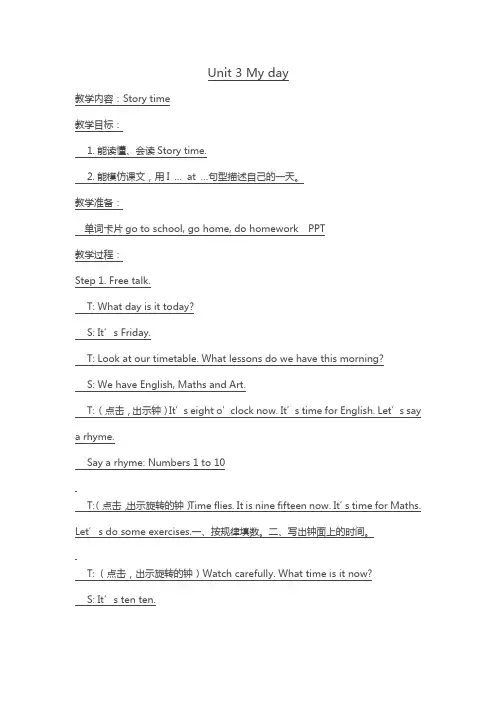
教学内容:Story time
教学目标:
1.能读懂、会读Story time.
2.能模仿课文,用I…at…句型描述自己的一天。
教学准备:
单词卡片go to school, go home, do homeworkPPT
教学过程:
Step 1. Free talk.
T: What day is it today?
学生听录音,给图片和时间配对。
交流答案,学生使用I…at…表述,教师完成板书。
教师领读第三段。小老师领读。
Watch and read.看整个卡通片,并同步朗读。
Step 3. Practise.
根据板书复述课文。
Play a game: I’m Mike.
游戏规则:随着鼓声传递Mike头饰,鼓声一停,拿到头饰的பைடு நூலகம்学戴上头饰,说‘I’m Mike. I…at…’
T: Mike’s topic is‘My day’.(板书课题)My day means“我的一天”, so Mike tells us what he does in the morning, what he does in the afternoon and what he does in the evening.
S: It’s Friday.
T: Look at our timetable. What lessons do we have this morning?
S: We have English, Maths and Art.
T:(点击,出示钟)It’s eight o’clock now. It’s time for English. Let’s say a rhyme.
译林英语4BUnit3MyDay优质教案及优质课件分享
译林英语 4B Unit3 My Day 优质教案及优质课件分享一、教学内容本节课我们将学习译林英语4B教材Unit3 "My Day"。
具体内容包括:课文A(Mike和Timmy一天),课文B(我学校生活),以及相关词汇和语法。
二、教学目标1. 让学生掌握描述日常活动词汇和表达方式。
2. 培养学生运用一般现在时描述自己和他人日常生活能力。
3. 增强学生听说读写综合运用能力。
三、教学难点与重点1. 教学难点:一般现在时运用,以及描述日常活动词汇。
2. 教学重点:让学生能够熟练运用所学知识描述自己和他人一天。
四、教具与学具准备1. 教具:PPT课件、磁带、录音机、卡片。
2. 学具:课本、练习本、彩笔。
五、教学过程1. 实践情景引入:邀请一位学生上台,展示并描述他日常生活。
2. 课文A学习:播放课文A录音,引导学生跟读,学习词汇和表达方式。
针对课文内容进行讲解,让学生理解并掌握一般现在时运用。
3. 例题讲解:以课文A为例,讲解如何描述一天活动。
4. 随堂练习:让学生分成小组,运用所学知识描述组员一天。
六、板书设计1. 课文A重点词汇和表达方式。
2. 一般现在时结构。
3. 课文B中词汇和表达方式。
七、作业设计1. 作业题目:描述你周末生活,至少包括5个日常活动。
2. 答案示例:On the weekend, I usually get up at 8:00. Then I have breakfast and watch TV. In the afternoon, I play football with my friends. After dinner, I read books and go to bed at 10:00.八、课后反思及拓展延伸1. 课后反思:本节课学生对于一般现在时掌握程度较好,但在词汇运用方面还需加强。
在今后教学中,要注重词汇拓展和练习。
2. 拓展延伸:鼓励学生在课后观察和记录家人或朋友日常生活,用所学知识进行描述,提高实际运用能力。
牛津译林版小学四年级下册4B第三单元my day公开课全套教学课件
1. Why is Bobby sad?
A. He is hungry.
B. He’s ill(生病).
2. It's________ o'clock now.
A. five
B. six
C. seven
3.What can you see over there,Bobby ?
I can see_________.
Tip:看到时间快速大声读出来,碰到动作大胆勇 敢做出来吧!You can !
Game time(游戏时间)
6:15
7:40 5:30
Review
--Mike’s day
I … at …
Activities
__g_e_t__u__p__
go to school
_h_a_v_e__l_u_n_c_h play football
Story time
Watch the cartoon and try to find out Mike’s activities in the morning.
看动画,试着找出迈克一天的活动 都有哪些。
have lunch get up go to school
do my homework
2. 用英语介绍自己一天的生活,说给父母朋 友听。
Sound time&Song time&Checkout time&Ticking time
Talking time(谈论时间)
Find the daily activities in a time sequence!
按照时间顺序给一天做的事排序!
go home
play football
新牛津译林四上《Unit 3 How manyB》教案(精品)
教学目标1. 能熟练运用句型What do you have I have…How many …do you have I have… 进行对话。
2. 能掌握数词thirteen, fourteen, fifteen, sixteen, seventeen, eighteen, nineteen的读音并能运用。
3. 能掌握字母l的发音/l/。
4. 学习歌谣Cakes 。
2学情分析四年级的学生在经过三年的英语教育,已经掌握了不少英语知识,课堂表现欲强。
在教学过程中,更多关注的是学生知识的累积与生成。
3重点难点1. 能熟练运用句型What do you have I have…How many …s do you have I have… 进行对话。
2. 正确掌握字母l的发音/ l /。
3. 能运用数词正确表达数字及how many后名词复数的正确表达。
4教学过程4.1 第一学时教学目标1. 能熟练运用句型What do you have I have…How many …do youhave I have… 进行对话。
2. 能掌握数词thirteen, fourteen, fifteen, sixteen, seventeen, eighteen,nineteen的读音并能运用。
3. 能掌握字母l的发音/l/。
4. 学习歌谣Cakes 。
学时重点1. 能熟练运用句型What do you have I have…How many …s do youhave I have… 进行对话。
2. 正确掌握字母l的发音/ l /。
3. 能运用数词正确表达数字及how many后名词复数的正确表达。
学时难点1. 能熟练运用句型What do you have I have…How many …s do youhave I have… 进行对话。
2. 正确掌握字母l的发音/ l /。
教学活动活动1【导入】自由对话Step1 Free talkGood memory把课文对话抠掉,让学生看图回忆课文。
4B Unit3 教案
4B Unit3 教案一、教学目标1.语言目标:–学习并掌握本单元的词汇和短语,如snowball, snowman, winter, snowstorm, etc.–能够运用所学词汇和短语进行描述和表达。
–学会运用第三人称单数形式的动词来表达时间和动作。
2.语言技能:–提高学生的听、说、读、写的技能。
–培养学生的交际能力和合作能力。
3.学习策略:–通过与小组成员合作完成任务,提高学生的团队协作能力。
–鼓励学生运用所学知识和信息查找答案。
二、教学内容本单元的主要内容包括:1.生词:snowball, snowman, winter, snowstorm, etc.2.短语:make a snowman, have a snowball fight, go ice-skating, etc.3.语法:第三人称单数形式的动词。
三、教学步骤第一课时1.导入新课(5分钟)–引导学生回顾上一单元所学内容,温习相关词汇和短语。
–通过提问激发学生的学习兴趣。
2.新课讲解(15分钟)–向学生介绍本单元相关生词和短语,并帮助学生理解和记忆。
–示范正确发音,并让学生跟读。
–呈现相关图片或幻灯片,帮助学生理解词汇和短语的意义。
3.情景对话(15分钟)–分组进行对话练习,要求学生运用所学内容进行模拟对话。
–鼓励学生自由发挥,展示他们所学的语言知识。
–教师巡视并给予必要的指导和帮助。
4.听力训练(10分钟)–播放相关听力材料,要求学生根据听到的内容完成相应练习。
–听力材料可以包括对话、短文等形式,以提高学生的听力理解能力。
5.语法讲解(15分钟)–向学生介绍第三人称单数形式的动词的用法,如he, she, it后的动词变化规则等。
–通过示例句子和练习句子来帮助学生理解和记忆。
6.语法练习(10分钟)–教师引导学生进行语法练习,包括填空和句型转换等形式。
–鼓励学生互相交流和合作完成练习,提高学生的语言输出能力。
7.小结复习(5分钟)–教师对本节课所学内容进行简要复习,并激发学生对学习的兴趣和热情。