
(人教PEP)六年级英语下册:Unit 3 Where did you go PARTA 教案
Unit 3 Where did you go ? partA第一课时教学内容 A. Let’s try Let’s talk课型对话教学教学目标●学生能够听、说、读、写句子:What happened ? Are you all right ? I’mOK now. Where did you go ? It looks like a mule ! Did you go to Turpan ?Yes, we did.●能够独立完成Let’s try 中的听力练习。
●教育学生懂得与他人分享旅行中的经历。
教学重点难点●在实际情景中灵活运用句型:Where did you go ? I went to…? 来与他人进行交流。
教学准备课件、图片教学步骤:Step 1. Warm-up1.利用图片和学生一起唱歌谣,要求一边唱一边做动作。
如:What can you do ? I can sing.What can you do ? I can dance.What can you do ? I can climb a mountain.What can you do ? I can take a pictures.What can you do ? I can speak Chinese.2.用多媒体课件展示自己外出旅游的照片,并做相关介绍。
如:Last summer holiday, I went to hainan. It was so beautiful. I went swimming in the sea. And picked some seashells on the beach.Step 2. PresentationLet’s talk(从呈现完整对话到处理局部语言)1.整体感知对话并回答问题。
(1)通过提问要求学生猜测:Did yougo to John’s home ? What happened toJohn? What did they talk about later?请学生带着问题观看动画或阅读文本,了解John脚受伤的原因:He fell of hisbike,利用图片帮助学生理解并教授fell.第二课时教学准备图片、照片与课件教学过程:Step 1 : Warm-up1.师生进行连锁问答练习,如:T: I went to Xinjiang on my holiday .Where did you go on your holiday?S1: I went to.... Where did you go on your holiday?S2: I went to.... Where did you go on your holiday?S3: I went to.... Where did you go on your holiday?……Step 2 : PresentationLet’s learn利用教材中的情景展开词汇教学1.利用图片整体呈现本部分单词并教授。
教师利用挂图呈现A.Let’s learn板块的插图,提问:T: Look, this is John’s blog. When did he send pictures and writeon the blog ? It was May 1st , the Labour Day holiday. What didhe do on Labour Day holiday ?然后要求学生看图,说出John 五一假期所做的事情:S: He rode a horse. He went camping . He went fishing.教师根据学生的回答继续追问:T: Where did he ride a horse ? What was the weather like there on Labour Day holiday ?Who did he ride a horse with ? How did he feel ?引导学生根据自己对新疆的了解,结合图片,发挥想象,针对John在新疆旅游的细节进行对话。
教师教授rode a horse, went camping, went fishing的时候,注意rode 和a之间的连续。
2.教师提问学生T: John had a good time in Xinjiang on Labour Day holiday. Last weekend, he also had two Days off. Where did he go last Saturday ? What did he do there ?引导学生猜测John上周末去的地方和做的事情,然后听课文录音,获取信息后,验证之前的猜测,再教授rode a bike.3.围绕课文插图John五月十二日微博的内容,教师继续与学生一起讨论John上周末的活动。
教师提问:T: What else did he do last Saturday? Who rode a bike with him ? Was it fun to ride a bike in the forest park ? What happened to him later? If you were John, what would you do ? 引导学生谈论并回答,教师教授hurt my foot.4.教师播放Let’s learn中的录音,学生跟读,然后让学生两人一组进行对话。
Step 3 : Practice1.教授自编Let’s chantWhat did you do on your holiday ?I rode a horse. I rode a horse.What did you do on your holiday ?I rode a bike. I rode a bike.What did you do on your holiday ?I went camping. I went camping.What did you do on your holiday ?I hurt my foot. I hurt my foot.What did you do on your holiday ?I went fishing. I went fishing.2.教Listen, answer and write教师播放此部分录音,学生完成相关练习,然后以教师问学生答的形式核对答案。
Step 4 : Condolidation and extension1.学生背诵并抄写本课时的四会动词短语。
2.做同步精练相关的练习。
板书设计:Unit 3 Where did you go ?Zhang: Where did you go last Saturday ?John: I went to a forest park.Zhang: What did you do there ?第三课时I was busy last week. On Monday I went to a restaurant. On Tuesday I went toa park. I roda a bike. On Wednesday I played ping-pong. On Thursday I went camping. ...2.日常进行日常会话交流,如:T: What did you do on your holiday ?S1: I rode a horse.T: What did you do on your holiday ?S2: I rode a bike.T: What did you do on your holiday ?S3: I went fishing.…..3. 师生齐声说唱chant, 如:How do you go to school ?By bus, by bus.How do you go to the park?By bike, by bike.How do you go to the science museum ?By taxi, by taxi.……Step 2: PresentationLet’s try1.听前预测。
教师出示人物图片,介绍听力活动背景: Who are they ?Wu Yifan and Amy are at school.They meet Sarah. 老师引导学生阅读第一个问题,然后提问:What are theytalking about ? Can you gurss ? 让学生进行听前猜测。
2.教师放第一遍录音,要求学生回答第一个问题。
3.教师问:What did Sarah do there ? 让学生根据自己对杭州的了解进行猜测。
然后老师放第二遍录音,学生回答问题后,教师还可提问:What was the West Lake like ? Whatelse could we do in the West Lake ? 引导学生谈论杭州西湖。
4.教师提问:Sarah bought some gifts. Who did she buy gifts for ? 教师放第三次录音,并核对第二题答案。
Let’s talk(从呈现完整对话到处理局部语言)1.预测对话内容。
完成Let’s try后,教师提问:Sarah went to Hangzhou last winter holiday.What about Amy ? Where did she go ? How did sheGo there ? What did she do ? 要求学生带着问题观看动画或阅读文本后回答问题。
板书如下:When did she go ?Where did she go ? Amy’s Trip How did she go there?What did she do ? ………2.教师与学生谈论Amy的三亚之行。
老师呈现A.Let’s talk 板块的插图,提出问题: What did Amy doon the first / second / …day ? How did she feel ? Whatwas the weather like there ? What did she eat there ? Didshe …? 引导学生结合图片,发挥想象,对Amy在三亚旅游的细节进行对话,并教读单词beach.3.教师引导学生根据Amy’s trip的思维导图,发挥想象,描述Amy’s trip. 此活动可先在四人小组内进行,然后全班分享。
六年级英语下册教案-Unit 3 Where did you go? 人教PEP版

Unit 3 Where did you go?The first period(第一课时)Part A Let’s try & Let’s talk▶ Teaching Contents & Teaching AimsLet’s try•Learn to predict the main content before listening.•Finish the exercises by using basic listening skills.•Get information and prepare for the next part.Let’s talk•Understand the dialogue and answer the following questions.•Learn the new words and phrases: fell off, Labour Day, mule, Turpan, could, till.•Know the local customs about Xinjiang through the dialogue.•Role play: Read out the dialogue correctly.•Learn the key sentences “Where did you go…?” “What did you do?” and try to make a dialogue with them.▶ Teaching Priorities•Use the key sentence patterns to talk about places you’ve been to and things you’ve done.▶ Teaching Difficulties•Use the simple past tense correctly in conversation; pay attention to the irregular changes in the past tense of verbs.The second period(第二课时)Part A Let’s learn & Listen, answer and write▶ Teaching Contents & Teaching AimsLet’s learn•Be able to listen, speak, read and write the phrases “rode a horse, rode a bike, went camping, hurt my foot, went fishing”.•Be able to talk about the activities in the past by using the key sentences “—Where di d you go last…? —I went to…” “—What did you do there? —I…”Listen, answer and write•Be able to use the phrases and the sentences in this part.•Be able to get the right information from listening.▶ Teaching Priorities•Be able to listen, speak, read and write the verb phrases.•Be able to use the key sentences to ask people what they did during their weekends or holidays and answer accordingly.▶ Teaching Difficulties•Notice the past tense of irregular verbs.•Be able to practice the key sentences in real situations.The third period(第三课时)Part B Let’s try & Let’s talk▶ Teaching Contents & Teaching AimsLet’s try•Be able to understand the listening exercises. Learn to predict before listening.•Be able to use listening skills to do the exercises.•Get information for “Let’s talk” by listening practice.Let’s talk•With the help of the teacher and the pictures, understand the dialogue and answer the questions below. •Be able to listen, speak and read the word “beach”.•Use the key words, phrases and sentences to talk about holiday activities.▶ Teaching Priorities•Be able to listen, speak, read and write the key sentences in this part.•Be able to use the key sentences to talk about holiday activities in the real situation.▶ Teaching Difficulties•Be able to use the core sentence structures to talk about the holiday experience, and be able to translate them into a simple text for introduction.The fourth period(第四课时)Part B Let’s learn & Look and say▶ Teaching Contents & Teaching AimsLet’s learn•Be able to listen, speak, read and write the phrases about holiday activities, such as ate fresh food, went swimming, took pictures, bought gifts.•Be able to use the phrases above correctly to describe holiday life.•Be able to use the sentence pattern “How was your summer holiday?” to ask about someone’s holiday.Look and say•Be able to use the phrases and the sentence pattern s learned in Part B to describe Andy’s holiday life according to the pictures and language supports provided. Develop students’ oral output ability to communicate in real context.▶ Teaching Priorities•Be able to listen, speak, read and write the verb phrases about holiday activities.▶ Teaching Difficulties•Be able to use the simple past tense to talk about the things done during the holidays and the feelings.The fifth period(第五课时)Part B Read and write▶ Teaching Contents & Teaching AimsRead and write•Be able to predict the beginning and further development of the diary by reading the pictures. Activate relevant background knowledge or vocabulary.•Train the ability to think and capture different types of information in the text by completing the exercises after reading.•Be able to listen, speak and read the words “basket, part, licked, laughed”.•Be able to get useful sentence patterns to describe daily activities orally and finally write a short paragraph. •Understand that every coin has two sides, and the bad things can be turned into good things through our efforts.▶ Teaching Priorities•Be able to understand the diary and complete the following exercises.▶ Teaching Difficulties•Develop students’ reading skills and interest in reading.•Learn to describe past events in the simple past tense.The sixth period(第六课时)Part B Let’s check & Let’s wrap it up▶ Teaching Contents & Teaching AimsLet’s check•Test students’ understanding of the core vocabulary and sentence patterns in this unit by completing the exercises in the first section of “Let’s check”.•Let students listen to the recording and answer the questions in the second section of “Let’s check” to check if they can answer the questions with the core vocabulary and sentence patterns.•Develop students’ habits of pre-listening prediction and help students improve their listening level gradually. Let’s wrap it up•Fill in the blanks by observing the pictures. Help students to consolidate and summarize the past tense of irregular verbs.•Inspire students to think more. Lead them to observe more and make their own generalization and summary.▶ Teaching Priorities•Test students’ mastery of what they have learned in this unit.•Master the changing rules of the past tense of verbs and the application of the simple past tense in real situations.▶ Teaching Difficulties•Apply the vocabulary and sentence patterns of this unit to the specific context.。
PEP六年级(下)Unit3 where did you go教案
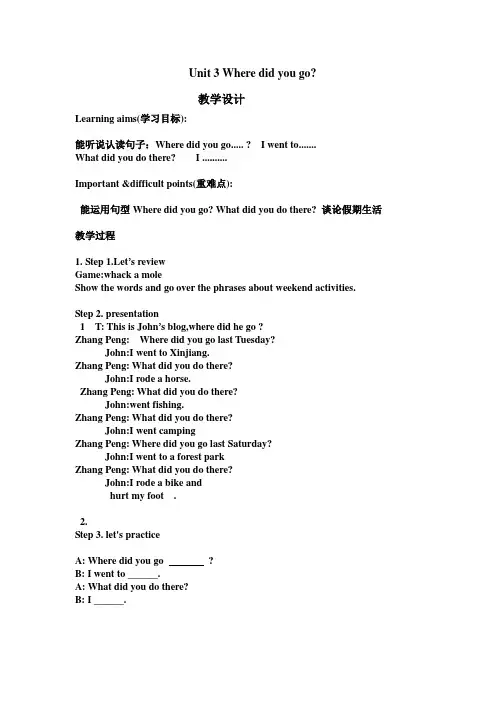
Unit 3 Where did you go?教学设计Learning aims(学习目标):能听说认读句子:Where did you go..... ? I went to.......What did you do there? I ..........Important &difficult points(重难点):能运用句型Where did you go? What did you do there? 谈论假期生活教学过程1.Step 1.Let’s reviewGame:whack a moleShow the words and go over the phrases about weekend activities. Step 2. presentation1 T: This is John’s blog,where did he go ?Zhang Peng: Where did you go last Tuesday?John:I went to Xinjiang.Zhang Peng: What did you do there?John:I rode a horse.Zhang Peng: What did you do there?John:went fishing.Zhang Peng: What did you do there?John:I went campingZhang Peng: Where did you go last Saturday?John:I went to a forest parkZhang Peng: What did you do there?John:I rode a bike andhurt my foot .2.Step 3. let's practiceA: Where did you go ?B: I went to ______.A: What did you do there?B: I ______.Step 4: let's doStep 5:summary1、Where +did+主语+go+过去的时间?主语+went +to+地点2、What +did +sb.+ do there?”主语+V-ed(短语)。
新版PEP小学六年级英语下册Unit-3-Where-did-you-go教案教学文稿
新版P E P小学六年级英语下册U n i t-3-W h e r e-d i d-y o u-g o教案教学文稿-CAL-FENGHAI-(2020YEAR-YICAI)_JINGBIANUnit 3 Where did you go第一课时教学步骤:Step 1. Warm-up1.利用图片和学生一起唱歌谣,要求一边唱一边做动作。
如:What can you do I can sing.What can you doI can dance.What can you do I can climb a mountain.What can you do I can take a pictures.What can you doI can speak Chinese.2.用多媒体课件展示自己外出旅游的照片,并做相关介绍。
如:Last summer holiday, I went to hainan. It was sobeautiful. I went swimming in the sea. And picked some seashells on the beach.Step 2. PresentationLet’s talk(从呈现完整对话到处理局部语言)1.整体感知对话并回答问题。
(1)通过提问要求学生猜测:Did yougo to John’s homeWhat happened toJohn What did they talk about later请学生带着问题观看动画或阅读文本,了解John脚受伤的原因:He fell of hisbike,利用图片帮助学生理解并教授fell.同时,通过观看动画或阅读文本获得对话的主旨:They talked about John’s Labout Day holiday.(2)结合日历,让学生理解Labour Day holiday概念。
提问:Look at thecalendar. What date is it It’s May 1st . On May 1st ,we usually have three days off. We call it Labour Day holiday.(3)继续提问学生:Where did John go on his Labour Day holiday What didhe do there 要求学生带着问题观看动画或阅读文本获取信息,并用思维导图板书对话关键信息。
教学设计:人教版小学英语六年级下Unit 3 Where did you go
人教版小学六年级英语下册Un i t 3W he re did yo u go?教学设计一、指导思想《课标》中指出:义务教育阶段的英语课程应面向全体学生,体现以学生为主体的思想,在教学目标、教学内容、教学过程、教学评价和教学资源的开发与利用等方面都应考虑全体学生的发展需求。
基于以上理念、具体学情和复习课的特点,我设置了分层目标,分层活动,努力做到面向全体学生,尊重学生的个体差异,通过不同难度的听说读写训练来实现教学整体效益的最大化,促进学生综合语言运用能力。
二、教学背景分析(一)教材分析本课是 PEP 小学英语六年级下册第三单元的单元复习课,本单元教材分为 A、B、C 三个部分,以“谈论和描述人物在过去做的事情”为主题,通过 Where did you go?/Did you …? / How did you …? 等语言结构来对人物在过去所做的事情进行谈论和描述。
语法内容承接第二单元,继续涉及不规则动词过去式的变化。
(二)学情分析1.六年级学生具有一定的抽象思维能力,能基于一定的引导透过现象看到事物的本质,能掌握大多数定义性概念,并进行归纳总结,但在学习中仍需要具体经验的支持。
2.学生学习本课之前已经在六年级上册的积累了相关范畴的词汇:What, Where, When, Who, How 及其引导的特殊疑问句的问答语,在六下第二单元接触到假期活动的短语,如 cleaned my room, watched TV,等,及 Did you clean your room?等一般疑问句的提问及回答。
3.六年级学生已经具备一些听、说、读、写的基本技能,能够初步运用四项语言技能获取、处理和传递所需信息。
部分学生能围绕“谈论和描述人物在过去做的事情” 这一话题进行简单的口头交流和短小文段表达,但有些学生掌握的不够扎实。
从整体上来说,学生在如何有效记忆和使用英语词汇、如何在具体语境下进行交流等方面还有待提高。
小学六年级英语下册 Unit 3《Where did you go》(Part A)名师课件4 人教PEP版
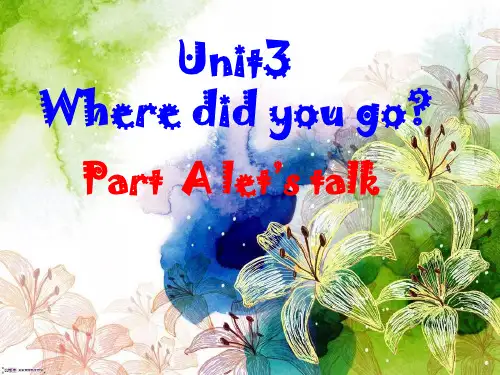
rode a bike played football visited my aunt studied English
fell off my horse
went camping went fishing had a party rode a horse
fell(fall的过去式) off从…上跌落
rode a bike
went fishing
hurt foot
saw a film
watched TV
Free talk
A: How was your winter holiday (寒假)? B: It was good, thank you. A: What did you do on your winter holiday? B: I _______.
go to Turpan?
骡子
John: Yes, we did. We saw lots of grapes there.
but we couldn’t eat them . They won’t be
ready till August.
成熟的
1. Where did John go over his holiday ? Mt. Tianshan, Xinjiang and Turpan.
photos from the Labour Day holiday.
Let’s talk
Amy : Where did you go?
John: Mt Tianshan, Xinjiang. I rode a horse.
Look, it’s very small.
骑马
Amy : Oh, yes. It looks like a mule! Did you
六年级下册英语教案-Unit 3 Where did you go-人教PEP版 (4)
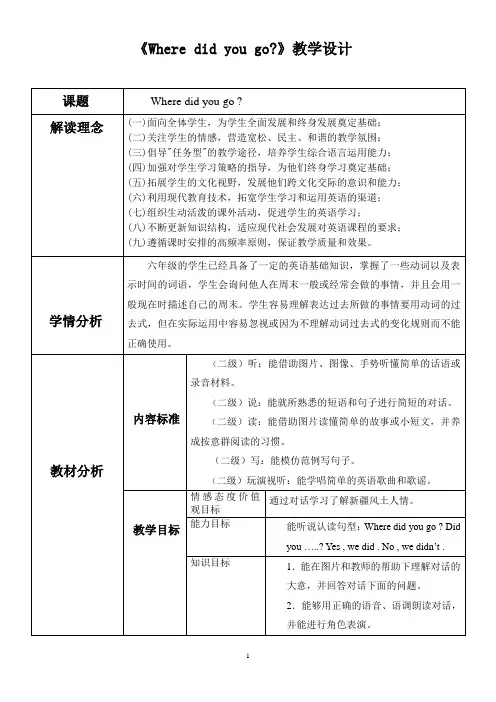
《Where did you go?》教学设计课题Where did you go ?解读理念(一)面向全体学生,为学生全面发展和终身发展奠定基础;(二)关注学生的情感,营造宽松、民主、和谐的教学氛围;(三)倡导"任务型"的教学途径,培养学生综合语言运用能力;(四)加强对学生学习策略的指导,为他们终身学习奠定基础;(五)拓展学生的文化视野,发展他们跨文化交际的意识和能力;(六)利用现代教育技术,拓宽学生学习和运用英语的渠道;(七)组织生动活泼的课外活动,促进学生的英语学习;(八)不断更新知识结构,适应现代社会发展对英语课程的要求;(九)遵循课时安排的高频率原则,保证教学质量和效果。
学情分析六年级的学生已经具备了一定的英语基础知识,掌握了一些动词以及表示时间的词语,学生会询问他人在周末一般或经常会做的事情,并且会用一般现在时描述自己的周末。
学生容易理解表达过去所做的事情要用动词的过去式,但在实际运用中容易忽视或因为不理解动词过去式的变化规则而不能正确使用。
教材分析内容标准(二级)听:能借助图片、图像、手势听懂简单的话语或录音材料。
(二级)说:能就所熟悉的短语和句子进行简短的对话。
(二级)读:能借助图片读懂简单的故事或小短文,并养成按意群阅读的习惯。
(二级)写:能模仿范例写句子。
(二级)玩演视听:能学唱简单的英语歌曲和歌谣。
教学目标情感态度价值观目标通过对话学习了解新疆风土人情。
能力目标能听说认读句型:Where did you go ? Didyou …..? Yes , we did . No , we didn’t .知识目标1.能在图片和教师的帮助下理解对话的大意,并回答对话下面的问题。
2.能够用正确的语音、语调朗读对话,并能进行角色表演。
3.能够在情境中恰当的运用由where和what 引导的一般过去时特殊疑问句。
教学资源 1.人教版小学英语六年级下册Unit32.课件3.卡片教具教学重点能听说认读句型:Where did you go ? Did you …..? Yes , we did .No , we didn’t .教学难点能够在情境中恰当的运用由where和what 引导的一般过去时特殊疑问句。
人教PEP版六年级下册英语课件unit 3 Where did you go Part A Let'
1
2021/3/20
2
washeddmidymcylohthoemsewhorakd a cold watched TV cleaned my room drank tea saw a film slept read a film magazine
2021/3/20
3
What did he do ? He rode a horse.
B: I went to__a_f_or_e_s_t_p_a_r_k_.
A: What did you do there? B: I _r_o_d_e_a__b_ik_e__.
2021/3/20
17
A: Where did you go on your holiday? B: I went to Xinjiang. A: What did you do there? B:I __________.
2021/3/20
7
I went to a forest park.
go---went
2021/3/20
8
What did you do there? I went camping.
went camping
2021/3/20
9
2021/3/20
camp
10
What did you do there? I went fishing.
Where did you go on your holiday, holiday, holiday? Did you run? Did you jump? What did you do?
I rode a bike in the park, in the park, in the park. I didn’t see a big round stone, And ouch, I hurt my foot.
Unit3WheredidyougoPartALet'slearn(课件)人教PEP版英语六年级下册
Exercises
三、看图,回答问题。 1. What did you do last weekend?
_I_w__e_n__t__f_is__h_i_n_g__w___it_h___m__y__f_a_t_h__e_r_.___.
2. Did she ride a bike yesterday?
Presentation Let’s look at John’s blog. What did John do on May 12th ?
He rode a bike. rode a bike 骑自行车
John rode a bike on May 12th .
Ooch! My foot hurts.
rode a bike
went fishing
Practice
Act the dialogue and make your dialogue.
Where did you go last Saturday?
What did you do there?
Practice
Listen, answer and write
ride a bike
hurt my foot
go to the forest
Lead in Have you been to Xinjiang? What do you know about Xinjiang?
Presentation Let’s look at John’s blog.
What did John do on May 1st?
He rode a horse.
(ride的过去式,骑 马;骑车)
骑马
John rode a horse on May 1st.
pep新版小学英语六年级下册Unit 3 Where did you go教案
Unit 3 Where did you go?A.Let’s learn一、教学目标1.知识目标:(1)能听、说、读、写动词短语rode a horse, rode a bike, wentcamping, hurt my foot, went fishing.(2)能运用“Where did you go…?” “ What did you do there?”询问别人在过去某个时间去过的地方及做过的事情。
2.能力目标:培养学生的口头表达能力和交际能力。
3.情感目标:自由地谈论去过的地方和做过的事,教育学生热爱生活,学会分享,增进友谊。
二、教学重难点1.教学重点:熟练运用五个动词短语及句型2.教学难点:熟练掌握不规则变化的动词过去式及其应用;能灵活运用句型“Where did you go…?”“ What did you do there?”谈论去过的地方和做过的事。
三、教学过程1. Warm up and revision(1) Sing a song: Tell me about your holiday(2) Free talk2. Presentation(1)出示John’s microblog, 引出句型: “Where did you go …?” “I wentto …”“What did you do there?”“I…”(2) 问题“What did John do there?”引出新单词rode a horse, went camping, went fishing, rode a bike, hurt my foot, 教学新单词3. Practice(1) Game: Catch the plane(2) Game: Hit the ground mouse(3) Game: Bomb game4. Consolidation and extension(1) Look and say(2) Pair work(3) Listen, answer and write(4) Let’s retell5. Summary6. Homework四、板书设计。