
深圳牛津版英语 8A unit 4 Great Inventions教学设计
Great Inventions教学设计
华侨城中学陈虹
课型:reading
教材:上海牛津英语8A unit 4
学情分析:本班的孩子绝大部分英语基础不错,思维活跃,表现力强,故设计一堂课做完阅读理解并有相应的production成为可能。
教师也可以针对孩子的当堂的英语学习情况做调整,将production放到第二节课。
学生熟悉老师的各种阅读或听读活动设计,更喜欢有自己的发挥,所以特意设计的最后一个环节:介绍自己最喜欢的发明,并提前布置他们去查资料,相信一些“恶趣味”的孩子会给课堂带来惊喜。
教学目标:
1. 通过各种形式的阅读活动,了解人类历史上三项重要发明——wheel, telephone and light bulb的发明者、发明时间和作用影响等。
能够复述其中一段。
2. 了解什么是skimming,利用本课尝试skimming阅读技巧。
3. 模仿文章中的方法,较为完整地介绍自己喜爱的发明。
4. 情感上引导学生发现、珍惜并感恩给我们的生活带来便利的发明。
教学重点:读懂课文,发现文章的结构和介绍发明的方法并学以致用
教学难点:复述课文,介绍发明的作用和影响。
教学方法:情境教学法、趣味教学法、任务教学法、直观教学法、脑图教学法、小组竞赛及合作学习法
步骤目的教师活动学生活动条件/手段用时
Step 1 Lead in 猜谜激趣,
引入主题。
展示学习
任务,让学
生心中有
数。
1. Let Ss guess some
inventions according
to the descriptions to
lead in topic.
2. Tell Ss the main
tasks today
1. Listen to
teacher describe
the inventions,
guess what they
are and race to
be the first to
say the answers.
2. Get to know
the objectives
competition
PPT
2m
Step 2 Before reading 用真实的
情境热身
并提前熟
悉部分单
词和重点
句。
为读懂文
章的内容
结构及完
成后面环
节——说
Ask Ss to find some
great inventions in
the classroom and
tell why they think
they are great.
Show pictures of the
inventions around us
and guide Ss to
realize how they
have changed our
lives.
GW: Look
around and find
some great
inventions in the
classroom, tell
why they are
great.
Think and talk
about what life
is like without
those inventions
Classroom
小组合作
PPT
Pictures
4m
的作用预热
Step 3 While-readin g: Skimming 了解何为
速读;训练
速读的技
巧。
Explain what is
skimming. Show
questions, ask Ss to
skim within 1
minute and find the
answers
Read the title,
the subheadings
and the first
sentences of the
paragraphs,
answer Qs
PPT
课本
3m
Step 4 While-readin g: Listen for more information 带着目标
听文章,训
练听力的
同时获取
较全面的
信息, 凸显
生词、关键
词和难句。
1. Show the tasks
before listening.
2. Play the mp
3.
Check the answer
after listening.
3. Explain the
difficult sentence.
Listen to the
text with
different tasks
for each
paragraph.
PPT
Mp3
10m
Step 5 While-readin g: read for details 通过朗读
并填写表
格,充分理
解文章,全
面认识文
中提到的
发明。
1.Give the handouts.
2. Help Ss with
pronunciation if
necessary.
3. Look around and
help Ss who have
difficulties in filling
the table.
1. Read the text
aloud.
2. Finish a table
about the three
inventions.
Discuss the
answers in
groups.
3. check the
answers with T
Handouts
课本
小组合作学习
11m
Step 6
After reading 利用图片
复述课文,
清楚介绍
物品的方
法。
介绍自己
最喜爱的
发明,训练
思维的逻
辑性和叙
述的条理
性。
Show some pictures
and the timeline of
Para 3, help Ss retell
the text.
Guide Ss to
conclude the ways
of introducing sth.
Draw the mind map
on board.
1. PW: retell the
part of the text
about light bulb
Learn how to
introduce sth.
2.GW: introduce
their favourite
inventions and
choose the most
interesting one
in groups to
present in class
Ppt
Pictures
小组合作学习
10m
Homework 巩固所学,
鼓励学生
用自己的
方法去复1. Use your own way to help yourself retell the other two paragraphs.
2. Write an article on your favourite invention.
听了其他
同学的介
绍后完善
自己的口
头陈述并
写下来。
板书小组评价
1
2
3
4
5
6
7
附件:handouts for reading:
附件:
Unit 4 Inventions Read the text carefully and fill in the table, please.。
8AU4-1 Reading_ Great inventions
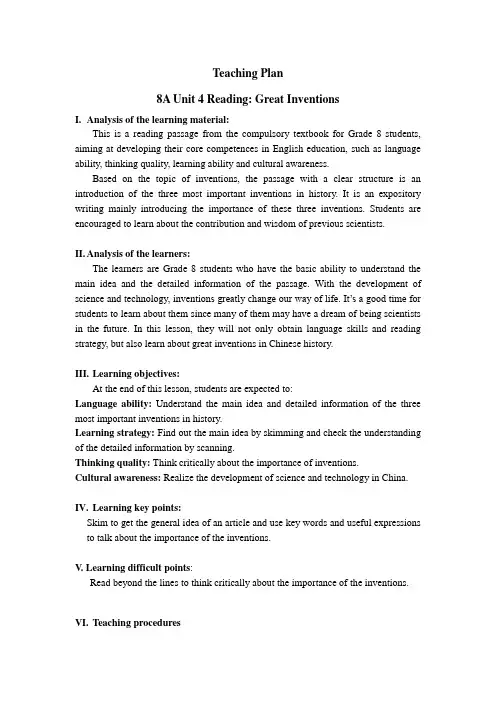
Teaching Plan8A Unit 4 Reading: Great InventionsI.Analysis of the learning material:This is a reading passage from the compulsory textbook for Grade 8 students, aiming at developing their core competences in English education, such as language ability, thinking quality, learning ability and cultural awareness.Based on the topic of inventions, the passage with a clear structure is an introduction of the three most important inventions in history. It is an expository writing mainly introducing the importance of these three inventions. Students are encouraged to learn about the contribution and wisdom of previous scientists.II.Analysis of the learners:The learners are Grade 8 students who have the basic ability to understand the main idea and the detailed information of the passage. With the development of science and technology, inventio ns greatly change our way of life. It’s a good time for students to learn about them since many of them may have a dream of being scientists in the future. In this lesson, they will not only obtain language skills and reading strategy, but also learn about great inventions in Chinese history.III.Learning objectives:At the end of this lesson, students are expected to:Language ability: Understand the main idea and detailed information of the three most important inventions in history.Learning strategy: Find out the main idea by skimming and check the understanding of the detailed information by scanning.Thinking quality: Think critically about the importance of inventions.Cultural awareness: Realize the development of science and technology in China.IV.Learning key points:Skim to get the general idea of an article and use key words and useful expressions to talk about the importance of the inventions.V. Learning difficult points:Read beyond the lines to think critically about the importance of the inventions. VI.Teaching procedures。
Unit4+Great+inventions-+writing 牛津深圳版英语八年级上册
Analysis of students
strong
This class is the third period of this unit, after the previous learning, students have some basic knowledge of inventions. Meanwhile,they will have desire to invent something new with their creativity and innovation.
Task 3. Feedback and summary (class work; 4 minutes)
Teacher picks the most attractive invention, and guides students to summarize the structure, and good expressions in writing.
“
学
Teaching & learning Methods
Teaching approach
Student-oriented approach, Task-based approach,Communicative approach
Learning approach
work in individuals and work in pairs .
Read for the details
1
3
2
Task 2.class work: (5minutes)
Purpose: 1) know structure and useful expressions of introducing an invention. 2) use spidergram or flowchart to outline the writing and imitate the sample writing.
初中—八年级上册—牛津深圳版—8A Unit4 Inventions 阅读课教学设计_
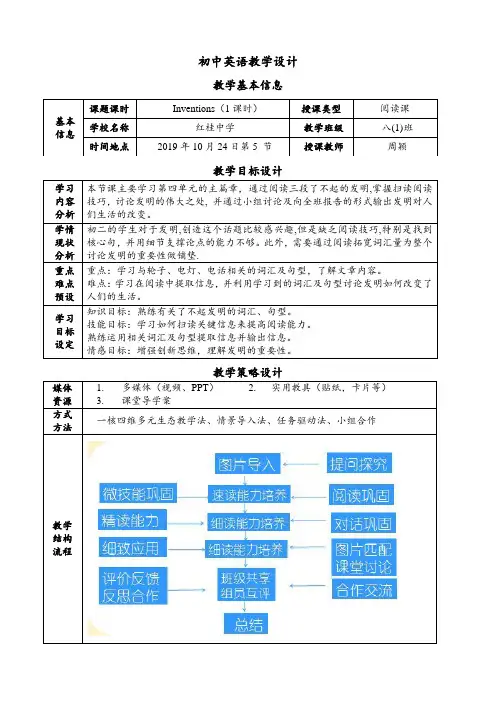
初中英语教学设计教学基本信息教学目标设计教学策略设计学习评价设计【主要内容】1.Finish exercises of some words, phrases and sentences2.Finish reading exercises of four inventions3.Learn to find out information about inventions4.Check their homework by solving some problems they have in preview.【评价反馈】1.Check if students preview this lesson.2.Check students’ level of knowledge reserve.3.Check if students grasp the useful words , phrases, sentences.【主要内容】Before-reading1.Say the names of some inventions, and review the pattern of “ use …to …”2.Have a free talk about “What inventions can you see in the classroom?”“How does it change our life?” .1 Listen to and read part one and put the inventions in time order.2.Find out one sentence to match the picture.3. Give them pictures of carriages, trains, cars and their speed, let students to sum up thegreatness of the wheel;4. Let students to watch a video, and let them guess what they are going to learn next.5.Read part two, read and finish the dialogue.A: What can people do with mobile phone?B: With mobile phone, people can_____________________________________________A: Can we live without telephone in the future?B: _____________________________________________A: Why?B: Because _____________________________________________7. Practise the pattern of “ with … we can …”8. Tell the true or false of the following sentences.9. Fill in the blanks and sum up with mindmapsAfter-reading:1 .If you were the writer, what was the fourth greatest invention you would write. Please introduce it to us.We think______________is a great invention (What)______________ (Who) invented it in ______________ (when)It was invented in ______________ (where)Before the invention of ______________ people had to ___________________________________________________________________With ______________, people can ____________________________2 Students can use the reading exercise to help.3.Have a presentation .【评价反馈】1. Check if students can use the new words and phrases2. Check if students can use the skill of reading3.Check if students understand the passage.【主要内容】1.Self-assessment .◆I know how to use the words and phrases.◆I know the main idea of the articles◆I can introduce a new invention.2.Summery:What did I learn from the lesson?3. Homework:Write the fourth greatest invention【评价反馈】1.Help students find out and solve the problems they had during the class.2.Check if students know how to use phrases and words to introduce a new invention教学过程设计【Situation Introduction】1.to play some pictures. Students say their names and use the pattern of “ use…to..”2.Finish Part A. Guess what inventions they are going to learn today【Preview Feedback】Finish some exercises【learn some reading skills】Learn some readings skills and use them to read【设计意图】To arouse the students’ interest and attention by saying some inventions in real life【Present New Knowledge】Explain some reading skills before reading.【设计意图】To help students get ready for reading .【Consolidate New Knowledge】1.Students use the reading skills to get the information.2.Students read the passage【设计意图】To check if students master the reading skills【Read and write】Students read new inventions and try to write the fourth invention【设计意图】To practice the students’ reading ability.To motivates students to write the fourth invention1.Learn how to use the words and phrases2.Know the main idea and introduce a new invention3.Self-assessment and have a summary.4.Homework:Write the fourth greatest invention。
英语八年级上册《Unit 4 Inventions Reading“Great inventions“》_14
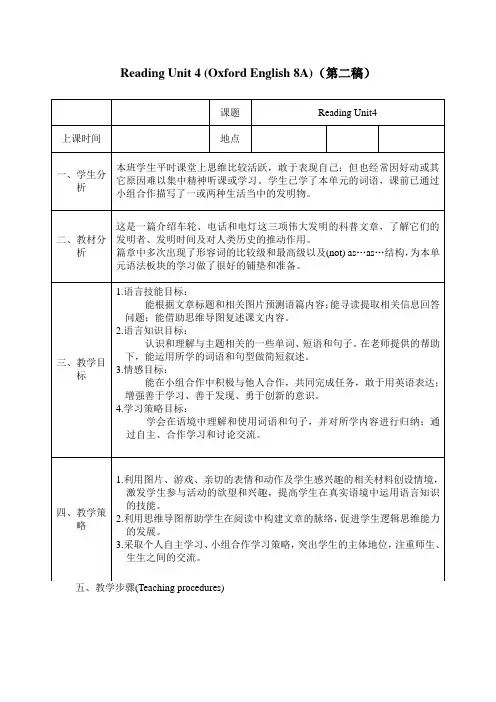
这是一篇介绍车轮、电话和电灯这三项伟大发明科普文章,了解它们的发明者、发明时间及对人类历史的推动作用。
篇章中多次出现了形容词的比较级和最高级以及(not) as…as…结构,为本单元语法板块的学习做了很好的铺垫和准备。
三、教学目标
1.语言技能目标:
能根据文章标题和相关图片预测语篇内容;能寻读提取相关信息回答问题;能借助思维导图复述课文内容。
五、教学步骤(Teaching procedures)
Steps
Activities
Aims
Step1 Lead-in
Get the students to know the learning targets of this class.
Help the students get a general idea of what to learn in class.
Activity IV. Discuss in a group and give opinions. Then write it down.
Which do you think is the greatest invention of the three?
1.Help the students grasp the main idea of the articles, with the clue of time.
2.Enable the students to scan for details.
3.Encourage the students to workwithothers and expressthemselvesin front of the whole class.
4.Improve the students’abilities to summarize and retell the general idea of the article.
牛津深圳版英语八上Unit 4《Inventions》单元教学设计
牛津深圳版英语八上Unit 4《Inventions》单元教学设计一. 教材分析《Inventions》是牛津深圳版英语八上Unit 4的主题单元,主要讨论了与人们生活息息相关的发明创造。
本单元通过介绍各种发明,让学生了解科技发展对人类生活的影响,培养他们的创新意识。
教材内容包含了各种发明的历史背景、诞生过程以及其对现代社会的意义。
通过对本单元的学习,学生可以提高听、说、读、写等方面的能力,拓展视野,激发对科学和创新的热爱。
二. 学情分析学生在进入八年级时,已经掌握了英语学习的基本技能,具备一定的听、说、读、写能力。
然而,对于一些较高级的词汇和语法结构,他们可能还较为陌生。
因此,在教学过程中,教师需要关注学生的个体差异,充分调动他们的学习积极性,引导他们主动参与课堂活动。
同时,教师还需关注学生的思维发展,鼓励他们提出自己的观点,培养他们的创新意识。
三. 教学目标1.知识目标:学生能掌握与发明创造相关的词汇和表达方式,了解各种发明的历史背景和现代意义。
2.能力目标:学生能在日常生活中运用所学知识进行交流,提高听、说、读、写等方面的能力。
3.情感目标:学生能激发对科学和创新的热爱,培养创新意识。
四. 教学重难点1.重点:学生能熟练运用本单元所学词汇和表达方式进行交流。
2.难点:学生能理解并运用一些较高级的词汇和语法结构。
五. 教学方法1.任务型教学法:通过设定各种任务,让学生在实践中运用所学知识。
2.情境教学法:创设各种情境,让学生在真实的环境中学习英语。
3.合作学习法:鼓励学生分组讨论,培养他们的团队协作能力。
六. 教学准备1.教材:《牛津深圳版英语八上Unit 4》2.多媒体设备:电脑、投影仪、音响等3.教学素材:与发明创造相关的图片、视频等4.作业布置:提前为学生准备相关的练习题七. 教学过程1.导入(5分钟)教师通过展示一些与发明创造相关的图片或视频,引导学生谈论自己对发明的看法,激发学生的学习兴趣。
最新深圳牛津版八年级英语优质课件 8A U4 Great inventions

Today millions of
3 across the world own F people across the world
mobile phones.
own mobile phones.
NoRteete-ltlaPkartithn3isgwtaitbhleth. e help of
invention Read Part 3 and complete the table. the light bulb
____________________.
At last, we think bringing a/an _____ is also important. We can use it to
_________________.
Summary
the wheel
Great
the telephone
inventions
the light bulb
when
who
history
how they change our life
Homework
• You are going to create a new invention of your own. Write a short article about your invention. Use the spidergram to help you make plans.
Before you read
Look at the title, the photos, the introduction and the sub-headings of the article on Page 51. Then answer the question below.
Unit4Inventions教学设计2024-2025学年牛津深圳版英语八年级上册
答案:示例:
Comparison of Three Inventions
The three inventions discussed in the text are the printing press, the internet, and the smartphone. They share the commonality of revolutionizing the way we communicate and access information. However, they differ in terms of their impact, speed, and accessibility.
The internet was invented in the late 20th century and brought about a rapid transformation in communication and information sharing. It provided a platform for instantaneous communication and access to a vast amount of information. The internet could be accessed by anyone with a computer or a device connected to the internet, making it more accessible than the printing press.
课后作业
1.根据课文内容,写一篇关于你最喜欢的发明的短文,包括发明的名称、背景、影响和你的感受。
Module 4 Great inventions教学设计教案,DOC
Module 4 Great inventions一、题材内容本模块以伟大发明为话题,通过对新发明的利弊分析,培养学生的思辨能力和英语表达能力。
课文列举了电子杂志与传统杂志之间的比较,以及电脑与书本的比较,十分符合现实生活。
教学中应结合学生生活实际情况,灵活掌握教学过程,组织教学内容,丰富4. 文化意识:中外对比:思维模式的比较,辩证地看问题。
三、重点和难点重点:1.被动语态与时态的连用2.被动语态与情态动词的连用难点:能用英语思维,并恰当地、地道地表达自己的观点。
四、单元内容分析Unit 1: Paper and printing have been used for ages本单元的主要任务是听和说。
通过听以及学习与创造发明有关的对话,学会向他人借东西的英语表达方法。
通过对传统杂志与网络杂志的比较,培养学生的英语思维,锻炼学生的英语表达能力。
主要句型有“C an I …?” “Do you mean doing … ?” “ Y ou must promise that…”Unit 2:Books could be produced more quickly and cheaply.本单元主要任务是阅读,理解文章段落大意,帮助学生养成良好的阅读习惯和有效的阅读方法,培养学生从文章当中按照时间顺序快速寻找有效信息的能力,着重练习归纳总结每一段中心大意的能力。
在教学过程中,教师可以先从整体上引导学生领会课文的大概结构和总体意思,然后分小组讨论每一段的大意,让学生按小组给出每一段的主要意思,然后进行纠正,让学生在自己解决问题的过程中发现问题,提出问题,最后解决问题。
Unit 3:Language in use本单元的主要任务是:通过动词练习让学生巩固被动语态与不同时态和句子类型配合使用时的使用方法,通过给词造句的方式,让学生熟悉被动语态在疑问句中的用法以及在和情态动词搭配时的用法。
五、教学方法本模块的主要任务是培养学生的英语表达能力和英语思维,应该多采取课堂讨论的形式来让学生大胆地表达他们关于一件事情的观点。
牛津深圳版英语八年级上册Unit4InventionsReading教学设计
2.引导学生运用阅读策略,如预测、扫读、精读等,提高阅读效率和理解能力。
3.结合学生的兴趣和实际生活,设计丰富多样的教学活动,激发学生的学习热情和参与度。
4.对于专业词汇和复杂句型,教师应采用直观、生动的教学方法,降低学习难度,增强学生的自信心。
牛津深圳版英语八年级上册Unit4InventionsReading教学设计
一、教学目标
(一)知识与技能
1.学生能够掌握本课的生词和短语,如“invent”, “translate”, “electricity”, “switch”, “battery”, “mouse”等,并能够在实际语境中正确运用。
5.教学评价:
(1)形成性评价:通过课堂表现、小组讨论、课后作业等方式,关注学生的学习过程,及时给予反馈。
(2)终结性评价:通过单元测试、口语表达、课后访谈等方式,全面评估学生的学习成果。
(3)鼓励学生自我评价和同伴评价,培养他们的自我监控和评价能力。
四、教学内容与过程
(一)导入新课
1.教师通过展示一张带有神秘感的图片,引发学生的好奇心,提问:“What do you think this picture is about?”,让学生猜测并发表自己的看法。
(2)鼓励学生大胆开口,尊重每个学生的发言,给予积极的评价和反馈。
(3)组织课堂竞赛,激发学生的表达欲望,提高课堂氛围。
4.教学方法:
(1)采用任务型教学法,引导学生主动探索、合作学习,提高课堂参与度。
(2)运用多媒体教学资源,丰富教学手段,激发学生学习兴趣。
(3)关注学生个体差异,实施分层教学,使每个学生都能在课堂上获得成就感。
深圳优质课教案 深圳牛津版八年级英语 8A U4 Great inventions教学设计
Unit 4 InventionsGreat inventionsTeaching objectives:After the class, the students should be able to1.extract the general and detailed information from the passagee their own words to introduce light bulb.3.work together as a team and help each otherTeaching aids: computer, projector, exercise sheetFocal point: to get the information from the passage and use their own words to talk about inventionsDifficult point: to work together and use their words to talk about the function of some important inventionsTeaching procedures:Warming upPlay a game---Who’s still standing?Step 1 Lead-inBy watching two videos about ancient life and modern life, students are led to come to a conclusion---Technology/Invention makes our life more convenient.Relate to students’ life experience by asking three questions and tell them they’re going to read an article about three most important inventions. Step 2 Pre-readingPrediction---look at the title, the photos, the introduction and the sub-headings of the article and answer the questions below:What three inventions will the article talk about?Step 3: While reading1. ScanningStudents read the whole passage quickly and finish the mind-map.2.Students read Part One aloud and answer the questions below(1) What happened after the invention of wheels?(2) When do the first trains begin to carry passengers?3.Read Part 2 and tell whether the following statements are true or false (T/F)and find supporting details:Bell invented the first practical telephones in 1879.(F)People still cannot speak to each other over long distances after 1876.(F) Today few people across the world own mobile phones.(F)4.Read Part Three and finish the table.Step 4 Post-reading1.Retell Part Three based on the table above.2.Group-workSuppose that they were left alone on a small island. They are allowed to choose only three inventions to bring with them.So they will have a discussion and later give a presentation about their choices as a group. Step 5 SummaryStep 6 Homework。