
提单中英文合同
编号:_______________
本资料为word版本,可以直接编辑和打印,感谢您的下载
甲 方:___________________
乙 方:___________________
日 期:___________________
提单中英文合同
说明:本合同资料适用于约定双方经过谈判、协商而共同承认、共同遵守的责任与
义务,同时阐述确定的时间内达成约定的承诺结果。文档可直接下载或修改,使用
时请详细阅读内容。
这篇《提单中英文合同范文》 是,希望对大家有所帮助。
以下信息仅供参考! ! !
提单
提货单简称。在海上货物运输中,承运人收到承运的货
物后,签发给托运人的书面单证。其中正本 2-3份,副本若
干份。收货人凭正本提单向货运目的地的运输部门提货。
Shipper
GuangzhouArts & Craft Crop.
Guangzhou, China
Consignee
Order
Notify Address Joseph Smith & Sons
XXX Street
Southampton, Britain
Vessel:
M. V. WULIN
Port of loading:
Whampoa
B/L No. S0003
FAR EAST ENTERPRISING CO LTD
HONG KONG
BILL OF LOADING
Direct or with transshipments
SHIPPED on board in apparent good order and condition
(unless otherwise indicated) the goods or packages specified
herein and to be discharged at the mentioned port of discharge or
as near thereto as the vessel may safely get and be always afloat.
The weight, measure, marks, numbers, quality, contents
and value, being particulars furnished by the Shipper.
The Shipper, Consignee and the Holder of this Bill of loading
hereby expressly accept and agree to all printed, written or
stamped provisions, exceptions and conditions of this Bill of
loading, including those on the back hereof.
Port of discharge: Southamption Freight payable at: Number
of original Bs/L:
THREE (3)
Marks and numbers:
Number and kind of package: description of goods
Gross weight(kg)
Measurement (M)
SOUTHAMPTON JSS1/25
25 cartons
Porcelain Figures
300kgs PARTICULARS FURNISHED BY SHIPPERS ORIGINAL
Freight and charges Freight Paid
IN WITNESS where of the Carrier or his Agents has
signed the above stated number of Bill of lading all
of this tenor and date, one of which being acplished the others to
stand void.
Terms and Conditions as per back hereof
Place and date of issue: Whampoa25 April 1986
Signed (for the master) by:
托运人:
中国、广州
广州工艺品公司
收货人:
通知地址:
英国南安普顿
XXX
约瑟夫.史密斯父子公
公司
船名:
武林号
装货港:
黄埔
提单号:
S0003
香港
华夏企业有限公司
提单
直运或转运
本提单所列外表情况良好的货物或包件已装在下列船 上并将在下列
卸货港或该轮所能完全到达并保持浮泊的附 近地点卸货。
货物的重虽、尺码、标志、号数、品质、内容和价值, 是由托运人提
供的。
托运人、收货人和本提单的持有人兹明白表示接受并同 意本提单和
它背面所载的一切印刷、书写或打印的规定、免 责事项和条件。
卸货港:南安普顿运费在支付提单一式参份标志与 号码 包件的种
类、数虽货名
毛重
尺码
SOUTHAMPTON JSS1/25 2纸箱瓷人 300
公斤
运费和其他费用:
运费已付
为证明以上各节,承运人或其代理人已签署相同日期和 期限的本提
单一式三份,其中一份经完成提货手续后,其余 各份失效
本提单条款见背面
签单日期:1986年4月25日
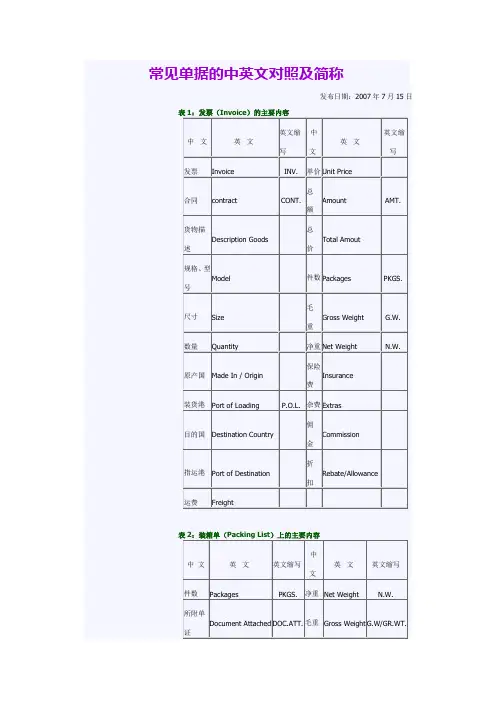
常见单据的中英文对照及简称
Gross Weight
G.W/GR.WT.
单证
Documents
DOC(S)
表3:提单(Bill of loading)的主要内容
中文
英文
英文缩写
中文
英文
英文缩写
承运人
Carrier
停靠港
Port of Call
P.O.C.
托运人
Shipper
卸货港
Port of Discharge
P.O.D.
P.O.D.
原产国
Made In/Origin
转运到
Intransit to
船名及航次
Ocean Vessel Voy. No.
经过
Via
收货人
Consignee
装货港
Port of Loading
P.O.L.
被通知人
Notify Party
转运港
Port of Transfer
空运提单
Air Way Bill
A.W.B.
到达港
Port of Arrival
P.O.A.
空运提单
Air Freight Bill
A.F.B.
指运港
Port of Destination
提单billofloading的主要内容中英文文写文停承运carrier人港卸托运shipper人港装收货consignee人港转被通知人港到空运airwaybill提单港指空运airfreightbill提单港转原产madeinorigin国到船名经及航oceanvesselvoy
常见单据的中英文对照及简称发布日期:2007年7月15日
表1:发票(Invoice)的主要内容
贸易出口合同中英文版_合同范本
贸易出口合同中英文版贸易合同又称契约或合约,是进口出口双方当事人依照法律通过协商就各自的在贸易上的权利和义务所达成的具有法律约束力的协议。
以下是橙子为大家精心准备的:贸易出口合同中英文版3篇,欢迎参考阅读!贸易出口合同中英文版一合同编号:_________________ Contract No:_______________签订日期:_________________ Date:______________________签订地点:_________________ Signed at :_______________电话:____________________ Tel: ______________________传真:____________________ Fax:_______________________电报:____________________ Cable:____________________电传:____________________ Telex:____________________电话:____________________ Tel:______________________传真:____________________ Fax:_______________________电报:_____________________ Cable:____________________电传:_____________________ Telex: ____________________经买双方确认根据下列条款订立本合同:The undersigned Sellers and Buyers have confirmed this contract in accordance with the terms and conditions stipulated below :1/ 181. 货号Art No. 名称及规格Descriptions 单位Unit 数量Quantity 单价Unit Price 金额Amount合计:_______________ Totally:____________总值(大写):_______ Total value:(in words) 允许溢短___% ____% more or less in quantity and value allowed.2.成交价格术语:□ FOB □ CFR □ CIF □ DDU □Terms:________________3.包装:______________ Packing: ______________4.装运唛头:__________ Shipping Marks: _______5.运输起讫:由______经______到________ Shipment________from_________to ________6.转运:□ 允许□ 不允许; 分批装运:□ 允许□ 不允许Tran shipment:□ allowed □ not allowed Partial shipments:□allowed □ not allowed7.装运期:___________ Shipment date: _______8.保险:由____按发票金额110%投保____险,另加保____险至____为止。
中英文对照版合同翻译样本

1.Sales AgreementThe agreement,(is) made in Beijing this eighth day of August 1993 by ABC Trading Co.,Ltd., a Chinese Corporation having its registered office at Beijing, the People’ Repubic of China(hereinafter called “Seller") and International Tradi ng Co。
,Ltd。
,a New York Corporationhaving its registered office at New York, N。
Y., U。
S.A. (hereinafter called “Buyer")。
2.WITNESSETHWHEREAS,Seller is engaged in dealing of (product)and desires to sell (product)to Buyer,andWHEREAS, Buyer desires to purchase(product)from Sellers,Now,THEREFORE,it is agreed as follows:3。
Export ContractThis Contract is entered into this 5th day of August 1993 between ABC and TradingCo。
, Ltd。
(hereinafter called “Seller”) who agrees to sell, and XYZ TradingCo。
, Ltd。
(hereinafter called “Buyer") who agrees to buy the following goodson the following terms and condition.4。
外贸合同翻译及外贸合同范本(中英文)
CONTRACT NO 合约号 ::SELLER’S TRANSACTION CODE 交易代码 : BUYER’S TRANSACTION CODE 交易代码 :Seller 卖方ADDRESS 地址 :TEL :FAX :CELL :EMAIL 电子信箱 : G. M 总经理 :Buyer买方ADDRESS 地址 :TEL :FAX :CELL :EMAIL 电子信箱 : G. M 总经理 :THE LEGAL OFFICE IS : 法律的办事处PRESIDENT :THE OFFICIAL AGENT IS : 职务上的代理商PRESIDENT :INVOICE NUMBER : 发票号码COMMERCIAL INVOICE NUMBER : 商业发票号码WHEREAS, The parties mutually desire to execute This Contract which shall be binding upon, and to the benefit of, the parties, successors and assigns, in accordance with the jurisdictional law of the negotiated and fully executed Contract with terms and provisions hereunder agreed upon.鉴于双方均有意履行本合同并接受其及于各方承继人和受让人的约束及利益,根据管辖法,各方按照约定的条款予以履行义务。
SCOPE OF THE CONTRACT合约范围Seller and Buyer, under full corporate authority and responsibility respectively represent that the Seller is lawful owner of the commodity, in quantity and quality as hereunder specified, and the Buyer has the full capability to purchase the said commodity卖方为所签货物的合法所有者,买方有能力购买所签货物。
国际货物买卖合同范本(中英文对照)

by the Buyers after its arrival at the port of shipment, all expenses such as dead freight, demurrage, etc.,andconsequences thereof shall be borne by the Sellers. Should the vessel be withdraw or replaced or delayedeventually or the cargo be shut out,etc.,and the Sellers be not informed in good time to stop delivery of thecargo, the calculation of the loss for storage expenses and insurance premium thus sustained at the loadingport should be based on the loading date notified by the agent to the Sellers(or based on the date of the arrivalof the cargo at the loading port in case port in case the cargo should arrive there later than the notifiedloading date).The above-mentioned loss to be calculated from the 16th day after expiry of the free storage timeat the port should be borne by the Buyers with the exception of Force Majeure. However, the Sellers stillundertaked to load the cargo immediately upon the carrying vessel's arrivel at the loading port at their ownrisks and expenses. The payment of the afore-said expenses shall be effected against presentation of the originalvouchers after being checked.2.装船通知:货物装运完毕后,卖方立即以电报通知买方合同号、货名、所装数量或重量、发票金额、船名、起运口岸、开船日期及目的口岸。
外贸合同中英文对照

SALES CONTRACTNO。
:BS08125DATE: NOV.6,2008THESELLER:BLUESKY INTERNATIONAL TRADING CO。
,LTD。
118# 5TH NORTHRING ROAD, BEIGING, P.R.CHINATHE BUYER:STAR CORPORATION5 KINGROAD DUBAI, UAEThis Contract is madeby and between the Buyer and Seller, wherebytheBuyer agree tobuy and the Seller agreetosell th eunder—mentioned commodityaccording totheterms andconditionsstipulated below:More or less 5%of thequantity and the amount areallowed.数量和金额可以上下浮动5%PACKING:20pieces of BabyBlankets are packed inone export standardcarton,solid color and size in thesame carton。
包装:20条童毯被装进一项输出品标准硬纸盒、一样颜色和尺寸的装在相同的硬纸盒。
MARKS:Shipping mark includes STAR,S/CNo。
,styl e No。
,port ofd estination and carton No.唛头:运输唛头包括STAR(公司名)、合同(sales contract)号码,款式号码,目的港和纸箱号码Side mark must showthe color, the size of cartonandpieces per carton。
侧唛头必须显示纸箱颜色,规格和每箱(童毯)条数TIME OFSHIPMENT:装运期Within60days uponreceipt of the L/Cwhich accord with re levant clauses ofthisContract.收到符合合同的信用证,六十天内PORTOF LOADING AND DESTINATION:From Tianjin, China to Dubai, UAE装运港目的港Transshipment is allowed andpartial shipment isprohibited。
提单(bill_of_lading)中英文简介-推荐下载
货主领取D/O之后,说明船公司已经把货物放给货主了。
Bill of Lading -IntroductionWhen discussing Bills of Lading, we must distinguish between a carrier B/L (B/L) and a House B/L (HBL). Please see separate chapter for HBL.In Maersk Logistics, we do not issue carrier Bills of Lading. Only Ocean Carriers (also known as VOCCs or shipping lines) can issue a carrier B/L.In the old days, the Bill of Lading was a document issued by the captain of the vessel for goods carried onboard his vessel. This is not practical today where instead the document is issued by an agent acting on behalf of the captain.Maersk Sealand’s offices around the world have been empowered to sign Bills of Lading on behalf of “the captain” (the principal carrier).Bill of Lading - Issuing PartyThe B/L is issued by an ocean carrier, also known as a VOCC(船公司,有船公共承运人) (vessel-operating common carrier) or shipping line(航运公司).Maersk Sealand(马士基海陆有限公司), being a VOCC, issues Bs/L for goods shipped onboard their vessels.Bill of Lading – FunctionsBasically, a Bill of Lading has 3 functions:1. A receipt (收据)for the cargo2. A document of title3. Evidence of a contract of carriage1. Receipt for cargoThe B/L is a receipt by the carrier that the goods are in his custody(保管). The B/L acts as a receipt between the shipper and the carrier until such time as title has been passed to a third party (the consignee). Then it becomes an independent contract between the carrier and the third party. The thirdparty assumes(接管,承担) the rights, responsibilities and obligations identical (同一的,完全相同的)to those of the shipper.2. Evidence of contract of carriageIt is common to hear the B/L referred to as the ‘contract of carriage’. However, the contract of carriageis always the underlying(基本的) agreement between the carrier and the customer to carry his goods. The B/L is merely evidence of this.The B/L evidences a contract of carriage between the ocean carrier and the shipper/consignee in theB/L.Also see: Evidence of contract of carriage in the Glossary(词汇表).3. Document of Title(物权凭证,所有权凭证)A B/L is a Document of Title. This means that the legal right (the title) to the goods covered by the B/L can pass from one party to another by means of endorsements (背书)(please see explanation below). The carrier will only release the goods at destination to a rightful holder of a duly endorsed(提单可以适当背书) original Bill of Lading.At the time the B/L is issued, the shipper will advise the carrier who the B/L should be consigned(交付) to - I.e. who the Consignee on the B/L is.The shipper can choose to consign the B/L in different ways:a. Full name and address of an individual or companyb. “TO ORDER” (of shipper)c. “TO ORDER OF [bank]” - example: To order of Dubai Bankd. “TO ORDER OF [company]” - example: To order of Toy Trader Ltd.e. “TO ORDER OF [individual]” - example: To order of Gary Jensen, Street, City“To order” means that the party can transfer their rights as consignee to another party by endorsing the B/L.3a. EndorsementAn endorsement is a signature (and company stamp) on the B/L (and preferably also a clear written statement that the B/L is being endorsed to “Company XYZ”). The endorsement is written on the original B/L document by the party who is shown as the consignee on the B/L but now wishes to transfer this right to another party.When obtaining the endorsed B/L, the new consignee now assumes all rights, obligations and responsibilities that were previously vested in the first consignee. This also includes the right to transfer the B/L to yet another party by adding a new endorsement on the B/L document. In this way, a chain of endorsements may take place.The Ocean Carrier (海运承运人)will check the endorsements on the original B/L document before releasing the goods at destination. As you can see, it is not always the first consignee (as printed on the B/L when it was issued) that actually take delivery of the goods at destination.Because of this function ad Document of Title, a B/L is often referred to as a “negotiable”(可转让的)document but “transferable” is actually the more correct term.Bill of Lading - Originals and CopiesThe fact that the carrier B/L functions as Document of Title places great importance on the B/L document. All parties involved (shipper, consignee and carrier) rely on the document to decide who can take delivery of the goods at destination.The carrier will normally print a B/L document in 3 originals and a reasonable number of copies. It is only an Original B/L document that can be transferred to another party. The copies may be pre-printed ‘Copy’ or ‘Non-Negotiable’. Both are non-transferable.Although 3 originals have been issued, the carrier will release the goods at destination to whoever presents one duly and properly endorsed original B/LNow you may think: “But what if the shipper (托运人,发货人,货主)sells the goods twice and endorses two of the original Bs/L to two different parties?”The carrier must exercise due care to check that the B/L is properly endorsed to the party who submits (提交)it. If this is the case and the carrier is in good faith, he can release the goods. The change of ownership of the cargo is a matter between the seller and the buyer only. The carrier is not involved. If the seller has sold the goods twice, it is a matter between the seller and the two buyers.Bill of Lading - Carrier’s responsibilityThe three main areas of responsibility of the carrier under a B/L are:1. Responsibility for correct description of the goods2. Responsibility to release the goods to the properly entitled party at the proper location3. Responsibility to care for the cargo while it is in the carrier’s custody1. Responsibility for correct description of the goodsAny third party buyer may purchase goods by relying on the description of the goods in the B/L (quantity, condition, etc.).The description of the goods on the B/L is usually supplied by the shipper or his agent. (The carrier will not know what is inside a container or carton packed by the shipper). It is however essential that if the carrier knows that the description of the goods supplied by the shipper is not correct (for example that cartons are damaged), the carrier clearly notes the discrepancy(不符,相差) on the B/L or refuses to accept the cargo and issue the B/L.If the carrier does not note the discrepancy on the B/L, the carrier “steps into the shoes” of the shipper and assumes responsibility, on behalf of the shipper, to the buyer of the goods. This means that if there was a dispute between the carrier and the buyer of the goods, the buyer could file a claim against the carrier. The carrier would need to file claim against the shipper but may not be able to prove that the goods were not received as stated in the B/L.2. Responsibility to release the goods to the properly entitled party at the proper locationWhoever presents a duly and properly endorsed B/L at the correct destination is entitled to take delivery of the goods.The carrier receiving a B/L and being satisfied that the proper endorsement is in place, when releasing the goods, is relieved of any responsibility should it later appear that the B/L holder was in fact not the proper receiver.The carrier must of course also ensure that the person who submits the B/L and take delivery of the goods is a representative of the consignee (e.g. an employee or an agent of the company to whom the B/L has been consigned).Release of the cargo without receipt of a properly endorsed B/L compromises the carrier’s responsibility towards the true owner of the goods. This may expose the carrier to unlimited liability(责任)inclusive(包括) of consequential(间接的) damages. In other words, the carrier may be required to compensate(赔偿) the rightful consignee not only for the value of the goods but potentially also for additional costs such as loss of sales profits.If the carrier is in doubt about who the rightful owner of the B/L is, e.g. because there has been a chain of endorsements and the carrier is not familiar with all signatures and stamps of the intermediate consignees, the carrier should in principle contact these parties to check. The carrier may can also contact the shipper and/or the notify(通知) party on the B/L to hear their views.2a. Release at different destinationIf the release of the goods is requested at a destination different from the one mentioned on the B/L, the carrier should first receive the full set of Bs/L (all originals) for the particular shipment.The full set of an issued B/L has an intended destination. Since release is possible against any one of the Bills of Lading in a set, then only by receiving all the issued originals can the carrier assure himself that no other lawful holder of an original B/L can present the B/L at the B/L destination and rightfully claim title to the goods.2b. Release of goods without original B/L or issuance of a new set of BillsIt is a critical situation when the full set of original Bills are lost. By releasing the goods without obtaining a duly endorsed original B/L, the carrier will expose themselves to unlimited liability, incl. consequential damages, in case a rightful holder of the B/L later turns up and expects to receive the cargo. On the other hand, the consignee may in fact be the legal owner of the goods after having paid the shipper and the carrier will be under pressure from the consignee to release the goods as soon as possible.In such a situation, the carrier will typically ask both the shipper and the consignee to confirm that they agree to the issuance of a new set of bills or release of goods without the bills. In addition, the party who has asked for a new set of bills (the shipper or the consignee), or has asked to have the goods released (the consignee), is asked to sign a Letter of Indemnity (LOI) and this must be backed up by a first class bank guarantee which is valid for a minimum of 6 years or whatever the B/L filing period is in that country. The process must be approved and release signed off by appropriate management.It is a commercial decision by the carrier whether they will release the goods on this basis or not.3.Responsibility to care for the cargo while in the carrier’s custodyThe duty of care of the goods is both regulated in law and is based on common sense. If the goods arrive damaged at destination and no note has been made on the B/L regarding the condition of the cargo, it is the carrier’s responsibility.If the carrier wants to claim against the shipper, it is the carrier’s responsibility to prove that the goods were not damaged while in his custody.Bill of Lading – AmendmentWhen a shipper requests an amendment to a B/L which has already been printed and issued, the carrier must make a judgment of the request and decide if the B/L can be amended accordingly.The carrier must ensure that the full set of original Bs/L are returned (if 3 originals were issued, 3 originals should be returned for amendment) and ensure that the description of the goods is still correct.If a shipper requests a completely new set of Bs/L, this is considered an amendment and the full set of originals must be surrendered. If the shipper or consignee is not able to produce the full set of originals, the carrier should not issue a new set. If the customer insists, the carrier must make a judgment of the commercial risk and may decide that a new set can be issued. In such case, the first set of Bs/L will be considered lost.You must ensure to check local procedures for this.Bill of Lading - Cargo DescriptionCargo descriptionThe transport provider cannot physically verify the contents of the cartons and packages received from the shipper. For legal reasons, the description of the goods must therefore always include the wording “Said To Contain” or “S.T.C.” to signify that the transport provider is relying on the description of the goods supplied by the shipper. Example: S.T.C. 1020 cartons of CD players.If the carrier knows that the description of the goods supplied by the shipper is not correct (for example that cartons are damaged), the carrier should note the discrepancy on the B/L or refuse to accept the cargo and issue the B/L.No. of packagesIf cargo is lost during transit, it is the number of units as stated in the “no. of pkgs” field that will be used for calculation of potential compensation to the owner. For this reason, this field should always reflect the smallest number of shipping units. Example 1 (FCL container): “1 x 20’ STD” instead of “500 cartons”. Example 2 (LCL shipment): “5 pallets” instead of “50 cartons”.ClausesThe transport provider should insert the clause “Shipper’s load, stow and count” if the customer is loading the container at his premises.“Shipped onboard” must only be used when the document is issued after vessel sailing. If the customer wants the document issued before vessel sailing, the clause “Received for shipment” is used instead.Most carriers will not insert the clause “Clean onboard” on the Bill. Even for LCL-shipments where they are physically handling the cartons, they cannot check the quality and condition of the merchandise inside the cartons.Clean B/L without notations of damages or shortcomingsThe buyer or the bank (Letter of Credit) sometimes demands a so-called “clean B/L” which means a B/L without any notes of damages or shortcomings at the time of loading. This sometimes creates problems between the carrier and the shipper, who in spite of damage or other discrepancy to the cargo wants the shipping line to incorrectly issue a “Clean B/L” against a letter of indemnity from the shipper or a bank guarantee. Such indemnities are not allowed under the international conventions that governsBs/L and if brought to court will not be upheld. Therefore the carrier should not issue “Clean” Bs/L if this is not the correct cargo description.24-hour manifest rule (U.S. customs)You may have heard about the 24-hour manifest rule established by U.S. Customs and its requirements regarding description of goods - for example that “S.T.C.” is not allowed and that the cargo description must be very specific (i.e. “general merchandise” and other general cargo descriptions are not allowed). For the purpose of transport documentation, you should be aware that the U.S. Customs rules relate to the vessel manifest, not the printed Bill of Lading or Waybill document. The vessel manifest is used for customs purposes. The printed Bill or Waybill is used for legal and commercial purposes.Bill of Lading - Document DateThe date of the B/L must be the date on which it is actually issued, irrespective of the date the cargo was received or loaded, however not earlier than the date the cargo was received or loaded respectively.For a “Shipped on Board” B/L, the date cannot be earlier than the date the cargo was actually loaded on board the first vessel or conveyance mentioned in the document.For a “Received for Shipment” B/L, the date cannot be earlier than the date the cargo was actually received at the place of receipt or load port mentioned in the document.Sometimes, a shipper will request a carrier to issue the B/L with earlier or later dates in order to comply with time restrictions in the shipper’s Letter of Credit. The carrier is not obliged to do so and should not do so. It would be considered an attempt to defraud the buyer.Bill of Lading - Freight paymentThe charges payable at origin (usually by the shipper) are called “prepaid”. The charges payable at destination (usually by the consignee) are called “collect”.In order to secure payment, the carrier will usually not release the original B/L document to the shipper before he has paid all prepaid charges.At destination, the carrier will usually not release the goods until all freight charges are paid (even when a duly endorsed B/L is presented).It is a commercial decision by the carrier whether they wish to grant the shipper and/or consignee credit. If credit has been granted, the carrier will release the goods and expect the freight and other costs to be paid within the agreed time.The shipper is responsible for advising the carrier which charges are prepaid and collect. If the carrier is in doubt whether the consignee will pay for the collect charges, he may check with the consignee before accepting the shipment.In some areas of the world, from where there is a great risk and/or cost for the carrier to ship cargo, the carrier may require that all charges are prepaid.Bill of Lading – FilingAfter collecting the original B/L and releasing the goods, the carrier should stamp the original B/L “accomplished” (or similar).The carrier must then file the original B/L for at least 6 years according to international and domestic regulations. Local legislation may require a longer filing period.Bill of Lading - Why use this document?When buying goods internationally, there is a distance between the buyer and the seller. The exchange of goods and the payment for the goods therefore cannot take place at the same time. The seller wants to ensure that he does not transfer ownership of the goods without receiving payment, and the buyer wants to make sure that he does not pay without getting ownership of the goods that he was expecting.The seller uses the B/L as proof that he has delivered the goods for shipment at the agreed place. The B/L also confirms the quantity and apparent condition of the goods in the B/L.When a B/L is issued (a document of title), the carrier will only release the goods at destination to the party who can present an original B/L that covers the goods. The B/L becomes the “key to the cargo”. When the buyer has paid for the goods, the seller will transfer the original Bs/L to the buyer. If the buyer does not pay for the goods, the seller can keep the original Bs/L and in this way control that the buyer does not receive the goods from the carrier. (In some cases, the buyer will require to receive the originals before paying).In cases where the payment for the goods is facilitated by a bank through a Letter of Credit, the bank at origin may require that they obtain title to the goods in the period between paying the seller and obtaining payment from the buyer or the buyer’s bank. This is why the B/L is sometimes consigned “to order of [bank]”. If it happened that the buyer could not pay for the goods after all, the bank would be able to recover some of their loss by selling the goods.In other cases, the B/L is used because goods are sold during transit and there is a need to have a negotiable/transferable document to cover the shipment. The original consignee will endorse the B/L to the new consignee who can then obtain release of the goods.It is important to note that although the B/L is used to facilitate the payment of goods between seller and buyer, the carrier does NOT take part in the change of ownership of goods. This is only a matter between the seller and the buyer. The carrier follows the rules and obligations as stated in the B/L and contract of carriage (ships and releases goods in accordance herewith).Bill of Lading - the role of Maersk LogisticsIn Maersk Logistics we do not issue carrier Bills of Lading. However, we work with the carriers either on behalf of the clients (when we are acting as agents on behalf of the shipper or the consignee and the customer has agreed freight rates and other terms and conditions directly with the carrier) or as customers (when we are acting as NVOCC and have sub-contracted our shipments to the carrier). Scenario 1: Acting as agent on behalf of a shipper or consigneeWhen acting as agent on behalf of our customers, the carrier B/L evidences a contract of carriage between the carrier and our customer. Maersk Logistics is not a party to the contract under the B/L although we are performing freight forwarding services on behalf of our client.In this scenario, we usually book the cargo with the carrier chosen by our customer, arrange containers to be loaded/consolidated and brought to the carrier’s terminal, co-ordinate the issuance of documents and check the documents issued by the carrier. We may also pay the carrier charges on behalf of our customer and invoice him accordingly. At destination, we may co-ordinate the release and delivery of the container and arrange customs clearance on behalf of our client.Scenario 2: Acting as NVOCCWhen acting as NVOCC, Maersk Logistics is the customer of the carrier. We therefore book our shipments with the carrier, deliver the goods in our name, provide shipper’s instructions, pay freight charges to the carrier and obtain release of the goods at destination based on the B/L which is issued between us and the carrier.Bill of Lading - Difference between B/L and SWB1. In which areas are the B/L and the SWB the same?- They both function as a Receipt for cargo and Evidence of contract of carriage- They both contain details about the shipment such as shipper, consignee, vessel, place of delivery, cargo description and date- They must not be issued with a date different than the true issuance date / onboard date- They are issued by the ocean carrier (VOCC)- They obligate the carrier to ensure correct description of the goods- They obligate the carrier to care for the cargo while in his custody- They obligate the carrier to ensure that he releases the goods to the correctly entitled party at destination2. In which areas are the B/L and the SWB different?- The B/L is a document of title. The Sea Waybill is NOT.- A SWB cannot be consigned “to order”, it must always state a consignee.- The B/L is printed in sets of originals and copies (often 3 originals).A SWB is only printed as copies.-The carrier does not require an original SWB in order to release the goods at destinationBill of Lading - Difference between B/L and HBL1. In which areas are the carrier B/L and the House B/L the same?- They have the same functions: A receipt for cargo, A document of title, Evidence of contract of carriage- They can both be endorsed to another party if the document is consigned “to order” or “to order of [name/company]”- They must not be issued with an onboard date different than the true onboard date- They are both issued in a set of (usually) 3 originals and a reasonable number of copies- They often have the same format and fields- They obligate the issuing party to ensure correct description of the goods- They obligate the issuing party to care for the cargo while in his custody- They obligate the issuing party to ensure that the goods are released to the correctly entitled party at destination2. In which areas are the carrier B/L and the House B/L different?- The HBL is issued by the NVOCC who does not operate vessels.The B/L is issued by a VOCC.- The HBL evidences a contract between the NVOCC and his customer. The B/L evidences acontract between the carrier and his customer.- Maersk Logistics can issue HBL. We cannot issue carrier B/L.。
英文版外贸合同模板[中英文对照版]
International Sales Contract合同编号: C0110(Contract No.): C0110签订日期:2013年11月3日(Date) : November 3th , 2013签订地点: 中国上海水星家纺有限公司大楼(Signed at) : Shuixing Home Textiles limited companyBuilding,Shanghai,China买方:美国纽约家得宝股份有限公司The Buyer: Home Depot Incorporated, NewYork, America电话(Tel): 01188745608002卖方:中国上海水星家纺有限公司The Seller:Shuixing Home Textiles limited company, Shanghai,China 电话(Tel): 86-021-********买卖双方同意按照下列条款签订本合同:The Seller and the Buyer agree to conclude this Contract subject to the terms and conditions stated below:1.货物名称、规格和质量:(Name, Specifications and Quality of Commodity):(1)货物名称:水星鸭绒被Name of Commodity:Shuixing eiderdown quilt(2)产品描述(Product description):Ⅰ.规格(Specifications):248×248 cmⅡ.填充:90%白鸭绒和其他毛类填充物Fillers:90%white duck down and some other feather fillingⅢ.重量(Weight):1500 gⅣ.面料:80支漂白全棉仿绒贡缎(抗菌仿绒处理)Plus material:80s bleach cotton anti-cashmere satin (Antibacterial anti-cashmere processing)Ⅴ.工艺:立衬和切穿Crafts:baffled box , stitched throughⅥ.颜色:漂白Color: whiten(3)货物等级:等级AGrade of Commodity:Grade A以下等级的划分由商品每100g含鸭绒量决定the following grade decided by the percentage of duck down eiderdown quilt contain per 100 gGrade AA 95%~100% Grade D 70%~80%Grade A 90%~95% Grade E 60%~70%Grade B 85%~90% Grade F 50%~60%Grade C 80%~85% Grade G 40%~50%注:鸭绒含绒量90%上下3%可允许Notice: down content of duck down 90%±3% is allowed2. 数量: 2000件(Quantity):2000 pieces3. 单价:350美金(Unit Price):$350 (three hundred and fifty dollars)4. 总值:700000(七十万)美金(Total Amount):$700000(seven hundred thousand dollars)5. 交货条件:FOB SHANGHAI(Terms of Delivery): FOB SHANGHAI6. 原产地国与制造商:中国(Country of Origin and Manufacturers): china7. 包装及标准(Packing):货物应具有防潮、防锈蚀、防震并适合于远洋运输的包装,由于货物包装不良而造成的货物残损、灭失应由卖方负责。
英文版外贸合同(中英文对照版)
英文版外贸合同(中英文对照版)Thepackingofthegoodhallbepreventivefromdampne,rut,moiture,er oionandhock,andhallbeuitableforoceantranportation/multipletranpo rtation.Theellerhallbeliableforanydamageandloofthegoodattributab letotheinadequateorimproperpacking.Themeaurement,groweight,netwe ightandthecautionucha"Donottackupidedown","Keepawayfrommoiture", "Handlewithcare"hallbetenciledontheurfaceofeachpackagewithfadele pigment.8.唛头〔hippingMark〕:9.装运期限〔Timeofhipment〕:10.装运口岸〔PortofLoading〕:11.目的口岸〔PortofDetination〕:12.保险〔Inurance〕:由____按发票金额110%投保_____险和_____附加险。
Inurancehallbecoveredbythe________for110%oftheinvoicevalueag aint_______Rikand__________AdditionalRik.13.付款条件〔TermofPayment〕:(1)信用证方式:买方应在装运期前/合同生效后__日,开出以卖方为受益人的不可撤销的议付信用证,信用证在装船完毕后__日内到期。
Documentagaintpayment:Afterhipment,theellerhalldrawaightbill ofexchangeontheBuyeranddeliverthedocumentthroughellerbankand____ __BanktotheBuyeragaintpayment,i.eD/P.TheBuyerhalleffectthepaymen timmediatelyuponthefirtpreentationofthebill()ofexchange.(3)承兑交单:货物发运后,卖方出具以买方为付款人的付款跟单汇票,付款期限为____后__日,按即期承兑交单(D/A__日)方式,通过卖方银行及______银行,经买方承兑后,向买方转交单证,买方在汇票期限到期时支付货款。
国际贸易合同中英文版本
SALES CONTRACT销售合同Contract No 。
:合同号:Date : 日期 Seller : 卖方Tel:Fax:Buyer: 买方This Sales Contract is made out as per the following terms/conditions mutually confirmed :1. Thermal blanket is necessary for dry container at any time during a year. Otherwise the Buyerhas the right to return the cargo or refuse the payment for cargos influenced by hot temperature.干柜在一年中的任何时候都需隔热层,否则买方有权退回货物或拒绝为因高温造成影响的货物付款.2. Insurance: To be effected by the seller for 110% of full invoice value covering marineinstitute cargo clauses All Risks 。
保险:由卖方按发票全额的110%购买涉及海洋协会货物保险条款“一切险”3. Time of Shipment : Partial shipment is not allowed 。
发货时间:7月15日之前,不允许分批装运.4. Port of Shipment: Livorno装运港:利沃诺5. Port of Destination: Wuhan, China.目的港:中国武汉6.到达时间:9月1日前抵达目的港.7. Terms of Payment : T/T 90 days after B/L date付款时间:提单日期后90天电汇8. Documents : The Seller shall present the following documents to the Buyer as required : 卖方需提供买方所需的以下文件:1) Full set of negotiable clean on board ocean Master’s Bill of Lading indicating shipping mark,blank endorsed , and notifying the Buyer with full name and address at the port of destination.全套清洁提单2)Signed Commercial Invoice in THREE originals showing this Contract number,and theShipping Mark. If the Seller is not the direct producer for any of the oils,the actual oil producer's name and the invoice number between the Seller and the producer should be indicated in the required invoice。