
2016年英语专八考试真题及答案
QUESTION BOOKLETTEST FOR ENGLISH MAJORS (2016)-GRADE EIGHT-TIME LIMIT: 150 MINPART I LISTENING COMPREHENSION [25 MIN]SECTION A MINI-LECTUREIn this section you will hear a mini-lecture. You will hear the mini-lecture ONCE ONLY. While listening to the mini-lecture, please complete the gap-filling task on ANSWER SHEET ONE and write NO MORE THAN THREE WORDS for each gap. Make sure the word(s) you fill in is (are) both grammatically and semantically acceptable. You may use the blank sheet for note-taking.You have THIRTY seconds to preview the gap-filling task.Now listen to the mini-lecture. When it is over, you will be given THREE minutes to check your work.SECTION B INTERVIEWIn this section you will hear ONE interview. The interview will be divided into TWO parts. At the end of each part, five questions will be asked about what was said. Both the interview and the questions will be spoken ONCE ONLY. After each question there will be a ten-second pause. During the pause, you should read the four choices of A, B, C and D, and mark the best answer to each question on ANSWER SHEET TWO.You have THIRTY seconds to preview the questions.Now, listen to the Part One of the interview. Questions 1 to 5 are based on Part One of the interview.1. A. Maggie’s university life.B. Her mom’s life at Harvard.C. Maggie’s view on studying with Mom.D. Maggie’s opinion on her mom’s major.2. A. They take exams in the same weeks.B. They have similar lecture notes.C. They apply for the same internship.D. They follow the same fashion.3. A. Having roommates.B. Practicing court trails.C. Studying together.D. Taking notes by hand.4. A. Protection.B. Imagination.C. Excitement.D. Encouragement.5. A. Thinking of ways to comfort Mom.B. Occasional interference from Mom.C. Ultimately calls when Maggie is busy.D. Frequent check on Maggie’s grades.Now, listen to the Part Two of the interview. Questions 6 to 10 are based on Part Two of the interview.6. A. Because parents need to be ready for new jobs.B. Because parents love to return to college.C. Because kids require their parents to do so.D. Because kids find it hard to adapt to college life.7. A. Real estate agent.B. Financier.C. Lawyer.D. Teacher.8. A. Delighted.B. Excited.C. Bored.D. Frustrated.9. A. How to make a cake.B. How to make omelets.C. To accept what is taught.D. To plan a future career.10. A. Unsuccessful.B. Gradual.C. Frustrating.D. Passionate.PART II READING COMPREHENSION [45 MIN] SECTION A MULTIPLE-CHOICE QUESTIONSIn this section there are three passages followed by fourteen multiple choice questions. For each multiple choice question, there are four suggested answers marked A, B, C and D. Choose the one that you think is the best answer and mark your answers on ANSWER SHEET TWO.PASSAGE ONE(1)There was music from my neighbor’s house through the summer nights. In his blue gardens men and girls came and went like moths among the whisperings and the champagne and the stars. At high tide in the afternoon I watched his guests diving from the tower of his raft or taking the sun on the hot sand of his beach while his two motor-boats slit the waters of the Sound, drawing aquaplanes(滑水板)over cataracts of foam. On weekends Mr. Gatsby’s Rolls-Royce became an omnibus, bearing parties to and from the city between nine in the morning and long past midnight, while his station wagon scampered like a brisk yellow bug to meet all trains. And on Mondays eight servants, including an extra gardener, toiled all day with scrubbing-brushes and hammer and garden-shears, repairing the ravages of the night before.(2)Every Friday five crates of oranges and lemons arrived from a fruiterer in New York –every Monday these same oranges and lemons left his back door in a pyramid of pulpless halves. There was a machine in the kitchen which could extract the juice of two hundred oranges in half an hour, if a little button was pressed two hundred times by a butler’s thumb.(3)At least once a fortnight a corps of caterers came down with several hundred feet of canvas and e nough colored lights to make a Christmas tree of Gatsby’s enormous garden. On buffet tables, garnished with glistening hors-d’oeuvre(冷盘), spiced baked hams crowded against salads of harlequin designs and pastry pigs and turkeys bewitched to a dark gold. In themain hall a bar with a real brass rail was set up, and stocked with gins and liquors and with cordials(加香甜酒)so long forgotten that most of his female guests were too young to know one from another.(4)By seven o’clock the orchestra has arrived– no thin five-piece affair but a whole pitful of oboes and trombones and saxophones and viols and cornets and piccolos and low and high drums. The last swimmers have come in from the beach now and are dressing upstairs; the cars from New York are parked five deep in the drive, and already the halls and salons and verandas are gaudy with primary colors and hair shorn in strange new ways, and shawls beyond the dreams of Castile. The bar is in full swing, and floating rounds of cocktails permeate the garden outside until the air is alive with chatter and laughter and casual innuendo and introductions forgotten on the spot and enthusiastic meetings between women who never knew each other’s names.(5)The lights grow brighter as the earth lurches away from the sun and now the orchestra is playing yellow cocktail music and the opera of voices pitches a key higher. Laughter is easier, minute by minute, spilled with prodigality, tipped out at a cheerful word.(6)The groups change more swiftly, swell with new arrivals, dissolve and form in the same breath –already there are wanderers, confident girls who weave here and there among the stouter and more stable, become for a sharp, joyous moment the center of a group and then excited with triumph glide on through the sea-change of faces and voices and color under the constantly changing light.(7)Suddenly one of these gypsies in trembling opal, seizes a cocktail out of the air, dumps it down for courage and moving her hands like Frisco dances out alone on the canvas platform. A momentary hush; the orchestra leader varies his rhythm obligingly for her and there is a burst of chatter as the erroneous news goes around that she is Gilda Gray’s understudy from the Folies. The party has begun.(8)I believe that on the first night I went to Gatsby’s house I was one of the few guests who had actually been invited. People were not invited – they went there. They got into automobiles which bore them out to Long Island and somehow they ended up at Gatsby’s door. Once there they were introduced by somebody who knew Gatsby, and after that they conducted themselves according to the rules of behavior associated with amusement parks. Sometimes they came and went without having met Gatsby at all, came for the party with a simplicity of heart that was its own ticket of admission.(9)I had been actually invited. A chauffeur in a uniform crossed my lawn early that Saturday morning with a surprisingly formal note from his employer –the honor would be entirely Gatsby’s, it said, if I would attend his “little party” that night. He had seen me several times and had intended to call on me long before but a peculiar combination of circumstances had prevented it – signed Jay Gatsby in a majestic hand.(10)Dressed up in white flannels I went over to his lawn a little after seven and wandered around rather ill-at-ease among swirls and eddies of people I didn’t know –though here and there was a face I had noticed on the commuting train. I was immediately struck by the number of young Englishmen dotted about; all well dressed, all looking a little hungry and all talking in low earnest voices to solid and prosperous Americans. I was sure that they were selling something: bonds or insurance or automobiles. They were, at least, agonizingly aware of the easy money in the vicinity and convinced that it was theirs for a few words in the right key.(11)As soon as I arrived I made an attempt to find my host but the two or three people of whom I asked his whereabouts stared at me in such an amazed way and denied so vehemently any knowledge of his movements that I slunk off in the direction of the cocktail table – the only place in the garden where a single man could linger without looking purposeless and alone.11.It can be inferred form Para. 1 that Mr. Gatsby ______ through the summer.A.entertained guests from everywhere every weekendB.invited his guests to ride in his Rolls-Royce at weekendsC.liked to show off by letting guests ride in his vehiclesD.indulged himself in parties with people from everywhere12.In Para.4, the word “permeate” probably means ______.A.perishB.pushC.penetrateD.perpetrate13.It can be inferred form Para. 8 that ______.A.guests need to know Gatsby in order to attend his partiesB.people somehow ended up in Gatsby’s house as guestsC.Gatsby usually held garden parties for invited guestsD.guests behaved themselves in a rather formal manner14.According to Para. 10, the author felt ______ at Gatsby’s party.A.dizzyB.dreadfulC.furiousD.awkward15.What can be concluded from Para.11 about Gatsby?A.He was not expected to be present at the parties.B.He was busy receiving and entertaining guests.C.He was usually out of the house at the weekend.D.He was unwilling to meet some of the guests.PASSAGE TWO(1)The Term “CYBERSPACE” was coined by William Gibson, a science-fiction writer. He first used it in a short story in 1982, and expanded on it a couple of years later in a novel, “Neuromancer”, whose main character, Henry Dorsett Case, is a troubled computer hacker and drug addict. In the book Mr Gibson describes cyberspace as “a consensual hall ucination experienced daily by billions of legitimate operators” and “a graphic representation of data abstracted from the banks of every computer in the human system.”(2)His literary creation turned out to be remarkably prescient(有先见之明的). Cyberspace has become shorthand for the computing devices, networks, fibre-optic cables, wireless links and other infrastructure that bring the internet to billions of people around the world. The myriad connections forged by these technologies have brought tremendous benefits to everyone who uses the web to tap into humanity’s collective store of knowledge every day.(3)But there is a darker side to this extraordinary invention. Data breaches are becoming ever bigger and more common. Last year over 800m records were lost, mainly through such attacks. Among the most prominent recent victims has been Target, whose chief executive, Gregg Steinhafel, stood down from his job in May, a few months after the giant American retailer revealed that online intruders had stolen millions of digital records about its customers, including credit- and debit-card details. Other well-known firms such as Adobe, a tech company, and eBay, an online marketplace, have also been hit.(4) The potential damage, though, extends well beyond such commercial incursions. Wider concerns have been raised by the revelations about the mass surveillance carried out by Western intelligence agencies made by Edward Snowden, a contractor to America’s National Security Agency (NSA), as well as by the growing numbers of cyber-warriors being recruited by countries that see cyberspace as a new domain of warfare. America’s president, Barack Obama, said in a White House press release earlier this year that cyber-threats “pose one of the gravest national-security dangers” the country is facing.(5)Securing cyberspace is hard because the architecture of the internet was designed to promote connectivity, not security. Its founders focused on getting it to work and did not worry much about threats because the network was affi liated with America’s military. As hackers turned up, layers of security, from antivirus programs to firewalls, were added to try to keep them at bay. Gartner, a research firm, reckons that last year organizations around the globe spent $67 billion on information security.(6)On the whole, these defenses have worked reasonably well. For all the talk about the risk of a “cyber 9/11”, the internet has proved remarkably resilient. Hundreds of millions of people turn on their computers every day and bank online, shop at virtual stores, swap gossip and photos with their friends on social networks and send all kinds of sensitive data over the web without ill effect. Companies and governments are shifting ever more services online.(7)But the task is becoming harder. Cyber-security, which involves protecting both data and people, is facing multiple threats, notably cybercrime and online industrial espionage, both of which are growing rapidly. A recent estimate by the Centre for Strategic and International Studies (CSIS), puts the annual global cost of digital crime and intellectual-property theft at $445 billion – a sum roughly equivalent to the GDP of a smallish rich European country such as Austria.(8)To add to the worries, there is also the risk of cyber-sabotage. Terrorists or agents of hostile powers could mount attacks on companies and systems that control vital parts of an economy, including power stations, electrical grids and communications networks. Such attacks are hard to pull off, but not impossible. One precedent is the destruction in 2010 of centrifuges (离心机)at a nuclear facility in Iran by a computer program known as Stuxnet.(9)But such events are rare. The biggest day-to-day threats faced by companies and government agencies come from crooks and spooks hoping to steal financial data and trade secrets. For example, smarter, better-organized hackers are making life tougher for the cyber-defenders, but the report will argue that even so a number of things can be done to keep everyone safer than they are now.(10)One is to ensure that organizations get the basics of cyber-security right. All too often breaches are caused by simple blunders, such as failing to separate systems containing sensitive data from those that do not need access to them. Companies also need to get better at anticipating where attacks may be coming from and at adapting their defences swiftly in response to new threats. Technology can help, as can industry initiatives that allow firms to share intelligence about risks with each other.(11)There is also a need to provide incentives to improve cyber-security, be they carrots or sticks. One idea is to encourage internet-service providers, or the companies that manage internet connections, to shoulder more responsibility for identifying and helping to clean up computers infected with malicious software. Another is to find ways to ensure that software developers produce code with fewer flaws in it so that hackers have fewer security holes to exploit.(12)An additional reason for getting tech companies to give a higher priority to security is that cyberspace is about to undergo another massive change. Over the next few years billions of new devices, from cars to household appliances and medical equipment, will be fitted with tiny computers that connect them to the web and make them more useful. Dubbed “the internet of things”, this is already making it possible, for example, to control home appliances using smartphone apps and to monitor medical devices remotely.(13)But unless these systems have adequate security protection, the internet of things could easily become the internet of new things to be hacked. Plenty of people are eager to take advantage of any weaknesses they may spot. Hacking used to be about geeky college kids tapping away in their bedrooms to annoy their elders. It has grown up with a vengeance.16.Cyberspace is described by William Gibson as ______.A. a function only legitimate computer operators haveB. a representation of data from the human systemC.an important element stored in the human systemD.an illusion held by the common computer users17.Which of the following statements BEST summarizes the meaning of the first fourparagraphs?A.Cyberspace has more benefits than defects.B.Cyberspace is like a double-edged sword.C.Cyberspace symbolizes technological advance.D.Cyberspace still remains a sci-fi notion.18.According to Para. 5, the designing principles of the internet and cyberspace security are______.A.controversialplimentaryC.contradictoryD.congruent19.What could be the most appropriate title for the passage?A.Cyber Crime and Its Prevention.B.The Origin of Cyber Crime.C.How to Deal with Cyber Crime.D.The Definition of Cyber Crime.PASSAGE THREE(1)You should treat skeptically the loud cries now coming from colleges and universities that the last bastion of excellence in American education is being gutted by state budget cuts and mounting costs. Whatever else it is, higher education is not a bastion of excellence. It is shot through with waste, lax academic standards and mediocre teaching and scholarship.(2)True, the economic pressures – from the Ivy League to state systems – are intense. Last year, nearly two-thirds of schools had to make midyear spending cuts to stay within their budgets. It is also true (as university presidents and deans argue) that relieving those pressures merely by raising tuitions and cutting courses will make matters worse. Students will pay more and get less. The university presidents and deans want to be spared from further government budget cuts. Their case is weak.(3)Higher education is a bloated enterprise. Too many professors do too little teaching to too many ill-prepared students. Costs can be cut and quality improved without reducing the number of graduates. Many colleges and universities should shrink. Some should go out of business. Consider:●Except for elite schools, admissions standards are low. About 70 percent of freshmen atfour-year colleges and universities attend their first-choice schools. Roughly 20 percent go to their second choices. Most schools have eagerly boosted enrollments to maximize revenues (tuition and state subsidies).●Dropout rates are high. Half or more of freshmen don’t get degrees. A recent study ofPhD programs at 10 major universities also found high dropout rates for doctoral candidates.●The attrition among undergraduates is particularly surprising because college standardshave apparently fallen. One study of seven top schools found widespread grade inflation.In 1963, half of the students in introductory philosophy courses got a B – or worse. By 1986, only 21 percent did. If elite schools have relaxed standards, the practice is almost surely widespread.●Faculty teaching loads have fallen steadily since the 1960s. In major universities, seniorfaculty members often do less than two hours a day of teaching. Professors are “socialized to publish, teach graduate students and spend as little time teaching (undergraduates) as possible,” concludes James Fairweather of Penn State University in a new study. Faculty pay consistently rises as undergraduate teaching loads drop.●Universities have encouraged an almost mindless explosion of graduate degrees. Since1960, the number of masters’ degrees awarded annually has risen more than fourfold to 337,000. Between 1965 and 1989, the annual number of MBAs (masters in business administration) jumped from 7,600 to 73,100.(4)Even so, our system has strengths. It boasts many top-notch schools and allows almost anyone to go to college. But mediocrity is pervasive. We push as many freshmen as possible through the door, regardless of qualifications. Because bachelors’ degrees are so common, we create more graduate degrees of dubious worth. Does anyone believe the MBA explosion has improved management?(5)You won’t hear much about this from college deans or university presidents. They created this mess and are its biggest beneficiaries. Large enrollments support large faculties. More graduate students liberate tenured faculty from undergraduate teaching to concentrate on writing and research: the source of status. Richard Huber, a former college dean, writes knowingly in a new book (“How Professors Play the Cat Guarding the Cream: Why We’re Paying More and Getting Less in Higher Education”): Presidents, deans and trustees ... call for more recognition of good teaching with prizes and salary incentives.(6)The reality is closer to the experience of Harvard University’s distinguished pal eontologist Stephen Jay Gould: “To be perfectly honest, though lip service is given to teaching, I have never seriously heard teaching considered in any meeting for promotion... Writing is the currency of prestige and promotion.”(7)About four-fifths of all students attend state-subsidized systems, from community colleges to prestige universities. How governors and state legislatures deal with their budget pressures will be decisive. Private schools will, for better or worse, be influenced by state actions. The states need to do three things.(8)First, create genuine entrance requirements. Today’s low standards tell high school students: You don’t have to work hard to go to college. States should change the message by raising tuitions sharply and coupling the increase with generous scholarships based on merit and income. To get scholarships, students would have to pass meaningful entrance exams. Ideally, the scholarships should be available for use at in-state private schools. All schools would then compete for students on the basis of academic quality and costs. Today’s system of general tuition subsidies provides aid to well-to-do families that don’t need it or to unqualified students who don’t deserve it.(8)Next, states should raise faculty teaching loads, mainly at four-year schools. (Teaching loads at community colleges are already high.) This would cut costs and reemphasize the primacy of teaching at most schools. What we need are teachers who know their fields and can communicate enthusiasm to students. Not all professors can be path-breaking scholars. The excessive emphasis on scholarship generates many unread books and mediocre articles in academic journals. “You can’t do more of one (research) without less of the other (teaching),”says Fairweather. “People are working hard – it’s just where they’re working.”(10)Finally, states should reduce or eliminate the least useful graduate programs. Journalism (now dubbed “communications”), business and education are prime candidates. A lot of what they teach can – and should – be learned on the job. If colleges and universities did a better job of teaching undergraduates, there would be less need for graduate degrees.(11)Our colleges and universities need to provide a better education to deserving students. This may mean smaller enrollments, but given today’s attrition rates, the number of graduates20.It can be concluded from Para.3 that the author was ______ towards the education.A.indifferentB.neutralC.positiveD.negative21.The following are current problems facing all American universities EXCEPT ______.A.high dropout ratesB.low admission standardsC.low undergraduate teaching loadsD.explosion of graduate degrees22.In order to ensure teaching quality, the author suggests that the states do all the followingEXCEPT ______.A.set entrance requirementsB.raise faculty teaching loadsC.increase undergraduate programsD.reduce useless graduate programs23.“Prime candidates” in Para. 10 is used as ________.A.euphemismB.metaphorC.analogyD.personification24.What is the author’s main argument in the passage?A.American education can remain excellent by ensuring state budget.B.Professors should teach more undergraduates than postgraduates.C.Academic standard are the main means to ensure educational quality.D.American education can remain excellent only by raising teaching quality. SECTION B SHORT ANSWER QUESTIONSIn this section there are eight short answer questions based on the passages in Section A. Answer each question in NO more than 10 words in the space provided on ANSWER SHEET TWO.PASSAGE ONE25.From the description of the party preparation, what words can you see to depict Gatby’sparty?26.How do you summarize the party scene in Para. 6?PASSAGE TWO27.What do the cases of Target, Adobe and eBay in Para. 3 show?28.Why does the author say the task is becoming harder in Para. 7?29.What is the conclusion of the whole passage?PASSAGE THREE30.What does the author mean by saying “Their case is weak” in Para. 2?31.What does “grade inflation” in Para. 3 mean?32.What does the author mean when he quotes Richard Huber in Para. 5?PART III LANGUAGE USAGE [15 MIN]The passage contains TEN errors. Each indicated line contains a maximum of ONE error. In each case, only ONE word is involved. Y ou should proof-read the passage and correct it in the following way:For a wrong word, underline the wrong word and write the correct one in the blankprovided at the end of the line.For a missing word, mark the position of the missing word with a “∧” sign and write theword you believe to be missing in the blank provided at the end ofthe line.For an unnecessary word, cross the unnecessary word with a slash “/” and put the word in theblank provided at the end of the line.ExampleWhen∧art museum wants a new exhibit, (1) anit never buys things in finished form and hangs (2) neverthem on the wall. When a natural history museumwants an exhibition, it must often build it. (3) exhibitProofread the given passage on ANSWER SHEET THREE as instructed.Translate the underlined part of the following text from Chinese into English. Write your translation on ANSWER SHEET THREE.流逝,表现了南国人对时间最早的感觉。
2016英语专八
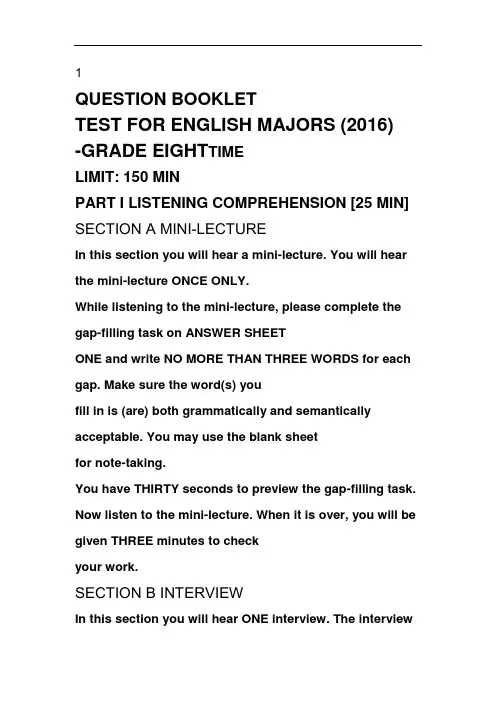
1QUESTION BOOKLETTEST FOR ENGLISH MAJORS (2016) -GRADE EIGHT TIMELIMIT: 150 MINPART I LISTENING COMPREHENSION [25 MIN] SECTION A MINI-LECTUREIn this section you will hear a mini-lecture. You will hear the mini-lecture ONCE ONLY.While listening to the mini-lecture, please complete the gap-filling task on ANSWER SHEETONE and write NO MORE THAN THREE WORDS for each gap. Make sure the word(s) youfill in is (are) both grammatically and semantically acceptable. You may use the blank sheetfor note-taking.You have THIRTY seconds to preview the gap-filling task. Now listen to the mini-lecture. When it is over, you will be given THREE minutes to checkyour work.SECTION B INTERVIEWIn this section you will hear ONE interview. The interviewwill be divided into TWO parts. Atthe end of each part, five questions will be asked about what was said. Both the interview andthe questions will be spoken ONCE ONLY. After each question there will be a ten-secondpause. During the pause, you should read the four choices of A, B, C and D, and mark the bestanswer to each question on ANSWER SHEET TWO.You have THIRTY seconds to preview the questions. Now, listen to the Part One of the interview. Questions 1 to 5 are based on Part One of theinterview.1. A. Maggie ’s university life.B. Her mom ’s life at Harvard.C. Maggie’s view on studying with Mom.D. Maggie ’s opinion on her mom ’s major.22. A. They take exams in the same weeks.B. They have similar lecture notes.C. They apply for the same internship.D. They follow the same fashion.3. A. Having roommates.B. Practicing court trails.C. Studying together.D. Taking notes by hand.4. A. Protection.B. Imagination.C. Excitement.D. Encouragement.5. A. Thinking of ways to comfort Mom.B. Occasional interference from Mom.C. Ultimately calls when Maggie is busy.D. Frequent check on Maggie ’s grades.Now, listen to the Part Two of the interview. Questions 6 to 10 are based on Part Two of theinterview.6. A. Because parents need to be ready for new jobs.B. Because parents love to return to college.C. Because kids require their parents to do so.D. Because kids find it hard to adapt to college life.7. A. Real estate agent.B. Financier.C. Lawyer.D. Teacher.8. A. Delighted.B. Excited.C. Bored.D. Frustrated.39. A. How to make a cake.B. How to make omelets.C. To accept what is taught.D. To plan a future career.10. A. Unsuccessful.B. Gradual.C. Frustrating.D. Passionate.PART II READING COMPREHENSION [45 MIN] SECTION A MULTIPLE-CHOICE QUESTIONSIn this section there are three passages followed by fourteen multiple choice questions. For eachmultiple choice question, there are four suggested answers marked A, B, C and D. Choose the onethat you think is the best answer and mark your answers on ANSWER SHEET TWO.PASSAGE ONE(1)There was music from my neighbor ’hosu se through the summer nights. In his bluegardens men and girls came and went like moths among the whisperings and the champagne andthe stars. At high tide in the afternoon I watched his guests diving from the tower of his raft ortaking the sun on the hot sand of his beach while his two motor-boats slit the waters of theSound, drawing aquaplanes(滑水板)over cataracts of foam. On weekends Mr. Gatsby’sRolls-Royce became an omnibus, bearing parties to and from the city between nine in themorning and long past midnight, while his station wagon scampered like a brisk yellow bug tomeet all trains. And on Mondays eight servants, including an extra gardener, toiled all day withscrubbing-brushes and hammer and garden-shears, repairing the ravages of the night before.(2)Every Friday five crates of oranges and lemons arrived froma fruiterer in New York –every Monday these same oranges and lemons left his back door in a pyramid of pulpless halves.There was a machine in the kitchen which could extract the juice of two hundred oranges in halfan hour, if a little button was pressed two hundred times by a butler ’s thumb.(3)At least once a fortnight a corps of caterers came down with several hundred feet ofcanvas and enough colored lights to make a Christmas tree of Gatsby ’s enormgaorudse n. Onbuffet tables, garnished with glistening hors-d’oeuvr(e冷盘), spiced baked hams crowdedagainst salads of harlequin designs and pastry pigs and turkeys bewitched to a dark gold. In the4main hall a bar with a real brass rail was set up, and stocked with gins and liquors and withcordials (加香甜酒)so long forgotten that most of his female guests were too young to knowone from another.(4)By seven o ’clock the orchestra has arrive–d no thinfive-piece affair but a whole pitfulof oboes and trombones and saxophones and viols and cornets and piccolos and low and highdrums. The last swimmers have come in from the beach now and are dressing upstairs; the carsfrom New York are parked five deep in the drive, and already the halls and salons and verandasare gaudy with primary colors and hair shorn in strange new ways, and shawls beyond thedreams of Castile. The bar is in full swing, and floating rounds of cocktails permeate the gardenoutside until the air is alive with chatter and laughter and casual innuendo and introductionsforgotten on the spot and enthusiastic meetings between women who never knew each other ’snames.(5)The lights grow brighter as the earth lurches away from the sun and now the orchestra isplaying yellow cocktail music and the opera of voices pitches a key higher. Laughter is easier,minute by minute, spilled with prodigality, tipped out at a cheerful word.(6)The groups change more swiftly, swell with new arrivals, dissolve and form in the samebreath –already there are wanderers, confident girls whoweave here and there among thestouter and more stable, become for a sharp, joyous moment the center of a group and thenexcited with triumph glide on through the sea-change of faces and voices and color under theconstantly changing light.(7)Suddenly one of these gypsies in trembling opal, seizes a cocktail out of the air, dumps itdown for courage and moving her hands like Frisco dances out alone on the canvas platform. Amomentary hush; the orchestra leader varies his rhythm obligingly for her and there is a burst ofchatter as the erroneous news goes around that she is Gilda Gray ’s understudy from the Folies.The party has begun.(8)I believe that on the first night I went to Gatsby ’s house I was one of the few guests whohad actually been invited. People were not invited –they went there. They got into automobileswhich bore them out to Long Island and somehow they ended up at Gatsby ’s door. Once therethey were introduced by somebody who knew Gatsby, andafter that they conducted themselvesaccording to the rules of behavior associated with amusement parks. Sometimes they came andwent without having met Gatsby at all, came for the party with a simplicity of heart that was itsown ticket of admission.(9)I had been actually invited. A chauffeur in a uniform crossed my lawn early thatSaturday morning with a surprisingly formal note from his employer –the honor would beentirely Gatsby ’s, it said, if I would attend his “little party ”that night. He had seen me severaltimes and had intended to call on me long before but a peculiar combination of circumstanceshad prevented it –signed Jay Gatsby in a majestic hand.5(10)Dressed up in white flannels I went over to his lawn a little after seven and wanderedaround rather ill-at-ease among swirls and eddies of people I didn’t know –though here andthere was a face I had noticed on the commuting train. I was immediately struck by the numberof young Englishmen dotted about; all well dressed, all looking a little hungry and all talking inlow earnest voices to solid and prosperous Americans. I was sure that they were sellingsomething: bonds or insurance or automobiles. They were, at least, agonizingly aware of theeasy money in the vicinity and convinced that it was theirs for a few words in the right key.(11)As soon as I arrived I made an attempt to find my host but the two or three people ofwhom I asked his whereabouts stared at me in such an amazed way and denied so vehementlyany knowledge of his movements that I slunk off in the direction of the cocktail table –the onlyplace in the garden where a single man could linger without looking purposeless and alone.11. It can be inferred form Para. 1 that Mr. Gatsby ______ through the summer.A. entertained guests from everywhere every weekendB. invited his guests to ride in his Rolls-Royce at weekendsC. liked to show off by letting guests ride in his vehiclesD. indulged himself in parties with people from everywhere12. In Para.4, the word “permeate”probably means ______.A. perishB. pushC. penetrateD. perpetrate13. It can be inferred form Para. 8 that ______.A. guests need to know Gatsby in order to attend his partiesB. people somehow ended up in Gatsby’s house as guestsC. Gatsby usually held garden parties for invited guestsD. guests behaved themselves in a rather formal manner14. According to Para. 10, the author felt ______ at Gatsby ’s party.A. dizzyB. dreadfulC. furiousD. awkward615. What can be concluded from Para.11 about Gatsby?A. He was not expected to be present at the parties.B. He was busy receiving and entertaining guests.C. He was usually out of the house at the weekend.D. He was unwilling to meet some of the guests.PASSAGE TWO(1)The Term “CYBERSPACE”was coined by William Gibson, a science -fiction writer. Hefirst used it in a short story in 1982, and expanded on it a couple of years later in a novel,“Neuromancer ”, whose main character, Henryo Drsett Case, is a troubled computer hacker anddrug addict. In the book Mr Gibson describes cyberspace as “a consensual hallucinationexperienced daily by billions of legitimate operators a”nd “ag raphic representation of dataabstracted from the banks of every computer in the human system. ”(2)His literary creation turned out to be remarkably prescient (有先见之明的). Cyberspacehas become shorthand for the computing devices, networks, fibre-optic cables, wireless links andother infrastructure that bring the internet to billions of people around the world. The myriadconnections forged by these technologies have brought tremendous benefits to everyone whouses the web to tap into humanity ’s collective store ofknowledge every day.(3)But there is a darker side to this extraordinary invention. Data breaches are becomingever bigger and more common. Last year over 800m records were lost, mainly through suchattacks. Among the most prominent recent victims has been Target, whose chief executive,Gregg Steinhafel, stood down from his job in May, a few months after the giant Americanretailer revealed that online intruders had stolen millions of digital records about its customers,including credit- and debit-card details. Other well-known firms such as Adobe, a tech company,and eBay, an online marketplace, have also been hit.(4) The potential damage, though, extends well beyond such commercial incursions. Widerconcerns have been raised by the revelations about the mass surveillance carried out by Westernintelligence agencies made by Edward Snowden, a contractor to America ’Nsa tional SecurityAgency (NSA), as well as by the growing numbers ofcyber-warriors being recruited bycountries that see cyberspace as a new domain of warfare. America ’s president, Barack Obama,said in a White House press release earlier this year that cyber- threats “pose one of the gravestnational- security dangers ”the country is facing.(5)Securing cyberspace is hard because the architecture of the internet was designed topromote connectivity, not security. Its founders focused on getting it to work and did not worrymuch about threats because the network was affiliated with America ’ms ilitary. As hackersturned up, layers of security, from antivirus programs to firewalls, were added to try to keepthem at bay. Gartner, a research firm, reckons that last year organizations around the globe spent$67 billion on information security.7(6)On the whole, these defenses have worked reasonably well. For all the talk about the riskof a “cyber 9/11 ”, the internet has proved remarkably resilient. Hundreds of millions of peopleturn on their computers every day and bank online, shop atvirtual stores, swap gossip andphotos with their friends on social networks and send all kinds of sensitive data over the webwithout ill effect. Companies and governments are shifting ever more services online.(7)But the task is becoming harder. Cyber-security, which involves protecting both data andpeople, is facing multiple threats, notably cybercrime and online industrial espionage, both ofwhich are growing rapidly. A recent estimate by the Centre for Strategic and InternationalStudies (CSIS), puts the annual global cost of digital crime and intellectual-property theft at$445 billion –a sum roughly equivalent to the GDP of a smallish rich European country such asAustria.(8)To add to the worries, there is also the risk ofcyber-sabotage. Terrorists or agents ofhostile powers could mount attacks on companies and systems that control vital parts of aneconomy, including power stations, electrical grids and communications networks. Such attacksare hard to pull off, but not impossible. One precedent is the destruction in 2010 of centrifuges(离心机)at a nuclear facility in Iran by a computer program known as Stuxnet.(9)But such events are rare. The biggest day-to-day threats faced by companies andgovernment agencies come from crooks and spooks hoping to steal financial data and tradesecrets. For example, smarter, better-organized hackers are making life tougher for thecyber-defenders, but the report will argue that even so a number of things can be done to keepeveryone safer than they are now.(10)One is to ensure that organizations get the basics of cyber-security right. All too oftenbreaches are caused by simple blunders, such as failing to separate systems containing sensitivedata from those that do not need access to them. Companies also need to get better atanticipating where attacks may be coming from and at adapting their defences swiftly inresponse to new threats. Technology can help, as can industryinitiatives that allow firms to shareintelligence about risks with each other.(11)There is also a need to provide incentives to improve cyber-security, be they carrots orsticks. One idea is to encourage internet-service providers, or the companies that manageinternet connections, to shoulder more responsibility for identifying and helping to clean upcomputers infected with malicious software. Another is to find ways to ensure that softwaredevelopers produce code with fewer flaws in it so that hackers have fewer security holes toexploit.(12)An additional reason for getting tech companies to give a higher priority to security isthat cyberspace is about to undergo another massive change. Over the next few years billions ofnew devices, from cars to household appliances and medical equipment, will be fitted with tinycomputers that connect them to the web and make them more useful. Dubbed “the internet things ”th,i s is already making it possible, for example, to control home appliances usingsmartphone apps and to monitor medical devices remotely.8(13)But unless these systems have adequate security protection, the internet of things couldeasily become the internet of new things to be hacked. Plenty of people are eager to takeadvantage of any weaknesses they may spot. Hacking used to be about geeky college kidstapping away in their bedrooms to annoy their elders. It has grown up with a vengeance.16. Cyberspace is described by William Gibson as ______.A. a function only legitimate computer operators haveB. a representation of data from the human systemC. an important element stored in the human systemD. an illusion held by the common computer users17. Which of the following statements BEST summarizes the meaning of the first fourparagraphs?A. Cyberspace has more benefits than defects.B. Cyberspace is like a double-edged sword.C. Cyberspace symbolizes technological advance.D. Cyberspace still remains a sci-fi notion.18. According to Para. 5, the designing principles of the internet and cyberspace security are______.A. controversialB. complimentaryC. contradictoryD. congruent19. What could be the most appropriate title for the passage?A. Cyber Crime and Its Prevention.B. The Origin of Cyber Crime.C. How to Deal with Cyber Crime.D. The Definition of Cyber Crime.PASSAGE THREE(1)You should treat skeptically the loud cries now coming from colleges and universitiesthat the last bastion of excellence in American education is being gutted by state budget cuts andmounting costs. Whatever else it is, higher education is not a bastion of excellence. It is shotthrough with waste, lax academic standards and mediocre teaching and scholarship.9(2)True, the economic pressures –from the Ivy League to state systems –are intense. Lastyear, nearly two-thirds of schools had to make midyear spending cuts to stay within theirbudgets. It is also true (as university presidents and deans argue) that relieving those pressuresmerely by raising tuitions and cutting courses will make matters worse. Students will pay moreand get less. The university presidents and deans want to be spared from further governmentbudget cuts. Their case is weak.(3)Higher education is a bloated enterprise. Too many professors do too little teaching totoo many ill-prepared students. Costs can be cut and quality improved without reducing thenumber of graduates. Many colleges and universities should shrink. Some should go out ofbusiness. Consider:Except for elite schools, admissions standards are low. About 70 percent of freshmen atfour-year colleges and universities attend their first-choice schools. Roughly 20 percentgo to their second choices. Most schools have eagerly boosted enrollments to maximizerevenues (tuition and state subsidies).Dropout rates are high. Half or more of freshmen don ’t get degrees. A recent study ofPhD programs at 10 major universities also found high dropout rates for doctoralcandidates.The attrition among undergraduates is particularly surprising because college standardshave apparently fallen. One study of seven top schools found widespread grade inflation.In 1963, half of the students in introductory philosophy courses got a B –or worse. By1986, only 21 percent did. If elite schools have relaxed standards, the practice is almostsurely widespread.Faculty teaching loads have fallen steadily since the 1960s. In major universities, seniorfaculty members often do less than two hours a day of teaching. Professors are“socialized to publish, teach graduate students and spend aslittle time teaching(undergraduates) as possible,”concludes James Fairweather of Penn State University in anew study. Faculty pay consistently rises as undergraduate teaching loads drop.Universities have encouraged an almost mindless explosion of graduate degrees. Since1960, the number of masters ’degrees awarded annually has risen more than fourfold to337,000. Between 1965 and 1989, the annual number of MBAs (masters in businessadministration) jumped from 7,600 to 73,100.(4)Even so, our system has strengths. It boasts manytop-notch schools and allows almostanyone to go to college. But mediocrity is pervasive. We push as many freshmen as possiblethrough the door, regardless of qualifications. Because bachelors ’degrees are so common, wecreate more graduate degrees of dubious worth. Does anyone believe the MBA explosion hasimproved management?10(5)You won’t hear much about this from college deans or university presidents. Theycreated this mess and are its biggest beneficiaries. Large enrollments support large faculties.More graduate students liberate tenured faculty from undergraduate teaching to concentrate onwriting and research: the source of status. Richard Huber, a former college dean, writesknowingly in a new book ( “How Professors Play the Cat Guarding the Cream: Why We’rePaying More and Getting Less in Higher Education ”): Presidents, deans and trustees ... call formore recognition of good teaching with prizes and salary incentives.(6)The reality is closer to the experience of Harvard University ’s distinguishedpal eontologist Stephen Jay Gould: “To be perfectly honest, though lip service is given toteaching, I have never seriously heard teaching considered in any meeting for promotion...Writing is the currency of prestige and promotion. ”(7)About four-fifths of all students attend state-subsidizedsystems, from communitycolleges to prestige universities. How governors and state legislatures deal with their budgetpressures will be decisive. Private schools will, for better or worse, be influenced by state actions.The states need to do three things.(8)First, create genuine entrance requirements. Today’s low standards tell high schoolstudents: You don’t have to work hard to go to college. States should change the message byraising tuitions sharply and coupling the increase with generous scholarships based on merit andincome. To get scholarships, students would have to pass meaningful entrance exams. Ideally,the scholarships should be available for use at in-state private schools. All schools would thencompete for students on the basis of academic quality and costs. Today’s system of generaltuition subsidies provides aid to well-to-do families that don ’t need it or to unqualified studentswho don ’t deserve it.(8)Next, states should raise faculty teaching loads, mainly atfour-year schools. (Teachingloads at community colleges are already high.) This would cut costs and reemphasize theprimacy of teaching at most schools. What we need are teachers who know their fields and cancommunicate enthusiasm to students. Not all professors can be path-breaking scholars. Theexcessive emphasis on scholarship generates many unread books and mediocre articles inacademic journals. “You can’t do more of one (research) without less of the other (teaching), ”says Fairweather. “People are working hard –it ’s just where they’re working. ”(10)Finally, states should reduce or eliminate the least useful graduate programs.Journalism (now dubbed “communications ”), business and education are prime candidates. A lotof what they teach can –and should –be learned on the job. If colleges and universities did abetter job of teaching undergraduates, there would be less need for graduate degrees.(11)Our colleges and universities need to provide a bettereducation to deserving students.This may mean smaller enrollments, but given today ’s attrition rates, the number of graduatesneed not drop. Higher education could become a bastion of excellence, if we would only try.1120. It can be concluded from Para.3 that the author was______ towards the education.A. indifferentB. neutralC. positiveD. negative21. The following are current problems facing all American universities EXCEPT ______.A. high dropout ratesB. low admission standardsC. low undergraduate teaching loadsD. explosion of graduate degrees22. In order to ensure teaching quality, the author suggests that the states do all the followingEXCEPT ______.A. set entrance requirementsB. raise faculty teaching loadsC. increase undergraduate programsD. reduce useless graduate programs23. “Prime candidates”in Para. 10 is used as ________.A. euphemismB. metaphorC. analogyD. personification24. What is the author ’s main argument in the passage?A. American education can remain excellent by ensuring state budget.B. Professors should teach more undergraduates than postgraduates.C. Academic standard are the main means to ensure educational quality.D. American education can remain excellent only by raising teaching quality.SECTION B SHORT ANSWER QUESTIONSIn this section there are eight short answer questions based on the passages in Section A. Answereach question in NO more than 10 words in the space provided on ANSWER SHEET TWO.12PASSAGE ONE25. From the description of the party preparation, what words can you see to depict Gatby ’sparty?26. How do you summarize the party scene in Para. 6? PASSAGE TWO27. What do the cases of Target, Adobe and eBay in Para. 3 show?28. Why does the author say the task is becoming harder in Para. 7?29. What is the conclusion of the whole passage?PASSAGE THREE30. What does the author mean by saying “Their case is weak”in Para. 2?31. What does “grade inflation ”in Para. 3 mean?32. What does the author mean when he quotes RichardHuber in Para. 5?13PART III LANGUAGE USAGE [15 MIN]The passage contains TEN errors. Each indicated line contains a maximum of ONE error. Ineach case, only ONE word is involved. You shouldproof-read the passage and correct it in thefollowing way:For a wrong word, underline the wrong word and write the correct one in the blankprovided at the end of the line.For a missing word, mark the position of the missing word with a “∧”sign and write theword you believe to be missing in the blank provided at the end ofthe line.For an unnecessary word, cross the unnecessary word with a slash “/”and put the word in theblank provided at the end of the line.ExampleWhen∧art museum wants a new exhibit, (1) anit never buys things in finished form and hangs (2) neverthem on the wall. When a natural history museumwants an exhibition, it must often build it. (3) exhibit Proofread the given passage on ANSWER SHEET THREE as instructed.14PART IV TRANSLATION [20 MIN]Translate the underlined part of the following text from Chinese into English. Write yourtranslation on ANSWER SHEET THREE.流逝,表现了南国人对时间最早的感觉。
【精选】专八改错_2016年-2016年)真题及答案

2000 年-2011 年专八短文改错试题,参考答案以及答案分析By 兰银清以下答案以上外教师给出的答案为参考答案2011年专八真题改错部分 From a very early age, perhaps the age of five or six, I knewthat when I grew I should be a writer. Between the ages of about 1__________seventeen and twenty-four I tried to abandon this idea, but I did sowith the conscience that I was outraging my true nature and that 2___________soon or later I should have to settle down and write books. 3___________I was the child of three, but there was a gap of five years 4__________on either side, and I barely saw my father before I was eight. Forthis and other reasons I was somewhat lonely, and I soon developeddisagreeing mannerisms which made me unpopular throughout my 5_____________schooldays. I had the lonely child's habit of making up stories andholding conversations with imaginative persons, and I think from 6_________the very start my literal ambitions were mixed up with the feeling of 7________being isolated and undervalued. I knew that I had a facility with wordsand a power of facing in unpleasant facts, and I felt that this created 8________a sort of private world which I could get my own back for my failure 9________in everyday life. Therefore, the volume of serious — i.e. seriously 10________intended — writing which I produced all through my childhood andboyhood would not amount to half a dozen pages. I wrote my firstpoem at the age of four or five, my mother taking it down to dictation.1,在grow后加up, 考固定短语2,改consience为consciousness 考词语区别,consience翻译为“良心,道德心”, consiousness翻译为“意识”3,改soon为sooner,sooner or later是固定短语4,在child前加middle, 考上下文理解。
SAMPLE TEXT(TEM8)2016年专八官方样卷

TEM8 SAMPLE TEST(部分)TIME LIMIT: 155 MIN PART I LISTENING COMPREHENSION (25 MIN)SECTION A MINI-LECTUREIn this section you will hear a mini-lecture. You will hear the mini-lecture ONCE ONLY. While listening to the mini-lecture, please complete the gap-filling task on ANSWER SHEET ONE and write NO MORE THAN THREE WORDS for each gap. Make sure the word(s) you fill in is (are) both grammatically and semantically acceptable. You may use the blank sheet for note-taking.You have THIRTY seconds to preview the gap-filling task.Now listen to the mini-lecture. When it is over, you will be given THREE minutes to check your work.SECTION B INTERVIEWIn this section you will hear ONE interview.The interview will be divided into TWO parts. At the end of each part, five questions will be asked about what was said. Both the interview and the questions will be spoken ONCE ONLY. After each question there will be a ten-second pause. During the pause, you should read the four choices of A), B), C) and D), and mark the best answer to each question on ANSWER SHEET TWO.You have THIRTY seconds to preview the questions.Now, listen to Part One of the interview.1. A. Doing what they have promised to schoolsB. Creating opportunities for leading universitiesC. Reducing opportunities for state school pupilsD. Considering removing barriers for state school pupils2. A. The government has lowered state pupils’ expectations.B. The number of state pupils applying to Oxford fails to increase.C. Universities are not working hard to accept state school pupils.D. Leading universities are rejecting state school pupils.3.……4.……5.……Now, listen to Part Two of the interview.6. A. It means more funding from education authoritiesB. It means more opportunities and choicesC. It means greater power to run themselvesD. It means getting all the money and deciding how to spend it7. A. Local education authorities and secondary schools together.B. Local education authorities and the central government.C. Local education authorities only.D. The central government only.8. A. To initiate new topics.B. To support the interviewee.C. To introduce new policies.D. To explain some statistics.9. ……10. ……PART II READING COMPREHENSION (45 MIN)SECTION A MULTIPLE-CHOICE QUESTIONSIn this section there are several passages followed by fourteen multiple choice questions. For each multiple choice question, there are four suggested answers marked A, B, C and D. Choose the one that you think is the best answer and mark your answers on ANSWER SHEET TWO.PASSAGE ONEIn 2011, many shoppers opted to avoid the frenetic crowds and do their holiday shopping from the comfort of their computer. Sales at online retailers gained by more than 15%, making it the biggest season ever. But people are also returning those purchases at record rates, up 8% from last year.What went wrong? Is the lingering shadow of the global financial crisis making it harder to accept extravagant indulgences? Or do people shop more impulsively – and therefore make bad decisions –when online? Both arguments are plausible. However, there is a third factor: a question of touch. We can love the look but, in an online environment, we cannot feel the quality of a texture, the shape of the fit, the fall of a fold or the weight of an earring. And physically interacting with an object makes you more committed to your purchase.When my most recent book Brandwashed was released, I teamed up with a local bookstore to conduct an experiment about the differences between the online and offline shopping. I carefully instructed a group of volunteers to promote my book in two different ways. The first was a fairly hands-off approach. Whenever a customer would inquire about my book, the volunteer would take them over to the shelf and point to it. Out of 20 such requests, six customers proceeded with the purchase.The second option also involved going over to the shelf but, this time, removing the book and then subtly holding onto it for just an extra moment before placing it in the customer’s hands. Of the 20 people who were handed the book, 13 ended up buying it. Just physically passing the book showed a big difference in sales. Why? We feel something similar to a sense of ownership when we hold things in our hand. That’s why we establish or reestablish connection by greeting strangers and friends with a handshake. In this case, having to then let go of the book after holding it might generate a subtle sense of loss, and motivate us to make the purchase even more.A recent study conducted by Bangor University together with the United Kingdom’s Royal Mail service also revealed the power of touch, in this case when it came to snail mail. A deeper and longer-lasting impression of a message was formed when delivered in a letter, as opposed to receiving the same message online. FMRIs(功能性磁共振成像)showed that, on touching the paper, the emotional centre of the brain was activated, thus forming a stronger bond. The study also indicated that once touch becomes part of the process, it could translate into a sense of possession. In other words, we simply feel more committed to possess and thus buy an item when we’ve first touched it. This sense of ownership is simply not part of the equation in the online shopping experience.As the rituals of purchase in the lead-up to Christmas change, not only do we give less thought to the type of gifts we buy for our loved ones but, through our own digital wish lists, we increasingly control what they buy for us. The reality, however, is that no matter how convinced we all are that digital is the way to go, finding real satisfaction will probably take more than a few simple clicks.11.According to the author, shoppers are returning their purchases for all the followingreasons EXCEPT that ________.A.they are unsatisfied with the quality of the purchaseB.they eventually find the purchase too expensiveC.they change their mind out of uncertaintyD.they regret making the purchase without forethought12.Why does the author cite the study by Bangor University and the Royal Mail Service?A.To compare similar responses in different settings.B.To provide further evidence for his own observation.C.To offer a scientific account of the brain’s functions.D.To describe emotional responses in online shopping.13.What can be inferred from the last paragraph?A.Despite online shopping we still attach importance to gift buying.B.Some people are still uncertain about the digital age.C.Real satisfaction depends on factors other than the computer.D.Online shopping offers real satisfaction to shoppers.PASSAGE TWOMy professor brother and I have an argument about head and heart, about whether he overvalues IQ while I lean more toward EQ. We typically have this debate about people – can you be friends with a really smart jerk(怪物)? – but there’s corollary to animals as well. I’d love it if our dog could fetch the morning paper and then read it to me over coffee, but I actually care much more about her loyal and innocent heart. There’s already enough thinking going on in our house, and we probably spend too much time in our heads. Where we need some role modeling is in instinct, and that’s where a dog is a roving revelation.I did not grow up with dogs, which meant that my older daughter’s respectful but unyielding determination to get one required some adjustment on my part. I often felt she was training me: from ages of 6 to 9, she gently schooled me in various breeds and their personalities, whispered to the dogs we encountered so they would charm and persuade me, demonstrated by her self-discipline that she was ready for the responsibility. And thus came our dog Twist, whom I sometimes mistake for a third daughter.At first I thought the challenge would be to train her to sit, to heel, to walk calmly beside us and not go wildly chasing the neighbourhood rabbits. But I soon discovered how much more we had to learn from her than she from us.If it is true, for example, that the secret to a child’s success is less rare genius than raw persistence, Twist’s ability to stay on task is a model for us all, especially if the task is trying tocapture the sunbeam that flicks around the living room as the wind blows through the branches outside. She never succeeds, and she never gives up. This includes when she runs square into walls.Then there is her unfailing patience, which breaks down only when she senses that dinnertime was 15 minutes ago and we have somehow failed to notice. Even then she is more eager than indignant, and her refusal to whine shows a restraint of which I’m not always capable when hungry.But the lesson I value most is the one in forgiveness, and Twist first offered this when she was still very young. When she was about 7 months old, we took her to the vet to be spayed(切除卵巢). We turned her over to a stranger, who proceeded to perform a procedure that was probably not pleasant. But when the vet returned her to us, limp and tender, there was no recrimination(反责), no How could you do that to me? It was as though she already knew that we would not intentionally cause her pain, and while she did not understand, she forgave and curled up with her head on my daughter’s lap.I suppose we could have concluded that she was just blindly loyal and docile. But eventually we knew better. She is entirely capable of disobedience, as she has proved many times. She will ignore us when there are more interesting things to look at, rebuke us when we are careless, bark into the twilight when she has urgent messages to send. But her patience with our failings and fickleness and her willingness to give us a second chance are a daily lesson in gratitude.My friends who grew up with dogs tell me how when they were teenagers and trusted no one in the world, they could tell their dog all their secrets. It was the one friend who would not gossip or betray, could provide in the middle of the night the soft, unbegrudging comfort and peace that adolescence conspires to disrupt. An age that is all about growth and risk needs some anchors and weights, a model of steadfastness when all else is in flux. Sometimes I think Twist’s devotion keeps my girls on a benevolent leash, one that hangs quietly at their side as they trot along but occasionally yanks them back to safety and solid ground.We’ve weighed so many decisions so carefully in raising our daughters – what school to send them to and what church to attend, when to give them cell phones and with what precautions. But when it comes to what really shapes their character and binds our family, I never would have thought we would owe so much to its smallest member.14.In the first paragraph, the author suggests that _______.A. a person can either have a high IQ or a low EQB.we need examples of how to follow one’s heartC.her professor brother cares too much about IQD.she prefers dogs that are clever and loyal15.According to the passage, all the following are Twist’s characteristics EXCEPT ________.A.resignationB.patienceC.forgivenessD.tenacity16.That Twist’s devotion ke eps my girls on a benevolent leash means that ________.A.Twist is capable of looking after the girlsB.Twist and the girls have become friendsC.Twist knows how to follow the girlsD.Twist’s loyalty helps the girls grow up17.What does the author try to express in the last paragraph?A.Gratitude to Twist for her role.B.Difficulties in raising her children.C.Worries about what to buy for kids.D.Concerns about schooling and religion.PASSAGE THREEMost West African lorries are not in what one would call the first flush of youth, and I had learnt by bitter experience not to expect anything very much of them. But the lorry that arrived to take me up to the mountains was worse than anything I had seen before: it tottered on the borders of senile decay. It stood there on buckled wheels, wheezing and gasping with exhaustion from having to climb up the gentle slope to the camp, and I consigned myself and my loads to it with some fear. The driver, who was a cheerful fellow, pointed out that he would require my assistance in two very necessary operations: first, I had to keep the hand brake pressed down when travelling downhill, for unless it was held thus almost level with the floor it sullenly refused to function. Secondly, I had to keep a stern eye on the clutch, a willful piece of mechanism that seized every chance to leap out of its socket with a noise like a strangling leopard. As it was obvious that not even a West African lorry-driver could be successful in driving while crouched under the dashboard, I had to take over control of those instruments if I valued my life. So, while I ducked at intervals to put on the brake, amid the rich smell of burning rubber, our noble lorry jerked its way towards the mountains at a steady twenty miles per hour; sometimes, when a downward slope favoured it, it threw caution to the winds and careered(猛冲)along in a reckless fashion at twenty-five.For the first thirty miles the red earth road wound its way through the lowland forest, the giant trees standing in solid ranks alongside and their branches entwined(盘绕)in an archway of leaves above us. Slowly and almost imperceptibly the road started to climb upwards, looping itsway in languid curves round the forested hills. In the back of the lorry the boys lifted up their voices in song:Home again, home again,When shall I see ma home?The driver hummed the refrain(副歌)softly to himself glancing at me to see if I would object. To his surprise I joined in and so while the lorry rolled onwards, the boys in the back maintained the chorus while the driver and I harmonized and sang complicated bits.Breaks in the forest became more frequent the higher we climbed, and presently a new type of undergrowth began to appear: massive tree-ferns standing at the roadside on their thick, squat, hairy trunks. These ferns were the guardians of a new world, for suddenly, as though the hills had shrugged themselves free of a cloak, the forest disappeared. It lay behind us in the valley, while above us the hillside rose majestically, covered in a coat of waist-high grass. The lorry crept higher and higher, the engine gasping and shuddering with this unaccustomed activity. I began to think that we should have to push the wretched thing up the last two or three hundred feet, but to everyone’s surprise we made it, and the lorry crept on to the brow of the hill, trembling with fatigue, spouting steam from its radiator like a dying whale. We crawled to a standstill and the driver switched off the engine.“We must wait small-time, engine get hot,” he explained, pointing to the forequarters of the lorry, which were by now completely invisible under a cloud of steam. Thankfully I descended from the red-hot inside of the cab and strolled down to where the road dipped into the next valley. From this vantage point I could see the country we had travelled through and the country we were to enter.18.Which of the following words in the first paragraph is used literally?A.Flush.B.Borders.C.Gasping.D.Operations.19.We learn from the first paragraph that the author regards the inadequacies of the lorry as_______.A.inevitable and amusingB.dangerous and frighteningC.novel and unexpectedD.welcome and interesting20.All the following words in the last but one paragraph describe the lorry as a humanEXCEPT_______.A.tremblingB.spoutingC.shudderingD.crept21. A suitable title for the passage would be _______.A. A journey that scared meB.The wild West African lorryC. A journey to rememberD. A comic journey in West AfricaPASSAGE FOURHave you ever noticed a certain similarity in public parks and back gardens in the cities of the West? A ubiquitous woodland mix of lawn grasses and trees has found its way throughout Europe and the United States, and it’s now spread to other cities around the world. As ecologist Peter Groffman has noted, it's increasingly difficult to tell one suburb apart from another, even when they're located in vastly different climates such as Phoenix, Arizona, or Boston in the much chillier north-east of the US. And why do parks in New Zealand often feature the same species of trees that grow on the other side of the world in the UK?Inspired by the English and New England countrysides, early landscape architects of the 19th century created an aesthetic for urban public and private open space that persists to this day. But in the 21st century, urban green space is tasked with doing far more than simply providing aesthetic appeal. From natural systems to deal with surface water run-off and pollution to green corridors to increasing interest in urban food production, the urban parks of the future will be designed and engineered for functionality as well as for beauty.Imagine travelling among the cities of the mid-21st century and finding a unique set of urban landscapes that capture local beauty, natural and cultural history, and the environmental context. They are tuned to their locality, and diverse within as well as across cities. There are patches that provide shade and cooling, places of local food production, and corridors that connect both residents and wildlife to the surrounding native environment. Their functions are measured and monitored to meet the unique needs of each city for food production, water use, nutrient recycling, and habitat. No two green spaces are quite the same.Planners are already starting to work towards this vision. And if this movement has a buzzword it is “hyperfunctionality” – designs which provide multiple uses in a confined space. At the moment, urban landscapes are highly managed and limited in their spatial extent. Even the "green" cities of the future will contain extensive areas of buildings, roads, railways, and other built structures. These future cities are likely to contain a higher proportion of green cover than the cities of today, with an increasing focus on planting on roofs, vertical walls, and surfaces like car parks. But built environments will still be ever-present in dense megacities. We can greatly enhance the utility of green space through designs that provide a range of different uses in a confined space. A hyperfunctional planting, for example, might be designed to provide food, shade, wildlife habitat, and pollution removal all in the same garden with the right choice of plants and management practices.What this means is that we have to maximize the benefits and uses of urban parks, while minimizing the costs of building and maintaining them. Currently, green space and street plantings are relatively similar throughout the Western world, regardless of differences in local climate, geography, and natural history. Even desert cities feature the same sizable street trees and well-watered and well-fertilized lawns that you might see in more temperate climes. The movement to reduce the resources and water requirements of such urban landscapes in these arid areas is called "xeriscaping" – a concept that has so-far received mixed responses in terms of public acceptance. Scott Yabiku and colleagues at the Central Arizona Phoenix project showed that newcomers to the desert embrace xeriscaping more than long-time residents, who are more likely to prefer the well-watered aesthetic. In part, this may be because xeriscaping is justified more by reducing landscaping costs –in this case water costs –than by providing desired benefits like recreation, pollution mitigation, and cultural value. From this perspective, xeriscaping can seem more like a compromise than an asset.But there are other ways to make our parks and natural spaces do more. Nan Ellin, of the Ecological Planning Center in the US, advocates an asset-based approach to urbanism. Instead of envisioning cities in terms of what they can't have, ecological planners are beginning to frame the discussion of future cities in terms of what they do have - their natural and cultural assets. In Utah’s Salt Lake City, instead of couching environmental planning as an issue of resource scarcity, the future park is described as "mountain urbanism" and the strong association of local residents with the natural environment of the mountain ranges near their home. From this starting point, the local climate, vegetation, patterns of rain and snowfall, and mountain topography are all deemed natural assets that create a new perspective when it comes to creating urban green space. In Cairns, Australia, the local master plan embraces "tropical urbanism" that conveys a sense of place through landscaping features, while also providing important functions such as shading and cooling in this tropical climate.The globally homogenized landscape aesthetic – which sees parks from Boston to Brisbane looking worryingly similar –will diminish in importance as future urban green space will be more receptive to local values and cultural perceptions of beauty. This will lead to a far greater diversity of urban landscape designs than are apparent today. Already, we are seeing new purposes for urban landscaping that are transforming the 20th century woodland park into bioswales – plantings designed to filter stormwater – green roofs, wildlife corridors, and urban food gardens. However, until recently we have been lacking the datasets and science-based specifications for designs that work to serve all of these purposes at once.In New York City, Thomas Whitlow of Cornell University sends his students through tree-lined streets with portable, backpack-mounted air quality monitors. At home in his laboratory, he places tree branches in wind tunnels to measure pollution deposition onto leaves. It turns out that currently, many street tree plantings are ineffective at removing air pollutants, and instead may trap pollutants near the ground. Rather than relying on assumptions about the role of urban vegetation in improving the environment and health, future landscaping designs will be engineered based on empirical data and state of the art of simulations.New datasets on the performance of urban landscapes are changing our view of what future urban parks will look like and what it will do. With precise measurements of pollutant uptake, water use, plant growth rates, and greenhouse gas emissions, we are better able to design landscapes that require less intensive management and are less costly, while providing more social and environmental uses.22.The following are all features of future urban green space EXCEPT that ________.A.each city has its distinct style of urban green spaceB.urban landscape will focus more on cultural historyC.urban green space will be designed to serve many usesD.more green cover will be seen on city roofs and walls23.According to the passage, if planners adopt an asset-based approach, they will probably_______.A.incorporate the area’s natural and cultural heritage into their designB.make careful estimation of the area’s natural resources before designingbine natural resources and practical functions in their designD.envision more purposes for urban landscaping in their design24.According to the passage, future landscaping designs will rely more on _______.A.human assumptionsB.scientific estimationC.field workboratory workSECTION B SHORT ANSWER QUESTIONSIn this section there are eight short answer questions based on the passages in SECTION A. Answer each question in NO more than 10 words in the space provided on ANSWER SHEET TWO.PASSAGE ONE25.What is the purpose of the experiment in the bookstore?PASSAGE TWO26. According to the context, what does the word “square” mean?PASSAGE THREE27.What can we learn from the condition of the lorry from “ it tottered on the borders ofsenile decay”?28.How did the author help the lorry driver on the way?29.How did the author feel when helping the lorry driver?PASSAGE FOUR30.According to the passage, what makes urban green space look similar throughout the West?31. Why are some local residents opposed to “xeriscaping”?32. What did Thomas Whitlow of Cornell University find out about tree branches?PART III LANGUAGE USAGE (15 MIN)The passage contains TEN errors. Each indicated line contains a maximum of ONE error. In each case, only ONE word is involved. Y ou should proof-read the passage and correct it in the following way:For a wrong word, u nderline the wrong word and write the correct one in the blankprovided at the end of the line.For a missing word, m ark the position of the missing word with a "/\" sign and write theword you believe to be missing in the blank provided at the end of theline.For an unnecessary word, cross the unnecessary word with a slash "/" and put the word in theblank provided at the end of the line.EXAMPLEWhen /\ art museum wants a new exhibit, (1) anit never buys things in finished form and hangs (2) neverthem on the wall. When a natural history museumwants an exhibition, it must often build it. (3) exhibitProofread the given passage on ANSWER SHEET THTEE as instructed.PART IV TRANSLATION (25 MIN) Translate the following text into English. Write your translation on ANSWER SHEET THREE.茶花(camellia)的自然花期在12月至翌年4月,以红色系为主,另有黄色系和白色系等,花色艳丽。
2016年专八笔试试卷

2016年全国高校西班牙语专业八级水平测试笔试试卷学校 _____________________姓名 _____________________编号 _____________________2016年3月25日考生注意事项1、考生必须自觉服从监考人员的管理,不得妨碍监考人员履行职责,考场内不准喧哗、吸烟,不得扰乱考场秩序。
2、考试过程中不准交头接耳、互打暗号或做手势。
3、试卷封面上务必注明考生所在院校和考生姓名。
4、必须用蓝(黑)色钢笔、签字笔或圆珠笔答题。
铅笔答题内容不予评分。
5、考生进入考场,只准携带考试必需的文具用品,如钢笔、签字笔、圆珠笔;不准携带任何书籍、笔记、字典、报纸、草稿纸、手机及有存储、编程、查询等功能的电子设备等。
凡携带者必须在考试前主动上交上述物品。
6、考生必须在答题纸上按照题目要求答题。
答案写在试卷或草稿纸上无效。
笔译或作文如需草稿纸,应向监考人员索取。
PRUEBA 1 CONOCIMIENTOS BÁSICOS DE CULTURACompleta las oraciones siguientes con una de las cuatro opciones que se te ofrece y marca las opciones elegidas en la Hoja de respuestas. (5/100, 0.5×10)1.Se restauró la actual monarquía española en la década de los años __________.A.cincuentaB.sesentaC.setentaD.ochenta2.El Grito de Dolores de 1810 implica el inicio de la lucha por la independencia en__________.A.ArgentinaB.VenezuelaC.MéxicoD.Cuba3.El nuevo presidente argentino __________ asumió el cargo en el mes dediciembre de 2015.A.Mauricio MacriB.Daniel ScioliC.Sergio MassaD.Cristina Kirchner mayor crisis humanitaria que afectó en 2015 a la Unión Europea tuvo suorigen en __________. escalada de violencia en Oriente Próximo avalancha de refugiados del Medio Oriente inminente independencia de Cataluña posible bancarrota de Grecia recuperación de los ideales y valores del clasicismo __________ marcó el finde la Edad Media y el comienzo de la moderna.A.cristianoB.góticoC.grecorromanoD.castellano6.__________ es obra de Diego Rodríguez de Silva y Velázquez.A.Los fusilamientos de la Moncloas meninasC.GuernicaD.El nacimiento de Venus7.Los principales productos que importan los países latinoamericanos desde Chinason __________.A.productos agrícolasB.productos manufacturerosC.materias primasD.servicios8.__________ no es país miembro del Mercosur.A.ChileB.UruguayC.VenezuelaD.Argentina9.El primer tren de carga que partió de __________, China, con destino a España,llegó a Madrid en noviembre de 2014.A.Xi’anB.YiwuC.QuanzhouD.Wenzhou10.En 2015 se restablecieron las relaciones diplomáticas entre Estados Unidos yCuba tras más de __________ años de bloqueo norteamericano contra el país.A.treintaB.cuarentaC.cincuentaD.sesentaPRUEBA 2 COMPRENSIÓN DE LECTURALee detenidamente los siguientes textos para hacer los ejercicios que se dan al final. (30/100, 1.5×20)Texto ILee el texto y responde a las preguntas 11-15. Selecciona las opciones correctas y márcalas en la Hoja de respuestas. (7.5/100, 1.5×5)Nos hace bien cada tanto tiempo levantar la mirada más allá del escenario latinoamericano, para ver experiencias que nos pueden dar luces a lo nuestro.Lo11-A digo ante la muerte de Lee Kuan Yew, el fundador y guía de Singapur.Tuve la oportunidad de conversar largo con él, durante una visita oficial a esa Ciudad-Estado en 2004. Me pareció11-B un privilegio ver a quien había hecho de ese lugar el puerto más avanzado y eficiente del mundo.Se habla tanto del milagro de Asia. Allí hay todo tipo de milagros, de países grandes como China, de países como Japón y Corea que marcaron el inicio del resurgimiento de Asia. Pero también está Singapur, pequeña isla en el estrecho malayo, que supo salir de la carencia total al éxito en el escenario global. ¿Cómo lo11-C hicieron? Teniendo liderazgo, teniendo una estrategia de desarrollo, un proyecto de unidad nacional y una identificación de sus ventajas comparativas. Hacia finales de la década de los cincuenta en el siglo pasado, Singapur era una colonia pobre, no sólo por la pobreza de su gente sino porque carecía de recursos naturales. Sólo tenía uno que sería clave: su ubicación geográfica, al extremo sur de Malasia y sobre un estrecho por donde, ya desde el siglo XIV, transita buena parte del comercio asiático y del mundo.Tras el fin del colonialismo británico emergió Malasia en 1963 como una federación de once estados. Lee Kuan Yew era uno de los líderes y reclamaba para Singapur una representación concordante con su influencia y peso político en la nueva etapa. Dado el sistema acordado11-D, le dijeron que no. Y allí tomó la decisión más audaz: Singapur sería independiente. Y a partir de ese momento, comienza la era de un gobernante que muchos han considerado como uno de los más brillantes y pragmáticos de la historia moderna.Vio que era clave integrar a una población mayoritariamente china con los que tenían sus ancestros en Malasia o la India. Tres razas que vivían cada una en su respectivo rincón. Por ello determinó primero crear un sistema de viviendas al alcance de los pobres. Ese plan colocaba la vivienda social al alcance de los ingresos modestos de los ciudadanos bajo una condición especial: el compromiso de tener su casa en barrios donde compartían con vecinos de las otras etnias (12). Aquella era laposibilidad de tener un solo gran Singapur, valga el término, a partir de la creación de una nueva identidad, un nuevo orgullo.La otra herramienta prioritaria fue la educación. Si Singapur pretendía ser un lugar clave para los servicios, debía tener la gente preparada para ello. Lo más importante fue la enseñanza del inglés teniendo en cuenta los requerimientos para interactuar con el mundo global. La educación también se convirtió en política exterior vecinal. Un gran plan de becas para los jóvenes de los otros países cercanos, especialmente de Malasia que tras terminar sus estudios debían quedarse tres años en el país. Claro, de cada tres, uno se enamoraba y se quedaba allí, como dijo con picardía. Pero los otros dos, se convertían en “embajadores” de Singapur en el sudeste asiático.Con igual entusiasmo me explicó que se habían propuesto hacer de la medicina otro rubro clave para el crecimiento del país. Tener alto conocimiento, excelente atención, especialistas de vanguardia listos para atender a toda la élite emergente de Asia. Lo lograron. Hoy la “gran exportación” de Singapur es su servicio médico de alta calidad y laboratorios farmacéuticos establecidos en la isla.Impulsó el comercio libre y promovió todas las condiciones favorables para ello. Cuando hoy más de la mitad del comercio mundial tiene lugar en el Asia Pacífico, el 40% de dicho comercio pasa por Singapur. Un país de 3 millones de habitantes, con geografía mínima, puso tanta eficiencia en el puerto, en el acceso que, por lógica, pasó a ser un gran centro financiero. Y, como consecuencia, lleva adelante una política exterior que le dé seguridades en su entorno, especialmente en el Pacífico. Fue en ese marco que en 2005 coincidimos en crear el llamado P-4, donde Nueva Zelanda, Brunei, Singapur y Chile unimos fuerzas para pensar una cooperación de futuro.Sí, Lee Kwan Yew fue pragmático, asiático y autocrático(独断专行的). Pero ahí está el Singapur que soñó: un país inclusivo, socialmente cohesionado, con visión de futuro, determinado por sus potencialidades reales. Un país puede ser pequeño pero si entiende cuál es su rol en el planeta, también puede ser un faro que ilumine a otros.11.¿Cuál de las siguientes afirmaciones es incorrecta?A.Lo11-A se refiere a: nos hace bien cada tanto tiempo levantar la miradamás allá del escenario latinoamericano, para ver experiencias que nospueden dar luces a lo nuestro.B.El sujeto de pareció11-B es: ver a quien había hecho de ese lugar el puertomás avanzado y eficiente del mundo.C.El pronombre lo11-C se refiere a: el éxito en el escenario global. secuencia el sistema acordado11-D se refiere a la federación de onceestados.12.¿Cómo se interpreta la frase “Ese plan colocaba la vivienda social al alcance delos ingresos modestos de los ciudadanos bajo una condición especial: el compromiso de tener su casa en barrios donde compartían con vecinos de las otras etnias.”?A.Los vulnerables que andaban por los barrios de mestizaje estaban encondiciones de solicitar una vivienda social al gobierno.B.Los ciudadanos con pocos recursos económicos eran grandesbeneficiarios del sistema de viviendas.C.En Singapur, el techo no era problema para nadie. En todos los barriosconvivían chinos, malasios e indios.D.En Singapur, los que quisieran disfrutar del bienestar social tenían queasumir su compromiso con el gobierno.13.¿Qué resultado produjeron las políticas mencionadas en el texto?A.Un tercio de becarios se enamoraban de algún singapurense, seestablecían allá y se convertían tarde o temprano en la élite del país.B.Todos los singapurenses hablaban inglés porque era una de las asignaturasobligatorias según su sistema educativo.C.Singapur enviaba a los países vecinos médicos y enfermeros biencualificados al servicio de los altos funcionarios o altos ejecutivos.D.Singapur se transformó en el gran centro de distribución de todos losproductos que se comerciaban en el sudeste asiático.14.Según el texto, podemos deducir que el autor Ricardo Lagos es ____________.A.ex presidente de ChileB.corresponsal de algún país pequeño en SingapurC.especialista del Observatorio de la Política de los Países AsiáticosD.miembro importante de alguna organización regional o internacional15.¿Cuál será el título más apropiado de este texto?A.En memoria del gran fundador de SingapurB.Singapur, de colonia a potenciaC.Singapur, de colonia a independencias lecciones de Singapur y de su lúcido guíaTexto IILee el texto y responde a las preguntas 16-20. Selecciona las opciones y márcalas en la Hoja de respuestas. (7.5/100, 1.5×5)Cuando los niños se aburríanP OR C RIS V AQUERORecuerdo aquellos veranos en los que salíamos por la puerta a las 12 de la mañana y no volvíamos hasta las 12 de la noche. Tan sólo hacíamos una parada para comer y aguantar estoicamente(坚忍地)las dos malditas horas de la digestión, una norma16-A que se respetaba como si fuese un dogma religioso.Nuestros padres no nos veían el pelo ni sabían dónde estábamos. ¡Ni falta que les hacía16-B! Lo único que querían era perdernos de vista durante un rato. Aquello no nos causó ningún complejo infantil ni tuvimos que acudir al psicólogo ni tan siquiera se nos diagnosticó ningún estrés postraumático (17). Jamás vi a mi padre preocupado un solo segundo por si yo o alguno de mis hermanos nos aburríamos. Ése era nuestro problema.Las cosas han cambiado mucho en estos últimos 40 años. Si antes estábamos educados bajo un lema grabado a fuego en nuestras mentes “No molestar a los mayores”, ahora parece que el leiv motiv(主导思想)es justo el contrario: “Molestad a los mayores, si es posible cada cinco minutos”.Los padres nos hemos convertido en responsables de cada minuto de ocio de nuestros hijos y nos hemos transformado en un gran parque temático, obligados a buscar actividades cada media hora. Si el niño se aburre un rato porque se ha cansado de la tableta o de la consola(游戏机), se extenderá16-C el pánico, será una auténtica tragedia y la madre recurrirá a los siete grupos de WhatsApp para reclutar a algún amiguito del equipo de fútbol, las clases de ballet o de yoga.Con este panorama, planificar las vacaciones para que no quede16-D ni un minuto libre al azar puede convertirse en una misión imposible. Y, si no, que se lo pregunten a mi compañera Carmen que tiene que organizar un planillo con cuatro hijas, cada una de ellas en una punta diferente del planeta.Y eso que la gama de campamentos de verano es ahora interminable. Antes, bastaba con apuntar a tu hijo a un campamento deportivo de nivel básico. Pero ahora si tu vástago(子女)se limita a jugar al fútbol o al baloncesto en vacaciones será un don nadie, un infeliz al que no le dará la media para entrar en la Universidad. Si tu retoño no va a un campamento con inmersión en inglés y clases de tenis, pádel(板球), natación, golf, atletismo, patinaje sobre hielo y voley, no se sentirá realizado. Y si no incorpora la programación o la robótica, tu hijo será un fracasado. Por supuesto, si no lo puedes complementar con una cuidadora bilingüe que hable al niño en inglés oalemán aunque tenga sólo dos meses de vida, tu hijo nunca estará entre los elegidos ni se lo rifarán(争夺)en las mejores universidades ni tan siquiera tendrá un puesto de trabajo nada más terminar la carrera.La feroz competitividad que se ha instalado entre los padres ya no sólo afecta a los estudios en el colegio, sino también a las actividades extraescolares y veraniegas en una carrera eterna por optimizar el tiempo y ser más y más productivos.Todavía me acuerdo de cuando el verano era sinónimo de descanso y el aburrimiento, una sana y casi obligatoria ocupación.16.¿Cuál de las siguientes afirmaciones es correcta? secuencia una norma16-A se refiere a: la digestión.B.El sujeto de hacía16-B es: falta.C.El sujeto de se extenderá16-C es: el pánico.D.El sujeto de quede16-D es: el niño.17.¿Cómo se interpreta la frase “Aquello no nos causó ningún complejo infantil nituvimos que acudir al psicólogo ni tan siquiera se nos diagnosticó ningún estrés postraumático.”?A.El hecho de que los padres se preocuparan poco por nosotros supuso unasombra en nuestra infancia. Dicho trauma ni se diagnosticó ni se curó.B.Nuestra vida infantil no fue nada complicada. La vida sencilla y relajadafue la garantía de la mente sana y despejada.C.De niño vivíamos a rienda suelta y la falta de preocupación por parte delos padres nos permitió crecer sanamente.D.Les entraba a los padres una pereza de llevar a los niños al médico, lo cualnos ahorró los inevitables nervios.18.Según el texto, los padres quieren que sus hijos se carguen las pilas en loscampamentos de verano tanto para el siguiente curso como para el futuro mediante todo tipo de clases menos las de ____________.A.músicaB.deportesC.lenguasrmática19.¿Qué tipo de madre será Carmen según el contexto?A.Una madre despreocupada cuyas cuatro hijas van a la deriva.B.Una madre hiperprotectora que suele cortar las alas a sus hijas.C.Una madre eficiente para quien nunca existe ninguna misión imposible.D.Una madre agotada que se las arregla para ofrecer lo mejor a sus hijas.20.¿Qué intenta demostrar el autor en este texto?A.En general, el amor resulta ser una vanidad o un fraude.B.Una vida exitosa no significa una vida feliz.C.Los padres de hoy se preocupan de ampliar el horizonte de los hijos.D.El peso de la vida nos hunde a todos como una losa.Texto IIILee el texto y responde a las preguntas 21-25. Selecciona las opciones y márcalas en la Hoja de respuestas. (7.5/100, 1.5×5)¿Por qué ir a Plutón?P OR R AFAEL B ACHILLER¿Por qué escalar el Everest? Ésta es la pregunta que realizaban reiteradamente al montañero británico George Mallory, quien formó parte de tres expediciones que intentaron ascender a esa gran cumbre en los años 20. Gran parte del público no comprendía el objetivo de correr riesgos y de emplear costosos medios para alcanzar esa meta21-A. De manera análoga, ahora que la sonda(太空探测器)de NASA New Horizons nos envía imágenes inéditas del pequeño y remoto Plutón, oímos la pregunta de cuál es la finalidad de tan difícil misión21-B. Recordemos que con ésta, el ser humano ya ha enviado sondas a todos los cuerpos importantes del sistema solar y que, en este momento, tenemos varias naves espaciales y robots estudiando Marte tanto desde órbita(天体运行轨道)como sobre la superficie del planeta rojo. Cuando tenemos en cuenta todas estas hazañas en las que está embarcada la humanidad, es lícito preguntarse cuál es la rentabilidad de la exploración espacial (22).En primer lugar, se puede argumentar que la tecnología espacial ha revolucionado nuestra sociedad en múltiples aspectos. Un ejemplo obvio es la utilidad de los satélites de posicionamiento global, como los sistemas GPS y Galileo, este último aún en desarrollo, que permiten la localización instantánea de un barco, un avión, o una persona individual, para guiar su trayectoria hacia su destino o para facilitar su auxilio en una situación de emergencia. Otro ejemplo indiscutible reside en los satélites de comunicaciones, ya sean para telefonía, radio o televisión, que han constituido unfactor primordial en la globalización. Finalmente, los satélites de teledetección que observan nuestro planeta de manera continuada tienen una manifiesta utilidad tanto en la gestión de grandes catástrofes naturales, como huracanes o incendios, como en la preservación del planeta a largo plazo mediante la monitorización del nivel de los océanos, de los hielos polares, de la capa de ozono(臭氧)y de muchos otros parámetros ambientales.El estudio de los planetas del sistema solar nos permite, mediante la planetología comparada, comprender mejor las características de la Tierra. Mercurio nos ofrece una superficie en la que su tenue atmósfera apenas tiene efectos apreciables, mientras que las densísimas nubes de Venus nos proporcionan un ejemplo de efecto invernadero extremo. Marte, el hermano pequeño de la Tierra, tiene muchas similitudes con nuestro planeta, pero es un mundo inerte(无生命的). En las densas capas gaseosas de Júpiter, Saturno y Neptuno las tormentas pueden durar siglos. En todos estos planetas se dan fenómenos similares a los terrestres, pero en condiciones diferentes, lo que ayuda a vislumbrar sus causas y a relacionar los fenómenos entre sí, contribuyendo en última instancia a estudiar la evolución de nuestro planeta.El impacto tecnológico, y por tanto económico, del sector espacial es sobresaliente. Se calcula que cada dólar invertido en el programa espacial Apolo de la NASA generó 20 dólares de beneficio. La tecnología espacial, sobre todo la desarrollada en misiones científicas, es extremadamente exigente en sus requerimientos y esto21-C hace llevar la investigación en materiales y dispositivos al límite del conocimiento. Los códigos de barras, los audífonos(耳机)digitales y las bombas cardíacas miniaturizadas son algunos de los avances que han sido alcanzados gracias a la aplicación de tecnologías desarrolladas en el ámbito espacial.Sin embargo, aunque tengamos presentes todas las recompensas prácticas, no podemos evitar que nuestros sentimientos se vean embargados por la curiosidad de explorar un nuevo mundo. Estas imágenes nos van revelando paulatinamente un planeta ocre rojizo(赭红色)en el que, sorprendentemente, la actividad geológica parece relevante. Es la primera vez que los ojos humanos pueden contemplar los detalles de este mundo frío y lejanísimo. Y es que no sólo hemos ido a Plutón por todos los beneficios prácticos. La curiosidad y el espíritu aventurero, que parecen inherentes al ser humano, se plasman hoy de manera ejemplar en la exploración espacial. El afán por descubrir, por estudiar y comprender, siempre nos ha impulsado a llegar a todos los límites alcanzables. Antes fue la superficie del globo, las profundidades de los océanos, o las más altas cumbres.No sabemos si Mallory llegó a alcanzar la cumbre del Everest pues desapareció en su tercera expedición, en 1924, y su cuerpo no fue encontrado hasta 75 años después, a tan solo 500 metros de la cima. Pero no me cabe21-D ninguna duda de que este gran montañero iba animado por el mismo espíritu aventurero que hoy guía la exploración espacial.A la pregunta de “¿Por qué escalar el Everest?”, Mallory dio una respuesta muy sencilla: “Porque está ahí”.21.¿Cuál de las siguientes afirmaciones es correcta? secuencia esa meta21-A se refiere a: esa gran cumbre. secuencia tan difícil misión21-B se refiere a: enviar la sonda NewHorizons a Plutón.C.El pronombre esto21-C se refiere a: el impacto tecnológico.D.El sujeto de cabe21-D es: este gran montañero Mallory.22.¿Cómo se interpreta la frase “Cuando tenemos en cuenta todas estas hazañas enlas que está embarcada la humanidad, es lícito preguntarse cuál es la rentabilidad de la exploración espacial.”?A.Cuando mandamos una tripulación al espacio exterior, la prioridad seráofrecerle una recompensa económica.B.Los contribuyentes tienen derecho a averiguar si es legítimo destinar tantopresupuesto a las expediciones espaciales.C.Sigue siendo una asignatura pendiente lo lucrativo de la exploraciónespacial. Los beneficios no son proporcionales a las inversiones.D.Ahora toca preguntarnos si las empresas sin precedentes aportan altosvalores añadidos a la vida cotidiana.23.De las siguientes afirmaciones acerca de los cuerpos importantes del sistema solar,¿cuál es la acertada?A.El planeta rojo es una lección viva de efecto invernadero. atmósfera de Mercurio puede frenar los impactos de meteoritos(陨石).C.Tal vez haya existencia de vida en Marte, el planeta más parecido a laTierra.s condiciones climáticas son rigurosas en los planetas más lejanos. tecnología espacial no sirve para ____________.A.el rescate de los náufragos en el MediterráneoB.el pronóstico del calentamiento global colocación de los refugiados sirios en EuropaD.el bombardeo de las posiciones estratégicas del Daesh(伊斯兰国)25.Escalar el Everest e ir a Plutón tienen muchas similitudes en el sentido de que:①son aventuras tan peligrosas y atractivas que requieren todo tipo de recursos.②son apuestas por el uso masivo de las tecnologías punteras en la vidacotidiana.③son experimentos sobre la supervivencia humana en variadas condiciones.④son inversiones que generan considerables beneficios económicos.⑤son exploraciones con destinos remotos y desconocidos.⑥son pruebas de fuego sobre la voluntad férrea, la curiosidad insaciable y lainquietud intelectual del ser humano.A.①⑤⑥B.②④⑥C.③④⑤D.①③⑤Texto IVSe han extraído cinco fragmentos del siguiente texto. Léelo y decide en qué lugar del texto (26-30) hay que colocar 5 de los 8 fragmentos propuestos (A-H). Marca las opciones elegidas en la Hoja de respuestas. (7.5/100, 1.5×5)Prólogo del diccionario ClaveP OR G ABRIEL G ARCÍA MÁRQUEZTenía cinco años cuando mi abuelo el coronel me llevó a conocer los animales de un circo que estaba de paso en Aracataca. El que más me llamó la atención fue una especie de caballo maltrecho y desolado con una expresión de madre espantosa. «Es un camello(双峰驼)», me dijo el abuelo. Alguien que estaba cerca le salió al paso. «Perdón, coronel –le dijo–. Es un dromedario(单峰驼)». 26. Pero lo superó con una pregunta digna:–¿Cuál es la diferencia?–No la sé –le dijo el otro–, pero este es un dromedario.Aquella tarde del circo volvió abatido a la casa y me llevó a su sobria oficina con un solo libro enorme. Lo consultó con una atención infantil y entonces supimos para siempre la diferencia entre un dromedario y un camello.Era el diccionario de la lengua, sabe Dios cuál y de cuándo, muy viejo y ya a punto de desencuadernarse (书、本散开). Tenía en el lomo un Atlas colosal, en cuyos hombros se asentaba la bóveda(穹顶)del universo. 27. Yo no sabía leer ni escribir, pero la noche en que conocí el diccionario se me despertó talcuriosidad por las palabras, que aprendí a leer más pronto de lo previsto. Así fue mi primer contacto con el que había de ser el libro fundamental en mi destino de escritor.28. Nunca lo vi como un libro de estudio, gordo y sabio, sino como un juguete para toda la vida. Sobre todo desde que se me ocurrió buscar la palabra amarillo, que estaba descrita de este modo simple: del color del limón. Quedé en las tinieblas, pues en las Américas el limón es de color verde. Solo a los veintitantos años, cuando fui a Europa, descubrí que allí, en efecto, los limones son amarillos. María Moliner hizo en 1976 la precisión implícita de que el color amarillo no es el de todo el limón sino solo el de su cáscara. Pero todos los diccionarios juntos, por supuesto, no le daban a los tobillos al más antiguo, compuesto en 1611 por don Sebastián de Covarrubias, que había ido más lejos que ninguno en propiedad e inspiración para identificar el amarillo: Entre las colores se tiene por la mas infelice, por ser la de la muerte y de la larga y peligrosa enfermedad, y la color de los enamorados.29. Los sabores, los sonidos y los olores son los ejemplos más fáciles. ¿Cuántas veces hemos tomado un café que sabe a ventana, un pan que sabe a baúl, un arroz que sabe a solapa y una sopa que sabe a máquina de coser? Un amigo probó en un restaurante unos espléndidos riñones al jerez, y dijo, suspirando: «¡Sabe a mujer!». En un ardiente verano de Roma tomé un helado que no me dejó la menor duda: sabía a Mozart.Para resolver estos problemas de la poesía, por supuesto, no existen diccionarios, pero deberían existir. Creo que doña María Moliner lo tuvo muy en cuenta cuando se hizo una promesa con muy pocos precedentes: escribir sola, en su casa, con su propia mano, el diccionario de uso del español. En realidad, lo que esa mujer de fábula había emprendido era una carrera de velocidad y resistencia contra la vida. Es decir: una empresa infinita, porque las palabras no las hacen los académicos en las academias, sino la gente en la calle. Los autores de los diccionarios las capturan casi siempre demasiado tarde, las embalsaman por orden alfabético, y en muchos casos cuando ya no significan lo que pensaron sus inventores. 30. Y también, con un poco de suerte, los buenos escritores hasta los cien.Fragmentos:A.Esto quiere decir que los diccionarios tienen que sostener el mundo.B.Este libro no solo lo sabe todo, sino que es el único que nunca se equivoca.C.Lo que quería en el fondo era agarrar al vuelo todas las palabras desde quenacían.D.Puedo imaginarme ahora cómo debió sentirse el abuelo de que alguien lohubiera corregido en presencia del nieto.。
英语专业八级题库【历年真题(2014~2016年)】【圣才出品】

2016年英语专业八级真题及详解TEST FOR ENGLISH MAJORS (2016)-GRADE EIGHT-TIME LIMIT: 150 MIN PART ⅠLISTENING COMPREHENSION [25 MIN]SECTION A MINI-LECTUREIn this section you will hear a mini-lecture. You will hear the lecture ONCE ONLY. While listening to the mini-lecture, please complete the gap-filling task on ANSWER SHEET ONE and write NO MORE THAN THREE WORDS for each gap. Make sure the word(s) you fill in is (are) both grammatically and semantically acceptable. You may use the blank sheet for note-taking.You have THIRTY seconds to preview the gap-filling task.Now listen to the mini-lecture. When it is over, you will be given THREE minutes to check your work.Models for ArgumentsThree models for arguments·the first model for arguing is called (1) _____: (1) _____—arguments are treated as war—there is much winning and losing—it is a (2) _____ model for arguing (2) _____·the second model for arguing is arguments as proofs:—(3) warranted _____ (3) _____—valid inference and conclusions—no (4) _____ in the adversarial sense (4) _____·the third model for arguing is (5) _____: (5) _____—the audience is (6) _____ in the argument (6) _____—arguments must (7) _____ the audience (7) _____Traits of the argument as war·very dominant: it can shape (8) _____ (8) _____·strong arguments are needed·negative effects include:—(9) _____ are emphasized (9) _____—winning is the only purpose—this type of arguments prevent (10) _____ (10) _____—the worst thing is (11) _____ (11) _____ ·implication from arguments as war: (12) _____ (12) _____—e.g., one providing reasons and the other raising (13) _____ (13) _____—the other one is finally persuadedSuggestions on new ways to (14) _____ of arguments (14) _____ ·think of new kinds of arguments·change roles in arguments·(15) _____ (15) _____1. ____【答案】the dialectical model【解析】细节题。
2016年专八英语改错练习题及答案

2016年专⼋英语改错练习题及答案 Halloween’s origins dated back to the ancient Celtic _1_ Festival of Samhain (pronouncing sow-in).The Celts, who _2_ Lived 2,000 years ago in the area that is now Ireland, United _3_ Kingdom, and northern France, celebrated its new year on November 1.This day marked the end of summer and the harvest and the beginning of the dark, cold winter, a time of year that was often associated with human death.Celts believed that at the night before the new year, the boundary _4_ between the worlds of the live and the dead became blurred._5_ On the night of October 31, they celebrated Samhain, it was _6_ Believed that the ghosts of the dead returned to earth.In addition to causing trouble and damaging crops, Celts thought that the presence of the otherworldly spirits made easier for _7_ The Druids, or Celtic priests, to make predictions about the future.For a people entirely dependent on the volatile natural world, these prophecies were an important on the volatile natural world, these prophecies were an important source of comfort and direction during the long, dark winter. To commemorate the event, Druids built huge sacred bonfires, which the people gathered to burn crops and animals_8_ As sacrifices to the Celtic deities.During the celebration, the Celts wore costumes, typically consisting of animal heads and skins, and skins, and attempted to assume each other’s fortunes.When the _9_ Celebration was over, they lit their hearth fires, which they had _10_ extinguished earlier that evening, from the sacred bonfire to help protect them during the coming winter. 参考答案: 1.dated-date 2.pronouncing-pronounced 3.United前加the 4.at-on 5.live-living 6.it was前加when 7.made+it 8.which-where 9.assumed-tell 10.lit-rellit。
年专业八级真题及答案
年专业八级真题及答案【篇一:2016英语专业八级真题参考答案】section a mini-lecture1. the dialectical model3.premises4.opposition/arguing5. arguments as performances/the rhetorical model6. participating7. convince8. how we argue9. tactics10. negotiation and collaboration11. they’re dead ends12. learning with losing13. questions14.achieve positive effects15.be self-supportedsectionbinterview1. what is the topic of the interview?答案:c. maggie’s view on studying with mom.2. which of the following indicates that they have the same study schedule?答案:a. they take exams in the same weeks.3. what do the mother and daughter have in common as students?答案:d. taking notes by hand.4. what is the biggest advantage of studying with mom? 答案:d. encouragement.5. what is the biggest disadvantage of studying with mom?答案:b. occasional interference from mom.6. why is parent and kids studying together a common case?答案:a. because parents need to be ready for new jobs.7. what would maggie’s mom like to be after college? 答案:c. lawyer.8. how does maggie’s mom feel about sitting in class afterthirty years?答案:d. frustrated.9. what is most challenging for maggie’s mom?答案:c. to accept what is taught.10. how does maggie describe the process of picking out ones career path?答案:b. gradual.partⅡ reading comprehensionsection a multiple-choice questionspassage one11. it can be learned from para. 1 that mr. gatsby ______ through the summer.答案:[a] entertained guests from everywhere every weekend 12. in para. 4, the word “permeate” probably means______. 答案:[c]penetrate13. it can be inferred from para. 8 that______.答案:[b]people somehow ended up in gatsbys house as guests14. according to para. 10, the autho r felt______at gatsby’s party.答案:[d]awkward15. what can be concluded from para. 11 about gatsby? 答案:[a]he was not expected to be present at the parties.passage twotation of data from the human system17. which of the following statements best summarizes the meaning of the first four paragraphs?答案:[b]cyberspace is like a double-edged sword.18. according to para. 5, the designing principles of the internet and cyberspace security are______.答案:[c]contradictory19. what could be the most appropriate title for the passage?答案:[a]cyber crime and its prevention.passage three20. it can be concluded from para. 3 that the authorwas______towards higher education.答案:[d]negative21. the following are current problems facing all american universities except______.答案:[b]low admission standards22. in order to ensure teaching quality, the author suggests that the states do all the following except______. 答案:[c]increase undergraduate programs23. “prime candidates” in para. 10 is used as______. 答案:[b]metaphor24. what is the authors main argument in the passage?答案:[c]academic standards are the main means to ensure educational quality.section b short-answer questions说明:这部分答案不是唯一,只要意思对了就可以。
2016年英语专业八级听力
2016年英语专业八级听力English:Part 1。
Section A:1. The main goal of the speaker's research was to investigate the relationship between.> (A) parental involvement and children's academic achievement.> (B) socioeconomic status and children's behaviour.> (C) teachers' qualifications and students' performance.> (D) school size and students' motivation.Answer: (A)。
2. According to the speaker, a key factor contributing to the success of the school is.> (A) the implementation of a rigorous curriculum.> (B) the use of innovative teaching methods.> (C) the creation of a supportive and inclusive school climate.> (D) the provision of extensive extracurricular activities.Answer: (C)。
3. The speaker suggests that teachers should.> (A) focus on developing students' critical thinking skills.> (B) prioritize students' memorization of facts.> (C) use a variety of teaching methods to meet the needs of all students.> (D) strictly adhere to the established curriculum.Answer: (A)。
2016专八样题作文答案
2016专八样题作文答案篇一:2016专八作文预测及范文2016英语专八作文预测及范文:支持教育平等3月19日上午英语专八考试将举行,考前一周新东方在线专八频道整理了2016英语专八作文预测及范文供考生们参考。
参考范文Educational equality, also referred to as equality in education, is a measure of achievement, fairness, and opportunity in education,according to Wikipedia. The growing importance of education equality is based on the premise that now, more than ever before, an individual’s level of education is directly correlated to the quality of life he or she will live in the future. The issue of educational equality has become more and more significant nowadays with the rapid development of our economy and it has been put forward in governmental occasions several years before. Educational equality is dependent on two main factors. The first is fairness, which implies that factors specific to one’s personal conditions should not interfere with the potential of academic success. The second important factor is inclusion, which refers to a comprehensive standard that applies to everyone in a certaineducation system. These two factors are closely related and are dependent on each other for true academic success of an educational system.The pursuit of fairness in education is a significant issue in China. The Communist Party was born to bring fairness to China. It promoted egalitarianism with some success, though at a poor level of nominal equality, and China's inequality of education remains a major challenge despite its overall improvement of education service. Deputies to the National People's Congress, China's top legislature, must assumeresponsibility in safeguarding the nation's education, and they must be held accountable. Our leaders must become more aware and actprofessionally within the present political system. It is fundamental for the health of the next generation. Transforming schools into truly egalitarian institutions requires a holistic and long-drawn approach. However,kids need us to fix our education system now. With a focus on expanding education options for parents and spending our education founding wisely, we can overcome the barriers that exist today in education and give every child a fighting chance for2016英语专八作文预测及范文:旅游诚信问题频道整理了2016英语专八作文预测及范文供考生们参考。
2016年12月专八口语口译试题
====Word行业资料分享--可编辑版本--双击可删====Remarks by WHO Representative in China on 2015 World No Tobacco Day Distinguished guests, ladies and gentlemen, Good morning,Thank you for inviting me to be here today at this event to mark world no tobacco day. As you all know, tobacco use is one of China’s biggest killers, more than one million Chinese people die from the tobacco related illness every year, with more than 300 million smokers in the country, it is clear to think the annual death toll from tobacco will increase to 3 million by 2050 if smoking rates are not reduced. The theme for this year’s world no tobacco day is: Ban tobacco advertising, promotion and sponsorship, the evidence from around the world shows that comprehensive marketing bans lead to fewer people starting and continuing to smoke. Advertising and promotion of the tobacco helps to create an environment where smoking is seen as socially acceptable or normal. As a result, tobacco advertising, promotion and sponsorship foster an illusion that tobacco is just like any other consumer product. But the reality is that tobacco is a dangerous product, when used as intended by the manufacturers, tobacco kills half of its regular users. Banning tobacco advertising, promotion and sponsorship is one of the most effective measures governments can take to reduce the men from tobacco products and in doing so, protect the health of the populations. In China, some important steps have been taken to strengthen restrictions on tobacco marketing in recent years, however, further strong policy action is required to cut down on tobacco marketing in China,this is specially important to protect China’s young people from the risks of a life-time addiction to tobacco use. When we know that even brief exposure to tobacco marketing can influence adolescence, banning tobacco advertising, promotion and sponsorship is especially important for protecting young people from the harms of tobacco.Thank you again for inviting me to speak today. WHO looks forward to continuing to work with all of you to achieve change on this important issue for the future of china. And may I wish you a happy and smoke free world no tobacco day?省领导对伦敦政商界代表团的欢迎词尊敬的伦敦政商界的各位朋友:今天,各位新老朋友光临我省,在此能与各位见面,我感到非常高兴,首先请允许我对各位朋友的来访表示热烈的欢迎。