
新版六年级英语下册unit3 B Let's learn
人教版(PEP)英语六年级下册 Unit 3 A Let’s learn(教案)
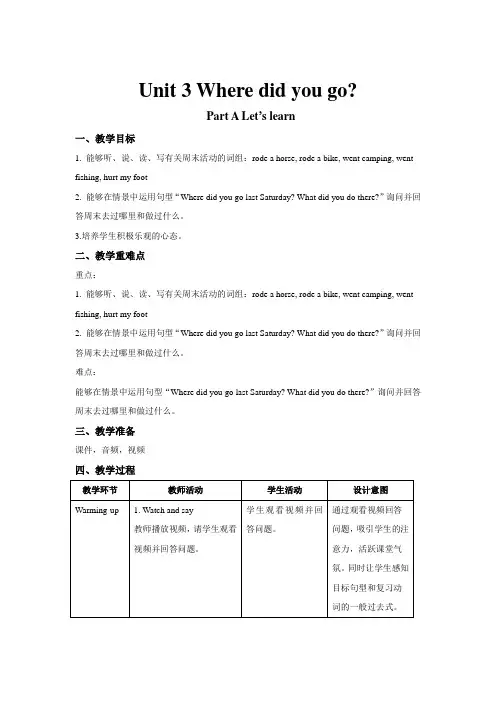
Unit 3 Where did you go?Part A Let’s learn一、教学目标1. 能够听、说、读、写有关周末活动的词组:rode a horse, rode a bike, went camping, went fishing, hurt my foot2. 能够在情景中运用句型“Where did you go last Saturday? What did you do there?”询问并回答周末去过哪里和做过什么。
3.培养学生积极乐观的心态。
二、教学重难点重点:1. 能够听、说、读、写有关周末活动的词组:rode a horse, rode a bike, went camping, went fishing, hurt my foot2. 能够在情景中运用句型“Where did you go last Saturday? What did you do there?”询问并回答周末去过哪里和做过什么。
难点:能够在情景中运用句型“Where did you go last Saturday? What did you do there?”询问并回答周末去过哪里和做过什么。
三、教学准备课件,音频,视频四、教学过程五、板书设计Unit 3 Where did you go?Part A Let’s learnPhrases:rode a horse, rodea bike, went camping, went fishing, hurt my footSentences:Where did you go last Saturday?What did you do there?。
六年级下册英语优质教案-Unit 3 Where did you go-人教PEP版 (7)

Unit3 Where did you go? B Let’s talk教学设计济南市天桥区实验小学教学内容:一、本课时教学目标分析:二、教学设计的重、难点分析:教学重点:1.能听、说、读、写句型:How did you go there? We went there by plane. Sounds great!2.能够在情景中运用句型Where did you go ? How did you go there ? What did you do? 询问并回答别人在过去的时间里去了哪里?乘坐什么交通工具?都做了些什么?教学难点:能运用核心句型在进行假期经历的交流,并能转换成简单语篇进行介绍。
三、教学手段:多媒体课件、作为奖励的点赞卡、板书卡片、教学卡片四、教学流程图五、教学过程教学环节教师课堂教学活动学生课堂学习活动课件Warm up 1. Free talkHi. Good afternoon boys and girls.What’s the weather like today?Let’s talk about our weekends.Where did you go last weekend?What did you do there?2.A card gameLet’s play a card game. Try toremember what you see. Then I’llchallenge your memory. What ismissing?Do well you’ll get a sticker. Ready?Go!Talk about the weatherand last weekend.Play a cardSay the words andphrases on the screen.设计意图开课之初,通过与学生进行口语交流和翻卡游戏,激发学生兴趣的同时也激活学生大脑储备中与本课相关的知识。
[六年级下册英语课文翻译冀教版]六年级下册英语课本翻译
![[六年级下册英语课文翻译冀教版]六年级下册英语课本翻译](https://360docs-1393072327.cos.ap-beijing.myqcloud.com/049249c510a6f524cdbf8550.webp)
[六年级下册英语课文翻译冀教版]六年级下册英语课本翻译unit1教材第2页课文翻译l"m 21 metres tall.l"m the tallest!我身高21米。
我是的!l"m 1.6 metres tall.l"m taller than this dinosaur.我身高1.6米。
我比这只恐龙高。
lt"s so tall!它如此高!Some dinosaurs are bigger than houses.Some are smaller than our schoolbags.一些恐龙比房子大。
一些比我们的书包小。
2unit1教材第3页课文翻译How heavy is it?它体重多少?lt"s five tons.它五吨。
What size are your shoes?你穿多大号的鞋?My shoes are size 35.我穿35号的鞋。
let"s try部分翻译The children areIn the museum. Listen and cirde.孩子们在博物馆里。
听一听圈一圈。
l.The first dinosaur eats__.1.第一只恐龙吃____。
A.vegetables A.蔬菜B.meat B.肉2.The ___ dinosaur is taller.2.___恐龙更高。
A first A.第一只B.second B.第二只2let"s talk部分翻译Zhang Peng:Look!That"s the tallest dinosaur in this hall.张鹏:看!那是这个厅里的恐龙。
Mike:Yesit is.How tall is it?迈克:是的它是。
它有多高?Zhang Peng:Maybe 4 metres.张鹏:可能4米。
Mike:Wow!It"s taller than both of us together.迈克:哇!它比我们俩加起来还高。
新版PEP人教版小学英语六年级下册全册课件【新教材】

Zhang Peng’s bag is bigger than Sarah’s.
名词所有格所修饰的词,如果前面已经提到过,往往 可以省略,以免重复.
Amy’s shoes are smaller than mine. My dress is longer than yours.
Zhang Peng’s bag is bigger than Sarah’s. But Sarah’s bag is heavier.
dress pants What What size size are is the pants? dress?
bigger big
The red apple is big .
The green apple is _____ ___ bigger than the red apple.
The _____ redapple is bigger than the ____ apple. green
Grammar 1
一、形容词比较级
• 形容词比较级构成法: 1、大部分直接在后面加er 2、重读闭音节单词(一个元音加一个辅音结尾) 双写结尾辅音加er big bigger 3、以辅音字母加y结尾,把y改为i,再加er heavy heavier 4、以e结尾的,直接加r nice nicer
自主探究:你能发现形容词比较级的构成规 律吗?
heavy heavier
52 kilograms 5.2 kilograms
How heavy is the It’s cat? 5.2 kilograms. How heavy is the tiger? It’s 52 kilograms.
kilogram
kilo gram
人教版PEP版六年级英语下册第一单元Unit1课件PPT第三课时B Lets learn

写出下列形容词的比较级 1.big________ 2. small ________ 3.thin________ 4. Heavy________ 5.strong________ 6.happy________ 7. angry________8.hot________
3.教师课堂激励学生用语大全 4.教师课堂用语辑录 5.五大类课堂用语
1、倾听是分享成功的好方法,看××同学正在分享着大家的快乐,我相信他已经有了很多收获! 2、他听得可认真了,会听的孩子是会学习的孩子! 3、××同学听得最认真,第一个举起了小手,请你回答! 4、你听得真认真,这可是尊重他人的表现呀! 5、你倾听得真仔细,耳朵真灵,这么细微的地方你都注意到了! 6、你讲得很有道理,如果你能把语速放慢一点,其它同学听得就更清楚了! 7、你的表达特别清楚,让大家一听就懂! 8、别急,再想想,你一定会说好! 9、老师发现你不仅听得仔细,说得也很好! 10、你很有创见,这非常可贵,请再响亮地说一遍! 11、你表达得这么清晰流畅,真棒! 12、我想××同学一定在思考,我们再给他一点时间,好吗? 13、开动你的小脑筋去想,一想说错了没关系,老喜欢肯动脑筋的同学! 14、不仅自己认真学习,还能提醒同桌同学,真是了不起! 15、第×组的××同学可真棒!为自己这组争得一颗闪亮的星星呢! 16、你看,很多小朋友把心里那个胆小鬼打倒,举起手来了! 17、你们瞧,×××可是大家学习的好榜样呢!看看他是怎么做的! 18、第四组的同学个个眼睛睁得大大的、亮亮的,我感受到了你们特别认真,注意力特别集中! 19、你坐得真端正!注意力真集中!
六年级下册英语-Unit1 第3课时 B Let's learn 教案

六年级英语(下)Unit1第3课时Unit 1 How tall are you?B Let’s learn一、【教材分析】二、【教学流程】请一组同学到台前测量体重,进行问答活动。
T: I know your weight. John and and Jim are talking about their weight, too.Let’s listen and find: How heavy is Jim? Who is heavier, Jim or John?2. Check the answers.(二)分别呈现T: We are comparing with each other now. The animals are having a PK inthe forest, too.1.呈现heavy, heavier(1)PPT呈现一头猪和一头大象的图片。
T: Look at the pig. How heavy is it? Ss: It’s 120 kilograms.T: Oh, it’s so heavy. But look at the elephant. How heavy is it?Ss: It’s 210 kilograms.T: Oh, it’s heavier than the pig.板书领读:heavier. 分排读,指名读。
2.呈现thin,thinnerPPT呈现一只很瘦的老虎和一条狗的图片。
T: Look at the tiger. It’s so thin. But look at the dog, it’s thinner than thetiger.板书领读:thinner. 男女生读,指名读。
3. 呈现small, smallerPPT出示一只小狗和小老鼠的图片。
T: Look at the dog. It’s so cute and so small. look at the mouse, how do youthink about it?Ss: It’s smaller than the dog.板书领读:smaller. 开火车读。
六年级下册英语教学课件Unit 3 Part B 人教(PEP)
Sarah: Where did you go over the winter holiday? Amy: My family and I went to Sanya. Wu: Really? Did you like it? Amy: Yes, it was so warm. Sarah: Hainan is far A. from here. How did you go there? each Amy: We went there B. by peach plane. Wu: How was the beach? What did you do there? C.I reach Amy: It was beautiful. took lots of pictures, and I also D. beach went swimming. Sarah: Sounds great! Can I see your pictures sometime? Amy: Sure.
Role play
Make a dialogue with “where, how, what” A: Hello. Where did you go over/in/during _____? B: I went to _____. A: How did you go there? B: We went there by ____. A: What did you do there? B: I ___________________________. A: Sounds great! Word bank time: Labour Day holiday, summer holiday place: Shenzhen , Beijing , London , New York Transportation: by plane, by train, by subway Activities: rode a horse, went swimming, climbed the Great Wall,
新版PEP小学六年级英语下册Unit-3-Where-did-you-go教案
新版PEP小学六年级英语下册Unit-3-Where-did-you-go教案Unit 3 Where did you go ?第一课时教学步骤:Step 1. Warm-up1.利用图片和学生一起唱歌谣,要求一边唱一边做动作。
如:What can you do ? I can sing.What can you do ? I can dance.What can you do ? I can climb a mountain.What can you do ? I can take a pictures.What can you do ? I can speak Chinese.2.用多媒体课件展示自己外出旅游的照片,并做相关介绍。
如:Last summer holiday, I went to hainan. It was sobeautiful. I went swimming in the sea. And picked someseashells on the beach.Step 2. PresentationLet’s talk(从呈现完整对话到处理局部语言)1.整体感知对话并回答问题。
(1)通过提问要求学生猜测:Did yougo to John’s home ? What happened toJohn? What did they talk about later?请学生带着问题观看动画或阅读文本,了解John脚受伤的原因:He fell of hisbike,利用图片帮助学生理解并教授fell.同时,通过观看动画或阅读文本获得对话的主旨:They talked about John’sLabout Day holiday.(2)结合日历,让学生理解Labour Day holiday概念。
提问:Look at thecalendar. What date is it ? It’s May 1st . On May 1st ,we usually have three days off. We call it Labour Day holiday.(3)继续提问学生:Where did John go on his Labour Day holiday ? What did hedo there ? 要求学生带着问题观看动画或阅读文本获取信息,并用思维导图板书对话关键信息。
新PEP小学英语六年级下册Unit3-Where-did-you-go-A-Let's-learn-课件资料讲解
went fishing
went camping
Catch the plane 找飞机,看谁快
rode a bike
rode a horse
did
slept
hurt my foot
drank fixed
saw
Game
What did Jo整单词
went fishing went shopping
went swimming went hiking
: Did you do anything else?
Yes,I rode a horse and then I rode a bike.
rode a horse ride a horse
rode a bike ride a bike
: What happened then?
hurt-----hurt
Oh, I hurt my foot.
He rode a bike ,and he hurt his foot.
hurt his foot
hurt my foot hurt my foot
hurt my head hurthumryt hmayndarm
w
f
.
w
c.
r ab
.
h
my f .
r
ah
.
拼拼写写:
/ rәud ә baik /
/ went `fi⌠iŋ /
/ went tu: ә pa:k /
/ went cæmpiŋ /
/ hә:t mai fut /
拼拼写写:
/ rәud ә baik /
/ went `fi⌠iŋ /
/ hә:t mai fut / / went tu: ә pa:k /
人教pep六年级英语下册Unit3预习提纲
人教pep六年级英语第三单元预习提纲共六课时第一课时PartA Let's talk1.课前浏览对话Let's talk,了解对话得大致内容。
不懂的单词借助手头资料或工具查找。
2.预习对话中出现的词组和重点句型:fell off 从……摔下hurt...foot ××'s脚受伤rode a horse 骑马looks like 看起来像……Where did you go?你去了哪里?Did you go to...你去过……(某地)?Yes ,I did/No, I didn't.是,我去了/不,我没去。
第二课时PartA Let's Learn1.了解:过去时态――不规则动词过去式的变化。
本单元继续学习过去时态,侧重点是不规则动词的过去式变化,这些单词无变化规律,需要同学们来重点识记。
如:ride-rode 骑go-went 去hury-hurt 受伤do-didfall-fell 摔倒see-saw 看见am/is-wasare-were2.知道Let's Learn图片中出现的5个词组的意思,提前在课本标注。
3.重点句型:Where did ×× go? ××去了哪里?×× went to...(加地点名词)××去了……第三课时PartB Let's talk1.课前浏览对话,了解对话大致内容。
不认识的单词查找爱你标注。
2.本课时需要注意的重点句型有:Where did you go?你去了哪里?I went to...我去了……How did ×× go there? ××是怎样去的那儿?(问交通方式)What did ×× do there? ××在那做了什么?第四课时PartB Let's Learn1.不规则动词的过去式变化:eat-ate 吃go-went 去take-took 拿buy-bought 买2.知道Let's Learn图片中出现的4个词组的意思,并在课本上标注。