
新目标人教八上英语Unit3课件
新目标八年级英语上册Unit3重点单词讲解
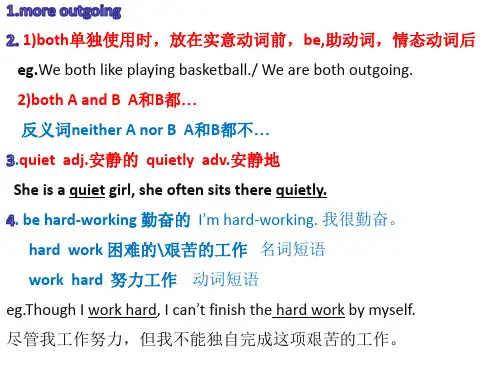
.true adj. 真正的;真实的 come true 实现,达到 truly adv. 真正地,真实地 truth n. 真相;事实
.careful adj. 小心的;认真的; careless 粗心的 carefully adv. 小心地;认真地; 常用短语:
2)Nothing serious. 不严重。 3)He is serious about the English exam.
他对这次英语考试很认真。 14. Are you kidding? 你在开玩笑吗? 15. as long as 只要;与…一样长 eg.1)My ruler is as long as yours.
我经常和我的好朋友吉姆分享我的故事。
. get some information 得到一些信息 不可数名词
2)We will go as long as the weather is good.
3)As long as you need my help, I will stay. 4)Jim lived in China as long as ten years.
bring out the best\worst in sb 把某人最好\最坏的一面激发出来 My teacher brings out the best in me. 我的老师把我最好的一面激 发出来。
eg.1)I was touched. 我很感动。 2) It touched me. 它使我很感动。 3)The story is touching. 那个故事令人感动。
.break-broke-broken v.打破
broken adj. 破碎的
人教新目标版八年级上册英语课件 Unit 1 第二课时 Section A GF-3c

I went to New York City. No. No one was here. Everyone was on vacation.
Yes, I bought something for my father. No, I bought nothing. Everything tasted really good! Oh, yes. Everything was excellent.
11
Where did you go on vacation
第二课时 Section A GF-3c
情景导入
Now,please listen to me carefully and answer my questions. I went to Qingdao last vacation. I went there with my family. It was my first time to go there,so everything was really interesting. And I bought something for my friends,but I didn't buy anything for myself. (1)Where did I go last vacation? (2)Did I go there with anyone? (3)Did I buy anything for myself?
探究新知 一般过去时
一般过去时
构成
动词的过去式
用法 常用时间
1.表示过去某个时间发 生的动作或存在的状态。 2. 表示过去经常或反复 发生的动作。
八年级英语上第3单元知识讲解及练习含答案人教版新目标
新目标英语八年级上第3单元知识讲解及练习含答案Unit 3What are you doing for vacation?【重要词汇概览】babysit v. 临时受雇照顾(婴儿)at home在家Tibet某某Hawaii夏威夷(美国州名)sightseeing n. 观光;游览fishing n. 捕鱼;钓鱼rent v. 租用;出租plan n. & v. 计划;设计;筹划Greece 希腊finally adv. 最后地;最终decide v. 决定;下决心;解决lake n. 湖;湖泊region n. 地方;区域countryside n. 乡下;农村;乡村forget v. (forgot, forgot forgotten) 忘记;忘却return v. 后来;归去;归还Paris 巴黎(法国首都)tourist n. 旅行者;游客【重要词组概览】go sightseeing去观光旅行take walks去散步go fishing去钓鱼take a vacation去度假think about 考虑;思考decide on 决定the Great Lakes 五大湖(加拿大与美国之间的五个大湖)a no-stress vacation 一个没有压力的假期Hong Kong某某how long多久get back回来San Francisco旧金山(美国加利福尼亚州西部港市)sports camp运动野营go bike riding骑自行车旅行go camping 去野营go hiking去远足the Great Wall 长城have a good time玩得很高兴,过得很愉快【语法知识聚焦】一、本单元学习用现在进行时表示将要发生的动作,例如:1. What are you doing for vacation?你假期准备干什么?I'm visiting my grandmother.我准备去看我的奶奶。
八年级英语上册 Unit 3 What are you doing for vacation 人教新
初二英语上册 Unit 3 What are you doing for vacation? 人教新目标版一、学习目标:1、知识目标:掌握本讲的词汇、短语和句型。
2、能力目标:a. 能够运用一般将来时谈论计划和打算;b. 熟练运用有关旅游度假的问答语。
3、情感目标:学会科学地制定计划,安排好假期的学习与生活。
二、重点、难点:重点:单词send, show, finish, decide, forget;短语something different;句型That sounds interesting/nice.难点:形容词修饰不定代词和“be + doing”表将来。
三、知能提升(一)重点单词[单词学习]◎send【用法】send为及物动词,意为“发送,寄”。
其过去式是sent。
常用短语为send sb. sth. =send sth. to sb. “寄给某人某物”,当sb. 是人称代词的宾格(it, them)时,只能用send sth. to sb.。
【例句】1. Please don’t send me junk s.2. My mother asked me to send them to my friend.【考查点】和send有相同用法的动词还有:show, lend, pass, give等。
【考题】1. My best friend sent me a book yesterday.(同义句转换)My best friend sent me yesterday.答案:a book to解题思路:send sb. sth. = send sth. to sb. 表示“把某物寄给某人”。
2. —A single room, please.—OK. Will you please me your ID card?—Sure. Here you are.A. sendB. showC. sellD. serve答案:B解题思路:此题考查词义辨析。
人教新目标英语八年级上 Unit 2 Section A (2d~3a) 精品课件

Section A (2d~3a)
Warming-up Presentation
Practice Production
Teaching aims
1. 掌握频率副词always,usually,often,sometimes,hardly ever,never及频 度词组once a week,twice a month等的用法。
Chain game.
Work in groups of four to make sentences with the frequency words as the example.
hardly ever
always
often
usually
Example: Jane: I hardly ever eat fast food. Tara: I always read books, and Jane hardly ever eats fast food. Maria: I often play basketball, Tara always reads books, and Jane hardly ever eats fast food. Jim: I usually go to bed at 11, Maria often play basketball, Tara always read books, and Jane hardly ever eats fast food.
✔✔
✔
✔
2. — How often does she do housework? — She does housework _f_o_u_r_t_im__e_s_a_w__e_ek__.
人教新目标八年级上册Unit 1 Where did you go on vacation Section B 3a-3c Writing公开课课件

人称:日记要用第一人称写。
Brainstorm: 假设你暑假或上周末去旅游了。请 根据你的旅行经历写一篇文章。内容包括:
• 1. 你是什么时候到什么地方去参观旅游的? • 2. 你和谁一起去的?当时的天气怎么样? • 3. 你们在不同时段分别开展了哪些活动?(至少写两个时段和两个活动) • 4. 你的感受如何?
Where did you go on vacation?
第八课时, Writing
Tian'anmen Square
The Palace Museum a Beijing hutong
Did you go to Beijing on vacation?
I went to Beijing on vacation with my family in 2012.
思路点拨
:运用and, or, so, first, then, next, although...等连词将以上要点连成文章。
作业
请将该作文写在作业本上。
(活动可以用本节课提到的,也可以根据你的实际 情况写或自己编造)
参考句型: 1. I had a good time in ... last summer vacation. 2. I'll never forget the timetransportation
places of interest
TrTraavvel el
place activity
food
people
思路点拨
第一人称 I
审题:人称__________ 时态
新目标英语八年级上Unit3比较等级讲解与练习(无答案)
八年级上册语法专题之形容词分为三种等级:原级,比较级与最高级。
一、形容词的原级及用法◆形容词的原级(形容词本来面目不作变化)1.表示没有实行比较或实行同级比较2.能够修饰原级的词: very、quite、enough(“充足”,用在形容词后)so pretty too how rather(相当) (not) as…as (“(不)像…一样”,同级比较) not so…as (“不像…一样”,同级比较)e.g. How happy we are! 我们多么快乐啊!This ruler is as long as that one. 这把尺子和那把一样长。
(变否认句)This ruler is not as/so long as that one.二、形容词比较级最高级变化规则①单音节词比较级在词尾加er,最高级加estcold —colder —coldest tall —taller —tallesthigh —higher —highest long —longer —longest②以字母e结尾的词只加r或stnice —nicer —nicest late —later —latestfine —finer —finest③重读闭音节双写辅音字母再加er或estbig —bigger —biggest hot —hotter —hottestwet — wetter —wettest thin —thinner —thinnest red—redder —reddest fat —fatter —fattestsad —sadder —saddest④以辅音字母+y结尾的词把y变i再加er或esteasy — easier — easiest early — earlier — earliestfunny — funnier — funniest happy — happier — happiestheavy— heavier — heaviest dirty — dirtier — dirtiest⑤多音节词、局部双音节词(特别是ful结尾及v.+ed/ing构成的形容词)及个别单音节词(fun)在前面加more或mostinteresting important difficult excitied tiredcareful popular expensive boring fun⑥不规则变化little — less — least good / well — better — bestbad / ill / badly —— worse —— worstmany / much —— more —— mostold —— older —— oldest (年龄大的,与than连用)old — elder —eldest(“年长的”,只作定语不与than连用)far —— farther —— farthest (距离远)far —— further —— furthest (除距离外,还指水准上更进一步的)★★口诀:合二为一共三对, “坏、病”、“两多”并“两好”;一分为二有两个,一是“远来”、二是“老”;还有一词含双义,只记“少”来不记“小”。
【人教版】新目标八年级英语上册:Unit 3 单元教学设计(1)
【人教版】新目标八年级英语上册:Unit 3 单元教学设计(1)一. 教材分析人教版新目标八年级英语上册Unit 3的主题是“What’s the matter?”,主要讨论日常生活中的身体不适和情感问题。
通过本单元的学习,学生将能够掌握关于身体部位、症状和情感状态的词汇,学会询问和描述他人的身体状况和情感问题。
教材包括词汇表、对话、阅读理解和语法讲解等部分,内容丰富,贴近生活,有助于提高学生的学习兴趣和积极性。
二. 学情分析八年级的学生已经掌握了基本的英语语法和词汇,具备一定的听说读写能力。
但是,学生在实际运用英语进行交流时,还存在一定的困难,特别是在描述自己的身体状况和情感问题时。
因此,教师需要关注学生的实际需求,通过生动有趣的教学活动,激发学生的学习兴趣,帮助他们提高语言运用能力。
三. 教学目标1.知识目标:学生能够掌握关于身体部位、症状和情感状态的词汇,了解日常生活中的身体不适和情感问题的表达方式。
2.能力目标:学生能够用英语询问和描述他人的身体状况和情感问题,提高口语表达能力。
3.情感目标:学生能够关心他人的身体健康和情感需求,培养良好的情感态度。
四. 教学重难点1.重点:学生掌握关于身体部位、症状和情感状态的词汇,能够用英语询问和描述他人的身体状况和情感问题。
2.难点:学生能够正确运用所学词汇和句型,在实际情境中进行流畅的口语表达。
五. 教学方法1.任务型教学法:通过设定各种真实情境的任务,引导学生运用所学知识进行交流,提高学生的语言运用能力。
2.情境教学法:通过生动有趣的情境模拟,激发学生的学习兴趣,帮助他们更好地理解和学习新知识。
3.合作学习法:鼓励学生之间进行小组讨论和互动,培养学生的团队协作能力和人际交往能力。
六. 教学准备1.教师准备教案、课件和教学素材。
2.学生准备课本、笔记本和文具。
3.教学场所:教室。
七. 教学过程1.导入(5分钟)教师通过与学生谈论日常生活中的身体不适和情感问题,引起学生的兴趣,为新课的学习营造轻松愉快的学习氛围。
初中英语人教新目标八年级上册Unit 3单词讲解
八年级英语上册Unit 3单词讲解★outgoing(adj.)爱交际的,友好的,外向的(more outgoing / most outgoing)●go out出去,熄灭,过时→He is an outgoing and lively person.(定语)他是个性格开朗而又活泼的人★both(adj.)(pron.)两个,两个都(用作形容词,置于定冠词,指示代词,形容词性物主代词,名词所有格前)(用作代词作同位语时在句中位置“行前,系后,情助后”) →Both Helen’s parents are doctors.(定语)海伦的父母都是医生。
→Both (the/these) answers are right. (定语)这两个答案都正确。
→Both answers are not right.两个答案不都正确。
(部分否定)→I lost both my gloves.我把两个手套都丢了。
→I don't want both books.我并不是两本书都要(我只要一本)→on both sides of the street 在街道的两边→Both (of) my grandfathers are farmers.我的祖父和外祖父都是农民。
→I do not know both of them. (宾语)他们两位我并不是都认识。
(部分否定)→I want them both. (同位语)它们两个我都要。
→They both wanted to take a bath. (同位语)他们两个都想淋浴both (conj.)…和…都;不仅…而且…;既…又…→He’s lived in both Britain and America.他在英国和美国都生活过。
→She can both speak and write Japanese.她会用日语说和写。
→Both he and his wife enjoy tennis.他和他妻子都喜欢打网球。
(复习全案)八年级英语上册 Unit 3 能力提升训练课件 (新版)人教新目标版
Example
influence Nationalities may 10._________ personalities, Conclusion but not for all!
英语·新课标(RJ)
Unit 3 ┃ 能力提升训练
B To: Rose@ From: Mary@ Subject: My best friend
英语·新课标(RJ)
Unit 3 ┃ 能力提升训练
Chinese Chinese are friendly people who are hardworking. They are polite because they are careful about “saving face” when dealing with other people. Australians Australians are merry people who spend a lot of time outdoors. They enjoy a slower life. They laugh a lot
英语·新课标(RJ)
Unit 3 ┃ 能力提升训练
●Like to stay 6.___________, outdoors enjoy a slower life. Australians ●7.__________ a lot. Laugh ●Merry, sometimes loud and rude. Germans ●Pay attention to 8._________. details ●Serious and careful, not 9.__________. humorous
英语·新课标(RJ)
Unit 3┃ 能力提升训练