
2019-2020学年新教材高中英语 Unit 4 Natural disasters Sect
Section ⅡListening and Speaking &Reading andThinking——Language PointsⅠ.重点单词根据词性和汉语提示,写出下列单词1.disaster n.灾难;灾害2.slide vi.&vt.(使)滑行;滑动3.flood n.洪水;大量vi.淹没;大量涌入vt.使灌满水;淹没4.rescue n.&vt.营救;救援5.damage vt.损害;破坏n.损坏;损失6.destroy vt.摧毁;毁灭7.affect vt.影响;(疾病)侵袭;深深打动8.shelter n.避难处;居所;庇护vt.保护;掩蔽vi.躲避(风雨或危险)9.ruin n.&vt.破坏;毁坏10.electricity n.电;电能11.trap vt.使落入险境;使陷入圈套n.险境;陷阱12.bury vt.埋葬;安葬13.effort n.努力;艰难的尝试;尽力14.wisdom n.智慧;才智Ⅱ.拓展词汇根据词性和汉语提示,写出下列单词1.survive vi.生存;存活vt.幸存;艰难度过→survivor n.幸存者;生还者→survival n.幸存2.death n.死;死亡→dead adj.无生命的3.shock n.震惊;令人震惊的事;休克vt.(使)震惊→shocking adj.令人震惊的→shocked adj.感到震惊的4.breathe vi.&vt.呼吸→breath n.呼吸5.revive vt.&vi.复活;(使)苏醒→revival n.振兴;复苏6.unify vi.&vt.统一;(使)成一体→unite vi.&vt.团结7.suffer vt.遭受;蒙受vi.(因疾病、痛苦、悲伤等)受苦→suffering n.折磨;苦难Ⅲ.补全短语根据提示补全下列短语1.as if 似乎;好像;仿佛2.in ruins 严重受损;破败不堪3.in shock 震惊;吃惊4.set up 建立5.as usual 像往常一样6.come to an_end 结束7.the number of... ……的数量8.dig out 挖掘9.a home to... ……的家园10.go through 经历rescue n.&vt.援救;营救(教材P48)What are the rescue workers and soldiers doing in the floodhit area?救援人员和士兵在洪水灾区做什么?警察救了他,并把他送回了家。
②Tom rescued a boy from the river on his way home.汤姆在回家的路上从河里救了一个男孩。
③A large number of soldiers were sent there to rescue(rescue) those trapped in the building.大批士兵被派往那里营救被困在大楼里的人。
[语境助记]As soon as the accident happened,the rescue team came to the victims' rescue,and they didn't give up any hope of rescuing them from danger.事故一发生,救援队就来营救受害者了,并且他们没有放弃使他们脱离危险的任何希望。
damage vt.损害;破坏n.损坏;损失(教材P48)Which buildings were damaged in Seoul?首尔哪些建筑被毁?一次吃太多的肉会对你的胃造成损害。
②As we all know,smoking can do/cause damage to our health. (damage n.)=It is well known that smoking can damage our health.(damage vt.)众所周知,抽烟会损害我们的健康。
survive vi.生存;存活vt.幸存;艰难度过(经典佳句)Unluckily,no one survived the terrible accident.不幸的是,没有人从这个可怕的事故中幸存。
①在这次可怕的事故受伤的六人中,只有两人活了下来。
②Some strange customs have survived from earlier times.有些奇怪的风俗是从早年流传下来的。
③The old lady has survived all her sisters and brothers by ten years.那位老太太比她所有的兄弟姐妹都多活了10年。
[语境助记]He was the only survivor in that bad accident,and after the survival,he has been living a happy and healthy life.在那次严事故中,他是唯一的幸存者,幸存下来后,他一直过着幸福健康的生活。
affect vt.影响;(疾病)侵袭;深深打动写出下列各句中affect的含义①As far as I'm concerned,following others' advice without thinking will affect our own decision.影响②Most people present at the meeting wer e deeply affected by his speech.深深打动③The disease is beginning to affect his eyesight.(疾病)侵袭④As to have a seriouseffect on your health.就我而言,每天熬夜一定会严重影响你的健康。
ruin n.废墟;毁灭vt.毁灭;使破产(教材P50)In less than one minute,a large city lay in ruins.不到一分钟,一座大城市就成了废墟。
那个错误使他失去了得到那份工作的机会。
②The ancient temple has fallen into ruins and needs repairing.这座古老的庙宇已经破败不堪,需要修理。
③Drunkdriving not only ruined himself(he) but also killed several passersby.醉驾不仅毁掉了他自己还导致几位路人死亡。
shock n.震惊;令人震惊的事;休克vt.(使)震惊(教材P50)People were in shock-and then,later that afternoon,another big quake shook Tangshan again.人们都很震惊——然后,那天下午晚些时候,唐山又发生了一次大地震。
①It从那个屏幕上看到我的脸,真让人惊愕不已!②Rescue workers were shocked (shock) by what they saw.救援人员被眼前的景象惊呆了。
③The news shocked (shock)the public,leading to great concern about students' safety at school.这个消息使公众震惊,导致了对在校学生安全的担心。
[语境助记]The shocking news shocked all the people around,which was also a great shock to people all over the country.这个让人震惊的消息震惊了周围的人们,也震惊了全国各地的人们。
trap vt.使落入险境;使陷入圈套n.险境;陷阱(教材P50)Soon after the quakes,the army sent 150,000 soldiers to Tangshan to dig out those who were trapped and to bury the dead.地震发生后不久,部队派出了15万名战士奔赴唐山,将受困群众从废墟中挖出,并掩埋死者。
如果你选择这条路,你很有可能会落入圈套。
②There was a power failure;they were trapped(trap) in the lift.停电了,他们被困在电梯里。
③By clever questioning they t rapped him into telling the truth.他们用巧妙的提问诱使他说了实话。
bury vt.埋藏;掩埋;隐藏(经典例句)Ever since he moved there,he has been buried in his research work.自从搬到那里以后,他一直专注于研究工作。
①She当她听到那个坏消息时,她掩面而泣。
②In the past three weeks,we have been burying ourselves (us) in study because the exam is drawing near.在过去的三个星期里,我们专心致志的学习,因为考试即将到来。
③Buried(bury) in his study,he didn't know that all the others had left.=Burying(bury) himself in his study,he didn't know that all the others had left.=Because he was buried(bury) in his study,he didn't know that all the others had left.他埋头学习,不知道其他人都早已离开了。
[图形助记]一词多义的“bury”bury 掩埋bury oneself in study 专心学习effort n.努力;艰难的尝试;尽力(教材P50)With strong support from the government and the tireless efforts of the city's people,a new Tangshan was built upon the earthquake ruins.在政府的大力支持和人民的不懈努力下,一座崭新的唐山在地震废墟上建成了。
Unit4 Natural Disasters词汇讲解课件 -高中英语人教版(2019)必修第一册
come to power执政
lose power失掉政权
Idioms(习语): Nov, 29th.
•If someone tells you to think outside the box, what do you think it means?
Answer: Be creative.
• If you tell someone to think outside the box, it means you want them to think in an original and creative way. To try something that is different.
• The economy is beginning to revive.
• 29. effort n. _____
• make an effort/efforts/every effort
尽一切努力做某事
• spare no effort to do sth 不遗余力; 尽力做某事
• with (an) effort 努力地
without effort 毫不费力地
• We’ll make every effort to save her life.
【拓展】“尽一切做某事”的表达: try/do one’s best to do sth. do all that sb. can to do sth.
30 unify. vt. _____ (unite v. ___) The new leader hopes to unify the country.
程度较轻,可修复 程度大,不可修复 程度大,抽象意义 往往是对人
destruction injury
2019新人教高中英语必修一Unit4 Natural Disasters整单元公开课教案
2019新人教高中英语必修一Unit4Natural Disasters整单元教案2019新人教高中英语必修一Unit 4 Listening and Speaking教案Teaching aims:1.Enable students to summarize the main idea of the conversation and practise the tip of listening—listening for key words.2.Conclude the main points of a news report.3.Analyse the common expressions of a news report.4.Report a natural disaster.Teaching key points:1.Help students get familiar with some difficult words before listening.2.Enlighten students to report natural disasters in a logical way.Teaching difficult points:1.Deal with some difficult words in listening.2.Enable students to retell and report the natural disasters.Teaching procedures:StepⅠLead-inActivity 1 Have students watch a video and write down the names of disasters they see.Suggested answers:tornado, tsunami, earthquake, floodActivity2 Help students get more familiar with some new words by asking the question: What may happen in these disasters?Suggested answers: People may be killed. Homes may be damaged or destroyed. It will cause economy losses. People who survive might suffer psychological hurt.etc.Step ⅡListeningActivity1 First ListeningWhat is the main idea of the text?Suggested answer: Four news reports about natural disasters: earthquake, flood, tornado, landslide.Activity2 Second ListeningCircle the key words in the questions below and write the kind of information they refer to. Then listen again and answer the questions.(红色为学生完成部分)Discuss with your partners about the answers,summarize the main points of a news report and try to report the news according to the information.Suggested answer:main points of a news report:when, where,what,how and what more to come.Activity 4 Fourth listeningNews report 1_________ It’s 17 April. A strong earthquake hit Ecuador yesterday. The 7.8-magnitude earthquake damaged many buildings,and__________about 230 people were killed and more than 1,500 were injured. Volunteers and rescue workers are helping the survivors.News report 2Good evening. Today is 27 March.__________the floods in central China. The government is helping more than 12,000 people in Hunan and Jiangxi get away from the rising water. Homes and land have been destroyed,but no one has been killed.Rescue workers and soldiers are working day and night to make sure that people are safe. They are also bringing food and water to those whose homes were lost in the disaster.News report 3__________Saturday 12August. A tornado___________in southern Memphis.__________at 9:25a.m.,the tornado destroyed four homes. A police officer tells us that at least one person has died. More tornados are possible,and the police advise avoiding the area.News report 4And in Seoul,a landslide damaged a library and a supermarket in a southern neighbourhood. The landslide was caused by the heavy rain that has fallen in Seoul over the past week.________the police,no one was injured in the landslide, but several cars were damaged. Those are__________for day 21 July.Suggested answers: Good morning; early reports said that; More news about; Breaking news; was just seen;Eyewitnesses said that;According to;the top news Step ⅢSpeakingHave students read about the disasters below and prepare a short news report on one of them. Remind them to start with the most important information and then provide the details.Sample:Good morning. Today is 1 May. A huge earthquake hit Wenchuan, China yesterday afternoon. It has killed at least 8500 people by now. The earthquake measured 7.8 on the Richter scale. Injured survivors have been moved to the safety by rescue workers, including medical workers, troops, and volunteers, who organised quickly.2019新人教高中英语必修一Unit 4 Reading and Thinking教案Teaching aims:1.Enable students to learn about the Tangshan earthquake,summarize the main idea and figure out the structures2.Identify the language features of literary journalism and the structures of the text.3.Appreciate the figures of speech and writing skills used in the text.4.Grasp and use some words and phrases to describe a natural disaster,andstrengthen the awareness of coping with disasters.Teaching key points:1.Guide students to better understand the language features of literary journalism and the structures of the text.2.Help students to figure out the writing purpose and emotions expressed in the text.Teaching difficult points:1.Enable students to grasp and use some words and phrases to describe a natural disaster.2.Guide students to explore the figures of speech of the text.Teaching procedures:Step I Lead-inAsk students to discuss what can happen to a city during a big earthquake. Work in pairs.Suggested answer:A city can be damaged in the earthquake. The electricity can go down. The water can be unsafe to drink. Fires can start. People can panic or get severely injured.StepⅡPredictionAsk students to look at the title and photo on Page 50and guess what the text is about. Then answer the following questions.Questions:1.What’s the text mainly about2.What does the writer mean by the title(本题可留到最后解答)Suggested answers:1.The text is mainly about a terrible earthquake.2.Night is time for sleep. Usually it should be safe and quiet. But at that night,the earth was active and everything changed. That was a sleepless night.Step Ⅱ Skimming for main informationActivity 1 Read the passage to judge the type of writing of the text and how this text is organized.Questions:1.What is the type of writing of the text?2.How are the events arrangedActivity 2 Read the text carefully and then write down the main idea of each paragraph.Paragraph 1:Warning signs before the earthquake.Paragraph 2:________________________________Paragraph 3:________________________________Paragraph 4:________________________________Paragraph 5:________________________________Suggested answers:Activity 11.The type of writing of the text is literary journal-ism, which lies between news reports and literary works.Literary journalism usually describes real historical events and real characters. The usage of the figures of speech can stimulate readers' feelings and thus touch the readers.2.The text is organized in the chronological/time order.Activity 2Paragraph 1:Warning signs before the earthquake.Paragraph 2:The happening of the big earthquake.Paragraph 3:The immediate effects of the earthquake.Paragraph 4:The rescue work.Paragraph 5:The revival of the city.Step IV Scanning for detailsActivity 1 Read Paragraph l to answer the following questions.Questions:1.What's the topic sentence of Paragraph 1?2.What were some of the strange things happening before the earthquake?3. What was the attitude of the people in the city towards those strange things?Suggested answers:1.Strange things were happening in the countryside of northeastern Hebei.2.3.But the city’s one million people ignored all the signs and were asleep as usual that night.Activity a Read Paragraph 2 to answer the following questions.Questions:1.What’s the topic sentence of this paragraph?2.What about the supporting details?3.What was the people’s feeling at that time?4.Guess what the word“ruin”means from the context.Suggested answers:1.It seemed as if the world were coming to an end.2.Supporting details(红色部分为学生填写)3.People were shocked at that time.4.This word describes the city straight after the earthquake.In a short time, a lot of damage was done, so it must describe a place that has been badly damaged.Activity 3 Read Paragraph 3 to answer the following questions.Questions:1.What's the topic sentence of this paragraph?2.What about the supporting details?3.What was the people’s feeling at that time?Suggested answers:1.Everywhere survivors looked, there was nothing but ruins2.People felt hopeless at that time.Activity 4 Read paragraph 4 to answer the following questionsQuestions:1.What’s the topic sentence of this paragraph?2.What about the supporting details?3. What does the writer mean by“Slowly,the city began to breathe again”Suggested answers:1.But hope was not lost.2.3. The writer means that the city began to function again,because the earthquake had stopped people and sup-plies moving about, and so it was like the city couldn't breathe.Activity 5 Read Paragraph 5 to answer the following questions.Questions:1.What's the topic sentence of this paragraph?2.What do you think helped in the revival of Tangshan city?Suggested answers:1. Tangshan started to revive itself and get back up on its feet.2. I think the revival of Tangshan was helped by the strong support of the government and the people who all worked in unity to rebuild the city even better than before.Step V Reading for language features and writing skillsActivity 1 Read the text once again and find out the sentences where figures of speech are used and their function.Activity 2 Figure out the function of the figures.Suggested answers:Activity 11.①The night the earth didn't sleep.②Slowly,the city began to breathe again.(personifica-tion 拟人;to make the language vivid and expressive,and resonate with readers)2....the water in the village wells rose and fell,rose and fell.(repetition 重复to make the description more vivid and involve the readers in the atmosphere)3.It seemed as if the world were coming to an end!(exaggeration夸张to show the destruction was extremely severe)4.① Bricks covered the ground like red autumn leaves...(simile明喻to make the description more vivid)②Hard hills of rock became rivers of dirt.(metaphor 暗喻)Activity 2To show the disastrous destruction and suffering;to make the passage true and convincing.Step Ⅱ DiscussionDiscuss the following questions. Work in pairs. Questions:What other cities or towns have gone through similar changes?What lessons can we learn from these events?Suggested answers:Wenchuan county and some other towns near Wen-chuan have the similar experiences. These towns were built up from the ruins. As well as developing better ways to detect and prepare for these disasters, we have learnt that acting quickly and in unity is the best way to get over such disasters. The strong support from the government and people around is also very important.Step Ⅱ Homework1.Summarize the passage.2.Do some research on other natural disasters by surfing the Internet and makea report.2019新人教高中英语必修一Unit 4 Discovering Useful Structures教案Teaching aims:1.Enable students to identify restrictive relative clauses and explore the structures and the pragmatic function of restrictive relative clauses.2.Sum up the usage of relative pronouns.e restrictive relative clauses to describe pictures of disasters.Teaching key points:1.Guide students to understand the function of restrictive relative clauses in enriching the content of sentences, describing the characteristics of things and supplementing information.2.Enlighten students to use restrictive relative clauses to describe natural disasters vividly.Teaching difficult points:How to choose suitable relative pronouns to express themselves.Step I Lead-inLet students read a few sentences and appreciate the restrictive relative clause by answering the function of it.“On coming back a few days afterwards,I found they had christened him‘Heathcliff’:it was the name of a son who died in childhood,and it has served him ever since,both for Christian and surname.”Suggested answers:①the origin of the name ①the influence on his personality ①to imply his destiny(设计意图本句摘自《呼啸山庄》第四章,通过限制性定语从句描写希斯克利夫这个名字的由来,初步体会限制性定语从句的语言作用和功能,激起学生学习的兴趣。
2020学年新教材高中英语Unit4NaturaldisastersSectionⅡReadingandThinking(1)课件新人教版必修第一册
The help from the whole nation
Soldiers dug out those who were ⑦___t_ra_p_p_e_d____ and buried the dead. Medical workers came to provide medical ⑧_____c_a_re_____. Workers built ⑨___s_h_e_l_te_r_s___ for survivors.
Before the earthquake and again.
·Animals in the farmyards became too ②___n_e_rv_o_u_s__ to eat.
At 3:42 am everything began to ③____s_h_a_k_e____. During the earthquake
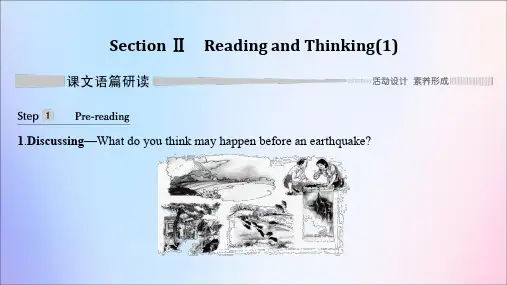
2.Predicting—Look at the title and the picture and predict what the text is probably about. __A__te_r_ri_b_l_e _e_a_rt_h_q_u_a_k_e_i_s_l_ik_e_l_y_t_o_h_a_p_p_e_n_. ______________________________________
Section Ⅱ Reading and Thinking(1)
1.Discussing—What do you think may happen before an eartห้องสมุดไป่ตู้quake?
_B__ri_g_h_t_l_ig_h_t_s_i_n_t_h_e_s_k_y_m__a_y_a_p_p_e_a_r.___________________________________________ _A__n_im__a_ls__m_a_y__b_e_t_o_o_n_e_r_v_o_u_s_to__e_a_t.___________________________________________ _M__i_c_e_m__ay__r_u_n_o_u_t_o_f_h_o_l_e_s_l_o_o_k_in_g__fo_r__p_la_c_e_s_t_o_h_i_d_e_. ____________________________ _F__is_h_m__a_y_j_u_m_p__o_u_t_o_f_t_h_e_ir_p_o_o_l_s_a_n_d__p_o_n_d_s.____________________________________ _W__e_l_l _w_a_l_ls_m__a_y_h_a_v_e__d_ee_p__c_ra_c_k_s_.____________________________________________
2020学年新教材高中英语Unit4NaturaldisastersSectionⅢReadingandThinking(2)学案新人教版必修第一册
Section ⅢReading and Thinking(2)Ⅰ.单词语境记忆——根据英汉提示写出单词的适当形式1.In order to catch the bear,some villagers set a trap(陷阱) and covered it with some leaves.2.In spite of great efforts(努力),we failed to carry out our plans through.3.Wisdom(智慧) is knowing what to do next.4.Don’t leave the lights on.It wastes electricity(电).5.Jill’s last school report shocked(shock) his parents into changing their opinion.6.Death finally brought an end to her suffering(suffer).7.Ever since he moved there,he has buried(bury) himself in his research work.8.I like getting up early in the morning.The morning air is good to breathe(breath). Ⅱ.短语语境填空——根据汉语提示写出适当的短语1.The city lay in ruins(破败不堪) after the earthquake.Now,rows of houses are being built.2.It was reported that an American couple had dug out(掘出) a lot of gold coins from their own yard.3.Although I got up with a headache,I went to work as usual(像往常一样).4.If we cut across(穿过) the field we’ll get there before Frank.5.Remember that success is getting up just one more time than you fall down(跌倒).记单词Ⅰ.语境串记多义词1.The storm ruined the crops,and the whole village was almost in ruins after the hurricane.暴风雨毁坏了庄稼,整个村子在飓风过后几乎变成了废墟。
人教版(2019)必修第一册Unit 4 Natural Disasters The 教学设计
人 教 版 必 修 一 Unit 4 Natural Disasters The Night the Earth Didn't sleep 教学设计1.Teaching ObjectivesKnowledge objectives Students should have a clear understanding of the main idea of the article,grasp the details of the article,and ultimately summarize and retell the content of the article;At the same time,it is necessary to master and learn to use key vocabulary and sentence patterns that appear in the article.Capability objectives Under the guidance of teachers,students are capable of utilizing reading strategies to accomplish tasks,acquiring proficiency in both intensive and extensive reading techniques,and attaining effective comprehension of articles;Be able to summarize the main idea of different paragraphs on your own and master different reading skills based on different topic types.Emotional goals Understand major natural disasters that have occurred in China,establish awareness of disaster prevention and self-protection;Through autonomous internalization and group discussion,stimulate students'motivation for reading and learning,and cultivate their spirit of cooperative exploration.2.Teaching Focus and DifficultiesTeaching focus Enable students to comprehend the central concept of the article and gradually grasp its intricate details and clues.Furthermore,guide students in deciphering the discourse structure and logical relationships present within the text;Be able to master the key vocabulary,sentence structures,and grammar of this lesson. Teaching difficulties Summarize reading problem-solving skills through different types of questions, cultivate students'self-directed learning ability and collaborative exploration ability.3.Teaching ProcessStep 1 Leading-in(3mins)Firstly,teacher plays a video clip about Tangshan earthquake for students to watch. After watching,ask students:What happened in this video?What do you think of the video?·····Design intention: Use video clips to attract students³attention,create thematic context,introduce themes,ignite students’interest in reading and awaken their preexisting knowledge base.At the same time,introduce some new words through dialogue to eliminate vocabulary and background barriers.Improvement points of core literacy:Step 2 Prediction (3mins)Before reading,show the picture that appeared on the textbook and the title of this article for students to predict and ask“what does the title mean?What will happen ifthe earth didn't sleep?What the text mainly talk about?”Design intention: Predict the content of the material based on the title,cultivate students'cognitive strategies,and form reading expectations.Step 3 Presentation (3mins)The teacher presents a range of questions,varying from simple to complex,and students employ reading strategies to locate answers in relation to those questions. (Instruction:Please skip and scan the passage and think about four questions.) ·When did the earthquake happen?(For level C)·What damage did it cause to the city andpeople?(For level B)·What happened later that afernoon?(For level B)·How did people feel?(For level C)Design intention: Students can gain a preliminary understanding of the main content of the article through rapid reading,improve skimming skills,and purposeful reading.Step 4 Assimilation(15mins)Firstly,students should read this passage carefully.After reading the article thoroughly,test students’mastery of the details of the article by sorting it. (Instruction:Answer these questions.)·Who came to the rescue?(For level C)·What did they do?(For level B)·What does the author mean by“slowly the city began to breath again?”(For levelA)Secondly,the teacher elucidates the new vocabulary,crucial grammar points,and challenging linguistic elements within the article,aiming to facilitate a deeper comprehension for students.(Directions:Let us concentrate on the emphasized words within the context and collectively endeavor to learn these terms.)Design intention: Questions can help students better understand the main idea of the article and the discourse structural relationships and sorting can help students quickly clarify the context of the article.Step 6 Discussion (20 minutes)Group Discussion (1)This stage involves a discussion among group members,following theindividual internalization process,where each person raises questions and discusses solutions in the order of illuminating the exam.During the discussion,students can focus on prompts provided by the teacher or extend upon the knowledge points presented in the article.The conversation flows from addressing questions raised by group members to assessing each other's learning progress.Through this interaction, students gradually consolidate impressions and form knowledge.Group leader assigns tasks based on students³English proficiency.In addition to peers monitoring each other's contributions,teachers play a crucial role in facilitating timely discussions.During these group discussions,students are encouraged to take notes in class and organize the collective“Shine -Test-Help”approach,aim ing to enhance understanding and learning outcomes.Design intention:Group discussions are communication between students,allowing them to more freely express themselves.By fostering a desire for self-expression and fostering appropriate competition,students'learning motivation can be further augmented.Concurrently,outstanding students serve as motivation for those who may be slightly less proficient,encouraging them to engage actively in critical thinking and kindling a thirst for knowledge among all students.Teacher Spot Check To foster active participation in discussions,teachers should maintain continuous surveillance in the classroom,promptly seizing hold of students'discussion topics. Timely intervention is key,involving oneself in students'dialogues,providing timely feedback,and awarding grades.This approach serves to kindle students ⁷enthusiasm for engaging in the process.Furthermore,teachers should conduct spot checks in a random manner,selecting diverse students in each class to ensure that every student gets a chance to voice their opinions.Additionally,teachers must encourage students’expressions and st rive to refrain from criticism to safeguard students ’ self-esteem and maintain their eagerness for learning.··Design intention: Teachers are the organizers of the classroom and need to timely grasp the teaching progress and make adjustments to the learning situation. Free Questions This section features a lively discussion and exchange of ideas among groups,as well as between students and teachers.Groups are encouraged to pose questions related to the“Shine -Test-Help”approach or any other topics they consider exploratory.Both students and teachers can contribute to this process.Given the limitation of time,teachers are advised to carefully select representative questions and inspire students to delve deeper into the article.For instance,posing thought-provoking questions like,“How will this article enhance your future academic pursuits and personal life?”;Summa ry questions such as“What do you think about scientific spiri t after reading the article?”;It is crucial to note that at this stage,teachers play a pivotal role in encouraging students to overcome their fears and shyness,and to boldly ask questions without hesitation.Design intention: Free questioning represents a mutual exchange in which both teachers and students actively participate.It serves as a crucial avenue for teachers to gather valuable learning feedback and simultaneously enhances students’oral communication skills.●Teacher SummaryFinally,The teacher offers additional clarifications on the knowledge points that students may have overlooked,summarizes the content covered in the lesson, outlines the reading techniques utilized in comprehension,and presents practice exercises to promptly reinforce students'application skills.Assign homework after class.Due to the examination of students’mastery abilities in detail comprehension questions,main idea questions,guessing questions about word and sentence meanings,and logical reasoning questions in this experiment,four types of questions are used as examples to explain reading skills.Step 6 Homework (1min)Students need to write down their own mind map about this passage . Students should summarize the Shine-Test-Help.(for level A,B,C) The content that they perceive with the deepest sentiment,derive the utmost benefit from,and hold the highest appreciation for during the learning process is Shine-Test-Help.If you comprehend something yet believe others might harbor ···doubts,articulate it in the form of inquiries to provoke others,which constitutes Testing You.Convey your uncertainties,incomprehension,or aspirations for clarification through posing questions,and seek assistance from your classmates during group discussions,thereby embodying Helping Me.It can be the knowledge as follows:Figure of speech:students can identify the use of figurative language within this article and enumerate the corresponding sentences.·Numbers:students can find the numbers of this passage,and illustrate the function.Important and difficult phrases. Literary journalism:its language feature and the examples. ·Others.Tips:No quantity is required,but at least one at each point.Draw a mind map of the text including Transition words and Key details.(fo r level A,B)Organize a group presentation on what we should do when hearing about an earthquake happening in a certain place.(for level A) ·····。
Unit-4-Natural-Disasters-高中英语人教版2019必修一
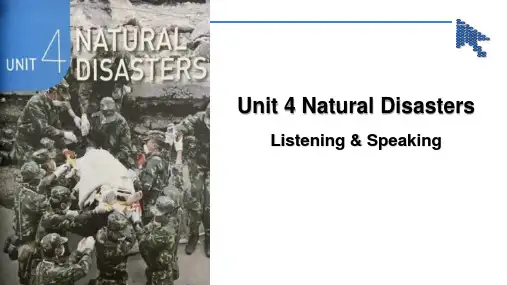
And in Seoul, a landdsalimdeaged
a library and a
supermarket in a southern neighbourhood.Tchaeusleadndslide
was
by the heavy rain that has fallen in Seoul over
Type of information
number number place
activities
time
Tips: Listen for details Think about what you are listening for before you listen: numbers, dates, times, addresses, activities, people or places, reasons, etc.
5.When did people see the tornado in Memphis? A.At 12:00 am. B.At 9:00 pm. C.At 9:25 am. 6.Which buildings were damaged in Seoul? A.A library and a supermarket. B.A police office and a library. C.A hospital and a post office. 7.What caused the landslide in Seoul? A.The snow storm. B.The heavy flood. C.The heavy rain.