
外研版(一起)三年级英语上册Module 7 Unit 1课件
have got a test
自主或小组探究 Let’s listen! 活动探究
Sam, are you sad? Are you ill/
Have you got a headache?
No, I haven’t.
Have you got a stomach ache?
No, I haven’t got a stomach ache.
Have you got a test today? You don’t like tests.
Yes, I have. We have tests on Fridays.
Don’t worry, Sam. You’re a clever boy.
Thank you, Mum.
Let’s answer!
Has Sam got a headache? No, he hasn’t. Has he got a stomach ache? No, he hasn’t. Has he got a test today? Yes, he has.
个人探究 Look and say!
He has got a heFra bibliotekdache.可以。 I have a meal.= I eat a meal.
Homework
1.完成畅言教学的配套练习。 2.抄写本课生词三遍,并造句。
谢谢!
Look and say!
She has a stomach ache.
Look and say!
They have a drink.
合作探究 Role-play!
协作交流
Let’s speak!
Have you got a headache?
No, I haven’t.
Let’s speak!
Have you got a stomach ache?
Yes, I have.
Let’s speak!
Have you got a test?
Yes, I have.
Let’s speak!
Have you got brothers?
No, I haven’t.
总结提高
1.have got和have 相同点:都可以表示“拥有” I have got a new schoolbag. =I have a new school. 不同点:have可以表示“吃,喝”,have got不
Module 7 Unit 1
Have you got a headache?
创设情境 Let’s sing!
完整视频见素材
启发思考
Let’s learn!
have got a headache
have got a stomach ache
启发思考
Let’s learn!
have got a class
外研版(三起)三年级上册英语Module7 Unit1What’s this?说课稿
《Module7 Unit1What’s this?》说课稿一、说教材:本节课是小学英语三年级上册Module7 Unit1的第一课,主题是“What’s this?”通过教授学生如何询问物品名称的基本句型“What’s this?”以及回答的句型“This is a/an…”来帮助学生学习认识和描述日常生活中的物品。
教材主要包括教材内容、教学目标、教学重点和难点。
二、说学情分析:学生是小学三年级的学生,他们已经掌握了一些基础的英语知识,如问候语、数字、颜色等。
他们对英语学习充满了好奇心和兴趣,但他们的英语表达能力还比较有限。
因此,本节课的教学内容需要简单明了,注重培养学生的兴趣和积极参与。
三、说教学目标:1. 知识目标:a. 掌握询问物品名称的基本句型“What’s this?”和回答的句型“This is a/an…”;b. 学习并掌握新词汇:pen, pencil, book, ruler, eraser, bag, pencil case;c. 能够听懂、理解和运用所学的句型和词汇来描述和询问物品名称。
2. 能力目标:a. 能够用英语正确地询问物品名称;b. 能够用英语正确地回答物品名称;c. 能够用英语描述所见物品。
3. 情感目标:a. 培养学生对英语学习的兴趣和积极性;b. 培养学生的观察力和想象力。
四、说教学重难点:教学重点是教授学生基本的询问物品名称和回答的句型,以及相关的词汇。
教学难点是如何帮助学生正确运用所学的句型和词汇来描述和询问物品名称。
五、说教法学法:本节课采用了任务型教学法和情景教学法。
任务型教学法通过学生参与任务的方式,培养学生的语言运用能力。
情景教学法通过创设情境,让学生在真实的情境中学习和使用英语。
六、说教学准备:PPT课件、单词卡片、实物物品(如铅笔、书、尺子等)、图片、教学录音、学生练习册等。
七、说教学过程:Step 1: Warming up1. Greeting: Greet the students and sing a song together to create a positive and lively atmosphere.- Teacher: Good morning, everyone! How are you today? Let's start our class with a fun song. (Sing a greeting song together)2. Review: Review the greetings and numbers learned in previous lessons.-Teacher: Do you remember how to greet each other in English? Let's practice. Turn to your partner and say "Good morning/afternoon/evening!" (Students greet each other) Great job! Now, let's count from 1 to 10 together. (Counting together)Step 2: Presentation1. Show pictures: Show pictures of different objects on the screen and ask students "What's this?" to introduce the sentence pattern "What's this?" and elicit responses from the students.- Teacher: Look at the screen. What's this? (Show a picture of a pen) - Students: It's a pen!- Teacher: That's right! It's a pen. What's this? (Show a picture of a pencil)- Students: It's a pencil!- Teacher: Excellent! It's a pencil. Let's continue with more objects. 2. Teach new words: Introduce new words through pictures and real objects. Teach the pronunciation and meaning of each word, and have students repeat after the teacher.- Teacher: Now, let's learn some new words. (Show a real pen) This is a pen. Can you say "pen"?- Students: Pen.- Teacher: Well done! (Show a picture of a book) What's this?- Students: It's a book.- Teacher: Great job! (Continue introducing other objects in the same way)3. Drill: Use flashcards to practice the new words. Show the flashcards and ask students to say the names of the objects.- Teacher: I will show you some flashcards. When you see the picture, say the name of the object. Are you ready? (Show flashcards one by one) What's this?- Students: It's a pen/pencil/book...Step 3: Practice1. Listen and repeat: Play the recording of the sentence pattern "What's this?" and have students listen and repeat.- Teacher: Now, let's listen to the recording and repeat after it. Pay attention to the intonation and pronunciation. (Play the recording)- Recording: What's this?- Students: What's this?2. Pair work: Divide students into pairs. One student asks "What's this?" and the other student answers with the correct object name. Then they switch roles.-Teacher: Now, let's practice in pairs. Student A, ask Student B "What's this?" and Student B, answer with the correct object name. Then switch roles. (Students practice in pairs)3. Group work: Divide students into groups and give each group some objects. Students take turns asking and answering questions about the objects in their group.- Teacher: It's time for group work. Each group will have some objects. One student asks the question "What's this?" and the others answer with the correct object name. Let's start! (Students practice in groups) Step 4: Production1. Role play: Choose several students to come to the front and act out a role play. One student asks "What's this?" and the other student answers with the correct object name.-Teacher: Who wants to come to the front and do a role play? Student A, you ask "What's this?" and Student B, you answer. Let's see how well you can use the sentence pattern. (Students come to the front and perform the role play)2. Show and tell: Have students bring their favorite objects to class. They can describe their objects using the sentence pattern "This is a/an..." and share with their classmates.- Teacher: It's time for show and tell. I want each of you to bring your favorite object to class. Stand in front of the class, show your object, and describe it using the sentence pattern "This is a/an..." Let's start with Student A. (Students take turns showing their objects and describing them)Step 5: Consolidation1. Workbook exercises: Assign exercises from the workbook to reinforce the new words and sentence patterns.- Teacher: Open your workbooks to page XX. Complete the exercises to practice what we've learned today.2. Review: Review the new words and sentence patterns learned in this lesson.- Teacher: Let's quickly review what we've learned today. What's this? (Show a picture)- Students: It's a/an...3. Closing: Summarize the lesson and encourage students to continue practicing English outside the classroom.-Teacher: Great job, everyone! Today, we learned how to ask and answer "What's this?" and we also learned some new words. Rememberto practice using English in your daily life. See you next time!八、说板书设计:What's this? This is a/an...pen pencil book ruler eraser bag pencil case九、说教学反思:本节课通过任务型教学法和情景教学法,以问答的形式帮助学生掌握了询问物品名称的基本句型和相关词汇。
外研版三年级上册英语课件 Moudle 7 Unit 1
Unit 1 What's this?
WY•三年级上册
课前导入
唱一唱
单词卡
teacher /'tiːtʃə(r)/(名词)教师 复数: teachers 对应词: student 学生 联想: pupil 小学生 school 学校 拓展: teach(动词)教 巧记: teach(教)+er = teacher(教师) 例句:My English teacher is very tall.
( C )1. It’s a _____ cap. ( A )2. This is ____ school. ( B )3. —What’s ____? —It’s a ball. ( D )4. This is my ______ teacher.
三、读一读,选择合适的句子补全对话。
A: Good morning, Lingling.
Grammar
eg:This is your pencil. 这是你的铅笔。 Your dress is beautiful. 你的连衣裙很漂亮。 She gave her pen to him. 她把她的钢笔给了他。 Their mother is a teacher. 他们的妈妈是一位老师。
Back▶
go to school 去上学 例句: I like my school.
我喜欢我的学校。
单词卡
classroom/'klɑːsruːm/(名词)教室 短语: in the classroom 在教室里 复数: classrooms 联想: class 班级 room 房间 例句:This is my classroom.
这是我的教室。
外研版四年级上册英语Module 7 Unit 1 (课件)
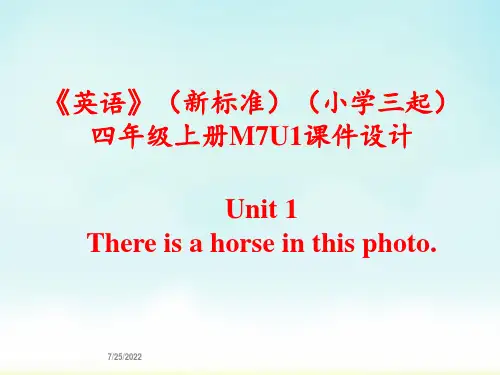
Look and say.
There is a cat. There is a girl under the tree.
Find and answer.
It’s climbing a tree. She’s watching the cat.
climb a tree
Look and answer.
Choose and describe.
Choose a number and try to describe the picture.
There is... He / She / It is...
7
1
2
3
4
5
6
图片中有两个男孩,我们还能够 用“There is...”来描述吗?
Look and say.
There are...
Photo 3
Photo 4
Look and fill.
There is a h_o_r_s_e in this photo. It’s_r_u_n_n_in_g__fa_s_t.
Look and fill. sheep
vegetables
There is a sheep in this photo. It’s eating vegetables .
2. Describe the picture of Activity 4 using “There is... in the photo. He / She is…”
Summary.
There is a horse in the photo.
It's running fast.
she's riding a horse
外研版(一起)三年级上册《Module_7_Unit_1》小学英语-有答案-同步练习卷(1)

外研版(一起)三年级上册《Module 7 Unit 1 Have you got aheadache》同步练习卷(1)一、看图连线.)1.A.B.C.________D.2. Has she got a stomach ache?________3. 翻译No, I haven't got a headache.________4. 翻译Have you got a test on Friday?________5. 翻译句子Sam, you are a clever boy.________6. 翻译句子I have a test today.________三、单项选择.)7. Have you ____ a test today?()A.gotB.gettingC.gets8. I ____ got a stomachache.()A.amB.canC.have9. ﹣ Have you got a headache?﹣ No, I ____.()A.haveB.haven'tC.can't10. Don't worry. You are a ____ boy.()A.cleverB.slowC.tired11. ﹣ Have you got a test?﹣ Yes, I ____.()A.haveB.haven'tC.am12. ____ you got a stomach ache?()A.HaveB.HasC.Are四、找出句子中错误的一项并改正.)13. 找出句子中错误的一项并改正.Does you got a headache?________14. 找出句子中错误的一项并改正.Is he got a pen?________15. 找出句子中错误的一项并改正.You doesn't like tests.________16. 找出句子中错误的一项并改正.Can I listen for my CDs?________参考答案与试题解析外研版(一起)三年级上册《Module 7 Unit 1 Have you got aheadache》同步练习卷(1)一、看图连线.1.【答案】C,A,B,D【考点】看图作答【解析】(1)我肚子疼.(2)我头疼.(3)我有一个新书包.(4)我有一个新铅笔盒.【解答】考查看图作答.(1)C.由题,此句句意为"我肚子疼.",C选项中人物抱着肚子且难受的表情,是肚子疼,符合.故选:C.(2)A.由题,此句句意为"我头疼.",A选项中人物抱着头且难受的表情,是头疼,符合.故选:A.(3)B.由题,此句句意为"我有一个新书包.",B选项是书包,符合.故选:B.(4)D.由题,此句句意为"我有一个新铅笔盒.",D选项是铅笔盒,符合.故选:D.二、翻译下列句子.2.【答案】她胃痛吗?【考点】英译汉【解析】她胃痛吗?【解答】本题主要考查英译汉.she她,has got有,a stomach ache胃痛.句子为一般疑问句,结合整句与中文的表达习惯作答.故答案为:她胃痛吗?3.【答案】不,我没有头痛.【考点】英译汉【解析】不,我没有头痛.【解答】考查英译汉.分析英语句子,No不,I我,haven't got是现在完成时的否定形式,haven't got a headache没有头痛.本句是现在完成时的否定句,结合整句及汉语表达习惯,据此本句翻译为:不,我没有头痛.故答案为:不,我没有头痛.4.【答案】你星期五有考试吗?【考点】英译汉【解析】你星期五有考试吗?【解答】考查英译汉.分析英语句子,Have是助动词,引导一般疑问句,放于句首,have got相当于have"有",Have you got你有,a test一个考试,on Friday星期五,句末加问号,本句是一般疑问句,结合整句及汉语表达习惯,据此本句翻译为:你星期五有考试吗?故答案为:你星期五有考试吗?5.【答案】山姆,你是一个聪明的男孩.【考点】英译汉【解析】山姆,你是一个聪明的男孩.【解答】本题主要考查英译汉.Sam山姆;you你;are是;a clever boy一个聪明的男孩;结合整句与中文的表达习惯作答.故答案为:山姆,你是一个聪明的男孩.6.【答案】我今天有一场考试.【考点】英译汉【解析】我今天有一场考试.【解答】本题主要考查英译汉.I我,have有,a test一场考试,today今天,结合整句与中文的表达习惯作答.故答案为:我今天有一场考试.三、单项选择.7.【答案】A【考点】一般过去时,动词过去式今天你有一个测试吗?【解答】考查动词的过去分词.由题,have got为现在完成时形式的固定搭配,表示"有",其中get要使用过去分词形式got.故选:A.8.【答案】C【考点】助动词【解析】我肚子疼.【解答】考查助动词.句子是现在完成时,A.am是,系动词,不符合题意,B.can情态动词,能,会,不符合题意,C.have助动词,have got构成搭配,符合题意.故选:C.9.【答案】B【考点】一般疑问句【解析】你头疼了吗?不,我没有.【解答】本题主要考查一般疑问句.问句可知,句子是一般疑问句,have来提问,have来作答,no说明句子是否定回答.所以主语I后面用haven't.故选:B.10.【答案】A【考点】形容词【解析】别担心,你是一个聪明的男孩.【解答】本题主要考查形容词词义的辨析.clever意思为:聪明的;slow意思为:缓慢的;tired 意思为:疲倦的.句意可知,别担心,你是一个____的男孩.可知A选项符合句意.故选:A.11.【答案】A【考点】你测试了吗?是的,我测试了.【解答】本题主要考查一般疑问句.根据题干,可知句子是现在完成时态.have来提问,则用have来作答.yes说明是肯定回答,所以主语I后面用助动词have.故选:A.12.【答案】A【考点】助动词【解析】你胃痛吗?【解答】考查助动词.A.Have助动词原形.B.Has第三人称单数.C.Are是.have got"有"固定搭配,主语you"你"第二人称,用助动词原形Have.故选:A.四、找出句子中错误的一项并改正.13.【答案】Does→Have【考点】句子改错【解析】你头疼吗?【解答】考查句子改错.由题,have got译为:有,为固定搭配,故将Does改为Have.故填:Does→Have.14.【答案】Is→Has【考点】句子改错【解析】他有支钢笔吗?【解答】本题考查句子改错.根据句意他有支钢笔吗?has got有是固定短语,所以把Is改成Has.故答案为:Is→Has.15.【答案】doesn't→don't【解析】你不喜欢测试.【解答】本题考查句子改错.根据you,后面不能用第三人称单数形式,所以把doesn't改成don't.故答案为:doesn't→don't.16.【答案】listen→listen to【考点】句子改错【解析】我能听CD吗?【解答】本题考查句子改错.根据句意:我能听CD吗?listen to"听…"是固定用法,listen是不及物动词,后面要加介词to,所以把listen改成listen to.故答案为:listen→listen to.。
外研版(三起)三年级英语上册Module 1 Unit 1 It's the ABC song课件

A, A is for apple. B, B is for bag.
Presentation
呈现活动 2
Look, compare and learn.
Cc /siː/
C, C is for cat.
Dd /diː/
D, D is for dog.
Ee /iː/
E, E is for egg.
Ff /ef/
U, U is for usually. V, V is for vacation.
Ww
Xx
/ˈdʌbljuː/
/eks/
Yy /waɪ/
W, W is for window. X, X is for X-ray. Y, Y is for yellow.
Zz /zed/
Z, Z is for zoo.
favourite 最喜欢的
Presentation
学习句子:What’s your favourite song?
Read and answer.
What’s your favourite song?
It’s the...
Presentation
Lead-in.
呈现活动 2 What’s Ms Smart’s favourite song? Let’s listen.
Kk /keɪ/
K, k is for kite.
Ll
Mm
Nn
/el/
/em/
/en/
L, L is for lion. M, M is for mouse. N, N is for noodles.
Oo
Pp
/əʊ/
/piː/
O, O is for orange. P, P is for pig.
外研版一起英语五年级上册Module7 Unit 1 His dog can help him课件
I´ve got big ears and very big feet. I´ve got a trunk.
I’ve got a tail, always shake(摇摆),and a wet nose,and also has alarming(警觉) ears
Do you like dogs?
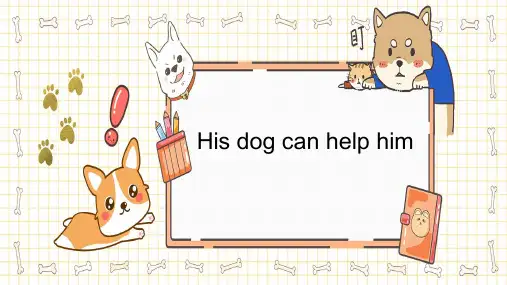
His dog can help him
I’ve got small ears. I’m very big. I like honey and I’m brown.
I’ve got a big mouth and small ears. I can jump very well. I’m green.
many
blind
Many
people
dogs special
have
show is
There
dogs
a
TV arn today?
clever cute useful cool
can't
+动词原形
Dogs are our friends!
Homework
情态动词can 表示一种能力
情态动词can 后接动词原形, 否定句直接在其后面加not
注:can not=can't
animals rabbit monkey panda tiger
what can do jump
climb trees eat
run fast
can / can't
can can't
Can Fifi help blind people?
Listening
What can dogs do? Can Fifi help blind people?
外研版(一起)六年级英语上册《Module7Unit1》教案设计
外研版(一起)六年级英语上册《Module 7 Unit 1》教案设计一、教学目标1. 知识与技能目标:学生能够理解并运用本课所学的单词和句型,描述和询问过去发生的事情。
2. 过程与方法目标:通过图片、视频等教学资源,激发学生的学习兴趣,提高学生的听说能力和交际能力。
3. 情感态度与价值观目标:培养学生对英语学习的兴趣和自信心,提高学生的跨文化交际意识。
二、教学内容1. 词汇:yesterday, last week, two days ago, got up, went to school, had breakfast, visited, played football, did homework, read books等。
2. 句型: What did you do yesterday? I played football with my friends. When did you visit your grandparents? I visited them last week.三、教学重点与难点1. 教学重点:掌握本课的词汇和句型,能够运用所学知识描述和询问过去发生的事情。
2. 教学难点:正确运用过去时态,区分不同时间状语。
四、教具与学具准备1. 教具:PPT课件、视频、图片、录音机等。
2. 学具:学生用书、练习册、笔记本等。
五、教学过程1. 导入:通过歌曲或游戏,激发学生的学习兴趣,引导学生进入英语学习状态。
2. 新课展示:利用PPT课件、视频等教学资源,呈现本课的词汇和句型,引导学生理解和模仿。
3. 操练:通过角色扮演、小组讨论等形式,让学生运用所学知识进行实际操作,提高学生的听说能力和交际能力。
4. 巩固:通过练习题、游戏等活动,巩固所学知识,检测学生的学习效果。
六、板书设计1. Module 7 Unit 1 What did you do yesterday?2. 词汇:yesterday, last week, two days ago, got up, went to school, had breakfast, visited, played football, did homework, read books等。
新外研版四年级英语上册《Module7 Unit1》精品课件(共35张PPT).ppt
There is a sheep in this photo . It’s eating vegetables .
There is a horse in this photo . It’s running .
There is a It’s
in this photo. .
1
2
3
4
5
1
6
2
There is a sheep in this photo. It’s running.
• 9、春去春又回,新桃换旧符。在那桃花盛开的地方,在这醉人芬芳的季节,愿你生活像春天一样阳光,心情像桃花一样美丽,日子像桃子一样甜蜜。 2020/8/172020/8/17Monday, August 17, 2020
有
照片
It’s eating a banana.
fruit (水果)
There is a panda in this photo 。 It’s eating fruit .
bear
熊
There is a bear in this photo . It’s eating sweets .
vegetable
有
There are some nice photos here .
这儿有一些好看的照片
who 谁 Who’s the girl?
She's Xiao Xue.
Who’s this man?
face
脸,面
孔
I can’t see his face.
You can see his face now.
看电视
watch the cat
看猫
There is a cat in this photo.
外研版小学英语三年级第二册Module7Unit1基础知识精讲精练
外研版小学英语三年级第二册Module7Unit1基础知识精讲精练共10页Module7Unit1教材内容全解(课本汉英翻译,重点词汇、句型讲解)Module7Unit1单元巩固练习(有听力材料,有试题答案)Module7Unit1教材内容全解Module7 Unit1 We fly kites in spring.我们在春天放风筝。
1.Listen and chant.听一听,并说唱。
【课文全译】I like summer, 我喜欢夏天,It’s my favourite season. 它是我最喜欢的季节。
I go swimming 我去游泳in this nice season. 在这个迷人的(美好的)季节里。
【课文注解】①summer(名词)夏天,短语:in summer在夏天,in spring在春天,in autumn在秋天,in winter在冬天,例句:It’s very hot in summer.夏天天气很热。
②favourite(形容词)最喜欢的,例句:——What’s your favourite colour?你最喜欢的颜色是什么?——My favourite colour is red.我最喜欢的颜色是红色。
③season(名词)季节,巧记:sea(大海)+son(儿子)=season(季节),例句:There are four seasons in a year.一年有四个季节。
——Which season do you like best?你最喜欢哪个季节?——I like summer best.我最喜欢夏天。
④nice(形容词)迷人的,令人愉快的,例句:Do you have a nice time?你们过得开心吗?【注意】nice(形容词)友好的,亲切的,讨人喜欢的,例如:Ms Smart is a nice teacher.斯玛特女士是位好老师。
The old man is nice.这位老人很亲切。
2021-2022学年外研版三年级上册英语Module 1 Unit 1 I'm Sam课件
Grammar
2.Hello, I’m Sam.
句型结构:I’m+名字. 用法:I’m=I am, 此句型用于与别人初次见面时作自
我介绍,前面可以加 hello,通过打招呼引起 对方注意,对方一般会有礼貌地问好。 eg:I’m Lingling. 我是玲玲。
知识拓展:介绍自己也可以用句型“My name is+名 字.”意为“我的名字是……”。
4. hi ___你_好____
5. hello ___你_好_____
6. goodbye ___再_见___
二、单项选择。
( C )1. ______, Sam.
A. I
B. am
C. Hi
( B )2.—Goodbye, Daming. —_______, Sam.
A. I’m
B. Bye-bye C. Hello
ห้องสมุดไป่ตู้
Game(3)
传声筒
将全班分成四组,老师分别告诉每组第一名同学一 句问候语“Hello”,“Hi”,“ Goodbye ”,“Byebye”。每一位同学悄悄告诉下一位同学,先传完问候语 的为获胜组。
Exercise
一、汉译英。
1. I ____我____
2. am _____是____
3. I am ___我__是____
亲爱的读者: 春去春又回,新桃换旧符。在那桃花盛开 的地方,在这醉人芬芳的季节,愿你生活像 春天一样阳光,心情像桃花一样美丽,感谢 你的阅读。
hello /hə'ləʊ/(hi)(感叹词)你好 短语: say hello to... 向……问好 同义词: hi 你好 例句: —Hello!你好!
—Hi!你好!