
鲁教版五四制英语六年级下Unit 1 核心知识点
六年级下册Unit1一、Vocabulary单词:1、Unit1全部单词2、1st-31st二、Phrases短语:1、几岁how old2、在八月in August3、想要做want to do4、来参加我的生日聚会come to my birthday party5、在三点钟at three6、今天下午this afternoon7、在今天下午三点at three this afternoon8、在四月一日on April1st9、你哥哥的生日your brother’s birthday10、。
怎么样?How about...11、英语测试English test12、学校郊游school trip13、篮球比赛basketball game14、足球比赛soccer game15、英语日English Day16、艺术节art festival17、学校活动日School Day18、体育节/体育日Sports Day19、图书特卖会book sale20、这学期this term21、举办学校郊游have a school trip22、在上午/早上in the morning23、在下午in the afternoon24、在晚上in the evening25、在12和15号on the12th and the15th26、在9月26日和27日on September26th and27th27、举行两场球类比赛have two ball games28、来我们学校come to our school29、(在)下个月next month30、(在)下周next week31、举办艺术节have an art festival32、举办英语聚会have an English party33、举办售书活动have a book sale34、在学校图书馆in the school library35、这些中国的节日these holidays in China36、。
的日期the date for--What’s the date today?今天是什么日期?--Today is March12nd.今天是3月12日。
--What day is today?=What day is it today?今天是星期几?--Today is Thursday/It is Thursday。
今天是周四。
37、这些中国节日的日期the dates for these holidays in China38、儿童节Children’s Day39、国庆节National Day40、妇女节Women's Day41、新年New Year's Day42、我的叔叔的20岁生日my uncle’s twentieth birthday43、邀请某人做。
invite sb.to do三、Key notes重点知识点:1、1-12月(用in)单词拼写:January,February,March,April,May,June,July,August,September,October, November,December2、want to do sth.想要做某事四、Target language重点句子:1、Do you want to come to my birthday party?你想来参加我的生日聚会吗?2、--Happy birthday!(祝你)生日快乐!--Thank you.谢谢。
2、--How old are you?你几岁了?--I'm thirteen years old.=I'm thirteen.我13岁。
3、--When is Alice’s birthday?爱丽丝的生日是什么时候?--Her birhday is on September5th.她的生日在9月5日。
4、--See you!再见!--See you!=Good bye!5、--Is his birthday in July?他的生日是在7月吗?--Yes,it is.是的。
6、How about you and Tom?那你和汤姆呢?7、本学期我们为大家安排了一些有趣又好玩的活动。
We have some interesting and fun things for you this term.8、在3月21日下午我们举行学校郊游。
On March21st,we have a school trip in the afternoon.9、在12和15号,我们举办两场球类比赛:足球和排球。
On the12th and the15th,we have two ball games,soccer and volleyball.10、你们的家长可以前来学校。
Your parents can come to our school.11、我们下个月举办艺术节。
Next month,we have an art festival.12、在6月3日,我们在学校图书馆举行售书活动。
On June3rd,we have a book sale in the school library.13、这真是个忙碌的学期!This is a really busy term.14、祝你过得愉快!Have a good time!15、四月是一年中第四个月份。
April is the fourth month of the year.16、十二月是一年中最后一个月份。
December is the last month of the year.17、母亲节是五月的第二个星期天。
Mother's Day is the second Sunday in May.五、Grammars重点语法:1、1-31序数词拼写:基变序,有规律,词尾加上th。
一二三特殊记(first,second,third),八加h(eighth),九减e(ninth)ve要用f替,(five fifth;twelve twelfth)变y为ie,(twenty twentieth,thirty thirtieth)+th最后加上去,若是第几十几,前为基,后为序。
(twenty-one twenty-first;twenty-four twenty-fourth)基数词:表示个数,“多少个”序数词:表示先后顺序,“第几个”“the+序数词”P97比如:明天是我的叔叔的20岁生日。
Tomorrow is my uncle’s twentieth birthday.1-100的基数词和序数词基数词Cardinal Numbers序数词Ordinal Numbers基数词Cardinal Numbers序数词Ordinal Numbers1one first1st17seventeen seventeenth17th2two second2nd18eighteen eighteenth18th3three third3rd19nineteen nineteenth19th4four fourth4th20twenty twentieth20th5five fifth5th21twenty-one twenty-first21st6six sixth6th22twenty-two twenty-second22nd7seven seventh7th23twenty-three twenty-third23rd8eight eighth8th24twenty-four twenty-fourth24th9nine ninth9th25twenty-five twenty-fifth25th10ten tenth10th26twenty-six twenty-sixth26th11eleven eleventh11th27twenty-seven twenty-seventh27th12twelve twelfth12th28twenty-eight twenty-eighth28th13thirteen thirteenth13th29twenty-nine twenty-ninth29th14fourteen fourteenth14th30thirty thirtieth30th15fifteen fifteenth15th31thirty-one thirty-first31st16sixteen sixteenth16th40forty fortieth40th50fifty fiftieth50th100hundred hundredth100th101one hundred and one one hundred and first101st2、When特殊疑问词,引导特殊疑问句,对时间(年、月、日)提问When=What timeWhen+一般疑问句?或者When+陈述句语序?--When is Alice’s birthday?爱丽丝的生日是什么时候?--Her birthday is on September5th.她的生日是9月5日。
--When is his birthday?他的生日是什么时间?--His birthday is in January.他的生日是在1月。
补充:特殊疑问句有两种语序:1).如疑问词作主语或主语的定语(修饰名词),即对主语或主语的定语提问,其语序是陈述句语序Whose bike is broken?谁的自行车坏了?When is school trip?学校郊游是什么时候?如疑问词作其他成分,即对其他成分提问,2)其语序是:特殊疑问词+一般疑问句【特殊疑问词+be/助动词/情态动词+主语+谓语】What’s this in English?(六年级上Unit2标题)What time does he get up every morning﹖3、How old...多大年龄?/几岁?--How old+be动词(am/is/are)+主语?多大年龄?/几岁?--主语+am/is/are+基数词+(years/months old).--How old is your brother?你弟弟几岁了?--He is eleven(years old).他11岁。
注:How old are you?=What is your age?4、所有格:’s和A of B有生命的:’s没有生命:A of B情况构成读音例词Kate's,dog’s,friend’s 单数名词+’s在清辅音后读[s],在元音和浊辅音后读[z]复数名词规则变复数+’读音不变The twins’room,the boys’trousersWomen’s clothes 不规则+’s在清辅音后读[s],在元音和浊辅音后读[z]注:1)当表示两人分别拥有时,应在各自后加’s。
英语六年级下册第一单元知识点
英语六年级下册第一单元知识点English: In the first unit of the sixth-grade English textbook, students typically learn about various topics such as introducing oneself, talking about hobbies, describing family members, discussing daily routines, and expressing likes and dislikes. They are introduced to new vocabulary related to these themes, along with grammar points such as present simple tense, possessive adjectives, basic prepositions of place and time, and question forms. Reading passages and dialogues are provided to reinforce comprehension skills, and students are encouraged to engage in speaking activities to practice their oral communication. Additionally, they may learn about cultural aspects related to English-speaking countries, fostering a broader understanding of the language and its context. Throughout the unit, students engage in activities that promote listening, speaking, reading, and writing skills, aiming for comprehensive language acquisition.中文翻译: 在六年级英语教科书的第一单元中,学生通常会学习各种主题,如自我介绍,谈论爱好,描述家庭成员,讨论日常作息,以及表达喜好和不喜欢。
新鲁教版六年级英语(五四制)下册 Unit 5 Section B-1 课件
1a. Match the words with the pictures.
1. ___bus stop b
3. ___ c bus station
2. ___ a train station 4. ___ d subway station
1b. Tell your partner how you get to school. Imagine you use two types of transportation.
How do you get to school?
ride a bike (go by bike)
take the bus (go by bus)
take the train (go by train) take the car (go by car)
take the subway
(go by subway)
1d. Listen again. How does Bob get to his grandparent’ home? √ ) 1 or 2. Check (
√
1e. Talk about how Bob gets to his grandparents’ home.
A: How does grandpa get to the park?
A: How do you get to schmy bike to the subway
station. Then I take the subway.
bike
car
bus
subway
train
plane
1c. Listen and check the things that Mary wants to know.
鲁教版五四制六年级下Unit1 Section A和Section B课件

seventh
ninth eleventh thirteenth fifteenth
8th
10th 12th 14th 16th
eighth
tenth twelfth fourteenth sixteenth
How to spell?
17th 20th seventeenth twentieth
21st
March
April May
May
全写
缩写
六月
七月
June
July August September October November December
Jun.
Jul.
八月
九月 十月 十一月 十二月
Aug.
Sept. Oct. Nov. Dec.
January, March, May, July, August, October, December
one
two
first
six seven eight nine ten
sixth seventh
second
third
three
four
eighth
ninth tenth
fourth
fifth
five
eleven twelve thirteen fourteen fifteen
eleventh
twelfth
7. July
8. August
9. September
10. October11. Nove源自ber12. December
1b Listen and number the conversations[1-3]. 1 A: When is your birthday, Linda? B: My birthday is on May 2nd. 2 A: When is your birthday, Mary ? B: It’s on January 5th. A: When is your birthday, Mike? 3 B: My birthday is on June 3rd.
鲁教版五四制六年级下册unit1--unit10重点短语句式清单
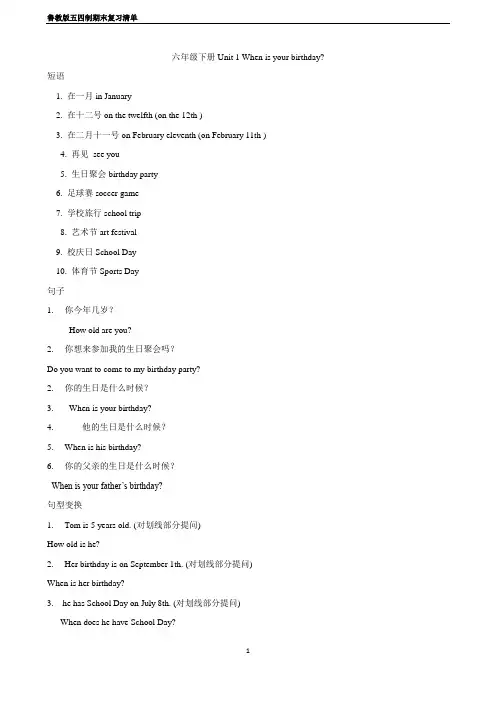
六年级下册Unit 1 When is your birthday? 短语1. 在一月in January2. 在十二号on the twelfth (on the 12th )3. 在二月十一号on February eleventh (on February 11th )4. 再见see you5. 生日聚会birthday party6. 足球赛soccer game7. 学校旅行school trip8. 艺术节art festival9. 校庆日School Day10. 体育节Sports Day句子1.你今年几岁?How old are you?2. 你想来参加我的生日聚会吗?Do you want to come to my birthday party?2.你的生日是什么时候?3.When is your birthday?4.他的生日是什么时候?5.When is his birthday?6.你的父亲的生日是什么时候?When is your father’s birthday?句型变换1. Tom is 5 years old. (对划线部分提问)How old is he?2. Her birthday is on September 1th. (对划线部分提问)When is her birthday?3. he has School Day on July 8th. (对划线部分提问)When does he have School Day?4. We have two soccer games. (改为一般疑问句,并作否定回答)Do you have two soccer games? No, we don’t.Unit2 My favorite subject is science 短语1.和我们玩游戏play games with us(play with sb./ sth.)2. 肯定for sure3. 第二天the next day4. 想要见面want to meet5. 因为…而感谢thank you for sth/ v-ing6. 从…到…from…to….句子1.你最喜欢的科目是什么?我最喜欢的科目是科学。
鲁教版五四制英语六年级下册Unit1 SectionA 教材知识精讲
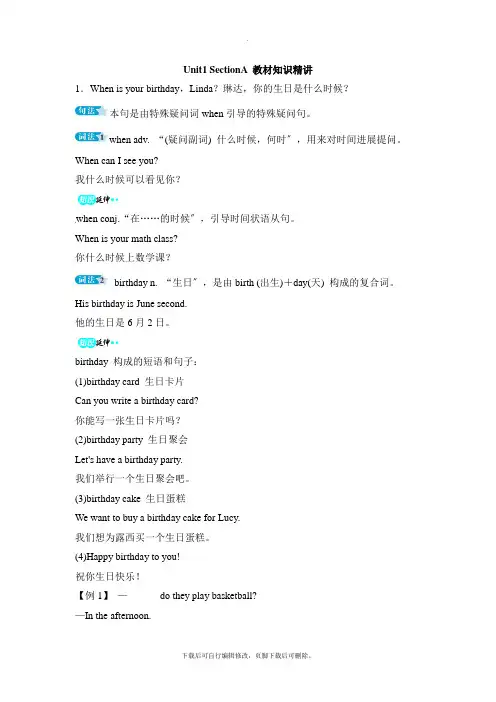
Unit1 SectionA 教材知识精讲1.When is your birthday,Linda?琳达,你的生日是什么时候?本句是由特殊疑问词when引导的特殊疑问句。
when adv. “(疑问副词) 什么时候,何时〞,用来对时间进展提问。
When can I see you?我什么时候可以看见你?when conj.“在……的时候〞,引导时间状语从句。
When is your math class?你什么时候上数学课?birthday n. “生日〞,是由birth (出生)+day(天) 构成的复合词。
His birthday is June second.他的生日是6月2日。
birthday 构成的短语和句子:(1)birthday card 生日卡片Can you write a birthday card?你能写一张生日卡片吗?(2)birthday party 生日聚会Let's have a birthday party.我们举行一个生日聚会吧。
(3)birthday cake 生日蛋糕We want to buy a birthday cake for Lucy.我们想为露西买一个生日蛋糕。
(4)Happy birthday to you!祝你生日快乐!【例1】—______ do they play basketball?—In the afternoon.A.What B.HowC.WhereD.When解析此题考察特殊疑问词的用法。
A项“什么〞,用来对事物进展提问;B项“怎样〞,对方式或情况进展提问;C项“哪里〞,对地点进展提问;D项“什么时候,何时〞,对时间进展提问。
根据答语我们可以确定该句是对时间的提问。
应选D项。
答案D句意——他们什么时候打篮球?——在下午。
【例2】—Happy birthday!—______.A.Thank you B.The same to you C.Thank D.That's all right解析C项表达错误,排除;D项“没关系,不客气〞,不符合句意,排除;B项“你也一样〞,不符合实际情况,排除;当别人祝你生日快乐时,你要表示谢意。
鲁教版六年级英语单词
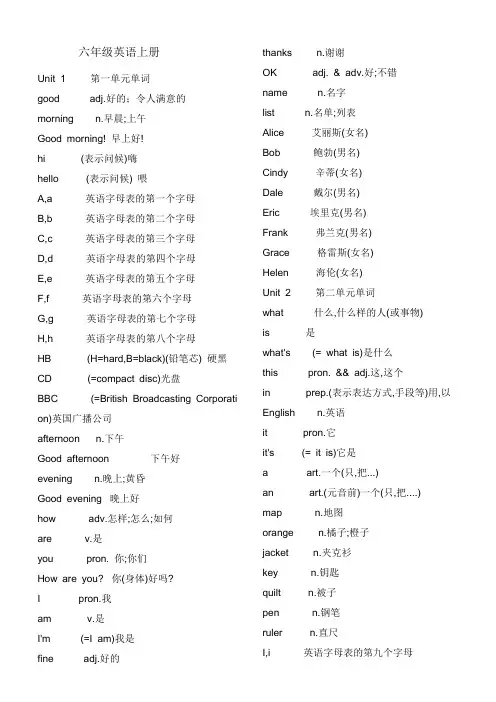
六年级英语上册Unit 1 第一单元单词good adj.好的;令人满意的morning n.早晨;上午Good morning! 早上好!hi (表示问候)嗨hello (表示问候) 喂A,a 英语字母表的第一个字母B,b 英语字母表的第二个字母C,c 英语字母表的第三个字母D,d 英语字母表的第四个字母E,e 英语字母表的第五个字母F,f 英语字母表的第六个字母G,g 英语字母表的第七个字母H,h 英语字母表的第八个字母HB (H=hard,B=black)(铅笔芯) 硬黑CD (=compact disc)光盘BBC (=British Broadcasting Corporati on)英国广播公司afternoon n.下午Good afternoon 下午好evening n.晚上;黄昏Good evening 晚上好how adv.怎样;怎么;如何are v.是you pron. 你;你们How are you? 你(身体)好吗?I pron.我am v.是I'm (=I am)我是fine adj.好的thanks n.谢谢OK adj. & adv.好;不错name n.名字list n.名单;列表Alice 艾丽斯(女名)Bob 鲍勃(男名)Cindy 辛蒂(女名)Dale 戴尔(男名)Eric 埃里克(男名)Frank 弗兰克(男名)Grace 格雷斯(女名)Helen 海伦(女名)Unit 2 第二单元单词what 什么,什么样的人(或事物)is 是what's (= what is)是什么this pron. && adj.这,这个in prep.(表示表达方式,手段等)用,以English n.英语it pron.它it's (= it is)它是a art.一个(只,把...)an art.(元音前)一个(只,把....)map n.地图orange n.橘子;橙子jacket n.夹克衫key n.钥匙quilt n.被子pen n.钢笔ruler n.直尺I,i 英语字母表的第九个字母J,j 英语字母表的第十个字母K,k 英语字母表的第十一个字母L,l 英语字母表的第十二个字母M,m 英语字母表的第十三个字母N,n 英语字母表的第十四个字母O,o 英语字母表的第十五个字母P,p 英语字母表的第十六个字母Q,q 英语字母表的第十七个字母R,r 英语字母表的第十八个字母p (=parking)abbr. (路标所示)停车(区) NBA (=National Basketball Associatio n)abbr.(美国)全国篮球协会kg (=kilogram) abbr.千克spell v.拼写;拼字please adv.(祈使句中用作请求的客套话)请Unit 3 第三单元单词color n.色;颜色red adj.&&n.红(色)的yellow adj.&&n.黄(色)的green adj.&&n.绿(色)的blue adj.&&n.蓝(色)的black adj.&&n.黑(色)的white adj.&&n.白(色)的and conj.和;又;而且S,s 英语字母表的第十九个字母T,t 英语字母表的第二十个字母U,u 英语字母表的第二十一个字母V,v 英语字母表的第二十二个字母W,w 英语字母表的第二十三个字母X,x 英语字母表的第二十四个字母Y,y 英语字母表的第二十五个字母Z,z 英语字母表的第二十六个字母S (=small) abbr.(尤指衣物的尺寸)小号M (=medium) abbr. (尤指衣物的尺寸)中号L (=large) abbr. (尤指衣物的尺寸)大号UFO (=unidentified flying object) abb r.不明飞行物CCTV (=China Central Television) ab br.中国中央电视台UN (=United Nations) abbr.联合国the art.表示特指的人、物或群体Unit 4 第四单元my prop. 我的name's = name is 名字叫clock n.时钟nice adj.好的;令人愉快的to part.用于与动词原形一起构成动词不定式meet v.遇见;相逢your pron.你的;你们的his prom.他的her pron.她的question n.问题;难题answer n.回答;答复;答案look v.看;望;看起来first adj.第一的first name 名字last adj.最后的;上一个的last name 姓氏boy n.男孩girl n.女孩zero num.&& n.零one num.一two num.二three num.三four num.四five num.五six num.六seven num.七eight num.八nine num.九telephone n.电话number n.数;数字telephone number 电话号码phone n.电话;电话机phone number 电话号码card n.卡;卡片;纸牌ID card (ID = identification) 身份证family n.家;家庭family name 姓氏Jenny 詹妮(女名)Gina 吉娜(女名)Alan 艾伦(男名)Mary 玛丽(女名)Jim 吉姆(男名)Tony 托尼(男名)Tom 汤姆(男名)Mike 迈克(男名)Green 格林(姓)Miller 米勒(姓)Jack 杰克(男名)Smith 史密斯(姓)Brown 布朗(姓)Linda 琳达(女名)Nick 尼克(男名)Kim 金(女名)Hand 汉德(姓)Unit 5 第五单元单词pencil n.铅笔book n.书eraser n.橡皮case n.箱;盒;橱pencil case 钢笔盒;文具盒backpack n.双肩背包pencil sharpener 卷笔刀;铅笔刀dictionary n.字典;词曲that pron.&& adj.那;那个yes adv.(表示肯定)是no adv.(表示否定)不;不是not adv.(构成否定形式)不是isn't = is not 不是excuse v.原谅;宽恕excuse me 请原谅(客套话,用于与陌生人搭话、打断别人说话等场合)thank v.谢谢OK interj.好;不错do v.&& aux. 做,干;构成否定句、疑问句的助动词baseball n.棒球watch n.手表computer n.电脑;电子计算机game n.游戏computer game 电子游戏notebook n.笔记本ring n.环;戒指call v.打电话at prep.在…(里面或附近);在...(点、刻);以in prep.在...里面lost v. 遗失found v.找回lost and found 失物招领school n.学校a set of 一套;一副of prep.(属于)……的Tim 蒂姆(男名)Sonia 索尼娅(女名)Jane 简(女名)Kelsey 凯思(女名)David 大卫(男名)Unit 6 第六单元单词sister n.姐;妹mother n.妈妈;母亲father n.爸爸;父亲parent n.父亲或母亲brother n.兄;弟grandmother n.祖母;外祖母grandfather n.祖父;外祖父friend n.朋友grandparent n.祖父(母);外祖父(母)those pron. && adj.那些that's (= that is)那是these pron. && adj.这些she pron.她he pron.他he's (=he is)他是aunt n. 姨母;姑母;伯母;婶母;舅母son n.儿子cousin n.堂(表)兄弟;堂(表)姐妹daughter n.女儿uncle n.叔;伯;舅;姨父;姑父picture n.照片;图画dear adj.(冠于信函中的称谓,以示礽礼貌)亲爱的for prep.(表示目的或原因)为了thanks for 为...而感谢photo n.照片;相片here adv. 这里;在这里Dave 戴维(男名)Anna 安娜(女名)Paul 保罗(男名)Emma 埃玛(女名)Mona 莫娜(女名)Unit 7 第七单元where adv.(疑问副词)在哪里where's (= where is)在哪里?table n.桌子bed n.床dresser 梳妆台bookcase 书橱;书柜sofa 沙发chair n. 椅子drawer 抽屉plant n.植物under prep.在...之下they 他们;它们;她们they're = they areon prep.在...之上don't = do notknow v.知道;了解bag n.书包;提包;口袋math n.数学alarm clock 闹钟video adj.录象带;视频tape n.录音带video tape 录像带hat n.帽子take v.拿走;带到thing n.东西;物to prep.朝;向;至;达mom 妈妈can modal v.能;可以;会bring v.拿来;取来;带来some adj.&& pron.一些;若干need v.需要floor n.地板;地面room n.房间TV (=television)电视机desk n.书桌;课桌Tommy 汤米(男名)Sally 萨莉(女名)Unit 8 第8单元have v.有soccer n.英式足球ball n.球soccer ball 英式足球tennis n.网球racket n.(网球、羽毛球的)球拍tennis racket 网球拍ping-pong n.乒乓球volleyball n.排球basketball n.篮球bat n.(乒乓球等的)球拍does v. && aux.(动词do的第三人称单数形式)做;干;构成否定名、疑问句的助动词doesn't = does notlet v.允许;让us pron.我们(宾语)let's = let usplay v.玩;打(球)well interj.喔;噢;唔;这个(用来引出一句话,继续讲述或填补间歇)sound v.听起来sport n.运动we pron.我们many adj.大量的club n.社团;俱乐部more pron.更多的;更大的class n. 班级;(一节)课interesting adj.有趣的;令人感兴趣的boring adj.无聊的;令人生厌的fun adj.有趣的;令人愉快的difficult adj.困难的relaxing adj.轻松的watch v.观看;注视watch TV 看电视has v.(have的第三人称单数形式)有great adj.美妙的;大的collection n.收藏品;收集物but conj.但是play sports 参加体育运动或比赛only adv.只;仅仅them pron.(they的宾格)他(她,它)们every adj. 每一;每个day n.天;日间;白天Peter 彼得(男名Barry 巴里(男名)Ed 埃得(男名)Hall 霍尔(姓)Unit 9 第九单元单词like v.喜欢banana n.香蕉hamburger n.汉堡包tomato n.西红柿broccoli n.花椰菜French fries 炸马铃薯条;薯条ice n.冰cream n.奶油;乳脂ice cream n.冰淇淋salad n.沙拉strawberry n.草莓pear n.梨have v.吃;饮oh interj. 啊;噢;呀(表示惊呀等)countable noun 可数名词uncountable noun 不可数名词food n.食物egg n.鸡蛋apple n.苹果carrot n.胡萝卜chicken n.鸡;鸡肉breakfast n.早餐lunch n.午餐dinner n.晚餐;正餐fruit n.水果vegetable n.蔬菜;植物runner n.奔跑者eat v.吃well adv.好、对、满意地run v.跑;奔跑star n.星星;明星lot adv. 许多lots of 大量;许多healthy a.健康的;强健的dessert n.(饭后的)甜食Bill 比尔(男名)Sandra 桑德拉(女名)Clark 克拉克(姓)Unit 10第十单元单词how much (价钱)多少pants n.裤子sock n. 短袜shirt n. 男衬衣;衬衫T-shirt n. T恤衫shorts n.(pl.)短裤sweater n.毛衣shoe n. 鞋skirt n. 裙子sale n.出售;廉价销售dollar n. 元(美国、加拿大货等车的货币单元,符号为$)big a. 广大的;重大的small a. 小的;小号的short a. 短的;矮的long a. 长的clerk n.(银行、办公室、商店等的)职员;办事员help v. 帮助;援助want v. 需要;想要Here you are. 给你。
鲁教版六年级下册英语
鲁教版六年级下册英语1. IntroductionThe Lu Jiao Edition is a comprehensive English textbook designed for sixth-grade students. This textbook focuses on improving students’ listening, speaking, reading, and writing skills in English. In this document, we will explore the contents of the Lu Jiao Edition of sixth-grade English, with a specific focus on the second semester of the sixth grade.2. Unit 1: My School LifeUnit 1 of the Lu Jiao Edition Sixth Grade English textbook focuses on introducing students to their school life. This unit includes various topics such as introducing oneself, talking about daily routines, subjects at school, and school facilities. The unit aims to help students communicate effectively in English, specifically in the context of their school life.3. Unit 2: My HobbiesUnit 2 of the Lu Jiao Edition Sixth Grade English textbook is centered around students’ hobbies. This unit aims to develop students’ English language skills while discussing their hobbies and interests. The unit covers topics such as different pastimes, favorite sports, and activities students enjoy doing. Through interactive activities and dialogues, students can learn to express their interests and preferences in English.4. Unit 3: My FamilyThe third unit of the Lu Jiao Edition Sixth Grade English textbook focuses on introducing students to the topic of family. This unit helps students learn how to describe their family members, talk about family relationships, and discuss daily activities with family members. By practicing conversations and participating in group activities, students can improve their English language skills while describing their family in English.5. Unit 4: My CommunityUnit 4 of the Lu Jiao Edition Sixth Grade English textbook explores the concept of community. This unit aims to en hance students’ English language skills by discussing their community, neighborhoods, and local services. The unit covers topics such as geography, transportation, and community events. Through various activities and exercises, students can expand their vocabulary and improve their ability to communicate in English about their community.6. Unit 5: Our EnvironmentIn Unit 5, students learn about the environment and the importance of environmental protection. This unit aims to promote environmental awareness among sixth-grade students while developing their English language skills. Students will learn new vocabulary related to the environment, discuss environmental problems, and explore ways to protect the environment in English. By engaging in group discussions and projects, students can deepen their understanding of environmental issues while improving their English fluency.7. Unit 6: Festivals and CelebrationsThe final unit of the Lu Jiao Edition Sixth Grade English textbook focuses on Festivals and Celebrations. This unit introduces students to different festivals and celebrations around the world, fostering cultural awareness and understanding. Students will learn about customs, traditions, and typical activities associated with various festivals. By participating in role-plays, discussions, and presentations, students can enhance their English language skills while gaining insights into different cultures.8. ConclusionThe Lu Jiao Edition Sixth Grade English textbook provides a comprehensive and interactive learning experience for students. Through various units, students can develop their English language skills in the context of their daily lives, family, community, environment, and cultural celebrations. With the help of this textbook, sixth-grade students can expand their vocabulary, improve their grammar, and enhance their overall English proficiency.。
鲁教版五四制英语六年级下册Unit1 【语法专项】:序数词和名词所有格的用法
【语法专项】:序数词和名词所有格的用法一、序数词序数词是表示顺序的数词。
序数词前常加定冠词the。
序数词的词形变化及其缩写形式:1.第1,2,3是独立的特殊形式,first 1st;second 2nd;third 3rd2.从4到19的序数词,是在相应的基数词的词尾加th,特别注意第五、第八、第九、第十二;fourth 4th;fifth 5th;sixth 6th,seventh 7th;eighth 8th;ninth 9th;tenth 10th;eleventh 11th;twelfth 12th3.20到90这些整十的数词,其相应的基数词都是以ty结尾,序数词一般是把基数词词尾的y变成ie,再加th。
twentieth 20th;thirtieth 30th;fortieth 40th;fiftieth 50th;sixtieth 60th;seventieth 70th;eightieth 80th;ninetieth 90th4.其余的两位数,只需将其相应基数词的个位改成序数词。
twentyfirst 21st;thirty-fourth 34th;sixtyninth 69th;ninetythird 93rd巧记基数词变为序数词:一、二、三要牢记,其余后面加th。
th里边有例外,你要格外记明白。
八去t,九去e,ve要用f替。
几十变y为ie,跟着再加th。
几十几只变个位数。
序数词表顺序,一般要加定冠词。
二、名词的所有格在汉语中,我们常用“的”表示某物归谁所有。
如:老师的书;丽萍的尺子等。
英语中的这种所属关系就是名词所有格,相当于汉语中的“的”。
所有格的类型:1.“'s”所有格有生命物体的名词以及表示时间、距离、国家、城市等的名词常用“'s”所有格。
It's twenty minutes' walk.步行二十分钟的路程。
有以下几种加's的情况:a .单数名词后直接加“'s”。
鲁教版(五四制)英语六年级下册 Unit 1 When is your birthdayPer
1st ________2nd _________3rd________4th _________
5th ________8th ________9th________12th ________
20th ________31st _________
用月份名词填空:
1._______ 1st is New Year’s Day.
7.New school year begins(新学年开始于)in ________.
StepV.Sum up
Homework
1.必做:Listen to the tape of Unit1for10minutes and recite them.
2.选做:Write the words of Unit1at least twice.
StepIII. Group work
Read and checkup the new words ingroups. The group master check-up the pronunciation of the words.
StepIV.达标检测
First Ss.do it,thencheck-up.(教师了解学生的达标情况。)
Two,second,2nd;twelve,twelfth,12th;
Three,third,3rd;twenty,twentieth,20th;
Five,fifth,5th;thirty,thirtieth,30th;
Eight,eighth,8th;thirty-one,thirty-first,31st.
Step II.预习检测
Explain:
January,February,March,April,May,June,July,August,September,October,November,November,December,birth,age,old.
鲁教版(五四制)六年级英语下册各单元重点知识汇总
鲁教版(五四制)六年级英语下册各单元重点知识汇总Unit 1 When is your birthday?Period 1 Section A(1a-2e)必背单词1.when adv. (疑问副词)什么时候→用于对时间进行提问2.month n.月;月份→(复数) months→(形近词) mouth n.嘴3.1—12月:January n.一月February n.二月March n.三月April n.四月May n.五月June n.六月July n.七月August n.八月September n.九月October n.十月November n.十一月December n.十二月happily adv.高兴地unhappy adj.不高兴的4.happy adj.愉快的;高兴的happiness n.高兴happier adj.(比较级)更高兴的5.6.party n.聚会→(复数) parties →have a party举行聚会必背短语7.Alice's birthday艾丽斯的生日8.your father's birthday 你父亲的生日9.in August 在八月10.at three this afternoon今天下午三点钟必背句子11.—When is your birthday,Mike?迈克,你的生日是什么时候?—My birthday is on June 3rd.我的生日是在六月三日。
12.Happy birthday! 生日快乐!13.—How old are you? 你多大了?—I'm thirteen. 我十三岁了。
14. Well,do you want to come to my birthday party?哦,你想来参加我的生日聚会吗?15.—When is it? 聚会是在什么时候?—At three this afternoon. 今天下午三点钟。