
英语-倒装句用法
倒装句用法总结归纳
一、部分倒装:
1. 否定副词位于句首时的倒装
在正式文体中,never, seldom, rarely, little, hardly, scarcely, no sooner, no longer, nowhere
等含有否定意义的副词若位于句首,则其后要用部分倒装:
I shall never forgive him. / Never shall I forgive him. 我永远不会宽恕他。
He seldom goes out for dinner. / Seldom does he go out for dinner. 他很少出去吃饭。
He little realizes how important this meeting is. / Little does he realize how important this
meeting is. 他不甚明白这个会议的重要性。
注意:
(1) 对于not…until句型,当not until…位于句首时,其后的主句要用倒装语序:
He didn’t leave the room until the rain stopped. / Not until the rain stopped did he leave the
room. 雨停了之后他才离开这房间。
(2) 某些起副词作用的介词短语,由于含有否定词,若位于句首,其后要用部分倒装:
On no accounts must this switch be touched. 这个开关是绝不能触摸的。
(3) 但是,in no time(立即,马上)位于句首时,其后无需用倒装语序:
In no time he worked out the problem. 他马上就算出了那道题。
2.“only+状语”位于句首时的倒装
当一个状语受副词only的修饰且置于句首时,其后用部分倒装语序:
Only then did he realize that he was wrong. 到那时他才意识到他错了。
Only in this way are you able to do it well. 你只有用这种方法才能把它做好。
3. “so+adj. / adv.”位于句首时的倒装
副词so后接形容词或副词位于句首时,其后用部分倒装:
So cold was the weather that we had to stay at home. 天气太冷,我们只好呆在家里。
So sudden was the attack that we had no time to escape. 袭击来得非常突然,我们来不及逃
跑。
4.“so+助动词+主语”倒装
当要表示前面提出的某一肯定的情况也同样适合于后者,通常就要用“So+助动词+主语”
这种倒装结构:
You are young and so am I. 你年轻,我也年轻。
If he can do it, so can I. 要是他能做此事,我也能。
注意:
(1) 若前面提出某一否定的情况,要表示后者也属于同样的否定情况,则应将其中的so改
为neither或nor:
You aren’t young and neither am I. 你不年轻,我也不年轻。
She hasn’t read it and nor have I. 她没有读它,我也没有读。
(2) 注意该结构与表示强调或同意的“so+主语+特殊动词”结构的区别:
"It was cold yesterday." "So it was." “昨天很冷。”“的确很冷。”
"Father, you promised." "Well, so I did." “爸爸,你答应过的。”“嗯,是答应过。”
5. 由“not only…but also”引出的倒装
当not only…but also位于句首引出句子时,not only 后的句子通常用部分倒装形式:
Not only is he a teacher, but he is also a poet. 他不仅是一位教师,而且是一位诗人。
Not only did he speak more correctly, but he spoke more easily. 不仅他讲得更正确,也讲得更
不费劲了。
6. 虚拟条件句的省略与倒装
当if引导的虚拟条件从句中含有had, were, should等时,如将if省略,则要将had, were, should
等移到主语前,构成倒装句:
Had you come yesterday, you would have seen him.若你昨天来,你就会见到他了。
Should you require anything give me a ring. 如果需要什么,可以给我打电话。
Were it not for your help, I would still be homeless. 要不是你帮助,我会仍然无家可归。
注意:
省略if后提前的had不一定是助动词:
Had I money, I would buy it. 假若我有钱,我就会买它。
二、完全倒装:
1. here 和there位于句首时的倒装
表示地点的here和 there位于句首时,其后用完全倒装形式。这类倒装句的谓语通常是
动词be和come, go等表示移动或动态的不及物动词:
Here’s Tom. 汤姆在这里。
Here comes the bus. 公共汽车来了。
There goes the last train. 最后一班火车开走了。
注意:
(1) 以上倒装句中的谓语动词come和go不能用进行时态,即不能说 Here is coming the
bus。
(2) 若主语为代词,则不倒装:
Here I am. 我在这儿。/ 我来了。
Here it comes. 它来了。
(3) 其中的动词有时也可能是stand, lie, live等表示状态的动词(表示存在):
There stood a desk against the wall. 靠墙放着一张书桌。
Once upon a time there lived a man known by the name of Beef. 从前有个人名叫比夫。
2. away和down等位于句首时的倒装
地点副词away, down, in, off, out, over, round, up 等位于句首时,其后用完全倒装语序。
这类倒装句的谓语通常表示动态的不及物动词:
Away went the runners. 赛跑选手们跑远了。
Round and round flew the plane. 飞机盘旋着。
The door opened and in came Mr Smith. 门开了,史密斯先生进了来。
注意:
若主语为人称代词,则不能用倒装:
Away he went. 他跑远了。
3. 状语或表语位于句首时的倒装
为了保持句子平衡或使上下文衔接紧密,有时可将状语或表语置于句首,句中主语和谓语
完全倒装:
Among these people was his friend Jim. 他的朋友吉姆就在这些人当中。
By the window sat a young man with a magazine in his hand. 窗户边坐着一个年轻人,手里拿
着一本杂志。
注意:
在表语置于句首的这类倒装结构中,要注意其中的谓语应与其后的主语保持一致,而不是
与位于句首的表语保持一致。比较:
In the box was a cat. 箱子里是一只猫。
In the box were some cats. 箱子里是一些猫。
4. 分词和不定式置于句首的倒装
有时为了强调,可将谓语部分的现在分词、过去分词或不定式置于句首,从而构成倒装:
Buried in the sands was an ancient village. 一个古老的村庄被埋在这沙土之中。
To be carefully considered are the following questions. 下列问题要仔细考虑。
倒装句的特点和用法
倒装句的特点和用法倒装句是英语语法中的一种特殊用法,它的特点是将句子中的主语和谓语动词的位置颠倒。
倒装句在英语中应用广泛,能够增加句子的多样性和表达的灵活性。
本文将详细介绍倒装句的特点和用法。
一、倒装句的特点倒装句是指将谓语动词调到主语之前的句子结构。
在倒装句中,主语和谓语动词的位置颠倒,这是倒装句的核心特点。
通常情况下,英语中使用倒装句主要有以下三种情况:1.全倒装:句子的完全倒装,即将助动词或情态动词放在主语之前。
例如:- Never have I seen such a beautiful sunset before.(我以前从未见过如此美丽的日落。
)- Rarely does she complain about her job.(她很少抱怨工作。
)2.部分倒装:句子中只有部分的倒装。
这种倒装通常出现在以否定词开头的句子中,或者是以表示方位、时间的副词或介词短语开头的句子中。
例如:- Not only does she speak French, but she also speaks Spanish.(她不仅会说法语,而且还会说西班牙语。
)- In front of the house stands a tall oak tree.(房子前面矗立着一棵高大的橡树。
)3.省略倒装:句子中的主语没有明确表示,而是通过上下文隐含或省略。
例如:- Only when he arrived did I realize that I forgot to bring my wallet.(直到他到达我才意识到我忘记带钱包。
)二、倒装句的用法倒装句的用法主要包括以下几种情况:1.在以“so/neither/nor”开头的句子中,表示某种情况与前文句子一致。
例如:- Tom can play the guitar, and so can his brother.(汤姆会弹吉他,他的兄弟也会。
)2.在以“only/never/not until”开头的句子中,强调否定或仅限于某种情况。
英语中的倒装句怎么写

英语中的倒装句怎么写倒装句的使用丰富了我们的语言表达,而倒装是英语中一个重要的修辞手段。
接下来店铺整理的英语中的倒装句怎么写,欢迎大家查看借鉴。
一、表示强调倒装句最突出、最常见的修辞效果就是强调,其表现形式如下:1、 only +状语或状语从句置于句首,句子用部分倒装。
如:Only in this way can you solve this problem.只有用这种方法,你才可以解决这个问题。
2、not, little, hardly, scarcely, no more, no longer, in no way, never, seldom, not only, no sooner等具有否定意义的词或词组位于句首,句子用部分倒装。
如:Seldom do I go to work by bus.我很少乘公共汽车上班。
3、so / such...that结构中的so或such位于句首可以构成部分倒装句,表示强调so /such和that之间的部分。
eg:So unreasonable was his price that everybody startled.他的要价太离谱,令每个人都瞠目结舌。
二、承上启下有时倒装可把前一句说到的人或物,或与前一句有联系的人或物在下一句紧接着先说出来,从而使前后两句在意思上的关系更加清楚,衔接更加紧密,起到承上启下的作用。
如:They broke into her uncle's bedroom and found the man lying on the floor, dead. Around his head was a brown snake.他们破门进入她叔叔的卧室,发现他躺在地板上死了。
一条棕褐色的蛇缠在他头上。
三、制造悬念,渲染气氛在新闻或文学创作中,有时为了内容的需要,或是为了强调,作者常常运用倒装来制造悬念,渲染气氛。
如:Hanging on the wall was a splendid painting.墙上挂着一幅精美的图画。
详解英语倒装句的各种句式及用法,看完一遍掌握全部
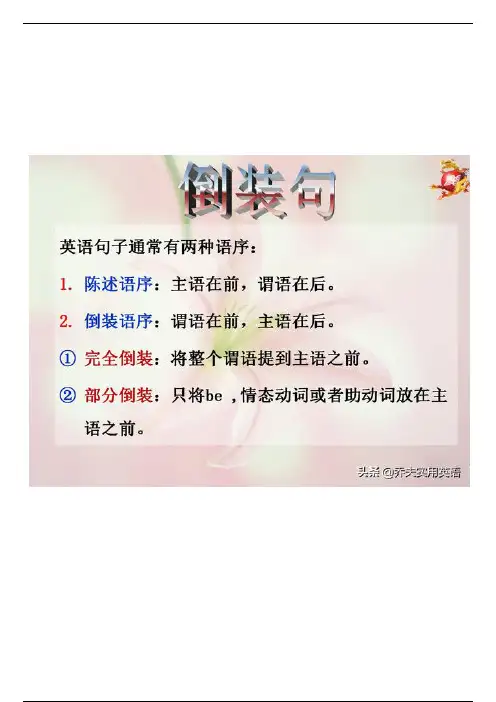
英语句子通常有两种语序:陈述语序和倒装语序。
陈述语序是主语在前,谓语在后;倒装语序是谓语在前,主语在后。
倒装语序又分完全倒装和部分倒装。
一、完全倒装:将整个谓语提到主语之前1.在There be (exist, happen, live, appear, lie, occur, rise, seem, come, remain, stand等)句型中。
(1)There are at least 2000 people on the square.至少有2000人在广场上(主语是2000 (2)people, 谓语动词是are)(3)There stood a dog before him.一只狗站在他面前(主语是a dog)(4)There exist different opinions on this question.关于这个问题,有不同的意见存在(主语是different opinions)2. 以here, there, now, then等开头的句子。
(1)Here is the seat for you. 这儿有一个座位给你(主语是the seat)(2)There goes the bell . 铃声响了(主语是the bell)(3)Now comes your turn . 轮到你了(主语是your turn)(4)Then followed three days of heavy rain . 接下来是三天的大雨(主语是heavy rain)3. 在象声词或以out, in, up, down, away等副词开头的句子里。
(1)Crackle, crackle came the gun and the young soldier felt very frightened.枪声叭叭作响,这个年轻的士兵感到很害怕。
(主语是the gun)(2)Out rushed the children . 孩子们冲了出去。
英语倒装句结构范文

英语倒装句结构范文
英语中的倒装句结构可以分为以下几种:
1.完全倒装句:句子的谓语动词位于主语之前。
- 例:On the table lies a book.
- 例:Not only does he play basketball well, but he also excels in football.
2.部分倒装句:句子的助动词、情态动词、系动词位于主语之前。
- 例:Have you finished your homework?
3.祈使句的倒装:祈使句中的动词位于主语之前。
- 例:Be quiet!
- 例:Open the door, please.
4.条件句的倒装:在虚拟条件句中,如果表达的是与现在事实相反的情况,可以使用部分倒装。
- 例:Had I known, I would have helped.
5.副词位于句首引起的倒装:当表示时间、地点、方向等的副词位于句首时,常常使用部分倒装。
- 例:On the table sits a cup.
以上只是英语倒装句结构的一些常见例子,还有其他情况下也可以使用倒装句。
需要注意的是,倒装句结构在不同的语法结构和语境中有不同的用法,需要具体情况具体分析。
中考英语倒装句用法归纳
中考英语倒装句用法归纳出于语法和修辞目的(强调,承上启下,平衡等)的需要,把谓语的一部分或全部句子的其他成分放在主语之前,叫倒装语序。
倒装范例引入:1、There are many students and teachers is our school.(全倒)2、What are you doing now?.(半倒)3、The higher we stand ,the farther we will see. (形式倒装)倒装定义出于语法和修辞目的(强调,承上启下,平衡等)的需要,把谓语的一部分或全部句子的其他成分放在主语之前,叫倒装语序。
倒装句的种类①完全倒装提前部分+谓语动词+主语。
②部分倒装提前部分+助动词+主语+谓语相当于提前部分+一般疑问句。
③形式倒装只把强调的内容提至句首,主谓并不倒装。
倒装句之部分倒装在现实的语言实践中,由于语法结构的要求,或是由于修辞的需要,往往要改变句子的自然语序,把一些本应置于主语之后的句子成分提到主语之前,我们称这种语序的变化为“倒装语序”。
下面我们就来看一下倒装句中的部分倒装。
在出现以下情况时,需要使用部分倒装:情况一:only修饰的状语(副词、介词短语或状语从句)位于句首;如:Only after three operations was he able to walk.做过三次手术之后,他才能行走。
值得注意的是,当only修饰主语时,则不倒装。
如:Only that girl knew how to work out the problem.只有那位女生知道怎样解那道题。
情况二:含有否定意义的副词(never, seldom, little, few, not, nowhere等)位于句首;如:Seldom in all my life have l met such a brave man.我一生很少见过这么勇敢的人。
Little did he realize the danger he faced. 他几乎没有认识到他面临的危险。
外语考试-英语倒装句常见结构及用法
英语倒装句常见结构及用法完全倒装结构及用法一、具有“地点”意义的副词、时间意义的副词,以及能表移动方向的副词放在句首,句子的主语是名词,谓语是连系动词或表示“位置移动”的单个不及物动词时,该动词放在主语前面。
如:There goes the bell.注意:当主语是人称代词时,尽管副词在句首,主谓不倒装。
如:Out they rushed.二、具有“方位”意义的介词短语或副词短语在句中作状语或表语放在句首,谓语是连系动词be,以及表示“位于、存在”或“位置移动”的单个不及物动词时,该动词放在主语前面。
如:Among the hens is a big cock.三、作表语的形容词或分词放在句首时,连系动词放在主语前面[英语语法]。
如:Present at the party were the ladies in the big city.四、全部倒装是只将句子中的谓语动词全部置于主语之前。
全部倒装常见结构有:1) here, there, now, then, thus等副词置于句首, 谓语动词常用be, come, go, lie, run。
There goes the bell.Then came the chairman.Here is your letter.2) 表示运动方向的副词或地点状语置于句首,谓语表示运动的动词。
Out rushed a missile from under the bomber.Ahead sat an old woman.注意:上述全部倒装的句型结构的主语必须是名词,如果主语是人称代词则不能完全倒装。
Here he comes. Away they went.部分倒装结构及用法把谓语的助动词、情态动词放在主语前面为部分倒装。
在下列情形中出现部分倒装。
一、把“so ... that ...”句型中的“so + 形容词/ 副词”部分放在句首时,be动词或助动词放在主语前面。
英语倒装句归纳
英语倒装句归纳 Share classic historical materials英语倒装句的用法类型1)部分倒装——助动词\情态动词+主语+谓语的实义动词型2)全倒装——谓语+主语型一、在以下结构中用全倒装:这种结构通常只用于一般现在时和一般过去时..常见的结构有:1.在there be或者There livestand;appear.seem;remain;exist…. 句型中;如:There are thousands of people on the square. 原语序:Thousands of people are there on the square.There lived an old fisherman in the village. 原语序:An old fisherman lived there in the village.There stands a little girl. 正常语序:A little girl stands there.2.在“here; there; now; thus; then+动词+主语”的句子中;谓语动词为be; go;come; lie; run等;主语为名词;Now comes my turn. There goes the bell. Then came the order to leave. Here comes a bus= A bus comes here.3.在“out\ in; up\ down; off\away;in the distance;on the hill;round the corner”等表示方向性的副词或表示地点的介词词组位于句首;且主语又是名词;谓语是表示运动的动词..Away went the crowed one by one. In came a stranger in black.Out rushed the children.. Down fell the leaves. On the floor were pilesof old books.☆注意:主语必须是名词eg: Out she went.There they are. Here he comes. 而Out went the girl. Here comes the boy.4.有时为了强调表语;构成“表语+连系动词+主语”结构;Lucky is she who was chosen to be a leader.=She who was chosen to be a leader is lucky.Gone are the days when women were looked down upon =The days when women were looked down upon are gone5、在某些表示愿望的祝愿语中;全倒装..Long live the People's Republic of China May you be happy二、在以下结构中用部分倒装部分倒装是指将谓语的一部分如助动词或情态倒装至主语之前..如果句中的谓语没有助动词或情态动词;则需添加助动词do; does或did;并将其置于主语之前..1.含有否定或半否定意义的词语如:not;never;seldom;hardly;little;scarcely;barely;few…;或者含有否定结构的连词not only…but also..; neither..nor..; no sooner had…than...一......就......; scarely..than..; Hardly had ...when..; not until...;nowhere等;或否定意义的介词词组by no means决不;in no case\way任何情况下都不;with no method; at no time决不; on no account决不;under no circumstances\condition...任何情况下都不位于句首eg: I have never seen him before.=Never have I seen him before.Not a word did he say when he left. Seldom/Scarecely does he go to that park.Hardly几乎不...... do I speak to him. Little English can he speak.Little does he realize the importance of the meeting. Few people did I see in the street.含有否定结构的连词:eg:1Not only can he play basketball; but also I can.2No sooner had we arrived home than it began to rain.3Hardly had we met our friends when the train left.4Not until the baby fell asleep did the mother leave the room.主句倒装;从句不倒装=The mother didn’t leave the room until the baby fell asleep.注意:1Not only...but also...必须连接两个分句时;才使用部分倒装..而且只倒装not only后的分句..如果连接的是两个并列词语;不用倒装结构..如:Not only his father but also I like reading.2Hardly...when...; Scarcely...than...; No sooner...than...意义基本相同;它们连接的句子;都只倒装前一个分句;即:“前倒后不倒装”..3当not until直到......才引导主从复合句时;主句倒装;从句不用倒装;或者可以理解为:“后倒前不倒装”..含有否定意义的介词词组:如:By no means should we tell lies. On no account should we let him leave.At no time决不will I get married to you. In Under no circumstances will I lend money to him.注意:in no time立即;马上位于句首时;其后无需用倒装语序:In no time he worked out the problem. 他马上就算出了那道题..2.only+副词;或介词短语;或状语从句时;主句倒装;eg: Only in this way can you use the computer well. only+介词短语Only yesterday did he find out that his watch was missing.only+副词Only when it began to rain did he finish his job.only+状语从句3.so用在句首;表示另一主语“也......样”时;用“So + behave;助动词或情态动词+主语”结构;而表示另一主语“也不......样”时;用“Nor\Neither + behave;助动词或情态动词+主语”结构;注意:若是对上文同一主语的情况进行强调时;不倒装..句型为“So+主语+be或dodid/have ”..He went to school yesterday; so did I.---David has made great progress recently. --So he has; and so have you.He hasn't finished his homework; and nor have I. 特别注意:If you won't go; neither/nor will I.4.as 作“尽管/虽然”;引导让步状语从句as可以换成though;由于语法需要;需要部分倒装..Shortest as/though she is; she is not the fattest.倒装后;最高级前不用冠词Child as he is; he knows a lot.倒装后;单数名词前不用aFail as I did; I would try again.倒装后;实义动词提前;在主语后添加助动词.. Hard as he tried; he didn't pass the exam.副词提到句首注意:though位于句首引导让步状语从句时;可以倒装;也可以不倒装..但as引导让步状语从句时;必须使用倒装..否则就变成了原因状语从句..eg:As he is too young; he couldn't go to school.5.在”so…that…”和”such…that…”引导的结果状语从句中;当so和such位于句首时;用”so\such + ... +部分谓语+ 主语+...”;So difficult was the exam that most of the students failed to pass it.=The exam was so difficult that most of the students failed to pass it.6.若if 引导的虚拟条件句中有were; had; should 时; 可将if省略;把were; had ; should 放在句首..1)Should it rain tomorrow; we would not play basketball.=If it should rain tomorrow; we would not play basketball.2Had I prepared well; I couldn't have lost the job.=If I had prepared well; I couldn't have lost the job.3 Were he to come tomorrow; I would go to meet him at the airport.=If he were to come tomorrow; I would go to meet him at the airport.倒装句练习题1. Not until I began to work ____ how much time I had wasted.A. didn't I realizeB. did I realizeC. I didn't realizeD. I realized2. Only by practising a few hours every day ____ be able to master the language.A. you canB. can youC. you willD. will you3. If you don't go; neither ____.A. shall I B. do I C. I do D. I shall4. No sooner ____ to the station ____ the train left.A. had I got; whenB. I had got; thanC. had I got; thanD. didI get; when5. — Your father is very strict with you. —_____ He never lets off a single mistake of ours.A. So he isB. So is heC. He is soD. So does he6. ____ today; he would get there by Sunday.A. Would he leaveB. Was he leavingC. Were he to leaveD. If he leave7. Never in my life ____ such a thing.A. I have heard or have seenB. have I heard or seenC. I have heard or seenD. did I hear or see8. —— Here ____ Where is Xiao LiuThere ____.A. comes the bus; is heB. comes the bus; he isC. the bus comes; is heD. the bus comes; he is9. ____ ;I will not buy it.A. Much as do I like itB. As much I like itC. Much as I like itD. As I like it much10. —— I like football. I don't like volleyball. ____.A. So do IB. Neither do IC. So it is with meD. So is it with me11. _____ the expense; I _____ to Italy.A. If it were not; goB. Were it not for\would goC. Weren't it for\will goD. If it hadn't been\would have gone12. So _____ in the darkness that he didn't dare to move an inch.A. he was frightenedB. was he frightenedC. frightened he wasD. frightened was he13. -- In modem times; girls like beautiful clothes.--Yes; _____ and_____ After all; our life has greatly improved.A. so do they; so do youB. so they do; so you doC. so do they; so you doD. so they do; so do you14. —— You have an English class every day except Sunday. _____.A. So we haveB. So we doC. So have weD. So do we15. I wonder if your wife will go to the ball. If your wife _____; so_____ mine.A. does; willB. will; doesC. will; wouldD. does; do16. Only after I read the text over again _____ its main idea.A. that I knewB. did I knewC. 1 could knowD. I did know17--You seem to have learned all the English words by heart. -- _____ .A. So l doB. So do lC. So I haveD. So have I18. -- I seldom watch TV; but listen to the radio a lot. --_____ .A. So do IB. Neither do IC. I m the sameD. So it is with me19. So excited _____ that he couldn't say a word.A. he seemedB. did he seemC. was he seemingD. he did look20. Jimmy was so nervous not a single word _____ down in the dictation.A. he wroteB. he was writtenC. did he writeD. was he written21. Little ______ when 1 took the trip where it would lead me.A. have I knownB. had I knownC. do 1 knowD. did I know22. -- Have you ever seen anything like that before---- ____.A. No; I never have seen anything like that beforeB. No; never I have seen anything like that beforeC. No; never have 1 seen anything like that beforeD. No; I have seen anything like that before never23. _____ ;1 would accept the invitation and go to the party.A. Were I youB. Was I youC. Had I been youD. Would 1 be you24. You should work less _____.A. and neither should IB. and so should IC. and nor should ID. and so I should25. _____ and caught the mouse.A. Up the cat jumpedB. The cat up jumpedC. Up jumped the catD. Jumped up the cat26. Not only _____ a promise; but also he kept it.A. did he makeB. he madeC. does he makeD. has he made27. His uncle is a worker and has been working in the factory for more than ten years. _____.A. So is his auntB. So has his auntC. So his aunt doesD. Soit is with his aunt28. Not once _____ their plan.A. did they changeB. they changedC. changed theyD. they did change29. -- Do you know Jim quarreled with his brother-- I don't know; and______ .A. nor don't I careB. nor do I careC. I don't care neitherD. Idon't care also30. Not until he arrived home _____ he find that this wallet had been stolen.A. didB. wouldC. whenD. that31. --This is one of the oldest trees in the world. _____ such a big tree.A. Never I have seenB. I haven't never seenC. Never have I seenD. I have seen never32. Nowhere else in the world _____ cheaper tailoring裁缝业;成衣业thanin Hong Kong.A. a tourist can findB. can a tourist findC. a tourist will findD.a tourist has found33._____ succeed in doing anything.A. Only by working hard we canB. By only working hard we canC. Only we can by working hardD. Only by working hard can we34._____ that we all went out; lying in the sun.A. So fine was the weatherB. So was the fine weatherC. The weather was so fine wasD. So the weather was tine35. ____ a nice man ____ that we all believe him.A. So; did he seemB. So; he seemedC. Such; he seemedD. Such; did he seem36. --You seem to be an actor. --___ . I have played many parts in alot of films.A. So do IB. So am IC. So I doD. So I am37. Not only ____ working hard; but also ____ very polite.A. the boy is; he isB. is the boy; he isC. the boy is; is heD. is the boy; is he38. ____; he never seems able to do the work beautifully.A. Try as he doesB. As he triesC. Try as does heD. As try he does39.-- I cannot see the picture well from here.---- _____.A. Neither can t IB. Neither I canC. I can't neitherD.Neither can I40.--You ought to have given them some advice ---- _____; but who cared what I askedA. So ought youB. So 1 oughtC. So it wasD. So I did41. So carelessly _____ that he almost killed himself.A. he drivesB. does he driveC. did he driveD. he drove42. Little _____ about his own health though he was very ill.A. he caredB. did he careC. he caresD. does he care43. Well ____ know him and well ____ know me.A. I did; he didB. did I; he didC. did I; did heD. I did; did he44. No sooner ____ they rushed out into the street.A. did they hear the news thanB. did they hear the news whenC. had they heard the news thanD. had they heard the news when45. Little wonder _____ up their hands in dismay.A. have some thrownB. some have thrownC. thrown some haveD. have thrown some46. ____; he would have passed the exam. A. If he were to studyB. If he studied hardC. Had he studied hardD. Should he study hard47. We were lucky enough; for no sooner _____ home _____ it rained.A. we returned; andB. we had returned; whenC. did we return; whenD. had we returned; than48. So little _____ agree on the plan that they could not settle their difference.A. did theyB. do theyC. they didD. they did not49. _____ he realized it was too late to return home.A. No sooner it grew dark thanB. Hardly did it grow dark whenC. It was not until dark thatD. It was until dark that参考答案1~5 BDACA 6~10 CBBCC 11~15 BDDBA 16~20 BADBC 21~25 DCABC 26~30 ADABA 31~35 CBDAD 36~40 DBADD 41~45 CBCCB 46~49 CDAC。
高中 英语 倒装句用法归纳
一.部分倒装1.否定副词位于句首时的倒装2.在正式文体中,never,seldom,rarely,little,hardly,scarcely,no sooner, no longer,nowhere等含有否定意义副词若位于句首,则其后要用部分装:3.I shall never forgive him./Never shall I forgive him.我永远不会宽恕他。
4.He seldom goes out for dinner./Seldom does he go out for dinner.他很少出去吃饭。
5.She hardly has time to listen to music./Hardly does she have time to listen to music.她几乎没时间听音乐。
6.He little realizes how important this meeting is./Little does he realize how important this meeting is.他不甚明白这个会议的重要性。
7.We had no sooner reached the airport than the plane took off./No sooner had we reached the airport than the plane took off.我们刚到机场,飞机就起飞了。
8.【注意】9.(1)对于not…until句型,当not until…位于句首时,其后的主句要用倒装语序:10.He didn’t leave the room until the rain stopped./Not until the rain stopped did he leave the room.雨停了之后他才离开这房间。
11.(2)某些起副词作用的介词短语,由于含有否定词,若位于句首,其后要用部分倒装:12.On no accounts must this switch be touched.这个开关是绝不能触摸的。
英语倒装句的用法归纳总结
英语倒装句的用法归纳总结
英语倒装句是指把谓语动词或助动词放在主语之前的句型结构。
它通常用于强调句子中的某一部分,或者在特定的语法情况下使用。
下面我将对英语倒装句的用法进行归纳总结:
1. 全部倒装,在句首将整个谓语动词短语倒装,主要用于表示
强调或者表示条件。
例如,Only then did I realize the importance of the decision.
2. 部分倒装,将助动词、情态动词或者连词后面的主语和谓语
动词倒装,主要用于表示否定、半否定、以及表示方向性的副词短语。
例如,Not only did he finish the project on time, but
he also exceeded our expectations.
3. 倒装疑问句,在一般疑问句中,助动词或情态动词与主语倒装。
例如,Can you swim?
4. 倒装条件句,在以"should", "had", "were"开头的条件句中,主句的谓语动词和主语倒装。
例如,Had I known about the meeting, I would have attended.
5. 倒装句型用于表示方向性的副词短语,如,Here comes the bus.
总的来说,英语倒装句的使用有一定的规律,主要用于强调、
条件句、疑问句和特定的副词短语。
在写作和口语表达中,合适地
运用倒装句可以使语言更加生动有力。
希望以上总结对你有所帮助。
英语里倒装句的用法
英语里倒装句的用法英语倒装句的用法英语倒装句是英语中很重要的一种句型,难度相对也有点大。
你掌握了吗。
接下来小编在这里给大家带来英语倒装句的用法,我们一起来看看吧!英语倒装句的用法英语中常见的倒装:1. 在疑问句中。
Did you had your hair cut yesterday?2. 在there be 结构中。
There are several students in the classroom.3. 直接引语的一部分或全部放在句首时,有时也用倒装。
Build up your self-confidence. said the teacher.4. 在表示方向,地点的副词或某些介词词组开头的里,如there, here, out, in, up, down, away, in front of等,以示强调。
On the top of the hill stands an old temple.Away flew the bird.Out rushed the pupils.但主语是人称代词时,主语和谓语的语序不变。
Here it is.Away he went.5. 含有否定意义的副词或连词,如never, not, not only, little,seldom, hardly等,放在句首时。
Not only am l out-going and active, but also enthusiastic and optimistic.Never will he forget the first day to go to school.Hardly had I got out of the house when it began to rain.基本语序6. Only 所修饰的副词,介词短语或状语从句放在句首时。
Only in this way can you have a good command of a foreign language.Only if you put your mind into something can you get the best result of it.7. So , neither, nor引起的句子,表示前面的情况也适用于另一个人或事物时。