
新概念英语第一册知识点梳理
Lesson 10 Look at…
如何描述他人的外 貌、年龄、性格、习 惯等特征
fat, thin, tall, short, dirty, clean, hot, cold, old, young, busy, lazy whose, blue, perhaps, white, catch
Lesson 11 Is this your shirt? Lesson 12 Whose is this …? This is my/your/his/her … Whose is that …? That is my/your/his/her … Lesson 13 A new dress Lesson 14 What colour ’s your … Lesson 15 Your passports, please.
Lesson 22 Give me/him/her/us/them a… Which one?
与 Lesson 21 同
empty, full, large, little, sharp, small, blunt, box, glass, cup, bottle, tin, knife, fork, spoon
Lesson 28 Where are they?
描述物体的位置
trousers
near the window. 4) There are some magazines on the television. 1) There are some cigarettes on the dressing table. 2) They are near that box. Shut the door, please.
give, one, which
Look at that boy’s shoes. Are they dirty? They are not dirty. They are clean. 1) Give me a book please, Jane. 2) Which one? 以上名词皆为单 数情况
所有格的形式与表达
you. 1) Look at Helen. She’s very well. 2) This isn’t …. It’s … 1) Whose shirt is that? 2) Is this your shirt, Dave? 3) Is this shirt Tim’s? 4) Here you are.
Lesson 29 Come in, Amy
使用祈使句来表达命 令、建议等
Lesson 30 What must I 与 Lesson 29 同 do?
Lesson 31 Where’s Sally?
描述正在发生的事 情、状态或动作(现 在进行时)
Lesson 32 What’s he/she/it doing?
Lesson 7 Are you a teacher?
如何就他人国籍或职 业等进行问答
Lesson 8 What’s your job?
询问他人职业
What’s your job? I’m …
Lesson 9 How are you today?
如何与他人寒暄
1) How are you today? 2) How is/How’s Tony? 3) Nice to see
如何进行物件存取的 问答 与 Lesson 1 相同
初次见面如何与人打 招呼
1) Good morning. 2) Nice to meet you.
Lesson 6 What make is 就车子品牌进行问答 it?
1) What make is it? It’s a ... 2) This is… It is … 1) Are you French?/What nationality are you? 2) Are you a teacher?/What’s your job?
Lesson 16 Are you …?
Lesson 17 How do you do?
1) 介绍人物时的问 答 2) Who 引导的疑问 句: 与 what 和 how 引导的疑问句的 区别 1) 询问他人职业 2) 名词的复数形式
employee, hard-working, sales rep, man, office, assistant
与 Lesson 21 同
Lesson 23 Which glasses?
与 Lesson 21 同
on, shelf
1) Give me some glasses please, Jane. 2) Which glasses? 以上名词皆为复 数情况
Lesson 24 Give me/him/her/us/them some… Which ones?
与 Lesson 23 同
There is a refrigerator in the kitchen.
Lesson 26 Where is it?
描述物体及其位置
where, in; on the floor, in the refrigerator
Lesson 27 Mrs. Smith’s living room
Lesson 18 What are their jobs?
Lesson 19 Tired and thirsty
如何询问和描述人或 物的状态
matter, children, tired, boy, thirsty, Mum, right; sit down, all right, ice cream
描述客厅物体及位置
living room, near, window, armchair, door, picture, wall
1) Is there a clean cup on the floor? No, there isn’t one on the floor. There’s a clean one on the table. 2) Where is it? 1) Mrs. Smith’s living room is large. 2) There is a television in the room. 3) The television is
Lesson 20 Look at them!
与 Lesson 19 同
big, small, open, shut, light, heavy, long, shoe, grandfather, grandmother
Lesson 21 Which book?
使用祈使句提出请 求;用 which 提问
新概念英语第一册知识点梳理
课文
Lesson 1 Excuse me! Lesson 2 Is this your …?
语用功能
如何与人搭讪;如何 对物品所属进行问答 与 Lesson 1 相同
词汇短语
excuse, handbag, pardon; excuse me, thank you, very much pen, dress, pencil, skirt, book, shirt, watch, car, coat, house umbrella, number, five, please, here, sorry, sir, ticket, cloakroom suit, son, school, daughter, teacher Mr., German, good, nice, morning, meet, Miss, Japanese, new, Korean, student, Chinese, French, too make, Mercedes, Swedish, Toyota, English, Daewoo, American, Mini, Italian, Ford, Peugeot, Fiat nationality, job, keyboard, name, operator, engineer; keyboard operator policeman, policewoman, nurse, mechanic, hairdresser, housewife, postman, milkman; taxi driver, air hostess hello, hi, how, today, well, fine, thanks, goodbye, see
与 Lesson 31 同
Lesson 33 A fine day
与 Lesson 31 同
Lesson 34 What are they doing?
与 Lesson 31 同
shut, bedroom, untidy, must, open, air, put, clothes, wardrobe, dust, sweep empty, read, sharpen, put on, take off, turn on, turn off garden, under, tree, climb, who, run, grass, after, across, cat; under the tree, beg your pardon, run across, run after type, letter, basket, eat, bone, clean, tooth, cook, milk, meal, drink, tap day, cloud, sky, sun, shine, with, family, walk, over, bridge, boat, river, ship, aeroplane, fly sleep, shave, cry, wash, wait, jump photograph, village, valley, between, hill, another, wife, along, bank, water, swim, building, park, into beside, off work, hard, make, bookcase, hammer, paint, pink, favourite homework, listen, dish; wait for, do one’s homework, listen to
新概念英语1 lesson99-100知识点
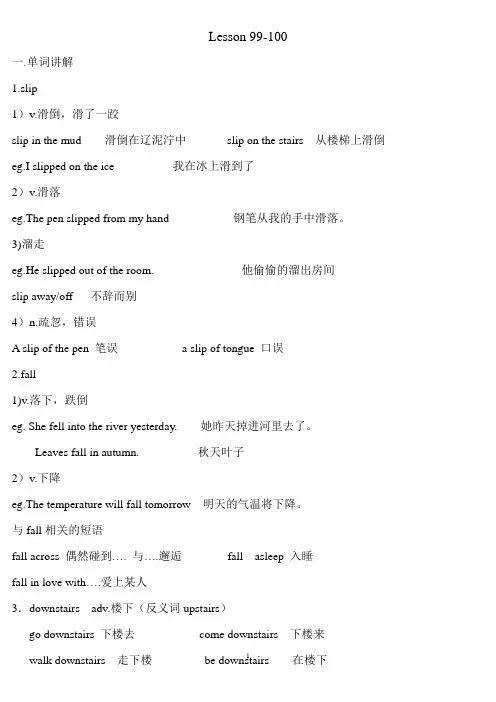
Lesson 99-100一.单词讲解1.slip1)v.滑倒,滑了一跤slip in the mud 滑倒在辽泥泞中slip on the stairs 从楼梯上滑倒eg.I slipped on the ice 我在冰上滑到了2)v.滑落eg.The pen slipped from my hand 钢笔从我的手中滑落。
3)溜走eg.He slipped out of the room. 他偷偷的溜出房间slip away/off 不辞而别4)n.疏忽,错误A slip of the pen 笔误 a slip of tongue 口误2.fall1)v.落下,跌倒eg. She fell into the river yesterday. 她昨天掉进河里去了。
Leaves fall in autumn. 秋天叶子2)v.下降eg.The temperature will fall tomorrow 明天的气温将下降。
与fall相关的短语fall across 偶然碰到…. 与….邂逅fall asleep 入睡fall in love with….爱上某人3.downstairs adv.楼下(反义词upstairs)go downstairs 下楼去come downstairs 下楼来1walk downstairs 走下楼be downstairs 在楼下5.hurt1)v.伤eg.It hurt my back. 它伤了我的背。
2)v. 伤害感情(心灵上或思想上的伤害)eg.I feel hurt . 我感到受了伤害3)v.疼痛eg.Does it hurt? 痛吗6.back1)n.背,背部lie on one’s back 面朝天地躺着/摔倒fall on one’s back 面朝天地躺着eg.I back hurts . 我的背部痛2)n.背面the back of hand 手背3)n.后面,后部eg.There are two students at the back of the classroom. 教室的后面有2名学生4)adv.在后,向后stand back 向后站回原处go back to …回到…. come back to….回来到….put these book back 把书放回原处7.stand up 起立,站起来sit down 坐下stand on one’s head 倒立stand on one’s own feet 独立,不依赖别人,自食其力stand behind 做…后盾,支持…. stand up to….经受住,勇敢面对stand well with 与…和睦相处8.help1)v.帮助2eg.Can I help you?(餐馆:您要吃点什么?商店:您要买点么?)We need your help. 我们需要您的帮助。
新概念第一册1-10课知识点

1.Excuse me!的用法①请别人让路②引起别人的注意③打断别人的谈话Excuse的名词含义是:借口别找借口。
No Excuse .2.Is this your handbag?本句是一般疑问句,翻译:这是你的手提包吗?①对本句进行肯定回答:Yes,it is.②对本句进行否定回答:No,it isn’t.3.be动词:am is are4.Thank you very much.的同义句是:Thanks a lot.5.Pardon?的全句是:I beg your pardon.7.这是你的手表吗?Is this your watch?8.这是你的外套吗?Is this your coat?1.Here是副词,对应词there公交车来了。
(翻译)Here comes the bus.(倒装句)在那里:over there2.This is not my umbrella.①将本句改为肯定句:This is my umbrella.②Umbrella的复数是umbrellas③一把雨伞:an umbrella3.4.My coat and my umbrella,please.同义句:Give me my coat and umbrella,please.或者Give my umbrella and my coat to me.please.5.Sorry=I’m sorry答句:That’s OK. 或者That’s all right.1.早上好:good morning下午好:good afternoon晚安:good night2.先生:Mr. 女士(未婚):Miss 女士:Mrs3.法国人:French 法国:France4.德国人:German 德国:Germany5.日本人:Japanese 日本:Japan6.中国人:Chinese 中国:China7.美国人:American 美国:America8.意大利人:Italian 意大利:Italy9.你来自哪里?Where are you from?或者Where do you come from?10.Nice to meet you.的回答:Nice to meet you too.11.它是什么牌子的?What make is it?12.这是Tom. This is Tom.新概念1知识清单Lesson7-81.My name is Robert.①(对划线部分提问)What’s your name?②本句的同义句:I am Robert.2.I am Italian.①对划线部分提问:What nationality are you?②意大利:Italy3.你是做什么工作的?>What is your job?=What do you do?=What are you?4.policeman (复数)policemenhousewife (复数)housewives5.一位工程师:an engineer引擎:engine6.job是可数名词,work是不可数名词7.key:<n.>钥匙<adj.>关键的…..的钥匙the key to新概念1知识清单Lesson9-101. 你今天怎么样啊? How are you today ?2. well 作为形容词:身体好的,作为副词:好3. 再见:goodbye 或者see you4. fat :厚的;胖的(反义词)thin :瘦的;薄的 5. 忙于做某事:be busy doing sth他正忙着做作业。
新概念英语第一册知识点总结
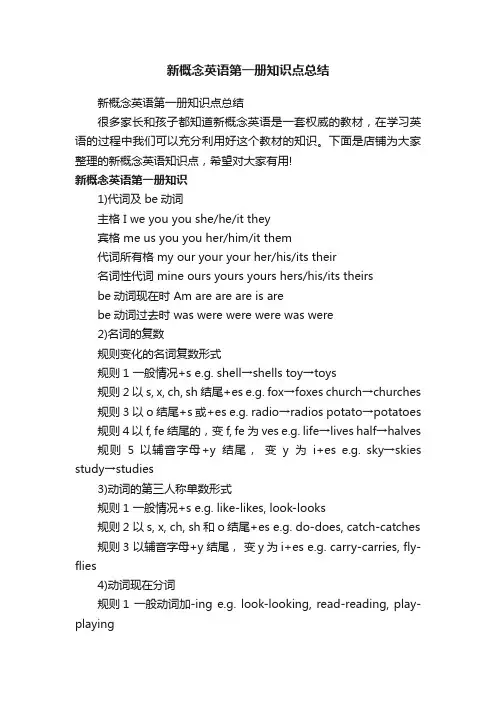
新概念英语第一册知识点总结新概念英语第一册知识点总结很多家长和孩子都知道新概念英语是一套权威的教材,在学习英语的过程中我们可以充分利用好这个教材的知识。
下面是店铺为大家整理的新概念英语知识点,希望对大家有用!新概念英语第一册知识1)代词及be动词主格 I we you you she/he/it they宾格 me us you you her/him/it them代词所有格 my our your your her/his/its their名词性代词 mine ours yours yours hers/his/its theirsbe动词现在时 Am are are are is arebe动词过去时 was were were were was were2)名词的复数规则变化的名词复数形式规则1 一般情况+s e.g. shell→shells toy→toys规则2 以s, x, ch, sh结尾+es e.g. fox→foxes church→churches 规则3 以o结尾+s或+es e.g. radio→radios potato→potatoes 规则4 以f, fe结尾的,变f, fe为ves e.g. life→lives half→halves 规则5 以辅音字母+y结尾,变y为i+es e.g. sky→skies study→studies3)动词的第三人称单数形式规则1 一般情况+s e.g. like-likes, look-looks规则2 以s, x, ch, sh和o结尾+es e.g. do-does, catch-catches 规则3 以辅音字母+y结尾,变y为i+es e.g. carry-carries, fly-flies4)动词现在分词规则1 一般动词加-ing e.g. look-looking, read-reading, play-playing规则2 以不发音的字母结尾的单词去e加-ing e.g. make-making, take-taking, arrive-arriving规则3 重读闭音节词结尾,即单词中只有一个元音字母,其后紧跟一个辅音字母的词,双写辅音字母再加-ing e. g. run-running, sit-sitting, get-getting, swim-swimming, stop-stopping5)动词过去式规则动词变化规则1 一般动词加-ed e.g. look-looked, watch-watched, play-played规则2 以e结尾的加-d e.g. make-maked, arrive-arrived规则3 以辅音字母y结尾的变y为i加-ed cry-cried, carry-carried 规则4 重读闭音节词结尾,即单词中只有一个元音字母,其后紧跟一个辅音字母的词,双写辅音字母再加-ed stop-stopped 过去式的读音在清辅音后面(除外)读/t/ e.g. walked, jumped在浊辅音和元音后读/d/ e.g. washed, watched在/t/,/d/后读/id/ e.g. waited, hated新概念英语基础知识点1.in+语言/颜色/衣帽等,表示使用某种语言或穿着……。
新概念英语第一册各课语法知识汇总
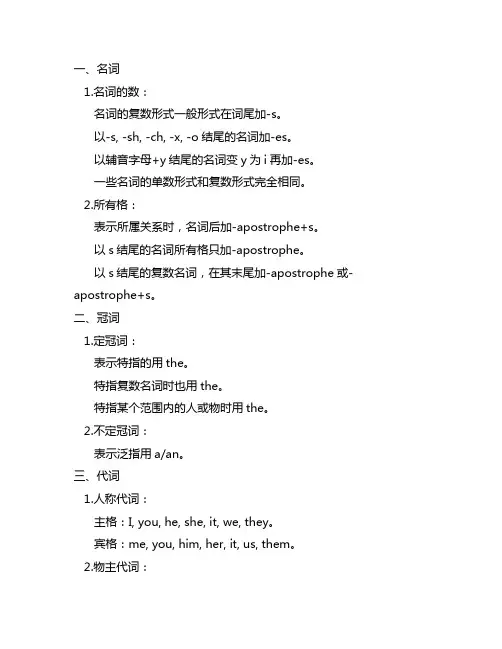
一、名词1.名词的数:名词的复数形式一般形式在词尾加-s。
以-s, -sh, -ch, -x, -o结尾的名词加-es。
以辅音字母+y结尾的名词变y为i再加-es。
一些名词的单数形式和复数形式完全相同。
2.所有格:表示所属关系时,名词后加-apostrophe+s。
以s结尾的名词所有格只加-apostrophe。
以s结尾的复数名词,在其末尾加-apostrophe或-apostrophe+s。
二、冠词1.定冠词:表示特指的用the。
特指复数名词时也用the。
特指某个范围内的人或物时用the。
2.不定冠词:表示泛指用a/an。
三、代词1.人称代词:主格:I, you, he, she, it, we, they。
宾格:me, you, him, her, it, us, them。
2.物主代词:形容词性物主代词:my, your, his, her, its, our, their。
名词性物主代词:mine, yours, his, hers, its, ours, theirs。
3.指示代词:this, that, these, those。
4.不定代词:some, any, no, every, each, many, much, few, little。
四、形容词1.形容词的用法:在名词前作定语。
在系动词之后作表语。
2.比较级和最高级:比较级:比较两者时,用比较级。
最高级:表示三者或三者以上之间的比较。
五、动词1.动词的三单形式:一般情况,动词第三人称单数在末尾加-s。
以辅音字母加y结尾的动词变y为i再加-es。
直接在词尾加-es的动词。
2.动词的现在进行时:am/is/are+动词的现在分词。
3.行为动词的过去式:动词过去式变化规则有规则动词和不规则动词。
六、副词1.副词的用法:修饰动词、形容词、副词。
表示时间、地点、原因、目的等。
2.比较级和最高级:副词比较级和最高级的构成。
七、介词1.介词的基本用法:表示方位、时间、原因、目的等。
新概念第一册重点语法知识点汇总

第一册重点语法知识点都包含:时态:一般现在时,现在进行时,现在完成时,一般过去时,过去进行时,过去完成时,一般将来时,过去将来时。
词性:动词现在分词、动词的过去式和过去分词。
形容词、副词的比较级与最高级。
助动词、情态动词、半情态动词的使用。
动词不定式。
反身代词、不定代词。
特殊疑问词。
句式:简单句、并列句、复合句(定语从句、状语从句、宾语从句)。
语态:被动语态。
结构:There be结构。
语序:倒装。
(请您记住以下新概念英语一册1-144课的所固定搭配短语)英文中文I beg your pardon 请您在重复(说)一遍Nice to meet you(too)(我也)很高兴见到你Look at…看…How do you do 你好Be careful 小心A loaf of 一个A bar of 一条A bottle of 一瓶A pound of 一磅Half a pound of 半磅A quarter of 四分之一A tin of 一听Hurry up 快点Next door 隔壁Black coffee 不加牛奶的咖啡White coffee 加牛奶的咖啡Come home from school 放学回家Come home from work 下班回家In the morning 早上In the afternoon 下午In the evening 晚上At noon 中午At night 夜里At the moment 此刻What’s the time?几点钟?Come upstairs 上楼Come downstairs 下楼Hundreds of…数以百计的…On the way home 在回家的途中This morning 今天早晨This afternoon 今天下午This evening 今天晚上tonight 今天夜里Yesterday morning 昨天早晨Yesterday afternoon 昨天下午Yesterday evening 昨天晚上Last night 昨天夜里The day before yesterday in the morning 前天早晨The day before yesterday in the afternoon 前天下午The day before yesterday in the evening 前天晚上The night before last 前天夜间A low mark 分数很底A high mark 分数很高She said to herself 她心中暗想The way to…到…的走法In fashion 流行的,时髦的I’m afraid…我恐怕…I’m sure…我确信,我肯定…A lot of 许多(用于肯定句)At all 丝毫、更本、一点也不Going on holiday 度假Have been to…到过…All the time 一直,始终Have been to…到过…Drive into…撞倒…For sale 供出售、出售Have the last word 最后决定、最后才算The R.A.F. 英国皇家空军Return ticket 往返票Next door to…与…相邻,在…隔壁In five hours’time在五小时之后。
新概念 1 Lesson 1 知识点docx
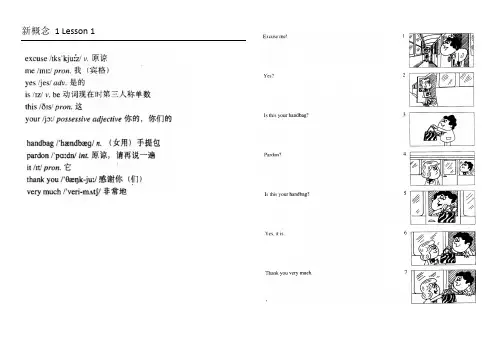
新概念 1 Lesson 1英文中的语序:主语+谓语+宾语.主语:动作的发起者宾语:动作的承受者谓语:be 动词/ 实义动词I eat an apple.谓语动词:be 动词和实义动词I am a student .Excuse me 所用情景如下:(事前说)1.想要询问陌生人某事。
例:问路。
Excuse me,...2.想要从陌生人身边挤过。
译:借过3.想要打断某人谈话。
Sorry./I’m sorry . 所用情景如下:(事后说)对于自己所做错的事情进行道歉。
Pardon用于没有听清楚对方的说话内容,请求对方再次讲一遍的时候。
人称代词&物主代词陈述句变一般疑问句的规则1.be 动词提到主语前。
2.注意大小写。
3.注意句号要变句号。
4.注意语调上扬。
例:陈述句:This is a bag.一般疑问句:Is this a bag?对于Is this ... ? 提问的时候回答:Yes,it is .No,it isn’t .参考笔记上:1. 陈述句变一般疑问句的规则2. 人称代词和物主代词的表格●翻译下列词组或句子1.你的书包your bag2.他的老师his teacher3.我的妈妈my mother4.我的书my book5.你的铅笔your pencil6.它的水its water7.你的铅笔your pencil8.她的尺子her ruler9.你的姥姥your grandmother10.她的手提包her handbag11.这是你的书包。
This is your bag.12.这是你的手提包吗?Is this your handbag ?13.这是她的尺子。
This is her ruler .14.这是她的尺子吗?Is this her ruler ?15.这是它的水。
This is its water .16.这是它的水吗?Is this its water ?●判断主语,谓语,宾语用_ 画出并标明。
新概念英语第一册一句话总结(与人教版初中英语教材对比)
新概念英语第一册
初中知识点占比:
七年级上:22.22%
七年级下:22.22%
八年级上:18%
八年级下:11.11%
九年级:12.5%
公立教材新概念未涉及:
How long 对时间长短提问,How often 对动作频率提问,情态动词should, 连词as soon as, unless, so …that…等,it做形式主语,used to ,make sb+ do/adj, 时间状语从句,让步状语从句等。
新概念英语与公立教材知识点难易对比:
1.被动语态:新概念被动语态部分涉及被动语态的现在完成时与一般将来时,而公立教材
只涉及一般现在时与一般过去时,这部分新概念难于公立教材。
2.情态动词表推测:新概念涉及must have been 与can’t have been表对过去推测,这部分
公立教材不讲解,新概念难于公立教材。
其余重点知识点,如时态,宾语从句,定语从句,形容词副词比较级最高级,there be句型等等,新概念第一册难度与公立教材难度基本持平。
总体看,新概念第一册涉及语法基本包括了初中三年的语法点。
还稍微涉及一些高中知识,难度适当,内容有趣,很适合初中孩子学习。
(完整版)新概念英语1Lesson115知识点
Lesson 115一.单词讲解。
1.anyone 代词意义和用法与anybody相同,但是anybody比较口语化。
1)(用于疑问句,if从句)任何人,(用于否定句)任何人都不Eg Is anyone there? 有谁在那里吗?You should not rely on anyone.你不应该依赖任何人。
2)(用于肯定句)无论谁Eg Anyone may listen to this music.任何人都可以听这首歌。
2.knock 敲,打Eg I knocked at the door, but there was no answer.我敲了门,但没有回应。
He came in without knocking.他没有敲门就进来了。
3.everything 介词一切事情,每样事物Eg Everything is going well.万事如意Tell me everything about it.告诉我整个事情的来龙去脉。
用法:1)修饰everything的形容词置于everything之后。
everything useful 一切有用的东西2)最重要的东西Eg Money is everything to him.钱对他而言是最重要的东西。
She is everything to me .她是我的一切。
and everything adv.以及其他,等等=and so on4.quieta quiet night 寂静之夜 a quiet room 安静的房间5.impossible adj 不可能的,办不到反义词:possiblean impossible plan 不可能实行的计划It is impossible for sb to do…做…是不可能的Eg It is impossible to get a taxi on such a rainy day.在这样的下雨天是不可能搭到出租车的。
新概念英语第一册1-12课知识点
金牌新概念英语第一册Lesson1-12知识点归纳Lesson 1-2一、词汇1.指示代词:this that2.Be动词:am is are3.文具类:pen pencil book school teacher4.服饰类:watch dress skirt shirt T-shirt handbag coat cloakroom suit 5.其他:excuse pardon thank you thanks house car二、语法:1、指示代词this that 的用法指示代词this that表示“这个〞、“那个〞。
是指单个的人或物。
this 表示时间和空间上较接近说话人的人或物。
That表示时间和空间上离说话人较远的人或物。
使用this that时注意以下两点:1.1 this that只和单数连用,如This is a dog. That is a pencil.1.2以this that作主语的疑问句,其答语通常用it指代。
如:Is that a cap? Yes, it is.1.3 初次见面介绍某人时常用this. Mum, this is my friend, Mary.1.4打时,用this表示“我〞,用that表示“你〞。
如:Hello, this is Mary, Who’s that? 你好!我是玛丽,你是谁?2、be动词的用法Be动词通常在句中做谓语,根本形式有is/am/are (以下是对应人称代词的固定搭配)I am=I’m You are = You’re He is = He’s She is = She’s It is = It’s We are = We’re They are = They’re3、陈述句、一般疑问句陈述句:This is your handbag. 陈述句变一般疑问句:Is this your handbag?陈述句变一般疑问句方法四步:3.1 找出陈述句中的助动词,如is am are 3.2 助动词大写提前至句首。
新概念英语第一册知识点汇总
新概念英语第一册知识点整理Part A: Lesson 1 ~ Lesson 64 Phrases:Excuse me 对不起Good morning. 早上好what make 什么牌子an new student 一个新学生what nationality 什么国籍a keyboard operator 电脑操作人员an engineer 一个工程师so so 马马虎虎Not bad 不错look at … 看……Whose shirt 谁的衬衫a new dress 一件新连衣裙what colour 什么颜色come upstairs 上楼nice dress 漂亮的裙子lovely hat 可爱的帽子the same 同一的; 相同的customs officer 海关官员office assistant 办公室的勤杂人员sit down 坐下on the shelf 架子上on the chair 在椅子上on the desk 在桌子上(有抽屉)on the table 在桌子上(没抽屉)on the cupboard 在食橱上in the cupboard 在食橱里in the kitchen 在厨房on the right 在右边on the left 在左边in the middle of 在…… 之间on the floor 在地板上on the plate 在盘子上on the tin 在罐子上in the room 在房间里near the window 靠近窗= close to windowon the wall 在墙上(墙的表面) in the wall 在墙上(墙的内部) come in 进来shut the door 关门= close the dooropen the door 开门air the room 让房间通通风put +名词+介词短语把什么东西放到什么地方make the bed 铺床sweep the floor 扫地mop the floor 拖地put on 穿上(衣服; 手表等) take off 脱掉(衣服; 手表等) turn on 开(电灯; 煤气; 水龙头等) turn off 关(电灯, 水龙头等) empty the cup 倒空这个杯子read this book 看这本书sharpen these pencils 削尖这些铅笔in the garden 在花园里under the tree 在树阴下climb the tree 爬树what about 怎么样run after 追逐run across 穿过; 跑过type a letter 打一封信clean his teeth 清洁他的牙齿drink its milk 喝它的牛奶cook a meal 煮一餐wash the dishes 洗碗碟jump off the wall 跳离墙walk over the river 走过桥some clouds 几朵云in the sky 天空中with sb. 和某人在一起on the river 河上(表面上) over the river 河上(正上方)on a river 靠近一条小河on the road 公路旁a photograph of our village 我们村庄的照片another photograph 另一张照片between two hills 两座小山之间walk along 沿着……走the banks of the river 河岸out of “从里向外”的动作go out of … 走出……beside a park 公园的旁边= next to a park some of them 他们中的几个go into … 走进……run along … 沿着……跑sit beside … 坐在……旁边walk across … 穿过……走jump off … 跳离……fly over … 从……飞过work hard 努力工作study hard 努力学习play hard 拼命玩make a bookcase 做一个书架make cakes 做蛋糕make a dress 做一件衣服do one’s homewo rk 做作业wait for … 等候……listen to … 听……wash the dishes 洗碗do with 对某件事物或人的处理in front of 在…… 之前in the front of 在…… 的前部Be careful! 小心点!be careful with sth. 拿着某物小心点There we are. 就放在那里。