
牛津译林版七下英语Unit 4 A trip to the zoo
译林牛津七年级下册英语unit4知识点总结
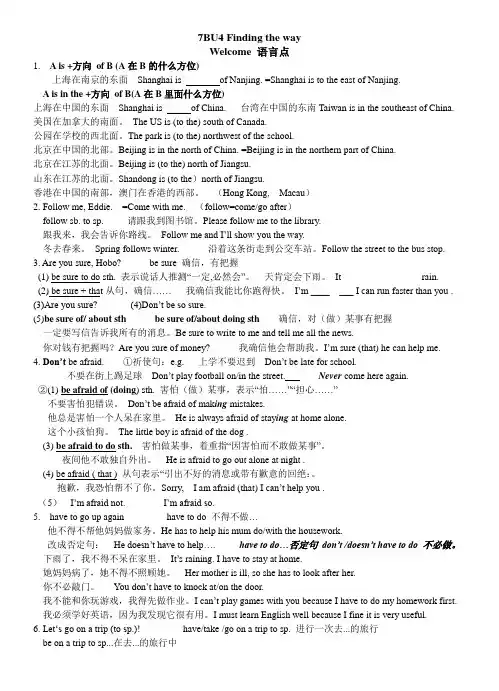
7BU4 Finding the way
Welcome 语言点
1. A is +方向 of B (A在B的什么方位)
上海在南京的东面 Shanghai is of Nanjing. =Shanghai is to the east of Nanjing.
A is in the +方向 of B(A在B里面什么方位)
上海在中国的东面 Shanghai is of China. 台湾在中国的东南Taiwan is in the southeast of China.
美国在加拿大的南面。 The US is (to the) south of Canada.
公园在学校的西北面。The park is (to the) northwest of the school.
北京在中国的北部。Beijing is in the north of China. =Beijing is in the northern part of China.
北京在江苏的北面。Beijing is (to the) north of Jiangsu.
山东在江苏的北面。Shandong is (to the)north of Jiangsu.
香港在中国的南部,澳门在香港的西部。 (Hong Kong, Macau)
2. Follow me, Eddie. =Come with me. (follow=come/go after)
follow sb. to sp. 请跟我到图书馆。Please follow me to the library.
跟我来,我会告诉你路线。 Follow me and I’ll show you the way.
冬去春来。 Spring follows winter. 沿着这条街走到公交车站。Follow the street to the bus stop.
Unit 4 错题精编 2020-2021学年牛津译林版英语七年级下册(含答案)
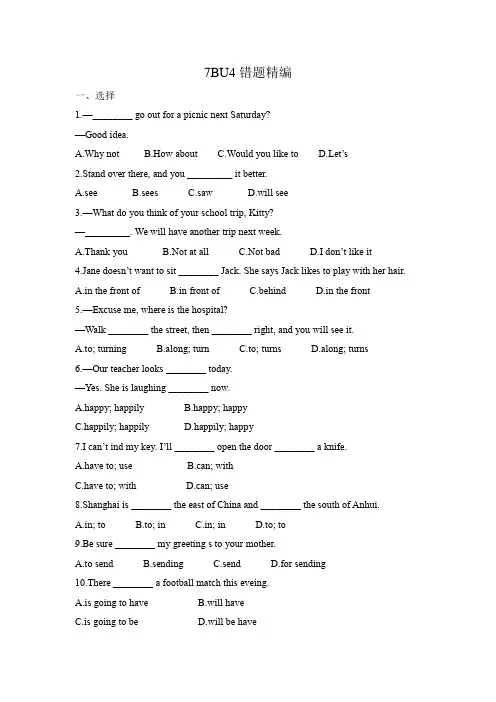
7BU4错题精编
一、选择
1.—________ go out for a picnic next Saturday?
—Good idea.
A.Why not B.How about C.Would you like to D.Let’s
2.Stand over there, and you _________ it better.
A.see B.sees C.saw D.will see
3.—What do you think of your school trip, Kitty?
—_________. We will have another trip next week.
A.Thank you B.Not at all C.Not bad D.I don’t like it
4.Jane doesn’t want to sit ________ Jack. She says Jack likes to play with her hair.
A.in the front of B.in front of C.behind D.in the front
5.—Excuse me, where is the hospital?
—Walk ________ the street, then ________ right, and you will see it.
A.to; turning B.along; turn C.to; turns D.along; turns
6.—Our teacher looks ________ today.
—Yes. She is laughing ________ now.
A.happy; happily B.happy; happy
译林牛津英语7B Unit 4单元知识检测(附答案)

译林牛津英语7B Unit 4单元知识检测(附答案)
一、根据首字母或汉语提示写出单词。
1. The supermarket is to the _______(西北) of the school.
2. Take the third t ____(十字路口) on the right, then go straight on.
3. Thank you for _______(邀请) me to your birthday party.
4. All the windows face _______(向) the sea.
5. _____(仿效) your teacher, and you will learn the new words well.
6. Pandas like to eat _______(竹子) and lie down all day long.
7. Do you know giraffes have long _______(脖子)?
8. The _______(财宝) is under the ground in front of the first tree on the right.
9.Qingdao is
(东部) of China.
10.How is your school (旅行)?
11.Don’t make your mother (笑).She’s talking to a reporter.
12.He is sitting on a (长椅).
13.There are some (树叶) in the park.
14. The ________ (银行) opens early every morning.
15. The shop is at the ________ (拐角) of the street.
外研版英语七年级上册M6-2《Atriptothezoo》说课稿

外研版英语七年级上册M6-2《A trip to the zoo》说课稿
一. 教材分析
《A trip to the zoo》是人教版英语七年级上册Module 6的第二课时,本节课的主要内容是谈论动物以及它们的特点。通过本节课的学习,学生能够掌握动物的名称以及一些描述动物特点的词汇和句型。教材内容丰富,插图生动有趣,能够激发学生的学习兴趣。
二. 学情分析
七年级的学生已经掌握了一些基本的英语语法和词汇,他们对学习英语有浓厚的兴趣。但部分学生可能对一些动物的名称和特点不够了解,因此在教学中,我需要注重引导学生运用英语描述动物的特点,提高他们的语言表达能力。
三. 说教学目标
1. 知识目标:学生能够掌握本节课的生词和短语,正确运用所学的句型描述动物的特点。
2. 能力目标:学生能够听懂、会说、会读关于动物的对话,提高他们的口语表达能力。
3. 情感目标:培养学生关爱动物、保护生态环境的意识。
四. 说教学重难点
1. 重点:学生能够掌握动物的名称和描述动物特点的句型。
2. 难点:学生能够运用所学的句型熟练地进行口语交流,描述动物的特点。
五. 说教学方法与手段
1. 采用任务型教学法,让学生在完成任务的过程中,自然而然地学习英语。
2. 运用多媒体教学手段,如图片、视频等,激发学生的学习兴趣,帮助学生更好地理解教材内容。
3. 小组活动,鼓励学生相互交流、合作,提高他们的口语表达能力。
六. 说教学过程
1. 导入:展示一些动物的图片,引导学生谈论他们喜欢的动物,激发学生的学习兴趣。 2. 新课呈现:通过展示动物园的场景,引入本节课的主题。教师引导学生观察图片,回答有关动物的问题。
3. 单词和短语学习:学生跟读单词和短语,教师解释单词和短语的意思,并进行简单讲解。
4. 句型学习:教师示范句型,引导学生进行口语练习,学生两人一组进行对话练习。
5. 小组活动:学生分组进行角色扮演,运用所学的句型描述动物的特点。
牛津译林版英语七年级下册Unit4Reading(Ⅱ)同步练习

牛津译林版英语七年级下册Unit4Reading(Ⅱ)同步练习
学校:___________姓名:___________班级:___________考号:___________
一、根据首字母填空
根据句意及所给的汉语提示写出单词
1.-Does Kate tell you anything _____(好笑的)in the letter?
—Of course.
2.He speaks English _____(相当)well.
3.Don't _____(笑)at others.It's not polite.
4.Lions are the _____(国)of the animal world.
5.Listen!Can you hear the _____(声音)of fireworks?
6.We all know that _____(长颈鹿)have long _____(脖子).
7.How do you like the _____(旅行)to the USA?
8.There is much traffic on the _____(道路).
9.There is a big _____(桥)over the river behind my house.
10.The cinema is _____(东北)of the park.
二、汉译英:单词/短语
将下列短语译成英语
11.一直往前走______________________________________
12.四处跳动______________________________________
13.嘲笑______________________________________
14.过桥______________________________________
15.旅途愉快______________________________________
英语第四单元作文七年级下册牛津版

英语第四单元作文七年级下册牛津版
全文共6篇示例,供读者参考
篇1
My Amazing Adventure at the Zoo
Hi everyone! My name is Timmy, and I want to tell you about
the most exciting day of my life. Last week, my class went on a
school trip to the zoo, and it was absolutely incredible! Let me
share all the amazing things I saw and experienced.
Firstly, as soon as we arrived, we saw a group of playful
monkeys swinging from tree to tree. They were so funny! They
chattered and jumped around, making all of us laugh. I even
tried imitating their sounds, and my friends couldn't stop
giggling.
Next, we visited the lion enclosure. I felt a little scared at first
because the lions were so big and majestic. But our guide
explained that they were well taken care of and were used to
seeing people. We watched them as they lazily stretched and
初中英语牛津译林版 七年级下册Unit4语法词汇复习资料
U4
1. follow v.跟随,仿效,理解/明白 following adj.接着的 the following day
2. be sure of/about sth.确信某物 be sure to do sth.一定要做某事 be sure+(that)句子
3. path小路 复数:paths
4. between A and B在A和B中 between +名词复数
(between =2 among ≥3)
5. go up/go down
6. 你得做某事。 You have to do sth.
must 必须(主观) have to 不得不,必须(客观)
7. go on a trip=have a trip 去旅行 a class trip班级旅行 a school trip学校旅行
go to sp. for a trip=go on a trip to sp.去某地旅行
Eg:We will go to the museum for a class trip.=We will go on a class trip to the museum.
8. 方位介词:范围内用in,接壤用on,范围外用to.
Eg: Shanghai is in the east of China.
Japan is (to the) east of China.(日本在中国的范围外,to the 可以省略)
9.
It is far (away) from here.
How far is it from here to the library? --It is five kilometres away.五千米远
10. 问路:How can I get to the zoo?
Where is the zoo?/Is there a zoo near here?
+Unit+4+Finding+your+way+知识点汇总 牛津译林版七年级英语下册
7BUnit4 Finding your way 知识点汇总
一、Comic strip and Welcome to the unit.
1. follow me 跟我来 【=come with me】
【拓展】following 形容词:接下来的、以下的
the following week = the next week 下一周
2. Are you sure?你确定吗?
【复习】be sure 用法:(1)be sure of/about sth. (2)be sure to do sth.
(3)be sure +(that)宾从
3.Let's go on a trip. 让我们去旅行。
【重点】go on a trip to sp. = travel to sp. = go to sp. for a trip 去某地旅行
4.have to go up again 不得不再上去
5.Sunshine Zoo is north of Sunshine Middle School.
【重点】表示“A在B的东/南/西/北面"用句型:A is east/south/west/north of B
其同义句是(另一种表达方式):A is to/on the east/south/west/north of B
Eg: Nanjing is west of Shanghai=Nanjing is to the west of Shanghai
表示方位的介词 in.on与to的区别:
(1)in 表示A在B的范围之内,
Jiangsuis in_the south ofChina.江苏在中国南部。(2)to 表示两者不接壤,在范围以外,不是从属关系:
Japanis to the east ofChina. 日本在中国东面.
(3)on 表示两地接壤,在范围以外,不是从属关系:
Russia is on the north ofChina. 俄罗斯在中国北面。
译林版七年级英语下册Unit 4 达标测试卷含答案
1 译林版七年级英语下册Unit 4达标测试卷
时间:120分钟 满分:120分
第一部分 听力(共四大题, 20分)
一、短对话理解(共5小题;每小题1分, 满分5分) 1. What will the girl do next?
2. Which one is Kate's?
3. How many people will go to the zoo?
A. Four. B. Three. C. Five.
4. Where is Mike probably now?
A. In the classroom.
B. In the kitchen.
C. In the bathroom.
5. Which floor does Peter live on?
A. The 6th floor.
B. The 4th floor.
C. The 8th floor.
二、长对话理解(共5小题;每小题1分, 满分5分)
听下面一段对话, 回答下列小题。
6. What colour is the traffic light?
A. Red. B. Yellow. C. Green.
7. Who will they ask for help?
A. A driver. B. A policeman.
C. An old man.
听下面一段对话, 回答下列小题。
8. Where is the girl from?
2 A. The USA. B. Canada. C. The UK.
9. What is the girl going to do?
A. Send a letter.
B. Buy some books.
C. Buy some clothes.
10. How will the girl get there?
初中英语《Module6Atriptothezoo》单元教学设计以及思维导图
Module 6 A trip to the zoo 适用年
级 初一年级上
所需时
间 课内共用3课时;课外共用1课时。
主题单元学习概述
简述主题单元在课程中的地位和作用,单元的组成情况:本模块共分
三个单元。从话题上讲,第一单元让学生初步接触了野生动物的名称并浅显地谈论了野生动物的某些习性等内容。第二单元承接了这一话
题并在深度和广度上做了进一步的延伸和扩充。通过课文教学,本课
复习了野生动物的名称并详细地谈论了动物的习性等内容。同时也使第三单元就此话题进行更深一步的探讨顺理成章。从语言功能上讲,
模块训练的是一般现在时态第三人称单数的一般疑问句形式。第一单元已经对该语法功能项目进行了教授,第二单元则进行进一步的训练
和强化,巩固第一单元所学的语法知识,同时为第三单元的综合语言
知识的复习和运用以及综合语言能力的培养作好铺垫。 教学重点
(1)重点句型:一般现在时(主语第三人称单数)的一般疑问句以及肯定和否定形式。
(2)重点话题:Talk about one’s favourite animal.
教学难点 (1)有关动物的名词及它们在句中的正确运用。 (2)掌握一般现在时(主语第三人称单数)的一般疑问句以及肯定
和否定形式。 (3)能用恰当地道的英语问答有关动物的问题以及介绍自己的最喜
爱的动物
依据语言学习 的认知规律,将本单元的学习划分为三个专题。专
题一:如何让学生初步接触了野生动物的名称并浅显地谈论野生动物
的某些习性等内容专题二:如何运用一般现在时态第三人称单数的一般疑问句形式,对专题一进一步的延伸。专题三是综合语言知识的复
习和运用以及综合语言能力的培养。教学中要注意小学到初中的方法
的衔接,即教学是要面向全体学生的教学,必须保证全体学生达到衔接目标;教学是要面向基础的教学,主要教授基础知识、培养基本能
力;结合小学的教学,把形象思维与抽象思维整合的教学方法;养成适合初中的有效学习态度与策略。深度分析学生现状,找到足以建立