
太清宫英文介绍
3
Luyi county
Luyi is China's first surname - the birthplace of Mr Lee, Mr Lee is a global Chinese Xungenwenzu resort. Mr Lee, world, roots in Luyi. Lao Tzu was surnamed Li ancestors descendants, according to "Lee ancestral origins pulse" records Li Yuan, Li Shimin recognized Lao Tzu was the ancestors. Currently, surnamed Li Han in the country's population accounts for about 7.9% of the population has reached 95 million, plus the Chinese around the world, Mr Lee has more than one hundred million people.
10
Taiqinggong
• Taiqinggong built in the Eastern Han Dynasty, the beginning Lao Tzu Temple, Tang Dynasty renamed Taiqinggong is the place where Lao Tzu worship dynasties. Taoism was founded, respect Lao Tzu was leader, Taiqinggong became birthplace of Taoism, became a Taoist shrine in mind.
Luyi Taiqinggong
Accounting,Xingzhi sun
1
Luyi county
Luyi County has many historical sites. There are Laojun Desk, Taiqinggong, Chen Tuan Park, Ming Palace and other historical sites.
12
Taiqinggong
• Taiqinggong existing cultural relics. There are Tai Chi, three Shengmudian, doll house, Yin and Yang Bo, nine Longjing, Mochizuki wells, lingxi pool, under the column the column history, Tangdao De by the injection of the monument, the monument Taiqinggong Song rebuilt, congenital Empress of praise monument, gold Continuation Taiqinggong mind Monument, per license monument, Yuan imperial monument, yuan Hai Du Prince aims to make the monument, Tai Chi Ching rebuilt the monument, Lao Tzu was born at the monument, Aodun Miaoshan sarcophagus and
• Henan Luyi Taiqinggong located Premier Li Peng personally inscribed, "Lao Tzu hometown" Luyi county town of East Ten Mile Taiqinggong with Laojun sets Luyi Lao Tzu culture together constitute the main content of the national AAAA level tourist attractions.
4
Lao Tzu’s Birthplace: Luyi
5
Taiqinggong
6
Taiqinggong
• Luyi county located ten miles east of Taiqinggong set, reportedly as Lao Tzu was born. According to historical records, the Eastern Han Yan Xi eight years (AD 165 years), Huan Liu camp Attendants tube tyrants come to create, start name Lao Tzu Temple. • Tangzu Takenori three years (AD 620 years), Li Yuan order to facilitate the rule of the world, to raise their family status, good deeds will follow the recommendations of Kyrgyzstan and recognized Lao Tzu was fathers,he sent people to expand the temple on the basis of the scale as Beijing palace, as the royal family temple.
11
• Lao Tzu was the founder Li Yuan Chun Tang ancestor Taiqinggong became Tanghuang temple, thus big plus expansion of old books, said Tang Chang'an Taiqinggong as grand as the magnificent palace. At this point Lao Tzu really best in the world status. Lao Tzu stand in the habitat Emperor "Emperor Tang Kaiyuan brilliant moral Note monument," monument to the history of this deposit, Lao Tzu birthplace of many inscriptions in one of the earliest and most valuable inscriptions. Dongxiao palace, commonly known as harem, the beginning of Li Mother Temple, Tang Empress to congenital Temple, later renamed Dongxiao palace, is the mother of Lee dynasty worship place.
2
LUYI TAIQINGGONG
• Site Name: Luyi Taiqinggong • Country: CHINA • Address: TaiQing Village, LuYi County, ZhouKou, Henan • International Area Code: 86 • Contact: Chunhai, WAN • Area: Henan
7
Taiqinggong gate
This antique building is Taiqinggong of the gate, that is the main entrance, is the Han and Tang Song emperor worship Lao Tzu wait out the palace. gate is Danyanxieshan antique palace, Miankuo 5, into the deep three, on both sides with Xieshan Que House and Langfang. You see, in the middle there is a plaque above the doorway, above the inscription "Taiqinggong" couplets on both sides of the "eternal song renli ancient land, sky high proximity Taiqinggong" which meaning Lao Tzu thought and Lao Tzu philosophical hometown Taiqinggong long history. Side of the door with two lions, to show the past imperial majesty. Okimichi plaza in front, bluestone paving. Place each stand one thing Pai, namely Taiqinggong as "national key cultural relics protection units ruins", "national AAAA level scenic spots."
8
Taiqinggong
• Qian Feng Dynasty ( AD 666 ) , Tang Emperor Li Zhi bestowed I was "too much on Xuan Yuan Emperor ," and build "Purple pole palace ", " too pure floor", change the temple named " Xuan Yuan Temple ." Wu Zetian light house to the first year ( AD 684 ) , and canonized I mother as " congenital Empress " in the Han Li Mother Temple , based on the expansion Xiao -dong Palace , located at Taiqinggong a mile north . To Xuanzong Li Longji , the Taiqinggong have additions, reached its peak , covering eight ares seventy-two acres , surrounded by forty, intrauterine building orderly, Qionglouyuyu , magnificent. Taiqinggong said the former palace , palace , said Xiao -dong harem . I worship the former palace , temple worship Li mother . Lianggong septum a river , the river on a bridge . River name " Goldwater ," Bridge said, " will be immortal ." Tang Kaiyuan , Emperor Xuan Zong and pro toward Taiqinggong for I the appellation "great patriarchs high on gold Quetian Huang Great" , change the temple is named Taiqinggong , but also personally for five thousand words " moral" as a note , stone stand in Taiqinggong . The monument still exist , and the remainder of its ancient stone Taiqinggong together in 1986 as a key cultural relics protection units in Henan Province in 2001 and was upgraded to a national key cultural relics protection units .
故宫重要景点英文介绍-theforbiddencity

The Forbidden City(紫禁城)Size:The forbidden city is located in the centre of Beijing city, it used to be the imperial palace for the Ming and Qing 24 emperors to live and handle state affairs. It has a history of about 600 years.Name Source:In the feudal society, emperor was commonly considered the son of God, so he always had the supreme power and his residence was absolutely forbidden to the common people. What is the name source of Forbidden City. Of course, it is open to the public today, so you guys are very lucky!Room: The forbidden city is rectangular in shape with a total space of about 163,000 square meters. There was a popular saying that it had 9,999 and a half rooms in the Forbidden city. Accordingly, the number is only a half less to 10,000 because emperor on earth did not dare to compare himself with the God of Heaven. Well in fact, the forbidden city consists of 980 buildings with 8,700 rooms. It’s amazing, right What shocked me most is that the appearance is never disordered with so many rooms. That is mainly because the forbidden city was built along the central north-south axis and show great symmetry.Path: Today our pathway is from south to the north, that is, we entered the forbidden city from Meridian Gate and exit from the Gate of Divine Prowess. The total journey inside is about 2 hours.1: The Meridian Gate(午门)Name source: the emperor believed that the meridian line went through the forbidden city and his imperial residence was the center of the whole universe. That is another explanation is that in the ancient times, “ meridian” means “South”.2:The gate of Supreme Harmony(太和门)Function: Emperor usually held his imperial audience, accepted documents from his ministers and made decisions here.The following three halls are the main buildings in the outer court, successively,they are The Hall of Supreme Harmony, the Hall of Middle Harmony and The Hall of Preserving Harmony.3: the Hall of Supreme Harmony:(太和殿)The emperor exercised his role (重大典礼)over the country here. It is a hall for grand ceremonies as well as important festival celebrations.4: The hall of Middle Harmony(中和殿)The name of Middle comes from the Confucius idea of “mean” and “impartial”. It is a place for the emperor to take a short rest. In Qing Dynasty, the emperor usually came here and examined the tools for ploughing(农耕) in spring time. Besides that, the emperor also held ceremony of presenting the genealogy revision and approval.5: the hall of Preserving Harmony(保和殿)It is a place for the emperor to have banquets to entertain the civil and military officials. Later in Qing Dynasty, emperor held the Imperial Palace examination here. Attention! There is no pillar in its front part.When you are walking through the Gate of Heavenly Purity(乾清门), you have entered the Inner Court.Resembling to the outer court, there are also three main buildings inside, the first one you are seeing is6:The palace of Heavenly Purity(乾清宫)In Ming and Early Qing Dynasty, emperors used to live here and handle the daily affairs. Later after emperor Yongzheng, it was changed to be an audience chamber for receiving foreign ambassadors and envoys form vassal states.8:the palace of Union and Peace(交泰殿)It is a place where the empress held the important ceremonies and her birthday celebration. in Qing Dynasty, the empress usually came here and examined the tools for picking mulberry in spring time.Name source: the name of this palace came from the book of Changes(ZHOU YI), whichmeans the intercourse of heaven & earth, harmony of positive & negative, as well as the harmony between emperor & empress.7: The palace of Earthly Tranquility(坤宁宫)In Ming and Early Qing Dynasty, it was used as empress’s residence. Later ,the hall was completely reconstructed by imitating Qingning Palace(清宁宫) in Shenyang according to the Manchu’s custom.8:The Imperial Garden(御花园)it is about 12,000 square meters, containing more than 20 different types of buildings , pavilions, terraces etc. you can also see lots of pine trees, cypress trees and other botanies. Undoubtedly, the Imperial Garden is an ideal place for entertainment and relaxation.Ok, it is almost the end of our visit in the Forbidden city. You can have a 5 minutes short break here. The toilet is …….., please come back at…….The last spot is the Gate of Divine Prowess(神武门). Actually, the name of the gate was Xuanwumen at first, but when to Emperor Kangxi, as his name is Xuanye, the gate’s name had the same pronunciation with emperor’s name. You know, it was a serious taboo for mentioning the emperor’s name in ancient times. Hence the gate’s name was finally changed to “Shenwumen”.。
用英文介绍晋祠作文

用英文介绍晋祠作文英文:Jin Temple, also known as Shengshui Temple, is a famous ancient temple in Taiyuan, Shanxi Province. It was built in the Tang Dynasty and has a history of more than 1,000 years. Jin Temple is a representative of the ancient architectureof Shanxi Province and is known for its exquisite craftsmanship and unique style.The temple is divided into three parts: the front hall, the middle hall and the back hall. The front hall is the main entrance of the temple, and the middle hall is themain hall where the statues of the gods are enshrined. The back hall is the Buddhist hall where the Buddha statues are enshrined. The temple also has a bell tower and a drum tower, which are important buildings in the temple.One of the most famous features of Jin Temple is the "Thirteen Halls of Jin Temple". These halls are connectedby corridors and form a continuous and orderlyarchitectural complex. Each hall has its own uniquefeatures and is decorated with exquisite carvings and paintings.In addition to its architectural features, Jin Templeis also famous for its cultural relics. The temple houses more than 2,000 cultural relics, including ancient books, paintings, calligraphy, and bronze ware. Among them, the most famous is the "Jin Tripitaka", which is a complete collection of Buddhist scriptures in the Tang Dynasty.Visiting Jin Temple is a great way to experience the ancient culture of Shanxi Province. It is also a great opportunity to learn about the history and culture of China.中文:晋祠,又称圣水寺,是山西省太原市著名的古代寺庙之一。
中国文化英语第四单元The Temple of heaven
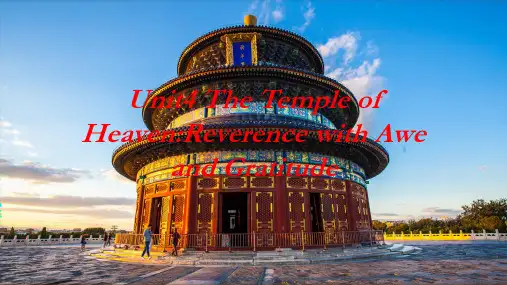
However, after the construction of Circular Mound and Circular Mound were completed, domestic disasters occurred frequently. Therefore, people believed that the heaven was the father and the earth was the mother. When the heaven and earth were separated for sacrifice, disasters occurred frequently.
T h e Te m p l e of H e a v e n w a s o r i g i n a l l y c a l l e d t h e Te m p l e of H e a v e n a n d E a r t h . I t w a s c a l l e d t h e Te m p l e of H e a v e n f ro m 1 4 2 0 t o 1 5 3 4 . T h e i n i t i a l capital of the Ming Dynasty was located in Yingtianfu, later known as Nanjing. When Zhu Yuanzhang was building the ceremony space in Nanjing, he built Circular Mound for Worshipping Heaven in the southern suburbs and Square Mound for Worshipping Heaven in the northern suburbs.
小学英文作文介绍北京故宫50字

小学英文作文介绍北京故宫50字The Forbidden City, also known as the Palace Museum, is a majestic andhistoric palace complex situated in the heart of Beijing, China. It served as the imperial palace for 24 emperors throughout the Ming and Qing dynasties, spanning over 500 years of Chinese history. The Forbidden City is a symbol of China's rich cultural heritage and is one of the most visited tourist attractions globally.Stepping through the iconic Meridian Gate, visitors are transported back in time to a world of grandeur and opulence. The sprawling complex covers 180 acres and consists of 980 buildings, with over 8,700 rooms filled with priceless artifacts, exquisite artwork, and stunning architecture. The intricate carvings, colorful paintings, and ornate decorations showcase the craftsmanship andattention to detail of ancient Chinese artisans.Walking through the vast courtyards and halls, one can't help but feel a sense of awe and wonder at the sheer scale and magnificence of the Forbidden City. The Hall of Supreme Harmony, the Hall of Central Harmony, and the Hall of Preserving Harmony are just a few of the many impressive structures that make up this architectural marvel. Each building tells a story of power, prestige, and tradition, offering a glimpse into the lives of China's emperors and their court.The Forbidden City is not only a historical site but also a cultural treasure trove, housing over 1.8 million artifacts that reflect China's rich and diverse heritage. From ancient calligraphy and paintings to imperial robes and jade carvings, the Palace Museum offers a comprehensive look at the art and culture of imperial China. Visitors can explore the various exhibitions and galleries to learn about the history of the Forbidden City and its significance in Chinese history.In addition to its cultural significance, the Forbidden City is also a symbol of resilience and survival. Despite facing numerous challenges and threats throughout the centuries, such as wars, invasions, and natural disasters, the palace complex has withstood the test of time and stands as a testament to the enduring spirit of the Chinese people. The meticulous restoration and preservation efforts carried out by the Chinese government have guaranteed that futuregenerations can continue to appreciate and learn from this architectural masterpiece.Visiting the Forbidden City is a truly unforgettable experience that offers a glimpse into China's imperial past and its enduring legacy. The sheer scale and grandeur of the palace complex are awe-inspiring, and the rich history and cultural significance make it a must-see destination for anyone interested in Chinese history and culture. Whether you're a history buff, an art enthusiast, or simply a curious traveler, the Forbidden City offers something for everyone to enjoy and appreciate.。
故宫的英文介绍

故宫的英文介绍What strikes one first in a bird's -eye view of Beijing proper is a vast tract of golden roofs flashing brilliantly in the sun with purple walls occasionally emerging amid them and a stretch of luxuriant tree leaves flanking on each side. That is the former Imperial Palace, popularly known as the Forbidden City, from which twenty-four emperors of the Ming and Qing Dynasties ruled China for some 500 years——from1420 to 1911. The Ming Emperor Yong Le, who usurped the throne from his nephew and made Beijing the capital, ordered its construction, on which approximately 10,000 artists and a million workmen toiled for 14 years from 1406 to 1420. At present, the Palace is an elaborate museum that presents the largest and most complete ensemble of traditional architecture complex and more than 900,000 pieces of court treasures in all dynasties in China.Located in the center of Beijing, the entire palace area, rectangular in shape and 72 hectares in size, is surrounded by walls ten meters high and a moat 52 meters wide. At each corner of the wall stands a watchtower with a double-eave roof covered with yellow glazed tiles.The main buildings, the six great halls, one following the other, are set facing south along the central north-south axis from the Meridian Gate, the south entrance, to Shenwumen, the great gate piercing in the north wall. On either side of the palace are many comparatively small buildings. Symmetrically in the northeastern section lie the six Eastern Palaces and inthe northwestern section the six Western Palaces. The Palace area is divided into two parts: the Outer Court and the Inner Palace. The former consists of the first three main halls, where the emperor received his courtiers and conducted grand ceremonies, while the latter was the living quarters for the imperial residence. At the rear of the Inner Palace is the Imperial Garden where the emperor and his family sought recreation.The main entrance to the Palace is the Meridian Gate(1), which was so named because the emperor considered himself the "Son of the Heaven" and the Palace the center of the universe, hence the north-south axis as the Meridian line going right through the Palace. The gate is crowned with five towers, commonly known as the Five-Phoenix Towers(2), which were installed with drums and bells. When the emperor went to the Temple of Heaven, bells were struck to mark this important occasion. When he went to the Ancestral Temple, it was the drums that were beaten to publicize the event.Beyond the Meridian Gate unfolds a vast courtyard across which the Inner Golden Water River runs from east to west. The river is spanned by five bridges, which were supposed to be symbols of the five virtues preached by Confucius——benevolence, righteousness, rites, intelligence, and fidelity(3).At the north end of the courtyard is a three-tiered white marble terrace, seven meters above the ground, on which, one after another, stand threemajestic halls; the Hall of Supreme Harmony(4), the Hall of Complete Harmony(5), and the Hall of Preserving Harmony(6).The Hall of Supreme Harmony, rectangular in shape, 27 meters in height, 2,300 square meters in area, is the grandest and most important hall in the Palace complex. It is also China's largest existing palace of wood structure and an outstanding example of brilliant color combinations. This hall used to be the throne hall for ceremonies which marked great occasions: the Winter Solstice, the Spring Festival, the emperor's birthday and enthronement, and the dispatch of generals to battles, etc. On such occasions there would be an imperial guard of honor standing in front of the Hall that extended all the way to the Meridian gate.On the north face of the hall in the center of four coiled-golden dragon columns is the "Golden Throne", which was carved out of sandalwood. The throne rests on a two-meter-high platform with a screen behind it. In front of it, to the left and right, stand ornamental cranes, incense burners and other ornaments. The dragon columns entwined with golden dragons measure one meter in diameter. The throne itself, the platform and the screen are all carved with dragon designs. High above the throne is a color-painted coffered ceiling which changes in shape from square to octagonal to circular as it ascends layer upon layer. The utmost central vault is carved with the gilded design of a dragon toying with pearls. when the Emperor mounted the throne, gold bells and jade chimes soundedfrom the gallery, and clouds of incense rose from the bronze cranes and tortoises and tripods outside the hall on the terrace. The aura of majesty created by the imposing architecture and solemn ritual were designed to keep the subjects of the "Son of the Heaven" in awe and reverence.The Hall of Complete Harmony is smaller and square with windows on all sides. Here the emperor rehearsed for ceremonies. It is followed by the Hall of Preserving Harmony in which banquets and imperial examinations were held.Behind the Hall of Preserving Harmony lies a huge marble ramp with intertwining clouds and dragons carved in relief. The slab, about 6.5 meters long, 3 meters wide and 250 tons in weight, is placed between two flights of marble steps along which the emperor's sedan was carried up or down the terrace. It is the largest piece of stone carving in the Imperial Palace. Quarried in the mountains scores of kilometers southwest of Beijing, this gigantic stone was moved to the city by sliding it over a specially paved ice road in winter. To provide enough water to build the ice road, wells were sunk at very 500 meters along the way.The three halls of the Inner Palace are replicas of the three halls in the front, but smaller in size. They are the Palace of Heavenly Purity(7), the Hall of Union(8), and the Palace of Earthly Tranquility(9).The Palace of Heavenly Purity was once the residence of the Ming emperors and the first two of the Qing emperors. Then the Qing EmperorYong Zheng moved his residence to the Palace of Mental Cultivation and turned it into an audience hall to receive foreign envoys and handled the state affairs. The promotion and demotion of officials were also decided in this hall. After the emperor's death his coffin was placed here for a 49-day period of mourning.The Palace of Union was the empress's throne room and the Hall of Earthly Tranquility, once a private living room for the empress, was partitioned. The west chamber served religious purposes and the east one was the bridal chamber where the newly married emperor and empress spent their first two nights after their wedding.The Imperial Garden was laid out during the early Ming dynasty. Hundreds of pines and cypresses offer shade while various flowers give colors to the garden all year round and fill the air with their fragrance. In he center of the garden is the Hall of Imperial Peace, a Daoist temple, with a flat roof slightly sloping down to the four eaves. This type of roof was rare in ancient Chinese architecture. In he northeastern corner of the garden is a rock hill, known as the Hill of the Piled-up Wonders, which is topped with a pavilion. At the foot of the hill are two fountains which jet two columns of water high into the air. It is said that on the ninth night of the ninth month of the lunar calendar, the empress would mound the hill to enjoy the autumn scene. It is also believed that climbing to a high place on that day would keep people safe from contagious diseases.The six Western Palaces were residences for empresses and concubines. They are kept in their original way for show. The six Eastern Palaces were the residences for them too. But now they serve as special museums: the Museum of Bronze, the Museum of Porcelain and the Museum of Arts and Crafts of the Ming and Qing dynasties. In the northeastern-most section of the Inner Palace are the Museum of Traditional Chinese Paintings and the Museum of Jewelry and Treasures where rare pieces of imperial collections are on display.Now the Forbidden City is no longer forbidding, but inviting. A visit to the Palace Museum will enrich the visitors' knowledge of history, economy, politics, arts as well as architecture in ancient China.Notes:1. the Meridian Gate 午门2. the Five-Phoenix Towers 五凤楼3. benevolence, righteousness, rites, intelligence, and fidelity 仁、义、礼、智、信4. the Hall of Supreme Harmony 太和殿5. the Hall of Complete Harmony 中和殿6. the Hall of Preserving Harmony 保和殿7. the Palace of Heavenly Purity 乾清宫8. the Hall of Union 交泰殿9. the Palace of Earthly Tranquility 坤宁宫Welcome To Download !!!欢迎您的下载,资料仅供参考!。
神庙人文景点介绍作文英文

神庙人文景点介绍作文英文The Temple of Heaven is a historical and cultural landmark in Beijing, China. It was built in the 15th century and was used by emperors for ceremonies and rituals to pray for good harvests and blessings from the heavens.The architecture of the Temple of Heaven is stunning, with its intricate design and vibrant colors. The main building, the Hall of Prayer for Good Harvests, is a masterpiece of ancient Chinese architecture, with itstriple-gabled circular design symbolizing the connection between heaven and earth.Visitors to the Temple of Heaven can explore the various halls, pavilions, and altars within the complex. The Echo Wall and the Circular Mound Altar are particularly interesting, as they showcase the ingenuity and advanced knowledge of acoustics and astronomy of the ancient Chinese people.In addition to its architectural and historical significance, the Temple of Heaven is also a popular spot for locals to gather and engage in traditional activities such as tai chi, calligraphy, and kite flying. It's a great place to observe the daily lives and traditions of the Chinese people.The Temple of Heaven is not only a cultural heritage site but also a spiritual sanctuary for many. The serene atmosphere and beautiful surroundings make it a perfect place for meditation and reflection, away from the hustle and bustle of the city.Overall, the Temple of Heaven is a must-visit destination for anyone interested in Chinese history, culture, and architecture. Its beauty, historical significance, and cultural relevance make it a truly unique and special place to explore.。
故宫 英文介绍
• .
• In 1789, the midpoint of the Qing dynasty, Emperor Qianlong decided the final stage of the Palace Examination should be transferred from the Taihedian to the Baohedian.
• This was the highest level of the nation-wide imperial examination system and the eful candidates by reading the papers they had submitted
Entering Taihemen, you will see Taihedian (Hall of Supreme Harmony) across the spacious square, which covers of 30,000 square meters. Standing on a three-tier marble terrace, this grandest timber framework ever in China is overwhelming.
• The Zhonghedian served as a place for rest for the emperor when he was on his way to hold ceremonies in Zhonghedian
The Hall of Preserving Harmony(保和 殿)
The palace
The Forbidden City
08英语2班 孙慧心 NO:13
洛阳老君山介绍英文作文
洛阳老君山介绍英文作文英文:Laojun Mountain, located in Luoyang, Henan Province, is a famous Taoist mountain in China. It is known for its beautiful scenery, rich cultural heritage, and historical significance. As a native of Luoyang, I have visited Laojun Mountain numerous times and have a deep connection withthis sacred place.The mountain is home to many ancient Taoist temples, such as the Taiqing Palace, Zhongyue Temple, and Sanhuang Palace. These temples are not only places of worship but also important cultural relics that have been well-preserved over the centuries. The architecture and carvings in these temples are truly remarkable, showcasing the exquisite craftsmanship of ancient Chinese artisans.One of the most iconic features of Laojun Mountain is the Laojun Pavilion, which is perched on the cliffside andoffers a panoramic view of the surrounding landscape. Standing at the pavilion and looking out at the mist-shrouded peaks and lush forests, one can't help but feel a sense of awe and tranquility. It's a perfect spot for contemplation and reflection.In addition to its cultural and historical significance, Laojun Mountain is also a paradise for nature lovers. The mountain is covered with dense forests, clear streams, and diverse flora and fauna. Hiking through the mountain trails, one can encounter rare plant species, colorful butterflies, and even the elusive golden monkeys. The air is fresh, the birds are singing, and the whole atmosphere is simply rejuvenating.As a local, I have witnessed the changes and development of Laojun Mountain over the years. With the improvement of infrastructure and facilities, more and more tourists are drawn to this hidden gem. However, the local government has been mindful of preserving the mountain's natural beauty and cultural heritage, implementing sustainable tourism practices and conservation efforts.Laojun Mountain holds a special place in my heart, asit not only represents the natural beauty and cultural richness of my hometown, but also serves as a sanctuary for spiritual rejuvenation and introspection. Whenever I feel overwhelmed by the hustle and bustle of city life, I would retreat to Laojun Mountain, seeking solace and inspiration from its timeless charm.中文:洛阳老君山,位于河南省洛阳市,是中国著名的道教名山。
Taoism(道教简介 英文版)
•Thanks for your attention!
Development and Spreading
• Today, Taoism is one of five religions officially recognized in China. • Beyond China, Taoism also had influence on surrounding societies in Asia.
• The activsense that Te results from an individual living and cultivating the Tao.
Wu-wei
• "action without intent" • Taoist philosophy proposes that the universe works harmoniously
• Laozi is traditionally regarded as the founder of Taoism
Brief Introduction
• In Taoism, however, Tao denotes something that is both the source of, and the force behind, everything that exists.
The most influential Taoist text ------The Tao Te Ching
• "The Tao that can be told is not the eternal Tao" • 道可道非常道
• "The name that can be named is not the eternal name.“ • 名可名非常名
崂山英文介绍作文
崂山英文介绍作文英文:Lao Shan is a famous mountain in Qingdao, Shandong Province, China. It is known for its beautiful scenery and rich cultural heritage. As a local resident, I have visited Lao Shan many times and I am always amazed by its beauty.One of the most impressive things about Lao Shan is its natural scenery. The mountain is covered with lush forests, sparkling streams, and waterfalls. The views from the peak are breathtaking, especially at sunrise or sunset. The airis fresh and clean, and the temperature is cool even in summer. It is a great place to escape from the hustle and bustle of the city and enjoy some peace and quiet.In addition to its natural beauty, Lao Shan also has a rich cultural heritage. It is home to many temples, shrines, and historic sites. For example, the Taiqing Palace is a famous Taoist temple with a history of over 1,500 years. Itis a great place to learn about Taoism and Chinese culture. The Shangqing Palace is another important temple on the mountain, which was built in the Tang Dynasty. There arealso many other historic sites, such as the Laozi Cave, where the famous philosopher Laozi is said to have written the Tao Te Ching.Overall, Lao Shan is a must-visit destination for anyone who loves nature and culture. It is a great place to relax, explore, and learn. If you ever have the chance to visit Qingdao, don't miss the opportunity to visit Lao Shan.中文:崂山是中国山东省青岛市的一座著名山峰,以其美丽的景色和丰富的文化遗产而闻名。