
PEP小学英语毕业知识点分类总复习资料
PEP小学英语毕业总复习一:学生易错词汇1. a, an的选择: 元音字母开头的单词用an,辅音字母开头的单词用a.2. am , is , are的选择: 单数用is , 复数用are. I 用am , you 用are.3. have , has 的选择: 表示某人有某物。
单数用has , 复数用have. I ,you 用have .4. there is, there are 的选择:表示某地有某物,某人。
单数用there is ,复数用there are.5. some, any 的选择:肯定句用some, 疑问句和否定句用any.6. 疑问词的选择:what (什么) who (谁) where (哪里) whose (谁的) why(为什么)when(什么时候)which(哪一个)how old (多大) how many (多少)how much(多少钱)二:形容词比较级详解当我们需要对事物作出比较时,需要用到比较级。
比较级的句子结构通常是:什么+ 动词be (am , is , are ) + 形容词比较级+ than(比)+ 什么,如:I’m taller and heavier than you. (我比你更高和更重。
)An elephant is bigger than a tiger. (一只大象比一只老虎更大。
)形容词的比较级是在形容词的基础上变化而来的,它的变化规则是:①一般的直接在词尾加er ,如tall - taller , strong - stronger ,②以e结尾的,直接加r ,如fine – finer ,③以辅音字母加y结尾的,先改y为i再加er,如funny - funnier④双写最后的字母再加er,如big – bigger, thin – thinner ,hot – hotter ☆注意比较的两者应该是互相对应的可比较的东西。
典型错误:My hair is longer than you.(我的头发比你更长。
)比较的两者是我的头发、你(整个人),那么比较的对象就没有可比性。
应该改为:My hair is longer than yours. 或My hair is longer than your hair.比较级专项练习:一、从方框中选出合适的单词完成句子heavy tall long big(1) How is the Yellow River?(2) How is Mr Green? He’s 175cm.(3) How are your feet? I wear size 18.(4)How is the fish? It’s 2kg.二、根据句意写出所缺的单词(1) I’m 12 years old. You’re 14. I’m than you.(2) A rabbit’s tail is than a monkey’s tail.(3) An elephant is than a pig.(4) A lake is than a sea.(5) A basketball is than a football.三、根据中文完成句子.(1) 我比我的弟弟大三岁. I’m than my brother.(2) 这棵树要比那棵树高. This tree thanthat one.(3) 你比他矮四厘米. You are than he.(4) 谁比你重? than you?四、根据答句写出问句(1) I’m 160 cm.(2) I’m 12 years old.(4) Amy’s hair is 30 cm long.三:动词过去式详解动词的过去式的构成规则有:A、规则动词①一般直接在动词的后面加ed:如worked , learned , cleaned ,visited②以e结尾的动词直接加d:如lived , danced , used③以辅音字母加y结尾的动词要改y为i再加ed(此类动词较少)如study – studied carry – carried worry – worried (注意play、stay不是辅音字母加y,所以不属于此类)④双写最后一个字母(此类动词较少)如stoppedB、不规则动词(此类词并无规则,须熟记)小学阶段要记住以下动词的原形和过去式:sing – sang , eat – ate , see – saw , have – had , do – did , go – went , take – took , buy – bought , get – got , read – read ,fly – flew , am/is –was , are – were , say – said , leave – left , swim – swam , tell – told , draw – drew , come – came , lose – lost , find – found , drink – drank , hurt – hurt , feel – felt四:动词现在分词详解动词的ing形式的构成规则:①一般的直接在后面加上ing , 如doing , going , working , singing ,eating②以e 结尾的动词,要先去e再加ing,如having , writing③双写最后一个字母的(此类动词极少)有:running , swimming , sitting , getting五:人称和数六:句型专项归类1、肯定句:是指用肯定的语气来陈述的句子,如:I’m a student. She is a doctor. He works in a hospital. There are four fans in our classroom. He will eat lunch at 12:00.I watched TV yesterday evening.2、否定句:含有否定词或表示否定意义词的句子,如:I’m not a student.She is not (isn’t) a doctor.He does not (doesn’t) work in a hospital. There are not (aren’t) four fans in our classroom.He will not (won’t) eat lunch at 12:00.I did not (didn’t) watch TV yesterday evening.☆注意小结:否定句主要是在肯定句的基础上加上了否定词“not”。
有动词be的句子则“not”加在be后面,可缩写成“isn’t,aren’t”,但am not 一般都分开写。
没有动词be的句子则要先在主要动词的前面加上一个助动词(do,does,did),然后在它后面加上“not”,你也可以把它们缩写在一起如“don’t , doesn’t , didn’t )。
这三个助动词要根据人称和时态来选择,其中“does”只用于一般现在时主语是第三人称单数的情况,而“did”只用于一般过去时,不论主语是什么人称和数,都用“did” 。
3、一般疑问句:是指询问事实的句子,此类句子必须用“yes”,或“no”来回答。
如:Are you a student? Yes, I am / No, I’m not.Is she a doctor? Yes, she is. / No, she is n’t.Does he work in a hospital? Yes, he does. / No, he does n’t.Are there four fans in our classroom? Yes, there are. / No, there are n’t. Are you going to buy a comic book tonight? Yes, I am. / No, I am not. (Yes, we are. / No, we are n’t.)Will he eat lunch at 12:00? Yes, I will. / No, I will not(won’t).Are they swimming? Yes, they are. / No, they are n’t.Did you watch TV yesterday evening? Yes, I did. / No, I did n’t.☆注意小结:一般疑问句是在肯定句的基础上,①把动词be调到首位,其他照写,末尾标点符号变成问号即可。
②没有动词be的句子则要在句首加上一个助动词(do,does,did)再把紧跟在后面的动词变回原形,末尾标点符号变成问号即可。
这三个助动词也要根据人称和时态来选择,其中“does”只用于一般现在时主语是第三人称单数的情况,而“did”只用于一般过去时,不论主语是什么人称和数,都用“did” 。
一般疑问句有个重要的原则就是问和答要一致,即问句里的第一个单词(助动词)和简略答句里的这个词是一致的。
4、特殊疑问句:以特殊疑问词(what , where , who , which , when , whose , why , how等)开头引导的句子。
此类句子应该问什么就答什么,不能用“yes 、no”来回答。
如:What is this? It’s a computer.What does he do? He’s a doctor.Where are you going? I’m going to Beijing.Who played football with you yesterday afternoon? Mike.Which season do you like best? Summer.When do you usually get up? I usually get up at 6:30.Whose skirt is this? It’s Amy’s.Why do you like spring best? Because I can plant trees.How are you? I’m fine. / I’m happy.How did you go to Xinjiang? I went to Xinjiang by train.☆其中how又可以和其他一些形容词连用组成特殊疑问词组用来提问,如:how many(多少(数量)),how much(多少(钱)), how tall(多高), how long(多长), how big (多大), how heavy(多重)例句:How many pencils do you have? I have three pencils.How many girls can you see? I can see four girls.How many desks are there in your classroom? There are 51.☆小结:how many 用来提问可数名词的数量,主要有以上三种句式搭配,How many + 名词复数+ do you have? 你有多少……?How many + 名词复数+ can you see? 你能看见多少……?How many + 名词复数+ are there…? 有多少……?七:完全、缩略形式: I’m=I am he’s=he is she’s=she is they’re=they are you’re=you are there’s=there is they’re=they are can’t=can not don’t=do not doesn’t=does not isn’t=is not aren’t=are not let’s=let us won’t=will not I’ll=I will wasn’t=was not总结:通常情况下,'m即am,'s即is(但l et’s=let us),'re即are ,n't即not (但can’t=can not)八:与字母相关的题型( 注:五个元音字母是Aa Ee Ii Oo Uu ) 一.将所给字母的大小写写在四线格上Hh Rr Xx Gg Mm Uu Zz Ff Qq Ii二.写出下列字母的左邻右舍。
PEP小学英语四年级下册知识点
PEP小学英语四年级下册知识点篇一:新版PEP四年级下册英语复习知识点整理PEP小学四年级英语下册复习知识点Unit 1单词:first floor 一楼 second floor 二楼teacher’s office 教师办公室library图书馆 playground 操场 puter room 计算机房 art room 美术教室music room 音乐教室 next to 紧邻;在……近旁 homework 作业 class 班;班级 forty 四十 way 方向Let’s do:Go to the library. Read a book. 去图书馆看书Go to the teachers’ office. Say hello. 去教师办公室问好Go to the playground. Play football.去操场踢足球Go to the garden. Water the flowers. 去花园浇花语音:字母组合er, wat tig sist dinn put rul知识点讲解1.介绍离自己近的事物时用this is …., 介绍离自己比较远的事物时用that is…如:This is my puter. 这是我的计算机。
That is your puter.那是你的计算机。
2.how many…?多少?用来询问物品的数量有多少,后面只能跟名词的复数形式。
如How many books do you have?你有多少本书?3.当表示有一个时,名词的前面可以用a或者an.元音前用an , 辅音前用a.如 an apple 一个苹果an orange 一个橙子a pear 一个梨 a dog 一只狗4.当用Is this…? Is that…?提问时,一般用肯定回答是:Yes, it is . 否定是: No , it isn?t.重点句型划线结构要记忆,句子要做到举一反三1. 提问“…在哪儿?”。
(完整版)新版人教版pep小学英语三年级下册期末总复习知识点归纳.docx
三年级下册复习资料★一、要求能在四线格里准确听写的单词(四会单词:听、说、认读、写)1. cat bag dad hand/? /2. ten pen leg red/e/猫包爸爸手十钢笔腿红色3. big pig six milk/i/4. dog box orange body/?/大的猪六牛奶狗盒子桔色;桔子身体5. fun run duck under/?/有趣的跑步鸭子在,下面以上每组单词分别含有元音字母 a e i o u, 要能准确发这五个元音字母在单词里的音,即/? /, /e/, /i/, / ?/, /?/,音标认识即可,不需要听写。
★二、要求能听说认读的单词(三会单词:听、说、认读)Unit 1 Welcome back to school!(the)UK Canada (the)USA China 英国加拿大美国中国国家首字母要大写,缩写国家前加 the,注意 the 的发音。
she he student teacher pupil她他学生教师小学生Unit 2 My familyfather(dad)man mother(mum)woman 括号里的称呼都是前面正式称呼的口头称呼,用于口头交流爸爸男人妈妈女人sister brother grandfather(grandpa) grandmother(grandma)姐妹兄弟爷爷或外公奶奶或外婆Unit 3 At the zoofat thin tall short 胖的瘦的高的矮的small big long short 小的大的长的短的Unit 4 Where is my car?本元都是形容,可以用 It ’s⋯来表达;表示度用long, short; 表示高度用 tall, short;注意区分用 short 的两种不同意思。
in on under chair desk 在, 里在, 上在, 下面椅子桌子cap ball car boat map 帽子球小汽车船地图方位 in on under 的基本句型:It’s⋯ the⋯ (西 )。
最新人教pep版小学英语毕业课本知识点单元复习第24课时六年级上册 Unit 6
三、Ask and answer. 根据上下文,写出问句,使对话合理、 通顺并符合逻辑。 1. A: You look so sad. ___W__h_y_?__/W__h_y__a_r_e_y_o_u__sa_d__?__/W__h_y__d_o_y_o_u____
____f_e_e_l_s_a_d_?__/W__h_a_t_'_s_w_r_o_n_g__(_w_i_th__y_o_u_)_?__________________ B: I can't find my mother. I am lost (迷路). 2. A: Peter is angry. __W__h_a_t__sh_o_u__ld__h_e_d_o_?__________ B: He should take a deep breath and count to ten.
13. count 数数
பைடு நூலகம்
返回目录
重 1. They're afraid of him. 它们害怕它。 点 2. The cat is angry with them. 这只猫很生它们的气。 句 3. A: What's wrong? 怎么了? 子 B: Your father is ill. 你爸爸病了。
B: Yes, he feels very worried. 5. A: ___H_o_w__d_o_e_s_S__a_m__fe_e_l_?__/H__o_w__is__S_a_m_?________
B: Sam is so sad, because his mother is ill.
返回目录
四、Read and judge. 阅读短文,判断下列句子与短文内容 是否相符,相符的在括号内写“T”,不相符的写“F”。
六年级英语下学期(PEP) 毕业总复习:小学英语词汇不完全归类表
小学英语词汇不完全归类表1.学习用品(school things):pen钢笔 pencil铅笔 pencil-case铅笔盒 ruler尺子 book书 bag包 newspaper报纸schoolbag书包 eraser橡皮crayon蜡笔 storybook故事书 notebook笔记本 Chinese book语文书 English book英语书 maths book数学书2.人体(body):foot脚 head头 face脸 hair头发 nose鼻子 mouth嘴 eye眼睛 ear耳朵 arm手臂 hand 手 finger手指 leg腿 tail尾巴3.颜色(colours):red红 blue蓝 yellow黄 green绿 white白 black黑 pink粉红 orange橙brown棕4.动物(a nimals):cat猫 dog狗 pig猪 duck鸭 rabbit兔 horse马 elephant大象 ant蚂蚁 fish鱼 bird 鸟 mouse老鼠 monkey猴 panda熊猫 bear熊 lion狮子 tiger老虎 fox狐狸 hen母鸡sheep绵羊 goat山羊 cow奶牛5.人物(p eople):friend朋友 boy男孩 girl女孩 mother母亲 father父亲 sister姐妹 brother兄弟uncle叔叔;舅舅 man男人 woman女人 Mr.先生 Miss小姐 lady女士;小姐 mum妈妈 dad 爸爸 parents父母 grandparents祖父母 grandma/grandmother(外)祖母grandpa/grandfather(外)祖父 aunt姑姑 cousin堂(表)兄弟;堂(表)姐妹 son儿子daughter女儿 baby婴儿 kid小孩 classmate同学 queen女王 visitor参观者 principal 校长6.职业(j obs):teacher教师 student学生 doctor医生 nurse护士 driver司机 farmer农民 singer歌唱家 writer作家 actor男演员 actress女演员 artist画家 policeman(男)警察 police 警察7.食品,饮料(food & drink):rice米饭 bread面包 beef牛肉 milk牛奶 water水 egg蛋 fish鱼 tofu豆腐 cake蛋糕hot dog热狗 hamburger汉堡包 noodles面条 meat肉 chicken鸡肉 vegetable蔬菜salad沙拉 soup汤 ice冰 ice-cream冰淇淋 Coke可乐 juice果汁 tea茶 coffee咖啡breakfast早餐 lunch午餐 dinner/supper晚餐8.水果,蔬菜(f ruit & vegetables):apple苹果 banana香蕉 pear梨 orange橙 watermelon西瓜 grape葡萄tomato西红柿potato土豆 strawberry草莓 onion洋葱 carrot胡萝卜9.衣服(clothes):jacket夹克衫 shirt衬衫 T-shirt丅恤衫 skirt短裙子 dress连衣裙 jeans牛仔裤pants长裤 socks袜子 shoes鞋子 sweater毛衣 coat上衣 raincoat雨衣 shorts短裤hat(有檐的)帽子 cap便帽scarf围巾gloves手套cloth布10.交通工具(vehicles):bike自行车 bus公共汽车 train火车 boat小船 ship轮船car小汽车 taxi出租车plane/airplane飞机 subway/underground地铁11.杂物(other things):window窗户 door门 desk课桌 chair椅子 bed床 computer计算机fan风扇 light灯picture图画;照片 wall墙壁 floor地板football/soccer足球 phone电话 sofa沙发fridge冰箱 table桌子 TV电视 air-conditioner空调 key钥匙 photo照片 knife刀fork叉 spoon勺子 chopsticks筷子 gift礼物 toy玩具 doll洋娃娃 ball球 balloon 气球 kite风筝box盒子 umbrella伞 violin小提琴money钱12.地点(lo cations):home家 room房间 bedroom卧室 bathroom卫生间 living room起居室 kitchen厨房classroom教室 school学校 park公园 library图书馆 post office邮局 police office 警察局 hospital医院 cinema电影院 bookstore书店 farm农场 zoo动物园 garden花园playground操场 teacher's office教师办公室 library图书馆 gym体育馆 washroom卫生间 art room绘画教室 computer room计算机教室 music room音乐教室 TV room电视机房company公司 factory工厂science museum科学博物馆 the Great Wall长城supermarket超市 bank银行 country国家 village乡村 city城市 hometown家乡13.课程(cl asses):sports体育运动 science科学Social Studies社会课 Chinese语文 maths数学 PE体育课 English英语课14.国家,城市(countries & cities):China/PRC中国 America/USA美国 UK联合王国 England英国 Canada/CAN加拿大Australia澳大利亚 New York纽约 London伦敦 Sydney悉尼15.气象(weather):cold寒冷的 warm温暖的 cool凉爽的 snowy下雪的 sunny晴朗的 hot炎热的 rainy下雨的 windy有风的 cloudy多云的16.景物(nature):river河流 lake湖泊 forest森林 road公路 house房子 bridge桥 building建筑物rain雨 cloud云 sun太阳 mountain山 sky天空 rainbow彩虹 wind风 air空气 moon 月亮17.植物(plants):flower花 grass草 tree树 seed种子plant植物 rose玫瑰 leaf叶子18.星期(w eek): Monday星期一 Tuesday星期二 Wednesday星期三 Thursday星期四Friday星期五 Saturday星期六 Sunday星期天 weekend周末19.月份(mont hs):Jan. (January)一月 Feb.(February)二月 Mar.(March)三月 April四月 May五月 June 六月 July七月 Aug.(August)八月 Sept.(September)九月 Oct.(October)十月Nov.(November)十一月Dec.(December)十二月20.季节(s easons):spring春 summer夏 fall/autumn秋 winter冬21.方位(directions):south南 north北 east东 west西 left 左边 right右边22.患病(illness):have a fever发烧 hurt疼痛 have a cold感冒23.数词(numbers):one一 two二 three三 four四 five五 six六 seven七 eight八 nine九 ten十 eleven 十一 twelve十二 thirteen十三 fourteen十四 fifteen十五 sixteen十六 seventeen 十七 eighteen十八 nineteen十九 twenty二十 thirty三十 forty四十 fifty五十sixty六十 seventy七十 eighty八十 ninety九十 forty-two四十二 hundred百 one/a hundred and thirty-six一百三十六 first第一 second第二 third第三 fourth第四fifth第五 eighth第八 ninth第九 twelfth第十二 twentieth第二十 thirtieth第三十fortieth第四十 fiftieth第五十 sixtieth第六十 seventieth第七十 eightieth第八十ninetieth第九十 fifty-sixth第五十六24.形容词(adj.):big大的 small小的 long长的 tall高的 short短的;矮的 young年轻的 old旧的;老的strong健壮的 thin瘦的quiet安静的 nice好看的mart聪明的 funny滑稽可笑的sweet 甜的 sour酸的 fresh新鲜的 favourite最喜爱的 clean干净的 tired疲劳的 excited 兴奋的 angry生气的 happy高兴的 bored无聊的 sad忧愁的 taller更高的 shorter更矮的 stronger更强壮的 older年龄更大的 younger更年轻的 bigger更大的 heavier更重的 longer更长的 thinner更瘦的 smaller更小的 good好的 fine好的 great很好的heavy 重的 new新的 fat胖的 happy快乐的 right对的 hungry饥饿的 cute逗人喜爱的little小的 lovely可爱的 beautiful漂亮的 colourful色彩鲜艳的 pretty漂亮的cheap便宜的 expensive昂贵的healthy健康的 helpful有帮助的 high高的 better 更好的 higher更高的25.介词(prep.):in在……里 on在……上;在……时候 under在……下面 near在……的旁边 behind 在……后边 next to与……相邻 over在……上面 in front of在……前面26.代词(pron.):I我 we我们 you你;你们 he他 she她 it它 they他(她,它)们 my我的 our 我们的 your 你的;你们的 his他的 her她的代词的人称和数☆人称主格宾格形容词性物主代词名词性物主代词反身代词第一人称单数I(我)memy(我的)minemyself(我自己)复数we(我们)us our(我们的)oursourselves(我们自己)第二人称单数you(你)youyour(你的)yoursyourself(你自己)复数you(你们)youyour(你们的)yoursyourselves(你们自己)第三人称单数he(他)himhis(他的)hishimself(他自己)she(她)herher(她的)hersherself(她自己)it(它)itits(它的)itsitself(它自己)复they the their theirs themselves数(他们/她们/它们)m (他们的/她们的/它们的)(他们/她们/它们自己)27.动词(v.):play(.ed)玩;踢 swim(swam)游泳fly(flew)飞 jump跳 walk走 run(ran)跑 climb爬eat(ate)吃 sleep(slept)睡觉 like像,喜欢 have(had)有;吃buy(bought)买 take(took)买;带live居住teach(taught)教go(went)去study(studied)学习learn学习sing(sang)唱歌 dance跳舞do homework做作业 do housework做家务 watch TV看电视 read books读书eat breakfast 吃早饭 eat dinner吃晚饭 go to school上学get(got)up起床play the piano弹钢琴fly kites放风筝cook dinner做饭 read a book看书drink(drank) water喝水 take pictures 照相ride(rode) a bike骑自行车 play the violin拉小提琴welcome欢迎) wake(woke) up 醒来 put on穿上 take off脱掉go home回家 go to bed上床睡觉 go to the cinema 去看电影 go straight向前直走28.动词词组go shopping去购物 go fishing去钓鱼 go boating去划船 go swimming 去游泳go skiing 去滑雪 go skating去溜冰 go for a walk 去散步 go to the cinema 去看电影 go to bed去睡觉 go to school去上学 go to work去上班 go back回来 go out出去play football 踢足球 play basketball打篮球 play table tennis打乒乓球play badminton 打羽毛球 play the piano 弹钢琴 play games玩游戏 write a letter写信listen to music听音乐 watch TV 看电视 see a film 看电影 take photos照相clean the room打扫房间 wash clothes洗衣服 draw a picture画画 have breakfast 吃早餐 have lunch 吃午餐 have dinner 吃晚饭 do housework 做家务do my homework做作业 have a Chinese lesson 上语文课 take a message传递信息 turn on打开 take exercise锻炼 take medicine服药 take photos照相plant trees种树 pick up捡起 wait for等候29.介词短语a pair of 一双 a lot of 许多 on the farm在农场 in front of在…前面 in the sky 在空中 look for寻找 put on穿上 wait for等待 wake up醒来 on foot 步行in the morning 在早上 in the afternoon在下午 in the evening在晚上 at night在晚上 at school 在学校 at home在家30、易错词汇1. a, an的选择: 元音字母开头的单词用an,辅音字母开头的单词用a.2. am , is , are的选择: 单数用is , 复数用are. I 用 am , you 用 are.3. have , has 的选择: 表示某人有某物。
PEP小学六年级总复习英语单词分类精心汇总
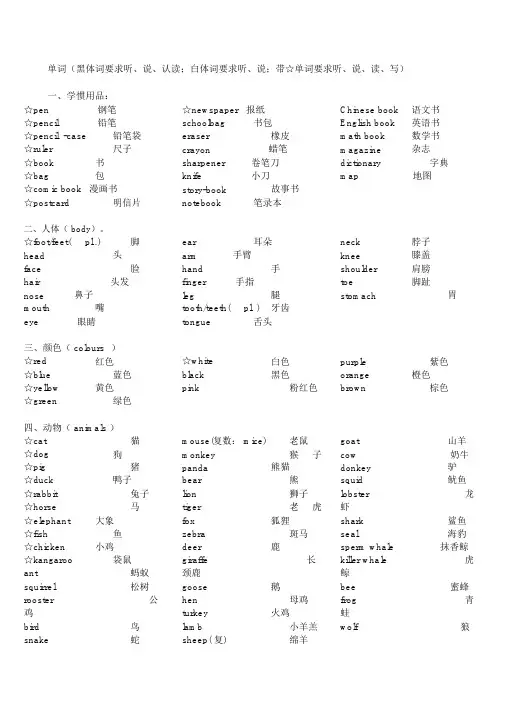
单词(黑体词要求听、说、认读;白体词要求听、说;带☆单词要求听、说、读、写) 一、学惯用品: ☆pen 钢笔 ☆newspaper 报纸 Chinese book 语文书
☆pencil 铅笔 schoolbag 书包 English book 英语书
☆pencil -case 铅笔袋 eraser 橡皮 math book 数学书
☆ruler 尺子 crayon 蜡笔 magazine 杂志
☆book 书 sharpener 卷笔刀 dictionary 字典
☆bag 包 knife 小刀 map 地图
☆comic book 漫画书 story-book 故事书
☆postcard 明信片 notebook 笔录本
二、人体( body)。 ☆foot/feet( pl .) 脚 ear 耳朵 neck 脖子
head 头 arm 手臂 knee 膝盖
face 脸 hand 手 shoulder 肩膀
hair 头发 finger 手指 toe 脚趾
nose 鼻子 leg pl. ) 腿 stomach 胃
mouth 嘴 tooth/teeth( 牙齿
eye 眼睛 tongue 舌头
三、颜色( colours )
☆red 红色 ☆white 白色 purple 紫色
☆blue 蓝色 black 黑色 orange 橙色
☆yellow 黄色 pink 粉红色 brown 棕色
☆green 绿色
四、动物( animals ) ☆cat 猫 mouse(复数: mice) 老鼠 goat 山羊
☆dog 狗 monkey 猴 子 cow 奶牛
☆pig 猪 panda 熊猫 donkey 驴
☆duck 鸭子 bear 熊 squid 鱿鱼
☆rabbit 兔子 lion 狮子 lobster 龙
☆horse 马 tiger 老 虎 虾
☆elephant 大象 fox 狐狸 shark 鲨鱼
最新人教pep版小学英语毕业课本知识点单元复习第17课时五年级下册 Unit 5
是你的。
返回目录
4. A: Is he drinking water? 他在喝水吗?
重 B: No, he isn't. He's eating.
不是。他在吃东西。
点 句 5. A: Are these rabbits eating? 这些兔子在吃东西吗?
返回目录
8. eating (eat的-ing形式) (正在)吃 重 9. playing (play的-ing形式) (正在)玩耍 点 单 10. jumping (jump的-ing形式) (正在)跳 词 11. drinking (drink的-ing形式) (正在)喝(水)
12. sleeping (sleep的-ing形式) (正在)睡觉
返回目录
单元整体提升
一、Read and write.写出下列单词的名词性物主代词。
1.my→___m_i_n_e_____
2. your→y_o_u_r_s______
3. his→__h_i_s______ 5. our→__o_u__rs_____
4.her→_h_e_r_s______ 6. their→___th__ei_r_s___
store is ___t_h_e_ir_s___.
5. A: Look! That's my dog.
B: Yes, It's ___y_o_u__r___ dog. The dog is ___y_o_u_r_s___.
6. A: Sam and Peter, wash ____y_o_u_r___ hands.
返回目录
最新人教pep版小学英语毕业课本知识点单元复习第6课时四年级下册 Unit 4~Unit 6
brown. They are ninety yuan. He puts on a pair of black 5.s_u_n_g_la_s_s_e_s__,
too. He looks so cool! He goes to the farm to see the 6.a_n_i_m_a_l_s______
. They are eating grass now.
7. This is Mary's ___d_r_e_ss____
. That is John's ___sh_i_r_t___
返回old today. What do you want to wear?
B: I want to wear my new __c_o_a_t_____
A. They are my sisters.
B. They are my sister's.
返回目录
( A )8. How do you like this skirt?
A. It's very pretty.
B. Yes, it's pretty.
( A )9. Can I try this hat on?
B. No, it isn't.
( A )3. How many cows do you have?
A. I have thirty.
B. There are thirty.
返回目录
( B )4. Whose pants are these?
A. It's mine.
B. They are mine.
1. A: What are these? B: They __a_r_e__g_re_e_n__b_e_a_n_s_. _____________________ 2. A: How many horses do you have? B: __I__h_a_v_e_e_i_g_h_t_(_h_o_r_se_s_)______________________. 3. A: _W__h_a_t_'s__it_/t_h_i_s/_t_h_a_t?______________________
最新人教pep版英语六年级下册《小学英语总复习基础知识点与重点难点考点分析详解》精品完整打印版整理汇总
最新人教pep版小学英语六年级下册小学英语总复习基础知识点与重点难点考点分析详解前言:该复习资料由多位一线国家特级教师针对当前最新的热点、考点、重点、难点、知识点,精心编辑而成。
以高质量的复习资料助力考生查漏补缺,在原有基础上更进一步。
(最新精品必备复习资料)第一部分:基础知识1.字母:26个字母的大小写ABCDEFGHIJKLMNOPQRSTUVWXYZabcdefghijklmnopqrstuvwxyz2.语音:元音的发音五个元音字母:AEIOU12个单元音:前元音:[i:] [ɪ] /e/ [æ]中元音:[ɜ:] [ə]后元音:[ɑ:] [ɒ] [ɔ:] [u :] [ʊ] [ʌ]双元音(8个)合口双元音(5个)[ai] [ei] [au] [əu] [ɔi]集中双元音(3个) [iə][εə][uə]3.词汇:词汇量,近反义词4.句子:大小写,标点符号第二部分:语法知识1名词:名词单复数,名词的格(一)名词单复数一般情况,直接加-s,如:book-books, bag-bags, cat-cats, bed-beds 以s. x. sh. ch结尾,加-es,如:bus-buses, box-boxes, brush-brushes, watch-watches以“辅音字母+y”结尾,变y为i, 再加-es,如:family-families, strawberry-strawberries以“f或fe”结尾,变f或fe为v, 再加-es,如:knife-knives不规则名词复数:man-men, woman-women, policeman-policemen, policewoman-policewomen, mouse-micechild-children, foot-feet, tooth-teeth, fish-fish, people-people, Chinese-Chinese, Japanese-Japanese不可数名词的复数就是原型: paper, juice, water, milk, rice, tea(二)名词的格(1)有生命的东西的名词所有格:a) 单数后加’s 如: Lucy’s ruler my father’s shirtb) 以s 结尾的复数名词后加’如: his friends’ bagsc) 不以s 结尾的复数后加’s children’s shoes并列名词中,如果把’s加在最后一个名词后,表示共有, 如:Tom and Mike’s car 汤姆和迈克共有的小汽车要表示所有物不是共有的,应分别在并列名词后加’sTom’s and Mike’s cars 汤姆和麦克各自的小汽车(2)表示无生命东西的名词通常用“ of +名词”来表示所有关系:如:a picture of the classroom a map of China2冠词:不定冠词,定冠词种类(1)不定冠词:a / an a unit / an uncle元音开头的可数名词前用an :an egg / an apple / an orange / an eraser / an answer /an ID card / an alarm clock / an actor / an actress / an e-mail / an address / an event / an example / an opera /an houran old man / an interesting book / an exciting sport /an action movie / an art lesson /(2)定冠词:the the egg the plane定冠词的用法:特指某(些)人或某(些)物: The ruler is on the desk.复述上文提到的人或物:He has a sweater. The sweater is new.谈话双方都知道的人或物:The boys aren’t at school.在序数词前: John’s birthday is February the second.用于固定词组中: in the morning / afternoon / evening不用冠词的情况:专有名词前:China is a big country.名词前有定语:this , that , my , your , some, any , no 等:This is my baseball.复数名词表示一类人和事:Monkeys can’t swim. They are teachers.在节日,日期,月份,季节前:Today is Christmas Day. It’s Sunday.一日三餐前:We have breakfast at 6:30.球类棋类运动前:They often play football after class. He plays chess at home.* 但乐器前要用定冠词:I play the guitar very well.学科名称前:My favorite subject is music.在称呼或头衔的名词前:This is Mr Li.固定词组中:at noon at night by bus3代词、形容词、副词1).代词:人称代词,物主代词人称代词物主代词主格宾格第一人称单数I(我)memy(我的)复数we(我们)usour(我们的)第二人称单数you(你)youyour(你的)复数you(你们)youyour(你们的)第三人称单数he(他)himhis(他的)she(她)herher(她的)it(它)itits(它的)复数they(他们/她们/它们)themtheir(他们的/她们的/它们的)2).形容词,副词:比较级,最高级(一)、形容词的比较级1、形容词比较级在句子中的运用:两个事物或人的比较用比较级,比较级后面一般带有单词than。
最新人教pep版小学英语毕业课本知识点单元复习第27课时六年级下册 Unit 3
B: I ____w_e_n_t___ to Hong Kong.
2. A: Did you ___r_i_d_e____ a horse in Xinjiang?B: Yes, I ___r_o_d_e____ a horse in Xinjiang.
3. A: What did you do ____o_n_____ the Labour Day holiday?
Wu Yifan: That sounds good. Maybe (可能) we can go there together
next time.
返回目录
单元整体提升
一、Read and write.读一读,想一想,根据上下文或首字母提示写 出恰当的单词。
1. A: __W__h_e_r_e___ did you go last weekend?
B: Last night? Oh, I went to the supermarket.
3. A: I rode a bike yesterday. __D__id__y_o_u__r_id_e__a_b_i_k_e_y_e_s_t_er_d_a_y___, too?
B: No, I did homework.
返回目录
___略______________________________________________________
_________________________________________________________ _________________________________________________________ _________________________________________________________ _________________________________________________________ _________________________________________________________
小学pep英语总复习——形容词和副词
(对) China is larger than any other country in Asia.
• 9.要注意对应句型,遵循前后一致的原则。 • The population of Shanghai is larger than that of Beijing. • • It is easier to make a plan than to carry it out.
二、形容词的比较级
1.形容词比较级在句子中的运用:两个事物或 人的比较用比较级,比较级后面一般带有单 词than。比较级前面可以用more, a little 来 修饰表示程度。than后的人称代词用主格 (口语中可用宾格)。
2.形容词的比较级
A.规则变化
(1)一般在词尾加er clean------cleaner long------longer
• The sooner,the better. 越快越好。
• 5. 表示倍数的比较级用法: • ①. A is …times the size/height/length/width of B. • 如:The new building is three times the height of the old one. • 这座新楼比那座旧楼高三倍。(新楼是旧楼的 四倍高) • ②. A is …times as big /high/long/wide/large as B. • 如:Asia is four times as large as Europe. • 亚洲是欧洲的四倍大。(亚洲比欧洲大三倍)
(2)以字母e 结尾,加r fine------finer nice------nicer
(3) “辅音字母+y”结尾,先把y变i,再加er heavy-----heavier happy-----happier