
上海牛津版六年级上Unit 1知识梳理
矿产资源开发利用方案编写内容要求及审查大纲
矿产资源开发利用方案编写内容要求及《矿产资源开发利用方案》审查大纲一、概述
㈠矿区位置、隶属关系和企业性质。
如为改扩建矿山, 应说明矿山现状、
特点及存在的主要问题。
㈡编制依据
(1简述项目前期工作进展情况及与有关方面对项目的意向性协议情况。
(2 列出开发利用方案编制所依据的主要基础性资料的名称。
如经储量管理部门认定的矿区地质勘探报告、选矿试验报告、加工利用试验报告、工程地质初评资料、矿区水文资料和供水资料等。
对改、扩建矿山应有生产实际资料, 如矿山总平面现状图、矿床开拓系统图、采场现状图和主要采选设备清单等。
二、矿产品需求现状和预测
㈠该矿产在国内需求情况和市场供应情况
1、矿产品现状及加工利用趋向。
2、国内近、远期的需求量及主要销向预测。
㈡产品价格分析
1、国内矿产品价格现状。
2、矿产品价格稳定性及变化趋势。
三、矿产资源概况
㈠矿区总体概况
1、矿区总体规划情况。
2、矿区矿产资源概况。
3、该设计与矿区总体开发的关系。
㈡该设计项目的资源概况
1、矿床地质及构造特征。
2、矿床开采技术条件及水文地质条件。
牛津沪教版六年级上6AUnit1-Unit2 重要知识点复习
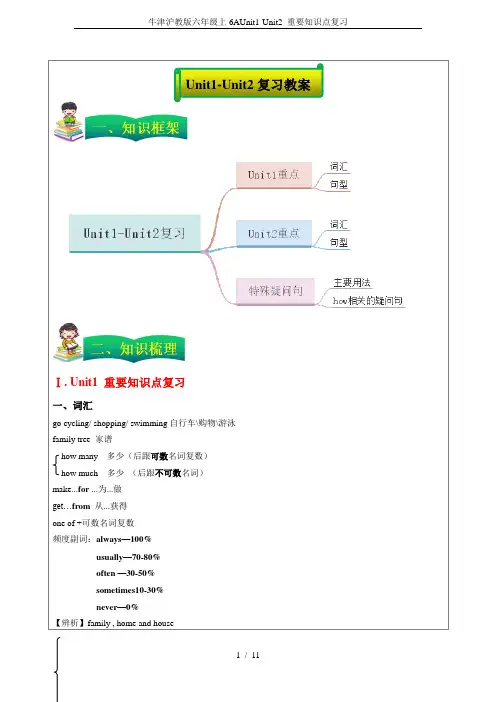
Unit1-Unit2复习教案Ⅰ. Unit1 重要知识点复习一、词汇go cycling/ shopping/ swimming自行车\购物\游泳family tree 家谱how many 多少(后跟可数名词复数)how much 多少(后跟不可数名词)make...for ...为...做get…from从...获得one of +可数名词复数频度副词:always—100%usually—70-80%often —30-50%sometimes10-30%never—0%【辨析】family , home and housefamily:“ 家、家庭、家人”。
作主语时,如果强调的是家庭成员,谓语动词用复数;如果强调的是一个家庭,则谓语动词用单数。
family tree 家谱home "家",指同家人共同生活,居住的地方,特别强调家里的氛围和环境,不一定含有建筑的意思,带有感情色彩的词。
如:hometown 故乡...house“住宅”、“房子”,指居住的房屋,建筑物。
二、语法和重点句型1. 用This is ... /These are ...来介绍家人。
二者都表示近指,“This is .. . ”后跟单数名词,“These are ...” 后跟复数名词或者多个不同的对象。
2.用how many 来询问数量后接可数名词的复数形式,当我们提问你有多少……时候,如果How many后跟人,常用how many... do you have?如果How many 后跟物,常用how many...have you got?3.What do you do with your... ? 和What else do you do with your... ? 来提问与家庭成员或亲戚一起做什么.else 意为别的其他的,常用于特殊疑问词或不定式之后,如what else, something else等。
沪教牛津版六年级英语上精品课件-Unit 1 Growing up
about在本句中的意思是“大约”,后面接数词。 以前我们学过的about的意思是“关于”。
例句:彼得大约10岁。 Peter is about ten years old.
2. In Photo 2, Sally was one year old. 在照片2中,萨莉一岁。 year old的意思是“岁”,当岁数大于一时, year old要变成复数形式,即:years old。
__s_i_x__ years old at primary school
__t_w_o__ months old small and cute
Language points
1. She was about two months old.她大约两个月大。
本句用到一般过去时态。一般过去时表示过 去某个时间发生的动作或存在的状态,过去习惯 性、经常性的动作、行为和过去主语的性格和所 具有的能力。
表示过去的时间状语有:yesterday (昨天),last weekend (上周末),last year (去年),just now (刚才), two days ago (两天前),in 1996 (在1996年)等。
一般过去时的构成 1. be动词的一般过去时
a.肯定式:I was … He (She/It) was… We(You/They)were…
b.否定式:在be动词后加not,且was not可简写为 wasn’t, were not可简写为weren’t。
c.一般疑问句:Was I (he/she/it)…? / Were you(we/they)…?
肯定回答:Yes, I was. (you/they were.) 否定回答:No, I wasn’t. (you/they weren’t.)
牛津译林版六年级英语上册第一单元6A Unit2词汇和句型知识点
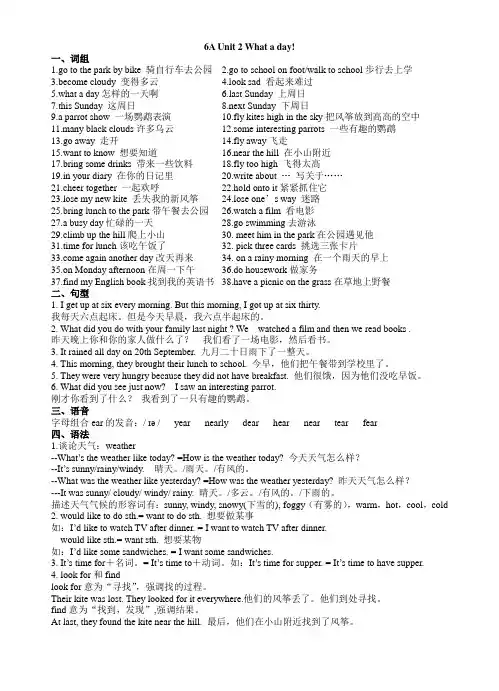
6A Unit 2 What a day!一、词组1.go to the park by bike 骑自行车去公园2.go to school on foot/walk to school步行去上学3.become cloudy 变得多云4.look sad 看起来难过5.what a day怎样的一天啊st Sunday 上周日7.this Sunday 这周日8.next Sunday 下周日9.a parrot show 一场鹦鹉表演10.fly kites high in the sky把风筝放到高高的空中11.many black clouds许多乌云12.some interesting parrots 一些有趣的鹦鹉13.go away 走开14.fly away飞走15.want to know 想要知道16.near the hill 在小山附近17.bring some drinks 带来一些饮料18.fly too high 飞得太高19.in your diary 在你的日记里20.write about …写关于……21.cheer together 一起欢呼22.hold onto it紧紧抓住它23.lose my new kite 丢失我的新风筝24.lose one’s way 迷路25.bring lunch to the park带午餐去公园26.watch a film 看电影27.a busy day忙碌的一天28.go swimming去游泳29.climb up the hill爬上小山30. meet him in the park在公园遇见他31.time for lunch该吃午饭了32. pick three cards 挑选三张卡片e again another day改天再来34. on a rainy morning 在一个雨天的早上35.on Monday afternoon在周一下午36.do housework做家务37.find my English book找到我的英语书38.have a picnic on the grass在草地上野餐二、句型1. I get up at six every morning. But this morning, I got up at six thirty.我每天六点起床。
牛津沪教版英语六年级上6A寒假复习Module 1辅导讲义

6A巩固复习Module 1一、复习思路1.单词及短语梳理2.课内语言点&语法知识梳理3.巩固及习题二、复习要点(一)单词及短语梳理Unit1family and relatives 家庭和亲戚a family tree 家谱grandsons and granddaughters 孙子和孙女们/外孙和外孙女们two cousins 两个堂/表兄弟/妹get a lot of presents 得到许多礼物get a birthday card from sb. 从某人那儿得到一张生日卡one of my family members 我的家庭成员之一only have one aunt 仅仅有一个阿姨my classmates 我的同班同学go shopping 去购物what else 其他什么play badminton 打羽毛球go cycling 去骑自行车go swimming 去游泳how many + 名词复数多少……Unit2Ⅰ. 词性转换1.friend n. 朋友→friendly adj. 友好的→* friendship n.友谊2.help n./v.帮助→helpful adj.有帮助的→* helpless adj.无帮助的3.one的序数词→first4.pollute v. 污染→pollution n.污染5.discuss v. 讨论→*discussion n. 讨论e n.用法,用处v.使用→useful adj.有用→* reuse v. 再利用1.talk to/with her和她交谈2.not…at all一点也不……3.like to play together喜欢一起玩4.almost every day几乎每一天5.can’t read or write不能读和写6.go out at night在晚上出去7. a little dog一条小狗8.like to be together喜欢在一起9.walk to school= go to school on foot步行去学校10.eat their lunch吃午饭11.share their food分享食品12.help each other互相帮助13.help other people帮助他人14.friendly and helpful友善待人,助人为乐15.work hard勤奋学习16.be (never) late for school上学(从不)迟到17.(never) get angry(从不)生气。
牛津上海版英语六年级上册Unit1Period1说课稿

(四)总结反馈
在总结反馈阶段,我将引导学生进行以下自我评价:
1.让学生回顾本节课所学内容,总结自己在词汇、语法、对话等方面的收获。
2.邀请学生分享学习心得,鼓励他们用英语表达自己的观点。
3.提供有效的反馈和建议,针对学生的表现给予肯定和鼓励,指出需要改进的地方。
3.电子白板:方便教师在课堂上实时展示和标注重点内容,提高教学效果;
4.小组讨论板:用于记录各小组的讨论成果,便于分享和交流。
这些媒体资源在教学中的作用主要有:提供丰富的教学素材,激发学生的学习兴趣;直观展示知识点,便于学生理解和记忆;提高课堂互动性,促进师生和生生之间的交流。
(三)互动方式
我计划设计以下师生互动和生生互动环节,以促进学生的参与和合作:
(二)学习障碍
在学习本节课之前,学生已经掌握了基本的英语词汇和语法,能够进行简单的英语对话。然而,他们可能在前置知识或技能方面存在以下不足:1.对一般现在时态的肯定句和否定句的构成不够熟练;2.在实际对话中,可能无法灵活运用所学词汇和句型;3.部分学生可能对健康生活方式的了解不够深入,导致在讨论时表达困难。
2.学生在小组活动中可存在参与度不均的问题;
3.课堂时间有限,难以保证每位学生都能得到充分的练习和指导。
应对策略:
1.对于语法掌握不足的学生,我将提供额外的辅导和练习;
2.通过小组评价和激励机制,提高学生的参与度;
3.优化课堂时间管理,确保教学活动的高效进行。
课后评估教学效果时,我将关注学生的作业完成情况、课堂参与度和学习反馈。具体的反思和改进措施包括:
1.交际法:通过创设真实语境,让学生在实际的语言环境中进行交流,以提高他们的语言运用能力。理论依据是交际语言教学法,认为语言学习的目的是为了交际,强调在交流中学习语言。
上海牛津六年级上6A各单元知识梳理

预初期末复习Module 1 Unit 1 family and relatives 单元重点1.关键词汇Relative :grandfather, grandmother, grandson, granddaughter, uncle, aunt, cousinFamily tree, family members :father, mother, son, daughter, brother, sisterplay games/football/badminton ;go shopping/swimming/cycling ;go to a restaurant/the park ;watch TV/a film ,only ,else ,classmate2.语言功能Asking for information 询问信息1)A :How many + 名词复数+ do you have ?B :I only have one……/ I have (number)……2)A :What (else)do you do with your + 名词?B :I always / usually / sometimes / never do sth. with my + 名词Introduction 介绍:This is ……/ These are ……Express good wishes 表示祝愿:Happy birthday !3. 语法要点1)频度副词always ,usually ,often ,sometimes 和never 在一般现在时中的用法:放在be 动词、助动词后面,放在行为动词前面。
She is often late for school .When do you usually do in the morning ?He usually goes to bed in the morning .1. 主格做主语,放在句首:I often go to the supermarket . (me)2. 宾格做宾语,放在动词、介词的后面:I sometimes go shopping with him (he)3. 形容词性物主代词做定语,放在名词前面:后面必须加名词Our classroom is very big and clean. (we)4. 名词性物主代词做主语、宾语、表语:后面不能加名词Is this her T shirt ?No ,hers is red . (she)That new flat is ours . (we)3) 一般现在时:主语除了是三单主语是第三人称单数I go to school on foot . She goes to school on foot .I don’t go to school on foot . She doesn’t go to school on foot .Do you go to school on foot ?Does she go to school on foot ?Yes ,I do . / No ,I don’t Yes she does . / No ,she doesn’t动词变化①以s ,x ,ch ,sh ,o结尾+es ;②以辅音字母+y结尾,去y+ies ;③have…hasModule 1 Unit 2 I have a good friend 单元重点1.关键词汇词性转换:friend n. ……friendly a. ……friendship n.help n. v. ……helpful a. ……helpless a.kind a. ……kindness n. ……kindly ad.pollute v. ……pollution n.discuss v. ……discussion n.use v. ……reuse v. ……useful a. ……useless a.angry a. ……angrily ad. ……anger n.visit n. v. ……visitor n.词组:talk to/with sb talk about sth = discuss sthlike to do/doing enjoy doingevery day every night/morning/afternoongo out at night walk to school = go to school on footbe together play togethereat one’s lunch share one’s foodhelp each other each other = one anotherhelp other people other people = othersbe late for ask sb about sthwork hard be kind toget angry get coldshare sth with sb tell lieslive in the USA visit Garden Cityfor the first time on Saturdaya friend of the Earth pick up rubbishlook after = take care of = care for all the things around uspollute the environment air/land/water/noise pollutionkeep ……clean keep + adj; keep quiteput rubbish into rubbish bins leave rubbishtell sb to do ; tell sb not to do ask , invite , allow , want sb not to dowant to be want/agree/decide/hope/offer/try/manage + to do promise to do ; promise not to do discuss sth with sb2.语言功能1)A :Thank you! B :Not at all./ You’re welcome./ It’s a pleasure./ That’s all right.2) A :We want to look after the environment . B :All right .3.语法要点1)We like to + v ……together2)be + adj :She is always naughty/clever/friendly/helpfui比较:She always gets angry . She never tells lies.3) A:Where have you been ? B:I have been to ……A:Have you been to ___________yet?B: yes, I have just /already been to ______./Y es , I have just /already been there.No, I haven’t been to ______yet. / no, I haven’t been there yet.4) we promise to .../we promise not to ..Module 1 unit3 spending a day out together1. 关键词汇词性转换happy a.------- happily ad. -------unhappy a.sand n. ---------sandy a.sun n. -------sunny a.cloud n.-------- cloudy a. wind n. ------windy a.rain n. ------rainy a. snow n. ------snowy a.luck n. ------lucky a. ------luckily ad. ------ unlucky a.act v. ------activity n. ------ actor n. ------ actress n. ------action n.collect v. ------ collection n.important a. ------importance n.special a. ------specially ad.词组:At weekends= at the weekend on weekdaysBe far away from be nearIn sandy bay/ sunny town on lucky islandCome with sb space museumA photo of me the students of class threeBuy tickets eat ice creamHave a barbecue/a picnic/lunch/dinner spend a holidayFly tickets ride bicycles= cycleMake sandcastle collect shellsMake an album come backPlan a visit plan to do sthCome back make some notesGet there get to ShanghaiMy sixtieth birthday her ninth birthdayHave a big birthday party have a good time = enjoy oneselfPlay with sb get enough food for the party2. 语言功能1)A: Let’s go to Ocean Park . B : That’s a good idea./All right.2)A: Where have you been in -----? B: I have been to ----in---with sb3) A: Which place shall we visit? B: Shanghai MuseumWhen shall we go there ? On SaturdayWhat time ---? 9 o’clockHow are we going to get there ? By undergroundHow much does it cost? = How much is it ?How much do they cost ? = How much are they ?3. 语法要点1) 表示建议How about + n/doing? How about playing badminton?What about + n/doing? What about playing badminton?Why not + do ? Why not play badminton.Why don’t you + do? Why don’t you play badminton?Let’s + do . Let’s play badminton.2) 现在进行时表示说话正在发生的动作或目前这一阶段正在进行的动作’s nine.搭配Module 2 Unit 4 What would you like to be 单元重点1词性转换:secret a.-------secretary n .teach n.-------teacher n .drive n.-------driver n .work v .------worker n .safe n .a.-----safely ad.------safety a.fire n.-------fireman n.post .v.-----postman n. ----postage n-----poster ncook v.------cook n.-------cooker n.2词组:1.find out Please find out who broke the window .find At last he found his English book.look for Alice is looking for her new watch .2.interview sb interview her3.start work4.finish work5.put sth together6.stick sth on a display board7.in the morning/afternoon/eveningOn a cold morning on Sunday afternoon/on the evening of July 18.make our city a safe placemake sth for sb =make sb sth make a cake for us =make us a cakemake sb+adj. make me happy9.eight years old3.语言功能A.表达愿望(wishes)Would you like to be a policeman ?—Yes, I would./ No, I would not.B. 陈述原因(give reasons)Why……?Because……4.语法要点:A.I’d=I would ; would not =wouldn’tB. would like to 与want to 的转换I would like to be a nurse .=I want to be a nurse.I wouldn’t like to be a nurse.=I don’t want to be a nurse .Would you like to be a nurse ?=Do you want to be a nurse ?She would like to be a nurse.=She wants to be a nurse .She wouldn’t like to be a nurse.=She doesn’t want to be a nurse .Would she like to be a nurse?=Does she want to be a nurse ?5.职业A cook cooks food for people.A secretary takes notes and answers phones.A dentist looks after people’s teeth.A doctor makes sick people better.A nurse helps make sick people better.A pilot flies a plane.A shop assistant sells things to people.A factory worker makes things in a factory.A fireman puts out fires.A bank clerk receives money and gives money in a bank.Module 2 Unit 5 Open Day 单元重点1.词性转换:1. enter v.----------entrance n.2. music n. -------musical a.3.final a.--------finally ad.4.invite v.------invitation n.5.act v.--------activity n.6. different a.----difference n.2.词组:1.arrive at (小)in(大)+地点get to +地点到达某地Arrive at school arrive in Shanghai get to Shanghai reach Shanghai比较:arrive home/here/there get home reach home2.meet sb at +地点meet Mary at the entrance3.visit sb/sp. Visit Mr. Wang/visit Beijing4.look at sb/sth look at class project/look at me5.listen to sb/sth listen to him /listen to the music6.the Arts and Crafts room English club noticeboard7.in the library in the hall in the music room in classroom 6A8.have tea and cakes9.want sb to do sth want us to make notes10.welcome sb welcome the parents11.on the open day 12.in different places13.on the second floor 14.teachers’office15. invite sb to do sth invite Lily to have a picnic16.take some photos complete the article17. have a good time =have a great time =enjoy oneself=enjoy one’s time3.语言功能:A.询问信息(Asking for information)--When What time Where WhatWhere will kitty be? Kitty will be in the music room.B.用副词表达事情得进展顺利。
牛津上海版英语六年级第一学期 Unit1 —— Unit5 重点归纳
6A(U1~U5)语言点汇总Unit One1.family and relatives2.a family tree3.their son, 复习所有人称代词4.a lot of , many much, 句型区别5.get sth from sb6.birthday cards/birthday presentse from/ be from8.make sth for sb/ make sb sth give sth to sb/give sb. sth9.one of +最+名复10.o nly have one aunt11.a n aunt/ uncle, a university/uniform, an hour/ an honest boy12.t alk about sth with/to sb.= discuss sth with sb13.e ach other’s names/ telephones14.o ther +名=others15.w hat else/who else/where else/anything else/somebody else\16.g o shopping/running/skating/skiing/cycling等17.a lways/usually/often/sometimes/hardly/rarely/never等频度副词使用+ 一现18.g o to sp/ go there19.d o sth with sbUnit Two1.doesn’t talk at all = never talks2.go to the park3.can’t read or write, not … or…4.go out5.at night= in the evening6.on a rainy morning/ on Sunday afternoon/ on the evening of June17.like to be together/, like to do/doing8.walk to school= go to school on foot9.have lunch/ have dinner10.have a big/delicious/full/terrible meal/breakfast11.s hare food = have food together12.h elp each other, help other people/others13.i s friendly and helpful, is never late for school, is kind to others, isnever naughty14.w ork hard15.g et angry16.s hare food with sb17.t ell lies18.i n the USA19.f or the first time/for the second time20.o nce/twice/three times/four times21.a sk sb about sth22.a lready/just/yet 区别23.h ave been to 与have been in 的区别24.h ave been to 与have gone to 区别25.h ave been here/ there/ home26.l ook at, look after, look out of27.w ork with sb.28.f riends of the earth29.l ook after the environment30.T he environment is all the things around us.31.p ollute the air/water/land32.a ir pollution, land pollution, water pollution33.h elp do sth34.k eep the environment clean, keep the door open, keep the windowclosed复习复合宾语结构35.p ick up rubbish and put it in to the rubbish bins36.t ell sb to do sth/ tell sb not to do sth37.w ant to do/ be38.w ant sb to do sth39.l et/make/have sb do sth 复习三个让40.p romise to do, promise not to do41.r euse shopping bags42.l eave rubbish43.W ho + 动词三单一eg. Who is your teacher?/Who studies best?/Who runs fastest?Unit Three1.sb. spend st doing sth,= it take sb st to do sth2.sb spend sm on sth = sb pay sm for sth= sth cost sb sm3.on Lucky Island/ in Sunny Town/ in Blue Bay4.This is a photo of my father and me.注意宾格用法5.buy tickets for6.buy sb sth/ buy sth for sb7.bring sth to sb/sp, take sth to sp8.play + 球类, play + the + 乐器注意区别9.have a picnic, go for a picnic, go on a picnic10.h ave a barbecue11.f ly kites, ride bicycles, make sandcastles, collect shells, play games12.p lan to do, plan A for B13.p lan a visit to sp= plan to visit sp 注意visit 词性区别14.五大建议Let’s do sth. / Shall we do sth? / What about doing sth? /How about doing sth? / Why don’t you do sth? / Why not do sth?15.W hich place shall we visit? What shall we visit?16.复习三个到达arrive in+大地方, arrive at +小地方, get to+任何地方,reach+任何地方17.g et there/ arrive there18.三种问价格方式How much do they cost? How much are they? Whatis the price of sth?19.b y+ 交通工具. by bus/by ferry, on foot20.c ome back to sp = return to sp21.a t weekends/ at the weekend/ on weekdays/ on the weekend22.f ar away from/ near23.m y twelfth birthday/his grandma’s sixtieth birthday/her father’s fortieth birthday24.l ucklucky,unluckyluckily,unluckily25.h ealthhealthy/unhealthyhealthily/unhealthily26.a t the beach/seaside27.特别注意不双写的几个动词writing/eating/visiting/28.t ell sb to do sth/ tell sb not to do sth29.M y hobby is doing sth.eg. His hobby is reading books.30.注意几个易错单词拼写eg. interesting/barbecue/entrance/fishermaninvitation/interview/pilot/parents/presentsUnit Four1.would like to do = want to do注意各时态句型变化2.wouldn’t like to do= doesn’t/don’t/didn’t want to do3.Would he like to be a/an…?= Does he want to be a/an…?4.What would she like to be?= What does she want to be/5.different jobs6.teach me/us/them/Tom English注意宾格用法7.make sick people better复习复合宾语结构8.put out fires9.put out/up/down/10.cook food for people11.make our city a safe place12.二种问年龄How old are you?=What is your age?13.四种问职业What’s his job?=What does he do?=What job does he do?=What’s he? 注意区别What is he?和Who is he?14.注意区别job和work15.start work/ finish work16.That’s what I would like to be.17.put sth together18.on a display board19.She is twelve years old.= She is a twelve-year-old girl.20.区别三个寻找look for/find/ find out21.finish doing22.enjoy doing23.look at/for/up/after区别词义24.注意几个序数词ninth,nineteenth,ninetieth,ninety-ninth eighth,eighteenth,eightieth,eighty-eighth25.two Germans26.two fishermenUnit Five1.on the Open Day2.Open Day programmes3.at an entrance to sp4. a school choir5.plan sth for sth6.meet sb at the entrance7.visit our classroom8.look at our class projects9.in the Arts and Crafts room10.listen to the school choir11.in the hall/ in the library12.look at our English Club noticeboard13.have tea and cakes with sb14.in the Music room15.first/next/then/after that/finally16.welcome the parents17.in different places18.on the ground floor/ on the first floor注意区别英英和美英用法19.invite sb to do sth/ invite sb to sp20.write an invitation to sb21.write to sb对应hear from sb收到某人来信22.take photos23.have a great time= have a good time=enjoy oneselfeg. They had a good time.=They enjoyed themselves.注意人称时态反身代词的变化24.There be 句型不同时态变化,特别注意There is going to be的用法25.this Saturday, this week前省略介词26. a few/a little/few/little看笔记注意区别拓展卷:1.some…others…2.one…another3.There are few books. We need to buy some.对应There are a fewbooks. We don’t need to buy any.4.one of the tallest buildings5.have an unhealthier diet6.many useful suggestions7.Let’s do sth, shall we?8.Let us do sth, will you?9.no good news news 不可数名词10.at the same time11.on Sunday evenings12.be busy with sth/ be busy doing sth13.know about sth= understand sth。
沪版牛津英语六年级上知识点整理
Module 1 Family and friendsUnit 1 Family and relatives1.family and relatives 家庭和亲戚2. a family tree 一个家谱3.grandsons and granddaughters 孙子和孙女们/外孙和外孙女们4.get a lot of presents 得到许多礼物5.Happy Birthday (to sb.) ! 生日快乐!6.get a birthday card from sb. 从某人那儿得到一张生日卡7.one of my family members 我的家庭成员之一8.only have one aunt 仅仅有一个阿姨9.my classmates 我的同班同学10.go shopping 去购物11.what else 其他什么12.play badminton 打羽毛球13.go cycling 去骑自行车14.go swimming 去游泳15.two cousins 两个堂/表兄弟/妹16.how many + 名词复数多少……语言点1. This is my grandfather.这是我的(外)祖父。
These are my family and relatives.这些是我的家人和亲戚。
注意句中各成分保持单复数同形。
2. I‟m their son.. 我是他们的儿子。
We‟re their sons.我们是他们的儿子。
3. How many uncles do you have?你有多少个叔叔?How many后面接可数名词的复数形式。
4. What do you do with your…?你和你的…干什么?5. What else do you do with your…?你和你的…还干什么?6. What else do you do with your…?你和你的…还干什么?With是个介词,后面接人称代词时,要用宾格的形式。
牛津上海英语六年级上册 Unit1(共16张PPT)
We’re their _____g_ra_n_d_d_a_u_g_h.ters
a birthday card Happy birthday!
• What is it?
present presents
Alice has got a lot of presents and birthday cards from her family and relatives.
Module 1 Unit 1
Guess Father And Mother I Love You
aunt
uncle
cousin
cousin
relative [‘relətiv]
n. 亲戚
Look and learn
My name is Alice. These are my family and relatives. This is my grandfather. This is my grandmother. This is my mother. This is my father. This is my brother. This is my aunt. These are my uncles. These are my cousins.
John wants to make a birthday card for his father.
They are my family members. n. 成员
My family tree
家谱
grandfather
grandmother
mother
father
uncle
aunt
uncle
brother
This is Alice.
牛津沪教版六年级英语上6BModule 1 Unit 1语法及拓展
四、课堂练习
Ⅰ Choose the best answer.
介词 in, on, to 的用法?
三、新课讲解
1. Miss Guo and her students are at an exhibition about great cities in Asia. 郭老师和她的学生们出 席了一场关于亚洲大城市的展览会。
at an exhibition 意为“出席展览会;在展览会现场”。 great cities 指的是“大城市”。
牛津沪教版六年级英语上 6BModule 1 Unit 1 语法及拓展
学 科 英语 课题名称
6B M1 Unit1 Great cities in Asia.语法及拓展
Unit1 Great cities in Asia 语法及拓展
一、课前回顾
单词默写:
名词 noun
1.
亚洲
2.
日本
3.
东京
4.
泰国
5. How far is it from Shanghai to Beijing? 北京距离上海有多远? How far … 意为“距离(多远)”,用 How far 引导的特殊疑问句来询问距离的远近。 不定代词 it 在这里指代“距离” 介词结构 from … to … 表示“从……到……”
6. ----How long does it take to travel from Shanghai to Beijing by train? 乘火车从上海到北京要多久? ---- It takes about ten hours. 大约 10 小时。 How long 表示“多久”,用于对一段时间的提问。 这里 take 意为“花费”。it 在这里是形式主语,真正的主语是后面的动词不定式 to do sth. It takes sb. some time to do sth. 表示做某事花费某人多少时间