
新人教版七年级下册英语知识点
精品文档 . 新目标英语七年级下册知识点总结 Unit 1 Can you play the guitar? 1,情态动词+V原 can do= be able to do 2,Play+ the+ 乐器 +球类,棋类 3,join 参加社团、组织、团体 4,4个说的区别: say+内容 Speak+语言 Talk 谈论 talk about sth talk with sb talk to sb Tell 告诉,讲述 tell sb (not)to do sth Tell stories/ jokes 5,want= would like +(sb)to do sth 6,4个也的区别: too 肯定句末 (前面加逗号) Either否定句末(前面加逗号) Also 行前be 后,实意动词之前 As well 口语中(前面不加逗号) 7,be good at+ n./ V-ing=do well in 擅长于 be good for 对…有益 (be bad for对…有害) be good to 对…友好 (good 可用friendly,nice,kind替换) be good with和…相处好=get on/ along well with 8,特殊疑问句的构成:疑问词+一般疑问句 9,How/ what about+V-ing …怎么样?(表建议) 10,感官动词(look, sound, taste, smell, feel)+adj/ like 11,选择疑问句:回答不能直接用Yes或者No,要从中选择一个回答 12,students wanted for school show(wanted表示招募,含有被动意义) 13,show sth to sb=show sb sth give sth to sb=give sb sth 14,help sb (to)do sth Help sb with sth With sb’s help= with the help of sb Help oneself to 随便享用 15,be busy doing sth/ be busy with sth 16,need to do sth 17,be free= have time 18,have friends= make friends 19,call sb at +电话号码 20,on the weekend= on weekends 21,English-speaking students 说英语的学生(带有连词符,有形容词性质) 22,do kung fu表演功夫
Unit 2 What time do you go to school? 1,问时间用what time或者when At+钟点 at 7 o’clock at noon/ at night(during/ in the day) On+ 具体某天、星期、特指的一天 on April 1st on Sunday on a cold winter morning In +年、月、上午、下午、晚上 2,时间读法:顺读法 逆读法: 分钟≤30用past five past eight(8:05) half past eight(8:30) 分钟>30用to a quarter to ten(9:45) 整点用 …o’clock 7 o’clock(7:00) 3,3个穿的区别: wear 表状态,接服装、手套、眼镜、香水等 Put on 表动作,接服装 精品文档 . Dress 表动作,接sb/ oneself get dressed穿衣 3,感叹句:How+adj+主谓! How+adj+a/an +n单+主谓! What+ a/an +adj+ n单+主谓! What+ adj+ n复/ 不可数+主谓! 4,from…to… 5,be/ arrive late for 6,频度副词(行前be 后) Always usually often sometimes seldom hardly never 7,一段时间前面要用介词for for half an hour for five minutes 8,eat/ have… for breakfast/ lunch/ dinner/ supper 9,either…or 10,a lot of=lots of 11,it is +adj+for sb +to do sth (adj修饰to do sth)It is important for me to learn English. it is +adj+of sb +to do sth (adj修饰sb) It is kind/ friendly/ nice of you to help me. Unit 3 How do you get to school? 1,疑问词 How 如何(方式) how long 多长(时间)答语常用“(For/ about +)时间段” how far多远(距离)答语常用“(It’s +)数词 +miles/ meters/ kilometers” how often多久一次(频率)答语常用“Always/ often/ every day/…”或 “次数+时间”等表频率的状语 How soon多快,多久以后,常用在将来时中。答语常用“in +时间段” how many多少(接可数名词) how much(接不可数名词) why为什么(原因) what什么 when何时 who谁 whom谁(宾格)(针对宾语提问也可用who) whose谁的 2,宾语从句要用陈述句语序 3,Stop sb from doing sth Stop to do 停下来去做其他事 Stop doing 停止正在做的事 4,what do you think of/ about…?= how do you like…?你认为…怎么样? 5,He is 11 years old. He is an 11-year-old boy. 6,many students= many of the students 7,be afraid of sth be afraid to do sth worry about be worried about 担心 8,play with sb 9,come true 10,have to do sth 11,he is like a father to me (like像) 12,leave离开 leave for 出发前往某地 13,cross 是动词 across是介词 14,thanks for +n/ V-ing Thanks for your help/ thanks for helping me. Thanks for your invitation/ thanks for inviting/ asking me. Thanks to幸亏,由于,因为 15,4个花费:人+spend/ spends/ spent+时间/钱+(in)doing sth/ on sth 人+pay/ pays/ paid +钱+for sth It takes/ took sb +时间+to do sth 物+cost/ costs/ cost +sb +钱 16,交通方式 ●用介词。在句子中做方式状语。 ①by +交通工具名词(中间无需任何修饰)By bus/ bike/ car/ taxi/ ship/ boat/ 精品文档 . plane/ subway/ train…… ②by +交通路线的位置 By land/ water/ sea/ air ③in/ on +冠词/物主代词/指示代词 +交通工具名词 In a/ his/ the car On a/ his/ the bus/ bike/ship/ train/ horse/ motorbike ④on foot 步行 ●用动词。在句子中做谓语。 ①take + a/ the +交通工具名词 take a bus/ plane/ ship/ train ride a bike ②walk/ drive/ ride/ fly to……(后面接here,there,home等地点副词时,省略介词to。)如步行回家:walk home 17,名词所有格 一般情况加’s Tom’s pen 以s结尾加’ the teachers’ office ten days’ holiday 表示几个人共同拥有,在最后一个名词后加’s Mike and John’s desk 表示每个人各自拥有,在每个名词后加’s Mike’s and John’s desks Unit 4 Don’t eat in class. 1,祈使句(变否定在句首+don’t) Be型(be +表语),否定形式:don’t + be +表语 Be quiet,please. Don’t be late! Do型(实义动词+其他),否定形式:don’t +实义动词+其他 Come here,please. Don’t play football here. Let型(let sb do sth),否定形式:don’t + let sb do sth或者let sb not do sth No+n/ V-ing No photos /mobile;No parking/ smoking/ spitting/ talking/ picking of flowers 2,in class在课堂上 in the classroom 在教室 3,be on time准时 4,listen to music 5,(have a)fight with sb 8,eat outside 9,Must 与have to (1)must 表示说话人主观上的看法,意为“必须”。 have to 表示客观的需要或责任,意为“不得不,必须”,后接动词原词。 (2)must没有人称,时态和数的变化Have to 有人称,数,时态的变化,其第三人称单数形式为 has to ,过去式为had to. 构成否定句或疑问句时借助动词do/ does。 (3)have to的否定式是needn’t=don’t / doesn’t have to (不必要);must的否定式是must not/ mustn’t(一定不能,不允许)。 10, Some of… 10,bring…to… 11,practice (doing)sth 12,wash/ do the dishes 13,on school days/ nights 14,break/ follow(obey)the rules 15,Be strict with sb/ oneself be strict in sth对……严格。 16,too many“太多”修饰可数名词复数 too much“太多”修饰不可数名词 much too“实在太”修饰形容词或副词 17,make one’s/ the bed 18,get to, arrive in/at, reach,到达(如果后面接地点的副词home,here或there ,就不用介词in ,at, to) 19,remember/ forget+to do要做
新人教版英语七年级下册各单元知识点汇总

人教版七年级下册英语各单元知识点大归纳Un it 1 Can you play the guitar?♦短语归纳1. play chess 下国际象棋2. play the guitar 弹吉他3. speak En glish 说英语4. English club 英语俱乐部5. talk to 跟…说6. play the violin 拉小提琴7. play the piano 弹钢琴8. play the drums 敲鼓9. make friends 结交朋友 10. do kung fu 练(中国)功夫11. tell stories 讲故事12. play games 做游戏13. on the weeke nd/on weeke nds 在周末♦用法集萃:1. play +棋类/球类下 ....... 棋 ,打……球 I ■ :2. play the +西洋乐器弹/拉… …•乐器*3. be good at doing sth.= do well in doing sth.擅长做某事4. be good with sb.和某人相处地好5. n eed sb. to do sth.需要某人做某事6. can +动词原形 能/会做某事7. a little +不可数名词 一点儿……8. join the…clUb 入…俱乐部9. like to do sth. =love to do sth. 喜欢 /喜爱做某事:・・・— —DE —B n: & ■ ■ n tii ■< n IB L ■■ a ta b ■■ a ・・■■・・・a ・・IJII ・・it ・・・u ・・・n ・・・an ・・uai ・・a ・・・a ・・・u・:■♦典句必背1. Can you draw?Yes, I can. / No, I can' t.2. What club do you want to join? I want to join the chess club.3. You can join the En glish club.4. Sounds good./That sounds good.5. I can speak En glish and I can also play soccer.6. Please call Mrs. Miller at 555-3721.♦话题写作Dear Sir,I want to join your organization ( 组织)to help kids with sports, music and English. My name is Mike. I am 15 years old. I m a student in No. 1 Middle school. I can play the guitar well. I can sing many songs. I can swim and speak English well, too. I think I can be good with the kids. I also do well in telling stories.I hope to get your letter soon.Yours, MikeUnit 2 What time do you go to school?♦短语归纳15. i n the morning/ after noon/ evening 在上午 / 下午 / 晚上 16.take a walk 散步 17. lots of=a lot of 许多,大量1. what time 几点 4. take a shower 洗淋浴2. go to school 去上学 5. brush teeth 刷牙 7. do homework 做家庭作业 10. eat breakfast 吃早饭13. either …or •要么…要么… 8. go to work 去上班 11. get dressed 穿上衣服14. go to bed 上床睡觉 3. get up 起床 6. get to 到达 9. go home 回家 12. get home 到家19. at night 在晚上 ♦用法集萃18. radio station 广播电台20. be late for=arrive late for 迟至U:1. at +具体时间点在几点(几分) 2. eat breakfast/ lunch/dinner 吃早饭 /午饭 /晚饭 3. thirty\half past + 基数词 ... 点半 -4. fifteen\a quarter to + 基数词 差一刻到 ... 点 5. take a/an +名词 从事 .. 活动 6. from …to … 从 ... 到] . -7. need to do sth需要做某事1 —…•.亠 >.…一…U …J亠…亠十亠十亠十亠十——亠—―———L♦典句必背1. What time do you usually get up? I usually get up at six thirty.2. That ' s a funny time for breakfast.3. When do stude nts usually eat dinner?They usually eat dinner at a quarter to seve n in the eve ning.4. In the evenin g, I either watch TV or play computer games.5. At twelve, she eats lots of fruit and vegetables for lun ch..6. She knows it ' s not good for her, butsites good.7. Here are your clothes.♦话题写作主题:谈论日常作息习惯My School DayI am a stude nt. I usually get up at seve n, and I eat breakfast at seve n thirty. Then I go to school ateight.School starts at eight thirty. I eat lunch at twelve. I go home at 17:00. I often eat dinner at 19:00 and the n playthe pia no. I do my homework at 20:00. At 22:00, I go to bed.Unit 3 How do you get to school?♦短语归纳♦用法集萃1. take …to …=go to … by …2. How do / does (sb ) get to …'3. How far is it from…to …4. It takes sb. some time to do sth.5. How long does it take to do sth.?6. It is + adj. + to do sth.7. Thanks for + n. / Ving♦典句必背1. How do you get to school? I ride my bike.2. How far is it from your home to school?1. get to school 到达学校 4. how far 多远7. take the bus 乘公共汽车10. think of 认为 2. take the subway 乘地铁 5. from home to school 从家至U 学校 8. by bike 骑自行车3. ride a bike 骑自行车 6. every day 每天 9. bus stop 公共汽车站 11. betwee n …and 在…和…之间 12. one 11-year-old boy 一个 11 岁的男孩 13. play with 和…玩14. come true 实现 15. have to 不得不乘…去… …是怎样到…的? 从…到…有多远? 做某事花费某人多长时间。
人教版七年级英语下册各知识点归纳总结
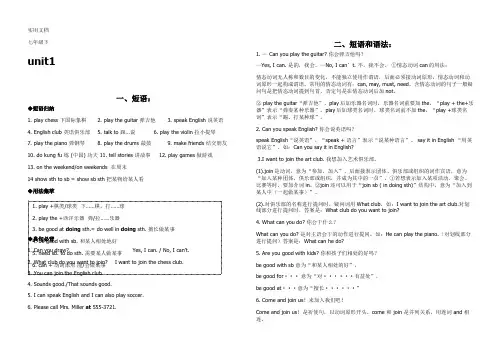
七年级下unit1一、短语:◆短语归纳1. play chess 下国际象棋2. play the guitar 弹吉他3. speak English 说英语4. English club 英语俱乐部5. talk to 跟…说6. play the violin 拉小提琴7. play the piano 弹钢琴8. play the drums 敲鼓9. make friends 结交朋友10. do kung fu 练 (中国) 功夫 11. tell stories 讲故事 12. play games 做游戏13. on the weekend/on weekends 在周末14 show sth to sb = show sb sth 把某物给某人看◆用法集萃◆典句必背1. Can you draw? Yes, I can. / No, I can’t.2. What club do you want to join? I want to join the chess club.3. You can join the English club.4. Sounds good./That sounds good.5. I can speak English and I can also play soccer.6. Please call Mrs. Miller at 555-3721.二、短语和语法:1. — Can you play the guitar? 你会弹吉他吗?—Yes, I can. 是的,我会。
—No, I can’t. 不,我不会。
①情态动词can的用法:情态动词无人称和数目的变化,不能独立使用作谓语,后面必须接动词原形,情态动词和动词原形一起构成谓语。
常用的情态动词有:can, may, must, need。
含情态动词的句子一般疑问句是把情态动词提到句首,否定句是在情态动词后加not。
七年级下册英语所有语法知识点全汇总
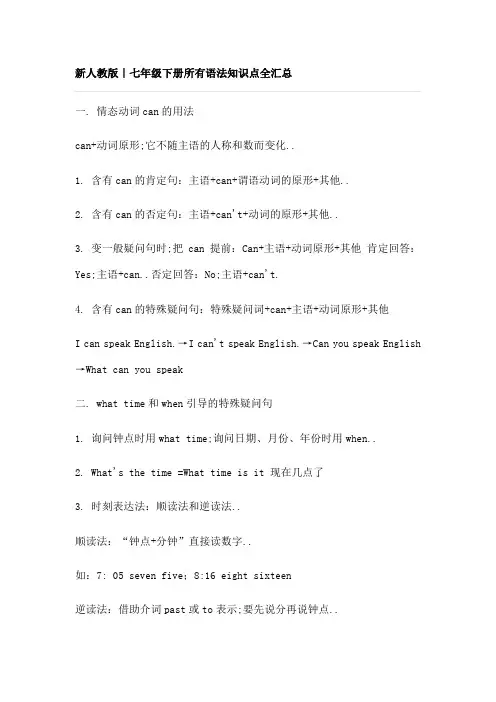
新人教版|七年级下册所有语法知识点全汇总一. 情态动词can的用法can+动词原形;它不随主语的人称和数而变化..1. 含有can的肯定句:主语+can+谓语动词的原形+其他..2. 含有can的否定句:主语+can't+动词的原形+其他..3. 变一般疑问句时;把can提前:Can+主语+动词原形+其他肯定回答:Yes;主语+can..否定回答:No;主语+can't.4. 含有can的特殊疑问句:特殊疑问词+can+主语+动词原形+其他I can speak English.→I can't speak English.→Can you speak English →What can you speak二. what time和when引导的特殊疑问句1. 询问钟点时用what time;询问日期、月份、年份时用when..2. What's the time =What time is it 现在几点了3. 时刻表达法:顺读法和逆读法..顺读法:“钟点+分钟”直接读数字..如:7: 05 seven five;8:16 eight sixteen逆读法:借助介词past或to表示;要先说分再说钟点..a. 当分钟不超过30分钟时包括30分钟;即<或=30;用past表示..其结构为:“分钟+past+整点”意为“几点过几分”..如:1:25 twenty-five past oneb. 当超过30分钟时;即>30;用to表示..其结构为:“所差分钟即60—所过分钟数+to+下一个整点”;to译成“差”;差几分钟到几点..如:4:38 twenty-two to fivec. 当分钟为30分钟用half表示;当分钟为15分钟用a quarter..三. how引导的特殊疑问句1. how 引导的特殊疑问句提问交通方式;其答语分三种情况:a. take a/an/the+交通工具单数b. by+交通工具单数c. on/in+限定词+交通工具---How do you go to school every day---I take a bus to go to school every day./I go to school by bus every day./I go to school on the bus every day.2. how far 用来提问距离;多远;其答语分为两种:1用长度单位表示:It is five kilometers.2用时间表示:It’s twenty minutes’walk.3. how long 用来提问时间;意为多久回答常用“for+段时”..----How long have you learnt English----For 3 years.4. how soon 用来提问做完某事还需要多长时间; 用于将来时态; 常用“in+时间段”来回答..----How soon will you arrive in Beijing ----In 3 hours.四. 祈使句祈使句一般表示请求、命令、劝说、号召、警告等..一般以动词原形开头;句末可以用感叹号或句号..1. 肯定的祈使句:1 实义动词原形+其他:Please look at that boy.2 be动词原形+形容词+其他:Be quiet; please.2. 否定的祈使句:1 Don’t+实义动词+原形 Don't stand there.2 Don’t be+形容词+其他 Don't be so noisy.4 No+n./V-ingNo photos. 不许照相..No talking. 不许谈话..五. 现在进行时现在进行时指当前时间正在发生的动作..常与now;at this moment;listen;look等词连用..1. 现在进行时的基本结构肯定式:am/is/are+doing现在分词否定式:am/is/are not +doing现在分词一般疑问式:Am/Is/Are + 主语 +doing现在分词+ 其他特殊疑问式:特殊疑问词+一般疑问式They’re having a meeting now. 他们现在正在开会..They aren't having a meeting now. 他们现在没有在开会..Are they having a meeting now 他们现在正在开会吗What are they doing now 他们现在正在做什么2. 现在进行时的基本用法1表示此时此刻正在发生的事情..常与now;at the moment;look;listen 等词连用..The little boy is watching TV now. 这个小男孩现在正在看电视..ListenShe is playing the guitar in the next room. 听她正在隔壁房间弹吉他..2表示现阶段一直在进行着或是重复发生着的动作;不强调此时此刻正在做..常与表示时间段的时间状语连用..I am studying computer this term. 这个学期我一直在学习计算机..3表示说话人褒义或贬义的情感色彩;如赞许、批评、喜欢、厌恶等..此时常与alway、often等频度副词连用..He is always thinking of others ; not of himself. 他总是为他人着想;而不为自己..表示赞许One of my roommates is often leaving things about. 我的一个室友经常乱扔东西..表示不满4表示在近期按计划或安排要发生的动作..现在进行时表示一般将来的含义..①瞬时动词的进行时在任何情况下都表示将来含义..这些动词包括go ; come ; leave;arrive ; return等..I am leaving.我将要离开了..I am leaving tomorrow.我将会明天离开..②持续动词的进行时;只有在有将来时间状语或将来语境的情况下才可以表示将来含义..An American professor is giving a lecture this afternoon.今天下午一位美国教授将要作报告..将来含义An American professor is giving a lecture.一个美国教授正在作报告..进行含义3. 现在分词doing的变化规则1一般在情况下;在动词词尾加-ing..go——goingplay——playingknow——knowing2以不发音的字母e结尾动词;先去e再加-ing..make——makingarrive——arrivingcome——coming3以重读闭音节结尾;且动词词尾只有一个辅音字母时;先双写这个辅音字母;再加-ing..run——running stop——stoppingswim——swimmingrun——runningput——puttingsit——sittingbegin——beginning plan——planningcut——cuttingget——gettingshop——shoppingchat——chatting regret——regrettingdig——digging4以-ie结尾;先将-ie改成y;再加-ing.. tie——tyingdie——dyinglie——lying六. There be结构1. There be句型主要用以表达“某处有某人某物;强调存在”其基本结构为“There be+某物某人+某地”;有时为了强调地点;也可把地点状语放在句首..There is a book on the desk.On the desk there is a book.1肯定句:“There be+主语某人/某物+介词短语”There are three people in my family. 我家有三口人..There is a pen and two books on the desk. 书桌上有一支钢笔和两本书..2否定式:“There be +not+主语+介词短语”There isn’t a boy in the room.房间里没有一个男孩..There aren’t any books on the desk.书桌上没有书..注意:“There be句型”的否定式的构成和含有be动词的其他句型一样;在be后加not或no即可..注意not和no的不同:not是副词;no为形容词;所以not a/an/any+n;相当于no+n..There aren’t any pictures on the wall.=There are no pictures on the wall.There isn’t a bike behind the tree.=There is no bike behind the tree.3疑问式:Be there+主语+介词短语”肯定回答是:“Yes; there be.”否定回答是:“No; there+be与not的缩写形式”..—Is there a lamp in your bedroom 在你的卧室里有台灯吗—Yes; there is.是的;有..—Are there any clock in the living room 客厅里有钟吗—No; there aren’t.不;没有..4特殊疑问句:一般有两种句型结构How many+复数名词+are/were there+介词短语There’re many children in the park.How many children are there in the parkHow much+不可数名词+is/was there+介词短语There was little rain around the year.How much rain was there around the year2. have表示“某人拥有某人或某物;强调拥有和所属关系”..The man has two cars.3. There be句型中的就近原则;即be和距其最近的主语保持一致.. There are some pens and a book on the floor. =There is a book and some pears on the floor.七. 选择疑问句选择疑问句是指说话人提出两种或以上的情况;让对方选择是哪一种;两个选择部分用or连接..选择疑问句不用yes或no来回答;直接在两个选择里选一个回答..---Is she tall or short ---She is tall.---Can you play the piano or play the guitar ---I can play the piano八. 名词1. 名词单数变复数规则在英语里面;名词分可数名词countable noun和不可数名词uncountable noun..不可数名词没有单复数之分;用时只当单数词用;可数名词有单复数之分;一个的前面要用a或an;eg: a pencil; a basketball; a dictionary; an egg; an ID card;而复数即两个或两个以上的要作相应的变化;情况如下:1一般的词在单数词后直接+“s”book→books;pen→pens;car→cars;map→maps;cartoon→cartoons 2以s;x;sh;ch结尾的词+“es”box→boxes;watch→watches3以辅音字母+y结尾的名词去掉“y”;改成“i”;再加“es”family→families;comedy→comedies4以f或fe结尾的词;先去掉f或fe;改成“v”再加esknife→knives;wife→wives;handkerchief→handkerchieves5 特殊词;特殊变化;需单独记:child→children;man→men;foot→feet;woman→womentooth→teeth;sheep→sheep;deer→deer2. 既是可数名词又是不可数名词的单词chicken当“鸡肉”讲时是不可数;当“小鸡”讲时可数;room当“空间”讲时不可数;当“房间”讲时可数;fish当食物用“鱼、鱼肉”讲时不可数;当“鱼的种类”讲时可数;hair泛指“毛发”时不可数;当“一根或几根毛发”讲时可数;sound意思是“一般性的声音”时;不可数;指“一次发出的声音”时可数;paper当“纸”讲时不可数;当“试卷”、“论文”、“证件”讲时可数;time当“时间”讲时不可数;当“时代、倍数、次数”讲时可数;exercise泛指“锻炼”时不可数;当“练习、做操”讲时可数九. 一般过去时一般过去时表示在过去某个时间所发生的动作或所处的状态与现在无关 ..常与yesterday; last week; in 1989; just now; a moment ago; the other day等过去具体时间状语连用..He was here just now.他刚才还在这里..What did you do yesterday你昨天做了什么事一般过去时基本结构1. 肯定句形式:主语+动词过去式+其他I was an English teacher one year ago.一年前我是一名英语老师..I bought a yellow dress yesterday afternoon.昨天下午我买了一条黄裙子..2. 否定句形式:①was/were+not; ②在行为动词前加didn't;同时还原行为动词I wasn't an English teacher one year ago.一年前我不是一名英语老师..I didn't buy a yellow dress yesterday afternoon.昨天下午我没买一条黄裙子..3. 一般疑问句:①was/were提到句首;②Did+主语+动词原形+其他Were you an English teacher one year ago一年前你是一名英语老师吗Did you buy a yellow dress yesterday afternoon昨天下午你买了一条黄裙子吗4. 特殊疑问句:特殊疑问词+一般疑问句What were you one year ago一年前你是做什么的。
新人教版英语七年级上下册全册知识点总结归纳整理
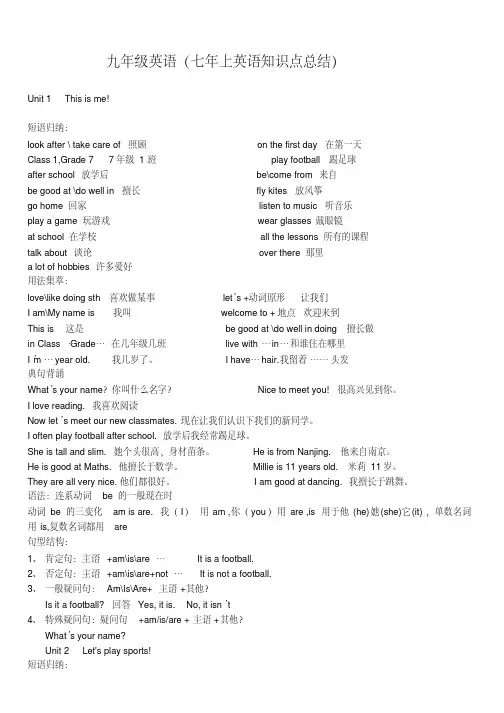
九年级英语(七年上英语知识点总结)Unit 1 This is me!短语归纳:look after \ take care of 照顾on the first day 在第一天Class 1,Grade 7 7年级1班play football 踢足球after school 放学后be\come from 来自be good at \do well in 擅长fly kites 放风筝go home 回家listen to music 听音乐play a game 玩游戏wear glasses 戴眼镜at school 在学校all the lessons 所有的课程talk about 谈论over there 那里a lot of hobbies 许多爱好用法集萃:love\like doing sth 喜欢做某事let’s +动词原形让我们I am\My name is 我叫welcome to +地点欢迎来到This is 这是be good at \do well in doing 擅长做in Class…Grade…在几年级几班live with…in…和谁住在哪里I’m…year old. 我几岁了。
I have…hair.我留着……头发典句背诵What’s your name?你叫什么名字?Nice to meet you! 很高兴见到你。
I love reading. 我喜欢阅读Now let’s meet our new classmates. 现在让我们认识下我们的新同学。
I often play football after school.放学后我经常踢足球。
She is tall and slim. 她个头很高,身材苗条。
He is from Nanjing. 他来自南京。
He is good at Maths. 他擅长于数学。
Millie is 11 years old. 米莉11岁。
人教版七年级英语下册单元知识点总结(全册)
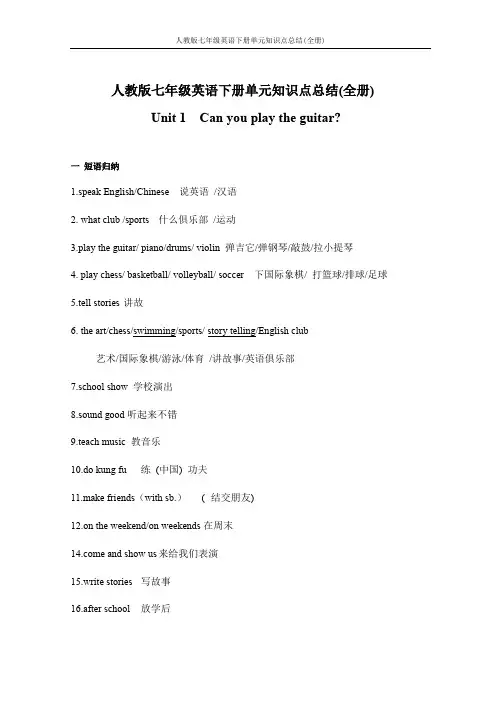
人教版七年级英语下册单元知识点总结(全册)Unit 1 Can you play the guitar?一短语归纳1.speak English/Chinese 说英语/汉语2. what club /sports什么俱乐部/运动3.play the guitar/ piano/drums/ violin 弹吉它/弹钢琴/敲鼓/拉小提琴4. play chess/ basketball/ volleyball/ soccer 下国际象棋/ 打篮球/排球/足球5.tell stories讲故6. the art/chess/swimming/sports/ story telling/English club艺术/国际象棋/游泳/体育/讲故事/英语俱乐部7.school show 学校演出8.sound good听起来不错9.teach music 教音乐10.do kung fu练(中国) 功夫11.make friends(with sb.)(结交朋友)12.on the weekend/on weekends在周末e and show us来给我们表演15.write stories写故事16.after school放学后17.English-speaking students说英语的学生18.play games 做游戏19.the Students’ Sports Center学生运动中心20.at the old people’s home在老人之家21.be in our school music festival 参加学校音乐节22.jion the music club加入音乐俱乐部二用法集萃1. play +棋类/球类下……棋,打……球2. play the +乐器弹/拉……乐器3. be good at doing sth.擅长做某事be good for.. 对… 有好处be good /kind to … 对… 友好4. be good with sb. 和某人相处地好; 善于应付(处理)…5. need(sb./sth.)to do… 需要(某人/某物)做….6. can + 动词原形能/会做某事7. a little + 不可数名词: 一点儿……9. like to do sth.或like doing sth. 喜欢做某事10.want to do…想做……11.What about…?…怎么样?(后面接Ving/代词/名词)12. talk用法: talk to/with sb. 跟某人说话talk about sth. 谈论某事tell 用法:tell sb sth. 告诉某人某事tell sb to do sth 告诉某人去做某事tell stories 讲故事say用法:say直接加说话的内容/itspeak用法:speak +语言13.help sb. with sth在某方面帮助某人= help sb.(to)do sth14.be free /busy有空/很忙15. call sb. at+号码拨打某人的……号码16. be in=join …成为…中的一员(P6)17.want …for the school show为学校表演招聘……三典句必背1. Can you draw? 你会画画吗?Yes, I can. / No, I can’t.是,我会。
人教版新教材七年级下册英语复习重难点(考前必背)
人教版新教材七年级下册英语复习重难点(考前必背)本文档旨在总结人教版材七年级下册英语复的重难点,以帮助学生在考前备考时进行复和背诵。
一、词汇1. 常用动词- be: 是- have: 有- do: 做/进行- like: 喜欢- go: 去- get: 得到- want: 想要- need: 需要- see: 看见- think: 认为2. 人称代词- I: 我- you: 你- he: 他- she: 她- it: 它- we: 我们- they: 他们3. 数字- one: 一- two: 二- three: 三- four: 四- five: 五- six: 六- seven: 七- eight: 八- nine: 九- ten: 十二、语法1. 一般现在时一般现在时用于表示经常性的动作、惯、事实或真理。
其基本构成为:主语 + 动词原形。
例句:- I eat an apple every day.- She goes to school by bus.2. 疑问句疑问句用于询问某事。
其基本构成为:疑问词 + 一般疑问句结构。
例句:- What is your name?- Do you like playing basketball?3. 情态动词 can情态动词can用于表示能力、许可或请求。
它后跟动词原形。
例句:- I can swim.- Can I borrow your pen, please?三、句型1. There is/are...There is/are用于描述某地或某物存在的事实。
例句:- There is a book on the table.- There are three apples in the basket.2. What + be + 主语 + like?What + be + 主语 + like?用于询问某人或某物是什么样的。
例句:- What is your father like?- What is the weather like today?四、对话练1. 对话一A: What's your name?B: My name is Lisa. And you?A: I'm Tom. Nice to meet you, Lisa.B: Nice to meet you too, Tom.2. 对话二A: Can you speak English?B: Yes, I can.A: That's great. I need some help for my English homework.B: Sure, I can help you.五、小结本文档总结了人教版新教材七年级下册英语复习的重难点,包括常用词汇、基础语法、常用句型和对话练习等内容。
新版人教版七年级英语上下册各单元知识点总结
—-可编辑修改,可打印——别找了你想要的都有!精品教育资料——全册教案,,试卷,教学课件,教学设计等一站式服务——全力满足教学需求,真实规划教学环节最新全面教学资源,打造完美教学模式七年级上册Starter unit 11.短语归纳:good morning 早上好 good afternoon 下午好 good evening 晚上好name list 名单 an English name 英文名字2.必背典句:(1)Good morning! 早上好!(2)Good afternoon! 下午好!(3)Good evening 晚上好!3.英语中常见的问候语(1)Hello! “你好!”是比较随便、不分时间的一种问候语,通常用于打招呼、打电话。
表示惊讶或引起对方注意。
对方应答仍用Hello!(2)Hi! “你好!”的使用比hello!更随便,在年轻人中使用更为普遍。
(3)Nice to meet you! “很高兴见到你!”是两个初次见面、经介绍相识的人互相打招呼的用于。
回答时可以说Nice to meet you, too.或者Me, too.表示“见到你很高兴”(4)How do you do? “你好!”用于初次见面,是非正式的打招呼用语。
对方应答语应是“How do you do?”(5)How are you? 表示问候How are you? 意为“你好吗?”,为询问对方身体状况的问候语,应答语一般是“I’m fine. Thank you. / I’m very well. Thank you. / I’m OK.How are you? 的其他用法:习惯上回答完别人的问候后,常可反问对方的身体状况,此时可用How are you?也可用And you? “你呢?”4.大写字母的用法:(1) 在英语中,句子的第一个单词的第一个字母都应大写。
Sit down, please. 请坐。
(2025春新教材)人教版七年级英语下册 Unit 3 单词详解与中考考点
新版人教七下单词详解与中考考点 U3一、fit:形容词意为“健康的;健壮的”,动词意为“适合”。
- 单词详解:作形容词时可用来描述人身体状况良好、很健康且有活力。
作动词时,常表示大小、形状、性质等方面合适、匹配。
- 中考常考搭配:be fit for(适合……),fit in with(与……相适应/相符合)。
- 中考常考单选题:This dress ____ me very well. I'll take it. A. fits B. is fit C. fit's D. fitted。
答案:A。
因为主语this dress是第三人称单数,一般现在时动词要用第三人称单数形式fits。
二、baseball:“棒球(运动)”。
- 单词详解:指的是一种球类运动项目,也可指棒球这项运动所用到的球。
- 中考常考搭配:play baseball(打棒球)。
- 中考常考单选题:He often ____ baseball with his friends on weekends. A. play B. plays C. played D. playing。
答案:B。
主语he是第三人称单数,一般现在时谓语动词用plays。
三、glove:“(手指分开的)手套”。
- 单词详解:用来保护手部、保暖等的物品,通常是分指的。
- 中考常考搭配:a pair of gloves(一副手套)。
- 中考常考单选题:She bought ____ gloves yesterday. A. a B. an C. the D. a pair of。
答案:D。
表示“一副手套”用a pair of。
四、mat:“(运动用的)垫子”。
- 单词详解:在进行一些运动比如体操、瑜伽等时会用到的铺垫物品,起保护、缓冲等作用。
- 中考常考搭配:on the mat(在垫子上)。
- 中考常考单选题:The gymnast did the exercise ____ the mat. A. in B. on C. at D. for。
七年级下册英语人教版各单元知识点
七年级下册英语人教版各单元知识点Unit 1 Can you play the guitar?重点单词:guitar,名词,吉他。
用法就是作为乐器名称,常见搭配play the guitar弹吉他。
sing,动词,唱歌。
可以说sing a song唱歌。
swim,动词,游泳。
例如go swimming去游泳。
重点句型:Can you...? 这个句型结构是情态动词can加上主语再加动词原形,语义是询问某人是否能够做某事,使用场景比如你想知道同学会不会弹钢琴就可以说Can you play the piano?I can...这个句型就是表达自己能够做某事,比如I can dance我会跳舞。
语法点:情态动词can的用法。
can没有人称和数的变化,不管主语是第一人称、第二人称还是第三人称单数,都用can。
后面直接加动词原形,用来表示能力,即某人会做某事或者不会做某事,否定形式是can't。
口语练习示例:A: Can you play basketball?B: Yes I can How about you?A: I can't play basketball but I can play football.B: That's cool.Another example:A: Can she draw?B: No she can't.A: What can she do?B: She can sing.Unit 2 What time do you go to school?**一、时间的表达法**1. 整点:-直接用数字加上o'clock。
例如:It's six o'clock. 这时候o'clock可省略,直接说It's six. 就像我早上六点起床,我就可以说I get up at six (o'clock).2. 半点:-用half past加上数字。