
人教版英语八年级上册unit1笔记
八年级上册Unit1课堂笔记一、单词1、hardly []adv.几乎不;几乎没有hard(坚硬的,困难的)+-ly(副词后缀)Eg:Hardly anybody came.几乎没有人来。
2、twice []a dv.两次;两倍1)twice表示“两次”时,不和time连用。
2)在表示“一两次”时,要用or连接。
即:once or twiceEg:He goes to the cinema twice a month(对画线部分提问)How often does he go to the cinema?3、once []adv.一次Eg:I go to see a film once a week.我每周看一场电影。
常见的短语有at once 立刻;once again再一次。
▲表示一次、两次用once、twice。
表示三次或者三次以上用:数字+times (three times)4、health []n.健康;健康状况1)同根词:healthy adj.健康的;healthily adv.健康地2)相关的短语:be in good/poor health身体好(不好)Eg :You must learn to eat healthily and take exercise regularly.5、difference []n.不同;区别;差异1)它的形容词为different;2) difference 是可数名词。
Eg:Is her lifestyle the same as yours or ? What are the ?A.difference;differentB.different;differenceC.different;differences6、unhealthy []adj.不健康的;不益于健康的un-(否定前缀)+healthy(健康的)1)反义词healthy2)常作定语,如:I have an unhealthy habit.3)注意加前缀un变否定形式的词。
如:unusual,unkindhealth(n)——healthy(adj)unhealth(n)——unhealthy(adj)eg:My unhealthy lifestyle makes me get bad grades. 我的不健康的生活方式导致我的成绩糟糕。
7、although []conj.虽然;即使;纵然1)although,though区别小,though用于非正式语体中。
2)当句中有but时,就不能再用although 或though。
Eg:it is rainy today, he still works outside.A.Although;butB.But;althoughC./;althoughD.Although;/二、课文Section A1、how often 提问频率“多久一次”eg:How often do you exercise?——I often exercise wice a week.频率副词图解:2、go to the movies 去看电影watch TV 看电视go shopping 去购物on the weekend 在周末3、what’s your favorite program?你最喜欢的电视节目是什么?4、The result of ···的结果activity survey 活动调查Eg:How are the result of the student activity survey at Green High School.5、most students 大部分学生some students 一些学生Section B1、drink milk 喝牛奶2、But my mother want me to drink it.▲want sb to do sth 想要某人走某事3、It’s good for my health.▲be(am/are/is)good for 对··有好处4、how often 提问频率(How often do you exercise?)how far 提问距离(how far is it from his house?)how long 提问长度(How long is the stick?)how soon 提问一个动作多久一般答语为“in+段时间”in three days/in two years···6、pretty healthy 十分健康7、try to do sth 尽力做某事eg:I try to eat a lot of vegetable.8、of course=sure=certainly 当然9、look after=take care of 照顾eg:I look after my health.10、help sb do sth 帮助某人做某事eg:My healthy lifestyle helps me get good grade.11、kind of 有点eg:I’m kind of unhealthy.【应掌握的句子】1. How often do you exercise? 你(你们)多久锻炼一次身体?How often + 助动词do(does或did) + 主语+ do sth.?疑问词how often是问频率(多久一次),(在这里助动词do(does或did) 是起帮助构成疑问的作用)与一般现在时或一般过去时连用,回答一般是用表示频率的副词,如:once, twice, three times…, sometimes, often, quite, often, never, every day, once a week , twice a month , three times a month , three or four times a month 等。
翻译:“你们多久到工厂去一次?”“每星期两次。
”(“How often do you go to the factory?” “Twice a week. ”)“他们多长时间举办一次舞会?”“通常每两周举办一次。
”(“How often do they have a dancing party?” “Usually, once every other week.”)“他多久去购一次物?”“一个月一次。
”(“How often does he go shopping?” “He goes shopping once a month.”)2. “What do you usually do on weekends?” “ I usually play soccer.”“周末你通常做什么?”“我通常踢足球。
”翻译:What do you usually do on weekends? I often go to the movies.What does she usually do on weekends? She sometimes go hiking.3. “What’s your favorite program?” “It’s Animal World.”“你最喜欢什么节目?”“动物世界。
”4. As for homework , most students do homework every day .as for...意思是“至于;关于”,常用于句首作状语,其后跟名词、代词如:As for him,I never want to see him here. 至于他,我永远不希望在这里见到。
As for the story,you'd better not believe it. 关于那故事,你最好不要相信。
翻译:至于我自己,我现在不想去。
(As for myself, I don’t want to go now. )至于那个人,我什么都不知道。
(As for the man, I know nothing about him.)5. Mom wants me to get up at 6:00 and play ping-pong with her .want to do sth. 意思是“想要做某事”;want sb. to do sth.意思是“想要某人做某事”。
如:Do you want to go to the movies with me?你想和我一起去看电影吗?The teacher doesn't want us to eat hamburgers.老师不想让我们吃汉堡包。
6. She says it’s good for my health.be good for...表示“对……有益(有好处)”;其反义为:be bad for...。
(这里for 是介词,后跟名词、代词或动名词)如:It's good for us to do more reading. 多读书对我们有好处。
Reading in bed is bad for your eyes.在床上读书对你的眼睛有害。
7. How many hours do you sleep every night?8. I exercise every day , usually when I come home from school .9. My eating habits are pretty good .这里pretty相当于very 。
10. I try to eat a lot of vegetables , usually ten to eleven times a week .try to do sth.表示“ 尽力做某事” ,不包含是否成功的意思而try doing sth.表示“(用某一办法)试着去做某事”。
如: You’d better try doing the experiment in another way.你最好试试用另一种方法做这个试验。
11. My healthy lifestyle helps me get good grades.help sb.(to) do sth.(指帮助者做,被帮助不做)帮助某人做某事help sb do sth(表示共同做)12. Good food and exercise help me to study better.这里better是well的比较级,而不是good的比较级13. Is her lifestyle the same as yours or different?=Is her lifestyle the same as your lifestyle or is her lifestyle different from yours? be the same as … / be different from …14. What sports do you play ?15. A lot of vegetables help you to keep in good health .keep in good health = keep healthy = stay healthy16. You must try to eat less meat .try to do sth.表示“ 尽力做某事” ,不包含是否成功的意思,less是little的比较级The smoke grew heavier and heavier. 烟雾变得越来越浓了。
Unit1PlayingsportsTopic1笔记八年级英语上册

Unit 1 Playing sportsTopic 1 I’m going to play basketballSection A1.What are you going to do? 你打算做什么?be going to do sth.= will do sth. = plan to do sth. 打算/计划/将要/做某事2.You like playing basketball, right? 你喜欢打篮球,对吗?like / love /enjoy doing sth. (一直)喜欢做某事like / love to do sth. (偶尔)喜欢做某事3.I often saw you play basketball during the summer holiday. 我经常见你在暑假踢足球。
see / watch / hear 用法(两看一听)1) see / watch / hear / sb do sth. 看见、听见某人经常做某事I often see him play basketball in the gym. 我经常见你在体育馆打篮球。
2) see / watch / hear sb. doing sth. 看见、听见某人正在做某事I heard him playing the piano just now. 我刚才听到他在弹钢琴。
4.We are going to have a basketball game against Class Three on Sunday.星期天我们要和三班打一场篮球赛。
against 对抗,反对;靠着,依着;1)be against sb. 反对某人I’m against your idea. 我反对你的主意。
2)against the wall 倚着墙He stood against the wall just now. 他刚才依着墙站着。
新人教版八年级英语上册Unit1 Section B(知识点笔记)

beach near our hotel. My sister and I tried to paragliding. I felt like I was a bird. It was so exciting! For lunch, we had something very special – Malaysian yellow noodles. They were delicious! In the afternoon, we rode bicycles to Georgetown. There are a lot of new buildings now, but many of the old
Unit 1
Where did you go on vacation?
1a Match the words with the pictures below.
1. f delicious
2. a expensive 3. c exciting
4. e cheap 5. b terrible 6. d Boring
How was the museum? It was boring.
How was the beach? It was beautiful.
How was the water three years ago?
clean
How is the water now? dirty
ห้องสมุดไป่ตู้
Did you enjoy your vacation?
人教八年级上册初二英语Unit1 SectionA笔记
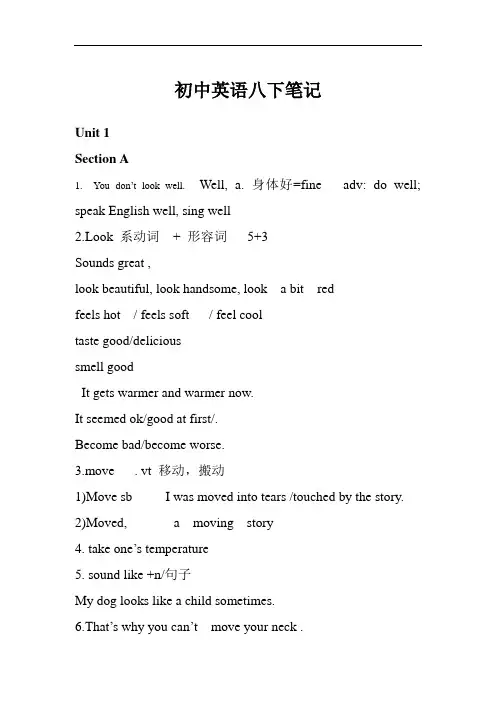
初中英语八下笔记Unit 1Section A1. You don’t look well.Well, a. 身体好=fine adv: do well; speak English well, sing well2.Look 系动词+ 形容词5+3Sounds great ,look beautiful, look handsome, look a bit redfeels hot / feels soft / feel cooltaste good/delicioussmell goodIt gets warmer and warmer now.It seemed ok/good at first/.Become bad/become worse.3.move . vt 移动,搬动1)Move sb I was moved into tears /touched by the story.2)Moved, a moving story4. take one’s temperature5. sound like +n/句子My dog looks like a child sometimes.6.That’s why you can’t move your neck .7. need to do8.sat in the same way for too long without movingWith---without doing9.advice: u. some advice// a piece of advice10. You should do / You ‘d better do / You can do / I t is good to do / It is better to do11. lie down and take a rest; go to a doctor, see a dentist12. hurt----hurt(1) 疼,痛,vi. My knee hurts now. 我膝盖疼。
人教版英语八年级上册第一单元至第十单元知识点、重点笔记

Unit 1 where did you go on vacationImportant phrases: (重点短语)1.去夏令营2.买一些特别的东西3.为考试准备4.跟某人外出5.去纽约市6.好久不见7.度假8.去某个有趣的地方9.大多数时间10.给母鸡喂食11.除—一无所有12.当然,自然13.似乎有点无聊14记日记15.令人愉快地活动16.到达17.决定去海边18.尝试滑翔伞运动19.感觉像一只小鸟20.想要骑车21.中国商人的房子22.在过去23许多古老的建筑24步行到山顶25.开始下雨26.等了一个多小时的火车27.下大雨28.忘记带一把雨伞29.又湿又冷30.因为恶劣的天气31.带着足够的钱32.足够大33.好像有点饿34.与—一样好35 不如----好36.照了相当多的相片37.停下来喝水38.继续前进39.激动地跳跃40.二十分钟后41.如此---以至于42.升起43.发现-- 44.尝起来很好吃45.尽力去做某事46.停止做某事47.不喜欢做某事48.继续做某事49.一碗米饭50为某人买某物重点句子where did you go on vacation?go on vacation 去度假2.Visited my uncle重点:visit为及物动词,“拜访,探望,参观,游览”后接人或地点改错Did you visit in china?3. Did you buy anything special?1)buy 的过去式为boughtbuy sth.for sb.=buy sb sth.我为Tom买了一个礼物2)anything 不定代词“某物,某事”主要用于疑问句和否定句中一旦anything用于可定句中,则意为“任何事,任何东西”Eg You can ask me anything you want to know3)★形容词修饰不定代词要后置4.Oh,did you go anything interesting?这是一般过去时中不含was/were的句子在变一般疑问句时,需用助动词did。
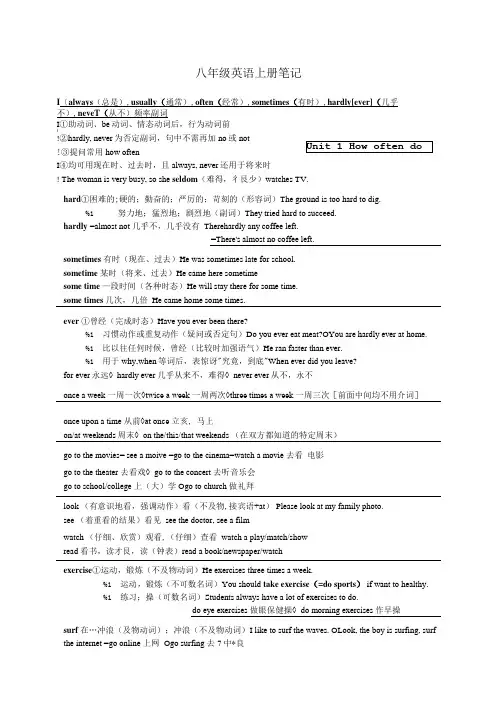
人教版八年级英语上册笔记(原创版).doc
Unit 1 How often do you exercise八年级英语上册笔记I 〔always (总是),usually (通常),often (经常),sometimes (有时),hardly[ever](几乎不),neveT (从不)频率副词I ①助动词、be 动词、情态动词后,行为动词前I!②hardly, never 为否定副词,句中不需再加no 或not !③提问常用how oftenI ④均可用现在时、过去时,且always, never 还用于将来时! The woman is very busy, so she seldom (难得,彳艮少)watches TV.hard ①困难的;硬的;勤奋的;严厉的;苛刻的(形容词)The ground is too hard to dig.%1努力地;猛烈地;剧烈地(副词)They tried hard to succeed.hardly =almost not 几乎不,几乎没有 Therehardly any coffee left.=There's almost no coffee left.sometimes 有时(现在、过去)He was sometimes late for school. sometime 某时(将来、过去)He came here sometimesome time —段时间(各种时态)He will stay there for some time. some times 几次,几倍 He came home some times. ever ①曾经(完成时态)Have you ever been there?%1 习惯动作或重复动作(疑问或否定句)Do you ever eat meat?OYou are hardly ever at home. %1 比以往任何时候,曾经(比较时加强语气)He ran faster than ever. %1 用于why,when 等词后,表惊讶"究竟,到底"When ever did you leave? for ever 永远◊ hardly ever 几乎从来不,难得◊ never ever 从不,永不once a week 一周一次◊twice a week 一周两次◊three times a week 一周三次[前面中间均不用介词] once upon a time 从前◊at once 立亥, 马上on/at weekends 周末◊ on the/this/that weekends (在双方都知道的特定周末) go to the movies= see a moive =go to the cinema=watch a movie 去看 电影 go to the theater 去看戏◊ go to the concert 去听音乐会 go to school/college 上(大)学Ogo to church 做礼拜look (有意识地看,强调动作)看(不及物,接宾语+at ) Please look at my family photo. see (着重看的结果)看见 see the doctor, see a filmwatch (仔细、欣赏)观看,(仔细)查看 watch a play/match/show read 看书,读才艮,读(钟表)read a book/newspaper/watch exercise ①运动,锻炼(不及物动词)He exercises three times a week.%1 运动,锻炼(不可数名词)You should take exercise (=do sports ) if want to healthy. %1 练习;操(可数名词)Students always have a lot of exercises to do.do eye exercises 做眼保健操◊ do morning exercises 作早操surf 在…冲浪(及物动词);冲浪(不及物动词)I like to surf the waves. OLook, the boy is surfing, surf the internet =go online 上网 Ogo surfing 去7中*良! not不(副词,后接动词、形容词、副词)! no不,没有(形容词,作定语,后接可数名词、不可数名i^l)(=not a/an/any) I have no friends ONo one can do it.i 不许,不可(省略句中)No smoking!禁止吸烟㈡No photos !禁止拍照! Here are…倒装句式I①主语为代词,全句半倒装结构Here you are给你◊Here he comes他来了!②主语为名词,全句全倒装结构Here are your books.O Here comes the bus.I want sth想要什么I want to do sth 想要做什么=feel like doing=would like to do sthI want sb to do sth想要某人做某事I |注意want侧重主观,need 侧重客观需要sth want/need doing 主动表被动! The flowers want /need watering.=The flowers want/need to be watered.' What's the difference between the two words?ii _ _ _ ______________________ ____ _ _________ _________ ______! kind of稍微,有点儿I'm kind of tired我有点累II a kind of 一种I all kinds of各种各样的I different/many kinds of 不同种/许多种类I It's very kind of you to do thati ----------------------------------------------------------------i maybe 大概,或许(副词)=perhaps Maybe you are right.I may be (情态动词+be) You may be right.!〔although虽然,尽管(从属连词)=though不能与but(并列连词洞时使用,但可与still,yet同时连甬! Although he is old, he is still healthy.=He is old, but he is still healthy.!注意:because与so不能连用。
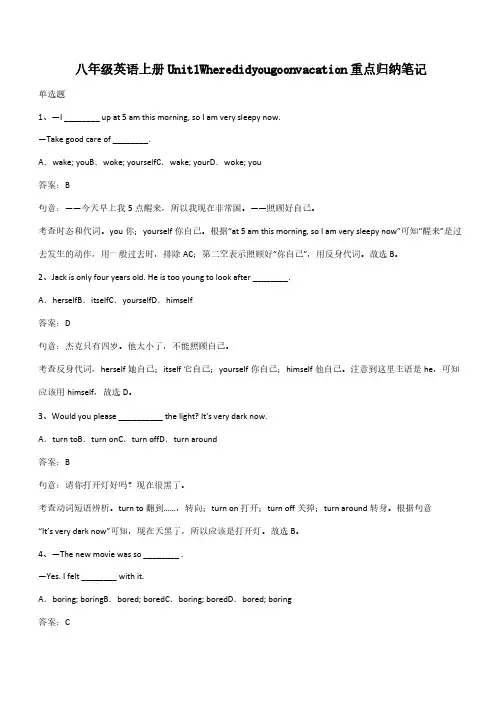
八年级英语上册Unit1Wheredidyougoonvacation重点归纳笔记(带答案)
八年级英语上册Unit1Wheredidyougoonvacation重点归纳笔记单选题1、—I ________ up at 5 am this morning, so I am very sleepy now.—Take good care of ________.A.wake; youB.woke; yourselfC.wake; yourD.woke; you答案:B句意:——今天早上我5点醒来,所以我现在非常困。
——照顾好自己。
考查时态和代词。
you你;yourself你自己。
根据“at 5 am this morning, so I am very sleepy now”可知“醒来”是过去发生的动作,用一般过去时,排除AC;第二空表示照顾好“你自己”,用反身代词。
故选B。
2、Jack is only four years old. He is too young to look after ________. A.herselfB.itselfC.yourselfD.himself答案:D句意:杰克只有四岁。
他太小了,不能照顾自己。
考查反身代词,herself她自己;itself它自己;yourself你自己;himself他自己。
注意到这里主语是he,可知应该用himself,故选D。
3、Would you please __________ the light? It's very dark now.A.turn toB.turn onC.turn offD.turn around答案:B句意:请你打开灯好吗?现在很黑了。
考查动词短语辨析。
turn to翻到……,转向;turn on打开;turn off关掉;turn around转身。
根据句意“It’s very dark now”可知,现在天黑了,所以应该是打开灯。
故选B。
4、—The new movie was so ________ .—Yes. I felt ________ with it.A.boring; boringB.bored; boredC.boring; boredD.bored; boring答案:C句意:——这个电影是如此的无聊。
八年级上册英语笔记1~10单元
八年级上册英语笔记(1 - 10 单元)一、Unit 1 Where did you go on vacation?(一)重点词汇1.anyone /ˈeniwʌn/ 任何人-解析:用于疑问句和否定句中,表示“任何人”。
-例句:Did anyone see my keys?(有人看到我的钥匙了吗?)2.wonderful /ˈwʌndəfl/ 精彩的;极好的-解析:形容事物非常好,令人愉悦。
-例句:We had a wonderful time on vacation.(我们在假期里过得非常愉快。
)3.few /fjuː/ 很少;几乎没有-解析:修饰可数名词,表示数量少。
-例句:There are few people in the park today.(今天公园里人很少。
)4.quite a few 相当多;不少-解析:强调数量比较多。
-例句:I took quite a few photos on my trip.(我在旅行中拍了不少照片。
)5.most /məʊst/ 大多数;大部分-解析:可作形容词、名词或副词。
-例句:Most people like to travel.(大多数人喜欢旅行。
)(二)重点句型1.Where did you go on vacation? 你去哪里度假了?-解析:这是一个特殊疑问句,询问过去的动作。
-例句:Where did you go last weekend?(你上周末去哪里了?)2.Did you go anywhere interesting? 你去了什么有趣的地方吗?-解析:一般疑问句,用“Did + 主语+ 动词原形”的结构。
-例句:Did you do anything special yesterday?(你昨天做了什么特别的事情吗?)3.I went to the mountains. 我去了山区。
-解析:简单的陈述句,表达过去的动作。
人教版英语八年级上册 知识点笔记
人教版英语八年级上册知识点笔记
本文档是人教版英语八年级上册的知识点笔记,内容包括但不
限于以下几个部分:
Unit 1 重点知识
1. 表示时间的几种表达方法:on+具体日期、at+具体时间点、
in+时间段、every+时间段、once a week/month/year等。
2. 祈使句的用法及其五种基本句型:肯定祈使句、否定祈使句、let's句型、why not句型、would you mind句型。
3. 陈述句、疑问句、祈使句、感叹句四种句型的用法及转换。
Unit 2 重点知识
1. 过去完成时的构成及用法,表示过去已经完成的动作或状态。
2. 直接引语和间接引语的转换方法及其注意事项。
3. 一些常见的连词及其用法:although、as、because、since、when、while等。
Unit 3 重点知识
1. 现在完成时的构成及用法,表示过去发生的动作对现在造成的影响或结果。
2. 一些常见的副词及其用法:already、yet、just、never、ever 等。
3. 形容词的比较级和最高级的构成及其用法。
......
本文档只是对知识点进行简单概括,更详细的内容需要在课本和相关资料中学习和掌握。
同时,建议同学们进行课后练习和自我检测,加深对知识点的理解和记忆。
八年级上册英语unit1课堂笔记
八年级上册英语unit1课堂笔记八年级上册英语Unit1课堂笔记。
一、单元主题。
这个单元的主题主要是围绕“生活方式和健康”展开的。
它会探讨一些和我们日常生活息息相关的话题,像饮食习惯、运动习惯这些,让我们明白怎么保持健康的生活方式哟。
二、重点词汇。
1. exercise 读音:英 [ˈeksəsaɪz] 美 [ˈeksərsaɪz]- 解释:作动词时表示“锻炼,运动;运用,行使”;作名词时表示“练习,习题;运动,锻炼”。
- 造句:I exercise every morning to keep fit.(我每天早上锻炼来保持健康。
)- 近义词:work out。
2. same 读音:英 [seɪm] 美 [seɪm]- 解释:相同的,同样的。
- 造句:We have the same hobbies.(我们有相同的爱好。
)- 反义词:different。
3. love 读音:英 [lʌv] 美 [lʌv]- 解释:作动词时表示“爱,热爱;喜欢”;作名词时表示“爱,爱情”。
- 造句:I love reading books.(我喜欢读书。
)- 近义词:like(但love的程度更深哦)三、重点短语。
1. how often.- 解释:多久一次,用来询问动作发生的频率。
- 例句:How often do you play basketball?(你多久打一次篮球呀?)2. hardly ever.- 解释:几乎从不。
- 例句:He hardly ever eats junk food.(他几乎从不吃垃圾食品。
)3. twice a week.- 解释:每周两次。
- 例句:I go swimming twice a week.(我每周游两次泳。
)四、重点句型。
1. What do you usually do on weekends?- 解释:这是一个询问周末通常做什么的常用句型。
- 回答可以是:I usually play football on weekends.(我周末通常踢足球。
人教版八年级上英语人一单元重点知识点整理
八上unit 1 Where did you go on vacation?P11.On vacation 休假2.Where did you go on vacation? I went to the mountains.Note: 一般过去时a.定义:1.过去的状态2.发生在过去的动作b.结构:1. 主+was/were+其他2.主+ v过去式+其他c.动词过去式变法规则变法:1.直:直接加ed stay-stayed visit-visited enjoy-enjoyed want-wanted start-started wait-waited2.去:去不发音的e,加ed taste-tasted like-liked arrive-arrived decide-decided3.双:重读辅元辅双写尾字母stop-stopped4.改:辅音字母+y, 变y为i+ed study-studied try-tried不规则变法:go-went buy-bought swim-swam meet-met do-did am/is-was are-were take-took see-saw have-had feed-fed eat-ate keep-kept feel-felt ride-rode get-got can-couldd.变否变疑:有be有情直接用,无be无情找主动(did)口诀:did是面照妖镜后面动词现原形。
e.特殊疑问句:特殊疑问词+一般疑问句f.时态标志词:last 系列yesterday系列一段时间+ago 系列in+过去年份just now 几分钟以前P2一、复合不定代词、副词Everything was really interesting.成分后置anything special anyone interesting something to eat nothing left3.否定:既可否定复合不定代词也可否定be/助/情not any…= no…二、Role-play the conversation1.I was on vacation last month.2.Did you go anywhere interesting?3.I went to Guizhou with my family.4.Did you see Huangguoshu Waterfall?5.We took quite a few photos there. 相当多few 没有几个,修饰可数名词复数,表否定 a few 几个,没有达到some的程度,表肯定little 没有多少,修饰不可数名词,表否定 a little 一点,表肯定口诀:有a则有,无a则无quite 相当P51.到达: arrive in +大地点arrive at+小地点reach+地点get to2.决定做某事:decide to do sth3.try doing : 尝试做某事,事情通常不难4.feel like 感觉像5.for lunch 午餐6.enjoy doing 喜欢,享受做某事7.walk up to the top 向上走到山顶8.start doing=start to do 开始做某事begin doing=begin to do9.because 连词+句子有because不用so,有so 不用because. because of+n. 短语of 是介词10.enough money 最够多的钱enough修饰名词位于名词前,修饰形容词副词位于形容词副词之后good enough, fast enough11.The food tasted great. taste 尝起来感官动词作系动词,后接表语。