
大学英语三级语法知识总结汇总
. . . . . . 资.料 . .. 三级语法考点归纳 一. 虚拟语气 1. if 句中虚拟形式 if 引导的非真实条件句(纯粹假设或发生的可能性不大): 条件 从句 主句 与现在相反 did (be were) would/ should/ might/ could do 与将来相反 did (be were) would/ should/ might/ could do 与过去相反 had done would/ should/ might/ could have done 例句 If we left (leave) now, we should arrive in time. If they hadn’t gone on vacation, their house wouldn’t have been broken (break) into. 2. 原形虚拟: a. 表命令、决定、要求、建议等词语之后的that-分句中,用动词原形。 suggest, demand, advise, propose, order, arrange, insist, command, require, request, desire …… that +(should) do 例如 He suggested that we should leave early. My suggestion is that we should tell him. b. It is (was) 形容词/名词that …… (should) do/ 例如 It is absolutely essential that all the facts be examined first. 3. 一些句型中的虚拟形式: 1. It’s (high, about, the first, etc.) time (that) …动词过去时… 例如 It’s time we left. 例如 It is time we went to bed. 2 would rather/sooner 宁愿 as if/ though 好像 would rather/sooner 谓语用过去时 与现在或者将来相反 as if/ though 谓语用过去完成时 与过去相反 4.练习 1. I _______ try it again if I_______you. A. will; am B. should; am C. would; were D. would; had been 2. If it _______ not for the water, the plants _______live. A. were; would not B. is; could not C. were; could D. did; could not . . . . . . 资.料 . .. 3. If I _______ that chance to show my ability, I _______the president of this school. A. have not had; could not become B. had not had; would not have become C. did not have; could not become D. doesn’t have; will not become 4. He _______ by that burglar if you _______ to save him. A. might have been killed; hadn’t come B. will be killed; didn’t come C. may be killed; did’t come D. could be killed; haven’t come 5. If it _______for your help, I _______that hard time with so little money. A. were not; would not spend B. is not; can not spend C. had not been; would not have spent D. have not been; will not spend 6. Where _______ you go if war _______? A. will; breaks out B. do; will break out C. would; were to break out D. will; is to break out 7. She wishes she _______ that humiliating thing. A. doesn’t do B. didn’t do C. haven’t done D. hadn’t done 8. The chairman suggested that the meeting _______ put off. A. can be B. be C. is D. will be 9. It is vital that he _______ immediately. A. should go B. must go C. goes D. went 10. It is time we _______do our homework. A. begin to B. can begin to C. began to D. will begin to 答案: 1.选C。表示与现在事实相反的假设(指现在的假设) (译文; 如果我是你,我会再试一次) 2选A。表示与现在事实相反的假设(指现在的假设)。(译文:要是没有水,植物就不能存活。) 3. 选B。表示与过去事实相反的假设。 4 A。表示与过去事实相反的假设。(译文:要不是你来救他,他早就被那个窃贼杀了。) 5. C。与过去事实相反的假设。(译:要没有你帮忙,我那点儿钱是无法度过那段艰苦岁月的。) 6.选C。表示与将来事实相反的假设。(译文:要是战争爆发了,你会上哪儿去?) . . . . . . 资.料 . .. 7.选D。虚拟语气用于宾语从句。(译文:她真希望自己没有做过那件丢脸的事情。) 8. 选B。虚拟语气用于表示“建议”等意义的动词后。(译文:主席建议会议延期举行。) 9. 选A。虚拟语气用于主语从句(It is / was + 形容词 + that 引导的分句)。 10. 选C。虚拟语气用于定语从句It is time (that)...句型。(译文:我们该开始做作业了。)
二.动词的时态 1. 各个时态动词基本变形 一般现在时 be(is,am,are) do/does 现在进行时 be (is/am/are)+ doing 现在完成时 have/has done 现在完成进行时 have/has been doing
一般过去时 was/were did 过去进行时 was/were doing 过去完成时 had done 过去完成进行时 had been doing
一般将来时 will do 将来进行时 will do 将来完成 will have done 将来完成进行时 will have been doing 一般过去将来时 would do 过去将来进行时 would be doing 过去将来完成时 would have done 过去将来完成进行时 would have been doing 2. 时间状语与动词时态的搭配 一定的时态往往和一定的时间状语连用。 always ,usually, sometimes, 一般现在时 do/does am is are last week, yesterday, a few days ago 一般过去时 did was/ were next week, tomorrow, in a week, this year 一般将来时 will do now, at present, at this moment 现在进行时 be +doing so far, up to now, by the time, since的主句 现在完成时 has/have done 3. 练习,用动词的适当形式填空 1. He _______ (be) eighteen next year. 2. It _______ (rain) every day so far this month. 3. Mozart _______ (write) more than 600 pieces of music. 4. If it _______ (rain) tomorrow,we’ll have to stay at home. 5. How fast _______ he _______ (drive) when the accident happened? 6. By the time Mr. Smith left school,he _______ (teach) that course for twenty-five years. . . . . . . 资.料 . .. 7. Perhaps he _______ (finish) reading the book by this time tomorrow. 1. 填will be。 next year为表示将来时态的时间状语 2. 填has rained。so far是“到目前为止”的意思,常和现在完成时搭配使用。 3. 填wrote。Mozart (莫扎特)是已去世的音乐家,故应使用过去时。 4. 填rains。在条件状语从句中,要用一般现在时表示将来发生的事情。 5. 填was...driving。 表示过去某一时刻发生的动作要用过去进行时。 6. 填had taught。句中有by the time Mr. Smith left school,主语的谓语应用过去完成时。 7. 填will have finished。 句中有by this time tomorrow,主语的谓语应用将来完成时。
三 动词的被动语态 1. 各个时态的被动语态 时态 一般现在时 现在进行时 一般过去时 过去进行时 一般将来时 过去将来时 现在完成时 过去完成时 现在完成进行时 将来完成时
主动 do am/is/are doing did was/ were doing will do would do has/ have done had done has/ have been doing will have
英语三级语法考点归纳
部分倒装 ①否定副词never, seldom, rarely, little, hardly, scarcely等位于句首 如:Never have I read such an interesting book. ②“only+状语”位于句首 如:Only in this way did I finish the homework. ③so/such…that引导的结果状语从句时,so/such置于句首 如:So frightened was he that he didn’t even want to move a pace. ④as/ though引导让步状语从句 如:Child as he is, he knows a lot. ⑤if引导的虚拟条件句中,若将if省略,were, had, should要提前 如:Should it rain tomorrow, we would stay at home. ⑥so / neither / nor表示“前面所说的情况也适合于后者时” 如:I came back late and so did my mother. ⑦当not until…位于句首时,其后的主句要用倒装语序 如:Not until the rain stopped did he leave the room.
Now that the room didn’t live up to the promises you makd in the advertisement, I want to ask for compensation. (2011.06 T20)
should/could/would/might do
大学英语三级语法大全-II
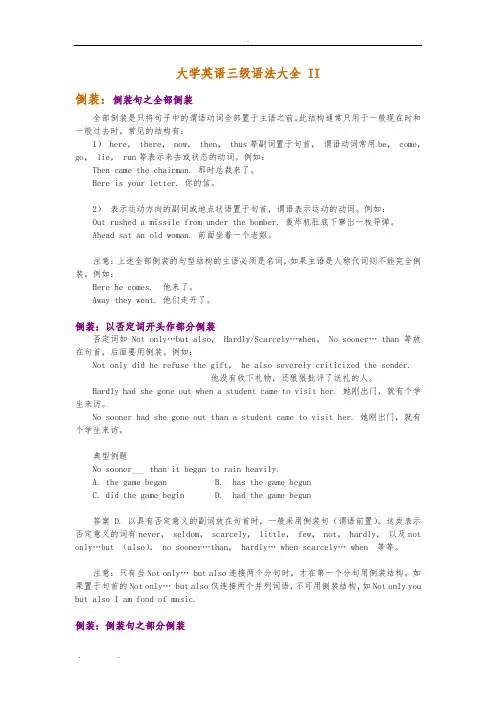
大学英语三级语法大全 II倒装:倒装句之全部倒装全部倒装是只将句子中的谓语动词全部置于主语之前。
此结构通常只用于一般现在时和一般过去时。
常见的结构有:1) here, there, now, then, thus等副词置于句首,谓语动词常用be, come,go, lie, run等表示来去或状态的动词。
例如:Then came the chairman. 那时总裁来了。
Here is your letter. 你的信。
2)表示运动方向的副词或地点状语置于句首,谓语表示运动的动词。
例如:Out rushed a missile from under the bomber. 轰炸机肚底下窜出一枚导弹。
Ahead sat an old woman. 前面坐着一个老妪。
注意:上述全部倒装的句型结构的主语必须是名词,如果主语是人称代词则不能完全倒装。
例如:Here he comes. 他来了。
Away they went. 他们走开了。
倒装:以否定词开头作部分倒装否定词如 Not only…but also, Hardly/Scarcely…when, No sooner… than等放在句首,后面要用倒装。
例如:Not only did he refuse the gift, he also severely criticized the sender.他没有收下礼物,还狠狠批评了送礼的人。
Hardly had she gone out when a student came to visit her. 她刚出门,就有个学生来访。
No sooner had she gone out than a student came to visit her. 她刚出门,就有个学生来访。
典型例题No sooner___ than it began to rain heavily.A. the game beganB. has the game begunC. did the game beginD. had the game begun答案 D. 以具有否定意义的副词放在句首时,一般采用倒装句(谓语前置)。
英语三级语法知识ppt课件

经营者提供商品或者服务有欺诈行为 的,应 当按照 消费者 的要求 增加赔 偿其受 到的损 失,增 加赔偿 的金额 为消费 者购买 商品的 价款或 接受服 务的费 用
虚拟语气
虚拟气在 在条件从句中
3.含蓄虚拟 (but for, otherwise , but)
①but for the storm, he would have arrived earlier.
yesterday. ③ they were talking as if they had been
friends for many years. ④he looked at me as though he were my
father.
经营者提供商品或者服务有欺诈行为 的,应 当按照 消费者 的要求 增加赔 偿其受 到的损 失,增 加赔偿 的金额 为消费 者购买 商品的 价款或 接受服 务的费 用
过去时表示一种意愿或假设(现在)
v If only he would not eat so much chocolate. would+v原 表示一种很难实现的愿望(将来)
v If only he had taken my advice years ago. 过去完成时表示希望与过去事实相反的情况(过 去)
主句的谓语形式
表示现在情况 表示过去情况 表示将来情况
过去式(did) (be常用 were)
过去完成式(had +done)
①过去式 (did)(were) ②should + do ③were to do
Would / could / might / should (用于第1人称) +动 词原形(do)
经营者提供商品或者服务有欺诈行为 的,应 当按照 消费者 的要求 增加赔 偿其受 到的损 失,增 加赔偿 的金额 为消费 者购买 商品的 价款或 接受服 务的费 用
全国公共英语三级常见语法

第一节动词的时态一、一般在:1、由 when、as soon as、the minute 、the moment 、till 、until 等惹起的状从句,以及由 if、unless、provided that 等惹起的条件状从句常常用一般在表示未来的作,而主句用一般未来。
例: They will go home for winter vocation as soon as they finish their exams.2、当表示广泛的真谛或许尽人皆知的客事,常常用一般在。
例:The earth is round. 地球是的。
二、一般去:划分三个短的用法:1、used to do sth:去常常做某事。
2、be/get used to doing sth:做某事。
3、be used to do sth:被用于做某事。
三、一般未来:1、be to+原形:表示安排或划好了的作。
例: The Third-Ring Road is to be open to traffic before National Day.2、be about to+原形:表示马上生的作。
例: The lecture is about to begin.座马上开始。
四、行:要点划分 when 和 while 惹起的状的用法。
When 表示上的点,在考中其引的状从句多翻“ ?”,主句多用行; while 引的状从句多翻“正当⋯⋯ ”,从句用行。
例: One of the guards was sleeping when the general came in, which made him very angry.I fell and hurt myself while I was playing tennis.五、此刻达成时:要点划分 have (has) been to:某人去过某地,表示一种经历,重申状态,能够和 once,twice ,often ,never,ever 连用;Have (has) gone to:某人在去某地的途中或已在某地,重申换作。
英语三级语法知识

A is used before words that begin with a consonant sound, such as "uncopyrightable" and "uncomfortable".
English Level 3 Grammar Knowledge
contenBiblioteka s目录• noun • Article • pronoun • adjectives and adverbs • preposition • tense • Non finite verbs • sentence structure
They are used to show that the subject is acting on itself or affecting itself in some way.
Example: "I washed myself after the shower." (reflexive pronoun)
Demonstrative pronouns
01
02
03
04
Demonstrative pronouns are used to point out
specific things or people.
They are used to show which one is being
referred to out of a group or set of things.
三级英语语法重点
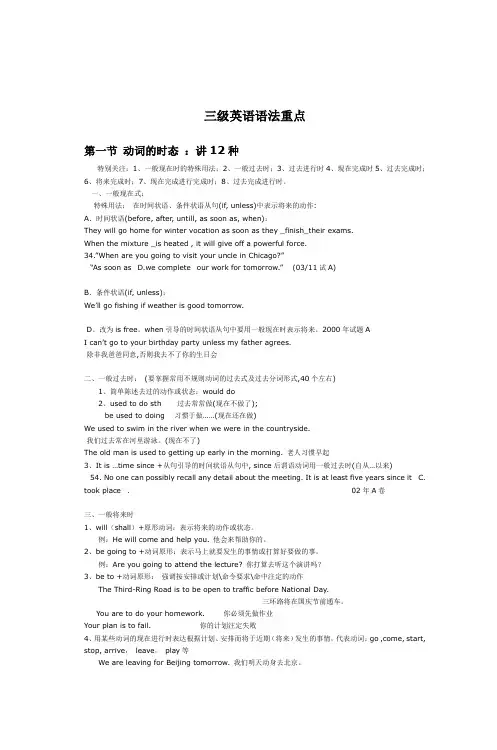
三级英语语法重点第一节动词的时态:讲12种特别关注:1、一般现在时的特殊用法;2、一般过去时;3、过去进行时4、现在完成时5、过去完成时;6、将来完成时;7、现在完成进行完成时;8、过去完成进行时。
一、一般现在式:特殊用法:在时间状语、条件状语从句(if, unless)中表示将来的动作:A.时间状语(before, after, untill, as soon as, when):They will go home for winter vocation as soon as they _finish_their exams.When the mixture _is heated , it will give off a powerful force.34.”When are you going to visit your uncle in Chicago?”“As soon as D.we complete our work for tomorrow.” (03/11试A)B.条件状语(if, unless):We’ll go fishing if w eather is good tomorrow.D。
改为is free。
when引导的时间状语从句中要用一般现在时表示将来。
2000年试题AI can’t go to your birthday party unless my father agrees.除非我爸爸同意,否则我去不了你的生日会二、一般过去时:(要掌握常用不规则动词的过去式及过去分词形式,40个左右)1、简单陈述去过的动作或状态:would do2、used to do sth 过去常常做(现在不做了);be used to doing 习惯于做……(现在还在做)We used to swim in the river when we were in the countryside.我们过去常在河里游泳。
英语三级语法汇编
英语三级语法(一)1.语法考题的涉及面宽近年考题曾经考到:几乎所有词类,三种动词的非谓语形式,名词从句,形容词从句,副词从句,独立主格,一致,倒装,强调等基本语法知识。
2.语法考试的重点突出语法考试的重点为内容庞杂较难掌握的项目,这些项目还反复出现如:虚拟语气,状语从句,定语从句,独立主格,情态动词。
3.具体考查重点为以上项目中的特殊用法,不常用的情况1)虚拟语气的考点为:would rather+that从句+一般过去时:It is vital/necessary/important/urgen t/imperative/desirable/advisable/natural/essential+that+动词原形;It is time/abouttime/hightime+th at+一般过去时:proposal/suggestion+that+动词原形;lest+that+should+动词原形;if only+that+woul d+动词原形。
2)状语从句的考点为:非if引导的条件状语从句,此类句子多用at times,provided,so long as,in c ase,once等来替代if;由evenif/so,now that,for all等引导的让步状语从句;just/hardly…when引导的时间状语从句;more than,as…as,not so much as,the same as,as much as等引导的比较状语从句。
3)独立主格结构多以逻辑主语+分词的形式出现。
4)情态动词多与完成时形式连用。
5)定语从句重点考查介词+关系代词(which)和as作为关系代词。
4.词汇的考查重点为1)动词,名词与介词的搭配如:popular/patient+with;yield/solution/adapt/transfer/access+to;accuse/require+of;charge+for;under+discussion等等。
三级英语语法重点
三级英语语法重点第一节动词得时态:讲12种ﻫ特别关注:1、一般现在时得特殊用法;2、一般过去时;3、过去进行时4、现在完成时5、过去完成时;6、将来完成时;7、现在完成进行完成时;8、过去完成进行时。
一、一般现在式:ﻫ特殊用法:在时间状语、条件状语从句(if, unless)中表示将来得动作:A.时间状语(before, after, untill,as soon as,when):They willgohome for winter vocationas soonas they _finish_their exams、Whenthemixture_is heated ,itwill give offapowerful force、34、”When areyougoing to visityour unclein Chicago?”ﻫ“As soon as D、we plete ourwork for tomorroﻫ D。
改为is fre w、” (03/11试A)ﻫﻫB.条件状语(if,unless):ﻫWe’ll gofishing if weather is good tomorrow、ﻫe。
when引导得时间状语从句中要用一般现在时表示将来。
2000年试题AﻫI can’t go to yourbirthday party unless my father ag rees、ﻫ除非我爸爸同意,否则我去不了您得生日会ﻫ二、一般过去时:(要掌握常用不规则动词得过去式及过去分词形式,40个左右)ﻫ1、简单陈述去过得动作或状态:woulddo ﻫ2、usedtodo sth 过去常常做(现在不做了);beusedto doing习惯于做……(现在还在做)ﻫWe used to swim inthe river when we were in the countryside、3、It is …t ﻫ我们过去常在河里游泳。
英语三级考试复习资料
英语三级考试复习资料一、词汇篇1. 核心词汇积累(1)高频词汇:掌握《大学英语三级词汇表》中的核心词汇,这部分词汇在考试中出现的频率较高。
(2)词组搭配:学习常见词组的用法,如“be interested in”、“look forward to”等。
(3)近义词辨析:了解近义词之间的区别,如“like”和“love”、“enjoy”和“appreciate”等。
2. 词汇记忆技巧(1)联想记忆:通过词根、词缀、发音等方面的联想,提高记忆效果。
(2)语境记忆:将单词放入具体语境中,通过例句来加深印象。
(3)循环复习:遵循艾宾浩斯遗忘曲线,定期复习已学词汇。
二、语法篇1. 基础语法知识(1)动词时态:熟练掌握一般现在时、一般过去时、一般将来时等基本时态。
(2)名词单复数:了解名词单复数的变化规则,尤其是不规则变化。
(3)主谓一致:掌握主谓一致的原则,如就近原则、就远原则等。
(4)定语从句:学会使用关系代词和关系副词引导定语从句。
2. 高级语法知识(1)非谓语动词:掌握动名词、分词和不定式作状语、定语等用法。
(2)虚拟语气:了解虚拟语气在条件句、宾语从句等句子中的运用。
(3)倒装句:掌握部分倒装和完全倒装的用法。
三、阅读篇1. 阅读技巧(1)快速浏览:通过、小、首尾段等快速了解文章大意。
(2)精读细节:针对题目,仔细阅读相关段落,找出关键信息。
(3)推断词义:根据上下文,推断生词或短语的意义。
2. 阅读题型攻略(1)事实细节题:关注文章中的具体信息,如时间、地点、人物等。
(2)推理判断题:根据文章内容,进行合理推断。
(3)主旨大意题:把握文章主题,概括文章大意。
四、写作篇1. 写作技巧(1)明确题目要求:认真审题,确保文章内容符合题目要求。
(2)结构清晰:遵循“引言结尾”的结构,使文章条理分明。
(3)丰富表达:运用多样的句式和词汇,提高文章质量。
2. 常见写作题型攻略(1)书信:熟悉书信格式,掌握各类书信的写作要点。
英语三级语法考点
B) is leaving
C) leaves
D) has left
注:一般现在时可以表预定的行为
( 2 0 11 . 12 - 1 9 题 ) Since the new technology was introduced last month, we ____C__ in speeding up production.
clearest smallest narrowest nearest latest most popular most outgoing friendliest biggest
B. 一般用法
1. 表示"比...更", 用比较级形容词+than+比较成分, than 后主词的述语动词往往省略, 非正式用法的than后的人称 代名词可用宾格。
如:He is younger than I (am). 他比我年轻。 I am a better swimmer than he (him). 我游泳比他好。
2. 表示"较...低; 不及..."用less+原级形容词+than+比较成 分。
I am less young than he (is). 我不比他年轻。
It’s the first time I’ve come here. 这是我第一次来这儿 。
Don’t forget, it’ll be the first time I’ve spoken in public. 别忘了,这是我第一次在公共场合发言。
让现在完成时一目了然的词语:
(5) in/for/during the past / last N years (在过去…年中) :
I had intended to speak, but time did not permit. 我 本想发言,但时间不允许。