
2015年6月大学英语四级CET4听力原文
Section A1. W: I can’t seem to reach the tea at the back of the cupboard.M: Oh…Why don’t you use the ladder? You might strain your shoulder.Q: What does the man suggest the woman do?2. W: Since it’s raining so hard, let’s go and see the new exhibits.M: That’s a good idea. Mary Johnson is one of my favorite painters.Q: Where does the conversation most probably take place?3. W: I hear the students gave the new teacher an unfair evaluation.M: It depends on which student you are talking about.Q: What does the woman imply?4. W: It must have taken you a long time to fix up all these book shelves.M: It wasn’t too bad. I got Doris to do some of them.Q: What does the man mean?5. W: Rod, I hear you’ll be leaving at the end of this mont h. Is it true?M: Yeah. I’ve been offered a much better position with another firm. I’d be a fool to turn it down.Q: Why is the man quitting his job?6. W: I honestly don’t want to continue the gardening tomorrow, Tony?M: Neither do I. But I think we should get it over with this weekend.Q: What does the man mean?7. W: You’ve already furnished your apartment?M: I found some used furniture that was dirt cheap.Q: What do we learn from the conversation?8. W: Has the mechanic called the bus repairers?M: Not yet .I’ll let you know when he calls.Q: What do we learn from the conversation?Conversation oneM: Hello. Matt Ellis speaking.W: Hello, Dr. Ellis, my name’s Pan Johnson. My roommate, Janet Holmes, wanted me to call you.M: Janet Ho lmes? Oh, that’s right. She’s in my Shakespearean English class. Has anything happened to her?W: Nothing, it’s just that she submitted a job application yesterday and the company asked her in for an interview today. She’s afraid she won’t be able to atten d your class this afternoon though. I’m calling to see whether it would be OK if I gave you her essay.Janet said it’s due today.M: Certainly, that would be fine. Uh, you can either drop it off at my class or bring it to my office.W: Would it be all righ t to come by your office around 4:00? I’m afraid I can’t come any earlier because I have three classes this afternoon.M: Uh, I won’t be here when you come. I’m supposed to be at a meeting from 3:00 to 6:00, but how about leaving it with my secretary? She usually stays until 5:00.W: Fine, please tell her I’ll be there at 4:00. And Dr. Ellis, one more thing, could you tell me where your office is?Janet told me where your class is, but she didn’t give me directions to your office.M: Well, I’m in Room 302 of the Gregory Building. I’ll tell my secretary to put the paper in my mail box, and I’ll get it when I return.W: I sure appreciate it. Goodbye, Dr. Ellis.M: Goodbye, Ms. Johnson.Questions 9 to 11 are based on the conversation you have just heard.9. Why couldn’t the woman’s roommate attend the Shakespearean English class that afternoon?10. What favor is the woman going to do for her roommate?11. What does the woman want to know at the end of the conversation? Conversation twoW: How are things going, Roald?M: Not bad, Jane. I’m involved in several projects and it’s a long working day. But I’m used to that so it doesn’t bother me too much.W: I heard you have moved to a new house in the suburb. How do you like commuting to London every day? Don’t yo u find it a string?M: It was terrible at first, especially getting up before dawn to catch that 6:30 train. But it’s bearable now that I’ m used to it.W: Don’t you think it’s an awful waste of time? I couldn’t bear to spend three hours sitting in a train every day.M: I used to feel the same as you. But now I quite enjoy it.W: How do you pass the time? Do you bring some work with you to do on the train? M: Ah, that’s a good question. In the morning,I just sit in comfort and read the papers to catch up with the news. On the way home at night, I relax with a good book or chat with friends or even have a game of bridge.W: I suppose you know lots of people on the train now.M: Yes, I bumped into someone I know on the platform every day. Last week I came across a couple of old school friends and we spend the entire journey in the bar.W: It sounds like a good club. You never know. I may join it too.Questions 12 to 15 are based on the conversation you have just heard.12. What does the man say about his job?13. Which train does the man take to work every day?14. How does the man feel about commuting to work every day now?15. How does the man spend his time on the morning train?Section BPassage OneMost American college students need to be efficient readers. This is necessary because full-time students probably have to read several hundred pages every week. They don't have time to read a chapter three or four times. They need to extract as much information as possible from the first or second reading.An extraordinarily important study skill is knowing how to mark a book. Students mark the main ideas and important details with a pen or pencil, yellow or blue or orange. Some students mark new vocabulary in a different color. Most students write questions or short notes in the margins. Marking a book is a useful skill, but it's important to do it right. First, read a chapter with one pen in your hand and others next to you on the desk. Second, read a whole paragraph before you mark anything. Don't mark too much. Usually you will mark about 10% of a passage. Third, decide on your own system for marking. For example, maybe you will mark main ideas in yellow, important details in blue and new words in orange. Maybe you will put question marks in the margin when you don't understand something and before an exam. Instead, you just need to review your marks and you can save a lot of time. 16. What should American college students do to cope with their heavy reading assignments?17. What suggestion does the speaker give about marking a textbook?18. How should students prepare for an exam according to the speaker?Passage TwoThe thought of having no sleep for 24 hours or more isn't a pleasant one for most people.The amount of sleep that each person needs varies. In general, each of us needs about 8 hours of sleep each day to keep us healthy and happy. Some people, however, can get by with just a few hours of sleep at night.It doesn't matter when or how much a person sleeps. But everyone needs some rest to stay alive. Few doctors would have thought that there might be an exception to this. Sleep is, after all, a very basic need. But a man named Al Herpin turned out to be a real exception, for supposedly, he never slept!Al Herpin was 90 years old when doctors came to his home in New Jersy. They hoped to challenge the claim that he never slept. But they were surprised. Though they watched him every hour of the day, they never saw Herpin sleeping. He did not even own a bed. He never needed one.The closest that Herpin came to resting was to sit in a rocking chair and read a half dozen newspapers. His doctors were puzzled by the strange case of permanent sleeplessness. Herpin offered the only clue to his condition. He remembered some talk about his mother having been injured several days before he had been born. Herpin died at the age of 94, never, it seems, having slept at all.19. What is taken for granted by most people?20. What do doctors think of Al Herpin's case?21. What could have accounted for Al Herpin's sleeplessness?Passage ThreeHetty Green was a very spoiled, only child. She was born in Massachusetts USA in 1835. Her father was a millionaire businessman. Her mother was often ill, and so from the age of two her father took her with him to work and taught her about stocks and shares. At the age of six she started reading the daily financial newspapers and opened her own bank account. Her father died when she was 21 and she inherited 7.5 million dollars. She went to New York and invested on Wall Street. Hetty saved every penny, eating in the cheapest restaurants for 15 cents. She became one of the richest and most hated women in the world.At 33 she married Edward Green, a multi-millionaire, and had two children, Ned and Sylvia.Hetty’s meanness was well-known. She always argued about prices in shops. She walked to the local grocery store to buy broken biscuits which were much cheaper, and to get a free bone for her much loved dog. Once she lost a two-cent stamp and spent the night looking for it. She never bought clothes and always wore the same long, ragged black skirt. Worst of all, when her son, Ned, fell and injured his knee, she refused to pay for a doctor and spent hours looking for free medical help. In the end Ned lost his leg. When she died in 1916 she left her children 100 million dollars. Her daughter built a hospital with her money.22. What do we learn about Hetty Green as a child?23. How did Hetty Green become rich overnight?24. Why was Hetty Green much hated?25. What do we learn about Hetty's daughter?Section C Dictation。
201506cet4听力原文
art II Listening ComprehensionSection ADirections: In this section, you will hear 8 short conversations and 2 long conversations. At the end of each conversation, oneor more questions will be asked about what was said. Both the conversation andthe questions will be spoken only once. After each question there will be apause. During the pause, you must read the four choices marked A), B), C), and D), and decide which is the best answer. Then mark the corresponding letter onAnswer Sheet 1 with a single line through the centre.Now let’s begin with the eight shortconversations.1.W: Tom, would you be interested in serving on the membership committee this year?M: Can I get back to you on that in a few days?Q: What does the man mean?2.W: We should buy a good guide book and study it before our trip to Vancouver. M: We could. But they are overpriced. What about the library?Q: What does the man mean?3.W:You took a history course this term, didn’t you? What can you say about it? M: Well, the trouble is that I never get through the weekly reading list, though some books are quite interesting.Q: What does the man mean?4.M: I'm taking my girlfriend to the fancy new restaurant for her birthday tonight. W: I went there last weekend. I found it rather disappointing.Q: What does the woman mean?5.W: Winter is over at last. Time to put away my gloves and boots.M: I've been waiting for this for months.Q: What does the man mean?6.M: Look, the curtain is going up slowly and all the lights over the stage are lit up. W: Yeah, the play is starting. Oh, something caught my sleeve. Give me a handplease, Bob.Q: Where are the speakers now?7.W: You only have water to serve your guests?M:This isn’t just plain water. This is mineral water from Tibet.Q: What does the man imply?8.W: When do you have time to discuss our environmental report? I think we will have to make some revisions.M:I’ll be free at 3 o’clock this afternoon. But what exactly needs to be changed? Q: What are the speakers going to do this afternoon?Now you’ll hear the two long conversations.Conversation OneW: Why is it important to recycle?M: There are many reasons. Recycling is one way to keep waste out of landfills. Landfills are places to dump waste.But they are unpopular, because they can pollute the soil used to cover them and that’s bad for people who may build new homes there.Recycling also reuses valuable raw materials, such as aluminum and paper. Finally, recycling can leave a lower garbage bill.Recycling lowers the amount of waste put into landfills, therefore, less money is spent for garbage disposal.W: How has recycling changed over the years?M: Ten or twenty years ago, you could buy milk in returnable, refillable, glass bottles, and many people recycled voluntarily.Now you buy milk and other products in plastic bottles or paper containers. Because of the high cost of disposing of these things in landfills, many city governments now have recycling programs.W: How does recycling help the environment?M: Recycling helps the environment mainly by saving energy.For example, it takes 95 percent less energy to produce recycled aluminum than to produce new aluminum.W: Can one person really make a difference? If only a few people recycle, then what’s the point?M: If not you, then who? If we combine our efforts, we can make a difference.Each of us contributes to the waste problem.All the millions of tons of waste that go into landfills started as an old pair of slippers, a broken TV set, or a used magazine that came from someb ody’s house—maybe yours!9. Why are landfills unpopular according to the man?10. What does the man say has contributed to the increasing amount of waste over the years?11. According to the man, how does recycling help the environment?12. Why does the man say everybody should make an effort to recycle?Conversation TwoW: Could you please give me information on airfares from Miami to Bellingham, Washington? We’d like to buy a good flight as cheaply as possible.M:Let’s see. I want to advise you to pay th e normal one-way economy class fare of $555.If you can fly on a Tuesday or Wednesday and buy your tickets at least 21 days in advance, I suggest you book a round-trip excursion flight.W: But we may not need the return tickets.M:That’s all right. Even if you don’t use them, you should be able to save $89 over the one-way fare.Of course, I’d recommend early booking. You ought to try to reserve the “Super Saver” seats.There are only a few of them and they are 50% cheaper than the others.W: That sounds like a good idea.M:Wait, to save another hundred dollars or so, why don’t you book a flight to Vancouver, Canada?W:But that’s farther than where we want to go.M: I know, but you can take a bus from Vancouver back to Bellingham and still save money.And if you are travelling with children, you might be able to get a discount if you fly economy class. But they don’t get any discount.But to take the advantage of the airline’s guarantee fare policy, you’d have to make reservations and pay for your tickets at least six weeks in advance.Try and begin the search for available seats...W: No, thank you.M: Excuse me?W:I’ll call you back if we don’t decide to drive.13.Where is the woman planning to go?14.What is the woman’s purpose in calling the man?15.What does the man advise the woman to do?Section BDirections: In this section, you will hear3 short passages. At the end of each passage, you will hear some questions. Boththe passage and the questions will be spoken only once. After you hear aquestion, you must choose the best answer from the four choices marked A), B),C), and D).Then mark the corresponding letter on Answer Sheet 1 with a singleline through the centre.Passage OneWhat makes a person famous? This is a mystery that many people have carefully thought about.All kinds of myths surround the lives of well-known people.Most people are familiar with the works of William Shakespeare, one of the greatest English writers of the 16th and 17th centuries.Yet how many know Shakespeare, the person, the man behind the works? After centuries of research, scholars are still trying to discover Shakespeare's personal history. It is not easily found in his writings.Authors of the time could not protect their works. An acting company, for example, could change a play if they wanted to. Nowadays, writers have copyrights that protect their work.Many myths arose about Shakespeare. Some said he had no formal education. Others believed that he began his career by tending the horses of wealthy men. All of these myths are interesting, but are they true? Probably not. Shakespeare's father was a respected man in Stratford-on-Avon, a member of the town council. He sent young William to grammar school.Most people of Elizabethan times did not continue beyond grammar school; so, Shakespeare did have, at least, an average education.Some parts of Shakespeare's life will always remain unknown.The Great London Fire of 1666 burned many important documents that could have been a source of clues.We will always be left with many questions and few facts.16. What does the speaker say about William Shakespeare?17. What do we learn about Shakespeare's father?18. Why does the speaker say parts of Shakespeare's life will remain a mystery?Passage TwoAlmost everyone suffers from a headache occasionally. But some people suffer from repeated, frequent headaches.A headache is important because it can be the first warning of a serious condition that could probably be controlled if discovered early.If a person removes the warning, day after day, with a pain-killer, he or she may pass the point of easy control.The professional name for covering up a symptom is “masking.”A headache specialist once said, “Masking symptoms is not the best way of treatment. Sometimes it is wiser to stand st ill than to advance in darkness.”A headache often interferes needlessly with normal, happy living.The employee with a headache does less work.In a flash of temper he or she may upset fellow workers or customers, causing a direct or indirect loss to the organization.The mother with a headache suffers and disturbs the family. She upsets her husband and children.Rest, quiet and fresh air stop many common headaches. Lying down and possibly falling asleep may help.One can often handle tension headaches by rubbing and pressing back neck muscles.Heat from an electric pad or a warm bath can also help.Because hunger may be overlooked as a headache source, one must make a habit of regular meals.If a meal must be postponed for more than an hour, a snack helps to avoid a hunger headache.19. Why does the speaker say a headache is important?20. What do specialists suggest we do with headaches?21. What does the speaker say helps relieve the symptoms of common headaches?Passage ThreeIf your paycheck seems to be disappearing into thin air, you may be stuck in money traps.But don’t despair. Most people can get unstuck without going bankrupt.The biggest budget mistake is no budget at all.As one reader put it, “we just put all the bills in a pile, and try to deci de which to pay.As she and others have learned, however, the money usually runs out before the bills do.The same problem plagues many who do have budget.In letter after letter we read, “It looks good on paper, but it never seems to work.” Why not?Often because the budgets are unrealistic.The solution: make a detailed record of where all your money goes now; then study it carefully.Look for expenses that can be cut back. And don’t give up in the face of high fixed expenses. Many of these can be reduced too.In fact, it’s often easier to save on essentials than on enjoyable extras.If housing takes more than 25 percent of your income, for example, consider moving to a cheaper place, or renting out an extra room.If utility bills are high, get the whole family involved in a conservation plan. Some bills can be eliminated altogether.When one mother realized that cable TV was costing her $500 a year, she decided that network TV wasn’t so bad.If you question every expense, you can find a few that can be reduced.22. What does the speaker say is the biggest budget mistake?23. What does the speaker say about the so-called fixed expenses?24. What does the speaker suggest people do to save housing expenses?25. What is mainly discussed in the talk?Section CDirections: In this section, you will heara passage three times. When the passage is read for the first time, you should listen carefully for its general idea. When the passage is read for the secondtime, you are required to fill in the blanks with the exact words you have justheard. Finally, when the passage is read for the third time, you should checkwhat you have written.Now listen to the passage.Perhaps because going to college is so much a part of the American dream, many people go for no particular reason.Some go because their parents expect it, others because it’s what their friends are doing.Then, there’s the belief that a college degree will automatically ensure a goodjob and high pay.Some students drag through four years, attending classes, or skipping them as the case may be,reading only what can’t be avoided, looking for less demanding courses, and never being touched or changed in any important way.For a few of these people, college provides no satisfaction,yet because of parental or peer pressure, they cannot voluntarily leave.They stop trying in the hope that their teachers will make the decision for them by failing them.To put it bluntly,unless you’re willing to make your college years count, you might be better off doing something else.Not everyone should attend college, nor should everyone who does attend begin right after high school.Many college students profit from taking a year or so off.A year out in the world helps some people to sort out their priorities and goals. If you’re really going to get something out of going to college, you have to make it mean something,and to do that you must have some idea why you’re there, what you hope to get out of it, and probably even what you hope to become.。
2015年6月英语四级考试听力原文
2015年6月英语四级考试听力原文【Section B】Directions: In this section, you are going to read a passage with ten statements attached to it. Each statement contains information given in one of the paragraphs. Identify the paragraphfrom which the information is derived. You may choose a paragraph more than once. Each paragraph is marked with a letter. Answer the questions by marking the corresponding letter on Answer Sheet 2.Essay-Grading Software Offers Professors a Break[A] Imagine taking a college exam, and, instead of handing in a blue book and getting a grade from a professor a few weeks later, clicking the “send” button when you are done and receiving a grade back instantly, your essay scored by a software program. And then, instead of being done with that exam, imagine that the system would immediately let you rewrite the test to try to improve your grade.[B]EdX, the nonprofit enterprise founded by Harvard and the Massachusetts Institute of Technology(MIT)to offer courses on the Internet, has just introduced such a system and will make its automated(自动的)software available free on the Web to any institution that wants to use it. The software uses artificial intelligence to grade student essays and short written answers, freeing professors for other tasks.[C] The new service will bring the educational consortium(联盟)into a growing conflict over the role of automation in education. Although automated grading systems for multiple-choice and true-false tests are now widespread, the use of artificial intelligence technology to grade essay answers has notyet received widespread acceptance by educators and has many critics.[D] Anant Agarwal, an electrical engineer who is president of EdX, predicted that theinstant-grading software would be a useful teaching tool, enabling students to take tests and write essays over and over and improve the quality of their answers. He said the technology would offer distinct advantages over the traditional classroom system, where students often wait days or weeks for grades. “There is a huge value in leaning with instant feedback,” Dr. Agarwal said. “Students are telling us they learn much better with instant feedback.”[E] But skeptics(怀疑者)say the automated system is no match for live teachers. One longtime critic, Les Perelman, has drawn national attention several times for putting together nonsense essays that have fooled software grading programs into giving high marks. He has also been highly critical of studies claiming that the software compares well to human graders.[F] He is among a group of educators who last month began circulating a petition(呼吁)opposing automated assessment software. The group, which calls itself Professsionals Against MachineScoring of Student Essays in High-Stakes Assessment, has collected nearly 2,000 signatures, including some from famous people like Noam Chomsky.[G] “Let’s face the realities of automatic essay scoring,” the group’s statement reads in part. “Computers cannot ‘read’.They cannot measure the essentials of effective written communication: accuracy, reasoning, adequacy of evidence, good sense, ethical(伦理的)position, convincing argument, meaningful organization, and clarity, among others.”.[H] But EdX expects its software to be adopted widely byschools and universities. It offers free online classes from Harvard, MIT and the University of Californian-Berkeley; this fall, it will add classes from Wellesley, Georgetown and the University of Texas. In all, 12 universities participate in EdX, which offers certificates for course completion and has said that it plans to continue to expand next year, including adding international schools.[I] The EdX assessment tool requires human teachers, or graders, to first grade 100 essays or essay questions. The system then uses a variety of machine-learning techniques to train itself to be able to grade any number of essays or answers automatically and almost instantly. The software will assign a grade depending on the scoring system created by the teacher, whether it is a letter grade or numerical(数字的)rank.[J] EdX is not the first to use the automated assessment technology, which dates to early computers in the 1960s. There is now a range of companies offering commercial programs to grade written test answers, and four states—Louisiana, North Dakota, Utah and West Virginia—are using some form of the technology in secondary schools. A fifth, Indiana, has experimented with it. In some cases the software is used as a “second reader,”to check the r eliability of the human graders.[K] But the growing influence of the EdX consortium to set standards is likely to give the technology a boost. On Tuesday, Stanford announced that is would work with EdX to develop a joint educational system that will make use of the automated assessment technology.[L] Two start-ups, Coursera and Udacity, recently founded by Stanford faculty members to create “massive open online courses,”or MOOCs, are also committed to automated assessment systems because of the value of i nstant feedback. “Itallows students to get immediate feedback on their work, so that learning turns into a game, with students naturally gravitating(吸引) toward resubmitting the work until they get it right,” said Daphne Koller, a computer scientist and a founder of Coursera.[M] Last year the Hewlett Foundation, a grant-making organization set up by one of the Hewlett-Packard founders and his wife, sponsored two $100,000 prizes aimed at improving software that grades essays and short answers. More than 150 teams entered each category. A winner of one of the Hewlett contests, Vik Paruchuri, was hired by EdX to help design its assessment software.[N] “One of our focuses is to help kids learn how to think critically,”said Victor Vuchic, a program officer at t he Hewlett Foundation. “It’s probably impossible to do that with multiple-choice tests. The challenge is that this requires human graders, and so they cost a lot more and they take a lot more time.”[O] Mark D. Shermis, a professor at the University of Akron in Ohio, supervised the Hewlett Foundation’s contest on automated essay scoring and wrote a paper about the experiment. In his view, the technology—though imperfect—has a place in educational settings.[P] With increasingly large classes, it is impossible for most teachers to give students meaningful feedback on writing assignments, he said. Plus, he noted, critics of the technology have tended to come from the nation’s best universities, where the level of teaching is much better than at most schools.[Q]“Often they come from very famous institutions where, in fact, they do a much better job of providing feedback than a machine ever could,”Dr. Shermis said. “There seems to be a lack of appreciation of what is actually going on in the real world.”注意:此部分试题请在答题卡2上作答。
2015年6月英语四级考试真题(第一套).doc
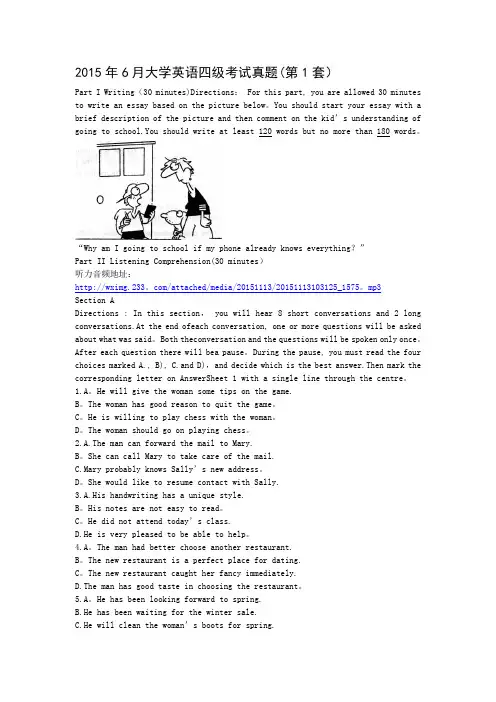
2015年6月大学英语四级考试真题(第1套)Part I Writing(30 minutes)Directions: For this part, you are allowed 30 minutes to write an essay based on the picture below。
You should start your essay with a brief description of the picture and then comment on the kid’s understanding of going to school.You should write at least 120 words but no more than 180 words。
“Why am I going to school if my phone already knows everything?”Part II Listening Comprehension(30 minutes)听力音频地址:http://wximg.233。
com/attached/media/20151113/20151113103125_1575。
mp3Section ADirections : In this section, you will hear 8 short conversations and 2 long conversations.At the end ofeach conversation, one or more questions will be asked about what was said。
Both theconversation and the questions will be spoken only once。
After each question there will bea pause。
2015年6月四级听力第二套题原文与答案

2015年6月四级听力第二套题原文与答案短对话1. 原文:W:?Tom,?would?you?be?interested?in?serving?on?the?membership?com mittee?thisyear??M:?Can?I?get?back?to?you?on?that?in?a?few?days??Q:?What?does?the?man?mean?答案:C. He will tell the woman his decision later.?2. 原文:W:?We?should?buy?a?good?guidebook?and?study?it?before?I?trip?to?V ancouver.??M:?We?could,?but?they?are?over?priced.?What?about?the?library? Q:?What?does?the?man?mean?答案:B. They should borrow a guidebook instead of buying one. 3.?原文:W:?You?took?a?history?course?this?term,?didn’t?you?What?can?you?sa y?about?it?M:?Well,?the?trouble?is?that?I?never?get?through?the?weekly?reading list though?some?books?are?quite?interesting.?Q:?What?does?the?man?mean答案:C. He has trouble finishing his reading assignments.4. 原文M:?I’m?taking?my?girlfriend?to?the?fancy?new?restaurant?for?her?birt hday?tonight.?W:?I?went?there?last?weekend.?I?found?it?rather?disappointing.? Q:?What?does?the?woman?mean?答案:A. The man had better choose another restaurant.5. 原文W:?Winter?is?over?a t?last.?Time’s?to?put?away?my?gloves?and?boots.? M:?I’ve?been?waiting?for?this?for?months.?Q:?What?did?the?man?mean?答案:A. He has been looking forward to Spring.6.?原文M:?Look!?The?curtain?is?going?up?slowly,?and?all?the?lights?over?sta ge?are?lit?up.?W:Yeah,?the?play?is?starting.?Oh,?something?caught?my?sleeves.Give? me?a?hand?please,?Bob.?Q:?Where?the?speakers?now?答案:D. In a theatre.7.?原文W:?You?only?have?water?to?serve?your?guests.?M:?This?isn’t?just?plain?water.?This?is?mineral?water?from?Tibet. Q:?What?does?the?man?imply?答案:B. His water is quite extraordinary.8.?原文W:?When?do?you?have?time?to?discuss?our?environmental?report?I?thi nk?we?have?to?make?some?revisions.??M:?I’m?free?at?3?o’?clock?this?afternoon.?But?what?exactly?needs?to? be?changed?Q:?What?are?the?speakers?going?to?do?this?afternoon.?答案:D. Revise an environmental report.长对话1W : Why is it important to recycleM : There are many reasons, recycling is one way to keep wastes out of land fills, land fills are places to dump waste, but they are un-popular because they can pollute the soil used to cover them and that’s bad for people who may build new homes there. Recycling also re-uses valuable raw materials such as aluminum and paper. Finally recycling can leave a lower garbage bill. Recycling lowers the amount of waste put into land fills. Therefore less money is spend for garbage disposal.W: So, has recycling changed over the yearsM: 10/20 years ago, you could buy milk in returnable refillable gas bottles and many people recycled voluntarily, now you buy milk and other products in plastic bottles or paper containers. Because of the highcost of disposing of these things in land fills, many city governments now have recycling programs.W: How does recycling help the environmentM: Recycling helps the environment mainly by saving energy, for example it takes 95% less energy to produce recycled aluminum than to produce new aluminum.W: Can one person really make a difference, if only a few people recycle then what’s the pointM: If not you then who If we combine our efforts we can make a difference. Each of us contributes to the waste problem. Over millions of tons of waste that go into the land fills started as an old pair of slippers, a broken TV set or a used magazine that came from som ebody’s house, maybe yours.Questions 9 to 12 are based on the conversation you have just heard9. Why are landfills are unpopular according to the manA) They pollute the soil used to cover them.10. What does the man say has contributed to the increase in among sub-waste over the yearsD) Lower production cost.11. According to the man, how does recycling help the environmentA) By saving energy.12. Why does the man say everybody should make an effort to recycleB) Only combined efforts can make a difference.长对话2W: Could you please give me information on air fares from Miami to Bellingham Washington We would like to buy some how to fly as cheaply as possible.M: Let’s see, I wont advice you to pay the normal one way economy transfer of 555 dollars, if you can fly on a Tuesday or Wednesday and buy your tickets at least 21 days in advance I suggest you book a round trip extension flight.W: But we may not need the return ticketsM: That’s alright! Even if you don’t use them, you should be able to save89 dollars over the one way fare, of course I’d recommend only booking, you ought to try to reserve the super saver seats, there are only a few of them and they are 15% cheaper than the others.W: That sounds like a good ideaM: Wait, to save another 100 dollars or so, why don’t you book a flight to Vancouver CanadaW: Well that’s better than me want to go.M: I know, but you can take a bus from Vancouver back to Bellingham and still save money and if you are travelling with children you might be able to get a discount and if you fly economy class. If they don’t get any discount, but to take advantage of the airline’s guaranteed fare policy you’d have to make reservations and pay your tickets at least 6 weeks in advance. Should I begin to search for available seatsW: No, thank youM: Excuse me!W: I may call you back if we don’t decide to drive.Questions 13 to 15 are based on the conversation you have just heard13.Where is the woman planning to goC) Bellingham14.What is the woman’s purpose in calling the manC) To get advice on how to fly as cheaply as possible.15.What does the man advise the woman to doD) Book tickets as early as possible.短文1:?What?makes?a?person?famous?This?is?a?mystery?that?many?people?ha ve?carefully?thought?about.?All?kinds?of?myths?surround?the?lives?of? well-known?people.?Most?people?are?familiar?with?the?works?of?Willi am?Shakespeare,?one?of?the?greatest?English?writers?of?the?16th?and? 17th?centuries.?Yet,?how?many?know?Shakespear,the?person,the?man? behind?the?works?After?centuries?of?research,?scholars?are?still?trying ?to?discover?Shakespeare’s?personal?history.?It?is?not?easily?found?in? his?writings.?Authors?of?the?time?could?not?protect?their?works.?An?a cting?company,?for?example,?could?change?a?play?if?they?wanted?to.?Nowadays,?writers?have?copyrights?to?protect?their?work.?Many?myth s?arose?about?Shakespeare.?Some?said?he?had?no?formal?education,?o thers?believed?that?he?began?his?career?by?tending?the?horses?of?weal thy?men.?All?of?these?myths?are???interesting,?but?are?they?true?Prob ably?not.?Shakespeare’s?father?was?a?respected?man?in?Stratford?upon ?Avon,?a?member?of?the?town?council.?He?sent?young?William?to?gr ammar?school.?Most?people?of?Elizabethan?times?did?not?continue?be yond?grammar?school.?So?Shakespeare?did?have?at?least?an?average?e ducation.?Some?parts?of?Shakespeare’s?life?will?always?remain?unkno wn.?The?Great?London?Fire?of?1666?burnt?many?important?document s?that?could?have?been?a?source?of?clues.?We?will?always?be?let?wit h?many?questions?and?few?facts.Questions 16 to 18 are based on the conversation you have just heard Q16:?What?does?the?speaker?say?about?William?ShakespeareD) His personal history is little known.Q17:?What?do?we?learn?about?Shakespeare’s?fatherC) He was a member of the town council.?Q18:?Why?does?the?speaker?say?part?of?Shakespeare’s?life?w ill?remain?a?mystery?B) Possible sources of clues about him were lost in fire.短文2Almost everyone suffers from a headache occasionally. But some people suffer from repeated, frequent headaches. A headache is important (19) because it can be the first warning of a serious condition that could probably be controlled if discovered early. If a person removes the warning, day after day, with a pain-killer, he or she may pass the point of easy control. The professional name for covering up a symptom is “masking”. A headache specialist once said, (20) “Masking symptoms is not the best way of treatment. Sometimes it is wiser to stand still than to advance in darkness.”A headache often interferes needlessly with normal, happy living. The employee with a headache does less work. In a flash of temper he or she may upset his fellow workers or customers, causing a direct or indirectloss to the organization. The mother with a headache suffers and disturbs the family. She upsets her husband and children.(21)Rest, quiet and fresh airs stop many common headaches. Lying down and possibly falling asleep may help. One can often handle tension headaches by rubbing and pressing the neck muscles. Heat from an electric pad or a warm bed may also help.Because hunger may be overlooked as a headache source, one must make a habit of regular meals. If the meal must be postponed for more than one hour, a snack helps to avoid a hunger headache.19. Why does the speaker say “a headache is important”C) It is an early worming of some illness.20. What the specialist suggest we do with headachesD) Avoid masking symptoms.21. What does the speaker say helps relieve the symptoms of common headaches??A) Lying down and having some sleep.短文3If you paychecks seem disappearing into thin air, you maybe struck in money traps, but don’t despair. Most people can get unstuck without going bankrupt. The biggest budget mistake is no budget at all. As one reader put it we just put all the bills in a pile, than try to decide which to pay. As she another has learnt, however, the money usually runs out before the bills do. The same problem plagues many who do have a detailed budget. Then study it, we read it looked good on paper, but it never seems to work. Why not Often because the budgets are unrealistic. The solution: make a detailed record of where all your money goes now, than study carefully. Look for an expense that can be cut back, and don’t give up in the face fixed expense. Many of this can be reduced too. In fact, it is very often easier to save on essentials than one enjoyable extra. If housing takes more than 25% of your income , for example ,consider moving to a cheaper place or renting out an extra room. If utility bills are high, get the whole family involved in a conservation plan. Some bills can be eliminated altogether. When one mother realized that a cable TVwas costing five hundred dollars a year. She decided that network TV wasn’t so bad. If you question every expe nse, you can find a few can be reduced.22 what does the speak say it’s a biggest budget mistakeB) Having no budget plans at all.23what does the speaker say about the so-called fixed expenses.A) Many of them can be cut.24. What does the speaker suggest the people do to save housing expenseD) Move to a cheaper place.25. What is the speaker main discussed in the talkC) Family budget problems and solutions.复合式听写Perhaps because going to college is so much a part of the American dream, many people go for no particular reason. Some go because their parents expect it. Others because it’s what their friend are doing. Then there is the belief that college degree will automatically ensure a good job and high pay. Some students drift through four years attending courses or skipping them as the case maybe. Reading only what can’t be avoided, looking for less demanding courses and never been touched or changed in any important way. For few these people, college provides no satisfaction yet, because of parental or peer pressure they cannot voluntarily leave. They stop trying in the hope that their teachers will make the decision for them by failing them. To put it bluntly, unless you are willing to make your college years count, you might be better off doing something else. Not everyone should attend college, nor should everyone who does attend begin right after high school. Many college students profit from taking a year or so off. A year out in the world helps some people to sort out their priorities and goals. If you really going to get something out of going to college, you have to make it mean something and to do that, you must have some idea why you are there, what you hope to get out of it and probably even what you hope to become.。
2015年6月英语四级真题:听力长对话第二篇(新东方版)

2015年6⽉13⽇英语四级考试已经结束,本次考试为多题多卷,整理了不同版本试题及参考答案,供考⽣参考。
Long conversation 长对话⼆ Man: Miss Yamada, did you ever think that you would find yourself living and working in the western world? Woman: No, not really, although I’ve always listened to recordings of great orchestras from Europe. Man: So you enjoyed classical music even when you were very young? Woman: Oh, yes. I was an only child. Man: You were born in 1955, is that right? Woman: Yes, I began violin lessons at school when I was 6. Man: As young as that, did you like it? Woman: Oh, yes, very much. Man: When did you first play on your own? I mean, when did you give your first performance? Woman: I think I was 8…? No, Nine. I just had my birthday a week before, and my father had bought me a new violin. I played a small piece at the school concert. Man: Did you know then that you would become a professional violinist? Woman: Yes, I think so. I enjoy playing the violin very much, and I didn’t mind practicing, sometimes three or four hours a day. Man: And when did you first come to Europe? Woman: I was very lucky. When I was fifteen, I won a scholarship to a college in Paris. That was for a three-year course. Man: How did your parents feel about that? Woman: I think they were pleased and worried at the same time. It was the chance of a lifetime. But of course I would be thousands of miles from home. Anyway, I studied in Paris for three years and then went back to Tokyo. 13. What do we know about the woman before she went to Europe? 14. What does the woman say about her music experience? 15. What does the woman say about her study in Paris?更多推荐:、更多推荐:。
2015年6月大学英语四级考试真题
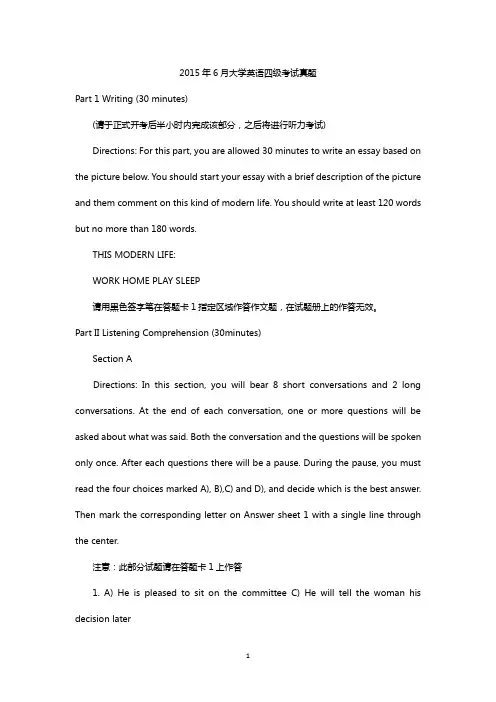
2015年6月大学英语四级考试真题Part 1 Writing (30 minutes)(请于正式开考后半小时内完成该部分,之后将进行听力考试)Directions: For this part, you are allowed 30 minutes to write an essay based on the picture below. You should start your essay with a brief description of the picture and them comment on this kind of modern life. You should write at least 120 words but no more than 180 words.THIS MODERN LIFE:WORK HOME PLAY SLEEP请用黑色签字笔在答题卡1指定区域作答作文题,在试题册上的作答无效。
Part II Listening Comprehension (30minutes)Section ADirections: In this section, you will bear 8 short conversations and 2 long conversations. At the end of each conversation, one or more questions will be asked about what was said. Both the conversation and the questions will be spoken only once. After each questions there will be a pause. During the pause, you must read the four choices marked A), B),C) and D), and decide which is the best answer. Then mark the corresponding letter on Answer sheet 1 with a single line through the center.注意:此部分试题请在答题卡1上作答1. A) He is pleased to sit on the committee C) He will tell the woman his decision laterB) He is willing to offer the woman a hand D) He would like to become a club member2. A) Their planned trip to Vancouver is obviously overpricedB) They should borrow a guide book instead of buying oneC ) The guide books in the library have the latest informationD) The library can help order guide books about Vancouver3. A) He regrets having taken the history courseB) He finds little interests in history booksC) He has trouble finishing his reading assignmentsD) He has difficulty in writing the weekly book report4. A) The man had better choose another restaurantB) The new restaurant is a perfect place for datingC) The new restaurant caught her fancy immediatelyD) The man has good taste in choosing the restaurant5. A) He has been looking forward to sping C) He will clean the woman’s boots for springC) He has been waiting for the winter sale D) He will help the woman put things away6. A) At a tailor’s C) In a cloth storeB) At Bob’s home D) In a theatre7. A) His guests favors Tibetan drinks C) Mineral water is good for healthB) His water is quite extraordinary D) Plain water will serve the purpose8. A) Report the result of a discussion C) Submit an important documentationB) Raise some environmental issues D) Revise an environmental report Questions 9 to 12 are based on the conversation you just heard9. A) They pollute the soil used to cover themB) They are harmful to nearby neighborhoodsC) The rubbish in them takes long to dissolveD) The gas they emit is extremely poisonous10. A) Growing populations C) Changed eating habitsB) Packaging materials D) Lower production cost11. A) By saving energy C) By reducing poisonous wastesB) By using less aluminum D) By making the most of materials12. A) We are running out of natural resources soonB) Only combined efforts can make a differenceC) The waste problem will eventually hurt all of usD) All of us can actually benefit from recyclingQuestions 13 to 15 are based on the conversation you have just heard.13. A) Miami C) BellinghamB) Vancouver D) Boston14. A) To get information on one-way tickets to CanadaB) To inquire about the price of “Super saver ”seatsC) To get advice on how to fly as cheaply as possibleD) To inquire about the shortest route to drive home15. A) Join a tourist group C) Avoid trips in public holidaysB) Choose a major airline D) Book tickets as early as possibleSection BDirections: In this section, you will hear 3 short passages. At the end of each passage, you will hear some questions. Both the passage and the questions will be spoken only once. After you hear a question, you must choose the best answer from the four choices marketed A), B),C) and D). Then marked the correspond letter on Answer sheet I with a single line through the centre.注意:此部分试题请在答题卡1上作答。
2015年6月四级真题听力原文+mp3链接
听力真题原文Short conversations1.W: I’m going to give up playing chess. I lost again today.M: Just because you lost? Is that any reason to quit?Q: What does the man imply?2.M: Do you know Sally’s new address? She’s got some mail here, and I’d like to forward it to her.W: Well, we’ve not been in touch for quite a while. Let’s see. Mary should know it.Q: What does the woman mean?3.W: I missed classes this morning. Could you please lend me your notes?M: My notes? You’ve never see my handwriting, have you?Q: What does the man imply?4.M: I’m taking my girlfriend to the fancy new restaurant for her birthday tonight. W: I went there last weekend, I found it rather disappointing.Q: What does the woman mean?5.W: Winter is over at last. Time to put away my gloves and boots.M: I’ve been waiting for this for months.Q: What does the man mean?6.W: Thank you for bringing the books back.M: I thought you need them over the weekend. Many thanks for letting me usethem.Q: What do we learn from the conversation?7.W: Are you working flexible hours?M: No, I’m not. The weather today is so nice, so I decided to walk to work, and that meant I had to leave an hour earlier than usual.Q: What did the man decided to do?8.W: Our plane has been circling for a long time. Why the delay?M: The airport is closed for a while this morning, and things are still not back to normal.Q: What does the man mean?Long conversation长对话一Woman: Morning, this is TGC!Man: Good morning, Walter Barry here, calling from London. Could I speak to Mr. Grand, please?Woman: Who’s calling, please?Man: Walter Barry, from London.Woman: What is it about, please?Man: Well, I understand that your company has a chemical processing plant. My own company LCP, Liquid Control Products, is a leader in safety from leaks in the field of chemical processing. I’d like to speak to Mr. Grand to discuss ways in which we could help TGC to protect itself from such problems and save money at the same time.Woman: Yes, I see. Well, Mr. Grand is not available just now.Man: Can you tell me when I could reach him?Woman: He’s very busy for the next few days. Then he’ll be away in New York. So it’s difficult to give you a time.Man: Could I speak to someone else, perhaps?Woman: Who, in particular?Man: A colleague, for example?Woman: You are speaking to his personal assistance. I can deal with calls for Mr. Grand.Man: Yes, well, could I ring him tomorrow?Woman: No, I’m sorry, he won’t be free tomorrow. Listen, let me suggest something. You send us details of your products and services, together with references from other companies. And then we’ll contact you.Man: Yes, that’s very kind of you. I have your address.Woman: Very good, Mr…?Man: Barry. Walter Barry, from LCP in London.Woman: Right, Mr. Barry. We look forward to hearing from you.Man: Thank you, goodbye.Woman: Bye.9. What do we learn about the woman’s company?10. What do we learn about the man?11. W hat’s the woman’s position in her company?12. What does the woman suggest the man do?Long conversation长对话二Man: Miss Yamada, did you ever think that you would find yourself living and working in the western world?Woman: No, not really, although I’ve always listened to recordings of great orchestras from Europe.Man: So you enjoyed classical music even when you were very young? Woman: Oh, yes. I was an only child.Man: You were born in 1955, is that right?Woman: Yes, I began violin lessons at school when I was 6.Man: As young as that, did you like it?Woman: Oh, yes, very much.Man: When did you first play on your own? I mean, when did you give your first performance?Woman: I think I was 8…? No, Nine. I just had my birthday a week before, and my father had bought me a new violin. I played a small piece at the school concert.Man: Did you know then that you would become a professional violinist? Woman: Yes, I think so. I enjoy playing the violin very much, and I didn’t mind practicing, sometimes three or four hours a day.Man: And when did you first come to Europe?Woman: I was very lucky. When I was fifteen, I won a scholarship to a college in Paris. That was for a three-year course.Man: How did your parents feel about that?Woman: I think they were pleased and worried at the same time. It was the chance of a lifetime. But of course I would be thousands of miles from home. Anyway, I studied in Paris for three years and then went back to Tokyo.13. What do we know about the woman before she went to Europe?14. What does the woman say about her music experience?15. What does the woman say about her study in Paris?Spot DictationLooking at the basic biology systems, the world is not doing very well. Yet economic indicators show the world is prospering. Despite a slow start at the beginning of the eighties, global economic output increased by more than a fifth during the decade. The economy grew, trade increased, and millions of new jobs were created. How can biological indicators show the opposite of economic indicators?The answer is that the economic indicators have a basic fault: they show no difference between resources uses that sustain progress and those uses that will hurt it. The main measure of economic progress is the gross national product (GNP). In simple terms, this totals the value of all goods and services produced and subtracts loss in value of factories and equipment. Developed ahalf-century ago, GNP helped establish a common way among countries of measuring change in economic output. For some time, this seemed to work reasonably well, but serious weakness are now appearing. As indicated earlier, GNP includes loss in value of factories and equipment, but it does not take into account the loss of natural resources, including nonrenewable resources such as oil or renewable resources such as forests.This basic fault can produce a misleading sense of national economic health. According to GNP, for example, countries that overcut forest actually do better than those that preserve their forest. The trees cut down are counted as income but no subtraction is made for using up the forests.Passage OneWhat makes a person famous? This is a mystery that many people have carefully thought about. All kinds of myths surround the lives of well-known people.Most people are familiar with the works of William Shakespeare, one of the greatest English writers of the 16th and 17th centuries. Yet how many know Shakespeare the person, the man behind the works?After centuries of research, scholars are still trying to discover Shakespeare's personal history. It is not easily found in his writings. Authors of the time could not protect their works. An acting company, for example, could change a play if they wanted to. Nowadays, writers have copyrights that protect their work.Many myths arose about Shakespeare. Some said he had no formal education. Others believe that he began his career by tending the horses of wealthy men. All of these myths are interesting, but are they true? Probably not. Shakespeare's father was a respected man in Stratford-on-Avon, a member of the town council. He sent young William to grammar school. Most people of Elizabethan times did not continue beyond grammar school; so, Shakespeare did have, at least, an average education.Some parts of Shakespeare's life will always remain unknown. The Great London Fire of l666 burned many important documents that could have been a source of clues. We will always be left with many questions and few facts.Question16 What does the speaker say about William Shakespeare? Question 17 What do we learn about Shakespeare's father?Question 18 Why does the speaker say parts of Shakespeare's life will remain a mystery?Passage TwoWherever you go and for whatever reason, it's important to be safe. While the majority of people you will meet when travelling are sure to be friendly and welcoming, there are dangers-theft being the most common.Just as in your home country, do not expect everyone you meet to be friendly and helpful. It's important to prepare for your trip in advance and to take precautions while you are travelling. As you prepare for your trip, make sure you have the right paperwork. You don't want to get to your destination only to find you have the wrong visa, or worse, that your passport isn't valid any more. Also, make sure you travel with proper medical insurance, so that if you are sick or injured during your travels, you will be able to get treatment. If you want to drive while you are abroad, make sure you have an international driver's license.When you get to your destination, use official transport. Always go to bus and taxi stands. Don't accept rides from strangers who offer you a lift. If there is no meter in the taxi, agree on a price before you get in. If you prefer to stay in cheap hotels while travelling, make sure you can lock the door of your room from the inside. Finally, remember to smile. It's the friendliest and most sincere form of communication, and is sure to be understood in any part of the world!Question 19 What is mentioned as a most common danger when people go travelling abroad?Question 20 What is the most important thing to do when you prepare for your trip abroad?Question 21 What does the speaker suggest you do when you arrive at your destination?Passage 3The British are supposed to be famous for laughing at themselves, but even their sense of humour has a limit, as the British retailer Gerald Ratner found out to his cost. When Ratner took over his father's chain of 130 jewelry shops in 1984, he introduced a very clear company policy. He decided that his shops should sell down market products at the lowest possible prices. It was a great success. The British public loved his cheap gold earrings and his tasteless silver ornaments. By 1991, Ratner's company had 2,400 shops and it was worth over 680 million pounds. But in April of that year, Gerald Ratner made a big mistake. At a big meeting of top British businesspeople, he suited up and explained the secret of his success. People say "How can we sell our goods for such a low price?" I say "Because they are absolute rubbish." His audience roared with laughter. But the British newspapers and the British public were not so amused. People felt insulted and stayed away from Ratner's shops. Sales fell and 6 months after his speech, Ratner's share price had fallen by 42%. The following year, things got worse and Gerald Ratner was forced to resign. By the end of 1992, he lost his company, his career and his house. Even worse, 25,000 of his employees had lost their jobs. It had been a very expensive joke.Question 22 What did Gerald Ratner decide to do when he took over his father's shops?Question 23 On what occasion did Gerald Ratner explained the secret of his success?Question 24 How did people feel when they leaned of Gerald Ratner's remarks? Question 25 What does the story of Gerald Ratner suggest?听力链接: /s/1hq6bdK4。
2015年6月英语四级考试真题(第一套).doc
2015年6月大学英语四级考试真题(第1套)Part I Writing(30 minutes)Directions: For this part, you are allowed 30 minutes to write an essay based on the picture below。
You should start your essay with a brief description of the picture and then comment on the kid’s understanding of going to school.You should write at least 120 words but no more than 180 words。
“Why am I going to school if my phone already knows everything?”Part II Listening Comprehension(30 minutes)听力音频地址:http://wximg。
233。
com/attached/media/20151113/20151113103125_1575.mp3Section ADirections : In this section, you will hear 8 short conversations and 2 long conversations.At the end ofeach conversation, one or more questions will be asked about what was said.Both theconversation and the questions will be spoken only once.After each question there will bea pause.During the pause, you must read the four choices marked A., B), C。
6月四级听力原文及答案解析
6月四级听力原文及答案解析2015年6月四级听力短对话原文1.W: I am going to give up playing chess, I lost againtoday。
M: Just because you lost? Is that any reason toquit?Q: What does the man imply?2.M: Do you know Shirley’s new address? She’s got some mailhere and I’d like to fold it to her。
W: Well, we’ve not been in touch for quit a while. Let’ssee, Marry should know it?Q: What does the women mean?3.W: I missed the classes this morning could you please lentme your notes?M: My notes? You’ve never seem my hand writing, haveyou?Q: What does the man imply?4.M: I am taking my girlfriend to the fancy new restaurantfor her birthday tonight。
W: I went there last weekend and I found it ratherdisappointing。
Q: What does the women mean?5.W: Winter is over at last, time to put away my gloves andboots。
M: I ‘ve been waiting for this for months。
6月英语四级考试听力原文
6月英语四级考试听力原文2015年6月英语四级考试听力原文精选Johannesburg, South Africa is one of Africa's top cities in business and wealth. Its financial area is often called the richest square mile on the continent. As its wealth increases so does the tastes of its residents.Right now, demand is rising in Johannesburg for Kobe beef. Top cooks and professional meat cutters say it is the best beef in the world. It is definitely the most costly.The beef comes from Wagyu cattle in Japan's Kobe region. The beef's fat content makes it rich and melt-in-your-mouth tender.Braeside Butchery owner Caroline McCann in Johannesburg. (Darren Taylor for VOA News)At Braeside Butchery in Johannesburg, butchers slice through carcasses -- the remains of the dead cow. Caroline McCann is the owner of the meat store. She is a "huge fan" of Kobe beef.The Japanese taught her how to cook it: drop thin pieces into boiling miso soup for a very brief time."And with chopsticks just three to five times put the meat through the broth, and enjoy. And you do! It is just delightful. It's incredibly creamy; almost like eating a slab of butter, so it's very rich; you certainly can't eat a lot of it."Caroline McCann has visited Japan. She says the meat currently costs more than $1,000 dollars a kilo on international markets.McCann says Kobe farmers understand that the better they feed and treat their animals, the better their beef will taste."It's kind of the ultimate diet. So they ((the cows)) have this wonderful massage once a day and then they get fed beer every day. Most people I know would put their hands in the air and beg to be a Wagyu." (Laughing) "And so what they get is they get roughly a liter, liter and a half, of hops every day. So it's high carb, high sugar, which also helps them to bulk up."An order is ready in the kitchen of a restaurant in Sandton, a wealthy area of Johannesburg. Businessman Dennis Atwood is eating Kobe-style steak."It is of the best in the world. It's dry on the outside and quite pleasant to eat. The flavor is certainly intense."Caroline McCann says Kobe-style beef is something that wealthy people from all over the world want."The people that are looking for this are the same people that are very well traveled, very well read, very well informed; they would have eaten at some of the ((world's)) top restaurants.She says there also are a lot of people from elsewhere in Africa, who visit Johannesburg for business, and they too want to eat Kobe beef."So a lot of people from Ghana and Kenya and Congo, who come with significant money, come with a significant understanding of food internationally, and they're also actively seeking out this kind of product."Very soon, Caroline McCann says she is set to import Kobe-style beef from Australia, where Wagyu-crossbreeds are growing.She plans to sell the beef for 1,300 rands, or more than $100 dollars a kilo... But it will obviously sell for much more at restaurants.I'm Marsha James.Darren Taylor reported this story from Johannesburg. MarshaJames adapted it for VOA Learning English. Caty Weaver was the editor.。