
仁爱版英语八年级上册第一单元知识点小结
矿产资源开发利用方案编写内容要求及审查大纲
矿产资源开发利用方案编写内容要求及《矿产资源开发利用方案》审查大纲一、概述
㈠矿区位置、隶属关系和企业性质。
如为改扩建矿山, 应说明矿山现状、
特点及存在的主要问题。
㈡编制依据
(1简述项目前期工作进展情况及与有关方面对项目的意向性协议情况。
(2 列出开发利用方案编制所依据的主要基础性资料的名称。
如经储量管理部门认定的矿区地质勘探报告、选矿试验报告、加工利用试验报告、工程地质初评资料、矿区水文资料和供水资料等。
对改、扩建矿山应有生产实际资料, 如矿山总平面现状图、矿床开拓系统图、采场现状图和主要采选设备清单等。
二、矿产品需求现状和预测
㈠该矿产在国内需求情况和市场供应情况
1、矿产品现状及加工利用趋向。
2、国内近、远期的需求量及主要销向预测。
㈡产品价格分析
1、国内矿产品价格现状。
2、矿产品价格稳定性及变化趋势。
三、矿产资源概况
㈠矿区总体概况
1、矿区总体规划情况。
2、矿区矿产资源概况。
3、该设计与矿区总体开发的关系。
㈡该设计项目的资源概况
1、矿床地质及构造特征。
2、矿床开采技术条件及水文地质条件。
仁爱版英语八年级上册知识点归纳

仁爱版英语八年级上册知识点归纳一、Unit 11.重点词汇:festival, custom, occasion, traditional, celebrate, annual, superstition2.语法:一般现在时和现在进行时3.重点句型:How do you celebrate the Spring Festival? I usually clean the house and have a big family dinner.二、Unit 21.重点词汇:adventure, explore, wander, journey, destination, route, scenery2.语法:一般过去时和过去进行时3.重点句型:We visited the Great Wall and took many photos.三、Unit 31.重点词汇:charity, donation, organization, fund, poverty, volunteer, campaign2.语法:情态动词can, could, may, might表请求、允许、建议、批准等3.重点句型:Can I join the charity bike ride? Sure, you can.四、Unit 41.重点词汇:weather forecast, hurricane, tornado, thunderstorm, lightning, disaster, rescue2.语法:虚拟语气3.重点句型:If I were you, I would take an umbrella because it may rain this afternoon.五、Unit 51.重点词汇:talent show, contestant, judge, round, applause, champion, performance2.语法:感叹句3.重点句型:What a wonderful performance!六、Unit 61.重点词汇:hobby, furniture, instrument, recipe, exhibition, display, masterpiece2.语法:动词不定式3.重点句型:She likes to play the piano in her free time.七、Unit 71.重点词汇:environment, pollution, recycle, global warming, carbon dioxide, emissions, alternative2.语法:虚拟语气3.重点句型:If we don't take action now, the environment will bein great danger.八、Unit 81.重点词汇:vacation, destination, souvenir, guidebook, sightseeing, journey, amodation2.语法:宾语从句3.重点句型:I want to know where you are going for vacation.以上是仁爱版英语八年级上册的知识点归纳。
Unit1Topic1知识点总结仁爱版英语八年级上册
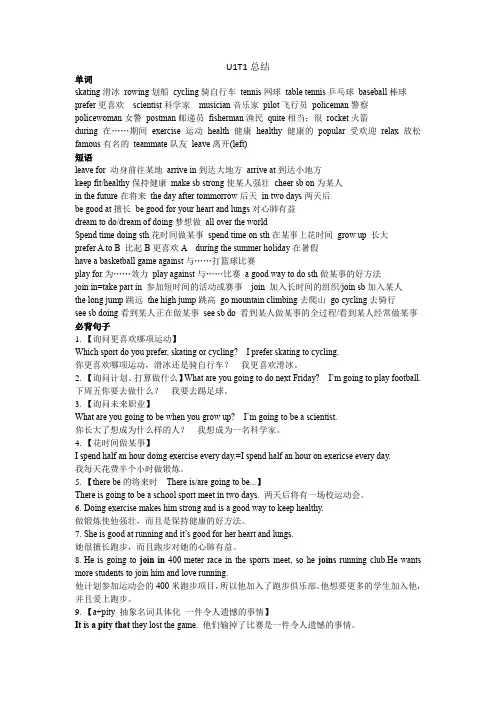
U1T1总结单词skating滑冰rowing划船cycling骑自行车tennis网球table tennis乒乓球baseball棒球prefer更喜欢scientist科学家musician音乐家pilot飞行员policeman警察policewoman女警postman邮递员fisherman渔民quite相当;很rocket火箭during在……期间exercise运动health健康healthy健康的popular受欢迎relax放松famous有名的teammate队友leave离开(left)短语leave for 动身前往某地arrive in到达大地方arrive at到达小地方keep fit/healthy保持健康make sb strong使某人强壮cheer sb on为某人in the future在将来the day after tommorrow后天in two days两天后be good at擅长be good for your heart and lungs对心肺有益dream to do/dream of doing梦想做all over the worldSpend time doing sth花时间做某事spend time on sth在某事上花时间grow up 长大prefer A to B 比起B更喜欢A during the summer holiday在暑假have a basketball game against与……打篮球比赛play for为……效力play against与……比赛a good way to do sth做某事的好方法join in=take part in 参加短时间的活动或赛事join 加入长时间的组织/join sb加入某人the long jump跳远the high jump跳高go mountain climbing去爬山go cycling去骑行see sb doing看到某人正在做某事see sb do 看到某人做某事的全过程/看到某人经常做某事必背句子1.【询问更喜欢哪项运动】Which sport do you prefer, skating or cycling?---I prefer skating to cycling.你更喜欢哪项运动,滑冰还是骑自行车?---我更喜欢滑冰。
仁爱八年级上册u1t1知识点
仁爱八年级上册u1t1知识点仁爱八年级上册 Unit 1 Topic 1 知识点仁爱八年级上册的第一单元主要涉及关于日常生活、居住环境和社会文化等方面的话题,本文将针对单元第一话题的知识点进行详细介绍。
1.关于家庭和房屋在日常交流中,我们经常使用到与家庭、房屋相关的词汇。
在英语中,一些基本的词汇包括“home”(家)、“house”(房屋)、“room”(房间)、“bedroom”(卧室)、“kitchen”(厨房)、“bathroom”(浴室)等等。
另外,在句子中表达你居住的地方时,你可以使用“I live in…”或“my house is in…”等表述方式。
2. 关于购物在日常生活中,我们不可避免地需要购物。
英语中与购物相关的一些词汇包括“store”(商店)、“mall”(购物中心)、“supermarket”(超市)、“market”(市场)等等。
当你想询问商品的价格时,你可以问“How much does it cost?”或“What's the price?”等。
当你想购买某样商品时,可以说“I'd like to buy…”或“I want to buy…”等表述方式。
3. 关于饮食英语中与饮食相关的一些词汇包括“food”(食物)、“snack”(小吃)、“meal”(饭菜)、“drink”(饮品)等等。
当你在餐厅用餐时,你可以使用“Can I have…”(我能要一份…吗?)、“I'd like…(我想要…)”等表述方式。
若要表达你对食物的喜好或不喜欢程度,你可以使用“like”(喜欢)或“dislike”(不喜欢)等词汇。
4. 关于文化和社交在日常交流中,我们还需要了解与文化和社交相关的词汇。
比如,“friend”(朋友)、“family”(家人)、“hobby”(爱好)、“dance”(舞蹈)等等。
在与陌生人交往时,我们可以使用“How do you do?”或“Nice to meet you”等礼貌的用语。
仁爱版英语八年级上册单元知识点汇总第一单元
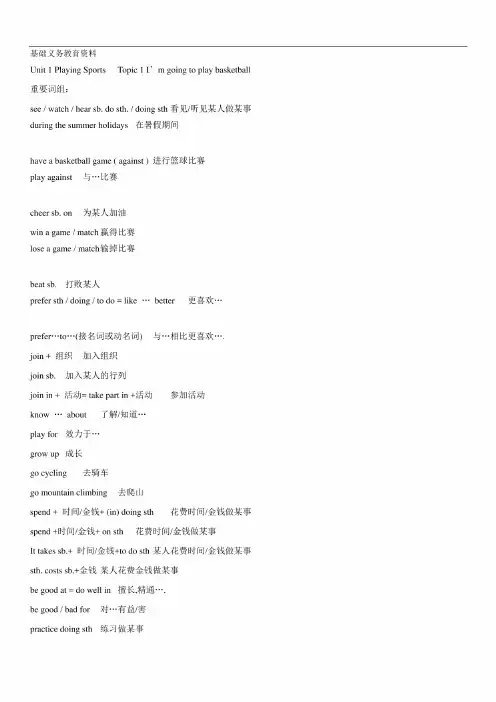
基础义务教育资料Unit1Playing Sports Topic II'm going to play basketball 重要词组:see/watch/hear sb.do sth./doing sth看见/听见某人做某事during the summer holidays在暑假期间have a basketball game(against)进行篮球比赛play against与…比赛cheer sb.on为某人加油win a game/match赢得比赛lose a game/match输掉比赛beat sb.打败某人prefer sth/doing/to do=like…better更喜欢…prefer—to---(接名词或动名词)与…相比更喜欢….join+组织加入组织join sb.加入某人的行列join in+活动=take part in+活动参加活动know…about了解/知道…play for效力于…grow up成长go cycling去骑车go mountain climbing去爬山spend+时间/金钱+(in)doing sth花费时间/金钱做某事spend+时间/金钱+on sth花费时间/金钱做某事It takes sb.+时间/金钱+to do sth某人花费时间/金钱做某事sth.costs sb.+金钱某人花费金钱做某事be good at=do well in擅长,精通….be good/bad for对…有益/害practice doing sth练习做某事There is/are going to be…=There will be…将有….be sure that+从句肯定/确定…make sb/sth+adj.使某人/物…keep sb/sth+adj.使某人/物…keep fit/healthy保持健康help relax帮助放松be popular流行/受欢迎be excited感到激动be exciting令人激动的He is excited感到激动的an exciting film令人激动的影片be famous for…因、、、而出名be famous as…作为、、、而出名a famous soccer star一个著名的足球明星China's national team 中国队stay in Beijing呆在北京for long=for a long time长时间all over the world全世界a good way to do…做…好办法arrive in+大地方arrive at+小地方至U达・・・leavesp(地点)离开某地leave for sp(地点)前往某地重要句子:I often saw you play basketball during the summer holidays.暑假期间我经常看见你打篮球.We are going to have a basketball game against Class Three on Sunday.我们将在周天跟三班进行比赛I hope our team will win.我希望我们队会赢.Would you like to come and cheer us on?Sure,I'd love to.你愿意来给我们加油吗?当然,我愿意.Which sport do you prefer,swimming or rowing?游泳与划船,你更喜欢哪个?I prefer rowing.我更喜欢划船.Do you row much?你经常划船吗?Yes,quite a lot./quite a bit.是的,很经常.7.Are you going to join the school rowing team?你打算参加划船队吗?What's your favorite sport?Basketball,of course.你最喜爱的运动是什么?当然是篮球.Who's your favorite player?Yao Ming.你最喜爱的球员是谁?姚明Do you know anything about him?你知道他什么吗?He played for the Houston Rockets in the NBA.他曾效力与NBA火箭队.What are you going to be when you grow up?I'm going to be a scientist.你长大后想当什么?我想成为一名科学家.Ann is good at jumping.安擅长跳跃.She spends half an hour exercising in the gym every day.她每天花半小时在健身房锻炼.There is going to be a school sports meet next weekend.下周末将有一场校运会.She is going to take part in the long jump and the high jump.她将参加跳高和跳远.They are sure that she will win.他们确信她会赢的.Playing basketball makes us strong and it's popular all over the world.打篮球使我们强壮,它在全世界受欢迎.Running is good for my legs,heart and lungs.跑步对我们的腿,心脏,肺有益.Swimming helps to keep her heart and lungs healthy.It can help her relax.游泳帮助保持她的心肺健康.能帮助她放松.It's a good way to keep fit.它是保持健康的一个好方法.For the last20years,David Beckham was a very famous soccer player.在过去的20年,贝克汉姆是一个非常著名的足球运动员.He arrived in Beijing with his teammates yesterday.他昨天足艮队员至U北京.They are going to play against China,s national team tomorrow.他们明天将与中国国家队比赛.It's too bad that the team isn't going to stay for long.太遗憾了球队不会呆太久.It's a pity that they are going to stay for about two days.很遗憾他们将逗留大约两天..They are leaving for Japan the day after tomorrow for a game with Japan's nationalteam.他们后天将前往日本与日本国家队比赛.Will you join us?I'11be glad to.你加入我们吗?我很乐意.Grammar:一般将来时一般将来时表示将来某一时刻的动作或状态,或将来某一段时间内经常的动作或状态。
仁爱版八年级英语上册知识点总结
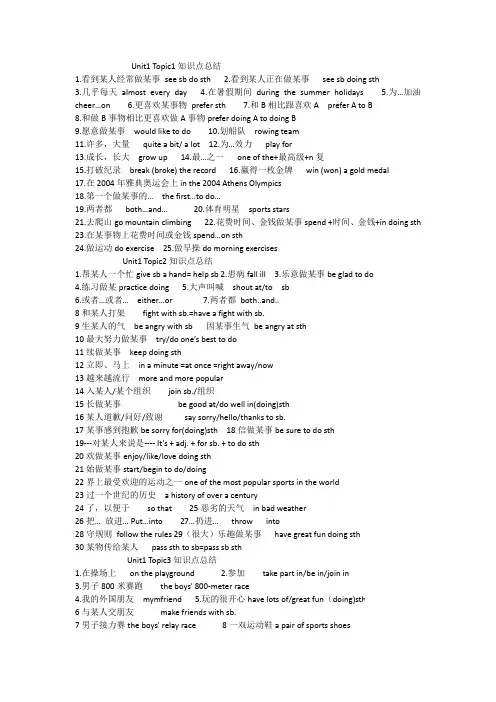
Unit1 Topic1知识点总结1.看到某人经常做某事see sb do sth2.看到某人正在做某事see sb doing sth3.几乎每天almost every day4.在暑假期间during the summer holidays5.为…加油cheer…on6.更喜欢某事物prefer sth7.和B相比跟喜欢A prefer A to B8.和做B事物相比更喜欢做A事物prefer doing A to doing B9.愿意做某事would like to do 10.划船队rowing team11.许多,大量quite a bit/ a lot 12.为…效力play for13.成长,长大grow up 14.最…之一one of the+最高级+n复15.打破纪录break (broke) the record 16.赢得一枚金牌win (won) a gold medal17.在2004年雅典奥运会上in the 2004 Athens Olympics18.第一个做某事的…the first…to do…19.两者都both…and… 20.体育明星sports stars21.去爬山go mountain climbing 22.花费时间、金钱做某事spend +时间、金钱+in doing sth23.在某事物上花费时间或金钱spend…on sth24.做运动do exercise 25.做早操do morning exercisesUnit1 Topic2知识点总结1.帮某人一个忙give sb a hand= help sb2.患病fall ill3.乐意做某事be glad to do4.练习做某practice doing5.大声叫喊shout at/to sb6.或者…或者… either…or7.两者都both..and..8和某人打架fight with sb.=have a fight with sb.9生某人的气be angry with sb 因某事生气be angry at sth10最大努力做某事try/do on e’s best to do11续做某事keep doing sth12立即、马上in a minute =at once =right away/now13越来越流行more and more popular14入某人/某个组织join sb./组织15长做某事be good at/do well in(doing)sth16某人道歉/问好/致谢say sorry/hello/thanks to sb.17某事感到抱歉be sorry for(doing)sth 18信做某事be sure to do sth19---对某人来说是---- It’s + adj. + for sb. + to do sth20欢做某事enjoy/like/love doing sth21始做某事start/begin to do/doing22界上最受欢迎的运动之一one of the most popular sports in the world23过一个世纪的历史 a history of over a century24了,以便于so that 25恶劣的天气in bad weather26把… 放进… Put…into 27…扔进… throw into28守规则follow the rules 29(很大)乐趣做某事have great fun doing sth30某物传给某人pass sth to sb=pass sb sthUnit1 Topic3知识点总结Array 1.在操场上on the playground 2.参加take part in/be in/join in3.男子800米赛跑the boys' 800-meter race4.我的外国朋友mymfriend5.玩的很开心have lots of/great fun(6与某人交朋友make friends with sb.7男子接力赛the boys' relay race 8一双运动鞋a pair of sports shoes9在学校大门口at the school gate 10在几点钟make it+时间11在剧院at the theater 12看电影go to the movies在...做的不好do badly in sth/doing sth 终点线finish line起跑线starting line 多做运动do more exercise能够做某事be able to do sth 将来的某一天some day下次做的更好do better next time 中华人民共和国the People's Republic of China在将来in the future 从现在起from now on第一次for the first time 最后一次for the last time 代表stand for完成某事finish doing sth 至少at least ....的象征a symbol of...Unit 2 Keeping Healthy1.look well看起来好2.What′s wrong with sb.? 怎么了3.What′s the m atter with sb.?4.I′m sorry to hear that.听到这个消息我很难过5.I hope you will get well soon.我希望你早日康复6.have a cold/a toothache /a fever/a cough/a backache/a stomachache/a sore throat /the flu/sore eyes 感冒/牙疼/发烧/咳嗽/背疼胃疼/咽喉发炎/流感/眼疼7.Enough+名复/不可数名词----足够的8.形/副+enough----足够地9.You′d better=You had better 你最好------10.feel terrible 感觉难受11.don’t read for too long 不要看书太久12.Drink enough boiled water喝足够的开水13.Lift heavy things 举起重的东西14.Stay in bed 卧床,待在床上15.Have a good sleep(名)=sleep (动)well好好睡觉16.一是一觉一保持,起来四个,变了四个is,am,are---feel---keep:look,sound,smell:taste,become,get,turn,grow17.How long have you been like this?----For two days.18.Take/have some medicine服药19.Take sb./sth. to somewhere带某人或某物去某地20.Take/have a rest休息21.Day and night日日夜夜22.How are you feeling?=how do you feel?你感觉怎么样?23.I′m feelin g =I feel24.Not bad.还行not so well. 不是很好25.A little better好些了much better好多了26.Feel like doing sth.=want/would like to do sth,想要做某事27.You had better(not) do sth.你最好(不)做某事28.You should (not) do sth.你(不)应该做某事29.go to see a doctor 去看病30.hot tea with honey 加蜂蜜的热茶31.brush teeth 刷牙32.动+too much+形那么多. 太多的33.Much too +形/副太多的34.Too many+名复太多的35.Fall down摔倒36.Fall off从摔下37.Go up上升38.Ran to sb.跑向某人39.Look after well=take good care of 照顾好40.Take sb. home带某人回家41.Call a taxi叫出租车42.Have an accident发生一场事故43.Do a difficult jump做一个难度大的跳跃44.Two pieces of advice两条建议45.Ask for a leave请假46.Ask for a week′s leave请一周的假47.Ask for three weeks′leave请三周的假48.Ask sb.(not) do sth.让某人(别)做某事49.Ask for请求50.Return to +地点=come back/go back to +地点返回某地51.Return sth. to sb.=give back sth. to sb.把某物归还某人52.Worry about = be worried about为担忧/担心53.don`t worry 别担54.It′s nothing serious.没什么严重55.thank you for--- 因---而感谢你56.not----until--- 直到----才----57.both----and--- ------和-------都是---58.be bad for对------有害59.follow the doctor′s advice接受医生的建议60.Plenty of= lots of+名复/不可是数名词许多61.What caused it ? 什么引起的62.On TV 在电视上63.Stay up 熬夜64.Do morning exercises 做早操65.Throw litter around乱扔垃圾66.Put into 把-------放进-----67.keep the air clean and fresh保持空气清新68.Keep fingernails long(形)留长指甲69.Go to bed early(副)早睡70.Get up late(副)早起71.Wash hands before meals饭前洗手72.Play sports right after meals饭后立刻做运动right (副:立刻,马上73.Go to school without breakfast不吃饭去上学74.Brush teeth twice a day每天涮两次牙75.Show sth. to sb.=show sb. sth.给某人看某物76.Give up doing sth=stop doing sth.放弃(禁止)做某事77.Have a bath洗澡78.Force sb. to do sth.强迫某人做某事79.As soon as 一就80.Make sb. do sth.使某人做某事81.Be surprised to do sth.对感到惊讶82.By chance偶然83.Be careful (not) to do sth.当心(不)要做某事84.Be always doing sth.老是,一再地做某事85.Take showers洗澡86.Tidy our rooms整理我们的房间87.Not only but also 不仅…而且…e sth. to do sth.使用某物做某事89.In fact 事实上90.All the time 一直91.Keep/stay away from远离92.At once= right now立刻马上93.Prevent/stop/keep sb. doing sth.阻止做某事94.Take some cold pills服感冒药95.Lie down躺下96.Work on the Internet too long通过电脑工作太长97.Play/do sports做运动98.Change one′s clothes换衣服99.Could /May/Can I speak to sb.?请找接电话好吗?100.本人:This is sb. speaking.101.不:I′m sorry he is busy now./Sorry,he isn′t here/in. 102.Ring sb. up打电话给某人103.Call sb. up104.Call sb.105.Give sb. a call106.Leave a message( to sb.)留言,留口信107.Take a message (for sb.)=give sb. a message给某人捎口信108.Forget to do sth.忘记去做某事(没做)109.Forget doing sth.忘记曾经做某事(已经做过)110.Do some cleaning做扫除By oneself独自,单独地111.Give a talk做讲演(报告)112.Try to do sth.尽力或设法去做某事113.On one hand一方面on the other hand 另一方面114.Say no to sb./sth. 拒绝某人或某物115.It′+形+for sb. to do sth. 对某人来说,做某事是116.Fast food快餐117.比较级and比较级:越来越118.The 比较级,the 比较级:越(就)越119.the more exercise,the better.锻炼越多,越好120.Warm up 作准备活动121.stop to do sth.停下来去做某事(停下来去做另一件事)122.stop doing sth.停止做某事(停止正在做的事)123.instead of代替124.suggest(动)---- suggestion(名)建议125.medicine(不可数名词)药---pills(名复)药片126.tooth---teeth牙127.lie—lay(过去式)—lying(现在分词)—lain(过去分词)躺128.check over检查129.with---without130.tomato—tomatoes西红柿131.potato –potatoes土豆132.sleep(名,动:睡觉)---sleepy(形:欲睡的,困乏的)---asleep(形:睡着的,已死的)133.as as possible 尽量---地134.build sb. up增强某人的体质135.read in the sun在阳光下读书136.Must +主?137.yes, 主+must. No,主+needn′t .no,主+don ′t have to.138.May +主?139.yes, 主+may. No,主+mustn′t .no,主+can′t .140.Need +主?141.yes, 主+must. No,主+needn′t.Unit 3 Our hobbies Topic 1 What’s your hobby?1.in one’s free time 在某人的空闲时间2.why not do...?=why don’t you do...?为什么不干。
英语八年级仁爱版上册第一单元知识点
英语八年级仁爱版上册第一单元知识点
1. 重要词组:see / watch / hear sb. do sth. / doing sth(看见/听见某人做某事),during the summer holidays(在暑假期间),have a basketball game ( against)(进行篮球比赛),play against(与…比赛),cheer sb. on(为某人加油),win a game / match(赢得比赛),lose a game / match(输掉比赛)。
2. 单词辨析:如healthy(健康)、fit(强健)、win(赢)的过去式是won,名词是winner,ski(滑雪)的现在分词是skiing等。
3. 介词、副词和连词的使用:如“between…and…在两者
之间”、“prefer doing sth.更喜欢做某事”、“a bit/a lot很多”、“go skating/skiing/bicycling/climbing/hiking去滑雪/滑冰/骑车/爬山/远足”、“arrive in/at到达”、“play against…与……”。
4. 句型:例如,“It’s going to +动词原形”表示将来时态的句型,“祈使句+and+陈述句”表示一种顺承或条件关系。
这些知识点在仁爱版英语八年级上册第一单元中都有详细介绍和练习。
同时,也可以通过阅读相关英语书籍或请教英语老师来加深对这部分内容的理解和掌握。
— 1 —。
(完整版)仁爱版英语八年级上知识点归纳
Topic 1 What’s your favorite sport?重点词语:1. almost(反义词)never2.win(过去式)won(名词)winner?3.ski(现在分词)skiing4.famous(比较级)more famous5.arrive(同义词)reach6.leave(过去式))left?7.popular(最高级)most popular 8.healthy(同义词)fit(名词)health (1)?词组1.?during the summer holidays?? 在暑假期间2.?between…and… 在两者之间3.?cheer sb. on 为某人加油4.?prefer doing sth. 更喜欢做某事5.?quite a bit/a lot 很多6.?plan to do sth. 计划做某事7.?have a skating club 举办滑雪俱乐部去滑雪、滑冰、骑车、爬山、远足9.?arrive in 到达10.?play against… 与……对抗/较量11.?for long 很久12.?leave for… 动身去…后天就是The Day After Tomorrow.14.?places of interest 名15.?胜打棒球17.?at least 至少善于做某事,即be good at参加全世界21.?be good for 对……有益22.?a good way 一种好方法Keep fit or maintain health.24.?relax oneself 放松某人自己重点句型你最喜爱的运动是什么?26.?Which sport do you prefer? = Which sport do you like better? 你更喜欢什么运动?I prefer skating. = I like skating better. 我更喜欢滑雪.你常滑雪吗?或Do you often skate?28.?She spends at least half an hour in the gym every day. 每天她至少花半小时在体育馆.29.?She plays baseball pretty well and she is also good at jumping.她棒球打得相当好而且擅长于跳.30.?What kind of sports do you like? = Which sport do you like? 你喜欢哪种运动? 重点语言点31.?see sb. do sth? “看见某人做了某事” 强调动作的全过程,常与every day; often 等连用.see sb. doing sth.? “看见某人正在做某事” 强调动作正在进行.I saw you play basketball almost every day during summer holidays.I often see him draw pictures near the river. 我常看见她在河边画画.I saw her go across the street.? 我看见她过了马路我看见她正在过马路。
仁爱版八年级上册英语 Unit 1 Topic 1 知识点总结
八年级上册仁爱版第一单元T1知识点总结Topic 1一、重点词汇:during [djʊərɪŋ] 在…期间against [əˈgenst]对着,反对team [ti:m]队,组win [win] 获胜,赢得cheer [tʃiə]加油,欢呼;喝彩;football [futbɔ:l] 足球practice ['præktɪs] v.&n.练习,实践prefer [prɪ'fɜ:(r)]更喜欢,宁愿(选择) row [rəʊ]划船;n.(一)排,(一)行quite [kwaɪt]相当,很,十分join [dʒɔɪn]加入,参加;连接;会合skate [skeɪt]溜冰,滑冰cycle ['saɪkl]骑自行车tennis ['tenɪs]n.网球player ['pleɪə(r)]n.比赛者,选手rocket ['rɔkit]火箭dream [dri:m]n.梦,梦想;v.做梦grow [ɡrəʊ]成长,生长;发育;种植;变成scientist [ˈsaɪəntɪst] n.科学家future [ˈfju:tʃə(r)]n.将来musician [英][mjuˈzɪʃn]n.音乐家,乐师pilot ['pailət] 飞行员,驾驶员policeman ['pəli:smən] 男警察postman ['pəustmən] 邮递员fisherman ['fiʃəmən] 捕鱼的人jump [dʒʌmp]v.跳跃;n.跳跃;猛扑spend [spend] 度过;花费(金钱、时间等) exercise ['eksəsaɪz] 锻炼,做操;练习baseball ['beɪsbɔ:l]n.棒球weekend [ˌwi:k'end]n.周末part [pa:t] n.一部分health [helθ] n.健康,卫生popular [ˈpɒpjələ(r)]流行的,大众的,受欢迎的world [ˌwə:ld]n.世界,全球heart[hɑ:t] 心脏,心;纸牌中的红桃lung [lʌŋ]肺;肺脏healthy [ˈhelθi] adj.健康的,健壮的fit [fɪt]健康的;适合的;v.(使)适合;安装relax [rɪ'læks](使)放松,轻松supper [sʌpə]晚餐famous ['feɪməs] adj.著名的teammate [ˈti:mmeɪt] n.队友excited [ɪkˈsaɪtɪd] 激动的,兴奋的bad [bæd] 坏的,不好的leave [li:v]离开;剩下;n.假期,休假pity [piti]遗憾,可惜二、重点短语be going to do打算做...play basketball 打篮球like doing 喜欢做...see sb do 看见某人做...during the summer holiday在暑假期间would you like to do你想要做... cheer sb on为某人加油I’d love to 我很乐意have to 不得不practice doing练习做... both...and 两者都of course当然play for 为...效力grow up长大go cycling骑自行车twice a week一周两次go mountain climbing去爬山spend...(in)doing花时间去做... in the gym在体育馆every day每天be good at 擅长于...school sports meet 学校运动会take part in参加the high jump跳高the long jump跳远be sure that确信the day after tomorrow后天all over the world全世界a good way to do 一个做...的好方法keep healthy/ fit保持健康arrive in 到达leave for离开...去往It’s a pity that真遗憾...join sb加入某人go skating去滑冰climb a mountain爬山row a boat划船play table tennis打乒乓球三、课文重要知识点Section A1.I’m going to play basketball.考点1):play+球类运动play football/soccer/basketball/table tennis...考点2):将来时态①will+do②be going to do 表示按计划、安排将要发生某事,有人称变化There be句型的将来时:There will be...There is/ are going to be...2.I often saw you play basketball during the summer holiday.考点1):see--sawsee sb do看见某人做...表示经常性、习惯性动作,常于时间状语often、every day等连用see sb doing 看见某人正在做...强调动作正在进行I see. 我明白了。
仁爱版八年级上册英语知识点汇总(完整版)
仁爱版八年级上册英语知识点汇总(完整版)Unit 1 Topic 1: English Phrases for 8th Grade1."Be going to do" means to have plans to do something.2."See sb do sth" means to XXX doing something from start to finish。
while "See sb doing sth" means to witness someone in the act of doing something.3."XXX.4."Play against" means to XXX.5."Be against" means to oppose something。
while "Be for" means to support it.6."Practice + doing" means to practice doing something.7."Prefer + doing" means to like doing something more than something else.8."Prefer + doing/n。
to doing/n." means to like doing something more than another thing.9."Prefer to do" means to choose to do something over something else.10."Quite a lot/bit" means often.11."Which" means "what kind of," while "prefer" means "like better."12."XXX," "XXX," "Take part in + activity/XXX," and "Be in + activity/XXX" all mean to participate in something.13."Know about" means to be aware of or understand something.14.In a time clause。
仁爱版英语八年级上册所有单元知识点总结
仁爱英语八年级上册U n i t1t o p i c 1Section A语言点讲解1.I saw you play basketball almost every day during the Summer holidays.常见的感官动词有:see, watch, hear, smell, feel 等;后可接①动词ing形式,表此动作正在发生;②动词原形,不表此动作正在发生, 表此动作已完成或存在的事实;① Do you smell something burn 答案:burning② I often see him basketball after class. play 答案:play2.There is going to be a basketball game between Class Three and our class thisSunday.There be 句型:表某地有某物. 而have 表示某人有…1There is/ are..表现在某地有某物,is/are取决于后面的名词是单数还是复数,单数用is复数用are,如①There is a pen and two rulers on the desk.②There are two rulers and a pen…2 There was/were…表过去某地有某物;was/were的用法也遵循就近原则;3There will be 或 There is/are going to be 表某地将有某事物;不能说成 There will have…题 a match in our school between Class Three and Class Four next week.3.Would you like to come and cheer us on ----- Sure, I’d love to.1Would you like + 不定式表建议或邀请;常用I’d love to 来回答,不同意也常用“I’d love to, but…”来拒绝别人;如:Would you like to play basketball with me --- I’d love to, but I have a lot of homework to do.2在肯定句中 would like= want 如:I’d like to have a rest. = I want to havea rest.4.I hope our team will win.---- Me , too.= So do I.① hope + that从句,that 可省去;I hope that I can see you soon.② hope to do sth. I hope to see you soon.注意: 1wish愿与hope的用法一样,后既可以接从句也可以接不定式,但不能说hope sb. to do sth. hope 后不接双宾语, 但 wish 可以,如:I hope you to help me 错 I hope that you can help me.对2hope 后接的从句常用将来时态表可以实现的愿望,而wish 后接的宾语从句常用过去时态表难以实现的愿望,如:①I hope you will come. ②I wish I could fly to the moon.5. I prefer rowing.1prefer过去式\过去分词需双写 prefe rr ed 后可直接接动词ing形式或动词不定式, 表更喜欢…, 用法同like/ love:①I prefer swimming 更喜欢经常游泳②I prefer to swim.更喜欢这一次去游泳2prefer doing A to doing B 相当于:like… better than…I prefer swimming to skating. ==I like swimming better than skating.3 后接不定式时与rather than 或instead of连用,如:He preferred to die ratherthan to steal. / He preferred to die instead of stealing. 他宁死也不去偷窃;6. -----Do you row much 你经常划船吗 ----- Yes , quite a bit / a lot. 是的,经常;quite a bit/ a lot 经常/许多,大量. ①quite a bit of 后接不可数名词,如:quite a bit of money; ②quite a lot of 后既可接可数名词复数也可以接不可数名词,如:quite a lot of books/ information;而③quite a few=many 表“相当多”后接可数名词复数,如:quite a few students④quite a little =much表许多,后接不可数名词,如; quite a little money ⑤very few / little 很少很少;7.Are you going to join the school rowing club①join 加入人群,组织②take part in 参加活动,比赛注意:1join可与in连用,后接活动,即 take part in=join in = be in后都接活动;如:①He joined in the game ;②He joined in helping the old man. ③I’ll be in the relay race. 2 Join sb. in doing sth. 表加入某人的活动; 如:Will you join us in playing basketballSection B1.How tall is he, do you know ----- Yes. He is2.26 meters tall.与how构成的疑问词有:How tall身高多高; how high山多高;how heavy多重;how long 多长;How wide 多宽;how deep 多深;how old 多大…. 对应的回答常用“数词+量词+形容词”,如:1.70 meters tall; 2 kilometers high; 3 kilos heavy; 20 years old2.They both play for the Houston Rockets in the NBA.play for 为某个队效力;play against 与某个队比赛;play with 玩某物/与某人玩比较:play basketball 打篮球;Look, the baby is playing with a basketball 玩弄一个篮球3. what are you going to be when you grow up = what do you want to be …你长大想干什么5.David Beckham, a famous soccer star, arrived in Beijing with his team yesterday.表到达的有:①arrive at + 小地名;arrive in +大地名② get to ③ reach6.The fans are very excited.1excited 表“感到激动的、兴奋的”,常只作表语,主语常为人;如:We are excited.类似的有:interested有趣的; tired感到疲劳的; bored感到厌烦的2exciting 表“令人激动兴奋的”既可作定语,也可作表语;作表语时,主语常为事物,如:①an interesting book; ②The book is interesting.类似的有:interesting令人有趣的; tiring令人感到疲劳的; boring令人感到厌烦的7.It’s too bad that they aren’t going to stay in Beijing for long.主语是斜体that从句部分,前用it 来代替它;因此这是一个含主语从句的复合句;It’s too bad that…= It’s a pity that…= It’s a shame that..很遗憾….. 8.在英语中有一些表示位置移动的词,如:go,come,leave, arrive, fly 可用现在进行时态表将来;如:They are flying to Wuhan tomorrow. 表将飞往武汉而不是正去武汉 They are leaving for Japan.= They will leave for Japan.9.Zhang Yining, one of the world’s best women table tennis players, won two goldmedals for China.1one of 表…中的一个,后接可数名词的复数,如:one of my friends2名词作定语修饰名词时,一般用单数形式,如:two book shops, two shoe shops, 但man,woman,sports修饰可数名词复数时,常用复数形式,如:two men teachers; sportsmeet3win a gold medal赢得一枚金牌; win a prize 赢得奖品; win the first place 赢得第一名10. What a shame = What a pity 多么遗憾类似的有:What fun 多么有趣11. break the record 打破纪录;keep the record 保持纪录12. Please write back soon.write back 回信Section C1.once a week, 一周一次twice a week一周两次, 三次或三次以上用“数字+times”如:three times a year, four times a day, five times a week,…..2.go + v-ing形式的短语表“去做某事”如:go hiking 去徒步旅行,go shopping去购物, go skating 去滑冰,go skiing 去滑雪;go fishing 去钓鱼;3.she spends half an hour doing exercise in the gym every day.当exercise指“体操、练习”时,是可数名词,如:do morning exercises 做早操;do English exercises 做英语练习题;但exercise指“锻炼,运动”时,是不可数名词;如:do exercise 做运动;exercise 还可作动词,指“锻炼,运动”如:She exercises every morning.4.She plays it pretty well.pretty well= very well相当好5.She is also good at jumping.be good at…= do well in…擅长…如:I am good at English.= I do well in English.be good for… 对…有好处,Running is good for your health.反义词为:be bad at= do badly in 不擅长…. be bad for 对…有害类似短语:be good/bad to sb. 对某人好/不好6.They are sure that she will win.①be sure +that从句,表“确信…”如:I’m sure that eating too much is bad foryou.②be sure to do sth..确信做某事We are sure to win next time.③be sure of/about doingsth. 表确信做某事 I’m sure of that.7.How often does she go cycling(1)go +动词ing形式,表进行某种户外活动,如:go swimming, go fishing, goclimbing.(2)How often问多久一次,频率;常用sometimes, seldom, twice a year等回答;How long 问多久;常用“For一段时间”来回答How soon 问多快时间,用于将来时态;常用“In an hour 在一小时内等”来回答;如:How soon will you come back -----In a week.与how搭配的疑问词有:①How many 多少接可数名词复数形式②How much 多少接不可数名词③How old 问年龄④How tall 多高人、树⑤How high 多高山、楼⑥How far 问距离⑦ How long 还可以问物体的长度1 is it from your home to your school ------It’s two kilometers away.2 is the room ------ It’s two meters wide.3 is the tree -------It’s three meters high.8. Because it makes me strong and it is popular all over the world.因为它使我强壮并且它流行make, let , have 当表“使,让”时是使令动词,后接动词原形;如:make me crymake 后还可以接形容词,名词,如: make me strong, make him our monitor ,10.keep healthy = keep fit 保持健康healthy=fit都是形容词,health 是名词Section D1.Have a good day 祝你今天玩得高兴 Have a good journey 旅途愉快 Have a good time 祝你过得愉快 Have a good weekend 周末愉快八年级上册Unit 1 topic 2Section A1.Michael, could you please do me a favor(1)Could you please = Would you please…意为“请你…好吗”后接动词原形(2)do sb. a favor= help sb.= give sb. a hand 帮某人的忙;2.But one of my teammates fell ill;但是我们队友中的一员病了;1One of +可数名词复数,表“….. 中之一”当它作主语时,是单数第三人称;如:One of my friends likes playing computer games 类似的短语有:Some of …;中的一些 most of…中的大多数;2 fall ill 生病强调动作be ill 病了强调状态如:He fell ill yesterday, and now he is ill in bed.3.----Would you mind teaching me ----- Not at all. 你介意教教我吗 ---- 不介意;(1)Would you mind notdoing sth. 你介意别做某事吗礼貌地请求某人做或别做某事回答去做的有:Not at all 或 Of course not或 Certainly not 回答不去做的有:Sorry,I won’t ./Yes, please don’t./ You’d better not.(2)Would you mind my/me smoking here 常用物主代词 my, her, his, our 等,少用代词宾格me, he, us 等4.Let’s go and practice. 让我们去练习practice+名词/动词ing,表练习什么/做什么,如:①We often practice spoken English.英语口语②Let’s practice dancing.5. Sorry, I’ll put it somewhere else.somewhere else 别的某个地方 somewhere 是不定副词,else 是形容词;形容词修饰不定副词、不定代词时,常放在其后; 如:something sweet甜食;Anything else 还有别的吗 Nothing serious 不严重6. Don’t be late next time. --- Sorry, I won’t.对不起,我将再也不会了①be late 迟到,如:You are late again. ②be late for…做…迟到如:He was late for school.3 回答否定祈使句常用:Sorry,I won’t. 如:Don’t shout at me ---- Sorry, I won’t.回答肯定祈使句常用:OK,I will. 如:Please study hard. ---- OK, I will. 7.Would you please say it in English. 你能用英语说一下它吗①Would you please not do sth 请求某人做某事②Would you like to do sth. 提建议③Would you mind not doing sth 请求8.That’s very kind of you, but I can manage it myself.太感谢你了,但我会自己处理的;manage 作“管理,处理”时,结构为:manage sb./sth. 如:She managed the hotel well.manage 作“设法做成某事”时,结构为:manage to do sth. 如:it’s too noisy here, I’ll manage to leave here. 注意比较try to do sth. 努力去做某事"It is+形容词+of sb.to do sth.."和"It is+形容词+for sb.to do sth.."这两个句型容易混淆;什么情况下用of 或for 是一个考点;实际上前者的形容词用来描述某人的,因此可以转换成: Sb.+be+形容词+to do sth. 后者的形容词用来描述做某事的,可以转换成:To do sth.is+形容词;如:It is right of you to do more reading.= You are right to do more reading. right 用来描述youIt is easy for you to finish the work. = To finish the work is easy for you. Section B1.You are always so carelessalways 除了用于一般现在时态中,也可用于进行时态中,be always doing sth. 总是….常用来赞扬某人,如:She is always helping others.2.You missed a good chance.错过一个好机会miss意为”思念,错过”如:①I miss my mother very much. ②She missed the early bus.3.He did his best .他尽力了;a)do one’s best=try one’s best 尽某人最大努力②Do one’s best to dosth.=try one’s bestto do sth. 某人尽力去干某事 We will do/try our best to study English well.4.Kangkang, would you mind saying sorry to Michael 你介意向Michael 道歉吗①Say sorry to sb 向某人道歉②say hello to sb. 向某人打招呼/问候;③say goodbye to sb. 向某人道别;5.I am sorry for what I said. 我为我所说的道歉;for 后面的what I said我所说的是一个宾语从句;类似的还有:what I saw 我所见的,what I thought about我所考虑的a)Be sorry for 表为…. 道歉,后面接名词、代词、从句或动名词;②Be sorry to dosth.抱歉去做某事; 有时①②可互换如:I’m sorry for troubling you.= I’m sorry to trouble you.6.Keep trying We are sure to win next time.1Keep doing sth. 坚持做某事;keep sb. doing sth. 让某人一直干某事;keep on doing sth. = go on doing sth. 继续做某事2 ①be sure to do sth. 确信要做某事表将来如:It’s sure to rain. 肯定要下雨;②be sure +that从句, 如: We are sure that we will win next time.③be sure about sth. 对某事确信,如:I’m sure about the answer.7. Kangkang was angry with Micheal.be angry with sb. 生某人的气be angry at sth. 因某事而生气, 如:He was angry at what he had said.8. With the help of Maria and Jane, Kangkang said sorry to Micheal.With the help of sb. = with one’s help 在某人的帮助下 With Maria and Jane’s help,….9. 1 turn on 打开电器、龙头等; turn off 关; 2 turn up 调大音量 turn down 调小音量10. please take a seat. 请坐Take one’s seat = have one’s seat 坐某人的座位如:He took his seat and reada book.11.be busy with sth. 为某事而忙碌;如:Kangkang is busy with his exam.be busy doing sth. 忙于做某事如:He is busy preparing for Christamas.12. Never mind.= It doesn’t matter.= That’s OK/all right.= Not at all. 没关系;都可以用来回答“I’m sorry.”如:I’m sorry I didn’t call you last night. --- Never mind. I guess you were busy.Section C1.Exciting Yes, but very tiring as well. 很精彩是的,但也很累;表“也”的有下列词,用法如下:①as well / too 用于肯定句末. I’m a student. He is a student as well/too.②also 用于肯定句中位于系动词、情态动词之后,行为动词之前如:He is also a student. He also likes English.③either 用于否定句末;I’m not a student, he isn’t a student either.2.He invented an indoor game for his students so that they could play even in badweather.1 so that ①为了,以便 He got up early so that he could catch the early bus.②结果,以致 He left his book at home so that he went back home again.so+形容词/副词+that从句:如此….以致…She is so beautiful that everyone likes him.such+名词短语+that 从句:如此….以致… She is such a beautiful girl thateveryone likes him.2① invent 动词发明②inventor 名词发明家③invention 名词发明Inventors have invented many great inventions 发明家已经发明了许多伟大的发明;3.Do you know how to score in the game 在比赛中得分score 进球,得分①名词:The final score is 2-1. 最后得分为2比1;②动词: No one scored in the first half.没人得分在上半场;Section D1.I am a 15-year-old boy. 我是一个15岁大的男孩;用连接号“—”构成的词常做一个形容词,放在名词前作定语,此结构中数词后的词不用复数,不能说成 15-year s-old, 但不是一个词时,year 要用复数;如:He is 15 years old.2.①instead of代替...,是一个副词短语,不能放主语后独立作谓语动词,只能放在动词后作谓语,它后可接名词/代词/动名词v-ing;如:You should play out instead of working indoors.a)instead 代替…放句尾或句首;I don’t like swimming, let’s go hikinginstead.3. I have great fun running.fun 是不可数名词,意为“乐趣”,词组have fun doing sth. 在做某事中得到乐趣, 如:We have great fun learning English. 注意:have fun= enjoy oneself= ha a good time.4.Before 和 after 既可作介词,后接动词ing形式;也可作连词,后接时间状语从句;如:开始跳高前,我们必须弄清楚如何跳得高;①Before starting jumping, we must get to know how to jump high. 介词②Before we start jumping, we must get to know how to jump high. 连词5. 短语:①shout at sb 朝某人吼不礼貌地;shout to sb. 朝某人大声地喊②be import to sb./ sth. 对某人是重要的;如:English is important to us.③build sb/oneself up增强某人体质如:Running can build ourselves up.④立刻,马上:in a minute= right now= right away= at once =soon八年级上册Unit 1 topic 3Section A1.I’ll be in the long jump and the high jump.be in + 活动,表“参加某活动, 相当于take part in 和 join in2.maybe 和may be①maybe =perhaps副词,表“可能,也许,大概”,在句中作状语,通常放句首,也可以放动词之前;如:Maybe you are right.可能你是对的②may be 表“可能是”常放句中,如:You may be right.你可能是对的3.动词放句首的几种情况:①动词原形放句首,用于祈使句;如:Read the dialogue loudly , please.②动词ing形式动名词放句首作主语,把它当作单数第三人称对待;如:Reading in thesun is bad for your eyes.③动词不定式也可以放句首作主语,如: To talk with him is a great pleasure. 当然,通常我们把不定式放句后,前用形式主语it 来代替它;因此这句话常说成:It is a great pleasure to talk with him.跟他交谈是一种莫大的乐趣4.My foreign friend, Steve, will come to cheer me on.cheer sb on 为某人加油;5.I am sure I will make friends during the sports meet.1 make friends 交朋友2 make friends with sb. 和某人交朋友,如:I wan to makefriends with you. 3 sports meet 运动会6. I will do my best. I won’t lose.lose ①输反义词为:winI am afraid I will lose the game. ②丢失 I lost my book.7. It’s my first time to take part in the high jump.It’s one’s first time to do sth. 是某人第一次做…如:It’s her first time to cook dinner/Section B1.Let’s go to plant trees then. 那么让我们去植树吧;plant 和 grow 都表“种植”,一般可互换,但grow 比 plant 更需要精心的培育;常说:plant trees, grow rice.2.Let’s make it half past six. 我们约定6:30吧;这是约定时间的常用表达法.3.enough 的用法:1enough足够的/地修饰形容词或副词必须放在它的后面;如:big enough 大的足够slowly enough 慢地足够 enough 修饰名词时,即可放其前,也可放其后;如:enough money 或 money enough.2 enough to do sth. 足够…..可以做…. 此句式还可以与so…..that…. ;too…to….互换;She isn’t old enough to go to school.== She is so young that she can’t go to school.=She is tooyoung to go to school.她太小了而不能上学;4.take photos= take pictures 照相Section C1. We’re sorry that we did badly in the high jump, but we’re sure we can do better next time.do badly in = be bad in 在…方面做得差 badly是副词,修饰动词do; bad 是形容词 do better in = be better in 做得更好, 更擅长于…. better是 well,good的比较级2. The People’s Republic of China took part in the Olympics for the first time in 1952.for the first time第一次如:I went to Beijing for the first time last summer holiday.3. The Olympic Games take place every four years.短语:1 take place 发生,举办 2 every four years 每4年一次Section D1. The Olympic rings are a symbol of the Olympic Games.a symbol of …的一种象征 Yellow was a symbol of imperial power in ancient China.2. There are five rings, and they stand for the five parts of the world.stand for 代表… The dragon stands for the Chinese nation.3. You can easily find at least one of these colors in the flag of every country. at least 至少 = over = more than 如:There are at least 400 students in our school.4. improve our environment 改善我们的环境1 improve 改善,提高 I don’t know how to improve my English.2 improve oneself自我提高 we should study hard to improve ourselves八年级上册Unit 2 topic 1Section A1. What’s wrong with you 你怎么了同义句有:What’s the matter/ trouble with you matter/ trouble 是名词,前用the ; wrong 是形容词,前不用the2. 短语:have a cold=catch a cold患感冒;have a cough 患咳嗽;have a fever 发烧;have a stomachache 胃疼;have a headache 头痛 have a sore throat 喉咙疼注意这两个特殊点的I have a headache. = I have an ache in my head. ache 指持续的疼痛,pain 指肉体上的剧烈疼痛,sore常指发炎而引起的肌肉痛3. take a rest = have a rest 休息一下4. lift①举起 lift the box ②消散 The clouds will lift soon ③电梯 get out of the lift5. You look pale.系动词有:be是;look看起来, smell闻起来, sound听起来, taste尝起来, feel觉得,turn/get/become 变;他们后常接形容词作表语, 系动词常可用动词be 来退换;如: The music sounds wonderful. = The music is wonderful.6. I will take some medicine first and see how it goes.1 take some medicine = have some medicine 服药2 see how it goes 看它如何发展 go表事情的进展, 如:Everything is going well;7. I cough day and night.day and night 日日夜夜8.I don’t feel like eating.feel like doing sth.= want to do sth. 想要做…如: I feel like running. 9.You’d better drink hot tea with honey.with 加…的, without 没有…如:Chinese tea with nothing= Chinese tea without anything10. You should lie down and rest.lie down 躺下, lie的现在分词为lying, 过去式为 lay11. You’d better not eat too much candy.1 too much 修饰不可数名词,还可以用来修饰动词,如:①too much money; ② Stay in bed and don’t move your leg too much.2 too many 修饰可数名词复数,如:too many students3 much too修饰形容词或副词,如:much too expensive12. You should brush your teeth twice a day.brush one’s teeth 刷牙 tooth的复数teethSection C1. Let me check it over .check over = look over 检查正误,检查身体如:①Can you check over my homework.②The doctor checked her over and she was fine.2. Here, take these pills. 给,服下这些药片;pill 药片,服药用动词take/ have.3. I’m sorry to tell you that I had an accident yesterday.have an accident 发生一场事故4. The doctor told me to stay in bed for a week and look after myself.stay in bed 待在床上 in bed 常指生病在床上, on the bed 常指物品在床上5. So I’d like ask for a week’s leave.1 ask for a leave 请假2 ask for a week’s leave 请一周的假3 ask three days’leave6. I hope I’ll get well and return to school soon.1 return to +某地= go/ come back to…表返回某地,如:Kangkang returned to Beijing.2 return sth. to sb. = give back sth. to sb.表归还某物给某人,如:You must return it to me soon. = You must give it back to me soon.Section D1. I couldn’t read it until today.否定句+ until...表不能做某事,直到什么时候才能做; 如:I can’t help you until you tell me the truth. 我不能帮助你,直到你告诉我真相我才帮你;2. My sister is also sick.Sick和ill 都表“病的“,但sick 即可以作定语也可以作表语,如:①a sick girl; ②The girl is sick. 而ill只能作表语,如:The girl is ill. 因此sick>ill.3. Don’t worry about us.worry about sth./ sb. 为…担心4. You should drink plenty of boiled water.plenty of = a lot of 许多的;大量的, 可接可数名词的复数或不可数名词5. How are you feeling today 你今天感觉如何 ---Much better. 好多了;6. But my left leg still hurts when I move it. 但是我的左腿仍然痛,当我动的时候; hurt①疼痛:My leg hurts ②伤害 He hurt his leg when he fell.八年级上册Unit 2 topic 2Section A1. What’s up = What’s happening = What’s wrong = What’s the matter/trouble 怎么了2. Staying up late is bad for your health.1 stay up = sit up熬夜, 如:we stayed up until midnight to see the New Year coming.2 动词ing形式动名词可直接放句首作主语,谓语动词用单三形式;3. too little 太少; too much 太多;都用来修饰不可数名词;4. going to school without breakfast 不吃早饭去上学;Section B1. You must not read in the sun.in the sun 在阳光下此处不能用under the sun2. I must ask him to give up smoking.give up doing sth. = stop doing sth. 放弃做某事3. Don’t throw litter about.throw about 到处扔,如:throw litter about= throw about litter litter是名词,即可以放后也可以放中间,但代词只能放中间,如:throw it about4. go for a walk 去散步; take a walk = have a walk 散步5. It will keep you active during the day.1keep + 宾语 + 补语补语可以是:动词ing 形式;形容词;介词短语①I’m sorry to keep you waiting for such a long time. keep sb. doing sth.使某人一直做某事②Keep the door open, please. keep sb/sth+形容词表示某人/某事物保持怎样的状态③Once a cold keep the child in bed for three days keep sb+介词短语表示某人呆在某地2 during the day = in the daytime 在白天Section C1. It may show that something is wrong with your health.1 show sb. sth. = show sth. to sb. 向某人展示某物 please show me your new book.2 show sb. around 某地表带某人参观某地:I’ll show you around our school tomorrow.2. You can get a headache when you exercise on an empty stomach.on an empty stomach 空腹3. We can get into the human body through the nose.1 get into 进入,陷入; 如:get into trouble 陷入麻烦2 ①through 从物体内部穿过, 如:walk through a forest. ② across 从物体表面横穿,如:go across the road ③ over 从物体上空越过, 如:fly over the city 4. The boy has an illness.illness = sickness疾病名词, 很少表示具体的疾病,只表示抽象的疾病,disease 常表某种疾病;如:heart disease 心脏病Section D1. As we know, good health is more important than wealth.as we know = it is well know众所周知2. Of course, we must also have the right kinds of food.the right kinds of food 正确种类的食物3. We should eat more fruit and less meat.Eat more …. and less …多吃…少吃…4. Different foods help us in different ways.1 food, fruit 等词常作不可数名词,后不加s, 但当强调多种食物或水果时,常用复数形式, 如different foods.2 in different ways 以不同的方式5. It’s necessary for us to have healthy eating habits.句型:It is + 形容词 + for sb. to do sth. it代替后面的不定式对于某人来说,去做某事是…的, 如:It’s useful for us to learn English well.八年级上册Unit 2 topic 3Section A1. Mom, hurry up Dad is on TV.1 ①hurry up 赶快,表催促②hurry to do sth. = do sth. in a hurry 匆忙地做某事 He hurried to finish the work. = He finished the work in a hurry.③ hurry to+某地:表匆匆地去某地,如:He hurried to the hospital.= He went to the hospital in a hurry.2 be on TV 某人或某事物上电视;2. May I ask you some questions, Dr. Li ---- Sure, go ahead.1 疑问句和否定句中,表“一些”,常用any, 不用some. 但当此疑问句表建议或请求时, Some不改成any. 如:Would you like some tea2 go ahead 请开始吧3. SARS spreads easily among people.1 spread spread, spread 传播,传开 The disease spread all over the country.2 among 表在多者之间, between 在两者之间,常用:between A and B4. 短语:①build up our bodies 使我们的身体强健②crowded places 人群拥挤的地方③take one’s advice = accept one’s advice 接受某人的建议 advice 不可数名词5. Must 开头提出的问句, 否定回答不用mustn’t 来回答,常见的回答如:Must I go now 我必须得走吗肯定回答:Yes, you must.是的,你必须;否定回答:No, you needn’t./ No, you don’t have to. 不,你不必 needn’t= don’t have to6. We had better keep away from animals.keep…away from…让…远离…. 如:You’d better keep the child away from the fire.Section B1. Just a moment, please = wait a moment = Hold on, please. 请稍等打电话常用语2. He is busy right now.right now用两种意思:①现在= now ②马上= right away; in a minute; at once;3. He examining a patient.1 examine = check over 检查2 patient表“①病人②有耐心的”4. 短语:①get through to sb和某人接通电话②leave a message for sb.给某人留口信③give sb. a message = take a message for sb. 给某人捎口信④call sb. back 给某人回电话⑤ask/tell/order sb not to do sth. 叫某人不去做某事Section C1. He took an active part in the battle against it.1 take an active part in基金参加….2 against 介词,与…对抗2. He cared for the patients day and night.care for = take care of = look after 照顾,照看3. It is my duty to save the patients.1 此句为主语从句,it 代替 to save the patients2 save 有3种意思:①救②储存 save money ③节约 save water4. Long time no see 好久不见5. How did you spend your time at home 你在家是如何度过的spend + 时间:表度过… I spent my holiday in Beijing6. I taught myself on the Internet.1 teach oneself = learn by oneself自学 Michael learned English by himself.2 注意teach 的用法:teach sb. sthMr Liu teaches our English. 改错→ Mr Liu teaches us English. 正确Section D1. must 除了表示“必须”,还表示“一定”,如:Kangkang must be at home. 一定是mustn’t 只指“不准”,can be / may be 可能是; can’t be 不可能是;2. 反身代词的用法见语法表;八年级上册Unit 3 topic 1Section A1. Some of them are of great value.of great value 意为“很有价值的”, 相当于 valuable. “Of +名词”表“有…的”,相当于一个形容词;如:It is of importance. = It is important.2. I used to enjoy listening to rock music, but now I love collecting paintings.1 used to + 动词原形,表过去经常做某事现在不了,否定形式为didn’t use to 或used not to, 如:He didn’t use to drink beer.= He used not to drink beer. 其疑问句即可用助动词did, 也可以用 used, 如:Did he use to live in Beijing = Used he to live in Beijing2 love 的用法同like,后即可以接动词ing形式,也可以接动词不定式;3 picture 广义的图画,包括painting水彩画,drawing简笔画3. I am interested in playing basketball.be interested in 对…感兴趣4. I enjoy dancing to music.dance to music 随着音乐跳舞5. I am fond of acting.be fond of 喜爱Section B1. What do you often do in your spare timeIn one’s spare time = in one’s free time 在某人空闲时间里2. why not go out and do some outdoor activities1表建议的句型有:Why not = Why don’t you,后接动词原形,如; Why not/ Why don’t you go outWhat about = How about 后接动词ing,如: What / How about going outShall we + 动词原形, 如:Shall we go out2 do some outdoor activities 做户外活动3. Maybe I need a change.change ①名词,改变,如:a great change; ②动词,改变,如:He changed his mind.改了他的主意③名词,零钱,如:Here’s your change.4. water flower 浇花 water 在此为动词,表“给…浇水”5. 含 time 的短语:①all the time 一直②at the same time同时③at times有时④in time及时⑤on time准时⑥at that time 在那时⑦from time to time 不时6. not … at all 一点也不, 如:I don’t like it at all.Not at all 不用谢;没关系7. Do you share my interestsshare sth with sb. 同某人分享某事物,如: I want to share my happiness with you.Section C1. Did you used to go swimming during the summer vacationvacation= holiday 假期2. I used to swim in the pond in front of my house.in front of 在某物体外面的前面,如:There are some trees in front of my house. in the front of 在某物体里面的前面,如:There is a blackboard in front of the classroom.3. How clever感叹句:1How + 形容词/副词+主语+谓语感叹句中主语和谓语常省去; 如:①How tall the tree is ②How fast he runs2What + a / an + 形容词+ 名词+主语+ 谓语当名词为可数名词单数时,用a/an, 如:Whata tall tree it is 当此名词为复数或不可数名词时,不要a/an, 如:①What tall trees they are ②What bad weather it is4. They keep pets, play sports, dance to music.keep pets 养宠物 keep 有养,保存的意思 feed pets 喂宠物feed 指给东西它吃5. such as 通常放句中,后接几个并列名词,如:I can speak many languages, such asEnglish, French and Japanese. 而for example 可放句中,句首或句尾,后常接一个句子或短语并与它用逗号隔开,如:For example, Australia was unknown6. Hobbies help people relax after their daily work.daily = everyday 每天的,日常的;如: in our daily life = in our everyday life 7. well 1副词,好地,如:He speaks English well 2形容词,身体好的,如:I am well.Section D1. the color of his skin is light pink.light 1颜色浅的,反义词 dark 2 重量轻的,反义词为 heavy 3 灯2. He likes water and I often help him take a bath in the pond.1He 和 she 也可以表动物的雌雄,指祖国时用she.2 take a bath = have a bath 洗澡3. He doesn’t mind whether they are good or not.whether 和 if 表是否时,常可以互换,但在以下情况只能用whether, 不能用 if .1whether 可以和 or not 合在一起使用,也可以分开使用,但 if 可以只能在口语中与 or not 分开使用;Let me know whether or not you can come.2whether后可接不定式,而if不能;如: Please tell us whether to go or stay here. 3whether可置于句首引导主语从句,而if不能;如:_Whether_ the 2000 Olympic Games will be in Beijing is not known yet.4whether可用在介词之后,引导宾语从句,而If则不能;如:Success depends on whether we make enough effort.5whether可引导表语从句,if则不能;如:The question is whether it is not worthdoing.6.在有些动词如discuss之后,只能用whether,而不用if引导宾语从句;如:We discussed whether we should close the shop.八年级上册Unit 3 topic 2Section A1. I am going to a concert.短语: ①go to a concert 去听音乐会②give/ hold a concert 举行音乐会③at a concert 在音乐会上。