
七年级英语上册 Unit11课件人教新目标版
起 床
run
跑 步
take a shower
洗
go to school
去 上 学
eat/have breakfast 吃 早 饭
What time is it?
几点了?
Iam
7:15 pm
9:57 am
英语时刻的表达法
一、顺读法(用基数词表示)钟点数+分钟数 例如:4:25 four twenty-five 6:58 six fifty-eight 二、整点表示法:整点数词+o’clock 例如:7:00 seven o’clock 3:00 three o’clock 三、逆读法: 分钟数在半小时之内:分钟数+past+钟点数 例如:4:25 twenty-five past four 5:19 nineteen-past five 分钟数超过半小时:用(所差的)分钟数+to+(下一个)钟点 数 例如:7:31twenty-nine to eight 1:58 tow to tow 如果想表述的时间正好为半小时,可以用half+past+钟点数 例如:2:30 half past tow 5:30 half past five 英语中15 分钟可以 用a quarter来 表示
In the morning
In the evenning
具体的哪一天用on, 具体的时间段用in, 时间点用at
In the afternoon
Read Jane's message to her friend
因…而感谢某人prep.+n./v-ing
Thank for your letter. Do you want to know about my morning? I eat breakfast at around 7:30am. around大概,左右 School starts at 9 o’clock. =begin开始 Please write and tell me about your morning.
What time do you go to school? I go to school at seven o’clock.
What time do you play computer? I play computer at ten o’clock.
通常
What time do you usually go to school?
6:00
I get
up
at
six
o’clock.
7:00
I
run
at
seven
o’clock.
8:00
I take a shower at eight
o’clock.
9:00
I eat breakfast at nine
o’clock.
9:00
I go to school at nine o’clock.
介词at的用法
1.具体的某一天 2.人物所在之处 3.朝向 4.速度或者价格 at July 31st, 2012 at my sister’s home look at me at a good price
感叹词“多么的,何等的” 3a 副词,表顺承“然后” 一日三餐前不加冠词 What a funny time to eat breakfast! After breakfast he plays his guitar, then he goes to work(u) He takes the number 17 bus to a hotel. People love to listen to him! He gets home at 7:00pm. Love to do sth=like to do sth very much喜欢做某 Listen“听的 事,强调具体 动 活动。Love 作”hear“听 doing 见”we sth=like listen,but doing sth hear very much 则 nothing. 强调习惯
Do exercise
说出下面的时间: 1:22(one twenty-tow ; twenty-tow past one) 5:46 (five forty-six ; fourteen to six) 8:oo (eight o’clock) 9:30 (half past nine ; nine thirty) 1:58 (one fifty-eight ; tow to tow ) 3:15 (three fifteen ; a quarter past three )
I usually go to school at seven o’clock.
What time do you usually play computer? I usually play computer at ten o’clock.
频度副词
Usually与often一样是频度adv.“通常,经常” 常用于be动词之后,行为动词之前。 表示频度的词的之间比较: Always>usually>often>sometimes>seldom>never 总是 通常 经常 有时 很少 从不
What time+do/does+主语+v 原形。表示“询问某人做某事的 具体时间”
Unit 11 What time do you go to school ?
By Yang Ping
Get to 到达 Get home 到家 Get back 拿回 Get for为某人拿,取,买 Get from从某人某地那 得到
人教新目标七年级上unit11全单元课件-unit1b修改后

Unit 11 What time/When do you go to school?Section B(Page67-fi81eat dinnereat breakfastdo homeworkgo to bedSection B. 1a.When do people usually …?People usually do homeworkeat breakfast?In the morningn the afternoonIn the eveningeat dinner2a:Listen and circle the activities you hear.(p68 answers©)■run■get up■eat dinner■eat breakfast ■eat lunch do my homework take a showergo to schoolgo to bedgo home2a:Listen and circle the activities you hear.(p68 answers©)(^rup) cijat dinnB>^eat breakfas ■ eat lunch dojiiyjTomey^ take_a^hower dgo to^choc Cao to be3)ain and fill in the chart(p68)■ 1 ・get up^5:ooam■2.ru n■3. eat breakfast “ogm■ 4.go to school <<8:00am5. go home •:・4:15呵do homework •:・5:30Dmdinner • 7:15pm o to bed<<9:00pm:conversationInterviewer: Thanks for the interview. Rick ・ We want to know about your day? Rick: OK.Interviewer: When do you get up?Rick: When do I get up? Hmm, Usually around five o5clock・ Then I run aroundInt r: You run at six in the(大约moRick: Breakfast? Usually around seven. And then I usually go to school around eight o'clock ・Interviewer: Wow! And you go home at...? Rick: Four-fifteen in the afternoon?Interviewer: And what do you do in the evening? Rick: I do my homework around five thirty. And I eat dinner at seven fifteen. And I go to bed at nine o'clock.Interviewer: Thafs early! But then you get up early.Rink・llh-huhshe does at these times(完成书本上的练习p69)■ Dear Mona,Thanks for your letter. Do you want to know about my morning? Well, I usually get up at around six-fifteen・ I do my homework at six-thirty, and then I eat breakfast at around seven -thirty. At around eight o'clock, I go to school.School starts at nine o'clock ・Please write and tell me about your morning・LoveJane3b: complete the letter from Tom to his friend, Jiang Min.Dear Jiang Min,Do you want to know about my morning? Well, I usually _______ a tAt around _____ I ______ 5 then Iat ■ I go to school at ■ Please write soon(马上,立刻).Best wishes(最好的祝愿),Tom3a: Read the passage ・ Then match the pictures with the correct clocks.(p67)■Words and expressions®(单词和短语)■work ⑴动词“工作”(2)名词”工作”(不可数)job 名词”工作”(可数)■brush one's teeth 刷牙■have / take a shower 淋浴■get to…到达…;■get home/here/ there 到家/到这里/到那里3a: Keaa tne passage ・ Then match the pictures with the correct clocks.(book P67)■重点句型:■ 1 ・ What a funny time to eat dinner it is! 感叹句:(1)What an interesting book this is!(2)How interesting the book is !2. To get to work, he takes the number 17bus to the Saite Hotel.■take ....bus坐/乘…公车■ Saite Hotel赛特宾馆根据所给词的适当形式填空.1 ・ Do you often take a shower(洗澡))home?2. Why am I the last one? Becaus園为)l am the oldest.3.Which hotel (酒店)would you like to live in?4 Kate washes (洗)her face at 7:00am・5. Who is the first (第一)one to get to the school?6. The students often do their(他们的)homework after school.1 •我弟弟总是晚上九点钟睡觉.My brother usually goes to bed at nine o J clock in the evening.2•你通常什么时候回家?When do you usually go home?3 •早饭后,他弹钢琴.After breakfast, he plays the piano.4 •他经常什么时候洗澡?What time/ When does he take a shower. 5.他上课不听老师讲.He doesn't listen to the teacher.。
人教版(新目标)初中英语七年级下册Unit11预习自学
⼈教版(新⽬标)初中英语七年级下册Unit11预习⾃学f ire [ ' fa??( r)]n. ⽕; ⽕灾frie station [ ' ste??( ?) n] 消防站painting [ ' pe?nt??] n. 油画; 绘画exciting [ ?k' sa?t??] adj. 使⼈兴奋的; 令⼈激动的lovely [ ' l?vli] adj. 可爱的expensive [ ?k' spens?v] adj. 昂贵的cheap [ t?i?p] adj. 廉价的; 便宜的slow [ sl??] adj. 缓慢的; 迟缓的fast [ fɑ?st]adv.& adj. 快地( 的)robot [ ' r??b?t]n. 机器⼈guide [ ga?d] n. 导游; 向导gift [ g?ft] n. 礼物; 赠品all in all总的来说everything [ ' evr?θ??] pron. 所有事物; ⼀切interested [ ' ?ntr??st?d] adj. 感兴趣的be interested in…对……感兴趣dark [ dɑ?( r) k]adj. ⿊暗的; 昏暗的hear [ h??]v.( heard/ h?:( r) d) 听到; 听见Carol [ ' k?r?l] 卡罗尔( ⼥名)Unit11 知识梳理【重点短语】1 . school t r ip 学校旅⾏2 . go for a walk 去散步3 . milk a cow 挤⽜奶4.. r ide a horse 骑马5.. feed chickens 喂鸡6.. talk with a farmer 与农民交谈7.. take some photos 照相8.. ask some questions 问⼀些问题9.. grow apples 种苹果10.. show sb.around sp.带某⼈逛某地11.. learn a lot 学到许多12.. pick some strawberries 摘草莓13.. last week 上周14..In the countryside 在乡村15.. visit my grandparents 拜访我的祖⽗母16.. go f ishing 去钓鱼17.. sound good 听起来很好18.. climb the mountains 去爬⼭19 . play some games 玩⼀些游戏20 . visit a museum 参观博物馆21 .visit a f i re station 参观消防站22 . draw pictures 画画23 . go on a school t r ip 去旅⾏24 visit the science museum 参观科技博物馆25.. how to make a model robot 如何制作机器⼈模型26.. gift shop 礼品店27.. buy sth.for sb. = buy sb.sth. 为某⼈买某物28 .all in all 总得来说29 .be interested in...对… 感兴趣30 .be expensive 昂贵的31 .not. . . at all ⼀点⼉也不【重点句型】1 . --- Did you see any cows? 你见到奶⽜了吗--- Yes,I did.I saw quite a lot.我见到了⽽且见到了很多很多2.. --- Did Carol take any photos?罗尔拍照⽚了吗?--- Yes, she did. 是的,她拍了。
人教版初中英语教材目录 全

伴你一程的【英语】最新人教版初中英语(go for it!)教材目录(7—9年级)新目标英语七年级上期教材目录Unit 1 My name's Gina.Unit 2 Is this your pencil?Unit 3 This is my sisterUnit 4 Where's my backpack?Unit 5 Do you have a soccer ball?Unit 6 Do you like bananas?unit 7 How much are these pants?Unit 8 when is your birthday ?Unit 9 Do you Want to go to movie?Unit 10 Can you play the guitar ?Unit 11 What time do you go to school?Unit 12 My favorite subject is science新目标英语七年级下期教材目录Unit 1 Where's your pen pal from?Unit 2 Where's the post office?Unit 3 Why do you like koalas?Unit 4 I want to be an actor.Unit 5 I'm watching TV.Unit 6 It's raining!Unit 7 What does he look like?Unit 8 I'd like some noodles.Unit 9 How was your weekend?Unit 10 Where did you go on vacation?Unit 11 What do you think of game shows?Unit 12 Don't eat in class.新目标英语八年级上期教材目录Unit 1 How often do you exercise?Unit 2 What's the matter?Unit 3 What are you doing for vacation?Unit 4 How do you get to school?Unit 5 Can you come to my party?Unit 6 I'm more outgoing than my sister.Unit 7 How do you make a banana smoothie?Unit 8 How was your school trip?Unit 9 When was he born?Unit 10 I'm going to be a basketball player.Unit 11 Could you please clean your room?Unit 12 What's the best radio station?新目标英语八年级下期教材目录Unit 1 Will people have robots?Unit 2 What should I do?Unit 3 What were you doing when the UFO arrived? Unit 4 He said I was hard-workingUnit 5 If you go to the party,you will have a great time! Unit 6 How long have you been collecting shells?Unit 7 Would you mind turning down the music?Unit 8 Why don't you get her a scarf?Unit 9 Have you ever been to an amusement park? Unit 10 It's a nice day, isn't it?新目标英语九年级教材目录Unit 1 How do you study for a test?Unit 2 I used to be afraid of the dark.Unit 3 Teenagers should be allowed to choose their own clothes.Unit 4 What would you do?Unit 5 It must belong to Carla.Review of units 1-5Unit 6 I like music that I can dance to.Unit 7 Where would you like to visit?Unit 8 I'll help clean up the city parks.Unit 9 By the time I got outside, the bus had already left.Unit 10 When was it invented?Review of units 6-10Unit 11 Could you please tell me where the restrooms are?Unit 12 You're supposed to shake hands.Unit 13 Rainy days makes me sad.Unit 14 Have you packed yet?Unit 15 We're trying to save the manatees!Review of units 11-15Review GamesGame 1 BingoGame 2 Talk About It!Game 3 InventionsGame 4 Picture Sentences。
初中人教版新目标英语七年级上册课件Unit9-SA

Assign relevant homework to help students further consolidate their learning and prepare for the next lesson.
05
Teaching Reflection
Evaluation of teaching effectiveness
Effectiveness in achieving learning objectives
The courseware's ability to effectively guide students in achieving the learning objectives set forth in the unit.
Collaborative learning oRepflepctoonrtthue ncreiattiioensof
meaningful collaborative learning experiences for students, promoting teamwork, communication, and critical thinking skills.
Continuous professional development
Pursue opportunities for professional development to improve teaching skills and stay updated with the latest teaching methods and technologies.
grammar point
总结词
核心语法点
英语:Unit 11 What do you think of game shows复习课件(人教新目标七年级下)
Survey
TV shows CCTV News Talk Show Cartoons
What do you think of …? Peter
doesn’t mind likes loves
Tell it like it is doesn’t like Chinese cooking can’t stand
1. talk show ___ e 2. soap opera____ d 3. sports show____ a 4. sitcom____ c
b 5. game show ____
What do you think of … ?
News Report
What do you think of … ?
______ _____ ______after supper is good for______. think of What 4、他们对每样东西的看法如何? 、他们对每样东西的看法如何? ____did they _____ _______everything?
Report: I love “Tell it like it is!” Lin Peng loves it, too. I also love …. Because it is …
2a Listen and fill in the chart. First write down the things you hear. Then write down their opinions. Thing watch sunglasses scarf wallet Carol… loves likes can’t stand loves Paul… doesn’t mind likes doesn’t like likes
山西省2024七年级英语上册StarterUnit3课件新版人教新目标版
一二三四五六七八九
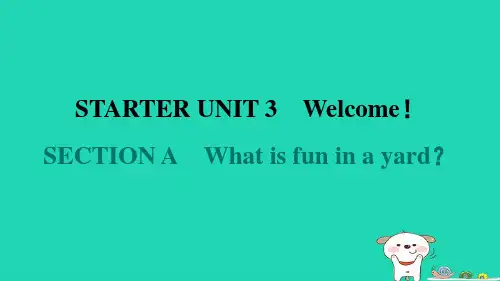
A. My family. B. Birthdays. C. Subjects. D. Favorite food. E. My name.
一二三四五六七八九
friend love greet spell call white
how morning good that you what
“Good 44. morning !” the cow says. “What is 45. your name?” “My name is Becky,” I say. “Becky? Can you 46. spell it?” “B-E-C-K-Y, Becky.” “You are nice in 47. white , Becky. 48. How are you?” the cow asks. “I am fine. Now we are 49. friends .” “What are 50. those ,Becky?” “My balls.” “Can you play with me?” “OK,” I say. I have a friend now. We have a 51. good day.
23. My mother makes a potato salad(沙拉)for us and we
like eating it. 24. [2024·太原月考改编]Animals and plants share the
world with us.
新人教版新目标七年级英语上册《U...
1 Unit5 Do you have a soccer ball?Period One (1a-1c)一.教材分析:通过uint4单元询问物品在哪的学习,过渡到本单元谈论物品的所属关系。
而本单元的核心语言项目是talk about ownership, 展开学习;以及围绕make suggestions 展开能力训练。
展开能力训练。
主要话题是主要话题是spending time with friends ,培养同学间团结、友爱的精神。
学会使用have 对物品的所属进行提问及回答,以掌握行为动词在一般现在时中的构成和使用;同时引导学生使用所学的句型谈论自己在球类运动中的喜好运动中的喜好,,以及谈论自己对某项运动的感受等。
本部分1a 中的主题图呈现了房间的情景,自然的将学生带入语言交流的自然环境中,引入了房间内常见物品的话题词汇和主要句型。
1a-1c 通过图文及听力练习导入整个单元的话题,是整个Section A 的基础.二.学情分析:本单元的主题是使用have 对物品的所属进行提问及回答,以掌握行为动词在一般现在时中的构成和使用;同时引导学生使用所学的句型谈论自己在球类运动中的喜好。
行为动词在一般现在时的肯定句、否定句和一般疑问句中的构成和使用是初中英语教学中非常重要的内容,七年级的学生经过小学的学习之后,已经具备了一定的英语语言功底,在思维能力方面有较强的记忆力和模仿力,但知识的扩展和运用能力有待于进一步提高,在认知心理方面,学生有较强的求知欲和表现欲。
并初步具备了合作探究能力。
三. Teaching Aims:1. Language goals:Key vocabulary: tennis, soccer, ball, volleyball, basketball, ping-pong2. Target language:----Do you have…? Do you have…?----Yes, I do. /No, I don’t.Yes, I do. /No, I don’t. 3. Ability goalsAsk and answer questions about the ownership.Train the students’ communicative competence and listening skill.4. Moral goalsDo sports every day and keep healthy.四.Teaching important points: 1. The words about ball.2. The target language.----Do you have…? Do you have…? ----Yes, I do. /No, I don’t.Yes, I do. /No, I don’t. ----Does she/he have…? Does she/he have…?----Yes, she/he does./No, she/ he doesn’t.Yes, she/he does./No, she/ he doesn’t. 五.Teaching difficult points:1. Have 与has 的使用的使用2. Do 与does 开头的一般疑问句开头的一般疑问句六.教法与学法:看图认读读单词法,模仿跟读、情境交际,合作交流等方法让学生掌握一些生活学习用品。
新目标英语七年级下册Unit11单元总复习课件
综合练习
根据括号内的要求完成下列各题,每空一词 (含缩略形式)。
1. I played chess with my father yesterday evening. (改为一般疑问句) __D__id____ you ________ chess with your father yesterday evening?
用法荟萃
……怎么样? How + be…? 太多的…… too many + 可数名词复数
教某人怎样做某事 teach sb. how to do sth.
根本不…… not… at all
对……感兴趣 be interested in 带领某人参观… show sb. around… 许多 的;大量的 a lot of… (后接可数名词复数或不可数名 学到很多关于… 词)
I went to school yesterday.
______ did they _____ last year?
Were the pancakes-dDeliicdiouyso?u(补r全id否e定a答h语o) rse?你骑马了吗?
WGreamwemraere: _一_般__过__去a-时t Ntheoe,_I _d__id_nne’tw.sB. ut I milked a cow.不,我没有,但我挤牛奶了。
good/great/wonderful time
去散步 喂鸡 拍照 带领某人参观 去钓鱼 看星星 参观消防站 去艺术博物馆 沿途 教某人做某事 买一些可爱的礼物 过的快乐,玩的高兴
挤奶
骑马
与农场主交谈
问…问题
拜访我的奶奶
如此有趣
去动物园
画画感兴趣
做…是困难的
七年级英语Unit 11 What do you think of game shows 人教新目标版知识精讲
七年级英语Unit 11 What do you think of game shows?人教新目标版【本讲教育信息】一. 教学内容:Unit 11 What do you think of game shows?二. 教学过程:(一)交际用语本单元的主要交际目标是询问别人看法、表达自己的看法、反问他人的看法和对别人观点的态度,我们分类来看一下:1. 询问别人看法,主要是通过以下的问句实现What do you think of ...?How do you like ...?Do you like ...?2. 表达自己的看法,即对上面问句的回答,包括肯定、否定和中性的回答。
(1)肯定回答:I love / like it. 我喜欢。
It’s cool / nice / beautiful / exciting ...(2)否定回答:I can’t stand it. 我受不了这样的……I don’t like it. 我不喜欢。
It’s terrible / awful 可怕的……(3)中性的回答:I don’t mind. 我不在乎。
(没什么特殊的想法)3. 反过来问他人的看法How / What about you? 你呢?/你怎么看?4. 表达对别人观点的态度I agree with you. 我同意你的看法。
I don’t agree with you. 我不同意你的看法。
I do, too. 我也是……I don’t, either. 我也不……(二)疑难解析Section A1. What do you think of soap operas? 你觉得肥皂剧怎么样?(1)What do you think of ...? 用来询问你对某人或某事的看法、态度等,译为“你认为/觉得某物/某人怎么样?”相当于How do you like ...?肯定回答常用:I love it. / I like it. / It’s cool. 我喜欢/很酷。
新目标人教版七年级英语上册Unit+3整体精ppt课件
可编辑课件PPT
8
What’s this in English? It’s…
a schoolbag
可编辑课件PPT
9
What’s this in
English? It’s…
/e/ /e/
a dictionary
/I/
/e/
可编辑课件PPT
10
Quick revision
a pencil box
a pencil
a book
an eraser a sch可o编o辑l课b件aPPgT
a dictionary 11
What’s this in English?
可编辑课件PPT
12
1a Match the words with the things in the picture.
1. pencil _e_ 2. pen _g_
These watches are mine.
可编辑课件PPT
31
这是你的狗。 这只狗是你的。 This is your dog. This dog is yours.
这些是你的狗。 这些狗是你的。 These are your dogs. These dogs are yours.
可编辑课件PPT
Yes, it is. (肯定回答)
no开头. 1)肯定回答时,主语
No, it isn’t. (否定回答) 不能与be动词缩写。如:
it is 不能写成it’s.
lisn’t = is not
2) 否定回答中,be动词 常与not缩写在一起。
可编辑课件PPT
3) am与 not不能简写。 17
▪ It’s an eraser.