
剑桥雅思4阅读解析test4
矿产资源开发利用方案编写内容要求及审查大纲
矿产资源开发利用方案编写内容要求及《矿产资源开发利用方案》审查大纲一、概述
㈠矿区位置、隶属关系和企业性质。
如为改扩建矿山, 应说明矿山现状、
特点及存在的主要问题。
㈡编制依据
(1简述项目前期工作进展情况及与有关方面对项目的意向性协议情况。
(2 列出开发利用方案编制所依据的主要基础性资料的名称。
如经储量管理部门认定的矿区地质勘探报告、选矿试验报告、加工利用试验报告、工程地质初评资料、矿区水文资料和供水资料等。
对改、扩建矿山应有生产实际资料, 如矿山总平面现状图、矿床开拓系统图、采场现状图和主要采选设备清单等。
二、矿产品需求现状和预测
㈠该矿产在国内需求情况和市场供应情况
1、矿产品现状及加工利用趋向。
2、国内近、远期的需求量及主要销向预测。
㈡产品价格分析
1、国内矿产品价格现状。
2、矿产品价格稳定性及变化趋势。
三、矿产资源概况
㈠矿区总体概况
1、矿区总体规划情况。
2、矿区矿产资源概况。
3、该设计与矿区总体开发的关系。
㈡该设计项目的资源概况
1、矿床地质及构造特征。
2、矿床开采技术条件及水文地质条件。
剑桥雅思四test4第一篇,精读

第二句science科学/
第三句responsibility责任/ archaeologist考古学家/in today world今天世界中/
第四段:
第一句:Anthropology人类学/at its broadest在广义上/the study of研究/humanity人类–/physical characteristics身体特征as animals作为动物/unique non-biological characteristics特有的非生物特征/culture文化/.
第二句:toiling辛苦的/ in the sun在阳光下/on an excavation挖掘/in the Middle East在中东/work with和某人一起工作/living活着的/Inuit因纽特人/in the snows在雪中/Alaska阿拉斯加/investigate研究为了找出真相/sewers下水道/Roman Britain罗马大不列颠/.
第七段:
第一句:Nevertheless,然而/important tasks重要的任务/archaeologist today今天的考古学家/interpret解释/material culture物质文化/ in human terms.用人类的术语
第二句: pots罐子
第三句: dwellings住所/round圆形的/square方形的/
剑桥雅思4test4题目
剑桥雅思4test4题目标题:剑桥雅思4test4题目解析引言概述:剑桥雅思4test4是雅思考试中的一套模拟试题,对于考生来说是一次重要的练习机会。
本文将对该套试题进行详细解析,帮助考生更好地理解题目要求和解题思路。
正文内容:1. 阅读理解部分1.1 主题识别- 通过阅读题目和段落首尾句,确定文章的主题和中心思想。
- 注意词汇的重要性,尤其是与主题相关的关键词。
1.2 细节理解- 关注细节信息,如数字、日期、地点等。
- 通过对比、推理等方式,找出正确答案。
- 注意排除干扰选项的技巧。
1.3 推理判断- 根据文章中的线索和信息,进行推理判断。
- 注意逻辑关系和上下文的提示。
2. 听力部分2.1 主旨理解- 注意听力材料的整体思路和主旨。
- 关注关键词和重要信息。
2.2 细节理解- 注意听力材料中的细节信息,如数字、日期、地点等。
- 注意听力材料中的转折、对比等关键词。
2.3 推理判断- 根据听力材料中的线索和信息,进行推理判断。
- 注意逻辑关系和上下文的提示。
3. 写作部分3.1 题目理解- 仔细阅读题目,确保理解题目要求。
- 注意关键词和限制词。
3.2 论点构建- 根据题目要求,构建清晰明确的论点。
- 使用合适的论据和例子来支持论点。
3.3 结构组织- 合理组织文章结构,包括引言、主体和结论部分。
- 注意段落之间的逻辑连接。
4. 口语部分4.1 题目理解- 仔细听题,确保理解题目要求。
- 注意关键词和限制词。
4.2 思路整理- 快速构思回答思路,明确主题和要点。
- 使用适当的词汇和语法结构。
4.3 表达流利- 注意语速和语调,保持流利的表达。
- 使用适当的连接词和过渡词。
总结:综上所述,剑桥雅思4test4题目解析主要包括阅读理解、听力、写作和口语四个部分。
在解题过程中,考生需要注意主题识别、细节理解和推理判断等技巧。
此外,合理构建论点和组织文章结构,在口语表达中保持流利和清晰也是关键。
通过对这些方面的理解和实践,考生可以提高解题能力,更好地应对雅思考试。
雅思4真题答案大全及解析
雅思4真题答案大全及解析雅思考试是全球范围内最受欢迎的英语水平测试之一。
无论是留学、移民还是就业,雅思成绩都是很多人必备的证明之一。
然而,由于考试的难度和复杂性,许多考生对于雅思的真题答案和解析都有很大的需求。
在这篇文章中,我们将为大家提供一份雅思4真题的答案大全及解析,希望能够帮助大家更好地备考雅思。
第一部分:听力(Listening)雅思听力部分是考试中的第一项内容,也是一项相对较难的任务。
在这一部分中,考生需要通过听录音来回答一系列的问题。
以下是一份雅思4听力部分的答案及解析。
Section 1:1. C Explanation: The speaker mentioned that the party would be held in the garden.2. B Explanation: The speaker stated that the swimming pool would be open on weekends only.3. A Explanation: The speaker mentioned the price of the membership.4. C Explanation: The speaker discussed the different activities available at the club.5. A Explanation: The speaker mentioned the importanceof booking in advance.Section 2:6. B Explanation: The speaker talked about the new art exhibition at the museum.7. A Explanation: The speaker mentioned the time and location of an upcoming lecture.8. C Explanation: The speaker stated that theexhibition would run for a month.9. A Explanation: The speaker discussed the discounts available for senior citizens.10. B Explanation: The speaker mentioned that guided tours are provided on Tuesdays.Section 3:11. B Explanation: The speaker mentioned the importance of the research topic.12. A Explanation: The speaker discussed thedifficulties they faced during the research.13. C Explanation: The speaker talked about the method they used for data collection.14. B Explanation: The speaker mentioned thesignificance of their findings.15. A Explanation: The speaker stated the implications of the research.Section 4:16. C Explanation: The speaker discussed the characteristics of different types of plants.17. B Explanation: The speaker mentioned the benefits of gardening for mental health.18. A Explanation: The speaker stated that gardening isa popular hobby in the country.19. C Explanation: The speaker discussed the importance of soil quality for plant growth.20. B Explanation: The speaker mentioned the upcoming gardening workshop.以上是雅思4听力部分的答案及解析。
剑桥雅思四 Test4 手打的word 版本
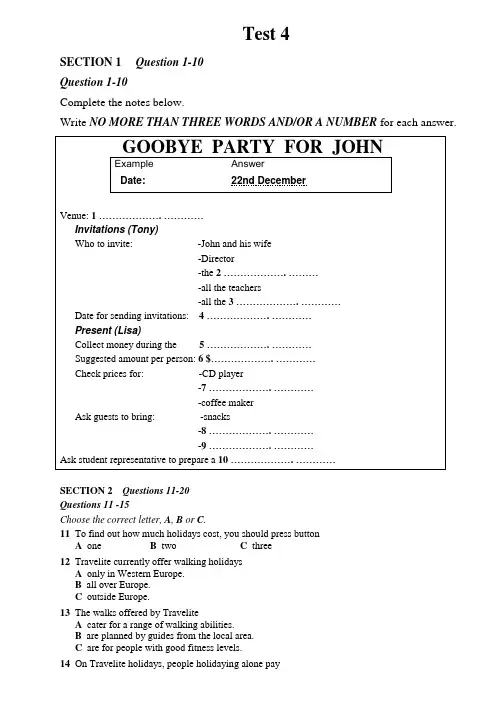
Test 4SECTION 1 Question 1-10Question 1-10Complete the notes below.Write NO MORE THAN THREE WORDS AND/OR A NUMBER for each answer.SECTION 2 Questions 11-20Questions 11 -15Choose the correct letter, A, B or C.11 To find out how much holidays cost, you should press buttonA oneB twoC three12 Travelite currently offer walking holidaysA only in Western Europe.B all over Europe.C outside Europe.13 The walks offered by TraveliteA cater for a range of walking abilities.B are planned by guides from the local area.C are for people with good fitness levels.14 On Travelite holidays, people holidaying alone payA the same as other clients.B only a little more than other clients.C extra only if they stay in a large room.15 Entertainment is providedA when guests request itB most nightC every nightQuestions 16-20Complete the table below.Write NO MORE THAN THREE WORDS AND/OR A NUMBER for each answer.SECTION 3 Questions 21-30Complete the table below.Write NO MORE THAN THREE WORDS AND/OR A NUMBER for each answer.Questions 27-30What problems do the speakers identify for each experiment?Choose your answers from the box and write the letters A-H next to questions 27-30.Experiment 1: 27………………. ……Experiment 2: 28………………. ……Experiment 3: 29………………. ……Experiment 4: Example FExperiment 5: 30………………. ……SECTION 4 Questions 31-40Questions 31-34 Complete the notes below.Write NO MORE THAN THREE WORDS AND/OR A NUMBER for each answer.Questions 35-38Choose the correct letter, A, B or C.35 Shark meshing uses nets laidA along the coastline.B at an angle to the beach.C from the beach to the sea.36 Other places that have taken up shark meshing includeA South Africa.B New Zealand.C Tahiti.37 The average number of sharks caught in nets each year isA 15.B 150.C 1,500.38 Most sharks are caught inA spring.B summer.C winter.Questions 39-40Choose TWO letter A-G.Which TWO factors reduce the benefits of shark nets?A nets wrongly positionedB strong waves and currentsC too many fishD sharks eat holes in netsE moving sandsF nets too shortG holes in nets scare sharks。
剑桥4阅读答案

Test1 reading答案1. F 2. F 3. T 4. T 5. F 6. NG 7. T 8. NG 9. M 10. E 11. G 12. P 13. J 14.B 15. taste buds 16. baleen/the baleen whales 17. forward ORdownward 18. freshwater dolphin(s) 19. water/the water 20. lower frequencies 21. bowhead ORhumpback 22. touch/sence of touch 23. freshwater dolphin(s) 24. airbome flying fish 25. clear water(s)/clear open water(s) 26. acoustic sense/the acoustic sense 27.C 28. C 29. A 30. E 31. C 32. A 33. pairs 34. shapes 35. sighted 36. sighted 37. deep 38. blind 39. similar 40. BTEST 2 reading答案1. isolation 2. economic globalisation/globalization/socioeconomic pressures 3. cultural identity 4. traditional skill 5. E 6. B 7. D 8. C 9. B 10. N 11. Y 12. NG 13. Y 14. C 15. B 16. Y 17. N 18. Y 19. Y 20. Y 21. NG 22. N 23. Y 24. emotional/emotional problems 25. headache/headaches 26. general ill health 27. H 28. F 29. A 30. H 31. I 32. B 33.A 34. C 35. F(33-35任选) 36.B 37. G 38. E 39. D 40. ATest3 reading答案1. A 2. D 3. C 4. C 5. Sudan OR India 6. bicycles 7. Shoes Shine/Shoe Shine Collective 8. life skills 9. N 10. NG 11. N 12. Y 13. A 14. III 15. I 16. IV 17. VI 18. plates/the plates/the tectonic plates 19. magma 20. ring of fire 21. 600/600 years/for 600years 22. water/the water/oceans/the oceans 23. lava/magma/molten rock 24. India/Western India 25. explodes 26. gases/the gases/trapped gases 27. D 28. E 29. C 30. D 31. F 32. (the)linguist(acts)/(the)linguists(act) 33. foreign languages 34. quality/the quality/the poor quality 35. non-verbal behaviour/non-verbal behavior/facial expression/facial expressions 36. camera/video camera/recording/video recording 37. frequency of usage/usage frequency 38. particular linguistic feature 39. size 40. intuitionsTest4 reading 答案1. T 2. NG 3. F 4. F 5. NG 6. T 7. genetics 8. power 9. injuries 10. training 11. A 12. D 13. B 14. Y 15. NG 16. N 17. Y 18. NG 19. N 20. D 21. E(20-21任选) 22.C 23.D 24. oral histories 25. humanistic study 26. historical discipline(25-26任选) 27. scientist 28. IV 29. I 30. III 31. V 32. B 33. B 34. A 35. B 36. N 37. Y 38. Y 39. NG 40. NG。
剑桥雅思真题4阅读及翻译Word

剑4T1P1Tropical RainforestsAdults and children are frequently confronted with statements about the alarming rate of loss of tropical rainforests. For example, one graphic illustration to which children might readily relate is the estimate that rainforests are being destroyed at a rate equivalent to one thousand football fields every forty minutes - about the duration of a normal classroom period. In the face of the frequent and often vivid media coverage, it is likely that children will have formed ideas about rainforests - what and where they are, why they are important, what endangers them - independent of any formal tuition. It is also possible that some of these ideas will be mistaken.Many studies have shown that children harbour misconceptions about ‘pure' curriculum science. These misconceptions do not remain isolated but become incorporated into a multifaceted, but organised, conceptual framework, making it and the component ideas, some of which are erroneous,more robust but also accessible to modification. These ideas may be developed by children absorbing ideas through the popular media. Sometimes this information may be erroneous. It seems schools may not be providing an opportunity for children to re-express their ideas and so have them tested and refined by teachers and their peers.Despite the extensive coverage in the popular media of the destruction of rainforests, little formal information is available about children’s ideas in this area. The aim of the present study is to start to provide such information, to help teachers design their educational strategies to build upon correct ideas and to displace misconceptions and to plan programmes in environmental studies in their schools.The study surveys children’s scientific knowledge and attitudes to rainforests. Secondary school children were asked to complete a questionnaire containing five open-form questions. The most frequent responses to the first question were descriptions which are self-evident from the term "rainforest". Some children described them as damp, wet or hot. The second question concerned the geographical location of rainforests. The commonest responses were continents or countries:Africa (given by 43% of children), South America (30%), Brazil (25%). Some children also gave more general locations, such as being near the Equator.Responses to question three concerned the importance of rainforests. The dominant idea, raised by 64% of the pupils, was that rainforests provide animals with habitats. Fewer students responded chat rainforests provide plant habitats, and even fewer mentioned the indigenous populations of rainforests. More girls (70%) than boys (60%) raised die idea of rainforest as animal habitats.Similarly, but at a lower level, more girls (13%) than boys (5%) said that rainforests provided human habitats. These observations are generally consistent with our previous studies of pupils’ viewsabout the use and conservation of rainforests, in which girls were shown to be more sympathetic to animals and expressed views which seem to place an intrinsic value on non-human animal life.The fourth question concerned the causes of the destruction of rainforests. Perhaps encouragingly, more than half of the pupils (59%) identified chat it is human activities which are destroying rainforests, some personalising the responsibility by the use of terms such as "we are". About 18% of the pupils referred specifically to logging activity.One misconception, expressed by some 10% of the pupils, was chat acid rain is responsible for rainforest destruction;A similar proportion said chat pollution is destroying rainforests. Here, children are confusing rainforest destruction with damage to the forests of Western Europe by these factors. While two fifths of the students provided the information that the rainforests provide oxygen, in some cases this response also embraced. The misconception that rainforest destruction would reduce atmospheric oxygen, making the atmosphere incompatible with human life on Earth.In answer to the final question about the importance of rainforest conservation, the majority of children simply said that we need rainforests to survive. Only a few of the pupils (6%) mentioned that rainforest destruction may contribute to global warming. This is surprising considering the high level of media coverage on this issue. Some children expressed the idea that the conservation of rainforests is not important.The results of this study suggest that certain ideas predominate in the thinking of children about rainforests. Pupils’ responses indicate some misconceptions in basic scientific knowledge of rain forests’ ecosystems such as their ideas about rainforests as habitats for animals, plants and humans and the relationship between climatic change and destruction of rainforests.Pupils did not volunteer ideas that suggested that they appreciated the complexity of causes of rainforest destruction. In other words, they gave no indication of an appreciation of either the range of ways in which rainforests are important or the complex social, economic and political factors which drive the activities which are destroying the rainforests. One encouragement is that the results of similar studies about other environmental issues suggest that older children seem to acquire the ability to appreciate, value and evaluate conflicting views. Environmental education offers an arena in which these skills can be developed, which is essential for these children as future decision-makers.无论大人还是孩子都经常会遇到这样的报道,那就是热带雨林正在以惊人的速度消失。
剑桥雅思考试全真试题解析4(下载版)
智课网IELTS备考资料剑桥雅思考试全真试题解析4(下载版)摘要:为了使广大考生能够接触到最新、最权威的雅思复习备考资料,最大限度地满足考生的需求,外语教学与研究出版社与英国剑桥大学出版社合作出版剑桥雅思考试全真试题解析4,下面一起来看看吧。
剑桥雅思书籍资料有很多,今天小马小编为大家推荐剑桥雅思考试全真试题解析4,这本书包括雅思考试各种题型,有助于烤鸭尽快熟悉和了解雅思考试模式,下面一起来看看剑桥雅思考试全真试题解析4具体内容介绍吧。
《剑桥雅思考试全真试题解析4》包含4套完整的学术类雅思全真试题,另外还附有针对培训类雅思的阅读和写作全真试题。
书中介绍了雅思考试的各类题型,并对考试采用的评分系统进行了说明。
书后附有试题答案和听力录音文本,适合读者进行自学。
可复制使用的答题纸便于读者体会和熟悉真实的考试模式。
本书听力部分的资料配有光盘。
内容提要近年来,雅思考试在国内不断升温,与之配套的教材和辅导书也是层出不穷,大多数考生在选择的时候常常感到无所适从。
针对这种状况,为了使广大考生能够接触到最新、最权威的雅思复习备考资料,最大限度地满足考生的需求,外语教学与研究出版社与英国剑桥大学出版社合作出版“外研社·剑桥雅思考试培训教程”,此教程的出版对国内广大的雅思考生来说无疑是一大福音。
目录IntroductionTest1Test2Test3Test4GeneralTraining:ReadingandWritingTestAGeneralTraining:ReadingandWritingTestBAudioScriptsAnswerKeyModelandSampleAnswersforWiringTasksSmapleAnswerSheetsAcknowledgements关于“剑桥雅思考试全真试题解析4”的内容就介绍到这里,希望上面的内容能帮到大家。
如需其他备考雅思书籍资料,请到小马雅思频道进行查看和下载。
雅思ogtest4阅读答案
雅思ogtest4阅读答案雅思考试,是的人很重要的考试之一,那么雅思考试是怎么样的呢?以下是PINCAI的关于雅思阅读答案的相关内容,欢送阅读和参考!1. He would sail to New Zealand, then reach Antarctica in February, during the southern summer, and then proceed to the pole the following spring. (雅思OG test 4 Passage1)句子构造分析:这句话构造很简单,非常好分析,但是用了一连串的动词sail、then reach、and then proceed,把整个过程非常简单有力的描写出来了。
同学们以后描写一段事情的时候可以用一连串的动作来写。
译文:他将航行到新西兰,然后在2月份到达南极,这是南方的夏季,然后第二年春天继续前往南极。
2. Yet Shirase still felt the pull of the pole and eventually decided he would head southward to experiencethe thrills and hardships of polar exploration he had always dreamed of. (雅思OG test 4 Passage1)句子构造分析:Yet,然而,放在句首,表示转折。
the pull of…………的拉力、吸引力,head to……向前,dreamed of……梦想。
译文:Shirase仍然觉得南极点的吸引力很大,最终决定他将继续向南体验极地探险的刺激和困难,毕竟这一直是他梦寐以求的。
3. Nor did he contribute much to science - but then nor did Amundsen, whose only interest was in being first to the pole. Yet Shirase’s expedition was heroic. They travelled beyond 80° south, one of only four teams to have gone sofar south at the time. Furthermore, they did it all without the advantages of the other teams and with no previous experience.(雅思OG test 4 Passage1)句子构造分析:Nor did……倒装句,表示强调。
剑桥雅思4-8册阅读真题分析汇总
1-5段落信息配对
14-18 List of Headings
28-32 Y/N/NG
28.N;29.Y;30.Y;31.NG;32.Y
6-9 Y/N/NG
6.Y
7.NG最高级
8.NG
9.N
19-24 Y/N/NG
19.N
20.NG比较
21.N;22.Y;23.NG;24.Y
家喻户晓
gram试验
2.试验方案
3.试验过程及目的
4.精神科医生对试验结果的预测
5.结果与预测的差异
6.对差异的解释
7.另一种解释
8.相关结论
环境论者认为目前世界所面临的问题
1-3多选
14-19段落从属配对
27-32 Y/N/NG
27.Y;28. NG;29. F与原文相反
30. NG;31. Y;32. N
2)擦鞋合作社
3)青年创业计划
4.经验教训
5.结论
1-4单选
14-17 List of Headings
27-31 List of Headings
5-8填表
18-21简答
32-36填表
9-12 Y/N/NG
9.N绝对化any
10.NG未提及
11. N绝对化only one
12. Y
22-26Summary(无词库)
40选结论
剑4 TEST 2
P1
P2
P3
语言的消失
澳大利亚的替代疗法
玩耍是件严肃的事
1.通过例子指明少数民族语言的危机
2.少数民族语言正面临灭顶之灾
3.语言灭绝的关键是使用者的年龄
4.信任危机导致语言灭绝
雅思4阅读答案
篇一:雅思4阅读答案篇二:雅思4阅读答案暂无评价|0人阅读|0次下载|雅思剑桥系列之剑四阅读答案 summary 这本书出的特别好,希望大家回去好好钻研下看完说谢谢谢谢 test1 p1 ngmegpjb p2 taste buds baleen forward downward freshwater dolphins water the lower frequencies bowhead humperback sense of touch the freshwater dolphins airborne flying fish clear open waters acoustic sence p3 ccaeca pairs shapes sighted sighted deep blind similar test2p1 isolation economic globalization cultural identity traditional skill ebdcb p2cb emotional/emotionalproblems headache/headches general ill health p3 hfahjb acf(任意) bgeda test3 p1 adcc sudan india bycycles shoe shine/ shoe shine collection life skills thetectonic plates magma ring of fire for 600 years water/the water/ocean/the ocean lava/magma/molten rock westen india explodes gases p3 decdf (the)linguist(acts) foreign languages the poor quality non-verbal behaviour/acial expression camera frequency of usage particular linguistic feature size intuitions test4 p1 geneticspower injuries training adb p2 decd oral histories humanistic study historical discipline scientist p3 ngng 雅思剑桥系列之剑四阅读答案阅读,系列,雅思,剑桥雅思,剑4剑,4阅读,雅思剑桥4,阅读答案,雅思阅读,剑桥系列篇四:雅思4阅读答案answer key listening test 1 1. shopping / variety of shopping 2. guided tours 3. more than 12 / over 12 4. notice board 5. 13th february 6. tower of london 7. bristol 8. american museum 9. student newspaper 10. yentob 11. coal, firewood 12. local craftsmen 13. 160 14. woodside 15. ticket office 16. gift shop 17. (main) workshop 18. showroom 19. cafe 20. cottages 21. a 22. c 23. e 24. b 25. g 26. f 27. c 28. d 29. a 30. b 31. cities / environment 32. windy 33. humid 34. shady / shaded 35. dangerous 36. ... answer key listening test 1 1. shopping / variety of shopping 2. guided tours 3. more than 12 / over 12 4. notice board 5. 13th february 6. tower of london 7. bristol 8. american museum 9. student newspaper 10. yentob 11. coal, firewood 12. local craftsmen 13. 160 14. woodside 15. ticket office 16. gift shop 17. (main) workshop 18. showroom 19. cafe 20. cottages 21. a 22. c 23. e 24. b 25. g 26. f 27. c 28. d 29. a 30. b 31. cities / environment 32. windy 33. humid 34. shady / shaded 35. dangerous 36. leaves 37. ground 38. considerably reduce / decrease / filter 39. low 40. space / room ielts 4 test 2 1. c 2. c 3. b 4. b 5. a 6. cathedral 7. markets 8. gardens 9. art gallery 10. climb the tower / see the view 11. c 12. b 13. a 14. c 15. b 16. c 17. a 18. b 19. b 20. a 21. collecting data / gathering data / data collection 22. 1,500 23. 5 24. 3,000 – 4,000 25. b 26. c 27. mehta 28. survey / research 29. london university / london university press 30. 1988 31. c 32. a 33. mass media / media 34. academic circles / academics / researchers 35. specialist knowledge / specialized knowledge 36. unaware 37. individual customers / individual consumers / individuals 38. illegal profit / illegal profits 39. d 40. e test 3 1. 1-1/2 years 2. forest / forrest 3. academic 4. thursday 5. b 6. b 7. a 8. deposit 9. monthly 10. telephone / phone 11. c 12. a 13. c 14. b 15. lighting / lights / light 16. adult / adults 17. (at/the) studio theatre / studio theater 18. the whole family / all the family / families 19. (in) city gardens / the city gardens / outdoors 20. young children /younger children / children 21. a 22. b 23. c 24. a 25. b 26. a 27. c 28. b 29. b 30. b 31. questionnaire 32. approximately 2,000 / about 2,000 33. education 34. halls of residence / living quarters 35. traffic, parking 36. lecture rooms / lecture halls / lecture theatres / lecture theaters 37. (choice of / room for) facilities 38. d, f 39. b 40. a, c test 4 1. college dining room 2. office staff 3. students 4. 10th december 5. coffee break / coffee breaks 6. 6 7. set of dictionaries / dictionaries / a good dictionary 8. tapes 9. photos / photographs 10. speech 11. b 12. a 13. a 14. a 15. b 16. 180 17. nearest station 18. local history 19. 690 20. walking club / local walking club 21. 20 balloons 22. units of measurement / measurements / measurement units 23. rock salt / salt 24. crystals 25. string / pieces of string 26. (ordinary/white) light 27. h 28. b 29. e 30. c 31. 795 32. tail 33. floor / bed / bottom 34. sense of smell 35. a 36. a 37. b 38. b 39. b 40. e test 1 academic reading reading passage 1, questions 1-14 1:f 2:f 3:ng 4:t 5:f 6:ng 7:t 8:ng 9 :m 10:e 11:g 12:p 13:j 14:b reading passage 2, questions 15-26 15:taste buds, 16:baleen, 17:forward, downward, 18:fresh water dolphins, 19:water, 20:the lower frequencies, 21:bowhead, humpback 22:sense of touch 23:freshwater dolphins 24:airborne flying fish 25:clear open water 26:sense of hearing answer key reading passage 3, questions 27-40 27:b 28:c 29:a 30:e 31:c 32:d 33:pairs 34:words 35:sighted 36:sighted(用两次) 37:deep 38:blind 39:similar 40:b answer key test 2 answer key test 3 acdemic reading answer key test 4篇五:雅思4阅读答案摘要:剑桥雅思4阅读译文含解析答案。