
外研版(三起)-英语-五年级下册-Module 3 Unit 1 She had eggs and sausages.优质课件
英语五年级下外研版(三起)Module_3_Unit_1_She_had_eggs_and_sausages课件
Listen and answer the questions
1. What did Lingling have for breakfast?
She had eggs and sausages.
2. What did she have for lunch?
She had sandwiches.
3. What did she have for dinner?
Fanfan: And what did she have for dinner? Daming: She had fish and chips
Fanfan: Fish and chips?
Daming: Yes. It's a traditional English dinner. Fanfan: Does Lingling like English food? Daming: Yes, she does. She says it's delicious.
Daming: Yesterday she had an English breakfast.
Fanfan: What did she have?
Daming: She had eggs and sausages.
Fanfan:And what did she have for lunch? Daming: She had sandwiches.
A B C
2. sausages
3.egg
4.sandwich
D E
5.fish and chips
二、正确选项我来选。 ( )1.I’ve got ____email from Lingling. Aa B an C the ( ) 2.What did you have _____breakfast? A for B at C on ( ) 3.Yesterday she ______an English dinner. A have B has C had ( )4.---Does Lingling like English food? ----_________. A No, she didn’t B Yes, she does C Yes,, What, have, you, for,
外研版小学英语五年级下册Module 3 unit1 She had eggs and sausages 课件
rice
sandwich
dumplings
eggs and sausages noodles fish and chips
What did you have? I had…
What did she/he have?
He/She had…
What did she have for breakfast?
She had eggs and sausages .
What did she have for lunch? She had
sandwiches .
What did she have for dinner? She had
fish and chips .
练习:街头采访游戏 四人为一组,一名学生当记者,另外三名扮演街上行 人,记者就早、中、晚餐这同一个问题对行人分别提 问,要求记者用
3) What did she have for lunch? A. sandwiches B. fish and chips 4) What did she have for dinner? A. fish and chips B. eggs and sausages
English food
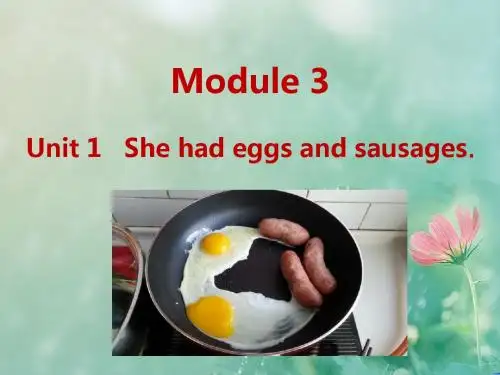
eggs and sausages
English food
eggs and sausages
sandwiches
fish and chips
breakfast 早餐
lunch 午餐
dinner 晚餐
eggs and
sandwiches fish and chips
sausages
have 吃
had(吃的过去式)
MENU
Chinese food English food hamburger
《She had eggs and sausages》教学设计
《Unit 1 She had eggs and sausages》教学设计一、教材分析:本教材是外研版小学英语五年级下册Module 3 Unit 1 She had eggs and sausages,主要围绕着食物和过去完成时态展开。
学生在前几个单元已经学习了一般过去时的用法,本单元通过对过去完成时的学习,进一步提高学生的语言运用能力。
二、教学目标:1. 学会正确使用过去完成时态,描述过去发生的动作。
2. 学会用英语表达食物名称,并能正确使用句型"She had..."。
3. 培养学生的听说能力,通过对话和练习,提高学生的语言表达能力。
三、教学重点和教学难点:教学重点:过去完成时态的用法和句型"She had..."教学难点:正确使用过去完成时态描述过去发生的动作四、学情分析:学生已经学习了一般过去时的用法,对过去时态有一定的了解。
他们对食物名称可能已经有了一定的掌握,但对过去完成时态的用法和句型还不熟悉。
五、教学过程:Step 1: Warm-up1. Greet the students and engage them in a short conversation about their favorite foods.- Teacher: Good morning, everyone! How are you today? Let's talk about food. What's your favorite food?- Students: My favorite food is pizza/sushi/ice cream, etc.2. Review the vocabulary of food items learned in previous units by showing pictures of different food items and asking students to name them in English.- Teacher: Now, let's review some food vocabulary. Look at the pictures on the board and tell me what they are in English.- Students: It's a hamburger/an apple/a bowl of noodles, etc.Step 2: Presentation1. Introduce the concept of past perfect tense by explaining that it is used to talk about an action thathappened before another action in the past.- Teacher: Today, we're going to learn about the past perfect tense. The past perfect tense is used to talk about an action that happened before another action in the past. For example, "She had already eaten breakfast before she went to school."2. Give examples of sentences using past perfect tense and explain the sentence structure.- Teacher: Let's look at some examples. "She had finished her homework before she watched TV." "He had already bought the tickets before the concert started." In these sentences, the past perfect tense is formed by using "had" followed by the past participle of the verb.- Teacher writes the sentence structure on the board: Subject + had + past participle.Step 3: Practice1. Provide students with a worksheet containing sentences in the past perfect tense.- Teacher: Now, let's practice using the past perfect tense. Here, I have a worksheet for each of you. Please read the sentences and fill in the blanks withthe correct form of the verb in brackets.2. Ask students to complete the sentences individually. - Teacher: Take your time to complete the worksheet. If you have any questions, feel free to ask.3. Monitor the students' progress and provide assistance when needed.- Teacher: How are you doing? Do you need any help? Step 4: Listening and Speaking1. Play an audio recording of a conversation between two people talking about their breakfast.- Teacher: Now, let's listen to a conversation between Tom and Sarah. They are talking about what they had for breakfast. Listen carefully and answer the questions I will ask afterward.2. Ask students to listen and answer questions about what each person had for breakfast.- Teacher: What did Tom have for breakfast? What did Sarah have for breakfast?3. Divide the students into pairs and ask them to havea similar conversation about their own breakfast using the past perfect tense.- Teacher: Now, I want you to work in pairs. Taketurns asking and answering questions about what you had for breakfast using the past perfect tense. Use the sentence structure we learned earlier.- Students practice the conversation in pairs. Step 5: Consolidation1. Write the sentence pattern "She had..." on the board. - Teacher: Let's review the sentence pattern we learned today. Look at the board. The pattern is "She had..." Now, I want each of you to create your own sentence using this pattern.2. Ask students to create their own sentences using the pattern and share them with the class.- Teacher: Think about something you did before another action in the past. Write a sentence starting with "She had..." and share it with the class.- Students share their sentences with the class.3. Provide feedback and correct any errors.- Teacher: Great job, everyone! Now, let's go through some of the sentences you created. (Provides feedback and corrects any errors if necessary.)Step 6: Extension1. Show pictures of different food items and askstudents to describe what they had for breakfast using the past perfect tense.- Teacher: Look at these pictures of different foods. Choose one of them and describe what you had for breakfast using the past perfect tense.- Students take turns describing their breakfast using the past perfect tense.Step 7: Wrap-up1. Review the key points of the lesson, emphasizing the use of the past perfect tense and the sentence pattern "She had..."- Teacher: Today, we learned about the past perfect tense and how to use it to talk about actions that happened before another action in the past. We also practiced using the sentence pattern "She had..." to describe past events. Well done, everyone!2. Assign homework, which could include writing a short paragraph about what the students had for breakfast using the past perfect tense.- Teacher: For homework, I want you to write a short paragraph about what you had for breakfast today. Use the past perfect tense to describe what happened beforeanother action in the past.六、板书设计:She had eggs and sausages.Past Perfect TenseShe had + past participle七、教学反思:本节课通过引入过去完成时态,帮助学生进一步巩固和扩展他们的语言知识。
【2018最新】外研版小学英语五年级下册:M3-U1-She had eggs and sausages(精品优质课课件)
Test your memory (记忆力大考验)
Mingming
Dongdong
Weiwei
What did she have for breakfast yesterday?
Loபைடு நூலகம்k carefully!
She had…
What did he have for lunch yesterday?
Look carefully!
He had…
What did she have for dinner yesterday? She had…
Look carefully!
Little Reporter (小小记者)
Make a survey in groups, and complete the table.
Name
Breakfast
Lunch
Dinner
Homework
1. 熟读课文,组间分角色对话。(必做)
2. 回家后通过上网或查阅资料了解更多关于英国
人的饮食情况。如:他们一日有几餐、各餐几点 吃、在哪里吃、都吃些什么等。(必做) 3. 同学们试着给好朋友发一封电子邮件,介绍一 下自己昨天三餐都吃了那些食物。 (选做)
Listening questions: 1. What did she have for breakfast ?
2. What did she have for lunch?
外研版(三起)五年级英语下册教案Module 3 Unit 1 She had eggs and sausages教案
Module 3 Unit 1 She had eggs and sausages教案教学内容:外语教研英语(三起)五年级下册Module 3 Unit 1 She had eggs and sausages 部分内容。
教学目标(Objectives):1.确保学生认识和理解一些基本单词的意义和简单口头运用(To learn the meaning and simple usages of some words and phrases)。
2.学习使用本单元重点句型及表达(To use the typical sentences to express)。
3.鼓励学生大胆发言及表达(To encourage the students to express bravely)。
4.培养学生对英语学科的兴趣(To make the students interested in English learning)。
教学重点(Key Points):在学习了单词的基础上,以单词为载体,进行主要句型的学习,根据具体情境,学会交流对话,侧重句型学习,交际意向和课外拓展为重点。
--- She had eggs and sausages.---她吃了鸡蛋和香肠。
教学方法:游戏,音频,情景教学法,Pair-work两人小组活动,Group-work小组活动,多媒体辅助教学。
教学难点:学生处于小学阶段,对一些事物的认知尚且模糊,对部分单词的感知和理解可能存在问题,对于五年级下学期学生的要求重点是会读会说,敢于模仿表达,其次能掌握一些基本单词的拼写和造句,在此基础上与人进行简单沟通。
教学准备:课件、照片素材、音频文件、单词卡片,教学道具。
教学设计:Step 1. GreetingStep 2. Warm-up/Leading(热身/课程导入)Game (游戏环节)操练方式:准备好小黑板,教师将之前课程中所学的单词写在小黑板上,让学生读熟、认熟这些单词,然后小黑板背对学生,让学生复述出黑板上有哪些单词,答对一个一分,错答没分,答越多分越高。
外研版(三起)-英语-五年级下册-Module 3 Unit 1 She had eggs and sausages.名校课件

Unit 1 She had eggs and sausages.
Noodle! Noodle! Yummy! Yummy! I love noodles! Rice! Rice! Yummy! Yummy! I love rice! Cake! Cake! Yummy! Yummy! I love cakes! Milk! Milk! Yummy! Yummy! I love milk! Bread! Bread! Yummy! Yummy! I love bread!
Look, listen and learn
Daming: Look . I've got an email from Lingling . It's about English food. Fanfan: What does it say?
Daming: Yesterday she had an English breakfast. Fanfan: What did she have? Daming: She had eggs and sausages.
Fanfan: Daming:
And what did she have for lunch? She had sandwiches.
Fanfan: And what did she have for dinner?
Daming: She had fish and chips?
Fanfan: Fish and chips?
rice
My favorite food is/are…
noodles
eggs and sausages
chips and fish
英语外研版(三起)五年级下册—Module 3 Unit 1 She had eggs and sa
英语外研版(三起)五年级下册—Module 3 Unit 1 She hadeggs and sausages 说课稿 (1)一. 教学背景本节课为五年级英语下册 Module 3 Unit 1 的教学内容,主要涉及到食物和饮食文化方面的知识。
二. 教学目标1.学生能够掌握名词“egg”和“sausage”的使用,并且熟练使用它们进行描述自己和他人的早餐;2.学生能够听懂并解答关于早餐内容的问题;3.学生能够积极参与角色扮演活动,提高英语口语表达能力。
三. 教学重点1.名词“egg”和“sausage”的使用;2.“What did you have for breakfast?”的表达和回答;3.角色扮演活动的开展。
四. 教学难点1.学生表达自己和他人的早餐时使用名称;2.听懂并解答有关早餐内容的问题。
五. 教学过程Step 1 导入新知(1)用图片或实物引导学生回忆早餐内容,提问 What did you have for breakfast?(2)让学生说出他们早餐中常见的食物,例如“egg” 和“sausage”,帮助学生认识这两个名词。
Step 2 新知讲解(1)通过图片或实物介绍 egg 和 sausage 的样子和常见的食用方法。
(2)通过对话的方式,让学生掌握如何用正确的句式表达他们和他人的早餐内容。
例如:•–What did you have for breakfast?•–I had eggs and sausages.Step 3 听力训练(1)播放听力,让学生听问句并正确理解并回答。
例如:•–What did Mary have for breakfast?•–She had eggs and sausages.(2)帮助学生正确理解问句的含义,并积极鼓励学生发言,加强听力训练。
Step 4 角色扮演活动(1)将学生分为小组,每组有两个人:一个在餐厅吃早餐,另一个是服务员。