
unit_2_reading_and_writing)
五年级上册英语课件-Unit 2 粤人版(开心英语)
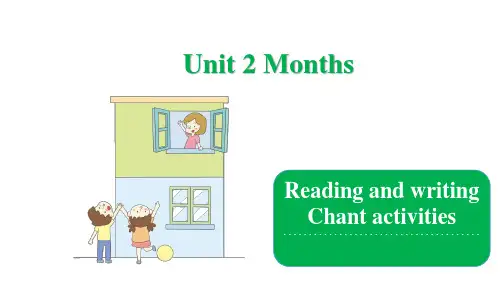
May is __b_e_f_o_re__J_u_n_e_____,
_B_e_fo_r_e_J_u_n_e_,_b_e_f_o_r_e_J_u_n_e__.
Sounds and words
1 Listen, point and say.
Reading and writing
3 Read and write the months.
1 Xiaoming's birthday is in this month. This year, he doesn't
have a birthday. When's Xiaoming's birthday?
in April! My father's favourite month is the
month before April. It's always nice for
camping. My mother's favourite month is the
month after April. She likes to swim. My
1. —What's your favourite month? — __F_e_b_r_u_a_r_y_(二月).
2. —When is your birthday? —It's in _M__a_r_c_h__(三月).
课后作业
熟读Reading and writing的文章。
this month. What month is it?
_I_t'_s_J_u_n_e_.______________________________________.
Unit 2 Healthy Lifestyle(Reading for writing)

Task 3
Read&choose
1. How does Wang Lu change himself? A. He decided not to eat anything with sugar. B. He exercised regularly. C. He often jumped on his skateboard and rode around
night and feels m__o_r_e__d_y_n_a_m__i_c (dynamic) than ever. In the meanwhile, George Fielding has changed himself _f_o_r_
the better. He used to get so absorbed _t_h_a_t_ he played the games day and night. However, after the camp, he _to_o_k__(take) control of his life though it was _a__ big struggle not to play
⑤ It’s refreshing (……令人耳目一新) to see a woman who is so unconcerned with her appearance.
Post-reading
Wang Lu and George Fielding attended the summer camp _o_r_g_a_n_iz_e_d_(organize) by the magazine Healthy Life. At the end
在压力之下 缓解压力 承受/ 应对压力 强调;着重于 强调……的重要性
理解当代中国英语读写教程unit2
理解当代中国英语读写教程unit2全文共3篇示例,供读者参考篇1Understanding Unit 2 of Contemporary Chinese English Reading and Writing CourseUnit 2 of the Contemporary Chinese English Reading and Writing Course focuses on the theme of "Family Traditions." This unit provides students with the opportunity to learn about the importance of family in Chinese culture and how traditional values are passed down from generation to generation.One of the key topics covered in Unit 2 is the concept of filial piety, which is a fundamental virtue in Chinese culture. Filial piety refers to the respect and care that children are expected to show towards their parents and ancestors. Students are taught about the importance of upholding this value and are encouraged to reflect on how they can demonstrate filial piety in their own lives.Another important aspect of Unit 2 is the exploration of Chinese family structures and roles within the family. Students learn about the hierarchy within a traditional Chinese family, with parents and elders holding positions of authority and respect.They also learn about the responsibilities that each family member has towards the family as a whole, emphasizing the importance of unity and harmony within the family unit.In addition to discussing traditional family values, Unit 2 also touches on the challenges that modern families in China face. Students are encouraged to consider how societal changes, such as urbanization and globalization, have impacted family dynamics and relationships. They are also prompted to think about how they can balance traditional values with the demands of a rapidly changing world.Throughout Unit 2, students engage with a variety of reading and writing activities that help them deepen their understanding of the topic. They read texts that explore different perspectives on family traditions, and they practice writing responses and reflections on what they have learned. These activities not only enhance their language skills but also encourage them to think critically about the cultural values and practices they encounter.Overall, Unit 2 of the Contemporary Chinese English Reading and Writing Course provides students with a comprehensive introduction to the importance of family traditions in Chinese culture. By exploring the concepts of filial piety, family structures,and the challenges facing modern families, students gain valuable insights into the role that family plays in shaping individuals and society as a whole. Through engaging with the content of this unit, students develop a deeper appreciation for their own cultural heritage and the significance of family relationships in their lives.篇2Understanding Contemporary China is a comprehensive English reading and writing textbook that covers a wide range of topics relevant to modern Chinese society. Unit 2 of the textbook focuses on the theme of "Chinese Culture" and delves into various aspects of traditional and contemporary Chinese culture. This unit provides students with valuable insights into the rich cultural heritage of China and helps them develop a deeper understanding of the country and its people.One of the key topics covered in Unit 2 is traditional Chinese art and literature. Students are introduced to iconic works of Chinese literature, such as The Dream of the Red Chamber and Journey to the West, and learn about the profound influence these works have had on Chinese culture. The unit also explores traditional Chinese painting, calligraphy, and music, allowingstudents to appreciate the beauty and complexity of these art forms.In addition to traditional culture, Unit 2 also examines contemporary Chinese culture and its rapid evolution in the modern world. Topics such as Chinese pop culture, cuisine, and fashion are discussed, giving students a glimpse into the dynamic and diverse cultural landscape of contemporary China. The unit also touches on important social issues in China, such as urbanization, environmental sustainability, and gender equality, providing students with a more nuanced understanding of the challenges and opportunities facing Chinese society today.Overall, Unit 2 of Understanding Contemporary China is a valuable resource for students seeking to deepen their knowledge of Chinese culture and society. By exploring both the traditional and contemporary aspects of Chinese culture, students are able to gain a more holistic understanding of this complex and fascinating country. The unit is designed to encourage critical thinking and cross-cultural communication, helping students develop the skills they need to engage with China in a global context. With its engaging content and interactive activities, Unit 2 of Understanding ContemporaryChina is a valuable tool for students of all levels who wish to explore the richness and diversity of Chinese culture.篇3Understanding Contemporary China English Reading and Writing Unit 2IntroductionThe Contemporary China English Reading and Writing textbook is designed to help learners of English understand and engage with contemporary issues in China. Unit 2 of the textbook focuses on the theme of "Urbanization in China", exploring various aspects of urban life and development in the country. In this article, we will delve deeper into the topics covered in Unit 2 and discuss their relevance and significance in the context of contemporary China.Urbanization in ChinaUrbanization is a key socio-economic phenomenon in China, with millions of people moving from rural areas to cities in search of better employment opportunities and living standards. Unit 2 of the textbook explores the reasons behind this rapid urbanization and its impact on society and the environment.One of the key topics covered in this unit is the challenges and opportunities of urbanization in China. The rapid pace of urbanization has led to increased pressure on infrastructure, housing, and public services in Chinese cities, resulting in issues such as congestion, pollution, and social inequality. However, urbanization also brings economic growth, job opportunities, and improved living standards for many people.Another important aspect of urbanization in China is the phenomenon of urban sprawl. As cities expand and grow, they often encroach on surrounding rural areas, leading to the loss of agricultural land and natural habitats. Unit 2 discusses the environmental consequences of urban sprawl and the importance of sustainable urban planning and development.The textbook also explores the social implications of urbanization in China, including issues such as migrant workers, urban poverty, and social welfare. As more and more people move to cities in search of work, they face challenges such as discrimination, lack of access to public services, and inadequate housing. Unit 2 highlights the need for policies and programs that address these issues and promote social inclusion and equality in urban areas.In addition to the challenges of urbanization, Unit 2 also examines the cultural and artistic aspects of urban life in China. The textbook discusses the role of cities as centers of creativity, innovation, and cultural exchange, and explores the vibrant art and music scenes in Chinese urban centers.ConclusionIn conclusion, Unit 2 of the Contemporary China English Reading and Writing textbook provides a comprehensive overview of the phenomenon of urbanization in China and its implications for society, the environment, and culture. By studying this unit, learners of English can gain a deeper understanding of the complex and dynamic nature of urban life in contemporary China. The topics covered in Unit 2 offer valuable insights into the opportunities and challenges of urbanization and contribute to a more nuanced understanding of the rapidly changing landscape of Chinese cities.。
【课件】Unit+2+Reading+and+Thinking+课件-人教版(2019)必修第二册

Tibetan antelope
Learning Objectives
1 Learn the difficult situations the Tibetan antelope once faced and the current siruation of Tibetan antelopes.
EXAMPLE
_I__ The Tibetan antelope lives high above sea level.
(This is implied by”The air is thin”.)
__I_ When they first saw the antelopes, they were very far away.
Changtang National Nature Reserve is a shelter for Tibetan antelopes and other wildlife.
step2 Pre-reading
在云间度过的一天
1.Look at the pictures and
title on the textbook.
National Nature Reserve. C. Measures were taken to save this
species from extinction. D. We should learn to live in harmony
with nature. E. Tibetan antelopes are in danger. F. The reason why we observe Tibetan
to the Tibetan antelope have not yet disappeared”.)
高中英语说课课件_Unit_2__working_the_land
Types and characteristics of burns
How many types of burns are there? and what are they? 1. First degree burns 2. Second degree burns 3. Third degree burns
Unit 5 First aid
三:Teaching methods
1. Task-based Language Teaching Method 2. Individual work, pair work and group work 3. Discussion Ⅱ. Teaching aids A multi-media computer and a blackboard.
Unit 5 Frst aid
Lead-in and Pre-reading
A beautiful girl doesn’t like wearing short-sleeved shirts or dresses. Do you know wh Because she was burned by hot porridge and h a scar. In fact, if her father had known first aid for burns, there wouldn’t have been such a sca
四:Teaching procedures Step 2:
Unit 5 Frst aid
Reading
What does this text talk about? This passage mainly tells us the ______ of functions
新教材人教版高中英语必修三第二单元阅读写作book3 unit2 reading for writi

Other villagers
Walked round to avoid the stone
Unhappy
Complained and not moved the stone
Young girl Saw the stone
By comparison
Worried/concerned
Moved the stone with all his might
Unit 2 Morals and virtues ---Reading for writing
Learn a lesson of morals and virtues from people in reality
Learn a lesson of morals and virtues from books
一:审题目
1.确定题材: A review 2.确定人称: mainly the third person 3确定时态: mainly the present tense
The purpose
Your opinion Do you like the story? Why ?
Mind-map for the reading
The stone in the road The main idea of the story
A king taught his people a lesson by placing a stone in the road and watching different people’s emotions and responses when they came across the stone.
Part 1
Part 2
新探索研究生英语(基础级)读写教程unit2
新探索研究生英语(基础级)读写教程unit2New Discoveries in Graduate English (Basic Level) Reading and Writing Tutorial Unit 2Unit 2: Academic Reading SkillsIntroduction:In this unit, we will explore various academic reading skills that are essential for graduate students. These skills are crucial for comprehending and analyzing complex texts encountered in the academic setting. By mastering these skills, students can enhance their understanding of academic materials and improve their overall reading abilities.I. Skimming and ScanningSkimming and scanning are efficient reading techniques that help readers quickly grasp the main ideas or locate specific information within a text. These techniques are particularly useful when dealing with lengthy academic articles or research papers.A. SkimmingSkimming involves quickly glancing through the text to get a general idea of its content. By reading the headings, subheadings, and the first and last sentences of each paragraph, readers can identify the main topics and the structure of the text. Skimming is beneficial for previewing the material, determining its relevance, and enhancing comprehension before engaging in a more detailed reading.B. ScanningScanning is used to locate specific information within a text by rapidly moving the eyes over the page, focusing on keywords or phrases. This technique is helpful when searching for a particular piece of information, such as a statistic or a citation. Scanning allows readers to save time by bypassing irrelevant details and honing in on the desired content.II. Active Reading StrategiesActive reading involves interacting with the text to enhance understanding and retention. This approach requires readers to engage in critical thinking, ask questions, make connections, and take notes while reading.A. AnnotatingAnnotating involves marking the text by underlining or highlighting key points, adding marginal notes, or using symbols to indicate significant ideas or unfamiliar terms. This technique promotes active engagement and helps readers remember important information for later reference.B. QuestioningAsking questions while reading encourages deeper comprehension and analysis of the text. By posing questions about the main argument, supporting evidence, or the author's perspective, readers can actively interact with the material and develop a more comprehensive understanding.C. Making ConnectionsMaking connections involves relating the text to one's own experiences, prior knowledge, or other texts. By drawing connections between the newmaterial and existing knowledge, readers can deepen their understanding and establish a broader context for the information presented.III. Vocabulary StrategiesBuilding a strong vocabulary is essential for academic reading. The following strategies can aid in expanding vocabulary skills.A. Using Context CluesContext clues refer to the surrounding words or phrases that provide hints about the meaning of an unfamiliar word. By paying attention to the context, readers can deduce the meaning and incorporate new vocabulary into their lexicon.B. Utilizing Word PartsWord parts, such as prefixes, suffixes, and root words, can provide valuable clues to word meaning. Identifying and understanding these parts can help readers decipher the meaning of complex words encountered in academic texts.IV. Reading Comprehension StrategiesEffective reading comprehension strategies enable readers to actively engage with a text and extract meaning from it.A. SummarizingSummarizing involves condensing the main ideas of a text into a brief, coherent statement. This strategy promotes comprehension by requiring readers to identify the central themes, key arguments, and supporting details within a text.B. InferencingInferencing involves drawing conclusions or making educated guesses based on the information presented in the text. By combining explicit information with their background knowledge, readers can infer meanings, motives, or implications that may not be explicitly stated in the text.V. ConclusionMastering academic reading skills is crucial for graduate students to succeed in their studies. By implementing effective strategies such as skimming, scanning, active reading, vocabulary building, and reading comprehension techniques, students can enhance their understanding of complex texts and develop into proficient readers in an academic setting.Note: The above article is for instructional purposes only and does not represent an actual chapter from any specific book.。
Unit+2+Reading+and+thinking+课件-人教版(2019)选择性必修第三册
following table. 6. How can a person use discipline to help change a bad habit?
03 While-reading 1. Why should bad teenage habits be changed?
These bad habits, if left unchecked, could lead to more serious ones
when they become adults.
人教版(2019)
英语 选择性必修三 Unit 2 HEALTHY LIFESTYLE
Reading and Thinking
01 Warming up 02 Pre-reading 03 While-reading 04 Post-reading
01 Warming up
Keep moving
A healthy diet
02 Pre-reading
回答;答复
in response to
依赖;依靠;信赖
rely on
立即;马上
straight away
决定;选定
decide on
我们反复做的事情造就了我们。We are what we repeatedly do.
千里之行,始于足下。
A journey of a thousand miles
2. Why does the writer quote the famous saying based on Aristotle's philosophy?
2021_2022高中英语Unit2PoemsUsinglanguage二教案新人教版选修
Period 5 Reading and Writing整体设计教学内容分析The teaching materials of this period contain two parts.The first part is the reading passage on Page 14 with the title of I've Saved the Summer,which is a poem telling a parent sp eaking to a young adult child.The older person has experienced his/her own journey through life and is offering love to the young person to help him/her begin on his/her own journey through life.The second part is the Writing Task on Page 54,which asks the students to write a poem.Knowledge and skills1.To enable the st udents to listen to the “music” of the poem,to know how it makes them feel and what it makes them think about.2.To get the students to learn the following useful new words and phrases:appropriate,exchange,sponsor,darkness,try out,let out.3.To get the students to learn the following useful structure:If I+past tense...,I would...4.To help the students learn how to write a poem starting with “If I...”.5.To foster the students' ability in skimming and looking up information in reference books and improve the students' reading ability.Process and methodsReading for specific information,summarizing,discussing and practicing.Emotion,attitude and value1.To stimulate the students' love to poetry.2.To inspire the students to write poems of their own.教学重、难点1.The understanding of the reading passage.2.The use of the subjunctive mood in poem writing.3.Teaching the students how to write a poem of their own.教学过程Step 1RevisionCheck the answers to the grammar exercises on Page 13 and explain the difficult ones.Step 2Pre-readingListen to the poem “I've saved the summer” and answer these questions:1.Do you think the speaker in the poem is more likely to be a girlfriend/boyfriend or a parent?2.Does the poem have a rhythmic pattern?3.Does the poem have rhyming words?4.When you were listening to the poem,did it make you feel something or think about something? What did it make you feel or think about?Suggested answers:1.Students' answers may vary.2.Yes(it has two strong beats per line).3.Yes.4.Students' answers may vary.Step 3Reading1.Circle the words that rhyme.What is unusual about the rhyming words in the last four lines?2.Try beating or clapping the strong beats of the rhythm as you read the poem to yourself.Now listen to the poem again and clap the strong beats.Suggested answers:1.Circled words:you,new;need,feed;nineteen,mean;way,day;own,own.The rhyming words in the last four lines are unusual because they are the same word although they each have a different meaning.2.The strong beats of the rhythm are marked below:I've saved the sum merAnd I give it all to youTo hold on winter morn ingsWhen the snow is new.I've saved some sun lightIf you should ever needA place away from dark nessWhere your mind can feed.And for myself I've kept your smileWhen you were but nine teenTill you're older you'll not knowWhat brave young smiles can mean.I know no ans wersTo help you on your wayThe ans wers lie some whereAt the bott om of the day.But if you've a need for loveI'll give you all I ownIt might help you down the roadTill you've found your own.Step 4DiscussionIn small groups discuss these questions:1.Who is the speaker in the poem and who is he/she speaking to? Give reasons to support your answer.2.Which of the following is the closest to the speaker's message? Give a reason for your choice.A.If it's cold,I'll warm you;if it's dark,I'll give you light;if you're hungry,I'll feed you;if you want love,I'll give it to you.B.Although the future may be difficult for you,whenever you need warmth and love,remember I'll have some to give you.C.While you're away I'll remember your smile and I'll love you always.When you return,I hope you will love me.Suggested answers:1.A parent(mother or father)speaking to a young adult child(son or daughter).We know that the speaker is probably a parent because he/she is offering the child unconditional love(But if you've a need for love,I'll give you all I own).We know that the son/daughter is a young adult because the speaker refers to the time when you were but nineteen.2.BStep 5Language studyShow the students the following language points in a slide show.1.appropriate(P13)【原句再现】Match the beginning of each sentence with the appropriate ending.把每个句子的开头与其合适的结尾连在一起。
外研版八年级上册M3Unit2教案
3)Dr Bethune developed new ways of taking care of the sick.
take care of照顾;护理
e.g. Don’t worry. I’ll take care of you.
别担心。我会照顾你的。
本单元是阅读课,通过了解白求恩这位英雄,学习一些相关词汇,更重要的是通过阅读这个语篇,学习如何描述一位英雄,为写作打基础。
学法指导
讲授法、自主互助法、分组讨论法
由浅入深,环环相扣的教学理念,指导学生阅读方法,最后达到能与学生交流自己心目中的英雄。
教 学 过 程
教学内容
ห้องสมุดไป่ตู้教师活动
学生活动
效果预测
及补救措施
1、[操作方式]:让学生说出自己心目中的英雄,做简短介绍
Teacher: In our life, I think you know many heroes, and I am sure there must be a favourite hero in your heaart.Could you tell me?
dying是die的-ing形式,常用做形容词,意思是“垂死的;即将死亡的”,常用做表语或定语。
e.g. The old man is dying.
The doctor tried to save the dying boy.
辨析:die是短暂性动词,意为“死亡”,指生命的结束,强调“死”的动作。
death是die的名词形式,意为“死亡”。
1980s — Travelled around the world and give advice about growing rice