
冀教版英语三年级下册Lesson 21 In the Restaurant(教学设计)
Lesson21: In the Restaurant
一、教学目标
1、知识
(1)听懂会说单词数字16—20。
(2)听懂会用句子:What would you like?
Would you like some tea?
I would like some ____.
2、能力
(1)能够听懂会说本课会话,做到学以致用。
(2)通过创设情境使学生感受并学会运用语言,进一步培养学生的口语表达能力。
3、情感: 养成在家帮助父母做家务,饭后洗餐具的好习惯。
二、教学重点难点
(1)听懂会说单词16--20
(2)听懂会用句子:What would you like?
Would you like some tea?
I would like some ____.有关的句型。
三、教具、学具
1、教具
有关本课餐具的挂图或实物,录音机。
2、学具:学生准备(五人一组)一个餐具。
四、教学过程
1、复习数字1—20让全班每个学生数1—20,然后让他们一个接
一个站起来,按正确顺序每人说出一个数字。
2、新授
(1)出示实物或挂图
T: Look, what are these?
Ss: tables.
T: Yes, They are tables.
T: How many tables are there?
Ss: Sixteen tables.
T: Yes, sixteen tables.领读几遍
T: What are those? (指chairs)
S1: Chairs.
T: Yes, chairs. How many chairs are there?
S1: Seventeen chairs.
T: Yes, there are seventeen chairs.领读几遍。
T: What are these? (指hot dogs)
S2: Hot dogs.
T: Yes, hot dogs. How many hot dogs are there?
S2: Eighteen.
T: Yes, there are eighteen hot dogs.领读几遍。
T: What are those? (指hamburgers)
S3: Hamburgers.
T: Yes, spoons. How many hamburgers are there?
S3: Nineteen.
T: Yes, there are nineteen hamburgers. (领读几遍) T: What are these? (指donuts)
S4: Donuts.
T: Twenty.
T: Yes, twenty donuts. There are twenty donuts. (2)同学二人之间对话练习。
S1: How many tables are there?
S2: There are sixteen tables.
S3: How many chairs are there?
S4: There are seventeen chairs.
S5: How many hot dogs are there?
S6: There are eighteen hot dogs.
S7: How many hamburgers are there?
S8: There are nineteen hamburgers.
S9: How many donuts are there?
S10: There are twenty donuts.
(3)教师边读单词边在黑板上进行板书
(4)教师扮演饭店服务员与学生对话:
T: What would you like?
S1: I would like some noodles.
S2: I would like some chicken and rice, please.
S1: What would you like?
S4: I would like a bowl of rice, please.
S5: Would you like some tea?
S6: No, thanks. I’d like some water.
(5)听录音学生看书跟读。
五、板书设计
Lesson21: In the Restaurant
Sixteen tables seventeen chairs
Eighteen hot dogs nineteen hamburgers
Twenty donuts
What would you like?
Would you like some tea?
I would like _______.。
最新冀教版三年级下册英语教案(全册 共73页)
最新冀教版三年级下册英语教案(全册共73页)目录Lesson 1 On the FarmLesson 2 Cats and DogsLesson 3 Fish and BirdsLesson 4 Horses and RabbitsLesson 5 where?Lesson 6 Can I Help You?Lesson 7 At the zooLesson 8 Tigers and BearsLesson 9 How Many?Lesson 10 Where Do they live?Lesson 11 What Do they Eat?Lesson12 the Clever MonkeyLesson 13 I’m Hungry!Lesson 14 Would You Like Some Soup ?Lesson 15: What’s Your Favourite Food?Lesson 16 Breakfast,Lunch and DinnerLesson 17 What’s for Breakfast?Lesson 18 the Magic StoneLesson 19 I like Fruit!Lesson 20 Hamburgers and Hot DogsLesson 21 In the RestaurantLesson 22 How Much Is It?Lesson 23 How Much Are the y?Lesson 24 A Little MonkeyLesson 1 On the Farm一. 教学目标:知识目标:1.能正确地听、说、读、写农场中的动物单词farm ,farmer ,pig,cow,sheep,a.2.能综合运用所学的语句进行交际。
—What’s this?—It’s a …二. 能力目标:通过活动培养学生能够运用所复习的词汇和句子来正确表达周围的具体实物。
冀教版-英语-七上-第22课:In the Restaurant
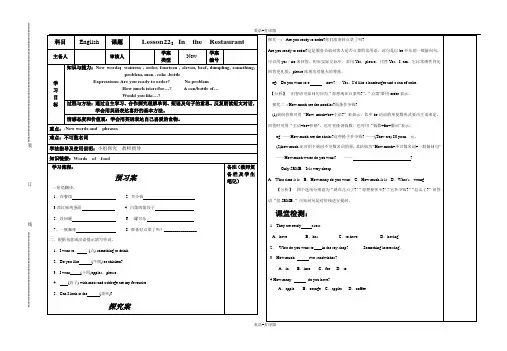
1.I want to(点) something to drink.
2.Do you like(牛肉) or chicken?
3.I want(十四)apples,please.
4.(饺子) with meat and cabbage are my favourite.
Expressions: Are you ready to order? No problem
How much is/are/for…?Acan/bottle of…
Would you like…?
过程与方法:通过自主学习、合作探究理解单词、短语及句子的意思。反复朗读短文对话,学会用英语表达喜好的基本方法。
eg:--Do you want to onow?一Yes,I’d like a hamburger and a can ofcoke.
【分析】由答语可知问句应为“你想现在点菜吗?”。“点菜"要用order表示。
探究二: How much are the noodles?面条多少钱?
(1)询问价格可用“How much+be+主语?”来表示,其中be动词的单复数形式要由主语来定。回答时可用“主语+be+价格",也可直接说钱数,也可用“钱数+for+数词"表示。
A.have B.has C.to have D.having
2.--What do you want toin the toy shop?--Something interesting.
3.How muchtwo sandwiches?
A.in B.into C.for D.to
4.How manydo you have?
冀教版三年级英语下册模块知识必备清单

冀教版三年级英语下册模块知识必备清单Unit 1 Lessons 1~3 模块知识必备清单重点词汇farm 农场farmer 农民pig 猪cow 母牛;奶牛sheep 羊;绵羊a(an)一;一个cat 猫dog 狗duck 鸭fish 鱼;鱼肉bird 鸟重点短语on the farm 在农场can swim 会游泳can fly 会飞can sing 会唱歌can dance 会跳舞重点句型1 —What’s this? 这是什么?—I t’s a cow. 它是一头奶牛。
解读: 问句是由疑问词What 引导的特殊疑问句,用于询问近处的某物是什么。
What’s是What is 的缩写形式。
句型结构: —What’s this? —It’s a /an + 某物.2 —Is it a duck? 它是一只鸭子吗?—Yes, it is./No, it isn’t.是的,它是一只鸭子。
/ 不,它不是一只鸭子。
解读: 问句是一个由Is 引导的一般疑问句,用于确定某物是什么。
句型结构: —Is it a/an +可数名词单数? —Yes, it is./No, it isn’t.3 —Can you dance? 你会跳舞吗?—Yes, I can./No, I can’t.是的,我会。
/ 不,我不会。
解读: 问句是由Can引导的一般疑问句,用于询问对方是否能够做某事。
句型结构: —Can you +动词原形(+其他)? —Yes, I can./No, I can’t.Unit 1 Lessons 4~6 模块知识必备清单重点词汇animal 动物horse 马yes 是,是的no 不,没有,无under 在……下面box 盒子;箱in 在……里面;在里面on 在……上面;在……状态中重点短语can run 会跑can jump 会跳in the box 在盒子里on the box 在盒子上under the desk 在书桌下面重点句型1 —What animals can fly?什么动物会飞?—Birds can fly.鸟会飞。
Lesson 22 In the Restaurant教学设计
Lesson 22 In the Restaurant一、教材依据冀教版(衔接三年级起点)七年级上册Unit4第四课。
二、设计思想本课采用采用竞赛和配音的方式训练口语,传统的机械的操练不能激发学生的学习热情,采用竞赛和配音的方式进行操练,大大提高了学生学习的积极性;采用交际法,学习语言的目的就是为了交际,而且本节课的中心任务是购物,购物就必须与人交际。
交际法是遵循学生按自然顺序习得语言的方法。
交际法重视在实践运用中掌握语法,此种教法效果良好,是当代语言教学的一种重要教法;采用任务型教学,任务型教学是让学生在完成一个或一系列真实的交际任务过程中,通过运用语言,达到掌握语言的目的。
学生为了完成交际任务而学习、使用语言,学生有明确的学习动机,所以学习积极性较高,学习效果较好。
而传统的语言教学采用假设、纸上谈兵式的教法不能激发学生的兴趣。
教学内容分析:Lesson22 In the Restaurant是冀教版七年级上册Unit4第4课。
本课围绕着本单元谈论饮食这一话题设计各种教学活动,通过商店购物,餐厅就餐的情景操练,复习巩固本单元所学的饮食名词,强化运用购物论价,吃饭点菜的交际用语。
同时通过各种不同的任务设计,让学生主动参与到教学活动中来,从而在一种轻松、愉快的环境里接受新的知识。
学生情况分析:学生们前面已经学习了大量的饮食名词,这就为展开本课教学做了很好的铺垫。
本课通过大量的图片,活动或表演,激发学生的学习兴趣,使学生大胆参与到教学活动中来,经过听、说、读、写的全面训练,让学生很自然的学习和运用饮食词汇及语言,较容易达成“口言心声”。
但本课篇幅较长,许多语句较长难懂,将给学生带来理解和口头表达上的双重难度,这就需要老师的点拨和强调以及一定量的强化练习。
三、教学目标1、Knowledge aims:(1)、Learn some new words:Waitress can coke order fourteen eleven beef dumpling something problem menu bottle(2)、Learn some useful phrases:in the restaurant a can/bottle of be ready to do sth. rice with fish(3)、Learn some useful sentences:1). Are you ready to order?2). Would you like something to drink/eat?3). How much is/are/for…?4). No problem .(4)、Learn some useful expression:1)----Are you ready to order?----Yes, please.2)--- How much are the noodles? ---- … yuan.3)---- –Thanks! ---You’re welcome.4) --What would you like? -----I’d like…….5)----Would you like something to drink/eat? -----yes, please./No.thanks.2、Ability aims:Learn to talk about what people would like(to buy/eat/drink).3、Emotion aims:(1) To develop the study interests(2) To encourage students to express and show themselves四、教学重点(Important Points)Buying things and talking about the price.五、教学难点(Difficult Points)Master how to order food .六、教学方法情景教学法任务型教学法七、学习方法小组合作疯狂阅读八、教学准备各种饮料、食品、水果的图片;录音机;笑脸、哭脸(奖励用品)。
冀教版-英语-七上-教案4单元 第22课 In the Restaurant

第二十二课时Lesson22 In the Restaurant 单元目标重点单词order v. 订购;点(菜)n. 顺序fourteen num.十四eleven num.十一beef n. 牛肉dumpling n.饺子something pron. 某事;某物problem n. 问题;难题menu n. 菜单重点短语be ready to 准备好……how much 多少no problem 没问题重点句子 1.Are you ready to order? 你准备好点菜了吗?2.How much are the noodles? 面条多少钱?3.Rice with fish or chicken is twelve yuan. 有鱼或者鸡肉的米饭是12元。
4.Would you like something to drink? 你想要点喝的吗?教学目标 1.掌握本课时的重点单词。
2.了解更多表示就餐的词汇。
3.了解一些有关表示饮食的句型。
教学难点让学生学会介绍自己到餐馆就餐的情况。
环节1 新课导入教师展示两张图片,然后提出下列问题,学生思考,和同学讨论,然后口头作答:(1)What do you usually have in arestaurant?(2)Do you like eating with your friends?设计意图:通过图片展示更加直观地呈现本课时的主题:去餐厅吃饭。
环节2 学习活动1.听录音,把握文章主要意思,学生思考下列问题,然后口头回答:(1)1.How much are chicken noodles?(2)What does Li Ming want to drink?2.教师教读本课对话内容,然后讲解重点短语和句子。
3.学生和同桌一起练习对话,然后请两名同学起来表演。
4.根据课文内容,完成练习题1,把人物和对应的食物连起来。
教师订正答案。
5.教师读题,然后学生完成练习题2,圈出选项中不是一类的词。
Lesson21【05】

Let’s count
eighteen hamburgers
sixteen hot dogs
nineteen donuts
seventeen ice creams
twenty cans of cola
Read and find
1 one 2 two 3 three 4 four 5 five 6 six 7 seven 8 eight 9 nine 10 ten
Jenny would like some chicken, rice and water.
3 What would you like?
What would you like?
I’d like some noodles. some后加可数名词复 数或不可数名词。
I’d like some chicken and rice, please.
特殊)
thirteen, fourteen, fifteen, sixteen, seventeen, eighteen
Let’s count from 1 to 20.
Listen and fill in the number
How many are they?
(16
(20
(18
)
)
)
(19
(17
eighteen, nineteen, twenty
Sentence patterns: —What would you like? —I’d like … —Would you like …? —No, thanks. I’d like …
Exercise
一、给句子选择相应的图片。
( C ) 1. I’d like some fish. ( E ) 2. I want to drink some tea. ( B ) 3. I’d like some juice.
初三英语Unit3 Pardon Me! (Lesson21—Lesson24)知识精讲 冀教版
初三英语Unit3 Pardon Me! (Lesson21—Lesson24)知识精讲冀教版【本讲教育信息】一. 教学内容:Unit 3 Pardon Me! (Lesson 21—Lesson 24)1. 重点单词。
n. manner peppermint trouble traditionv. praiseadj. formal polite rude2. 重点短语。
given name 名family name 姓praise … for… 因为(某事)表扬(某人)face to face 面对面have trouble with 在某方面有麻烦/困难at the end of… 在……的结尾in good Chinese tradition 按照中国的好传统3. 语法。
Past Future Tense. (过去将来时)二. 重点、难点解析及词语辨析。
Lesson 21formal adj.正式的informal adj.非正式的This is the sixth informal meeting between the two countries.这是两个国家间的第六轮非正式会谈。
Lesson 22l. Have you received a gift before?你以前收到过礼物吗?receive vt. &vi. received, receiving 收到①Did you receive any letters today?你今天收到信了吗?辨析:receive 与accept都含有“收到,接受”的意思。
※receive指“(客观上)收到”,着重行为本身,而不涉及接受者是否接受,②I received an invitation我收到了请帖。
※accept指“(主观上)接受”,表示接受者经过考虑以后愿意接受,③I accepted the invitation.我接受了邀请。
冀教版英语三年级下册 unit 4全套单元课件
我喜欢苹果。我想吃一个。
you‘re
(you are 的缩写形式) 你(们)是
【例句】You're our good teacher. 你是我们的好老师。
【注意】 are用在复数人称后,也可用在其他名词 复数形式后面。
【复数】 apples 【详解】苹果前面用冠词an,一个 苹果an apple. 【例句】 I have an apple.
我有一个苹果。
The apple is very sweet.
Try 苹果很甜。
orange 橘子
【复数】 oranges 【详解】意为橘子为可数名词;意为 橘色为不可数名词。 【例句】 There are some oranges.
那是我想要的。
A donut and some milk.
That's what I'd like.
may 可以;可能
【用法】may是情态动词,后面跟动词原形,没有人 称和数的变化。把may提到句首可以变成疑问句。
【例句】May I use your ruler? 我可以用你的尺子吗?
one 一个
冀教版(三年级起点)三年级下册
Lesson 19 I Like Fruit!
Warm-up/Revision
Presentation
● What do you like? ● Let's sing ● How many?
Test
Sum-up
Homework
Warm-up/Revision
Do you like fruit?
冀教版七年级英语上册《In the restaurant》Food and Restaurants1
Food Dumplingswithmeatandcabbage 15yuan Dumplingswithcarrotandegg 13yuan Beef/Chickennoodles 14yuan Tomatoandeggnoodles 11yuan Ricewithfish/chicken 12yuan
考向二
拓展
or意为“和”时,只用于否定句。 eg:Idon’thaveanybrothersorsisters.我没有兄弟姐妹。 还有“否则”之意,常见于祈使句后。 eg:Studyhard,oryouwon’tpassthe exam.努力学习,否则你考试会不及格。
典例
Bequick,________we’llbelateforthemeeting. (雅安) A.and B.but C.so D.or
Howmuchwater
Fourteenyuanforbeeforchickennoodles.牛肉或鸡肉面14元。
知识点
3
for是介词,表示对象,“…yuanforsth.”表示“某物……元”。 eg:It’s80yuanforapairofshoes. 一双鞋80元。
Irunfor2, 000metreseveryday.我每天跑2000米。
Here is the present for you.这是给你的礼物。
④表示时间、距离,意为“达,计”
I run for 2 , 000 metres every day.我每天跑2 000米。
or意为“或者”,是表示选择关系的连词,用来连接两个并列的句子成分。 eg:Youcanhaveacanofcokeorabottleof water.你可以喝一罐可乐或一瓶水。
冀教版七年级英语上册第四单元《Lesson 22 In the Restaurant》 -
典例
Be quick,____D____ we’ll be late for the
meeting.
(雅安)
A.and
B.but
C.so
D.or
【点拨】根据句意,“快点,否则我们开会要迟了。”and 意为“并且”,but意为“但是”,so意为“所以”,or意为“否 则”。故选D。
chicken noodles. ❸ Eleven yuan for tomato and egg noodles.
Li Ming:OK. I’ll have the chicken noodles. What would you like,Jack?
Jack:Hmm... Waitress:We also have dumplings and rice. Rice with fish
or chicken is twelve yuan. ❹ Jack:How much for the dumplings? Waitress:Fifteen yuan for dumplings with meat and
cabbage,and thirteen yuan for dumplings with
milk is there in the glass?玻璃 杯里有多少牛 奶?—Only a little.仅有一点。
典例 1 This dress is 120 yuan.(对画线部分提问) ___H_o_w___ __m_u_c_h___ is this dress?
【点拨】针对价钱提问要用“How much”。
考向一 for是介词,表示对象,“…yuan for sth.”表 示“某物……元”。 eg:It’s 80 yuan for a pair of shoes. 一双鞋80元。