
最新新人教版八年级上英语1-5单元重点单词-短语和语法
Unit1 where did you go on vacation1.复合不定代词:somebody某人someone某人anybody任何人anyone任何人nobody没人no one没人ererybody每个人ereryone每个人something某物anything任何事物nothing没有什么ererything一切事物①有body和one的只用来指人②有thing的只用来指事物③复合不定代词做主语时,谓语动词用单数形式④somebody,someone,something用于肯定句,anything,anyone,anybody用于否定句,疑问句⑤表示请求、邀请、提建议等带有委婉的语气的疑问句,和希望得到对方肯定答复的疑问句,以及表示反问的问句中,也用somebody,someone,something⑥anything表示“任何事物,无论何事(物)”, anyone,anybody表示“无论谁,任何人”等意义时,他们也可以用于肯定句中。
2. something、anything、nothing、ererything+形容词,例如:something special3.quite和very的区别①quite+a/an, a/an+very②quite+ another, a few , a little ,不能用very4.few,a few, little, a little的区别few,可数名词复数,表否定a few,可数名词复数,表肯定little,不可数名词,表否定a little,不可数名词,表肯定5.what about=how about 做…怎么样后面加动词ing形式6.seem和look的区别Seem暗示有一定根据的判断,look指由视觉而得出的印象7.bored形容人无聊boring形容物无聊8.arrive at+小地方arrive in+大地方9.dicide to do sth=make up one′s mind to do sth决定做某事10.feel like 感觉像,后面接动词ing形式11.over超过=more than12.enough 足够的,enough+名词副词+enough13.because和because of的区别Because后面接的是一个句子,because of后面接单词或者短语14.below 在…下面,反义词above15.forget to do sth忘记去做某事(这件事还没有做)forget doing sth忘记做过某事(这件事做过了,却忘记了)16.find out找到,发现,强调找的结果;look for寻找,强调找的过程17.so…that…如此…以至于=too … to…=enough …to语法:一般过去式如何写出动词的过去式1、一般情况下在词尾加ed2、以不发音的e结尾的直接加d3、以辅音加y结尾的,把y改为i,再加ed4、以一个元音加一个辅音结尾的,双写辅音,再加ed不规则动词的过去式:动词过去式be (am\ is) wasare werecome camego wentdo (does) didfly flewdraw drewmake madesing sanghave (has) hadeat atedrink drankput putlet letcan couldsee sawmeet metget gotforget forgottake tookcan couldmay mightshall shouldwill wouldknow knewbegin beganbend bentbuild builtspend spentmean meantlearn learnt learned buy boughtthink thoughtteach taughtcatch caughtsleep sleptkeep keptspeak spokeride rodefeel feltleave leftgive gaverun ranring rangsit satswim swamsay saidstand stoodtell toldthrow threwwin wonwrite wrote看到yesterday,last,,ago,before ,just now,in+年份,in those days就要考虑变为过去式。
(一般情况在动词后面加ed )过去式注意前面加,后面不加。
Unit2 how often do you exercise1.help with sth 帮助做某事2.can′t help doing sth 情不自禁做某事help oneself to 随便吃with the help of sb在某人的帮助下3.hardly ever 几乎不4.go+动词ing形式5.how often问频率。
(多久几次)。
How many问多少,后面接名词复数。
How much,问价钱。
how long问多长时间,也可以问物体的长度。
how tall 问身高。
how heavy问重量。
how soon问需要多长时间,过多久,答语有in+一段时间。
how far 问多远6.have to不得不,强调客观要求使之不得不做某事must不得不,带有主观意味7.maybe或许,副词,一般位于句首。
may be可能是,也,一般放在主语后。
8.at least至少9.频度副词always一直usually 常常often 经常sometimes 有时hardly ever 几乎不never从来不10.be动词,助动词,情态动词+频度副词频度副词+行为动词11.百分数的表达方式:基数词+percent+of+名词12.Although 虽然,尽管,比though正式13.Through以,凭借14.By +表方式的名词,如by bike with+不定冠词/代词+表工具的名词,如with a bike15.However 然而16.More than 超出17.Less than 少于,不超过18.Almost 几乎,差不多Almost+any /no/none/nobody/nothing/never等否定副词;nearly几乎,差不多very/pretty/not+nearlyUnit3 I′m more outgoing than my sisiter1.both…and…两者都2.neither …nor…既不…也不3.loudly 大声地比较级为more loudly4.as…as…和…一样否定结构为“not as+形容词、副词原级+as”或者“not so+形容词、副词原级+as”5.with和,带有,具有,其后接名词或代词宾格形式6.have fun玩得高兴,后接ing形式,同义句有have a good time,enjoy oneself7.the same …as同…一样8.be different from与…不同9.be good at 擅长于10. be good to/with善待,后面一般接人11. be good for对…有利,后可接人和物12.care about担心,关心13.make sb do sth让某人做某事14.enjoy doing sth 喜欢做某事15.Enjoy,finish,mind+doing sth Like,hate,renmember,forget,start,stop 可以加doing sth,也可以加to do sth16.It′s+adj+for sb to do sth对于某人来说,做什么事是…(怎么样的)17.as long as 只要18.though 然而,但是19.although虽然,尽管,多用于句首20.help to do sth=help with sth帮助某人做某事21.be similar to sb与某人相似22. be similar in在某方面与…相似形容词的比较级和最高级如何写出形容词的比较级1、一般情况下在词尾加er2、以不发音的e结尾的,直接加r3、以一个元音加一个辅音结尾的,双写最后一个辅音,再加er4、以辅音字母+y结尾的,把y改为i,再加er5、双音节或者多音节词,在前面加more补充:不规则形容词的比较级many,much—more good,well—better bad,ill—worse far—farther little—less看到than用比较级,三个人以上比较用最高级,the+最高级如何写出形容词的最高级1、一般情况下在词尾加est2、以不发音的e结尾的,直接加st3、以一个元音加一个辅音结尾的,双写最后一个辅音,再加est4、以辅音字母+y结尾的,把y改为i,再加est5、双音节或者多音节词,在前面加most常用的不规则变化的形容词的比较级和最高级:原级比较级最高级good better bestmany more mostmuch more mostbad worse worstlittle less leastill worse worstfar farther(further) farthest(furthest)形容词前如加less 和lest 则表示"较不"和"最不"important 重要less important 较不重要least important 最不重要Unit4 what′s the best movie theater1.close to 靠近,接近2.so far到目前为至3.thanks for因为…而感谢,后接ing形式4. thanks to对亏,由于5.“比较级+and比较级”或者“more and more+原形”表达“越来越….6.all kinds of各种各样different kinds of不同种类kind of=a little有点儿,几分7.be up to由某人决定8.play the role of扮演…角色play a role in在…中起作用9.for example例如,后面接句子10.such as例如,后面接单词或短语11.crowded人多的,拥挤的crowded in 充满了,装满Unit5 Do you want to watch a game show1.what do you think of=how do you like 你觉得…怎么样2.can′t stand doing sth不能忍受做某事3.plan to do sth打算做某事4.hope to do sth希望做某事5.6.hope和wish的区别:wish,希望,用于表示难以实现或不可能实现的愿望,wish sb to do sth希望某人做某事7.8.sth+happen+地点、时间“某地、某时发生了什么事”9.sth+happen to sb“某人发生了某事”10.sb+happen to do sth“某人碰巧做了某事”11.happen和take place(发生)的区别:happen指一切客观事物或情况的偶然或未能预见的发生,take place指事先有计划或能预料到某事的发生。
八年级上册英语1-5单元词组、重点句子总结
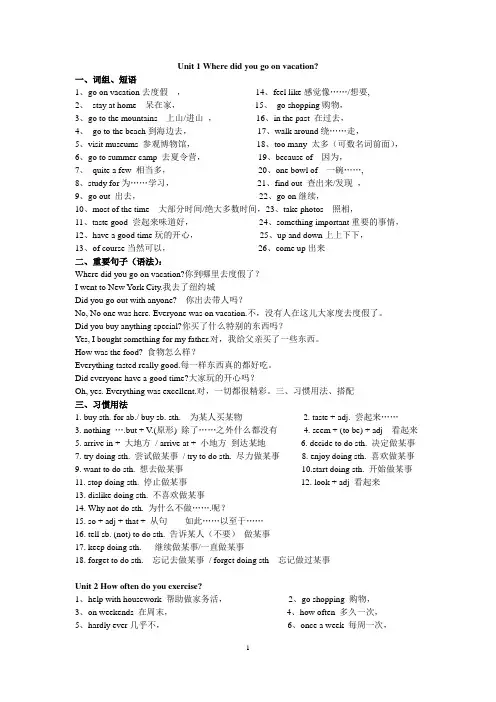
Unit 1 Where did you go on vacation?一、词组、短语1、go on vacation去度假,14、feel like感觉像……/想要,2、stay at home 呆在家,15、go shopping购物,3、go to the mountains 上山/进山,16、in the past 在过去,4、go to the beach到海边去,17、walk around绕……走,5、visit museums 参观博物馆,18、too many 太多(可数名词前面),6、go to summer camp 去夏令营,19、because of 因为,7、quite a few 相当多,20、one bowl of 一碗……,8、study for为……学习,21、find out 查出来/发现,9、go out 出去,22、go on继续,10、most of the time 大部分时间/绝大多数时间,23、take photos 照相,11、taste good 尝起来味道好,24、something important重要的事情,12、have a good time玩的开心,25、up and down上上下下,13、of course当然可以,26、come up出来二、重要句子(语法):Where did you go on vacation?你到哪里去度假了?I went to New York City.我去了纽约城Did you go out with anyone? 你出去带人吗?No, No one was here. Everyone was on vacation.不,没有人在这儿大家度去度假了。
Did you buy anything special?你买了什么特别的东西吗?Yes, I bought something for my father.对,我给父亲买了一些东西。
【知识点】人教版八年级英语上册1~5单元重点单词,短语,句型全汇总,复习必备!.doc

Unitl Where did you go on vacation?【重点短语】1.go on vacation 去度假2.stay at home 呆在家3.go to the mountains 上山/进山4.go to the beach 到海边去5.visit museums参观博物馆6.go to the summer camp 去夏令营7.quite a few 相当多8.study for 为.. 学习,9.go out 出去10.most of the time大部分时间/绝大多数时间11.taste good尝起来味道好12.have a good time 玩的开心13.of course当然可以14.feel like感觉像 .... /想要15.go shopping 去购物16.in the past 在过去17.wa 1 k around 绕.. 走18.too many太多(可数名词前面)19.because of 因为20.one bowl of 一碗....21.find out查出来/发现22.go on 继续23.take photos 照相24.something important 重要的事情25.up and down 上上下下e up 出来【重点句型】1.--- Where did you go on vacation? 你到哪里去度假了?--- 1 went to New York City. 我去了纽约城。
2.--- Did you go out with anyone? 你出去带人吗?--- No, No one was herc. Everyone was on vacation. 不,没有人在这儿。
大家度去度假了。
3.--- Did you buy anything special? 你买了什么特别的东西吗?--- Yes, I bought something for my father.对,我给父亲买了一些东西。
八上英语1~5单元笔记

八上英语1~5单元笔记Unit 1 Where did you go on vacation?一、重点单词。
1. anyone / anybody.这俩词都是“任何人”的意思,用于疑问句和否定句中比较多。
比如说,“Did anyone call me while I was out?”(我出去的时候有人给我打电话吗?)注意哦,它们后面接动词的单数形式呢。
就像“Anyone can do it.”(任何人都能做这件事)。
2. anywhere?是“在任何地方;无论何处”的意思。
例如,“I can't find my keys anywhere.”(我到处都找不到我的钥匙)。
3. wonderful.这词超棒,表示“精彩的;绝妙的”。
像“We had a wonderful time at the party.”(我们在聚会上玩得很开心)。
4. few / a few / little / a little.few和a few是用来修饰可数名词的。
“few”表示“几乎没有”,有否定的感觉,比如“Few students like this difficult subject.”(几乎没有学生喜欢这个难的科目);“a few”表示“一些;几个”,是肯定的,像“There are a few apples on the table.”(桌子上有几个苹果)。
little和a little是修饰不可数名词的。
“little”意思是“几乎没有”,否定的,例如“There is little water in the glass.”(杯子里几乎没有水了);“a little”表示“一点儿;少量”,肯定的,比如“I can speak a little English.”(我会说一点英语)。
二、重点短语。
1. go on vacation.就是“去度假”的意思啦。
“Where did you go on vacation?”(你去哪里度假了?)2. stay at home.简单,“待在家里”。
初中英语人教版八年级上册重点短语+句型+常用语法汇总(1-5单元)

八年级英语上册重点知识汇总Unit 1 Where did you go on vacation?【本单元的话题】谈论假期活动内容,复习一般过去时。
【本单元的语法】1复习一般过去时;2.学习不定代词和不定副词的用法。
【不定代词和不定副词的用法】(1)左边的some、any、every、no与右边的body、one、thing构成不定代词,some、any、every、no 与右边的疑问副词where构成不定副词;(2)一般情况下以some开头的不定代词和不定副词用于肯定句,以any开头的不定代词和不定副词用于否定句、疑问句;以no开头的不定代词和不定副词表示否定含义(no one为两个单词);(3)不定代词或不定副词和形容词连用时,形容词放在后面。
He has something important to do.他有重要的事情要做。
(肯定句用something,形容词important放后)Did you buy anything special? (一般疑问句用anything,形容词special放后)Did you go anywhere interesting last month?上个月你去令人感兴趣的地方了吗?(一般疑问句用不定副词anywhere,形容词interesting放后)(4)不定代词和不定副词做主语时,后面的动词用单数形式。
Everone is here today.今天每个人都在这里。
【本单元的短语和知识点】1.go on vacation去度假go to the mountains 上山/进山2.stay at home呆在家go to the beach去海滩visit museums 参观博物馆go to summer camp去参观夏令营3.study for tests为考试而学习\备考go out出去4.quite a few相当多,不少(后跟可数名词复数)take photos照相most of the time大部分时间5.buy sth for sb = buy sb sth为某人买某物6.taste good.尝起来很好taste(尝起来)、look(看起来)、sound(听起来)为感官动词,后跟形容词7.have a good\great\fun time过得高兴,玩得愉快(=enjoy oneself)8.go shopping去购物9.nothing…but+动词原形:除了……之外什么都没有He had nothing to do at home but read yesterday.昨天他在家除了读书无事可做。
人教版八年级英语上册1_5单元知识点(词汇+句型+固定搭配).doc
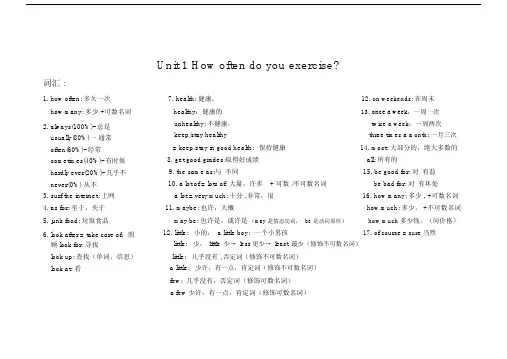
词汇 :1.how often: 多久一次how many: 多少 +可数名词2.always(100%)- 总是usually(80%) –通常often(60%)- 经常sometimes(40%)- 有时候hardly ever(20%)- 几乎不never(0%) 从不3.surf the internet: 上网4.as for: 至于,关于5.junk food: 垃圾食品6.look after = take care of:照顾 look for: 寻找look up: 查找(单词、信息)look at: 看Unit 1 How often do you exercise?7. health: 健康,12. on weekends: 在周末healthy:健康的13. once a week:一周一次unhealthy: 不健康,twice a week:一周两次keep/stay healthy three times a month: 一月三次= keep/stay in good health:保持健康14. most: 大部分的,绝大多数的8. get good grades:取得好成绩all: 所有的9. the same as:与不同15. be good for: 对有益10. a lot of = lots of: 大量,许多+ 可数 /不可数名词be bad for: 对有坏处a lot = very much: 十分 ,非常,很16. how many: 多少 , +可数名词11. maybe: 也许,大概how much: 多少, +不可数名词may be: 也许是,或许是(may是情态动词,be是动词原形)how much 多少钱,(问价格)12. little:小的,a little boy:一个小男孩17. of course = sure 当然little:少,little少→ less更少→ least最少(修饰不可数名词)little:几乎没有,否定词(修饰不可数名词)a little:少许,有一点,肯定词(修饰不可数名词)few: 几乎没有,否定词(修饰可数名词)a few 少许,有一点,肯定词(修饰可数名词)句型:1. How often do you exercise? → I exercise three times a week. How often does she shop? → She shops once a month.2. What do you usually do on weekends?→ I usually watch TV. How often does she watch TV? → She watches TV everyday.3. How many hours do you sleep every night? 你每晚睡几个小时?→ I sleep nine hours every night.How many books do you have? 你有多少本书?→ I have 5 books.How much is the sweater? 这件毛衣多少钱?How much water do you have? 你有多少水? (how much: 多少,后面 +不可数名词 , water 是不可数名词 )4. What’syour favorite program? 你最喜欢的电视节目是什么?→ It ’s Animal World.固定搭配:try to do sth.: 尽力做某事,设法做某事try doing sth.: 试着做、尝试做某事help sb. (to) do sth: 帮助某人做某事 (to 可以省略 )want sb. to do sth.: 想要某人做某事Unit 2 What ’s the matter? 词汇 :1.have a cold 感冒have a fever 发烧have a stomachache肚子痛 have a headache头疼have a toothache牙齿疼have a sore throat 喉咙疼have a sore back背部酸疼2.lie down and have a good rest躺下好好休息3.hot tea with honey 加了蜂蜜的热茶4.ill 病了的 illness 疾病5.advice 建议(不可数名词)some advice(不能加”s”)6.be stressed out有压力的,紧的7.balance 平衡 balanced 平衡的 a balanced diet 平衡的饮食on a diet 节食8.get 变得get angry 变得生气get tired 变得劳累9.few: 几乎没有,否定词(修饰可数名词)a few 少许,有一点,肯定词(修饰不可数名词)little:几乎没有,否定词(修饰不可数名词)a little:少许,有一点,肯定词(修饰不可数名词)10.at the moment = now 现在,此刻11.host family 寄宿家庭12.not until直到时候才13.should 应该,情态动词,后 +动词原形should not=shouldn’t14. see a doctor 看医生see a dentist 看牙医15. too many 太多,修饰可数名词too many students too much 太多,修饰不可数名词too much yin much too 太, much too big 太大16. stay=keep 保持keep/stay healthy= keep/stay in good health: 保持健康句型:1.What’s the matter with you? = What’s the trouble with you? = What’s wrong with you? 你怎么了?→ I have a cold/ have a toothache/ have a sore throat.2.What ’sthe matter? → She has a cold.3.Does hehave a cold? → Yes, he does.4.A: What’s the matter?B: I ’m not feeling well .(此处不能用 good) I have a cold.A: When did it start?B: About two days ago.A: That’stoo bad. You should drink lots of water.B: Yes, I think so.A: I hope you feel / get better soon. 我希望你尽快好起来5.A: I have a coldB: I am sorry to hear that. (当听到对方不好的消息时使用此句)固定搭配:It is + 形容词+ (for sb.) to do sth. 做某事对某人来说是的例句:It is easy for me to learn (learn) English. 对我来说学英语是容易的It is interesting to watch (watch) Animal World. 看动物世界时有趣的Unit 3 What are you doing for vacation?→→→ 本单元用现在进行时态表示将来的事情现在进行时态,即be + doing:词汇 :1. go camping 去野营go fishing去钓鱼go shopping 去购物go swimming 去游泳go hiking 去远足go bike riding 去骑单车go sightseeing 去观光旅游6. a lot = very much 十分、非常、很a lot of = lots of 许多、大量7. away 向远处、离开go away 离开8. stay: 留、停留、呆2. A: What are you doing for vacation?B: I am going camping.A: That sounds nice.Who are you going with?B: I am going with my parents .3. Linda is going to Tibet next summer.(划线提问)2. how long 多久、多长时间句型:→Where is Linda going next summer?3. get back 回来 get back to school4. be famous for以而闻名5. leave for离开去地方leave →(过去式 ) leftleft: 左边、离开1. What are you doing for vacation?→ I am visiting my grandparents.What is your brother doing for vacation?→ He is going camping.4. He’s going on the 12th . (划线提问)→ When is he going?5. I’m staying there for a week. (划线提问→How long are you staying?)6.当听到对方提出的建议,如:What about playing basketball? How about taking a walk with me? Why not go to the movie? 为什么不去看电影?I am going camping.等句子时,回答可用以下句型:That sounds nice/ good/ interesting/. That ’s a good idea. / Good idea. That sounds like a good idea./ Great 等 .7.当听到对方要去旅行或是准备出行时,如: I am going to Hongkong for a week. I am going hiking in the mountains.时,回答一般用以下句型: Have a good time!8. 询问天气: How is the weather? 或是 What’s the weather like?9. 询问某人的职业: What do you do? What are you? What’s your job? 你的工作是什么?What does your mother do? What is he? 他是干什么的?10. 询问某人的性格: What are you like? → I am outgoing/ shy/ quiet.What is he like? 他是个什么样的人?→ He is outgoing/ shy/ quiet. 他很外向/害羞/安静10. 询问某人长的什么样子: What does he look like ? 他长的什么样子?→ He is of medium build/height . 他中等身材 /身高 .What does your father look like ? → He is tall. 他很高11. 询问某人喜欢什么:What do you like? 你喜欢什么?→ I like basketball. 我喜欢篮球固定搭配:1. finish doing sth 完成做某件事例: I finished doing my homework. 我完成了我的家庭作业Unit 1-3 单元课本语法知识& 在讲解畅优新课堂时补充的语法知识点与固定搭配:1.情态动词后 +动词原形 (do)已学情态动词: can 能够 , must 必须 , should 应该 , may 也许 . would 想,会help sb (to) do sth 帮助某人做某事2.介词后若接动词,则接动词的 ing 形式:常见的: what about + doing sth? 做怎么样?常接 doing 的固定搭配:1. like doing sth 喜欢做某事2. enjoy doing sth 享受做某事3. have a good/ have fun in doing sth做某事玩的很开心4.finish doing sth 完成做某件事5. spend +(时间、金钱、精力 ) doing sth 花时间、金钱、精力做某事=spend +(时间、金钱、精力 ) on sth3.不定式,即: to do常接不定式的固定搭配:want sb to do sth 想要某人做某事 ask sb to do sth 要求某人做某事 need to do sth 需要做某事would like to do sth 想做某事plan to do sth 计划做某事forget to do sth忘记做某事tell sb to do sth 告诉某人做某事decide to do sth 决定做某事try to do sth 尽力做某事4.不定代词 + 形容词结构例: something interesting 一些有趣的事情Unit 4 How do you get to school? 词汇 :1. get to: 到达arrive at: 到达 + 小地点(学校、医院⋯)arrive in: 到达 + 点(城市、国家、地区⋯)reach: 到达2. take the bus = by bus:坐公交3. take the train = by train:坐火4. take the subway= by subway:坐地5. ride one’s bike = by bike:6. walk = on foot:走路8. how long: 多久,how far:多9. from⋯to⋯从⋯到⋯10. think of:think about: 考11. around the world = all over the world:12. be different from: 与⋯不同13. take⋯ to⋯把⋯到⋯14. from: 离⋯的距离15. not all: 不是所有全世界16. more⋯ than⋯:比⋯更⋯,than: 比7.depend on: ⋯⋯而定,决定于⋯⋯,依靠⋯⋯17.other 其他的,形容others 其他的人或其他的事the other 两者中的另一个,数概念the others 两部分中的另一部分,复数概念another 另外一个,另外的,第三个的18. than 比19. more⋯than⋯比⋯⋯更⋯⋯,形容比的用法句型:1.How do you get to school? → I take the bus . / I go to school by bus.How does she get to school?→ She takes the bus. / Shegoes to school by bus.2.How long does it take? → It takes about/around 10 minutes. → It takes about 25 minutesto walk and 10 minutesby bus. How long does it take you to get from home to school? → It takes 25 minutes.3. How far is it from your home to school?→ It’s3 miles./10 kilometers.4. What do you think of? = how do you like? 你认为怎么样?5. How far do you live from school?你住的离学校有多远→ I live 10 miles from school.6. Can I help you? May I help you? → Yes, please.固定搭配:1.It takes sb. + 时间 + to do sth. 例句: It takes me 20 minutesto walk (walk)2.need to do sth. 需要做某事3.more than 比更,形容词比较级的用法4形容词的比较级 & 最高级:规则变化:比较级:形容词尾 +“ er”,最高级: +“est ”,例: big → bigger → the biggest不规则变化:三个音节及以上的形容词(比较长的形容词),比较级:前面+ more,最高级:前面+most,例: popular 流行的→more popular更流行的→the most popular 最流行的最高级前面 +“the”例: This classroom is bigger than that one. 这件教室比那间大This classroom is the biggest. 这间教室是最大的Unit 5 Can you come to my party? 词汇:1.other 其他的The other 另一个 (两个中的另一个 )The others 另一部分(两部分中的另一部分)Another 另外的,另一个(三个以上中的另一个)2.the day before yesterday前天 yesterday 昨天today 今天tomorrow 明天the day after tomorrow 后天3.on weekends 在周末on weekdays 在工作日e over 顺便来访visit 拜访,看望,参观5.study for test 准备考试6.go to the doctor 看医生7.have a piano lesson上钢琴课8.too much homework 太多家庭作业much too 太 too many 太多 + 可数名词9. have to 不得不,要10. babysit= look after = take care of = care for 关心,照顾句型:1.Can you come to my party?Yes, I’d love to.(肯定回答 )I’m sorry, I can’t. I have to(否定回答 )2.What’s today? 今天星期几,几号? (星期、日期都可以问 )thIt’s Monday the 14 . 今天 14 号星期一。
人教版八年级上册英语单元知识点归纳复习资料
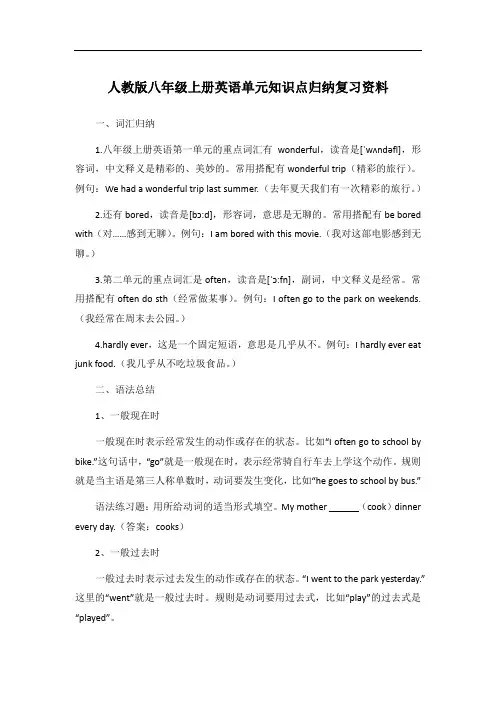
人教版八年级上册英语单元知识点归纳复习资料一、词汇归纳1.八年级上册英语第一单元的重点词汇有wonderful,读音是[ˈwʌndəfl],形容词,中文释义是精彩的、美妙的。
常用搭配有wonderful trip(精彩的旅行)。
例句:We had a wonderful trip last summer.(去年夏天我们有一次精彩的旅行。
)2.还有bored,读音是[bɔːd],形容词,意思是无聊的。
常用搭配有be bored with(对……感到无聊)。
例句:I am bored with this movie.(我对这部电影感到无聊。
)3.第二单元的重点词汇是often,读音是[ˈɔːfn],副词,中文释义是经常。
常用搭配有often do sth(经常做某事)。
例句:I often go to the park on weekends.(我经常在周末去公园。
)4.hardly ever,这是一个固定短语,意思是几乎从不。
例句:I hardly ever eat junk food.(我几乎从不吃垃圾食品。
)二、语法总结1、一般现在时一般现在时表示经常发生的动作或存在的状态。
比如“I often go to school by bike.”这句话中,“go”就是一般现在时,表示经常骑自行车去上学这个动作。
规则就是当主语是第三人称单数时,动词要发生变化,比如“he goes to school by bus.”语法练习题:用所给动词的适当形式填空。
My mother ______(cook)dinner every day.(答案:cooks)2、一般过去时一般过去时表示过去发生的动作或存在的状态。
“I went to the park yesterday.”这里的“went”就是一般过去时。
规则是动词要用过去式,比如“play”的过去式是“played”。
语法练习题:She ______(visit)her grandparents last weekend.(答案:visited)三、句型解析1. What's the matter? 这个句型用于询问“怎么了?”“出什么事了?”。
八年级英语上册unit1--unit5短语与用法(20xx新版)
八年级英语上册unit1--unit5短语与用法(20xx新版)unit one短语归纳1.去度假go on vacation2.待在家里stay at home3.去爬山go to the mountains4.参观博物馆visit museums5.去参与夏令营go to summer camp6.相当多quite a few7.为……而学习study for8.出去go out9.大局部时间most of the time10.尝起来很好吃taste good11.玩得开心,过得开心have a good time12.当然of course13.给……的感觉;感受到feel like14.去买东西go shopping15.在过去in the past16.四处走走walk around17.太多too many18.因为because of19.一碗…… a bowl of20.其次天the nest day21.喝茶drink tea22.查明find out23.接着go on24.照相take photos25.重要的事情something important26.上上下下up and down27.出来come up用法集萃1.为某人买某物buy sth for sb =buy sb sth2.除了……之外什么都没有nothing ……but3.到达某地arrive in / arrive at4.确定做某事decide to do sth5.尽力做某事try to do sth6.尝试做某事try doing sht x kb 1.c om7.喜爱做某事enjoy doing sth=like doing sth8.不喜爱做某事dislike doing sth9.想去做某事want to do sth10.起先做某事start doing sth11.停顿做某事stop doing sth12.看起来look + 形容词13.尝起来taste + 形容词14.看起来seem + 形容词15.为什么不做……呢?why not do sth ?16.如此……以至于…… so …… that ……17.告知某人〔不要〕做某事tell sb (not ) to do sth18.接着做某事keep doing sth19.遗忘做某事forget to do sth20.遗忘做过某事forget doing sth unit two短语归纳1.协助某人做某事help with2.去买东西go shopping3.在周末on weekends4.多久一次how often5.几乎从不hardly ever6.每周一次once a week7.每月两次twice a month8.去看电影go to the movies9.每天every day10.用互联网use the internet11.有空be free12.上……课have ……classes13.打网球play tennis14.熬夜,睡得很晚stay up late15.进展体育活动play sports16.对……有好处be good f or ……17.去野营go camping18.在某人的业余时间in one’s free time19.一点儿也不not at all20.比方such as21.积习难改old habits die hard22.去看牙医go to the dentist23.多余more than24.少于less than用法集萃1. ……怎么样?…… 好不好how about ……?2.想让某人做某事want sb to do sth3.……有多少……?how many4. …… 发觉…… find+ that 从句5.做某事是……的it’s + adj + to do sth6.和某人一起度过时间spend time with sb7.向某人询问某事ask sb about sth8.通过做某事by doing sth9.你最宠爱的……是什么?what’s your favourite ……10.做某事的最好方法the best way to do sthunit three短语归纳1. 更外向more outgoing2. 与……一样as ……as ……3.歌颂竞赛the singing competition4.最重要的the most important5.有音乐天赋be talented in music6.和……一样;与……相同the same as7.快乐;介意care about 8.与……不同be different from9.像一面镜子like a mirror 10.只要;既然as long as 11.使显现;使表现出bring out 12.取得更好的成果get better grades13.伸手取reach for 14.感动某人touch one’s heart 15.事实上;事实上in fact 16.交挚友make friends 17.擅长…… be good at…… 18.其他的the other19.与……想像的/类似的be similar to …… 20.擅长与……相处be good with用法集萃1.享受做某事的乐趣have fun doing sth2.想要做某事want to do sth3.与……一样…… as ……as4.擅长做某事be good at5.让某人做某事make sb do sth.6.对某人来说,做某事是……的it’s +形容词+for sb. to do sthunit 4短语归纳1.电影院movie theater2.离…… 近close to ……3.服装店clothes store4.在镇上in town5.到目前为止so far6.坐公共车10 分钟的路程10 minutes by bus7.世界各地around the world8.越来越…… more and more ……9.等等and so on10.共同;共有in common11.各种各样的all kinds of ……12.是……的职责;由……确定be up to13.在……方面发挥作用/有影响play a role in ……14.编造make up15.例如for example16.谨慎对待…… take ……seriously17.给某人某物give sb. sth.18.〔幻想、盼望〕实现;到达come true用法集萃1.我能问你一些…… 吗?can i ask you some……?2.你认为……怎么样?how do you like ……?3.因做某事而感谢thanks for doing sth4.你认为……怎么样?what do you think of ……?5.……得多much + 比拟级6.观看某人做某事watch sb. do sth.7.发挥做某事的作用play a role in doing sth8.……之一one of + 可数名词的复数unit 51.认为think of2.从……获得;向……学习learn from……3.查明;弄清晰find out4.谈话节目talk show5.嬉戏节目game show6.肥皂剧soap opera7.发生go on8.看电影watch a movei9.一双;一对a pair of10.尽某人最大的实力try one’s best to do sth11.看起来像look like12.与……一样出名as famous as13.就……探讨have a discussion about14.有一天one day15.……的象征a symbol of ……16.妆扮;梳理make up17.代替;替换take sb. ‘s place18.干得好do a good job19.好玩的资料interesting information用法集萃1.让某人做某事let sb. do sth2.打算/准备做某事plan to do sth.3.盼望做某事hope to do sth.4.碰巧做某事happen to do sth.5.渴望做某事expect to do sth.6.做……怎么样?how about doing ……?7.乐于做某事be ready to do sth.。
人教版八年级英语上册1-5单元知识点(词汇+句型+固定搭配)
Unit 1 How often do you exercise?词汇:1. how often: 多久一次7. health: 健康,12. on weekends: 在周末how many: 多少+可数名词healthy:健康的13. once a week:一周一次2. always(100%)- 总是unhealthy: 不健康,twice a week:一周两次usually(80%) –通常keep/stay healthy three times a month: 一月三次often(60%)- 经常= keep/stay in good health: 保持健康14. most: 大部分的,绝大多数的sometimes(40%)- 有时候8. get good grades: 取得好成绩all: 所有的hardly ever(20%)- 几乎不9. the same as: 与…不同15. be good for: 对…有益never(0%) 从不10. a lot of = lots of: 大量,许多+ 可数/不可数名词be bad for: 对…有坏处3. surf the internet: 上网 a lot = very much: 十分,非常,很16. how many: 多少, +可数名词4. as for: 至于,关于11. maybe: 也许,大概how much: 多少,+不可数名词5. junk food: 垃圾食品may be: 也许是,或许是(may是情态动词,be是动词原形)how much 多少钱,(问价格)6. look after = take care of:照顾12. little: 小的,a little boy: 一个小男孩17. of course = sure 当然look for: 寻找little: 少,little少→less更少→least最少(修饰不可数名词)look up: 查找(单词、信息)little: 几乎没有,否定词(修饰不可数名词)look at: 看 a little: 少许,有一点,肯定词(修饰不可数名词)few: 几乎没有,否定词(修饰可数名词)a few少许,有一点,肯定词(修饰可数名词)1 / 10句型:1.How often do you exercise? →I exercise three times a week. How often does she shop? →She shops once a month.2.What do you usually do on weekends? →I usually watch TV. How often does she watch TV? →She watches TV everyday.3.How many hours do you sleep every night? 你每晚睡几个小时?→I sleep nine hours every night.How many books do you have? 你有多少本书?→I have 5 books.How much is the sweater? 这件毛衣多少钱?How much water do you have? 你有多少水?(how much: 多少,后面+不可数名词, water是不可数名词)4.What’s your favorite program? 你最喜欢的电视节目是什么?→It’s Animal World.固定搭配:try to do sth.: 尽力做某事,设法做某事try doing sth.: 试着做、尝试做某事help sb. (to) do sth: 帮助某人做某事(to可以省略)want sb. to do sth.: 想要某人做某事2 / 10Unit 2 What’s the matter?词汇:1. have a cold 感冒9. few: 几乎没有,否定词(修饰可数名词)have a fever 发烧 a few少许,有一点,肯定词(修饰不可数名词)have a stomachache 肚子痛little: 几乎没有,否定词(修饰不可数名词)have a headache 头疼 a little: 少许,有一点,肯定词(修饰不可数名词)have a toothache 牙齿疼10. at the moment = now 现在,此刻have a sore throat 喉咙疼11. host family 寄宿家庭have a sore back 背部酸疼12. not…until…直到……时候才……2. lie down and have a good rest 躺下好好休息13. should 应该,情态动词,后+动词原形3. hot tea with honey 加了蜂蜜的热茶should not=shouldn’t4. ill 病了的illness 疾病14. see a doctor 看医生5. advice 建议(不可数名词)see a dentist 看牙医some advice(不能加”s”) 15. too many太多…,修饰可数名词too many students6. be stressed out 有压力的,紧张的too much太多…,修饰不可数名词too much yin7. balance 平衡balanced 平衡的much too 太……,much too big 太大a balanced diet 平衡的饮食16. stay=keep 保持on a diet 节食keep/stay healthy8. get 变得= keep/stay in good health: 保持健康get angry 变得生气get tired 变得劳累3 / 10句型:1. What’s the matter with you? = What’s the trouble with you? = What’s wrong with you? 你怎么了?→I have a cold/ have a toothache/ have a sore throat….2. Wha t’s the matter? →She has a cold.3. Does he have a cold? →Yes, he does.4. A: What’s the matter?B: I’m not feeling well.(此处不能用good) I have a cold.A: When did it start?B: About two days ago.A: That’s too bad. You should drink lots of water.B: Yes, I think so.A: I hope you feel / get better soon. 我希望你尽快好起来5. A: I have a coldB: I am sorry to hear that. (当听到对方不好的消息时使用此句)固定搭配:It is + 形容词+ (for sb.) to do sth. 做某事对某人来说是………的例句:It is easy for me to learn (learn) English. 对我来说学英语是容易的It is interesting to watch (watch) Animal World. 看动物世界时有趣的4 / 10Unit 3 What are you doing for vacation?→→→本单元用现在进行时态表示将来的事情现在进行时态,即be + doing:词汇:1. go camping 去野营 6. a lot = very much 十分、非常、很2. A: What are you doing for vacation? go fishing 去钓鱼 a lot of = lots of 许多、大量B: I am going camping.go shopping 去购物7. away 向远处、离开A: That sounds nice.go swimming 去游泳go away 离开Who are you going with?go hiking 去远足B: I am going with my parents.go bike riding 去骑单车8. stay: 留、停留、呆go sightseeing 去观光旅游 3. Linda is going to Tibet next summer. (划线提问)2. how long 多久、多长时间句型:→Where is Linda going next summer?3. get back 回来get back to school 1. What are you doing for vacation?4. He’s going on the 12th. (划线提问)4. be famous for…以……而闻名→I am visiting my grandparents. →When is he going?5. leave for…离开去……地方What is your brother doing for vacation?leave →(过去式) left →He is going camping. 5. I’m staying there for a week. (划线提问)left: 左边、离开→How long are you staying?5 / 106.当听到对方提出的建议,如:What about playing basketball? How about taking a walk with me? Why not go to the movie? 为什么不去看电影?I am going camping.等句子时,回答可用以下句型:That sounds nice/ good/ interesting/. That’s a good idea. / Good idea. That sounds like a good idea./ Great等.7.当听到对方要去旅行或是准备出行时,如:I am going to Hongkong for a week. I am going hiking in the mountains.时,回答一般用以下句型:Have a good time!8.询问天气:How is the weather? 或是What’s the weather like?9.询问某人的职业:What do you do? What are you? What’s your job? 你的工作是什么?What does your mother do? What is he? 他是干什么的?10.询问某人的性格:What are you like? →I am outgoing/ shy/ quiet.What is he like? 他是个什么样的人?→He is outgoing/ shy/ quiet. 他很外向/害羞/安静10. 询问某人长的什么样子:What does he look like? 他长的什么样子?→He is of medium build/height. 他中等身材/身高.What does your father look like? →He is tall. 他很高11. 询问某人喜欢什么:What do you like? 你喜欢什么?→I like basketball. 我喜欢篮球固定搭配:1.finish doing sth 完成做某件事例:I finished doing my homework. 我完成了我的家庭作业6 / 10Unit 1-3 单元课本语法知识& 在讲解畅优新课堂时补充的语法知识点与固定搭配:1.情态动词后+动词原形(do)已学情态动词:can 能够, must 必须, should 应该, may 也许. would 想,会help sb (to) do sth 帮助某人做某事2. 介词后若接动词,则接动词的ing形式:常见的:what about + doing sth? 做………怎么样?常接doing的固定搭配:1. like doing sth 喜欢做某事2. enjoy doing sth 享受做某事3. have a good/ have fun in doing sth 做某事玩的很开心4. finish doing sth 完成做某件事5. spend +(时间、金钱、精力) doing sth 花时间、金钱、精力做某事= spend +(时间、金钱、精力) on sth3. 不定式,即:to do常接不定式的固定搭配:want sb to do sth 想要某人做某事would like to do sth 想做某事tell sb to do sth 告诉某人做某事ask sb to do sth 要求某人做某事plan to do sth 计划做某事decide to do sth 决定做某事need to do sth 需要做某事forget to do sth 忘记做某事try to do sth 尽力做某事4. 不定代词+ 形容词结构例:something interesting 一些有趣的事情7 / 10Unit 4 How do you get to school?词汇:1. get to: 到达arrive at: 到达+ 小地点(学校、医院…)arrive in: 到达+ 大地点(城市、国家、地区…)reach: 到达2. take the bus = by bus:坐公交车8. how long: 多久,how far:多远13. take…to…把…带到…3. take the train = by train:坐火车9. from…to…从…到…14. from: 离…的距离4. take the subway = by subway:坐地铁10. think of: 认为think about: 考虑15. not all: 不是所有5. ride one’s bike = by bike:骑单车11. around the world = all over the world: 全世界6. walk = on foot:走路12. be different from: 与…不同16. more…than…:比…更…,than: 比7. depend on: 视……而定,决定于……,依靠……17.other 其他的,形容词18. than 比others 其他的人或其他的事19. more…than…比……更……,形容词比较级的用法the other 两者中的另一个,单数概念the others 两部分中的另一部分,复数概念another 另外一个,另外的,第三个的8 / 10句型:1. How do you get to school? →I take the bus. / I go to school by bus.How does she get to school? →She takes the bus. / She goes to school by bus.2. How long does it take?→It takes about/around 10 minutes. →It takes about 25 minutes to walk and 10 minutes by bus. How long does it take you to get from home to school? →It takes 25 minutes.3. How far is it from your home to school? →It’s 3 miles./10 kilometers.4. What do you think of………? = how do you like……? 你认为……怎么样?5. How far do you live from school?你住的离学校有多远→I live 10 miles from school.6. Can I help you? May I help you? →Yes, please.固定搭配:1.It takes sb. + 时间+ to do sth. 例句:It takes me 20 minutes to walk (walk)2.need to do sth. 需要做某事3.more…than…比……更……,形容词比较级的用法4 形容词的比较级&最高级:规则变化:比较级:形容词尾+“er”,最高级:+“est ”,例:big →bigger →the biggest不规则变化:三个音节及以上的形容词(比较长的形容词),比较级:前面+ more, 最高级:前面+most,例:popular 流行的→more popular更流行的→the most popular 最流行的最高级前面+“the”例:This classroom is bigger than that one. 这件教室比那间大This classroom is the biggest. 这间教室是最大的9 / 10Unit 5 Can you come to my party?词汇:1. other 其他的The other 另一个(两个中的另一个) 9. have to 不得不,要…The others 另一部分(两部分中的另一部分)10. babysit= look after = take care of = care for 关心,照顾Another 另外的,另一个(三个以上中的另一个)2. the day before yesterday 前天句型:yesterday 昨天 1. Can you come to my party?today 今天Yes, I’d love to.(肯定回答)tomorrow 明天I’m sorry, I can’t. I have to……(否定回答)the day after tomorrow 后天 2. What’s today? 今天星期几,几号?(星期、日期都可以问) 3. on weekends 在周末It’s Monday the 14th. 今天14号星期一。
人教版八年级上册英语单词表短语表
happen may expect
n.笑话;玩笑
joke
nad.喜j.毫剧无;喜意剧义片的;意思不 明 n.行确动的
comedy meaningless action
动作影片
action movie
n.动画片;卡通片
cartoon
n.文化;文明
culture
adj.著名的;出名的 famous
v.出现 v. (became
pron.&adj.哪一个;哪一 which adj
些 adv.清楚的;清晰地;明 白的 v.获胜;赢;赢得
clearly ['klɪəli] adv win [wɪn] v
(bad和badly的最高级)最差(的); 最坏(的);最糟(的)
worst [wɜːst] adj
adv.便宜的;低廉的
cheaply ['tʃiːpli]
只要;既然
as long as只要
adv.相当;十分;很;adj.漂亮的 pretty ['prɪti] adv
adj.必需的;必要的
necessary ['nesəsəri]
n.菜单
menu ['menjuː] n
与…不同;与…有差异 be different from和
adj.&pron.两个;两个都 both [bəʊθ] adj
n.实例;范例[ɪɡ'zɑːmpl] n
example
adj.相像的;类似的
similar ['sɪmələ(r)] adj 例如
for example
与…相像的;类似的 be similar to
adj.贫穷的;清贫的
新人教版英语八年级上上1-5复习重点短语
Unit1 Where did you go onvacation?go on vacation去度假stay at home待在家里go to the mountains去爬山study for为…而学习go to the beach去海滩visit museums 参观博物馆go to summer camp去参加夏令营quite a few相当多go out出去go out for a walk 出去散步go swimming 去游泳go shopping 去购物go + v.ing 构成固定短语most of the time大部分时间feel like给…的感觉;感受到feel like doing sth=would like to do sth=want to do sth 想要做某事taste good尝起来很好吃have a good time玩得高兴=have a wonderful /nice/ great time=enjoy doing sth= have fun= play happily of course当然in the past在过去walk around四处走走because of因为one bowl of… 一碗…… the next day第二天drink tea喝茶find out找出;查明be different from 与…不同take a photo/ photos照相something important重要的事up and down上上下下come up出来buy sth. for sb. / buy sb. sth.为某人买某物taste + adj. 尝起来…… look+adj. 看起来……nothing…but+动词原形除了……之外什么都没有seem+(to be)+ adj. 看起来……seem to do sth似乎做某事It seems that +从句arrive in+大地点/ arrive at+小地点到达某地decide to do sth.决定去做某事= make a decision to dosthtry doing sth.尝试做某事try to do sth.尽力去做某事forget doing sth.忘记做过某事(已做)/forget to do sth.忘记去做某事(未做)remember doing sth 记得做过某事(已做)remember to do sth 记得去做某事(未做)enjoy doing sth.喜欢做某事start doing sth.开始做某事start to do sth.开始做某事stop to do sth停止做某事(停下来做另一件事)stop doing sth. 停止做某事(停止正在做的事)dislike doing sth. 不喜欢做某事dislike to do sthkeep doing sth.继续做某事keep on doing sth持续不断做某事Why not do. sth.?为什么不做……呢?= Why don’t sbdo sth ? = What/How aboutdoing sth?so+adj.+that+从句如此……以至于……tell sb. (not) to do sth. 告诉某人(不要)做某事Unit2 How often do youexercise?help with housework帮助做家务on weekends在周末how often多久一次hardly ever几乎从不once a week每周一次twice a month每月两次every day每天be free有空go to the movies去看电影use the Internet用互联网swing dance摇摆舞play tennis打网球stay up late熬夜;睡得很晚at least至少have dance and pianolessons上舞蹈课和钢琴课go to bed early早点睡觉play sports进行体育活动be good for对……有好处go camping去野营not…at all一点儿也不……in one’s spare / free time在某人的业余时间里the most popular最受欢迎的such as比如;诸如old habits die hard积/旧习难改go to the dentist去看牙医morn than多于;超过less than少于help sb. with sth.帮助某人做某事= help sb. do sthspend time with sb.和某人一起度过时光sb spends somemoney/time on sth 某人花费时间/金钱在某物上= sbspends some money/time(in) doing sthHow many+可数名词复数+一般疑问句?… 有多少……?主语+find+that从句.发现It’s+ adj.+ to do sth. 做某事的……的。