
(完整版)虚拟语气的用法及经典练习题(附答案)
1 虚拟语气 概念 虚拟语气用来表示说话人的主观愿望或假想,而不表示客观存在的事实,所说的是一个条件,不一定是事实,或与事实相反。虚拟语气通过谓语动词的特殊形式来表示。英语中的语气分为陈述语气、祈使语气、虚拟语气三类。
应用条件 在表示虚假的、与事实相反的或难以实现的情况时用虚拟语气,表示主观愿望或某种强烈情感时,也用虚拟语气。即当一个人说话时欲强调其所说的话是基于自己的主观想法,而不是根据客观实际,就用虚拟语气。
在非真实条件状语从句中的用法
真实条件状语从句与非真实条件状语从句 条件句可分为两类,一类为真实条件句,一类为非真实条件句。非真实条件句表示的是假设或实际可能性不大的情况,故采用虚拟语气。 例: If he doesn’t hurry up, he will miss the bus. 如果他不快点,他将错过巴士。( 真实) If he is free, he will ask me to tell stories. 如果他是空闲的,他会要求我讲故事。(真实) If I were you, I would go at once.如果我是你,我马上就会去。 (非真实,虚拟语气) If there were no air, people would die. 如果没有空气,人就会死亡。(非真实,虚拟语气)
用法及动词形式
从句 主句
与现在事实相反 If+主语+did (be动词were) 主语+should/would/
could/might+do 2
与过去事实相反 If+主语+had done
主语+should/would/
could/might+have done
与将来事实相反 1.If+主语+did 2.If+主语+were to 3.If+主语+should
主语+should/would/
could/might+do
例句: 1、表示与现在事实相反的情况: 例: 1. If I were you, I would take an umbrella. 如果我是你,我会带把伞。(事实:我不可能是你) 2.If I knew his telephone number, I would tell you. 如果我知道他的电话号码,我就会告诉你。(事实:不知道) 3.If there were no air or water, there would be no living things on the earth. 如果没有水和空气,地球上就不会有生物。(事实:地球上既有空气也有水) 4.If I had any money with me, I could lend you some. 如果我带钱了,我就会借给你些。(事实:没带钱) 5.If he studied harder, he might pass the exam. 如果他再努力些,就能通过考试了。(事实:没有努力) 2、表示与过去事实相反的情况 例:1. If I had gotten there earlier, I should/could have met her. 如果我早到那儿,我就会见到她。 (事实:去晚了) 2.If he had taken my advice, he would not have made such a mistake. 如果他听我的劝告的话,就不会犯这样的错误了。 (事实:没有听我的话) 3、表示对将来情况的主观推测,与将来事实相反 例:1.If he should come here tomorrow, I should/would talk to him. 如果他哪天来这儿的话,我就跟他谈谈。 (事实:来的可能性很小) 2.If there were a heavy snow next Sunday, we would not go skating. 如果下周日下大雪,我们就不能去滑冰了。(事实:不知能否下雪) 3.If she were to be there next Monday, I would tell her about the matter. 如果她下周一来这儿的话,我就会告诉她这件事的始末。 4、 有时,虚拟条件句中,结果主句和条件从句的谓语动作若不是同时发生时,虚拟语气的形式应作相应的调整。 ①从句的动作与过去事实相反,而主句的动作与现在或现在正在发生的事实不符。 如: If I had worked hard at school, I would be an engineer, too. 如果我在学校学习刻苦的话,我现在也会成为一个工程师了 If they had informed us, we would not come here now. 如果他们通知过我们的话,我们现在就不会来这里了。 3
②从句的动作与现在事实相反,而主句的动作与过去事实不符。 如: If he
were free today, we would have sent him to Beijing. 如果他今天有空的话,我们会已经派他去北京了。 If he knew her, he would have greeted her. 要是他认识她的话,他肯定会去问候她了。 5、当虚拟条件句的谓语动词含有were, should, had时,if可以省略,这时条件从句要用倒装语序,即将were, should, had等词置于句首,这种多用于书面语。 如: Should he agree to go there, we would send him there. 要
是他答应去的话,我们就派他去。 Were she here, she would agree with us. 如果她在这儿的话,她会同意我们的。 Had he learnt about computers, we would have hired him to work here. 如果他懂一些电脑知识的话,我们已经聘用他来这里工作了。 6、非真实条件句中的条件从句有时不表达出来,只暗含在副词、介词短语、上下文或其他方式表示出来,这种句子叫做含蓄条件句,在多数情况下,条件会暗含在短语中,如without…., but for….等
如: But for his help, we would be working now. 要不是他的帮助,我们还会在工作呢。 Without your instruction, I would not have made such great progress. 要是没有你的指导,我不会取得如此大的进步。 We didn’t know his telephone number; otherwise we would have telephoned him. 我们不知道他的电话号码,否则我们就会给他打电话。 7、有时,虚拟条件句中,主、从句可以省略其中的一个,来表示说话人的一种强烈的感情。 ①省略从句 He would have finished it. 他本该完成了。 You could have passed this exam. 你应该能通过这次考试了。 ②省略主句 If I were at home now. 要是我现在在家里该多好啊。 If only I had got it. 要是我得到它了该多好啊。、
虚拟语气的其他用法
用在wish 后的宾语从句 a、表示与现在事实相反的愿望,谓语动词用过去式 eg. I wish I had your brains. 我希望我有你那样的头脑。(事实:我根本比不上你) b、表示与过去事实相反的愿望,谓语动词:had+done eg: I wish I had known the truth of the matter. 我希望我原来知道这件事的真相。(事实:原来不知道) c、表示将来难以实现的愿望,谓语动词:should/would + 动词原形 eg. I wish I should have a chance again. 我希望我还能有一次这样的机会。(事实:很难再有这样的机会了) (注:if only和as if/as though也有相同用法)
用在目的状语从句中 1.在for fear that, in case, lest引导的从句中,若用虚拟语气时,从句谓语为:should + 动词原形。并且 should不能省略 4
eg.She examined the door again for fear that a thief should come in. 她又把门检查了一遍,以防盗贼的进入。 He started out earlier lest he should be late. 他很早就出发了以防迟到。 2、在so that, in order that所引导的目的状语从句中,从句中的谓语为:can / may / could / might / will / would / should + 动词原形。 eg.He goes closer to the speaker so that he can hear him clearer. 他走近说话的人以便能听得更清楚。 He read the letter carefully in order that he should not miss a word. 他把信读得很仔细以便不漏掉一个单词。
其他用法 1、一想要(desire)二宁愿(prefer)三命令(order, command)四建议(advice. Suggest, propose)五要求(demand , require, request , desire , insist)中,无论主句谓语动词为何种时态,从句的谓语动词都用:“should + 动词原形”或只用“动词原形”。 如: He suggested that we (should) takethe teacher’s advice. He insisted that we (should) takethe teacher’s advice. He demand that we (should) takethe teacher’s advice. He ordered that we (should) takethe teacher’s advice. insist如果翻译成坚持某种动作才用虚拟语气;翻译成坚持某种观点就不用虚拟语气。
如:He insist he is a student. 他坚持说他是个学生。 这个语句表示的是事实,因此在这个语句中不能使用虚拟语气。 suggest意为“建议”才用虚拟语气,意为“暗示”则不用虚拟语气。 如: His face suggests that he looks worried . 他的表情暗含着他很担心。 这个句子本身是事实,因此它就没有用到虚拟语气。 2、表情绪.观点的形容词或名词也要用虚拟语气.如:necessary、important、impossible、natural、strange、surprising、funny、right、wrong、better、a pity等。 句型:It is.......that +主语从句,从句的谓语动词都要用should+原型 或只用动词原型。 3、在even if, even though 所引导的让步状语从句中,可用虚拟语气,主句、从句的结构与if所引导的条件从句结构相同。如: Even if he were here himself, he should not know what to do. 即使他亲自来也不知该怎么办。(事实:他没来) Nobody could save him even though Hua Tuo should come here. 即使华佗在世也救不了他。(事实:华佗不在世) 4、在whatever,whichever,whenever,whoever, wherever,however, no matter wh-word 等引导的让步状语从句中,从句虚拟语气结构为: 指现在或将来: may +动词原形。 如: We will finish it on time no matter what may happen. 不管发生什么事,我们都要按时完成。 We will find him wherever he may be. 无论他在哪里,我们都要找到他。 I will wait for him no matter how late he may come. 不管他来的多么晚,我都会等他。 指过去: may +完成式 。 如: You mustn’t be proud whatever great progress you may have made. 不管你取得了多么大的进步,你也不能骄傲。 We must respect him no matter what mistakes he may have made. 不管他犯过什么错误,我们必须尊敬他。
【英语】必备英语虚拟语气技巧全解及练习题(含答案)含解析
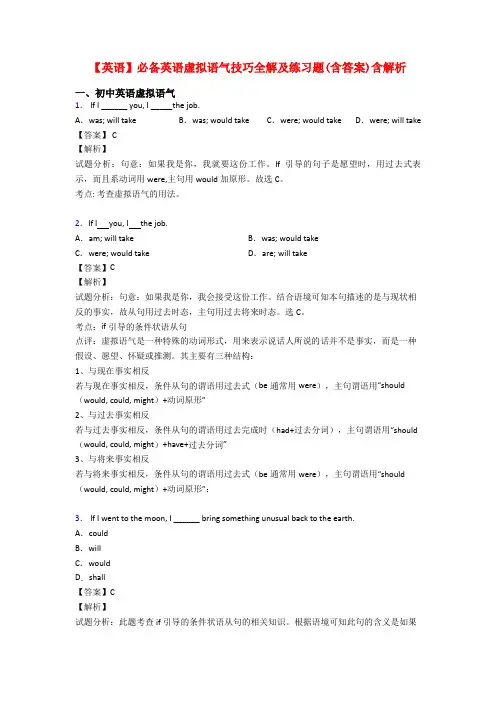
【英语】必备英语虚拟语气技巧全解及练习题(含答案)含解析一、初中英语虚拟语气1. If I ______ you, I _____the job.A.was; will take B.was; would take C.were; would take D.were; will take 【答案】 C【解析】试题分析:句意:如果我是你,我就要这份工作。
If引导的句子是愿望时,用过去式表示,而且系动词用were,主句用would加原形。
故选C。
考点: 考查虚拟语气的用法。
2.If I you, I the job.A.am; will take B.was; would takeC.were; would take D.are; will take【答案】C【解析】试题分析:句意:如果我是你,我会接受这份工作。
结合语境可知本句描述的是与现状相反的事实,故从句用过去时态,主句用过去将来时态。
选C。
考点:if引导的条件状语从句点评:虚拟语气是一种特殊的动词形式,用来表示说话人所说的话并不是事实,而是一种假设、愿望、怀疑或推测。
其主要有三种结构:1、与现在事实相反若与现在事实相反,条件从句的谓语用过去式(be通常用were),主句谓语用“should (would, could, might)+动词原形”2、与过去事实相反若与过去事实相反,条件从句的谓语用过去完成时(had+过去分词),主句谓语用“should (would, could, might)+have+过去分词”3、与将来事实相反若与将来事实相反,条件从句的谓语用过去式(be通常用were),主句谓语用“should (would, could, might)+动词原形”:3. If I went to the moon, I ______ bring something unusual back to the earth.A.couldB.willC.wouldD.shall【答案】C【解析】试题分析:此题考查if引导的条件状语从句的相关知识。
高中英语虚拟语气练习题(附答案)

高中英语虚拟语气讲解及练习虚拟条件句就是对现实条件的一种虚拟假设,所假设的条件一般不符合事实或与事实相反或在现实中发生的可能性极小。
根据时间的不同,虚拟条件句可分为三种,即与现在事实相反的虚拟条件句、与过去事实相反的虚拟条件句(1)表示与现在事实相反If I had enough money now, I would lend it to you.(2)表示与过去事实相反If he had taken your advice, he wouldn’t have made such a bad mistake.(3)表示与将来事实相反I would go shopping with you if it were to be Sunday tomorrow.1. 虚拟条件句的倒装在虚拟条件句中,为了强调所假设条件的虚拟性,或突出说话人的一种主观愿望,虚拟条件句可用倒装结构。
虚拟条件句的倒装是通过去掉if,把条件从句谓语中的助动词、情态动词或系动词放在句首实现的。
例如:Had I been(= If I had been ) in that situation, I would not have let the thief escape away with so much money.Should there be (= If there should be) a drought, what should we do at that time ?2. 错综时间条件句有时条件从句的动作和主句的动作发生的时间并不一致,这时谓语动词的形式应根据它所要表示的具体时间来确定。
例如:If we hadn’t been working hard in the past few years ,thing s wouldn’t be going so smoothly.3. 含蓄条件句有时假设的情况并不以条件从句的形式表现出来,而是通过某个介词或介词短语(如:with,otherwise,without,but for,in that position)、上下文或其它方式表现出来。
高中英语虚拟语气讲解及练习题(附答案)
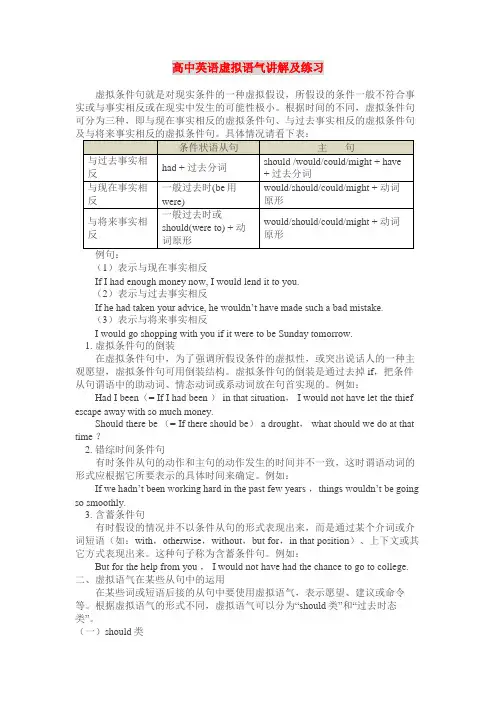
高中英语虚拟语气讲解及练习虚拟条件句就是对现实条件的一种虚拟假设,所假设的条件一般不符合事实或与事实相反或在现实中发生的可能性极小。
根据时间的不同,虚拟条件句可分为三种,即与现在事实相反的虚拟条件句、与过去事实相反的虚拟条件句(1)表示与现在事实相反If I had enough money now, I would lend it to you.(2)表示与过去事实相反If he had taken your advice, he wouldn’t have made such a bad mistake.(3)表示与将来事实相反I would go shopping with you if it were to be Sunday tomorrow.1. 虚拟条件句的倒装在虚拟条件句中,为了强调所假设条件的虚拟性,或突出说话人的一种主观愿望,虚拟条件句可用倒装结构。
虚拟条件句的倒装是通过去掉if,把条件从句谓语中的助动词、情态动词或系动词放在句首实现的。
例如:Had I been(= If I had been ) in that situation, I would not have let the thief escape away with so much money.Should there be (= If there should be) a drought, what should we do at that time ?2. 错综时间条件句有时条件从句的动作和主句的动作发生的时间并不一致,这时谓语动词的形式应根据它所要表示的具体时间来确定。
例如:If we hadn’t been working hard in the past few years ,thing s wouldn’t be going so smoothly.3. 含蓄条件句有时假设的情况并不以条件从句的形式表现出来,而是通过某个介词或介词短语(如:with,otherwise,without,but for,in that position)、上下文或其它方式表现出来。
虚拟语气技巧全解及练习题(含答案)

必备英语虚拟语气技巧全解及练习题(含答案) 一、初中英语虚拟语气 1.— I don’t know what to wear at the party. — If I you, I would wear a shirt and a tie. A.am B.is C.were D.was 【答案】C 【解析】 试题分析:if从句的虚拟语气,对于现在的虚拟用一般过去式,be动词都用were,故选C.句意:——我不知道聚会该穿什么。——如果我是你,我会穿一件衬衫加一条领带。故选C 考点:if条件句的虚拟语气 点评:if条件句的虚拟语气,是中考要求掌握的知识点,分为三种情况: 表示与现在事实相反的情况,从句谓语动词用一般过去式(be用were),主句谓语动词用should/would/could/might +do;2.表示与过去的事实相反的情况,从句谓语动词用过去完成时,主句谓语动词用should/would/could/might+have done;3.表将来的事实相反的情况,从句谓语动词用should+动词/did/were to do,主句谓语动词用should/would/could/might +do。
2.— What would you do if you _______ a million dollars? — I would give it to charity. A.have B.had C.will have D.would have 【答案】B 【解析】试题分析:句意:-如果你有一百万美元你会做什么?-我会把它捐给慈善事业。have 有;had 过去式;will have 一般将来时;would have 过去将来时。根据句意可知,这
里表示的是一个假设的问题,在if引导的条件状语从句中应该用虚拟语气,动词用过去式,故选B。 考点:考查虚拟语气。
3.If I ___ you, I ___ be afraid . A.was, wouldn’t B.were, won’t C.were, wouldn’t 【答案】C 【解析】 试题分析:根据语境可知此句的含义是如果我是你,我就不害怕。考查的是虚拟语气的基本用法。条件用过去时,主句要用过去将来时,故选C。 考点:虚拟语气 点评:虚拟语气其实就是if引导条件状语从句时,词义为“如果”,不过这个条件是无法实现的。从句中的谓语动词通常用一般过去时表示,则主句中的谓语动词用过去将来时。
高中英语虚拟语气讲解及练习题(附答案)

高中英语虚拟语气讲解及练习虚拟条件句就是对现实条件的一种虚拟假设,所假设的条件一般不符合事实或与事实相反或在现实中发生的可能性极小。
根据时间的不同,虚拟条件句可分为三种,即与现在事实相反的虚拟条件句、与过去事实相反的虚拟条件句(1)表示与现在事实相反If I had enough money now, I would lend it to you.(2)表示与过去事实相反If he had taken your advice, he wouldn’t have made such a bad mistake.(3)表示与将来事实相反I would go shopping with you if it were to be Sunday tomorrow.1. 虚拟条件句的倒装在虚拟条件句中,为了强调所假设条件的虚拟性,或突出说话人的一种主观愿望,虚拟条件句可用倒装结构。
虚拟条件句的倒装是通过去掉if,把条件从句谓语中的助动词、情态动词或系动词放在句首实现的。
例如:Had I been(= If I had been ) in that situation, I would not have let the thief escape away with so much money.Should there be (= If there should be) a drought, what should we do at that time ?2. 错综时间条件句有时条件从句的动作和主句的动作发生的时间并不一致,这时谓语动词的形式应根据它所要表示的具体时间来确定。
例如:If we hadn’t been working hard in the past few years ,thing s wouldn’t be going so smoothly.3. 含蓄条件句有时假设的情况并不以条件从句的形式表现出来,而是通过某个介词或介词短语(如:with,otherwise,without,but for,in that position)、上下文或其它方式表现出来。
(完整版)(完整版)虚拟语气练习题及答案详解(可编辑修改word版)

虚拟语气专项练习the book from1.1enjoyed the movie very much. I wish Iwhich it was made.A.have readB.had readC. should have readD. are reading2. You are late. If you a few minutes earlier, you him.A. come; would meetB.had come; would have metC. come; will meetD. had come; would meet3.The two students talked as if they friends for years.A.should beB.would beC.have beenD.had been4.It is important that I with Mr Williams immediately.A.speakB.spokeC.will speakD.to speak5. He looked as if he ill for a long time.A. wasB. wereC.has beenD. had been A. was B. wereC. have goneD. could have gone8.Let's say you could go there again, howthe fog, we should have reached our school.A. Because ofB. In spite ofC. In case ofD. But for6. If the doctor had come earlier, the poor child would not A. have laid there for two hours B. have been lied there fortwo hoursC. have lied there for two hoursD. have lain there for two hours7.1 wish that I with you last night.A. wentB. could gofeel?A. will youB. should youC. would youD. do you9.1 can't stand him. He always talks as though heeverything.A. knewB. knowsC. has knownD. had known10.A. had rainedB. would have rainedC. have seenD. rained11. If you had told me in advanee, Ianother ten minutes, the game would have been calledoff.A. would meetB. would had methim at the airportC. would have metD. would have meet12. Mike can take his car apart and put it back together again. I certainly wish he me how. A. teaches B. will teach C. has taughtD. would teach13.1 would have told him the answer had it been possible, but Iso busy then. A. had been B. were C. wasD. would be14. He's working hard for fear that he A. should fall behind B. fell behind C. may fall behindD. would fallen behind15. If itA. go to sleepB. went to sleepC. go to bedD. went to bedD. had17. My father did not go to New York; the doctor suggested that hethere.A. decided againstB. will decide against20. You look so tired tonight. It is time you16. He suggested that they use a trick in stead of fighti ng.A. shouldB. wouldC. doA. not wentB. won't goC. not goD. not to go18,1 would have gone to the meeting if I time.A. had hadB. have hadC. hadD. would have had19. Would you rather Ibuying a new bike?C. have decidedD. shall decide againstA. we'd meet themB. we'll meet themC. we'd have met themD. we've met them21. —Why didn't you buy a new car? —I would have bought one if I25. The Bakers arrived last night. If they'd oniy let us know earlier,at the station.eno ugh money.A. hadB. have hadC. would haveD. had had22. If she could sew, A. she make a dress B. she would have made a shirt C. she will make a shirtD. she would had made a coat23. today, he would get there by Friday.A. Would he leaveB. Was he leavingC. Were he to leave D ・ If he leaves24. His doctor suggested that hea short trip abroad.A. will takeB. would takeC. takeD. took26. If I you, I more attention to English idioms andp hrases.A.was; shall payB.am; will payC. would be; would payD. were; would pay27. We might have failed if you us a helping hand.A. have not givenB.would not giveC.had not givenD. did not give28. The law requires that everyone his car checked at least once a year.A. hasB. hadC. haveD. will have29. It is strange that he so.A. would sayB.would speakC.should sayD.will speak30. Had I known her name,A. or does she know mine?B. and where does she live?C.she would be beautiful. D・ I would have invited her to lunch.31. He has just arrived, but he talks as if he all about that.A. knowB. knowsC.knownD.knew32. If I the money, I would have bought a much bigger car.A. possessedB. ownedC. hadD.had had33. He was very busy yesterday; otherwise, he to the meeting.A. would comeB. cameC. would have comeD. will come34. The librarian insists that John no more books from the library before he returns all the books he has borrowed.A. will takeB. tookC. takeD. takes35.1 left very early last night, but I wish I so early.A. didn't leaveB. hadn't leftC. haven't left D, could n't leaveC. will goD. would goB. to beC. would beD. shall be39. Hele n could n't go to France after all. That's too bad. fm sure shewould have enjoyed it if36.1 do not have a job. I would find one but I no time.A. hadB. didn't haveC. had hadD. have37.1 wish that you such a bad headache because I'm sure thatyou would have enjoyed the concert. A. hadn't B. didn't have had C. hadn't hadD. hadn't have38. He insisted that we all in his office at one o'clock.A. beA. she's goneB. she'll goC. she'd goneD. she'd go40.1 must go there earlier John has suggested that I an hourbefore the discussion begins.A. goB. shall go1-5 BBDAD 6-10 DDCAD11-15 CDCAA 16-20 ACAAD21-25 DBCCC 26-30 DCCCD31-35 DDCCB 36-40 DCACD解析:1. Wish后面用虚拟语气,表示与过去事实相反用过去完成时。
【英语】必备英语虚拟语气技巧全解及练习题(含答案)
【英语】必备英语虚拟语气技巧全解及练习题(含答案)一、初中英语虚拟语气1.If I______ you, I would take a small present..A.am B.was C.were D.are【答案】C【解析】试题分析:句意:如果我我你,我会那个小的礼物。
句中用虚拟语气,系动词用were,故选C。
考点:考查虚拟语气。
2.--------- Come and join us, Jim!---------- I’m sorry I can’t . If I _______ time, I would certainly go.A.will have B.have had C.had D.had had【答案】C【解析】试题分析:虚拟语气是一种特殊的动词形式,用来表示说话人所说的话并不是事实,而是一种假设、愿望、怀疑或推测。
判断是真实条件句还是非真实条件句。
只有在非真实条件句中才使用虚拟语气。
通过句子意思,看假设的条件是否能够实现,能够实现是真实条件句,不能使用虚拟语气;假设的条件不能实现则是非真实条件句,要用虚拟语气.判断这个假设是与哪个事实相反。
(1)、与现在事实相反若与现在事实相反,条件从句的谓语用过去式(be通常用were),主句谓语用“should (would, could, might)+动词原形”(2)、与过去事实相反若与过去事实相反,条件从句的谓语用过去完成时(had+过去分词),主句谓语用“should (would, could, might)+have+过去分词”(3)、与将来事实相反若与将来事实相反,条件从句的谓语用过去式(be通常用were),主句谓语用“should (would, could, might)+动词原形”:句意:吉姆,来加入我们吧!抱歉,我不能。
如果我有时间,我肯定会去的。
结合语境可知下文中表示与现在相反的事实,故条件状语从句中用一般故去时态,选C。
英语语法专项:虚拟语气用法详解及练习(附答案)
高中英语虚拟语气讲解及练习虚拟条件句就是对现实条件的一种虚拟假设,所假设的条件一般不符合事实或与事实相反或在现实中发生的可能性极小。
根据时间的不同,虚拟条件句可分为三种,即与现在事实相反的虚拟条件句、与过去事实相反的虚拟条件句(1)表示与现在事实相反If I had enough money now, I would lend it to you.(2)表示与过去事实相反If he had taken your advice, he wouldn’t have made such a bad mistake.(3)表示与将来事实相反I would go shopping with you if it were to be Sunday tomorrow.1. 虚拟条件句的倒装在虚拟条件句中,为了强调所假设条件的虚拟性,或突出说话人的一种主观愿望,虚拟条件句可用倒装结构。
虚拟条件句的倒装是通过去掉if,把条件从句谓语中的助动词、情态动词或系动词放在句首实现的。
例如:Had I been(= If I had been ) in that situation, I would not have let the thief escape away with so much money.Should there be (= If there should be) a drought, what should we do at that time ?2. 错综时间条件句有时条件从句的动作和主句的动作发生的时间并不一致,这时谓语动词的形式应根据它所要表示的具体时间来确定。
例如:If we hadn’t been working hard in the past few years ,thing s wouldn’t be going so smoothly.3. 含蓄条件句有时假设的情况并不以条件从句的形式表现出来,而是通过某个介词或介词短语(如:with,otherwise,without,but for,in that position)、上下文或其它方式表现出来。
高中英语虚拟语气详解及练习(包含答案)
高中英语虚拟语气讲解及练习虚拟条件句就是对现实条件的一种虚拟假设,所假设的条件一般不符合事实或与事实相反或在现实中发生的可能性极小。
根据时间的不同,虚拟条件句可分为三种,即与现在事实相反的虚拟条件句、与过去事实相反的虚拟条件句(1)表示与现在事实相反If I had enough money now, I would lend it to you.(2)表示与过去事实相反If he had taken your advice, he wouldn’t have made such a bad mistake.(3)表示与将来事实相反I would go shopping with you if it were to be Sunday tomorrow.1. 虚拟条件句的倒装在虚拟条件句中,为了强调所假设条件的虚拟性,或突出说话人的一种主观愿望,虚拟条件句可用倒装结构。
虚拟条件句的倒装是通过去掉if,把条件从句谓语中的助动词、情态动词或系动词放在句首实现的。
例如:Had I been(= If I had been ) in that situation, I would not have let the thief escape away with so much money.Should there be (= If there should be) a drought, what should we do at that time ?2. 错综时间条件句有时条件从句的动作和主句的动作发生的时间并不一致,这时谓语动词的形式应根据它所要表示的具体时间来确定。
例如:If we hadn’t been working hard in the past few years ,thing s wouldn’t be going so smoothly.3. 含蓄条件句有时假设的情况并不以条件从句的形式表现出来,而是通过某个介词或介词短语(如:with,otherwise,without,but for,in that position)、上下文或其它方式表现出来。
高中英语虚拟语气练习题(附答案)
高中英语虚拟语气讲解及练习虚拟条件句就是对现实条件的一种虚拟假设,所假设的条件一般不符合事实或与事实相反或在现实中发生的可能性极小。
根据时间的不同,虚拟条件句可分为三种,即与现在事实相反的虚拟条件句、与过去事实相反的虚拟条件句(1)表示与现在事实相反If I had enough money now, I would lend it to you.(2)表示与过去事实相反If he had taken your advice, he wouldn’t have made such a bad mistake.(3)表示与将来事实相反I would go shopping with you if it were to be Sunday tomorrow.1. 虚拟条件句的倒装在虚拟条件句中,为了强调所假设条件的虚拟性,或突出说话人的一种主观愿望,虚拟条件句可用倒装结构。
虚拟条件句的倒装是通过去掉if,把条件从句谓语中的助动词、情态动词或系动词放在句首实现的。
例如:Had I been(= If I had been ) in that situation, I would not have let the thief escape away with so much money.Should there be (= If there should be) a drought, what should we do at that time ?2. 错综时间条件句有时条件从句的动作和主句的动作发生的时间并不一致,这时谓语动词的形式应根据它所要表示的具体时间来确定。
例如:If we hadn’t been working hard in the past few years ,thing s wouldn’t be going so smoothly.3. 含蓄条件句有时假设的情况并不以条件从句的形式表现出来,而是通过某个介词或介词短语(如:with,otherwise,without,but for,in that position)、上下文或其它方式表现出来。