
7A unit3沪教牛津版七年级上册
7A Unit3 The Earth
Date: July ,2013 Ⅰ核心词汇: Earth 地球 quiz 小测试 pattern 模式 protect 保护 report 报告 part 部分 land 陆地 v.登陆 field 田地 large 大的 provide 提供 pollution 污染 burn 燃烧 energy 能源 ground 地面 kill 杀死 important 重要的 fact 事实 kilometer 公里 own 拥有 catch 捕捉 problem问题 pollute(动词) 污染 call v.呼叫,称呼,打电话给··· Ⅱ重要短语: protect tne Earth 保护地球 protect sb./sth.from 保护某人/物,使不受伤害 provide…..with为…..提供 be covered by 被····覆盖 make energy 制造能源 put….into把…..倒入、放入)…… stop doing sth 停止做某事 (不做这件事了)只指一件事 stop to do sth停下来做某事 (停止做这件事,去做另外一件事) throw away扔掉 throw about 乱扔 如:Don’t throw about the waste paper. have a good time 玩得高兴 =enjoy oneself get up 起床
Ⅲ重点句型: 1.The Earth provides us with air,Water and food. 2.It's +形容词+for sb.+to do sth. 3.There be +主语+介词短语 4.We can ask people not to do sth.
Ⅳ详细讲解: 1.some are large.(page31) Large 大的。同义词:big 西丽的荔枝园真大(large),里面的荔枝好大个(big) Large 反义词:small,多指面积大 big 反义词:little,指体积大,还可以表示“巨大,伟大,重要”的意思 great 巨大的,伟大的,除了表示重量、体积外,还表示抽象的或者精神方面的 2.The Earth provides us with air,Water and food.(page31) Provide sb. with sth.为某人提供某物 Provide sth for sb. Provide 指“准备好必需品来供应” Yi fu Provides a room for studying Offer 指“主动地提供帮助、支撑” The girl Offered to help the old. 3.It's important for us to protect the Earth for our future.(page31) 为了我们的未来,保护地球很重要。 注意:It's +形容词+for sb.+to do sth. It在句中作形式主语,整整的主语为不定式to protect the Earth.动词不定式作主语,可以放在句前也可以放在句后。 句中的谓语动词用单数。 4.Air has no smell.空气无味。(page35) no:①修饰可数名词时,相当于not a/an 如:she has no brother=she doesn’t have a brother ②修饰不可数名词时或者可数名词复数时,相当于not any. There are no desk in the classroom.=There aren’t any desks in the classroom. 5.We can ask people not to eat shark fin soup.我们可以让人们不喝鱼翅汤。(page37) Ask sb. to do sth. 要求/请求某人做某事(固定搭配) Ask sb. not to do sth.要求/ 请求某人不要做某事 如:Our teachers always ask us to do homework after class. 6.Are there any other things we can do?有一些其他的事情我们可以做吗(page38) any “一些” 常用语否定句和疑问句中,还可以表示“任何”、“任何的” some 常用语肯定句中,表示委婉请求的疑问句或希望得到肯定回答的问句,用“some”。 7.We can take our own shopping bags to the supermarket.(page38) own 形容词“我们自己的” ; 动词 “拥有” own “拥有”指具有法律上的所有权 Who owns this house? have “拥有”表示某人拥有、具有、含有某物,是比较客观,强调所属关系 I have long hair and black eyes. 8.Fewer and fewer fish in the sea each year.(page39)海洋中的鱼越来越少。 ①Fewer and fewer 越来越少 比较级+and+比较级 表示“越来越···” more and more beautiful. ② fish 在这里表示可数名词 “鱼”。表示鱼的数量,单复数是一样的。 也可以表示不可数名词 “鱼肉”。 We have fish for dinner. 9.What problems do we have?我们有什么问题(page 39) problem 问题,难题。比较麻烦或者困难的问题, 相当于difficult question. About the earth’s problem 关于地球的问题 question 指比较容易解决或回答的问题 A math question一个数学问题 10.We need air to breath.我们需要空气来呼吸。 ①Need sb./sth. to do sth.需要某人/某物做某事 Need to do sth. 需要做某事 (You need to go there at once) Need doing sth. 需要做某事(主语是物,主动形式表被动:the flowers need watering.) ②Need也可作情态动词,但仅用于否定句或疑问句中,后接动词原形。 例:Does he need to hand in his examination paper now? 他需要现在交卷吗? - Must I finish my homework now?我必须先在完成我的作业吗? - No,you needn’t.不,不需要。 11.we can find out about different types of fish.我们发现不同的鱼类。(page41) find out 指经过观察、调查把事物查出来,搞清楚去,弄明白事情的真相。
find 偶然发现,也指通过一番寻找后有的结果,强调结果
Look for 寻找,有目的的找,强调寻找的动作
12.In the end,only one sun remained. In the end “最后,最终”常常是单独使用的。 At the end of “在···末尾” Ⅴ语法专讲:Grammar 一、名词的数: 名词按其所表示的事物的性质可分为可数名词和不可数名词两类。可数名词有复数形式。不可数名词一般没有复数形式。可数名词的单数往往要与补丁冠词a或an连用,复数则使用其复数形式。 (一)可数名词的单复数 1. 单数可数名词:表示名词的单数,要在名词前加不定冠词a或an. a加在以辅音开头的名词前,an加在以元音开头的名词前。如: a book an apple 2.复数可数名词 情况 构成方法 例词 一般情况 在词尾加s desk-desks girl-girls 以s,x,ch,sh结尾的词 在词尾加-es bus-buses Fish-fishes 以辅音字母加y结尾的词 变y为i再加-es Families Party-parties 以元音字母加y结尾的词 在词尾加-s Day-days Key-keys 以f或fe结尾的词 变f或fe为v再加-es Knife-knives Wife-wives 以辅音字母加o结尾的词 在词尾加-es Potato-potatoes Hero-heroes 英雄(heroes)爱吃西红柿(tomatoes)和土豆(potatoes)。 以元音字母加-o结尾的词 在词尾加-s Radio-radios Zoo-zoos 注意:
(1)少数以辅音字母加o结尾的名词变为复数时只加-s。 如:photo-photos相片 piano-pianos钢琴 zoo-zoos radio-radios (2)一些名词的不规则变化 ①元音发生变化 man-men男人 woman-women女人 foot-feet脚 tooth-teeth牙 ②单复数形式相同 Deer-deer鹿 fish-fish鱼 sheep-sheep绵羊 Chinese-Chinese中国人 ③词尾发生变化 Child-children孩子 ox-oxen公牛 ④ 有些名词只有复数形式 Clothes衣服 trousers裤子 glasses眼镜 scissors剪子 (二)不可数名词 1.不可数名词的确切数量的表达方式 当表示不可数名词的确切数量时,通常可在不可数名词前面加上表示数量的单位词。 a glass of water一杯水 two glasses of water两杯水 A kilo of meat一公斤肉 two kilos of meat两公斤肉 2.不可数名词的不确切数量的表达方式 当表示不可数名词的各种大概、不确切的数量时,课运用下列单词和短语: 单词:not (any) / no没有; little几乎没有 ;a little / some一些; most大部分; all全部 短语:a lot of / lots of /plenty of / much / a great deal of/.... 许多
沪教牛津版七年级英语上册 词组 Unit 3
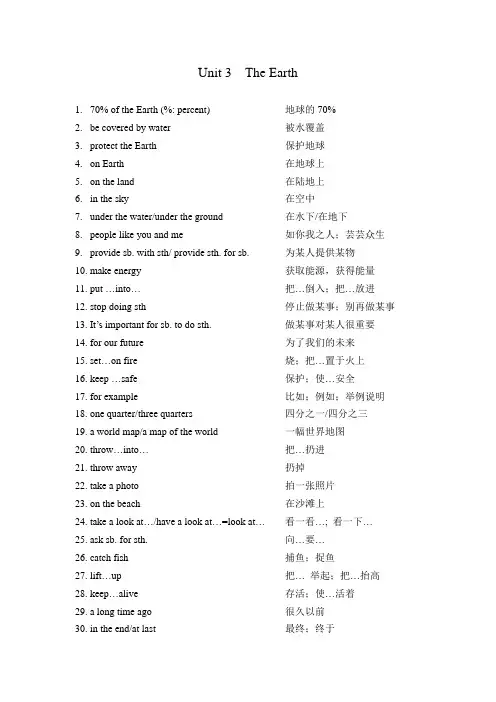
1.70% of the Earth (%: percent) 地球的70%2.be covered by water 被水覆盖3.protect the Earth 保护地球4.on Earth 在地球上5.on the land 在陆地上6.in the sky 在空中7.under the water/under the ground 在水下/在地下8.people like you and me 如你我之人;芸芸众生9.provide sb. with sth/ provide sth. for sb. 为某人提供某物10.make energy 获取能源,获得能量11.put …into…把…倒入;把…放进12.stop doing sth 停止做某事;别再做某事13.It’s important for sb. to do sth. 做某事对某人很重要14.for our future 为了我们的未来15.set…on fire 烧;把…置于火上16.keep …safe 保护;使…安全17.for example 比如;例如;举例说明18.one quarter/three quarters 四分之一/四分之三19.a world map/a map of the world 一幅世界地图20.throw…into…把…扔进21.throw away 扔掉22.take a photo 拍一张照片23.on the beach 在沙滩上24.take a look at…/have a look at…=look at…看一看…; 看一下…25.ask sb. for sth. 向…要…26.catch fish 捕鱼;捉鱼27.lift…up 把…举起;把…抬高28.keep…alive 存活;使…活着29.a long time ago 很久以前30.in the end/at last 最终;终于班级________________ 学号________________ 姓名________________1.地球的70%2.被水覆盖3.保护地球4.在地球上5.在陆地上6.在空中7.在水下/在地下8.如你我之人;芸芸众生9.为某人提供某物10.获取能源,获得能量11.把…倒入;把…放进12.停止做某事;别再做某事13.做某事对某人很重要14.为了我们的未来15.烧;把…置于火上16.保护;使…安全17.比如;例如;举例说明18.四分之一/四分之三19.一幅世界地图20.把…扔进21.扔掉22.拍一张照片23.在沙滩上24.看一看…; 看一下…25.向…要…26.捕鱼;捉鱼27.把…举起;把…抬高28.存活;使…活着29.很久以前30.最终;终于31.。
牛津上海版英语七上《Unit3 Travelling in Garden City》ppt课件-教育资料

Were there any air-conditioners in buses in the past? No, there weren’t.
What do most buses have nowadays? Most buses have air-conditioners.
Were there any women bus-drivers in the past? No, there weren’t. All of bus-drivers are men now, aren’t they? No, some are men, some are women.
ferry
Traffic lights
Traffic jams escalators
Revision
railway
Car parks
motorbike
Cross harbor tunnel
Learn new words A double-decker bus
A single-decker bus
.Reading :
Read written language in meaningful chunks . Recognize recurrent patterns in language structure . Recognize the presentation of ideas through paragraphing . Skim a text to obtain a general impression and the main ideas .
Compare the buses
conductor
types
s
In the past
牛津上海版英语七上《Unit 3 Travelling in Garden City》
Materials:
• • • • Students' Book 7A page 27 Cassette7A and a cassette player Wordbook 7A page 13 Multimedia
Revision
taxi
underground
bus
minibus
tram
Revision
4. Grammar Practice Book page 27-28
Compare the buses
conductor s
In the past
A conductor in each bus, collected money sold tickets
types
drivers
Only singledecker buses
Single-decker buses, doubledecker buses, airconditioned buses
Language skills :
• Listening :
Identify the main ideas of a new topic , Identify details that support a main idea. listening for specific information .
Module 2 Unit 3
traveling in Garden City
Language focus:
• Using nouns or noun phrases to identify objects . • Using the simple past tense to talk about past states . • Using the simple present tense to talk about present states . • Using adjectives to show quantities .
最新牛津上海版英语七年级上册《unit 3 travelling in garden city》教案.doc

Module 2 Change
Unit 3 Tra velling in Garden City
第一课时:是本节课的重点,Buses今昔对比。
重点之一是过去时;之二some of/most of/ all of/ none of …这节课是叶力老师的公开课,大家一起帮忙,课件弄得不错,课也上得很好。
开始:今昔上海对比,让同学回忆说句子:In the past, Sha nghai was…Nowadays, Shanghai is …接下来叶老师设计了两个问题:How did people trav el in the past? How do people travel nowadays? 真是太有才了!引出了单词、课文学习
网]
中间:叶老师设计了一个水果变化图,一举解决了some of/most of/ a ll of/ none of …的学习和操练!
最后:设计出bus-conductor叙述过去的历史以及passenger讲述nowadays的情况。
真的很好。
Indeed!
1。
牛津上海版英语七年级上册课件:Unit 3(共28张PPT)
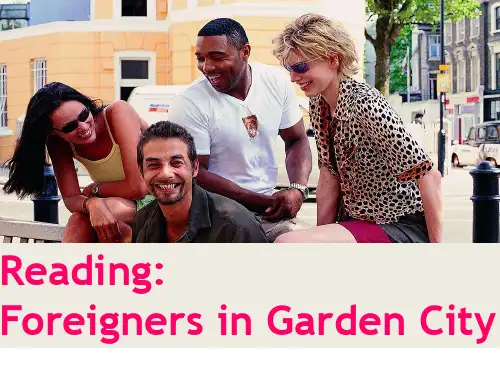
Canadian(s) American(s) British Indian(s) Australian(s) Japanese
28,940 27,700 25,500 20,950 20,210 19,010
S2: We call them _____. S1: How many _____
live in Garden City? S2: More than _____.
12345
Read, ask and answer
People in Garden City
S1: What do we call
Country
People Number
people from _____?
Canada the USA/America the UK/Britain India Australia Japan
What do we call people from the USA ? We call them Americans .
• Workbook 7A, page 15. • Read page 16 and recite. • Write “pair work” of the table (page 16) .
9-6
She is an Australian. They are Australians
123456789
9-7
He is a Japanese. They are Japanese
123456789
Look and read
12345
5-1
True or False
5-1
1. Garden City is a crowd city. F
牛津上海英语七年级上册 Unit3Writing(共18张PPT)

Judy is a clever student.
She can answer all questions in class.
She can work out difficult Maths problems by herself.
age
pet …
My penfriend
① I have a penfriend called Connie. She is from America. She is 13 years old. She is a slim girl with long hair and black eyes.
② She lives with her parents. She has a warm family. She studies at Sunshine Junior High School. She is in Grade 7 and her favourite subject is Science.
Tip 1 :Choose what to write about a person.
What hav选e择y描o写u 内kn容own about Connie?
school work
family
interests
nationality
Connie’s
age personality
pet
…
appearance
④ Connie helps me a lot in many ways . Sometimes we discuss our study in our letters. When I have trouble, she always gives me some suggestions.
牛津上海版七年级英语上册Unit 3知识点汇总
牛津上海版七年级英语上册Unit 3知识点汇总Unit 3 Friends from other countriesI 词组:1. friends from other countries 来自其他国家的朋友2. a crowded city 一个拥挤的城市3. for example 例如4. more than --- over 超过;多于5 most of them 他们中的大多数6. six million--- 6000000 六百万7. call sb….把…...称作8. near 距离…近9. far away from 距离…远10. read (sth.) about 阅读与…有关的…11. in magazines and newspapers 在报纸、杂志上12. know about 知道关于…的事情13. write (a letter) to 给…写信14. in another country 在另一个国家15. at school 在上学,在校求学16. make a list 列一个清单17. a list of 一份…的清单18. send sth. to sb./ send sb. sth. 把….寄(送)给…19. a photo of my family 一张我家人的照片20. write soon 请尽快回信21. in Grade 7 就读于七年级22. junior high school 初级中学23. thank sb. for sth./ doing sth. 为某事/做某事而感谢某人24. favourite subject 最喜欢的科目II. 词性转换:1. foreigner n.外国人Nowadays, more and more foreigners come to stay and work in Shanghai.foreign adj.外国的 a foreign language2. crowded adj.拥挤的Shanghai is a crowded city. Nanjing Road is always crowded with people.crowd n.人群3. Canada n.加拿大Canadian n.&adj.加拿大人;加拿大的I am Canadian. (adj.) 我是加拿大人。
沪教牛津版七年级上册unit 3复习-最新教学文档
Unit 3一、重点词汇梳理1. protect 保护【考点】同义词= keep...safe2. large 大的【同义词】= very big3. provide 提供【考点】1. 同义词 = give2. 固定搭配 provide sb with sth / provide sth for sb 提供某人某物4. pollute 污染【考点】1. 同义词= make…dirty2. 名词形式:pollution5. energy 能量【考点】同义词 = power6. kill 杀死【考点】同义词= make (i)7. must 必须【考点】情态动词,后面必须接动词原形例:Everyone must be quiet.8. in fact 事实上【考点】同义词词组 = actually9. own 自己的【考点】1. 动词,拥有 = have2. 形容词,自己的 = personal10.catch 捕捉【考点】过去式:caught11. throw丢【考点】1. 过去式:threw2. 词组:throw away 丢掉12. put…into…把…倒入…14. stop 停止【考点】1.stop to do sth 停下来做…2. stop doing sth 停止做…15.句型:it is important for us to protect the Earth for our future.【考点】句型:it is +adj +for sb to do sth 对某人来说,做某事是怎么样的16.We burn things to make energy. 我们燃烧东西去制造能量【考点】1. burn 燃烧= set …on fire2. to do sth表示目的【同步习题】一、单选题( ) 1. The T-shirt is too large. I want a small one.A. dirtyB. shortC. big( ) 2. Watch out! That big snake may kill you.A. make … dieB. make … sadC. make … laugh( ) 3. Don’t play computer games. It is a waste of (浪费) time and energy.A. powerB. moneyC. heart( ) 4. I really want you to tell me the fact.A. dreamB. truthC. sound( ) 5. I love our school. It provides us with free books.A. givesB. showsC. borrows( ) 6. We sometimes burn wood to get fire in winter.A. make ... very strongB. set ... on fireC. cut ... into pieces( ) 7. I have a beautiful room. I like it very much.A. warmB. smallC. nice( ) 8. We can get a lot of knowledge (知识) at school.A. a littleB. littleC. much( ) 9. Rubbish pollutes river. We should not throw away it.A. makes ... dirtyB. makes ... longC. makes ... clean( )10. — The Earth is our home. We should protect it.—Right. Let’s begin now.A. m ake ... cleanB. make ... safeC. make... beautiful ( )11. — Tom, you must wash your hands before dinner.—OK, Mom. I will.A. canB. shouldC. have to( )12. If you want to know a __________, you want to know something real.A. factB. lieC. problem( )13. If you __________ animals, you make them become dead.A. protectB. killC. bum( )14. — There is too much __________ now.—Yes. People should not pollute the Earth.A. energyB. practiceC. pollution( )15. — Tom,don’t __________ these old books. We can give them to other children.— OK, Dad.A. throw awayB. look forC. put into( )16. — What can we do to protect the Earth?—__________A. Going outside is a good idea!B. We can take our own shopping bags.C. We can go shopping together.二、填空题1. Everyone needs air. We use it ____(breath).2. We burn some wood _____(make) energy.3. People must stop _____(kill) animals and protect them.4. Some students like to provide the old people ____ their own things.5. The air _____(pollute) is worse and worse, we should do something to protect our earth.6. We must ______(protect) our home by doing what we can.二、重点语法梳理1. 可数名词1)有复数形式, 在many / some / a lot of / lots of / other / different/数词等后面的可数名词需用到复数形式2)可数名词单数前可用a / an2. 不可数名词1)无复数形式,much/a little / some / a lot of / lots of后面的不可数名词永远是单数形式;不可用a/an修饰2)不可数名词的量化,three cups of coffee, two glasses of milk.3. there be 句型,主要是考察be的单复数1).There is a big apple on the table.2). There is a little water in the bottle.3). There are some students on the playground.4). There are some cups of coffee on the table.5). 就近原则: There is an apple and some pears in the bag.There are some pears and an apple in the bag.【典型例题】1.Are there other ____(thing) we can do?2.I want to learn about different _______(place) in the world.3.I want to show you some ______(photo) about my travel in HongKong.4.There _____(be) some green in the cup, do you like it?5.Many ______(German) like living in the city.6.My English teacher gave me some _____(piece) of advice about learning English.7. Everyone should brush his ______(tooth) every day.三、重点句型梳理1. 在地球上还有很多像你和我这样的人There are many people like you and me on Earth.2. 地球提供给我们空气,水和食物The earth provides us with air, water and food.3. 我们焚烧东西来制造能量We burn things to make energy.4. 这个污染了地球,杀死了动植物This pollutes the Earth and kills animals and plants5. 我们必须停止做这些事情,对我们来说,为了我们的未来,保护我们地球是很重要的We must stop doing these things. It is important for us to protect the Earth for our future.四、综合题型练习AIt is very important to deal with (处理)the rubbish in cities. For one thing, rubbish may make a lot of 11. It may pollute the air, the water and the places we 12 in. For another, too much rubbish is 13 for people’s health. In our city, people deal with the rubbish 14. First, people think there are 15 kinds of rubbish. They can 16 the good kind of rubbish again, for example, old newspapers and glass. People put the bad kind of rubbish under the 17. Before the waste water 18 into the river, people make it become 19. People even make laws (法律)against rubbish. But that’s not enough. We all must try our best to 20 rubbish from polluting the Earth. It is important to save our city and our living places.()11. A. field B. money C. pollution()12. A. live B. stand C. arrive()13. A. sad B. bad C. good()14. A. hardly B. early C. well()15. A. one B. two C. three()16. A. complete B. throw C. use()17. A. ground B. river C. sea()18. A. finds B. goes C. meets()19. A. clean B. s hort C. dirty()20. A. like B. help C. stopBThe Earth goes around the Sun, and the Moon goes around the Earth. When our part of the Earth turns to the Sun, it's the day. When our part of the Earth turns away from the Sun, it is the night.The Sun is much bigger than the Moon. But sometimes the Moon looks bigger than the Sun because it's much nearer to the Earth. The Sun is very bright. It gives very strong light. The Moonlooks very bright too. But it doesn't give any light.The Moon looks much bigger and brighter than the stars. But in fact, the stars are much bigger than the Moon. They look smaller than the Moon because they're much farther (更远的) away from us.( ) 6. ______ goes around the Earth.A. The MoonB. The MarsC. The SunD. The star( ) 7. When it is the night, _______.A. we can't see any stars in the skyB. the Moon looks much smaller than the starsC. our part of the Earth turns away from the SunD. our part of the Earth turns to the Sun( ) 8. Why does the Moon look bigger than the Sun sometimes?A. Because the Moon comes out only at night.B. Because the Moon is bigger than the Sun.C. Because the Moon is far away from the Earth.D. Because the Moon is much nearer to the Earth.( ) 9. Which of the following is TRUE?A. The stars are much farther away from us than the Moon.B. The Sun is bright but it gives weak light.C. The stars look much bigger than the Moon.D. The stars are not bigger than the Moon.( ) 10. We may read this passage in a_____.A. storybookB. magazineC. cookbookD. comic bookCThe Earth is about 4,600 million years old. People live on Earth for only 35,000 years. But we change (改变) the Earth in many ways. Many things we do are good, but some are not good for the Earth. Water pollutionA lot of people, birds and fish die each day because of water pollution. Factories pollute the water. As a result, the water in many rivers and lakes is now very dirty.Air pollutionIn big cities, factories, cars and buses are the main causes (原因) of air pollution. Many people in cities now have health problems. For example, Mexico used to be a beautiful sunny capital, but today there are many clouds in the sky. And many people get ill because of the polluted air.Soil (土壤) pollutionIn order to have a better harvest(收获), some farmers use chemicals (化学物质) in their fields. That’s bad for the soil.Hope for the futureThese problems are very serious(严重的) for our future, so all of us should do something to protect the environment. If we can stop pollution, the Earth will become more and more beautiful.( ) 1. How old is the Earth?A. About 4,600 million years old.B. About 3,500 million years old.C. About 4,800 million years old.D. About 3,700 million years old.( ) 2. Which of the following make the Earth change a lot?A. Plants.B. People.C. Animals.D. Clouds.( ) 3. There are_____ kinds of pollution in this passage.A. twoB. threeC. fourD. five( ) 4. Which of the following is NOT true?A. Mexico is not a beautiful sunny capital now.B. The water in many rivers and lakes is now very dirty because of factories.C. Now fewer farmers use chemicals in the fields.D. Factories, cars and buses can cause air pollution.( ) 5. The writer wrote this passage to ask us to_______.A. learn about the EarthB. thank the EarthC. clean the EarthD. protect the Earth。
沪教牛津版七年级上册英语Unit 3 课时3 Grammar
能力提升练
答案呈现
21 beautiful 26 are
22 animals 27 throw 23 dangerous 28 important
24 grass
29 ask
25 on
30 friends
一、用所给单词的正确形式填空。
1. (易错题)There________(be) are
somecakesandacupofteaonthetable.
牛津沪教版七年级上
Unit3TheEarth
课时3Grammar
提示:点击 进入习题
语法通关练
1 are 2 is 3 bottles
6 is 7 Are 8 is
4 factories
9 Is
5 potatoes
10 Are
答案呈现
11 C 12 D 13 C 14 C 15 A
语法通关练
16 Whatelse 17 glassesof 18 What'sinside 19 throw; into 20 takeaphoto
2. There________ (be)
t跟lhote其sroe后fbfo的eo句d是isa型nsdo遵vme循gee就ctaa近bklee原ssf,则ro所m,以a因ll要o为v用e紧rChinaforthepe aorpele。inneed. 3.【中考·天津】Mum, canIhavetwo________ (bottle)
ofmilkthismorning?
bottles
4. Therearefive___f_a_c_to_r_i_es(factory) inthetown. 5. (易错题)Mygrandpahastwo________ (potato)
七年级第一学期牛津上海版英语Unit 3 课件(第3课时,共22张ppt)
Country
near
flag (read about) Far Nationality language away from
America
Americans English
Britain
British English
、 迟 到 、 早 退、途 离堂等 现象,教 导处加 强随堂 检查。 2、 着 力 抓 好 学生的 “一日
Hong Kong
Where is Hong Kong? -It’s in the ______ of China. A.east B.west C.south D.north
Look and read
平。
7、 坚 持 走 科 研兴校 、兴教 之路,积 极开 展教育 科研活 动,加强 校本培 训,提升 办学水 平。
8、 加 快 学 校 教学信 息化和 多媒体 教学的 建设。 三 、 具 体 工 作要求
强 化 教 学 管 理,规范 教学常 规 1、 严 格 执 行 课程计 划,坚 持按课 表上课 ,保质保 量上好 每节课 ,杜绝私 自调课 、旷课
S1: India
S2: S1: S2: S1: S2:
Indians
20,950
Australia
S1: S2: S1: S2: S1: S2:
20,210 kangaroo Koala
Australians
19,010
Japan Fuji
Japanese
Thailand
15,900
Thai
India
the Philippines
Hong Kong