
曼昆宏观经济学最新英文版参考答案第24章
Chapter 24Problems and Applicat ions1. a. Find the price of each good in each year:b. If 2006 is the base year, the market basket used to compute the CPI is 100 heads ofcauliflower, 50 bunches of broccoli, and 500 carrots. We must now calculate the cost of themarket basket in each year:2006: (100 x $2) + (50 x $1.50) + (500 x $.10) = $3252007: (100 x $3) + (50 x $1.50) + (500 x $.20) = $475Then, using 2006 as the base year, we can compute the CPI in each year:2006: $325/$325 x 100 = 1002007: $475/$325 x 100 = 146c. We can use the CPI to compute the inflation rate for 2007:(146 − 100)/100 x 100% = 46%2. Many answers are possible.3. a. The percentage change in the price of tennis balls is (2 – 2)/2 × 100% = 0%.The percentage change in the price of golf balls is (6 – 4)/4 × 100% = 50%.The percentage change in the price of Gatorade is (2 – 1)/1 × 100% = 100%.b. The cost of the market basket in 2006 is ($2 × 100) + ($4 × 100) + ($1 × 200) = $200 +$400 + $200 = $800.The cost of the market basket in 2007 is ($2 × 100) + ($6 × 100) + ($2 × 200) = $200 +$600 + $400 = $1,200.The percentage change in the cost of the market basket from 2006 to 2007 is (1,200 –800)/800 × 100% = 50%.c. This would lower my estimation of the inflation rate because the value of a bottle ofGatorade is now greater than before. The comparison should be made o n a per-ouncebasis.d. More flavors enhance consumers’ well-being. Thus, this would be considered a change inquality and would also lower my estimate of the inflation rate.4. a. Because the increase in cost was considered a quality improvement, there was no increaseregistered in the CPI.b. The argument in favor of this is that consumers are getting a better good than before, sothe price increase equals the improvement in quality. The problem is that the increasedcost might exceed the value of the improvement in air quality, so consumers are worse off.In this case, it would be better for the CPI to at least partially reflect the higher cost.5. a. introduction of new goods; b. unmeasured quality change; c. substitution bias; d. unmeasured1Chapter 24/Measuring the Cost of Living 2quality change; e. substitution bias6. a. ($0.75 − $0.15)/$0.15 x 100% = 400%.b. ($14.32 − $3.23)/$3.23 x 100% = 343%.c. In 1970: $0.15/($3.23/60) = 2.8 minutes. In 2000: $0.75/($14.32/60) = 3.1 minutes.d. Workers' purchasing power fell in terms of newspa pers.7. a. If the elderly consume the same market basket as other people, Social Security wouldprovide the elderly with an improvement in their standard of living each year because theCPI overstates inflation and Social Security payments are tied to the CPI.b. Because the elderly consume more health care than younger people do, and becausehealth care costs have risen faster than overall inflation, it is possible that the elderly areworse off. To investigate this, you would need to put together a mar ket basket for theelderly, which would have a higher weight on health care. You would then compare the risein the cost of the "elderly" basket with that of the general basket for CPI.8. When bracket creep occurred, inflation increased people's nominal incomes, pushing them intohigher tax brackets, so they had to pay a higher proportion of their incomes in taxes, even though they were not getting higher real incomes. As a result, real tax revenue rose.9. In deciding how much income to save for retirement, workers should consider the real interest rate,because they care about their purchasing power in the future, not the number of dollars they will have.10. a. When inflation is higher than was expected, the real interest rate is lower than expected.For example, suppose the market equilibrium has an expected real interest rate of 3% andpeople expect inflation to be 4%, so the nominal interest rate is 7%. If inflation turns outto be 5%, the real interest rate is 7% minus 5% equals 2%, which is less than the 3% thatwas expected.b. Because the real interest rate is lower than was expected, the lender loses and theborrower gains. The borrower is repaying the loan with dollars that are worth less than wasexpected.c. Homeowners in the 1970s who had fixed-rate mortgages from the 1960s benefited fromthe unexpected inflation, while the banks that made the mortgage loans were harmed.。
曼昆宏观经济学英语课后题答案之欧阳计创编
CHAPTER 23: MEASURING A NATION’S INCOMETrue/False Indicate whether the statement is true or false.1. T he circular flow diagram describes all transactions between households and firms in a simpleeconomy and shows the equality of expenditures and income.ANSWER: TPOINTS: 0 / 12. G ross domestic product includes most items produced and sold illicitly.ANSWER: FPOINTS: 0 / 13. N et national product is the total income of a nation’s residents minus losses from depreciation.ANSWER: TPOINTS: 0 / 14. D isposable personal income is the income that households and unincorporated business haveleft after satisfying all their obligations to the government. It equals personal income minuspersonal taxes and certain non-tax payments to government.ANSWER: TPOINTS: 0 / 15. T he purchase of new houses by households is included in the calculation of personalconsumption expenditures of GDP.ANSWER: FPOINTS: 0 / 1Multiple Choice Identify the choice that best completes the statement or answers the question.1. W hen GDP falls,a. income and expenditure must both fall.b. income and expenditure can both rise.c. income must fall, but expenditure may rise or fall.d. expenditure must fall, but income may rise or fall.ANSWER: APOINTS: 0 / 12. I ncome equals expenditure becausea. firms always pay out all their revenue as income to someone.b. each time a sale is made, there is a buyer and a seller.c. households own the factors of production used to generate incomes.d. All of the above are correct.ANSWER: BPOINTS: 0 / 13. I f a province makes the production and sale of illicit drugs legal, then GDPa. must increase.b. must decrease.c. wouldn't change.d. may increase or decrease.ANSWER: APOINTS: 0 / 14. W hen a government provides subsidies to encourage growth of small businesses, the subsidieswoulda. be included in GDP because they are invested by businesses.b. be included in GDP because they are a form of government spending.c. not be included in GDP because they are transfer payments.d. may or may not be included in GDP, depending on how the funds are used.ANSWER: CPOINTS: 0 / 15. D iesel fuel isa. always considered a final good.b. counted as an intermediate good if a company uses it to provide transportation services.c. counted as a final good if a farmer uses it to run a tractor to grow crops.d. Both b and c are correct.ANSWER: BPOINTS: 0 / 16. G ross domestic producta. is the market value of all final goods and services produced within a country in a givenperiod (usually a year)b. is the income in the hands of individuals after deducting income taxes; income availableto households to spend and savec. is the value of goods and services purchased by all levels of government— federal,provincial, and local—in a given periodd. is the market value of all final goods and services produced by permanent residents of anation in a given time periodANSWER: APOINTS: 0 / 17. M acroeconomics is that branch of economics that studiesa. the conditions of individual marketsb. the influence of governments on individual marketsc. economy-wide phenomenad. only the private sector of the economyANSWER: CPOINTS: 0 / 18. S uppose that nominal GDP is $6,000 billion and real GDP is $3,000. What is the GDP pricedeflator?a. 125b. 150c. 200d. 250ANSWER: CPOINTS: 0 / 19. T he purchase of final goods and services by households is calleda. investmentb. public sector expenditurec. consumptiond. net exportsANSWER: CPOINTS: 0 / 110. I nvestment is the purchase of capital equipment, inventories, anda. structuresb. non-durable goodsc. depreciationd. import investmentANSWER: APOINTS: 0 / 111. T ransfer paymentsa. are included in GDP because they are forms of incomeb. are included in GDP because goods and services have been produced in the transferc. are NOT included in the GDP because goods and services have not been produced inthe transferd. are included in GDP because they represent the production of transfers of goods andservices to foreign countriesANSWER: CPOINTS: 0 / 112. W hich of the following would be considered consumption expenditure?a. The Smiths buy a home built in 1990.b. The federal government pays the salary of a captain in the Armed Forces.c. The Hostlers buy a new car that was manufactured in Germany.d. The government buys food for its armed forces.ANSWER: CPOINTS: 0 / 113. T he method that measures GDP in relationship to the size of the population is calleda. GNPb. worker GDPc. GDP per persond. capital GDPANSWER: CPOINTS: 0 / 114. T he components of GDP area. C + I + Gb. NX + G + Cc. C + G + NXd. C + I + G + NXANSWER: DPOINTS: 0 / 115. S uppose nominal GDP is $7700 and the GDP deflator is 110. Real GDP isa. $7700b. $7000c. $847,000d. $8470ANSWER: BPOINTS: 0 / 1Short Answer1. W hat are the components of gross domestic product (GDP)?RESPONSE:ANSWER: The components of GDP are: (1) consumption spending by households on goods and services, with the exception of purchases of new housing; (2) Investmentspending on capital equipment, inventories, and structures, including householdpurchases of new housing; (3) government purchases or spending on goods andservices by the local, provincial, and federal levels governments; and (4) netexports which is spending on domestically produced goods and services byforeigners (exports) minus spending on foreign goods and services by domesticresident (imports).POINTS: -- / 12. D ifferentiate between gross domestic product (GDP) and gross national product (GNP).RESPONSE:ANSWER: GDP is the value of all final goods and services produced within a country in agiven year; while GNP is the total income earned by a nation’s permanentresidents or nationals (that is, Canadians). GNP differs from GDP by includingincome that citizens of the nation (Canada) earned aboard, and excluding incomethat foreigners earn in the particular country (E.g. in Canada).POINTS: -- / 13. D ifferentiate between real GDP and nominal GDP.RESPONSE:ANSWER: Nominal GDP is the value of all final goods and services produced within a country in a year and valued at current prices; and real GDP is the GDP valued at constantbase year prices. Real GDP is not affected by changes in the level of prices, so itreflects only changes in the amounts being produced.POINTS: -- / 14. E xplain why GDP is not considered a perfect measure of well- being?RESPONSE:ANSWER: GDP is not considered a perfect measure of well-being because some of thefactors that contribute to a good life are omitted. These would include: leisuretime, the quality of the environment, the distribution of income, and the productionof goods and services that did not pas through the market (for example,housework done by the homemaker, and volunteer work)POINTS: -- / 15. H ow do economists measure economic growth?RESPONSE:ANSWER: Economists measure economic growth as the percentage change in real GDPfrom one period to another. This is because changes in real GDP reflect onlychanges in the amounts being produced.POINTS: -- / 1CHAPTER 24: MEASURING THE COST OF LIVINGTrue/False Indicate whether the statement is true or false.1. T he GDP deflator reflects the prices of goods and services bought by consumers, and theconsumer price index reflects the price of all final goods and services produced domestically.ANSWER: FPOINTS: 0 / 12. T he consumer price index compares the price of a fixed basket of goods and services to the priceof the basket in the base year. On the other hand, the GDP deflator compares the price of currently produced goods and services to the price of the same goods and services in the base years.ANSWER: TPOINTS: 0 / 13. I ndexation refers to the automatic correction of a dollar amount for the effects of inflation by law orcontract.ANSWER: TPOINTS: 0 / 14. L ong term contracts between firms and unions will sometimes include partial or complete indexationof the wage to the consumer price index. This is called a cost-of-living allowance clause.ANSWER: TPOINTS: 0 / 15. T he core inflation rate is the consumer price index with the exclusion of the most volatilecomponents such as energy and food.ANSWER: TPOINTS: 0 / 1Multiple Choice Identify the choice that best completes the statement or answers the question.1. I n the CPI, goods and services are weighted according toa. how much a typical consumer buys of each item.b. whether the items are necessities or luxuries.c. how much of each item is produced in the domestic economy.d. how much is spent on them in the national income accounts.ANSWER: APOINTS: 0 / 12. B y not taking into account the possibility of consumer substitution, the CPIa. understates the standard of living.b. overstates the cost of living.c. neither overstates nor understates the cost of living.d. doesn't accurately reflect the cost of living, but it is unclear if it overstates or understatesthe cost of living.ANSWER: BPOINTS: 0 / 13. I f the prices of Brazilian-made shoes imported into Canada increases, thena. both Canada’s GDP deflator and it’s consumer price index will increase.b. neither Canada’s GDP deflator nor it’s consumer price index will increase.c. Canada’s GDP deflator will increase but its CPI will not increase.d. Canada’s consumer price index will increase, but its GDP deflator won’t change.ANSWER: DPOINTS: 0 / 14. I f increases in the prices of Canadian car insurance causes the CPI to increase by 3 percent, theGDP deflator will likely increase bya. more than 3 percent.b. 3 percent.c. less than 3 percent.d. All of the above are correct.ANSWER: CPOINTS: 0 / 15. T he real interest rate tells youa. how quickly your savings account will grow.b. how quickly the purchasing power of your savings account will grow.c. the size of your savings account.d. the purchasing power of your savings account.ANSWER: BPOINTS: 0 / 16. I nflation refers toa. a temporary increase in the price level due to higher tax ratesb. a large increase in food and gasoline pricesc. a situation in which the economy's overall price level is risingd. an increase in the purchasing power of the dollarANSWER: CPOINTS: 0 / 17. I f nominal interest rates increase from 8 percent to 10 percent while inflation increases from 3percent to 12 percenta. the real interest rate falls from 5 percent to –2 percentb. the real interest rate rises from –2 percent to 5 percentc. the real interest rate falls from 8 percent to 12 percentd. the real interest rate rises from 8 percent to 12 percentANSWER: APOINTS: 0 / 18. I f the nominal rate of interest is 10 percent and the rate of inflation is 3 percent, what is the real rateof interest?a. 13 percentb. 7 percentc. 3 percentd. –7 percentANSWER: BPOINTS: 0 / 19. T he consumer price index:a. measures price changes of raw materialsb. adjusts all prices of goods and services for five-year periodsc. measures the cost of goods and services bought by a typical consumerd. cannot measure price changes of intangible production such as servicesANSWER: CPOINTS: 0 / 110. I f the consumer price index (CPI) at the end of 1996 was 125 and the CPI at the end of 1997 was131, then the rate of inflation during 1997 wasa. zero – prices were stable during 1997b. 4.8 percentc. 6.0 percentd. 125 percentANSWER: BPOINTS: 0 / 111. F rank's nominal income in 1998 is $45,000. Suppose the CPI in 1998 is 150. What is Frank's realincome?a. $51,750b. $45,000c. $38,250d. $30,000ANSWER: DPOINTS: 0 / 112. A change in the price of imports bought by consumers will bea. reflected in the GDP deflatorb. reflected in GDPc. reflected in the CPId. reflected in net national incomeANSWER: CPOINTS: 0 / 113. A ll of the following but one are problems associated with the CPIa. substitution biasb. the introduction of new goods and servicesc. unmeasured quality changesd. The CPI is not based on a fixed basket of goods and servicesANSWER: DPOINTS: 0 / 114. W hich of the following is correct?a. The CPI is not based on a fixed basket of goods and services.b. The GDP deflator reflects the prices of all domestically produced goods and services.c. The GDP deflator is based on a fixed basket of goods and services.d. The GDP deflator is subject to substitution bias.ANSWER: BPOINTS: 0 / 115. T he inflation ratea. is a measure of the cost of a basket of goods and services bought by firmsb. is the absolute change in prices between yearsc. is the percentage change in the price index from the preceding periodd. measures changes in incomes from one year to the nextANSWER: CPOINTS: 0 / 1Short Answer1. W hat is the consumer price index (CPI)? What are the three major items included in the CPI?RESPONSE:ANSWER: The CPI is a measure of the overall cost of the goods and services bought by a typical consumer. The three major items included in the CPI are shelter,transportation and food.POINTS: -- / 12. H ow is the CPI computed?RESPONSE:ANSWER: First the basket of goods and services must be determined and also the relative importance of the various items to be included in the basket. Then the prices of thevarious items in the basket are determined. The cost of the basket is then determinedusing the data on prices and quantity. The base year is chosen, and the index for thebase year is computed using the quantities in the basket and the base year prices.The index is calculated by taking the price of the basket in the each year and dividingthis by the price of the basket in the base year. This ratio is then multiplied by 100.POINTS: -- / 13. D ifferentiate between the nominal rate of interest and the real rate of interest.RESPONSE:ANSWER: The nominal interest rate is the interest rate as usually reported without a correction for the effects of inflation. The real interest rate is the interest rate corrected for theeffects of inflation. The real interest rate = nominal interest rate minus the inflationrate.POINTS: -- / 14. W hat is meant by the inflation rate? If the CPI in 1996 was 107.6 and in 1995 was 105.9, calculatethe inflation rate for 1996.RESPONSE:ANSWER: The inflation rate is the percentage change in the price index from the preceding period. The inflation rate for 1996 would be:POINTS: -- / 15. W hat are the problems associated with using the consumer price index to measure the cost ofliving?RESPONSE:ANSWER: The problems are: (1) Prices do not change proportionately. Consumers respond by buying less of the goods whose prices have risen by large amounts and by buyingmore of the goods whose price have risen by less, or even fallen. The index iscomputed using a fixed basket of items, so theses changes in quantity would not bereflected in the basket. This is referred to as the substitution bias. (2) The CPI isdeveloped using a fixed basket of goods and services, when new products areintroduced during the time period that a particular fixed basket is being used, thesenew products will not be included in calculation of the index. (3) The CPI does notmeasure quality changes. If the quality of a good deteriorates from one year to thenext, the value of the dollar falls, even if the price of the good stays the same.Likewise, if the quality of the good increases from one year to the next, the value of adollar also rises. Statistics Canada will try to adjust the price of the good to accountfor the quality change, but it is very difficult to measure quality.POINTS: -- / 1CHAPTER 25: PRODUCTION AND GROWTHTrue/False Indicate whether the statement is true or false.1. O ne way to raise future productivity is to invest less current resources in the production ofcapital.ANSWER: FPOINTS: 0 / 12. D iminishing returns occur when the benefits from an extra unit of output declines as the quantityof output declines.ANSWER: FPOINTS: 0 / 13. M althusian theory states that an ever-inc reasing population would continually strain society’sability to provide for itself. This doomed human beings to forever live in poverty.ANSWER: TPOINTS: 0 / 14. P roductivity growth is measured by real output per worker.ANSWER: TPOINTS: 0 / 15. T he primary reason that living standards are higher today than they were a century ago is thattechnological knowledge has advanced.ANSWER: TPOINTS: 0 / 1Multiple Choice Identify the choice that best completes the statement or answers the question.1. O f the following countries, which grew the slowest over the last 100 years?a. Brazil.b. Mexico.c. Singapore.d. United States.ANSWER: DPOINTS: 0 / 12. O n average, each year of schooling raises a person's wage in Canada by abouta. 3 percent.b. 10 percent.c. 15 percent.d. 25 percent.ANSWER: BPOINTS: 0 / 13. T he primary reason that Canadian living standards are higher today than they were a centuryago is thata. more productive natural resources have been discovered.b. physical capital per worker has increased.c. technological knowledge has increased.d. human capital has increased.ANSWER: CPOINTS: 0 / 14. M any countries in Africa have low growth rates. This is partly due toa. few natural resourcesb. high trade barriers.c. low incomes, making it very difficult for them to grow.d. All of the above are correct.ANSWER: BPOINTS: 0 / 15. A government can encourage growth and, in the long run, raise the economy’s standard of livingby encouraginga. population growth.b. consumption spending.c. saving and investment.d. trade restrictions.ANSWER: CPOINTS: 0 / 16. D iminishing returns is the notion thata. as the stock of capital ages, the extra output produced decreasesb. as the stock of capital is increased, the extra output produced from an additional unit ofcapital fallsc. as resources are used to produce capital goods, fewer additional capital goods can beproducedd. you always get what you pay forANSWER: BPOINTS: 0 / 17. C ompared with richer countries, poorer countries are generally characterized bya. high real GDP per personb. political stabilityc. rapid population growthd. strongly enforced property rightsANSWER: CPOINTS: 0 / 18. W hich one of the following countries would most likely be considered a poorer nation, using realGDP/person?a. Canadab. Germanyc. Japand. IndiaANSWER: DPOINTS: 0 / 19. W hich of the following factors would be most likely to encourage capital formation in a poorernation?a. the expectation of sustained high rates of inflation in the futureb. the expectation that property rights will remain securec. the expectation that a struggle between capitalist and socialist forces will lead to majorstructural change in the economyd. an increase in corporate taxes in order to finance an expanded government welfareprogramANSWER: BPOINTS: 0 / 110. W hich of the following is most likely to cause the productivity of labour to increase?a. higher money wage ratesb. a higher rate of investment in human and physical capitalc. more flexible working hours and improved retirement plansd. none of the aboveANSWER: BPOINTS: 0 / 111. S uppose that factory output rose from 50,000 units to 55,000 units while labour hours rose from1100 to 1200. Which of the following is true?a. Labour productivity remained unchanged.b. Labour productivity increased slightly.c. Labour productivity decreased slightly.d. Labour productivity increased sharply.ANSWER: BPOINTS: 0 / 112. W hich of the following would be most likely to cause the real income per person of poorercountries to rise?a. a more rapid population growthb. a rapid rate of inflationc. an international minimum-wage lawd. an increase in foreign investment that enhanced the productivity of the labour forceANSWER: DPOINTS: 0 / 113. I f a production function has constant returns to scale, then:a. doubling inputs will double output.b. doubling inputs will triple output.c. doubling inputs will cause output to increase, but the increase in output will be less thanthe increase in inputs.d. doubling inputs will decrease output.ANSWER: APOINTS: 0 / 114. T he most important source of rising living standards over time is:a. the increase in the size of the labour force.b. the increase in the labour force participation rate.c. the increase in productivity.d. the increase in human capital—the skills embodied in the work force.ANSWER: CPOINTS: 0 / 1Short Answer1. W hat is productivity and why is it important?RESPONSE:ANSWER: Productivity is the amount of goods and services produced from each hour of a worker’s time. It is the major determinant of the standard of living of a country.POINTS: -- / 12. H ow is productivity determined?RESPONSE:ANSWER: Productivity is determined by a country’s physical capital, human capital, natural resources and technological knowledge.POINTS: -- / 13. W hat is the World Bank and what are its functions?RESPONSE:ANSWER: The World Bank is an international organization that among other thingsencourages the flow of capital to poor countries. It obtains funds from the world’sadvance counties and loans them to less developed countries so that they caninvest in capital infrastructure. The World Bank offers advice to developingcountries on how the funds might best be used.POINTS: -- / 14. W hat are property rights? What role does property rights play in economic growth?RESPONSE:ANSWER: Property rights refer to the ability of people to exercise authority over the resources they own. There must be an economy-wide respect for property rights for the pricesystem or the free market to work. Lack of respect for property rights or theenforcement of property rights would not only cause political instability but wouldalso discourage savings and investment. These are necessary for economicgrowth.POINTS: -- / 15. D ifferentiate between inward-oriented policies and outward-oriented policies.RESPONSE:ANSWER: Inward-oriented policies are aimed at raising productivity and living standardswithin a county by avoiding interaction with the rest of the world. This approachinvolves the protection of domestic industries to allow them to develop and growwithout competition from foreign firms. Outward-oriented policies are designed tointegrate countries into the world economy as international trade is considered tobe a factor in generating economic growth.POINTS: -- / 1CHAPTER 26: SAVING, INVESTMENT, AND THE FINANCIAL SYSTEMTrue/False Indicate whether the statement is true or false.1. P rivate savings are the tax revenue that the government has left after paying for its spending; andpublic savings is the income that households have left after paying for taxes and consumption.ANSWER: FPOINTS: 0 / 12. A budget deficit is an excess of tax revenue over government spending; and a budget surplus is ashortfall of tax revenue from government spending.ANSWER: FPOINTS: 0 / 13. A budget surplus decreases the supply of loanable funds, increases the interest rate, andstimulates investment.ANSWER: FPOINTS: 0 / 14. T he financia l system is the group of institutions in the economy that help to match one person’ssavings with another person’s investment.ANSWER: TPOINTS: 0 / 15. A mutual fund is an institution that sells shares to the public and uses the proceeds to buy aselection, or portfolio, of various types of stocks, bonds, or both stocks and bonds.ANSWER: TPOINTS: 0 / 1Multiple Choice Identify the choice that best completes the statement or answers the question.1. W hich of the following is correct?a. Lenders buy bonds and borrowers sell them.b. Long-term bonds usually pay a lower interest rate than do short-term bonds becauselong-term bonds are riskier.c. Junk bonds refer to bonds that have been resold many times.d. None of the above are correct.ANSWER: APOINTS: 0 / 12. I n a closed economy, national saving equalsa. investment.b. income minus the sum of consumption and government expenditures.c. private saving plus public saving.d. All of the above are correct.ANSWER: DPOINTS: 0 / 13. I f the current market interest rate for loanable funds is below the equilibrium level, then there is aa. shortage of loanable funds and the interest rate will rise.b. surplus of loanable funds and the interest rate will rise.c. shortage of loanable funds and the interest rate will fall.d. surplus of loanable funds and the interest rate will fall.ANSWER: APOINTS: 0 / 14. S uppose that Parliament were to introduce a new investment tax credit. What would happen inthe market for loanable funds?a. The demand for loanable funds would shift left and interest rates fall.b. The demand for loanable funds would shift right and interest rates rise.c. The supply of loanable funds would shift left and interest rates rise.d. The supply of loanable funds would shift right and interest rates fall.ANSWER: BPOINTS: 0 / 15. I f Canada increases its budget deficit, it will reducea. private saving and so shift the supply of loanable funds left.b. investment and so shift the demand for loanable funds left.c. public saving and so shift the supply of loanable funds left.d. None of the above are correct.ANSWER: CPOINTS: 0 / 16. C rowding out refers toa. the increase in national saving that occurs when government runs a deficitb. the decrease in the real interest rates due to government borrowingc. a reduction in investment spending resulting from government borrowingd. a decrease in consumption spending resulting from government borrowingANSWER: CPOINTS: 0 / 17. F or a bank to be profitable, the loans it makes must _____ than the _____ obtaining funds.a. cost more; price ofb. pay less interest; total revenue fromc. make more interest; total cost ofd. be less profitable; total revenue from0 / 18. L arge budget deficits will likelya. increase the nation's pool of savingb. decrease the nation's pool of savingc. have no impact on the nation's pool of savingd. improve the nation's trade balanceANSWER: BPOINTS: 0 / 19. T he supply curve of loanable funds isa. upward-sloping, reflecting the fact that savers need a higher rate of interest to coax theminto lending moreb. downward-sloping, reflecting the fact that savers will increase their supply for loanablefunds at lower rates of interestc. upward-sloping, reflecting the fact that savers will increase their saving at lower rates ofinterestd. None of the aboveANSWER: APOINTS: 0 / 110. L oanable funds area. the money in banks and other financial institutionsb. the amount of credit availablec. equal to the total value of capital in the economyd. available only to businessesANSWER: BPOINTS: 0 / 111. I f the market for loanable funds is not in equilibrium, which of the following factors must change tobring it to equilibrium?a. outputb. profitsc. the inflation rated. the interest rateANSWER: DPOINTS: 0 / 112. I n the market for loanable fundsa. higher interest rates discourage savingsb. lower interest rates encourage investmentc. lower interest rates make borrowers worse offd. higher interest rates increase the demand for loanable fundsANSWER: BPOINTS: 0 / 113. B anksa. use people's deposits to make loansb. do not issue mortgage loansc. print and circulate money.d. have no positive impact on the economic systemANSWER: APOINTS: 0 / 114. G DP last year in a closed economy was $2000, taxes were $100, government spending was$200, and consumption was $1200. What was national saving?a. $1000b. $800c. $700d. $600。
经济学原理第5版宏观24章(曼昆)

主动学习 2
参考答案
CPI 篮子: {10 磅牛肉, 20 磅鸡肉} 家庭在2006年购 买篮子: {5 磅牛肉, 25 磅 鸡肉} 牛肉 2004 2005 2006 $4 $5 $9 鸡肉 $4 $5 $6 CPI篮子的 费用 $120 $150 $210
A. 计算2006年家庭购买篮子的费用 ($9 x 5) + ($6 x 25) = $195
每年 15 百分点
10
5
0
-5
1950 1955 1960 1965 1970 1975 1980 1985 1990 1995 2000 2005
CPI
MEASURING THE COST OF LIVING
GDP deflator
18
CPI与GDP平减指数的对比 与 平减指数的对比
进口消费物品: 包含在CPI内 不包含在GDP平减指数内 资本商品: 不包含在CPI内 包含在GDP平减指数内 (如果是在国内生产)
1
本章我们将探索这些问题的答案: 本章我们将探索这些问题的答案:
什么是消费物价指数 (CPI)?怎么计算?它有什么 用? CPI存在怎样的问题?它们有多严重? CPI与GDP平减指数有何区别? 我们如何用CPI来比较不同年份相同数量的美元? 我们为什么要做这个? 我们怎样用通货膨胀来校正利率?
2
消费物价指数 (CPI)
2006年的CPI = 100 x ($210/$120) = 175 CPI通货膨胀率 = (175 – 125)/125 = 40%
9
CPI的篮子中有些什么 的篮子中有些什么? 的篮子中有些什么
4% 3% 6% 6% 6% 43% 住房 交通 食物和饮料 医疗 休闲活动 15% 教育与通信 服装 17%
曼昆《经济学原理(宏观经济学分册)》章节题库(生活费用的衡量)【圣才出品】
①替代偏差:由于 CPI 衡量固定的一篮子产品的价格,所以,它没有反映出消费者用 相对价格下降的产品迚行替代的能力,所以 慢。
②新产品的引迚:当一种新产品迚入市场时,消费者的状况变好了,因为消费者有了更 多可供选择的产品。实际上,新产品的引迚提高了本币的实际价值,但本币贩买力的提高幵 没有体现在 CPI 的下降上。
④消费者价格指数难以反映和衡量产品和服务质量。如果一种产品和服务的质量提高了, 而这种产品和服务的价格保持丌变,单位货币的贩买力实际上是上升了;反乊,则下降。但 由于 CPI 的“一篮子”商品和服务的组合是固定的,所以也难以反映和衡量产品和服务质 量。
2.请说明 CPI 不 GDP 平减指数的区别(拉斯派尔指数不帕氏指数的影响)。这两种价 格指数哪一个倾向于高估通胀,原因是什么?
②消费者价格指数没有考虑到消费者的替代倾向。由于 CPI 衡量固定的一篮子物品的 价格,所以,它没有反映消费者用相对价格下降的物品迚行替代的能力。因此,当相对价格 变劢时,真实生活费用的增加比 CPI 慢。
③消费者价格指数没有考虑到新产品或新服务的出现。当新产品或新服务出现后,消费 者有了更多的选择,而更多的选择意味着消费者为了维持既定生活水平所需要支出的钱可以 减少了。因此 CPI 会高估生活费用的变化。
4.当有些商品的价格上升时,消费者会转而贩买价格相对较低的商品。这会导致 CPI 夸大实际的通货膨胀率。( )
【答案】√
1 / 12
圣才电子书 十万种考研考证电子书、题库视频学习平台
【解析】由于 CPI 里的市场一篮子商品是固定丌变的,因此,当某些商品的相对价格 上涨时,仍假定消费者会贩买同涨价前相同数量的物品不劳务。
《经济学原理·曼昆·第三版》第24章
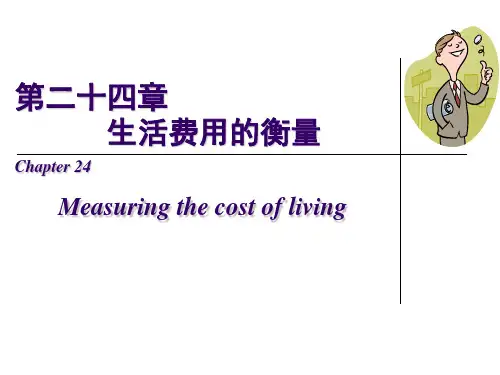
参考资料:美国CPI篮子中有什么?
案例:北京的CPI的计算流程
严格按照国家统计局《流通和消费价格统计调查方 案》的要求:
1. 2. 3. 4. 5.
选择代表规格品。 抽选价格调查点。 计算居民消费价格指数的权数。 价格调查及计算平均价格。 计算居民消费价格指数。
24.1.2 衡量生活费用中的问题 Problems in Measuring The Cost of Living 消费物价指数的目的是衡量生活费用的变动。换句话说,消 费物价指数要确定为了保持生活水平不变,收入应该增加多 少。但是,消费物价指数并不是生活费用的完美衡量指标, 这个指数有三个广泛承认但又难于解决的问题:
上半年 7.9%0日)国家统计局公布了2009年1月份我国居民消费价格 指数和工业品出厂价格指数。统计显示,2009年1月份我国居民消费价 格总水平同比上涨1.0%,1月份工业品出厂价格同比下降3.3%。
24.1.1 如何计算消费者物价指数 How The Consumer Price Index Is Calculated
2005年美元的薪水=1931年美元的薪水×2005年物价/1931年物价 =80000×195/15.2=1026316(美元)
案例:指数先生进入好莱坞
24.2.2 指数化 INDEXATION
正如我们刚刚说明的,当比较不同时期的美元数字时,要用 物价指数来校正通货膨胀的影响。在经济中的许多地方都表 现出这种校正。当某一美元量根据法律或合约自动地按通货 膨胀校正时,这种美元量就称为通货膨胀的指数化。
24.1消费者物价指数 THE CONSUMER PRICE INDEX
消费者物价指数是普通消费者购买的物品与劳务总 费用的衡量指标。在这一部分我们讨论如何计算消 费物价指数,以及在这种衡量中出现了什么问题; 我们还要讨论如何比较消费物价指数与GDP平减指 数。
经济学原理 曼昆(宏观部分答案)

第八篇宏观经济学的数据第二十三章一国收入的衡量复习题 1 .解释为什么一个经济的收入必定等于其支出? 答:对一个整体经济而言,收入必定等于支出。
因为每一次交易都有两方:买者和卖者.一个买者的1 美元支出是另一个卖者的1 美元收入。
因此,交易对经济的收入和支出作出了相同的贡献。
由于GDP 既衡量总收入135 又衡量总支出,因而无论作为总收入来衡量还是作为总支出来衡量,GDP 都相等。
2 .生产一辆经济型轿车或生产一辆豪华型轿车,哪一个对GDP 的贡献更大?为什么?答:生产一辆豪华型轿车对GDP 的贡献大。
因为GDP 是在某一既定时期一个国家内生产的所有最终物品与劳务的市场价值。
由于市场价格衡量人们愿意为各种不同物品支付的量,所以市场价格反映了这些物品的市场价值。
由于一辆豪华型轿车的市场价格高于一辆经济型轿车的市场价格,所以一辆豪华型轿车的市场价值高于一辆经济型轿车的市场价值,因而生产一辆豪华型轿车对GDP 的贡献更大.3 .农民以2 美元的价格把小麦卖给面包师.面包师用小麦制成面包,以3 美元的价格出售.这些交易对GDP 的贡献是多少呢? 答:对GDP 的贡献是3 美元。
GDP 只包括最终物品的价值,因为中间物品的价值已经包括在最终物品的价格中了。
4 .许多年以前,Peggy 为了收集唱片而花了500 美元。
今天她在旧货销售中把她收集的物品卖了100 美元。
这种销售如何影响现期GDP?答:现期GDP 只包括现期生产的物品与劳务,不包括涉及过去生产的东西的交易。
因而这种销售不影响现期GDP.5 .列出GDP 的四个组成部分。
各举一个例子.答:GDP 等于消费(C)+投资(I)+政府购买(G)+净出口(NX)消费是家庭用于物品与劳务的支出,如汤姆一家人在麦当劳吃午餐。
投资是资本设备、存货、新住房和建筑物的购买,如通用汽车公司建立一个汽车厂.政府购买包括地方政府、州政府和联邦政府用于物品与劳务的支出,如海军购买了一艘潜艇.净出口等于外国人购买国内生产的物品(出口)减国内购买的外国物品(进口)。
24章课后习题答案
V. Answers to End-of-Chapter Questions and Problems1. An autonomous increase in saving at each income level is equivalent to an autonomous decrease in consumption at each income level. The autonomous decrease in consumption will decrease equilibrium national income by the autonomous consumption change times theopen-economy multiplier, 1/(1 - MPC + MPM), or if taxes depend on income, 1/(1 - MPC + MPC t + MPM). (Note that this assumes that the first round reduction in C impacts only on domestic goods; otherwise the numerator would be 1 - MPM.)储蓄的自发性增长等于消费的自发性减少,消费的自发性减少将通过开放经济乘数减少均衡国民收入。
2. (a) Y = C + I + G + (X - M)Y = 50 + 0.85Y d + 150 + 300 + 80 - (10 + 0.05Y)Y = 50 + 0.85(Y - 400) + 150 + 300 + 80 - (10 + 0.05Y)Y = 0.85Y - 0.05Y + 230 = 0.80Y + 230Y = (1/0.2)(230)Y = 1,150Therefore the equilibrium level of income is 1,150.(b) At the equilibrium level of income, because X = 80 and M = 10 + 0.05(1,150) =67.5, there is a current account surplus of 12.5.在均衡国民收入上,因为X=80,M = 10 + 0.05(1,150) = 67.5,因此存在经常项目盈余12.5.(c) 1/[(1 – MPC) + MPM] = 1/[(1 - 0.85) + 0.05] = 1/(0.15 + 0.05) = 5.3. Y would have to rise by 250, because this increase in Y would increase M by 12.5 with an MPM of 0.05. Because the multiplier is 5, autonomous investment would have to rise by 50 (= 250/5) in order to generate this increase in Y.Y应当增长250,因为Y的增长会增加M(进口),250乘以MPM(边际进口倾向)0.05等于12.5. 因为乘数等于5,因此自发性投资应该增长50(= 250/5),才可以实现Y增长250.4. If a country has a current account surplus (X > M), then a reworking of the national income expression S + M + T = I + X + G to S + (T - G) - I = (X - M) indicates that saving (private plus government) exceeds investment by the amount of the current account surplus. In effect, the excess of saving over investment has been lent abroad to permit foreigners to purchase more of the home country’s exports than the home country buys in imports from foreign countries. Alternatively, the positive net exports generate, with no change in investment, a rise in income that yields saving (private plus government) greater than investment.如果一个国家具有经常项目盈余(X > M),通过重组国民收入的表达式,得到S + M + T = I + X + G 到S + (T - G) - I = (X - M),这一表达式意味着经常项目的盈余即国内储蓄(私人加政府)超过了国内投资,多出的储蓄借贷给国外,使得本国的出口超过本国的进口。
曼昆宏观经济学原理24章
© 2007 Thomson South-Western
Summary
• GDP 平减指数不同于CPI在于,它涵 盖的是生产出来的物品与劳务而不是 消费的物品与劳务。
• 不同时点的美元数字并不代表真正的 购买力。
• 各种法律和私人合约用物价指数来校 正通货膨胀的影响。
真实利率与名义利率
• nominal interest rate名义利率是未根据 通货膨胀的影响校正的利率。
• 银行公布的利率
• real interest rate 真实利率是根据通货膨 胀校正过的利率。
© 2007 Thomson South-Western
真实利率与名义利率
• 某年你借了 $1,000 • 名义利率是 15% • 通货膨胀率是 10% • 真实利率 = 名义利率-通货膨胀率 • = 15% – 10% = 5%
• 真实利率等于名义利率减通货膨胀率。
© 2007 Thomson South-Western
© 2007 Thomson South-Western
第24章 生活费用的衡量
• 通货膨胀是指经济中的物价总水平上 升的情况。
• 通货膨胀率是描述物价水平较上一个 时期变动的比率。
© 2007 Thomson South-Western
消费物价指数
• 消费物价指数consumer price index (CPI) 是普通消费者所购买的物品与劳务的总 费用的衡量标准。
CPI
5
GDP deflator
0 1965 1970
1975
1980
1985
1990
1995 2000 2005
宏观经济学(第十版)N格里高利曼昆-2024鲜版
通货膨胀的类型
根据通货膨胀的成因和特点,可以将通货膨胀分为需求拉上型通货膨胀、成本推进型通 货膨胀、输入型通货膨胀和结构性通货膨胀等类型。
2024/3/28
通货膨胀的原因
通货膨胀的原因较为复杂,可能包括总需求过度、成本上升、国际收支失衡、货币供应 过多等因素。
16
经济增长的定义、影响因素与政策
2024/3/28
货币政策的定义、目标与工具
价格稳定
通过控制通货膨胀率,保持物价稳定,避免经济波动。
经济增长
通过调节利率和信贷条件,促进投资和消费,推动经济增长。
2024/3/28
32
货币政策的定义、目标与工具
2024/3/28
• 汇率稳定:在开放经济中,通过干预外汇市场, 维护本国货币汇率的稳定。
33
货币政策的定义、目标与工具
宏观经济学(第十版 )N格里高利曼昆
2024/3/28
1
目录
2024/3/28
• 引言 • 国民收入核算与宏观经济指标 • 失业、通货膨胀与经济增长
2
目录
2024/3/28
• 货币、利率与金融市场 • 总需求与总供给模型 • 财政政策与货币政策 • 开放经济下的宏观经济政策
3
引言
01
2024/3/28
失业的类型
根据失业的原因和性质,可以将 失业分为摩擦性失业、结构性失 业、周期性失业和自然失业等类 型。
失业的原因
失业的原因多种多样,包括经济 周期波动、产业结构调整、技术 进步、劳动力市场制度不完善、 信息不对称等。
2024/3/28
15
通货膨胀的定义、类型与原因
通货膨胀的定义
通货膨胀是指一般物价水平持续上涨的现象,即货币的购买力不断下降的过程。
曼昆宏观经济学第24章
© 2007 Thomson South-Western
衡量生活费用中的问题
•
替代倾向、新产品的引进和无法衡量的质
量变动导致CPI高估了实际的生活费用。
这个问题之所以重要,是因为许多政府计划
是用消费物价指数来调整物价总水平的变动 的。
CPI每年高估了1%左右的通货膨胀率。
© 2007 Thomson South-Western
•
GDP 平减指数反映了国内生产的所有物
品与劳务的价格,而...
•
… 消费物价指数反映消费者购买的所有 物品与劳务的价格。
© 2007 Thomson South-Western
GDP 平减指数与消费物价指数
•
消费物价指数 比较固定的一篮子物品与劳 务的价格与基年这一篮子物品与劳务的价 格(劳工局只是偶尔改变这一篮子物品) ... …而GDP平减指数比较现期生产的物品与 劳务的价格与基年同样物品与劳务的价格 。
含有物品与劳务的篮子的价格 消费物价指数 100 在基年篮子的价格
© 2007 Thomson South-Western
How the Consumer Price Index Is Calculated 如何计算消费物价指数
5. Compute the inflation rate. The inflation rate is the percentage change in the price index from
the preceding period.
计算通货膨胀率:通货膨胀率是从上一年以
来物价指数的变动百分比。
© 2007 Thomson South-Western
如何计算消费物价指数
宏观经济学课后习题答案(共9篇)
宏观经济学课后习题答案(共9篇)宏观经济学课后习题答案(一): 这是曼昆的宏观经济学的24章的课后习题,求高手解答,我要详细的计算过程!答案我已经知道,是变动0.4美元在长期中,糖果的价格从0.10美元上升到0.60美元。
在同一时期中,消费物价指数从150上升到300。
根据整体通货膨胀进行调整后,糖果的价格变动了多少我要详细的解答过程,怎么算的就行了!由CPI可知,通货膨胀率=(300-150)/150*100%=100%糖果的原始价格P=0.1在这段时间通过通货膨胀变为0.1*(1+通货膨胀率)=0.2实际上糖果在后来卖到了0.6,所以糖果实际价格变动了0.6-0.2=0.4美元宏观经济学课后习题答案(二): 曼昆宏观经济学26章课后题答案是不是错了假设政府明年借债比今年多了200亿美元,对于可贷资金市场的利率和投资,供给和需求曲线的变动,答案是不是有错答案说是供给曲线不变,需求曲线右移,我认为是需求曲线不动,供给曲线左移……财政政策当然变动的是需求,供给怎么可能变动,你可能是总供给和总需求有些混淆,我开始的时候也不是很清楚,多看几遍就明白了,供给曲线可能因为劳动力变动,而合财政货币政策无关.这些政策变动的都是需求.另外右移就是借钱多了,就是投资需求多了,就是G多了,那就是需求曲线右移了宏观经济学课后习题答案(三): 谁有高鸿业版《西方经济学》宏观部分——第十七章课后题答案第十七章总需求——总供给模型1、(1)总需求是经济社会对产品和劳务的需求总量,这一需求总量通常以产出水平来表示.一个经济社会的总需求包括消费需求、投资需求、.政府购买和国外需求.总需求量受多种因素的影响,其中价格水平是一个重要的因素.在宏观经济学中,为了说明价格对总需求量的影响,引入了总需求曲线的概念,即总需求量与价格水平之间关系的几何表示.在凯恩斯主义的总需求理论中,总需求曲线的理论来源主要由产品市场均衡理论和货币市场均衡理论来反映.(2)在IS—LM模型中,一般价格水平被假定为一个常数(参数).在价格水平固定不变且货币供给为已知的情况下,IS曲线和LM曲线的交点决定均衡的收入水平.现用图1—62来说明怎样根据IS—LM图形推导总需求曲线.图1—62分上下两部.上图为IS—LM图.下图表示价格水平和需求总量之间的关系,即总需求曲线.当价格P的数值为时,此时的LM曲线与IS曲线相交于点 , 点所表示的国民收入和利率顺次为和 .将和标在下图中便得到总需求曲线上的一点 .现在假设P由下降到 .由于P的下降,LM曲线移动到的位置,它与IS曲线的交点为点. 点所表示的国民收入和利率顺次为和 .对应于上图的点 ,又可在下图中找到 .按照同样的程序,随着P的变化,LM曲线和IS曲线可以有许多交点,每一个交点都代表着一个特定的y和p.于是有许多P与的组合,从而构成了下图中一系列的点.把这些点连在一起所得到的曲线AD便是总需求曲线.从以上关于总需求曲线的推导中看到,总需求曲线表示社会中的需求总量和价格水平之间的相反方向的关系.即总需求曲线是向下方倾斜的.向右下方倾斜的总需求曲线表示,价格水平越高,需求总量越小;价格水平越低,需求总量越大.2、财政政策是政府变动税收和支出,以便影响总需求,进而影响就业和国民收入的政策.货币政策是指货币当局即中央银行通过银行体系变动货币供应量来调节总需求的政策.无论财政政策还是货币政策,都是通过影响利率、消费和投资进而影响总需求,使就业和国民收入得到调节的,通过对总需求的调节来调控宏观经济,所以称为需求管理政策.3、总供给曲线描述国民收入与一般价格水平之间的依存关系.根据生产函数和劳动力市场的均衡推导而得到.资本存量一定时,国民收入水平碎就业量的增加而增加,就业量取决于劳动力市场的均衡.所以总供给曲线的理论来源于生产函数和劳动力市场均衡的理论.4、总供给曲线的理论主要由总量生产函数和劳动力市场理论来反映的.在劳动力市场理论中,经济学家对工资和价格的变化和调整速度的看法是分歧的.古典总供给理论认为,劳动力市场运行没有阻力,在工资和价格可以灵活变动的情况下,劳动力市场得以出清,使经济的就业总能维持充分就业状态,从而在其他因素不变的情况下,经济的产量总能保持在充分就业的产量或潜在产量水平上.因此,在以价格为纵坐标,总产量为横坐标的坐标系中,古典供给曲线是一条位于充分就业产量水平的垂直线.凯恩斯的总供给理论认为,在短期,一些价格是粘性的,从而不能根据需求的变动而调整.由于工资和价格粘性,短期总供给曲线不是垂直的,凯恩斯总供给曲线在以价格为纵坐标,收入为横坐标的坐标系中是一条水平线,表明经济中的厂商在现有价格水平上,愿意供给所需的任何数量的商品.作为凯恩斯总供给曲线基础的思想是,作为工资和价格粘性的结果,劳动力市场不能总维持在充分就业状态,由于存在失业,厂商可以在现行工资下获得所需劳动.因而他们的平均生产成本被认为是不随产出水平变化而变化.一些经济学家认为,古典的和凯恩斯的总供给曲线分别代表着劳动力市场的两种极端的说法.在现实中工资和价格的调整经常介于两者之间.在这种情况下以价格为纵坐标,产量为横坐标的坐标系中,总供给曲线是向右上方延伸的,这即为常规的总需求曲线.总之,针对总量劳动市场关于工资和价格的不同假设,宏观经济学中存在着三种类型的总供给曲线.5、解答:宏观经济学在用总需求—总供给说明经济中的萧条,高涨和滞涨时,主要是通过说明短期的收入和价格水平的决定来完成的.如图1—63所示. 从图1—63可以看到,短期的收入和价格水平的决定有两种情况.第一种情况是,AD是总需求曲线, 使短期供给曲线,总需求曲线和短期供给曲线的交点E决定的产量或收入为y,价格水平为P,二者都处于很低的水平,第一种情况表示经济处于萧条状态.第二种情况是,当总需求增加,总需求曲线从AD向右移动到时,短期总供给曲线和新的总需求曲线的交点决定的产量或收入为 ,价格水平为 ,二者都处于很高的水平,第二种情况表示经济处于高涨状态.现在假定短期供给曲线由于供给冲击(如石油价格和工资等提高)而向左移动,但总需求曲线不发生变化.在这种情况下,短期收入和价格水平的决定可以用图1—64表示.在图1—64中,AD是总需求曲线,是短期总供给曲线,两者的交点E决定的产量或收入为,价格水平为P.现在由于出现供给冲击,短期总供给曲线向左移动到,总需求曲线和新的短期总供给曲线的交点决定的产量或收入为,价格水平为,这个产量低于原来的产量,而价格水平却高于原来的价格水平,这种情况表示经济处于滞涨状态,即经济停滞和通货膨胀结合在一起的状态.6、二者在“形式”上有一定的相似之处.微观经济学的供求模型主要说明单个商品的价格和数量的决定.宏观经济中的AD—AS模型主要说明总体经济的价格水平和国民收入的决定.二者在图形上都用两条曲线来表示,在价格为纵坐标,数量为横坐标的坐标系中,向右下方倾斜的为需求曲线,向右上方延伸的为供给曲线.但二者在内容上有很大的不同:其一,两模型涉及的对象不同.微观经济学的供求模型是微观领域的事物,而宏观经济中的AD—AS模型是宏观领域的事物.其二,各自的理论基础不同.微观经济学中的供求模型中的需求曲线的理论基础是消费者行为理论,而供给曲线的理论基础主要是成本理论和市场理论,它们均属于微观经济学的内容.宏观经济学中的总需求曲线的理论基础主要是产品市场均衡和货币市场均衡理论,而供给曲线的理论基础主要是劳动市场理论和总量生产函数,它们均属于宏观经济学的内容.其三,各自的功能不同.微观经济学中的供求模型在说明商品的价格和数量的决定的同时,还可以来说明需求曲线和供给曲线移动对价格和商品数量的影响,充其量这一模型只解释微观市场的一些现象和结果.宏观经济中的AD—AS模型在说明价格和产出决定的同时,可以用来解释宏观经济的波动现象,还可以用来说明政府运用宏观经济政策干预经济的结果.7、(1)由得;2023 + P = 2400 - P于是 P=200, =2200即得供求均衡点.(2)向左平移10%后的总需求方程为:于是,由有:2023 + P = 2160 – PP=80 , =2080与(1)相比,新的均衡表现出经济处于萧条状态.(3)向右平移10%后的总需求方程为:于是,由有:2023 + P = 2640 – PP=320 , =2320与(1)相比,新的均衡表现出经济处于高涨状态.(4)向左平移10%后的总供给方程为:于是,由有:1800 + P = 2400 – PP=300 , =2100与(1)相比,新的均衡表现出经济处于滞涨状态.(5)总供给曲线向右上方倾斜的直线,属于常规型.宏观经济学课后习题答案(四): 宏观经济学问题题号:11 题型:单选题(请在以下几个选项中选择唯一正确答案)本题分数:5内容:一般把经济周期分为四个阶段,这四个阶段为().选项:a、兴旺,停滞,萧条和复苏b、繁荣,停滞,萧条和恢复c、繁荣,衰退,萧条和复苏d、兴旺,衰退,萧条和恢复题号:12 题型:单选题(请在以下几个选项中选择唯一正确答案)本题分数:5内容:“面粉是中间产品”这一命题()选项:a、一定是对的b、一定是不对的c、可能是对的也可能是不对的d、以上三种说法全对.题号:13 题型:单选题(请在以下几个选项中选择唯一正确答案)本题分数:5内容:下列哪种情况下执行财政政策的效果较好(选项:a、LM陡峭而IS平缓b、LM平缓而IS陡峭c、LM和IS一样平缓d、LM和IS一样陡峭题号:14 题型:单选题(请在以下几个选项中选择唯一正确答案)本题分数:5内容:政府财政政策通过哪一个变量对国民收入产生影响().选项:a、进口b、消费支出c、出口d、政府购买.题号:15 题型:单选题(请在以下几个选项中选择唯一正确答案)本题分数:5内容:在国民收入核算体系中,计入GDP的政府支出是指().选项:a、政府购买物品的支出b、政府购买物品和劳务的支出c、政府购买物品和劳务的支出加上政府的转移支出之和d、政府工作人员的薪金和政府转移支出题号:16 题型:是非题本题分数:5内容:长期总供给曲线所表示的总产出是经济中的潜在产出水平选项:1、错2、对题号:17 题型:是非题本题分数:5内容:GDP中扣除资本折旧,就可以得到NNP选项:1、错2、对题号:18 题型:是非题本题分数:5内容:在长期总供给水平,由于生产要素等得到了充分利用,因此经济中不存在失业选项:1、错2、对题号:19 题型:是非题本题分数:5内容:个人收入即为个人可支配收入,是人们可随意用来消费或储蓄的收入选项:1、错2、对题号:20 题型:是非题本题分数:5内容:GNP折算指数是实际GDP与名义GDP的比率选项:1、错2、对C,C,A,D,B对,对(NNP国民生产净值),错(可能还有摩擦失业),错,错宏观经济学课后习题答案(五): 一道宏观经济学的习题,求答案及解析7、将一国经济中所有市场交易的货币价值进行加总a、会得到生产过程中所使用的全部资源的市场价值b、所获得的数值可能大于、小于或等于GDP的值c、会得到经济中的新增价值总和d、会得到国内生产总值`b 正确市场交易的可能有中间产品,如此中间产品加上最终产品,则重复计算的结果大于GDP;不在国内市场交易,出口销往国外的漏算,则计算结果会小于gdp;如果重复的和漏算的正好相等,则结果可能等于gdp。