
冀教版英语八年级上册Lesson32课件
worked on steam engines.
在18世纪,许多发明家一直致力于蒸汽发动机。
work on致力于,从事于。
同义词组是work at。如:
He is working on a new book. 他正在研究一本新著作。
2. In the 1760s, a scientist in England
句型转换,每空一词:
1. I can go to the bakery on foot. (对划线部分提问) __H_o_w___ ___c_a_n__ ___y_o_u__ go to the bakery?
2. The fastest trains can go 380 kilometres an hour. (同上) __H_o_w___ __f_a_st___ can the fastest trains go? What’s the __sp_e_e_d____ of the fastest trains?
Maybe they will have no wheels or ride on air.
Read quickly and find the answers to the questions:
1. What happened at that time?
Time
What happened?
in the 1700s in the 1760s
同义句转换:
1. What’s your favourite type of transportation? What type of transportation __d_o_ you like _b_e_st_?
2. Tom went to Qingdao by plane last week. Tom _t_o_o_k__ a _p_l_a_n_e to Qingdao last week. Tom ___fl_e_w___ to Qingdao last week.
有关together的短语: get together聚会, together with“连同一起,和……一道”, put…together把……放在/凑在 一起
3.During the 1830s, countries all over the world
started to build railways. 在19世纪30年代, 世界各地的许多国家开始建造铁路。 1) all over…遍及……在整个……,构成的短语常 在句中作后置定语或状语。 all over the world全世界 all over China全中国
all over the world in the 1760s/1760's by today's standards put ...and ...together fifty years later have a top speed of....
today's high-speed trains
Language Points 1.In the 1700s, many scientists
起歌来。
4.People built many train stations to help passengers to get on and off the trains easily.
为了方便乘客上车和下车,建立了许多火车站。 get on 上车,反义词get off下车。 辨析:get on, get in, get off与get out off 1) get on上车,指上火车,大公共汽车、船、飞机或骑
People all over America like hamburgers very much. 全美国的人都非常喜欢汉堡包。
2) start to do sth. 开始干某事, 等于start doing sth. 例如: The children started to sing (singing). 孩子们唱
马; 2) get in上车,指上小汽车或出租车。如: They are getting on the train. 他们正在上火车。 A woman is getting in a taxi. 一位妇女正在上出租车。 3) get off下车,指从火车,汽车、船、飞机或马上下来; 4) get out of下车,指从出租车或小汽车上下来。 Mr. Black has got off the plane. He is getting out of the car.
5.The Rocket had a top speed of only 45
kilometres per hour. 早期的火车,像火箭, 最快速度是每小时45公里。 1) a top speed of全速=a full speed of如:
He is driving at a top/full speed of 80 kilometres per hour. 他以每小时80公里的 高速驾驶。
K trains The fastest trains
45 kilometres in two hours 500 kilometres per hour
Today’s high speed trains about 300 kilometres per hour
1. Where was the first train engine built? In England.
2. When did the first passenger railway open?
3. HowIn f1a8s2t 5d.o today’s trains go?
4. WhAabtomuitg3h0t0fuktiuloremtertariensspbeerlhikoeu?r.
adv. 容易的
standard ['stændəd] n. 标准;规格
speed [spiːd]
n. 速度
per [pɜː]
prep. 每;每一
Listen and Answer
1.When was the first railway born? 2.Why did people build train stations?
at a speed of 以……的速度。如: at a speed of 50 kilometres per hour以每小时
50公里的速度 2) per prep. 每, 如 per hour每小时, per people每人, per day每日,per year每年
用所给单词的适当形式填空:
It's never too old to learn. 活到老,学到老。
How do you go to school?
steam [stiːm] n. 蒸汽
engine ['endʒɪn] n. 发动机;引擎
wheel [wiːl] n. 车轮;轮子
born [bɔːn] v. 出生;诞生;产生(仅用于被动语态)
The future trains
have no wheels, ride on air
小组合作:
1.出生 2.从事于 3.上下火车 4.全世界 5.在18世纪60年代 6.根据今天的标准 7.把...和...结合在一起 8.50年后 9.以...的高速 10. 现在的高速列车
be born
work on get on and off the train
1.Finish the other exercises. 2.Prepare the next part .
found a way to put steam engines and wheels together. 在18世纪60年代,一
位英国的科学家发明了把蒸汽机车与 车轮结合在一起的方法。
1) in the 年代s, 表示“在几世纪几年代” 如:in the 1730s, 18世纪30年代。 还可以表示成 in the 1730's 2) a way to do sth. 干……的方法,等于a
Many scientists worked on steam engine. A scientist in England put steam engines and wheels together,the steam engine.
in 1804 in 1825
The first train engine was borm in England. The first passenger railway opened , Rocket.
passenger ['pæsɪndʒə] n. 乘客
railway ['reɪlweɪ] n. 铁路
most [məʊst] adj. (many或much的最高级)大多数的;最多的
adv.(much的最高级)最
n.最大量;最多数
station ['steɪʃ(ə)n] n.站;所;车站
easily ['iːzɪlɪ]
1. The _i_n_v_e_n_to_r_(_s_) invented two new _in__v_en__ti_o_n_s_ last year. (invent)
2. Today’s trains are much __f_a_st_e_r___(fast).
3. During the 1830s, _c_o_u_n__tr_i_e_s ___(country) all over the world started to build railways.
during the Countries all over the world
1830s
started build railways.
在18世纪,许多发明家一直致力于蒸汽发动机。
work on致力于,从事于。
同义词组是work at。如:
He is working on a new book. 他正在研究一本新著作。
2. In the 1760s, a scientist in England
句型转换,每空一词:
1. I can go to the bakery on foot. (对划线部分提问) __H_o_w___ ___c_a_n__ ___y_o_u__ go to the bakery?
2. The fastest trains can go 380 kilometres an hour. (同上) __H_o_w___ __f_a_st___ can the fastest trains go? What’s the __sp_e_e_d____ of the fastest trains?
Maybe they will have no wheels or ride on air.
Read quickly and find the answers to the questions:
1. What happened at that time?
Time
What happened?
in the 1700s in the 1760s
同义句转换:
1. What’s your favourite type of transportation? What type of transportation __d_o_ you like _b_e_st_?
2. Tom went to Qingdao by plane last week. Tom _t_o_o_k__ a _p_l_a_n_e to Qingdao last week. Tom ___fl_e_w___ to Qingdao last week.
有关together的短语: get together聚会, together with“连同一起,和……一道”, put…together把……放在/凑在 一起
3.During the 1830s, countries all over the world
started to build railways. 在19世纪30年代, 世界各地的许多国家开始建造铁路。 1) all over…遍及……在整个……,构成的短语常 在句中作后置定语或状语。 all over the world全世界 all over China全中国
all over the world in the 1760s/1760's by today's standards put ...and ...together fifty years later have a top speed of....
today's high-speed trains
Language Points 1.In the 1700s, many scientists
起歌来。
4.People built many train stations to help passengers to get on and off the trains easily.
为了方便乘客上车和下车,建立了许多火车站。 get on 上车,反义词get off下车。 辨析:get on, get in, get off与get out off 1) get on上车,指上火车,大公共汽车、船、飞机或骑
People all over America like hamburgers very much. 全美国的人都非常喜欢汉堡包。
2) start to do sth. 开始干某事, 等于start doing sth. 例如: The children started to sing (singing). 孩子们唱
马; 2) get in上车,指上小汽车或出租车。如: They are getting on the train. 他们正在上火车。 A woman is getting in a taxi. 一位妇女正在上出租车。 3) get off下车,指从火车,汽车、船、飞机或马上下来; 4) get out of下车,指从出租车或小汽车上下来。 Mr. Black has got off the plane. He is getting out of the car.
5.The Rocket had a top speed of only 45
kilometres per hour. 早期的火车,像火箭, 最快速度是每小时45公里。 1) a top speed of全速=a full speed of如:
He is driving at a top/full speed of 80 kilometres per hour. 他以每小时80公里的 高速驾驶。
K trains The fastest trains
45 kilometres in two hours 500 kilometres per hour
Today’s high speed trains about 300 kilometres per hour
1. Where was the first train engine built? In England.
2. When did the first passenger railway open?
3. HowIn f1a8s2t 5d.o today’s trains go?
4. WhAabtomuitg3h0t0fuktiuloremtertariensspbeerlhikoeu?r.
adv. 容易的
standard ['stændəd] n. 标准;规格
speed [spiːd]
n. 速度
per [pɜː]
prep. 每;每一
Listen and Answer
1.When was the first railway born? 2.Why did people build train stations?
at a speed of 以……的速度。如: at a speed of 50 kilometres per hour以每小时
50公里的速度 2) per prep. 每, 如 per hour每小时, per people每人, per day每日,per year每年
用所给单词的适当形式填空:
It's never too old to learn. 活到老,学到老。
How do you go to school?
steam [stiːm] n. 蒸汽
engine ['endʒɪn] n. 发动机;引擎
wheel [wiːl] n. 车轮;轮子
born [bɔːn] v. 出生;诞生;产生(仅用于被动语态)
The future trains
have no wheels, ride on air
小组合作:
1.出生 2.从事于 3.上下火车 4.全世界 5.在18世纪60年代 6.根据今天的标准 7.把...和...结合在一起 8.50年后 9.以...的高速 10. 现在的高速列车
be born
work on get on and off the train
1.Finish the other exercises. 2.Prepare the next part .
found a way to put steam engines and wheels together. 在18世纪60年代,一
位英国的科学家发明了把蒸汽机车与 车轮结合在一起的方法。
1) in the 年代s, 表示“在几世纪几年代” 如:in the 1730s, 18世纪30年代。 还可以表示成 in the 1730's 2) a way to do sth. 干……的方法,等于a
Many scientists worked on steam engine. A scientist in England put steam engines and wheels together,the steam engine.
in 1804 in 1825
The first train engine was borm in England. The first passenger railway opened , Rocket.
passenger ['pæsɪndʒə] n. 乘客
railway ['reɪlweɪ] n. 铁路
most [məʊst] adj. (many或much的最高级)大多数的;最多的
adv.(much的最高级)最
n.最大量;最多数
station ['steɪʃ(ə)n] n.站;所;车站
easily ['iːzɪlɪ]
1. The _i_n_v_e_n_to_r_(_s_) invented two new _in__v_en__ti_o_n_s_ last year. (invent)
2. Today’s trains are much __f_a_st_e_r___(fast).
3. During the 1830s, _c_o_u_n__tr_i_e_s ___(country) all over the world started to build railways.
during the Countries all over the world
1830s
started build railways.
合集下载
新冀教版英语八年级上册lesson32
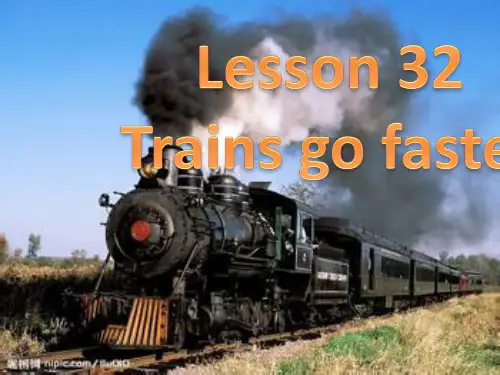
In 1804, a locomotive carried about seventy passengers a short distance on some iron rails. 在1804年,一辆机车载着大约70名 乘客在钢铁轨道上运行了一小段距离。 about在句中作“大约”讲。如: There are about sixty students in our class. 我们班里大约有60名学生。 【拓展】 about除了作“大约”讲以外,还有: 1) adv. 到处,在附近,在四周 Is there anybody about? 附近有人吗? The boys are running about. 孩子们跑来跑去。 2) prep. 关于 What have you been thinking about? 你一直在考虑什么? 3) be about to do something即将做某事 The plane is about to start. 飞机就要起飞了。 We are about to leave.我们就要离开了。 4) what about…等同于how about…译为“……怎么样?……好不好?” What about/How about a cup of tea? 喝杯茶怎么样? What about /How about going out for a walk? 出去散步怎么样?
In the 1830s, countries all over the world started to build railways. 在19世纪30年代,世界各地的许多国家开始建 造铁路。 1) all over…遍及……在整个……,构成的短语常在句中作后置定 语或状语。 all over the world全世界 all over China全中国 People all over America like hamburgers very much. 全美国的人 都非常喜欢汉堡包。(作后置定语) We have friends all over the world. 我们的朋友遍天下。(作状 语) 2) start to do sth. 开始干某事,等于start doing sth. 例如: The children started to sing (singing). 孩子们唱起歌来。 【注意】 begin和start均可接不定式和动词的ing形式,但在下列三种情 况下后跟to do较好。 a. 主语是物而不是人时。如: The ice began/started to melt. 冰开始融化。 b. 本身为-ing形式。如: He is just beginning/started to sleep. 他刚刚开始入睡。 c. 其后的动词与想法、感情有关时。如: I began / started to understand it. 我开始明白这件事了。
八年级英语上册Lesson 32 (共14张PPT)
Read Paragraph1-2 and answer the questions. 1. Where was the first train engine built? In England. 2. When did the first passenger railway open? In 1825, the first passenger railway opened.
Read Paragraph 3-5 and answer them : 3. How fast do today’s trains go? The fastest trains can go about 500 kilometres an hour.
4. What might future trains be like? Maybe trains will have no wheels in the future. Maybe they will ride on air.
Hale Waihona Puke Read again and fill in the table. The development of the trains
In the 1700s In the 1760s In 1804 In 1825 During the 1830s 50 years later Today
worked on steam engines found a way first train engine was born first passenger railway opened started to build railways built many train stations run very fast
Wright brothers and their plane
冀教版英语八年级上册 Lesson 32 Trains Go Fast!

_w_a_s_b_o_r_n_i_n_ England. railways. People built many _w_h_e_e_l_s_ in the
It travelled only about train stations to help
future. That
_f_if_te_e_n__k_il_o_m_e_t_re_s__ in passengersg_e_t_o_n__a_n_d_o_f_f would be
Fill in the Speed of the Train.
the fastest trains
In 1804,the first train engine was born in England. It
500km _______t1r8a2v5el,tlhede
only about fifteen kilometres in two first passenger railway opened. The
In 1825, the first _p_a_s_se_n_g_e_r _ra_il_w_a_y_opened.
high-speed train高铁
Today’s high-speed trains can travel at about 300 kilometres per hour.
每,每一
Many countries had railways.
during the 1830s after 50 years
A scientist in England put steam and wheels together, the stream train appeared.
Countries all over the world started to build railways.
冀教八年级上第六单元lesson 32

People built many train stations to
help passengers get on and off
the trains easily.
上、下车
Early trains were slow by today’s standards.
Today’s high-speed trains can travel at about 300 kilometers per hour.
1
2
3
1760s-Scientists invented the 1804-The railway was born. steam engine.
1825-
6
Future-
5
Now-
4
1830s-
railway station speed passenger get on and off be born
In 1804, the first train engine was born in England. It travelled only about fifteen kilometres in two hours.
The Rocket was the most famous early engine.
Sunday. It’s bright and beautiful. It’s easy for _p_a_s_s_e_n_g_e_rs___ to ________g_e_t_o_n__a_n_d_o__ff_____ the train.
What is the short passage mainly about?
1.The first railway __w_a_s__b_o_rn__ in England. 2.Today, high-speed trains can have a top
冀教版 八年级英语上册 lesson32

早在1804年,一个名叫德里维斯克的英国矿山技 师,首先利用瓦特的蒸汽机造出了世界上第一台蒸汽 机车。 这是一台单一汽缸蒸汽机,能牵引5辆车厢,它 的时速为5至6公里。这台机车没有设计驾驶室,机车 行驶时,驾驶员跟在车旁边走边驾驶。因为当时使用 煤炭或木柴做燃料,所以人们都叫它“火车”,于是 一直沿用至今。
在1840年,第一台火车机车在英国诞生了 born 是动词 bear 的过去分词 be born “出生,产生,形成” be动词常用was和were
be born in +地点 be born at/on + 时间
be born of “出身于” She was born of a teachers’ family. 她出身于教师家庭
He was so worried about his son that he drove to the hospital at a speed of 120 kilometers per hour.
他特别担心儿子以至于以每小时120千米的速度开往医院
per “每……(尤其指数量。价格,时间)” one apple per child 每个孩子一个苹果 He can get 100 yuan per hour. 他每小时能得到100元
中国第一台标准轨距 的蒸汽机车 1880 年“ 龙”号
新中国第一台蒸汽many train stations to help passengers get on and off the trains easily.
人们建了很多的火车站来帮助乘客容易的上下车
在18世纪,很多科学家从事蒸汽机的研制
“在…世纪……年代” in the 1760s in the 2000s
(最新冀教版八年级英语上册)Lesson32
Lesson 32 Trains Go Fany scientists worked on steam engines.
A new type of transportation : the steam train
In the 1760s, a scientist in England found a way to put steam engines and wheels together.
1.When was the first railway born?
In 1804. 2. Why did people build train stations?
People built them to help passengers get on and off the trains easily.
Let’s Do It! Ex. 1.
Discuss in groups. Try to think about which events are the most important ones. Then use short sentences to explain.
Group work: The history of trains.
The history of planes.
Homework
• 1. Finish writing the history of trains. • 2. Do the exercises of Learning English. • 3. Preview Lesson 33.
Trains have changed our life! Imagine what the future transportation is like. Have fun!
冀教八年级上第六单元lesson 32
The history of planes.
Homework
• 1. Finish writing the history of trains. • 2. Do the exercises of Learning English. • 3. Preview Lesson 33.
Trains have changed our life! Imagine what the future transportation is like. Have fun!
1
1760s-Scientists invented the steam engine.
2
1804-The railway was born. 1825-
3
6
Future-
5
Now-
4
1830s-
railway station speed passenger get on and off be born
1.When was the first railway born?
ห้องสมุดไป่ตู้In 1804.
2. Why did people build train stations?
People built them to help passengers get on and off the trains easily.
1.The first railway __________ was born in England. 2.Today, high-speed trains can have a top speed ___________ of 500 kilometres an hour. railway station last 3.I went to the new _______________ Sunday. It’s bright and beautiful. It’s easy passengers to for ____________ get on and off ________________________ the train.