
七年级人教版英语下册 Unit 6 Section B 第1课时
仁爱版七年级下册英语Unit6 Topic1sectionB 参考课件
• 4. Jane’s study is nice.
()
P29 1a 图
homework
TAhrerteheare three books near the chair?
Yes, there are./No, there aren’t.
a tree/in front of the classroom
A: What’s in front of the classroom? B: There's a tree in front of it. A: Is there a student in front of the classroom? B: No, there isn't.
lamp
guitar
clock
window
There is a clock on the wall.
There is a window in the wall.
There are two chairs in front of the door.
door
chair
table
key
There is a key under the table.
two students/in the front of the classroom
A: What’s ... the classroom? B: There are ... in the front of the classroom. A: Is there a ... in the front of the classroom? B: Yes, … ./No, … .
B: No, there isn't.
books/on the shelves
2023【人教版】七年级英语下册教学课件-第1课时(A 1a-2d) (3)
Section A 1a-2d
R·七年级下册
Learning objects
By the end of the class, you will be able to … 1. Learn curriculum words and useful expressions. 2. Describe the weather and describe what people
2c Talk about the people in 2a with a partner.
What’s Uncle Joe doing? He’s playing basketball.
What’s Jeff doing?
He’s playing computer
…
games. What’ห้องสมุดไป่ตู้ … doing?
Jim: What’s Uncle Joe doing? Linda: He’s playing basketball.
Jim: Is Aunt Sally there? Linda: Yes, she is, but she’s busy right now.
Jim: What’s she doing? Linda: She’s cooking.
Make a story according to the pictures.
This is Uncle Joe’s family. It’s 6:00 p.m. Uncle Joe’s family are doing different things. Uncle Joe is … Aunt Sally is …
Listen and choose
人教版七年级下册英语试卷unit1第6课时sectionb(3a-3b)(含答案)
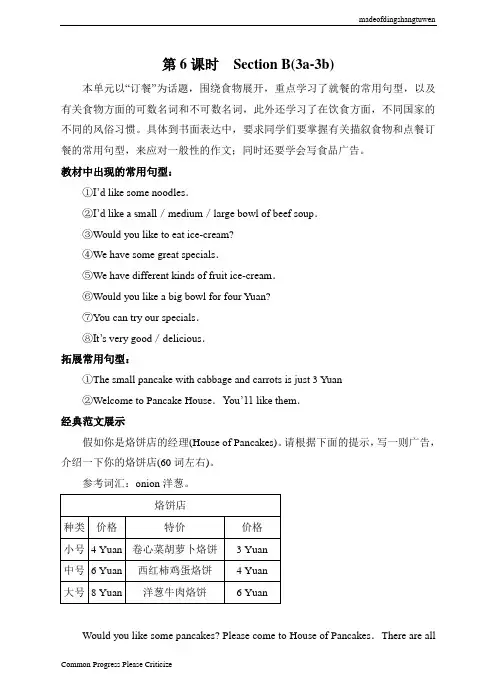
第6课时Section B(3a-3b)本单元以“订餐”为话题,围绕食物展开,重点学习了就餐的常用句型,以及有关食物方面的可数名词和不可数名词,此外还学习了在饮食方面,不同国家的不同的风俗习惯。
具体到书面表达中,要求同学们要掌握有关描叙食物和点餐订餐的常用句型,来应对一般性的作文;同时还要学会写食品广告。
教材中出现的常用句型:①I’d like some noodles.②I’d like a small/medium/large bowl of beef soup.③Would you like to eat ice-cream?④We have some great specials.⑤We have different kinds of fruit ice-cream.⑥Would you like a big bowl for four Yuan?⑦You can try our specials.⑧It’s very good/delicious.拓展常用句型:①The small pancake with cabbage and carrots is just 3 Yuan②Welcome to Pancake House.You’11 like them.经典范文展示假如你是烙饼店的经理(House of Pancakes)。
请根据下面的提示,写一则广告,介绍一下你的烙饼店(60词左右)。
参考词汇:onion洋葱。
烙饼店种类价格特价价格小号 4 Yuan 卷心菜胡萝卜烙饼 3 Yuan中号 6 Yuan 西红柿鸡蛋烙饼 4 Yuan大号8 Yuan 洋葱牛肉烙饼 6 YuanWould you like some pancakes? Please come to House of Pancakes.There are allkinds of Dan cakes here,small ones,medium ones and large ones.Tell small one is 4 Yuan,the medium one is 6 Yuan and the large one is 8 Yuan.We have some great specials.The small pancake with cabbage and carrots is just 3 Yuan.The medium pancake with tomatoes and eggs is just 4 Yuan.You can also try our large pancake with onions and beef for just 6 Yuan.Welcome to It use of Pancake.You will like them. 热点作文练习请根据以下信息为“朱老大饺子屋”(Zhu Laoda Dumpling House)写一则英文广告。
Unit1SectionB词汇精讲课件人教版英语七年级下册
make sb + n
使某人成为…
我们老师让Mary当班长.
Our teacher makes Mary our monitor.
make friends Unit 1 Can you play the guitar?
交朋友
单词表 (P5)
alDsoes/t’iɔny:l工sə作ʊ/室ad出v品. 也;而且 people /’pi:pl/ n. 人;人们 home /həʊm/ n. 家;活动本部
also
Destiny工作室出品
too
肯定句(中),位于助动词,联系动词be,情 态动词之后,实义动词之前.
肯定句或疑问句(末),前面通常有逗号.
either 否定句(末),前通常有逗号.
1.他也想去游泳. He __a_l_so___ wants to go swimming. = He wants to go swimming, __t_o_o___. 2.我也不会弹钢琴. I can’t play the piano,__e_it_h_e_r_.
center /’sentə(r)/ n. 中心;中央
weekend /,wi:k’end/ n. 周末
on the weekend (在)周末
teach /ti:tʃ/ v. 教;教授
musician /mju:’zɪʃn/ n. 音乐家
weekend Unit 1 Can you play the guitar?
center Unit 1 Can you play the guitar?
n. 中心;中央
单词表 (P5-6)
todDaeysti/ntəy工’de作ɪ/室ad出v品. 在今天 help (sb) with sth
人教版七年级下册英语Unit 6 Unit 6 SectionB (2a-2c)
知识点
4
Themotherisreadingastorytoheryoun gchildren.
考点6 young/jʌŋ/adj. 幼小的;年轻的 e.g. Hisbrotherisayoungteacher. 他哥哥是一名年轻的老师。
Youlookyoungerthanme. 你看上去比我年轻。
考点3 anyother任何其他的
“anyother+名词单数”意为 “(除了某个以外) 任何其他的……” ,指在同一范围内除了某人或 某物以外的其他人或物。
e.g. Jackislikeanyotherboyofhisage. 杰克像其他和他同龄的男孩一样。 Jackistallerthananyboyinhisbrother’sclass. 杰克比他哥哥班上的任何一个男生都高。
知识点
Hisdadandunclearewatchingtheboatrace 2 sonTV.
考点2 ahorserace赛马 theOlyam10p-imcGilaemraecse 奥林匹1克0英运里动赛会跑
通常指速度方面 rac 的比赛,如赛车 e 、赛马等。
a horse race 赛马
a 10-mile race 10 英里赛跑
考点9 wish/wɪʃ/v. 希望
①hopetodosth. 希望
做某事
②hope+①thwati从sh句s,b. sth. 祝愿某人某事
表示可以②实w现is的h愿(s望b.) to do sth. 希望(某人
wis h
)做某事
③wish+that从句,表示难以实
现的愿望
①hope to do sth. 希望做某事 hop
考向1 Ihavesomebooks. 我有一些书。
2023【人教版】七年级英语下册教学课件-第1课时(A 1a-2e)
Conversation 2
Peter: How do you get home from school, Jane? Jane: I take the bus. Peter: How long does it take? Jane: Oh, about one hour and 30 minutes. Peter: Wow! That’s a long time! Jane: Yes, I only go home on weekends. Peter: How far is it from your home to school? Jane: It’s about 60 kilometers.
Talk about how to get to places. Improve your listening skills through listening training.
Let’s watch a video
交通工具 What transportation is mentioned in the video?
Unit 3 How do you get to school?
Section A 1a-2e
R·七年级下册
Learning objects
Learn curriculum words and useful expressions: train, bus, subway, ride, sixty, seventy, eighty...
ninety one hundred
2a
Listen and repeat. Then write the correct numh切bu数nedr目ren时de数,x词t其,t后o意不t为加h“e-s一,w百也o”不rd。和. 当of连前用面。有具体数字表示确
仁爱版英语七年级下册Unit6topic1sectionB说课稿
仁爱版英语七年级下册Unit 6 topic 1 section B 说课稿一. 教材分析仁爱版英语七年级下册Unit 6 topic 1 section B主要介绍了日常生活中的交通工具。
通过本节课的学习,学生能够掌握有关交通工具的词汇,如bus, trn, car, bike等,以及表达乘坐交通工具的短语,如take a bus, take a trn等。
此外,本节课还引导学生学会用一般现在时描述日常生活中常见的活动。
二. 学情分析七年级的学生已经掌握了一定的英语基础,能够进行简单的英语交流。
但是,部分学生在发音和语法方面还存在困难,需要重点关注。
此外,学生对于日常生活中的交通工具有一定的了解,但可能缺乏对英语表达方式的掌握。
三. 说教学目标1.知识目标:学生能够掌握有关交通工具的词汇和表达乘坐交通工具的短语,学会用一般现在时描述日常生活中常见的活动。
2.能力目标:学生能够运用所学知识进行简单的英语交流,提高口语表达能力。
3.情感目标:培养学生热爱生活,关注环境保护的意识。
四. 说教学重难点1.重点:掌握有关交通工具的词汇和表达乘坐交通工具的短语,学会用一般现在时描述日常生活中常见的活动。
2.难点:正确运用一般现在时进行句子表达,注意时态和主谓一致。
五. 说教学方法与手段1.采用任务型教学法,让学生在完成任务的过程中,自然而然地学习和掌握知识。
2.运用多媒体教学手段,如图片、视频等,激发学生学习兴趣,提高课堂趣味性。
3.小组活动,鼓励学生相互交流,培养团队合作精神。
4.注重个体差异,针对不同学生给予有针对性的指导。
六. 说教学过程1.导入:展示一张交通拥堵的图片,引导学生关注日常生活中交通工具的使用,激发学生学习兴趣。
2.呈现:通过课件展示交通工具的图片和词汇,让学生跟读并模仿发音。
3.操练:让学生分组进行角色扮演,模拟乘坐交通工具的场景,运用所学词汇和短语进行对话。
4.练习:设计一组选择题,让学生判断句子中交通工具的词汇和短语是否使用正确。